Artículo de investigación
Contribution of international air transport at the entrance of COVID-19 in Brazil
Contribución del transporte aéreo internacional a la entrada de COVID-19 en Brasil1
Contribuição do transporte aéreo internacional na entrada da COVID-19 no Brasil
Contribution of international air transport at the entrance of COVID-19 in Brazil
Ciencia y Poder Aéreo, vol. 17, no. 2, pp. 23-35, 2022
ESCUELA DE POSTGRADOS DE LA FUERZA AÉREA COLOMBIANA
Received: 15 February 2022
Accepted: 27 May 2022
Abstract: COVID-19 is currently considered one of the greatest threats to health, safety, and the economy worldwide. An intense movement of international passengers may be critical for either the contingency or the spread of disease in a pandemic situation. Various research on international and national epidemics and their evolution have already been addressed in the medical literature. However, there are few studies to measure the influence of air transport on the proliferation of COVID-19 in Brazil yet. Thus, this article aims to verify if the movement of international air passengers influenced the COVID-19 spreading in Brazil. Therefore, air traffic and its concentration were analyzed, trying to identify its main entrances and volume of passengers. After that, statistical regression methods were used to estimate how passengers coming from countries contaminated by COVID-19 influenced the spread of the disease in Brazil. As a main result, it was found that foreign passengers disembarked in Brazil are directly related to the cases of COVID-19 in the country, making air transport a gateway to the virus in Brazil.
Keywords: international airport, international movement, COVID-19, regression modeling, disease spread.
Resumen: Actualmente, el COVID-19 es considerado una de las mayores amenazas para la salud, la seguridad y la economía a nivel mundial. Un intenso movimiento de pasajeros internacionales puede ser crítico tanto para la contingencia como para la propagación de enfermedades en una situación de pandemia. Varios estudios sobre epidemias internacionales y nacionales y su evolución ya han sido abordados en la literatura médica. Sin embargo, aún existen pocos estudios para medir la influencia del transporte aéreo en la propagación del COVID-19 en Brasil. Por lo tanto, este artículo tiene como objetivo verificar si el movimiento de pasajeros aéreos internacionales influyó en la propagación del COVID-19 en Brasil. Para ello se analizó el tráfico aéreo y su concentración, tratando de identificar sus principales entradas y volumen de pasajeros. Posteriormente se utilizaron métodos de regresión estadística para estimar cómo los pasajeros provenientes de países contaminados por COVID-19 influyeron en la propagación de la enfermedad en Brasil. Como resultado principal, se constató que los pasajeros extranjeros desembarcados están directamente relacionados con los casos de COVID-19 en el país, lo que convierte al transporte aéreo en una puerta de entrada del virus.
Palabras clave: aeropuerto internacional, movimiento internacional, COVID-19, modelado de regresión, propagación de la enfermedad.
Resumo: Atualmente, o COVID-19 é considerado uma das maiores ameaças à saúde, segurança e economia em todo o mundo. Um movimento intenso de passageiros internacionais pode ser crítico tanto para a contingência quanto para a propagação de doenças em uma situação de pandemia. Diversas pesquisas sobre epidemias internacionais e nacionais e sua evolução já foram abordadas na literatura médica. No entanto, praticamente não existem estudos para medir a influência do transporte aéreo na proliferação da COVID-19 no Brasil. Assim, este artigo tem como objetivo verificar se a movimentação de passageiros aéreos internacionais influenciou a disseminação da COVID-19 no Brasil. Para tanto, analisou-se o tráfego aéreo e sua concentração, procurando identificar suas principais entradas e volume de passageiros. Em seguida, métodos de regressão estatística foram usados para estimar como passageiros vindos de países contaminados pela COVID-19 influenciaram a disseminação da doença no Brasil. Como principal resultado, constatou-se que os passageiros estrangeiros desembarcados no Brasil estão diretamente relacionados aos casos de COVID-19 no país, tornando o transporte aéreo uma porta de entrada para o vírus no Brasil.
Palavras-chave: aeroporto internacional, movimento internacional, COVID-19, modelagem de regressão, propagação de doenças.
Introduction
Among all transport systems, traveling by air can be considered one of the most important, due to its speed and safety while carrying people and goods (Couto et al., 2015). Air transport has shown consistent growth (ICAO, 2018; SAC, 2020) when compared to other means for medium and long-distance trips. The intense international movement of passengers worldwide was brought about by an increase in the number of passengers and destinations, mainly in air transport hubs. In a pandemic situation, they can represent critical points for either the contingency or the spread of the transmission of respiratory viruses.
The combination of an increasing number of passengers, motivated by the ease of air transport, with the risk of epidemic spreading has been a concern to public health authorities worldwide (Grout et al., 2017). Also, in recent years, several outbreaks of infectious diseases transmitted by air have been reported during air travel (Mangili et al., 2015). Aircraft transmission cases have been studied, such as Severe Acute Respiratory Syndrome (Olsen et al., 2003), influenza pandemic H1N1 (Baker et al. 2010), Ebola virus (Mangili et al., 2015), and recently the COVID-19.
According to Sohrabia et al. (2020), in December 2019, an unprecedented outbreak of pneumonia of unknown etiology emerged in the city of Wuhan, Hubei province in China, which spread rapidly throughout the region. The virus was identified as a new corona-virus, referred to by the International Virus Taxonomy Committee (ICTV) as Coronavirus 2, which causes a severe acute respiratory syndrome, the SARS-CoV-2 (Benvenuto et al., 2020).
This disease, which might be lethal, is diagnosed by symptoms such as fever, sore throat, runny nose, cough, and difficult breathing (Paital et al., 2020). In January 2020, the new coronavirus, or COVID-19, was considered a public health emergency of international importance by the World Health Organization (WHO, 2020). On March 11, 2020, the World Health Organization (WHO) declared the disease a pandemic, affecting more than 114 countries. This disease infected more than 5.3 million people until May 21, 2020, resulting in more than 340 thousand deaths. Besides causing damage to the global economy, the pandemic has been jeopardizing tourism and consequently, air transport (UNO, 2020). In this context, COVID-19 is currently considered one of the greatest threats to health, safety, and the economy at a global level. Several types of research on international and national epidemics and their evolution trends have already been addressed in the medical literature. The spread of a disease, with its epidemiological evidence on a global scale, has often been questioned as to whether it is related to air travel (Bogoch et al., 2020; Lau et al., 2020; Sokadjo & Atchade, 2020; Wilder et al., 2003).
According to Kramer et al. (2016), using epidemio-logical data combined with air and land transport data becomes significant in evaluating and identifying the geographical behavior of infectious diseases. Budd & Ison (2020) affirm that it is relevant to understand the results of transport practices during national lockdowns to develop a new future for transport in a post-COVID world.
Nikolaou & Dimitriou (2020) analyzed the dynamics of the spread of infectious diseases linked to air transport in the European continent. The results demonstrate the effectiveness of European epidemic control. However, additional policy measures were proposed to manage these phenomena. Furthermore, the response time is essential since the aerial mode is often associated with land modes, contributing to the rapid spread of the disease.
Balcan et al. (2010) created the Global Epidemic and Mobility (GLEaM) model integrating socio-demographic and population mobility data. The authors expose a stochastic approach to the disease, spatially structured to simulate the spread of epidemics on a worldwide scale. The project for COVID-19 on the GLEaM platform is monitoring the virus in the United States of America.
Thus, studies that assess the likelihood of the spread of diseases worldwide, linked to transport systems, collaborate to identify the dominant paths of a given disease spread (Gautreau et al., 2008). Furthermore, these studies can fulfill a meaningful role in shaping containment policies and measures.
Candido et al. (2020), using data from all international flights to Brazil from February to March, 5, 2020, concluded that more than 50 % of all imported COVID-19 cases to Brazil, came from infected passengers from Italy, and around 9 % and 8 % of cases came from infected passengers from China and France.
Studies aiming to measure the influence of air transport on the proliferation of COVID-19, except for Candido et al. (2020), were not found in the literature either in Latin America or in Brazil. Therefore, this article aims to analyze the influence of the movement of international air passengers on the beginning of the COVID-19 dissemination process in Brazil, adopting a larger assessment period than Candido et al's study, from December 2019, when the initial cases appeared worldwide, to the beginning of community transmission in Brazil at the end of March 2020. This research is relevant because Brazil is one of the most affected countries in the world. Furthermore, it may be a significant scientific contribution in discovering the factors that contributed most significantly to the COVID-19 spread, and allowing comparisons between other countries and continents.
Materials and methods
It is necessary to analyze air traffic and its concentration to explain and verify the influence of the intensity of international air travel at the beginning of the spread of COVID-19 in Brazil. Initially, it was necessary to identify the main points of entry and their passenger volume and subsequently use statistical regression methods to estimate the influence of passengers from countries with COVID-19 cases on the spread of the disease in Brazil.
Data base
Brazil is a relevant country in the domestic movement of passengers by air transport due to its continental dimensions. Moreover, as it has several tourist hubs throughout its vast territory and has close relations with many countries, mainly in Europe and North America. Its international movement is significant. Brazil is the first one in South America in air traffic. So, it has several international flights arriving at and departing from about 19 different airports (SAC, 2020). Figure 1 represents the international airports receiving passengers from the European, Asian, American, and African continents in the months before the worldwide spread of COVID-19.
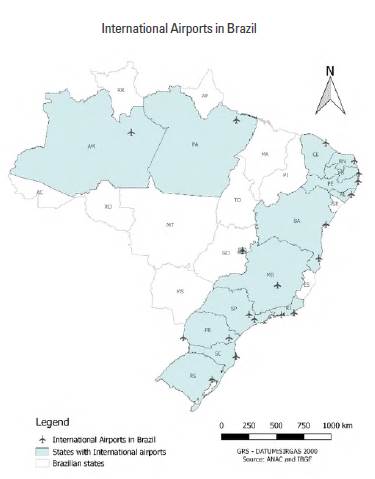
Figure 1
International Airports in Brazil
Font: Created by the authors.
The airports of Salvador (SSA), Fortaleza (FOR), Manaus (MAO), Rio de Janeiro (GIG), São Paulo (GRU e vcp), and Recife (REC) were selected as the basis to test the trigger of the COVID-19 spread, as they represent the main entrance gates for international passengers in Brazil, which means around 90 % of all Brazilian airports (ANAC, 2020). Figure 2 highlights the international air routes to the sampled airports.
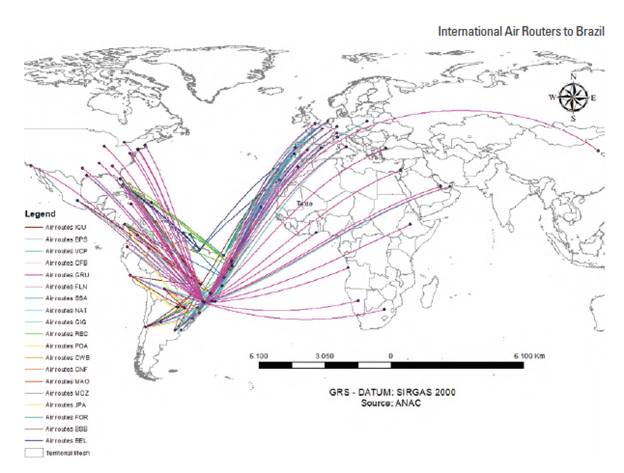
Figure 2
International flights landing in Brazil
Font: Created by the authors.
There was a significant concentration of routes from Western European and North American countries, where most disease cases were concentrated, after its onset in China. The number of passengers, who disembarked in Brazil there daily, was accounted for the analysis of this influence, based on data from the National Civil Aviation Agency (ANAC, 2020) from December 1, 2019 to March 31, 2020. This period was adopted to assess the international air passenger influence on imported disease cases. After March 31, 2020, COVID-19 infections have occurred through community transmission, as informed by health authorities.
Due to community diffusion, the daily data reported by the Brazilian states from February 26 to March 20, 2020, delivered by the Ministry of Health (Ministério da Saúde, 2020a), was used to determine the confirmed cases of COVID-19.
Other information utilized was the number of confirmed cases of COVID-19 in the countries with passengers arriving at the selected airports. Altogether, around 39 countries had flights to Brazil. Angola and Cape Verde in Africa did not present any COVID-19 cases until March 20, 2020. These data came from the reports on the Evolution of COVID-19 released by the World Health Organization (WHO). The analysis gathered data from February 26 to March 20, 2020.
Method
In this study, we used both simple and quantile regression, as these modelings offer an extension of the simple regression estimate, based on the mean, for univariate conditional quantile functions through optimization of a linear objective function by parts in waste. Therefore, it is a statistical technique designed to estimate and conduct inferences on the conditional quantile functions (Koenker, 2015).
The author also states that it is a robust regression tool, with critical advantages over simple regression, including robustness to outliers, in the assumption of normal distribution and quantification of relationships through the complete distribution of the dependent variable. The interpretation of the estimated coefficients by quantile regression is similar to the simple regression coefficients; however, the advantage of using it is associated with the robustness tests of a result measured by simple regression and which indicates the median behavior observed, extending to the behavior of observed quantiles (Koenker, 2015).
Initially, we tested passengers disembarking from international flights as a dependent variable, and the number of cases of COVID-19 in the origin countries as an independent variable. According to Equation 1:

Subsequently, the causal relationship between the cases of COVID-19 accumulated up to March 20, 2020, was tested in the Brazilian states with the highest inflow of international passengers (SSA, FOR, REC, GRU, VCP, and GIG) and also the state of Amazonas (MAO) considered the epicenters in the country as a dependent variable. While, the independent variable is passengers disembarked that were significant in the previous model. For this second model, panel data was used with a daily series, according to Equation 2:

A variation of the Equation 2 model was tested to analyze the relationship of new COVID-19 cases per day in a Brazilian states due to a higher number of international passengers coming not only from Europe and the United States (SSA, FOR, REC, GRU, VCP, and GIG) but also from the states considered the epicenters in the country (MAO), as a dependent variable and the passengers who were significant in the previous model. For this second model, we used panel data with dimensions (6 states x 111 days), according to Equation 3:

Results
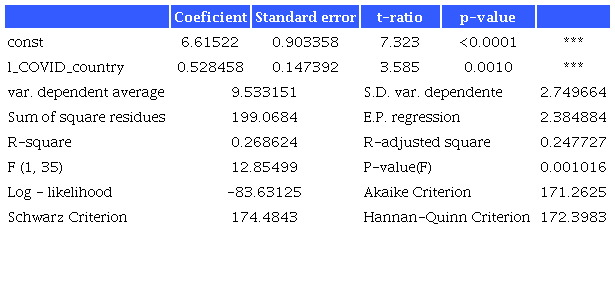
This section presents the results of the modeling mentioned in the previous topic. The Gretl software (2017) has processed the models. Initially, model 01 identified the relationship between the number of international passengers landing in Brazil and the number of COVID-19 cases in their countries of origin. This model aims to analyze the first perceptions and conduct the following models. According to Equation 1, Ordinary Least Squares (OLS) estimates the parameters of model 01 by the logarithmization of the variables to facilitate the direct analysis of the elasticities. Table 1 shows the results:
Font: Created by the authors.
Model 01 results in a R2 determination coefficient of 0.268, which measures the model's adherence to the data. However, we did not intend to predict, but to assess the tendency shown by the data as our aim is to find if there is a casualty link between International Passengers landing in Brazil and the COVID-19 cases in the country where these flights came. Thus, the independent variable, the logarithm of COVID-19 cases in their countries of origin, is statistically significant (p = 0,001) with a positive coefficient (0.528458). In other words, the number of COVID-19 cases in their countries of origin has a positive relationship with the number of international passengers disembarked in Brazil, which is controlled by the number of COVID-19 cases per country. Statistically, for an increase of 1 % of COVID-19 cases in Brazil, in the period, almost 0.528 % of them might be a contribution from international passengers.
Subsequently, through the leverage and influence tests, as shown in figure 3, we tried to identify the countries with greater influence in model 01. At first, the countries numbered 31 and 10 (China and Italy), showed critical importance in the results as they represent the start of the pandemic worldwide and the first spread in Europe. This result corroborates with the findings of Candido et al. (2020) in Brazil.
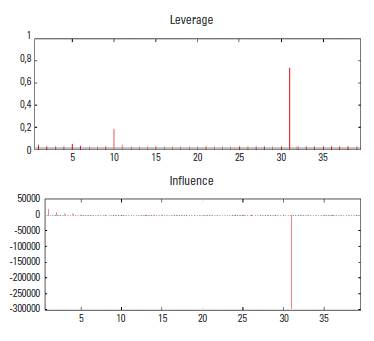
Figure 3
Graph to identify influential observations - Leverage and influence
Font: Created by the authors.
To test the robustness of model 01, a quantile regression was applied by adding the dummy variable (D_Epicenters_Int). This dummy variable is related to countries showing, at the time, a significant COVID-19 incidence. We consider the dummy variable equal to 1 when relating to epicenters with more than 2,000 cases by March 20, 2020. Moreover, they represent countries that maintain frequent flights to Brazil. In addition to Italy and China, Spain, the United States, Germany, France, Switzerland, the United Kingdom, and the Netherlands were added to the analysis of the Model 02, as they were considered epicenters before Brazil.
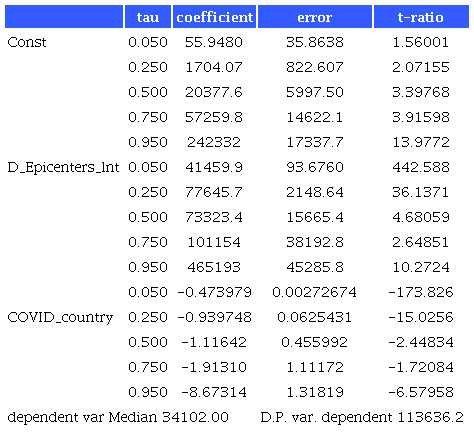
Table 2 identifies the results of model 02, also depicting Equation 1. The observations are based on 39 countries with flights to Brazil in the period.
Font: Created by the authors.
We observed that the dummy variable is statistically significant according to its t-ratio. All coefficients are positive, demonstrating a direct relationship with international passengers coming from these countries. The model shows that 41,459.9 passengers were influenced by 5 % of COVID-19 cases, 77,645.7 were influenced by 25 % of COVID-19 cases, and so on.
On the other hand, the variable COVID country did not adopt the logarithmic model, but the results supported the thesis, since when evaluating the cases of COVID in these countries, the coefficient was negative, demonstrating that with the increase in cases of COVID worldwide, there was a decrease in international passengers. Since the government adopted restrictive measures on air transport, lots of flights and routes have been temporarily canceled (Monmousseau et al., 2020).
Also, we noticed from Model 02 and the variable D_Epicenters_Int, that foreign passengers related to COVID-19 cases had come from those countries where cases were confirmed before Brazil. It can be explained as these regions were epicenters of the pandemic, following China, where the pandemic started (Ceylan 2020; Lau et al. 2020).
Thus, models 03, 04, and 05 were processed. The purpose of these models was to find a causal relationship, according to Equation 2. In other words, the cases of COVID-19 in Brazilian states with passengers coming from epicenter countries were investigated. It is worth mentioning that the Brazilian states with the most cases of coronavirus are the ones where the international airports are located, which means passengers disembarking from the epicenters before March 20, 2020.
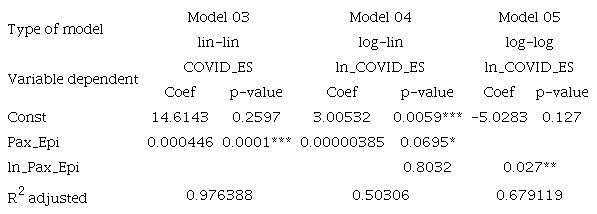
Table 3 compares three models estimated using the Ordinary Least Squares Method (OLS). There were few observations, only six Brazilian states, but the models showed results statistically significant.
Font: Created by the authors.
In all models, the adjusted determination coefficients (R2) present values ranging from 50 % to 98 %. Passengers disembarked from epicenter countries are positively related to cases of COVID-19 in the states of destination in Brazil within the confidence level of 0.01 to 7 %. That is, the greater the number of passengers coming from the epicenters, the greater the increase in the number of cases of COVID-19 in the assessed Brazilian states.
Thus, Model 06 was elaborated to investigate the real influence of the nine countries considered epicenters and associate them with the trigger of COVID-19 in Brazil, and also to analyze whether they all present the same percentages of virus spread. Furthermore, the model collaborates with the objective of validating the initial research hypothesis, in which it maintains a positive relationship between the international movement of air passengers and the first cases of COVID-19 in Brazil.
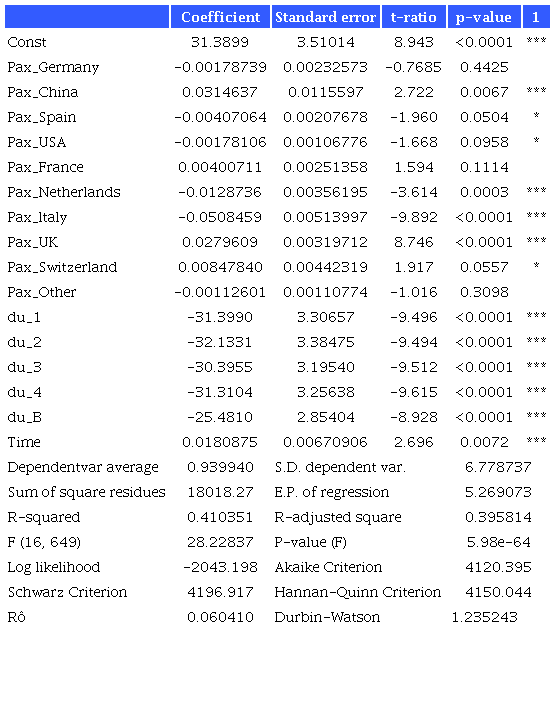
The estimation of Model 06 was made through OLS, as shown in Equation 3. The structure of this panel model is based on data from the five states with the largest number of cases in Brazil, up until March 20, 2020. It also included, the State of Bahia, where there is also an international airport with a high frequency of flights from Europe and the United States of America. Table 4 indicates the results of this model.
Font: Created by the authors.
Model 06 constitutes as a dependent variable the new cases of COVID-19 in the six analyzed states. As independent variables were used, passengers disembarked from countries that were considered significant in Model 2 (China, Italy, Spain, the United States, Germany, France, Switzerland, the United Kingdom, and the Netherlands) and passengers from other countries. In addition, categorical variables (du_1 to du_6) were included in order to represent the states, namely: 1 = Bahia, 2 = Amazonas, 3 = Ceará, 4 = Pernambuco, 5 = Rio de Janeiro and 6 = São Paulo. Finally, it was included a time trend variable in the relationship among the variables.
The model results in a coefficient of determination R2 of 0.41. This could be considered a low value for prediction. In searching for causality, it is more relevant to analyze its significance by the p-value. When analyzing the coefficient of the variables, it seems that passengers from China, the United Kingdom, and Switzerland contributed positively and significantly (p-value < 0.05) to the increase in cases of COVID-19 in the Brazilian States. It is important to highlight that the only states that received passengers disembarked from these countries were Rio de Janeiro and São Paulo.
From this data, Spain, the United States, the Netherlands, and Italy showed a significant (p-value < 0.05) but negative correlation. Thus, it is not possible to support the relationship between new coronavirus cases and passengers landing from these countries. Finally, Germany, France and other countries the parameters were insignificant in the performed analysis.
The variables of interest are the level changes within the categories (du_1 to du_6). The other variables are the effects control of the countries. Regarding the categorical variables representing the states, we observed that all showed a negative sign, except for the State of São Paulo. It points out that São Paulo presents a more intense influence in new COVID-19 cases, associated with the arrival of passengers from other countries, while the State of Amazonas reveals the lowest.
Discussions
The results of this research indicate that the number of COVID-19 cases in the world has negatively influenced the number of passengers who disembarked from international flights in Brazil. This fact was already expected, as the explosion of COVID-19 cases in countries with more connections to Brazil caused air travel to decrease. In addition, not only air transport from Brazil but also worldwide had to be repressed, either with reduced routes or flight cancellations. These measures were supported by regulatory agencies, as well as by federal and state governments.
The results of Model 01 infer that there was a positive relationship between the number of international passengers landed in Brazil and the number of COVID-19 cases in the respective countries, which corroborates with the measures articulated by government officials, regulatory bodies, and health agencies to restrict air transport during epidemic periods. However, according to Nikolaou & Dimitriou (2020), the response time of these decisions is fundamental to visa control. In the case of Brazil, these actions did not take place in due time. For example, while European countries were experiencing a gradual return of the air mode with some necessary health restrictions, Brazil had suffered a drop of 98 % in international passengers, compared April 2019 with April 2020, and for domestic passengers, 94.5 % (SAC, 2020).
Model 02 was processed to test the robustness of model 01 and ascertain the relationship between international passengers landed, and the number of COVID-19 cases in the countries analyzed. In the model, categorical variables were also used, representing the countries considered as epicenters in this study, with more than 240 thousand cases of the coronavirus before March 20, 2020.
Thus, countries like China, Italy, Spain, the United States, Germany, France, Switzerland, the United Kingdom, and the Netherlands are positively associated with the total passengers who disembarked in Brazil. It is worth mentioning that most of these countries constitute direct routes to the airports of the states that have registered the highest number of COVID-19 cases in Brazil, which are Ceará, Pernambuco, São Paulo, and Rio de Janeiro.
The model also showed that the number of COVID-19 cases in the countries previously mentioned had a significant, and negative correlation with the number of international passengers disembarked in Brazil. It suggests that as the cases increased, air passenger numbers decreased. It demonstrated that people decided to travel less, reinforcing the measures taken by the regulatory agencies to stop air transport.
With these first results showing a strong correlation with passengers originating from the most affected countries, new tests were carried out to find a causal correlation among passengers disembarked from these countries with the states with the highest number of COVID-19 cases in Brazil, before March 20, 2020, and which airports have international air routes. According to Sokadjo and Atchadé (2020), we can assume that when passenger air traffic increases, the number of COVID-19 cases may also increase.
Besides the states of Amazonas, Ceará, Pernambuco, Rio de Janeiro, and São Paulo, the state of Bahia was included on the list, which, despite not registering many cases, received more international passengers than the state of Amazonas, for example. The models 03, 04, and 05 showed that passengers disembarked from epicenter countries are positively related to COVID-19 cases in the states of arrival, that is, the greater the number of passengers, the higher the number of cases in the states. As a result, there is a significant relationship between the movement of air passengers and the number of confirmed cases in these states.
However, passengers from countries considered epicenters might not have the same trigger intensities as the virus spread in Brazilian states. Thus, the last model comprised testing the casualties of international passengers with the number of COVID-19 cases in the Brazilian states previously mentioned. In addition, this model seeks to answer the critical study objective. So, is it possible that international air transport was the trigger for the spread of COVID-19 in Brazil?
Model 06 includes daily data on the new COVID-19 cases and passengers disembarked from the most critical countries as well as passengers coming from the other countries. The results show that passengers from China, the United Kingdom, and Switzerland contributed positively to the increase in COVID-19 cases. These results corroborate the studies by Lau et al. (2020), which suggest a strong relationship between COVID-19 infections and the movement of international air passengers.
However, when comparing states, São Paulo revealed a more significant influence on international passengers with increasing COVID-19 cases. The other states demonstrated less influence compared to São Paulo, being the state of Amazonas the one to exert the lowest influence.
The results indicate that the gateway for the virus, through air transport, was the State of São Paulo. São Paulo presents the International Airport of São Paulo/ Guarulhos as the international airport with the highest number of passengers, having passengers disembarked from all countries that were epicenters of COVID-19 before Brazil, in addition to being the main international hub airport. In 2019, the airport had a demand of almost 43 million passengers, both international and national.
Due to the large territorial extension of Brazil, most people travel not only by air transport, but also by road. Thus, it is possible that the coronavirus cases spread to other states through the movement of domestic passengers and by other transport means. Brazil comprises 26 states and one federal district (IBGE, 2020). The airports of the State of São Paulo, São Paulo International Airport/Guarulhos and Campinas International Airport/Viracopos present regular domestic routes to all Brazilian states.
It is convenient to point out, that due to the vast territorial extension of Brazil, a diversity of both climate and temperature, as well as cultural and economic differences, the State of Amazonas presents the least influence of new cases of COVID-19 associated to the arrival of international passengers, followed by Bahia, Pernambuco, Ceará and Rio de Janeiro.
It is worth noting that, due to Brazil's vast territorial extent, a diversity of climate and temperature, as well as cultural and economic differences, the State of Amazonas has the least influence on new COVID-19 cases associated with the arrival of international passengers, followed by Bahia, Pernambuco, Ceará, and Rio de Janeiro.
In the State of Amazonas, up to May 24, 2020, there were 29,867 coronavirus cases and 1,758 deaths (Ministério da Saúde, 2020b). According to the National Institute of Meteorology-INMET (2020), this state presented the highest national rainfall index, with an average of 3,000 mm in 2019.
Therefore, in addition to rainfall factors influencing the spread of COVID-19 in the State of Amazonas, which is in line with the study of Sobral et al. (2020), social and economic factors are fundamental for the spread of the disease through community transmission.
This article also confronts the results obtained by Sajadi et al. (2020), as the case of Brazil revealed that a hot and tropical climate also enables the spread of the virus. The number of confirmed COVID-19 cases in Brazil, until May 25, 2020, was the second worldwide, being behind the United States only.
Regarding the northeastern states, Pernambuco, Ceará, and Bahia, all of them had high numbers of confirmed cases of the virus and a high number of deaths, except for Bahia, which until May 24, 2020, had 460 deaths.
The southeastern states of Rio de Janeiro and São Paulo also show a significant number of confirmed cases and deaths. Rio de Janeiro presents this number of cases as it is considered a highly touristic state. In addition, many international flights to Rio have connections in São Paulo. And São Paulo, as an economic business hub, attracts many foreigners as well as Brazilians from all over the country.
According to Suau et al. (2020) the larger airports like the ones considered in this study will be the first to attract new airlines to provide safe traffic and stay on the market. Then these conclusions on the problem of the spread of COVID-19 among countries on different continents can help governments and their technical and managerial bodies plan new action strategies, or in more precise terms, plan actions to combat and mitigate the spread of diseases like COVID-19.
Conclusion
A few studies associating air transport and the spread of respiratory viral diseases were reviewed in the literature. Concerning Brazil, only one work was related to this theme. Large parts of the studies are in the medical field. Therefore, this article pointed out a gap in studies on viral diseases related to air transport, in addition to represent a current theme in the global context and of importance to several agencies, airport operators, concessionaires, and users of the system.
The main result of this work identified that the initial trigger of the disease was the virus's arrival in Brazil, through international air passengers from China, the United Kingdom, and Switzerland, disembarking at airports in Sao Paulo. For future research, it is suggested: (i) the application of spatial statistics in order to verify the spatial pattern of the virus spread in Brazil; (ii) individual analysis of each international airport in order to find the air routes responsible for the main disseminators of the virus; (iii) the evaluation of the spread of the virus in Brazil due to regular domestic air routes; (iv) the analysis of the contribution of other means of transport in Brazil to the spread of the disease, mainly on road and sea transport; and (v) an investigation in more detail of the relationship between COVID-19 cases and social and economic factors.
References
ANAC. (2020). Assuntos dados e estadísticas. Agência Nacional de Aviação Civil. https://www.anac.gov.br/assuntos/dados-e-estatisticas/mercado-de-transporte-aereo/consulta-interativa/demanda-e-oferta-ranking-de-aeroportos
Baker, M. G., Thornley, C. N., Mills, C., Roberts, S., Perera, S., Peters, J., Kelso, A., Barr, I. & Wilson, N. (2010). Transmission of pandemic A/H1N1 2009 influenza on passenger aircraft: Retrospective cohort study. The British Medical Journal, 21: 1-7. https://doi.org/10.1136/bmj.c2424
Balcan, D., Gonçalves, B., Hu, H., Ramasco, J. J., Colizz, V. & Vespignani, A. (2010). Modeling the spatial spread of infectious diseases: The Global Epidemic and Mobility Computational Model. Journal of Computational Science, 1 , 132-145. https://doi.org/10.1016/j.jocs.2010.07.002
Benvenuto, D., Giovanetti, M., Ciccozzi, A., Spoto, S., Angeletti, S. & Ciccozzi, M. (2020). The 2019-new coronavirus epidemic: evidence for virus evolution. Journal of Medical Virology, 92, 455-459. https://doi.org/10.1002/jmv.25688
Bogoch, I. I., Watts, A., Thomas, A., Huber, C., Kraemer, U. G. & Khan, K. (2020). Potential for global spread of a novel coronavirus from China. Journal of Travel Medicine, 2, 1-3. https://doi.org/10.1093/jtm/taaa011
Budd, L. & Ison, S. (2020). Responsible Transport: A post-COVID agenda for transport policy and practice. Transportation Research Interdisciplinary Perspectives, 5. https://doi.org/10.1016/j.trip.2020.100151
Candido, D. S., Faria, N. R., Watts, A., Abade, L., Kraemer, U. G., Pybus, O. G., Croda, J., Oliveira, W., Khan, K. & Sabino, E. C. 2020. Routes for COVID-19 importation in Brazil. Journal of Travel Medicine, 21(3). https://doi.org/10.1093/jtm/taaa042
Ceylan, Z. (2020). Estimation of COVID-19 prevalence in Italy, Spain, and France. Science of The Total Environment, 129. https://doi.org/10.1016/j.scitotenv.2020.138817
Couto, G. S., Silva, P. C., Ruiz, L. B. & Benevenuto, F. (2015). Structural Properties of the Brazilian Air Transportation Network. Anais da Academia Brasileira de Ciências; 87, 1653-1674. https://doi.org/10.1590/0001-376520 1520140155
Gautreau, A., Barrat, A. & Barthelemy, M. (2008). Global disease spread: Statistics and estimation of arrival times. Journal of Theoretical Biology, 251 509-522. https://doi.org/10.1016/j.jtbi.2007.12.001
Gretl. (2017). GNU Regression, econometric and time-series library (Gretl). Software. http://gretl.sourceforge.net/
Grout, A., Howard, N., Coker, R. & Speakman, E. M. (2017). Guidelines, law, and governance: disconnects in the global control of airline-associated infectious diseases. The Lancet Infectious Diseases, 17, 118-122. https://doi.org/10.1016/S1473-3099(16)30476-5
IBGE. (2020). Cidades e estados. Instituto Brasileiro de Geografia e Estatística. https://www.ibge.gov.br/cidades-e-estados.html?view=municipio
ICAO. (2018). Annual report 2018. International Civil Organization. Available in: https://www.icao.int/annual-report2018/Documents/Annual.Report.2018_Air%20Transport %20Statistics.pdf
INMET. (2020). Análise do tempo e do clima. Instituto Nacional de Meteorologia. http://www.inmet.gov.br/portal/index.php?r=clima/page&page=desvioChuvaAnual
International Air Transport Association (IATA). Montreal. https://www.iata.org/
Koenker, R. (2015). Quantile Regression. International Encyclopedia of the Social & Behavioral Sciences (Second Edition), Elsevier, 712-718. https://doi.org/10.1016/B978-0-08-097086-8.42074-X
Kramer, A. M., Pulliam, J. T., Alexander, L. W., Park, A. W., Rohani, P. & Drake, J. M. (2016). Spatial spread of the West Africa Ebola epidemic. Royal Society Open Science, 3(8).
Lau, H., Khosrawipour, V., Kocbach, P., Mikolajczyk, A., Ichii, H., Zacharksi, M., Bania, J. & Khosrawipour, T. (2020). The association between international and domestic air traffic and the coronavirus (COVID-19) outbreak. Journal of Microbiology, Immunology and Infection, 53(3), 467-472. https://doi.org/10.1016/jJmii.2020.03.026
Mangili, A., Vindenes, T. & Gendreau, M. (2015). Infectious risks of air travel. Microbiology Spectrum, 3, 1-10. https://doi.org/10.1128/microbiolspec.IOL5-0009-2015
Ministerio da Saúde. (2020a). Painel de casos de doença pelo coronavirus 2019 (COVID-19) no Brasil pelo Ministerio da Saúde. https://covid.saude.gov.br/
Ministério da Saúde. (2020b). https://www.gov.br/saude/pt-br/coronavirus/informes-diarios-covid-19
Monmousseau, P., Marzuoli, A., Feron, E. & Delahaye, D. (2020). Impact of Covid-19 on passengers and airlines from passenger measurements: Managing customer satisfaction while putting the US Air Transportation System to sleep. Transportation Research Interdisciplinary Perspectives, 7, 100179. https://doi.org/10.1016/j.trip.2020.100179
Nikolaou, P. & Dimitriou, L. (2020). Identification of critical airports for controlling global infectious disease outbreaks: Stress-tests focusing in Europe. Journal of Air Transport Management, 85, 101819. https://doi.org/10.1016/j.jairtraman.2020.101819
Olsen, S. J., Chang, H. L., Cheung, Y. Y., Tang, F. Y., Fisk, T. L., Ooi, P. L., Kuo, H. W., Jiang, D. S., Chen, K. T., Lando, J., Hsu, K. H. & Chen, T. J. (2003). Transmission of the severe acute respiratory syndrome on aircraft. The New England Journal of Medicine, 349, 2416-2422. https://doi.org/10.1056/NEJMoa031349
Paital, B., Kabita D., and Sarat K. P. (2020). "Inter nation social lockdown versus medical care against COVID-19, a mild environmental insight with special reference to India." Science of the total environment728, 138914. https://doi.org/10.1016/j.scitotenv.2020.138914
SAC. (2020). Secretaria de Aviação Civil. Website Hórus. Ministério dos Transportes, Portos e Aviação Civil. https://horus.labtrans.ufsc.br/gerencial/#Movimentacao/Ranking
Sajadi, M. M., Habibzadeh, P., Vintzileos, A., Shokouhi, S., Miralles, F. & Amoroso A. (2020). Temperature, humidity, and latitude analysis to predict potential spread and seasonality for COVID-19.
Sobral, F. F., Duarte, G. B., Sobral, G. P., Marinho, L. M. & Melo A. S. (2020). Association between climate variables and global transmission of SARS-CoV-2. Science of the Total Environment729, 138997. https://doi.org/10.1016/j.scitotenv.2020.138997
Sohrabia, C., Alsafi, Z., O'neilla, N., Khan, M., Kerwan, A., Al-Jabir, A., losifidis, C. & Aghad, R. (2020). World Health Organization declares global emergency: A review of the 2019 novel coronavirus (COVID-19). International Journal of Surgery, 76, 71-76. https://doi.org/10.1016/j.ijsu.2020.02.034
Sokadjo, Y. M. & Atchadé, M. N. (2020). The influence of passenger air traffic on the spread of COVID-19 in the world. Transportation Research Interdisciplinary Perspectives, 8, 100213. https://doi.org/10.1016/j.trip.2020.100213
Suau, P., Voltes, A. & Cugueró, N. (2020). An early assessment of the impact of COVID-19 on air transport: just another crisis or the end of aviation as we know it? J. Transport Geogr., (86), 102749. https://doi.org/10.1016/j.jtrangeo.2020.102749
Wilder, A., GOH, K. T. & Paton, N. I. (2003). Experience of severe acute respiratory syndrome in Singapore: importation of cases, and defense strategies at the airport. Journal of Travel Medicine, 10(5), 259-262.
World Health Organization. Coronavirus disease (COVID-19) outbreak. Geneva: WHO; 2020. Available in Available in https://www.who.int/emergencies/diseases/novelcoronavirus-2019. Accessed on: March 14, 2022.
Notes
Conflict of interest declaration