Carátula del artículo
A qualitative study exploring physicians’ perceptions on the role of community pharmacists in Dubai
 Ibrahim K. Rayes dr.ibrahimrayes@gmail.com
Ajman University of Science and Technology, United Arab Emirates
Abduelmula R. Abduelkarem karem1961@hotmail.com
University of Sharjah, (United Arab Emirates
Pharmacy Practice, vol. 14, no. 3, 738, 2016
Centro de Investigaciones y Publicaciones Farmaceuticas
Received: 18 February 2016
Accepted: 31 August 2016
INTRODUCTION
Pharmaceutical care has passed through three major redefinitions over the last two decades.1 The medicine preparation era was replaced by the dispensing era
which was, over a period of time, overtaken by the clinical pharmacy movement.2 Most recently, pharmaceutical care has adopted a new set of assumptions, concepts,
and values that have made the pharmacy practice patient-centered rather than merely
product-oriented.3,4,5
Pharmacists among other healthcare providers have an important role in health service delivery
because of their knowledge and location close to patients, so that they are sometimes the first line
of responding.6 This interaction between patients and
pharmacists has been extensively studied in many developed countries and values like patient
satisfaction and perception of public regarding the role of pharmacists with pharmaceutical care
type or with specific disease management services were thoroughly assessed.7,8,9,10 However, these values are often not
generalizable to developing countries such as the Middle East where the first priority is still
traditional pharmacy practice.11 As a reason to the shift in
the type and quality of pharmaceutical services offered to patients, the interaction between
community pharmacists and physicians has also enhanced.12,13
In general, communication between pharmacists and physicians is both interesting and problematic because each party’s professional identity is at stake when the two professionals interact.14 Recently the pharmacy profession has expanded significantly in terms of professional services delivery and now it has been recognized as an important profession in the multidisciplinary provision of healthcare. It should be mentioned that some physicians feel that pharmacists are attempting to expand their clinical roles, so topics of optimal drug selection and use have become contested ground where the two professions seek to establish their autonomy and assert their authority over decisions about drugs and drug use. Since these tasks were perceived the sole responsibility of physicians, recent attempts to establish pharmacists’ legitimate authority may be seen by some physicians as unwelcome encroachments.15
In the United Arab Emirates (UAE), the health care system is well developed and the facilities are predominantly Governmental, offering their services to all citizens. However, outside the secondary care sector the majority of patients obtain their medication from the growing number of private community pharmacies. Despite the fact that pharmacy practice in community pharmacies in the Gulf area, such as within the UAE, has shown some improvement during the last 15 years, it has not yet fully gained the trust of the public or indeed of health professionals. This would appear to be due to several reasons, including a perceived lack of professionalism on the part of pharmacists by public and health professionals, commercial pressure on community pharmacies, and a lack of enforcement of the regulations governing pharmacy practice within both the community and in hospital settings.16 However, this does not appear to be the case within some of the developed countries, where the notion of pharmacists prescribing medications and their involvement in patient care seems to been much more readily acceptable to the population and to doctors. This is most likely due to the perception of pharmacists in those countries as senior health professionals.17
There had not been any research to measure the perceptions of physicians on the role of community pharmacists in Dubai. For this reason, the aim of this study is to explore the opinions of physicians operating within the boundaries of Dubai on the significance of professional interaction among the two professions.
METHODS
Semi-structured interviews were used to collect data in this research after extensive literature review and depending on a survey done in Pakistan.18 Application of previously validated instruments to address pharmacy practice issues was found to be useful to ensure instrument validity and reliability.19
The participants were physicians recruited using Dubai health authority (DHA) physicians’ list that was adopted as sampling frame. The sample of 12 physicians was randomly selected via a predetermined numbering system from a current list of approximately 88 (7 male, 5 female) physicians registered to provide their services in government and private hospitals as well as private clinics of the city of Dubai, UAE. The study took place between May 10, 2013 and June 11, 2013. The appointed research team experts managed arrangements for the time and place of interviews during the initial contact and obtained written consents from the participants prior to each interview.
The interviews mainly focus on physicians’ perception on the role of community pharmacists and their willingness to collaborate with them. Furthermore, the research team gathered information regarding their experience of working with community pharmacists in their respective positions. Probing questions were used where necessary by the research team and the participants were given freedom to express their views at the end of the interview session. Each interview was conducted by the researcher at the place and time convenient for the physicians and lasted approximately twenty to thirty minutes. The research team conducted all the interviews in English, audio taped and transcribed verbatim. The authors verified transcripts for their accuracy by listening to the tapes. Then, analyzed the transcripts line by line, which were read repeatedly and thematically analyzed for its content.20 From the analysis, saturation of data was reached after 12 interviews with no new themes emerging in the last two interviews. This study was approved by the Ajman University of Science and Technology Human Research Ethics Committee in the UAE.
RESULTS
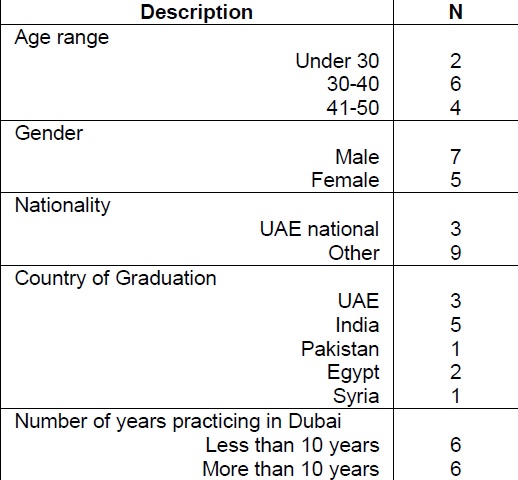
Twelve interviews were conducted by the research team. Among the participants seven were male while five were female. Demographic characteristics of respondents are shown in Table 1.
Table 1
Physicians’ demographic data
Thematic content analysis yielded four major themes: 1) Pharmacist as a healthcare professional in physician minds. 2) Psychological perceptions towards pharmacists. 3) Willingness to collaborate with pharmacists. 4) Separation of prescribing from dispensing in Dubai.
Theme 1: Pharmacist as a Healthcare Professional in Physician Minds
To investigate the way physicians look at pharmacist’s profession in Dubai, we asked participants about the definition of pharmacist to them. All informants were aware of their importance to the ideal medical team.
-
“A pharmacist is a healthcare professional responsible of observing drugs or medications and dispensing them.” (D1)
-
“When talking about the simplest healthcare setting, general practitioner in a private clinic will start the medical chain, then nurses, and after that an important presence of a pharmacist to provide consultation about pharmacological issues of medicines” (D8)
Theme 2: Psychological Perceptions towards Pharmacists
Perceptions towards the role of community pharmacists in Dubai were not very optimistic (n=7) among physicians when we asked them about the way they measure pharmacist’s profession importance and significance.
-
“Theoretically, pharmacists must not be perceived as drug sellers only. They are very essential to any medical team especially when it comes to clarifications about any medication. However, this should not mean that they have the same practical knowledge and exposure to patients that we have. They are only professional with pharmacology. In Dubai, I am afraid to state that pharmacists are business people” (D5)
-
“Some doctors think that pharmacists interfere with their jobs, this phenomena might be true –sometimes- but the other way around of interference in also existing. This can only be explained due to lack of knowledge about each profession’s responsibilities and duties.” (D7)
Theme 3: Willingness to Collaborate with Pharmacists
Almost all informants (n=11) agreed that collaboration with community pharmacists pours into enhancing patients’ drug therapy outcomes and accelerating cure process.
-
“For sure, I would like to work with pharmacists and I am currently doing that. A doctor cannot perform properly without advises on medicines from pharmacists. There are sometimes many drugs available in the market and the only person who has vast information about them is the pharmacist.” (D2)
-
“Yes, I would love to work with them. Doctors must have good relationships with pharmacists. I frequently contact pharmacists when I require information about medications’ safety or any possible drug-drug interaction.” (D4)
Theme 4: Separation of Dispensing From Prescribing in Dubai
Separation of dispensing from prescribing is a major issue in many Asian countries.21 Fortunately, informants explained that the situation in UAE in general and Dubai in particular is different. This means that there is a perspicuous separation between the duties of the two professions.
-
“According to DHA, it is illegal for us to sell medicines to patients in our clinics. I believe that there is a huge fine if any doctor does so.” (D6)
-
“When talking about myself as a psychiatrist, it is against the ethics and the regulations to provide drugs to my patients in my clinic and I think that even general practitioners do not do it here.” (D10)
DISCUSSION
Recently, community pharmacists have become closer to patients as their profession changed its approach and mutated to a better contribution with public rather than being merely product centered.22 This resulted into enhancing the cooperation between pharmacists and physicians and the ability to discuss matters related to accelerating patients’ cure process.23,24
In developed countries, studies showed that physicians accepted the extended role of community pharmacists.25,26 Other studies investigated physicians’ perceptions regarding the role of community pharmacists showed that they do support and acknowledge pharmacists’ role but overall, they do not know what to expect from pharmacists.27,28
Possibility of interpersonal conflicts might flourish due to increased frequency of contact and
collaboration with other individuals and this is what is occasionally occurring between pharmacists
and physicians.29 Few studies have shown negative experiences
from physicians when dealing with pharmacists. It was reported that some pharmacists have been
involved in dispensing alternatives without prior permission instead of prescribed medicines.30 When it comes to clinical pharmacists, the perception of
physicians is different as there are studies which showed very favorable attitude towards the
clinical pharmacists’ role with some concerns from transferring some responsibilities to
clinical pharmacists.31,32,33
In the context of developing countries, the situation of pharmacy practice varies from one country to another. In a neighbor country like Qatar, a study had shown that physicians had less comfort and expectations of patient-oriented pharmacist roles but were not threatened to learn more about these capabilities or explore enhanced collaboration in patient care.34 In case of UAE, pharmacy profession is in an advanced stage of its development in terms of pharmaceutical care. During recent years in Dubai, many advancement points had helped pharmacists to play greater role in patients’ healthcare. Some of them were developing many new and up-to-date rules and regulations by DHA which controls licensing procedures for all medical professionals and organizations. In addition, competition level was dramatically increased in Dubai because of the entry of huge multinational and domestic pharmacy chains which are spending plenty of their financial resources on training their pharmacists, advertisements, and fancy decorations in their pharmacies. These points combined forced community pharmacists in Dubai to enhance services provided in order to win competition and grant a higher market share.
Therefore, contact of community pharmacists in Dubai with physicians was increased due to the
above points. To understand the perception of physicians practicing in Dubai regarding their recent
experience of community pharmacists and pharmacy services provided by them and their future
expectation is very critical. This will help to develop strategies for better services provided to
patients in the future due to elevated collaboration level between pharmacists and physicians.
Similar studies were conducted in developed countries.35,36,37
Although all the informants who participated in this research agreed that the pharmacists are very important members for any healthcare setting, but more than half of them (n=7) defined community pharmacists as medical professionals responsible only of dispensing medicines.
Pharmaceutical care is a worldwide accepted mission of pharmacy profession, which cannot be fulfilled without proper collaboration with other healthcare professionals to practice rational drug usage.30 Interviewers extracted this point from the informants who almost agreed (n=11) on this concept. However, seven physicians had sort of doubt about the current scenario of pharmacy practice in Dubai in regards to pharmacists interfering with some of their duties and responsibilities. Due to the previous point, five of them added that they look at community pharmacists in Dubai as business people. In a recent study; the same concept was discovered in Qatar.38
A contradictory perception was extracted by the respondents stated that they are willing to work hand in hand with community pharmacists. This theoretical and comprehensive perception was only applied by four respondents in their daily medicine practice in Dubai.
Among the two professions, their respective knowledge and expertise demand separation of medicine and pharmacy into two independent but correlated professions.39,40 In many developing countries and some developed countries, the separation of prescribing from dispensing is not common due to insufficient pharmacy services coverage, increased drug accessibility and availability for the physicians’ patients and for financial gain.41 This situation is popular among physicians in many Asian countries where they both prescribe and dispense drugs, earning profits that vary with the types and amount of drugs dispensed.21,42 The situation in the UAE in general and Dubai in particular is totally different compared to some developing countries facing the problem of lack of separation between prescribing and dispensing as there are strict rules and regulations by MOH and DHA which hinder physicians from providing pharmacy services in their clinics.
Study Limitations
We conducted this study only among private sector physicians and governmental hospital physicians operating in the city of Dubai. The exclusion of physicians from public and private sectors in rural areas of Dubai might limit the generalizability of the study. Furthermore, conducting limited number on interviews with physicians might limit the generalizability of the study.
CONCLUSIONS
This study was the first of its kind to explore the perception of physicians on the role of community pharmacists in Dubai. It can be concluded from the results extracted that physicians in Dubai found receptive to the expanding role of the community pharmacists as well as considering them drug information source. However, these expectations do not match with their daily experience as the community pharmacists are not providing quality range of clinically focused pharmacy services rather they perceive pharmacists product-oriented. Although they are expecting broad range of services from community pharmacists, but they are sometimes appearing less comfortable with pharmacists’ provision of direct patient care.
References
Higby GJ. American pharmacy in the twentieth century. Am J Health Syst Pharm. 1997;54(16):1805-1815.
Clark BE, Mount JK. Pharmacy service orientation: a measure of organizational culture in pharmacy practice sites. Res Social Adm Pharm. 2006;2(1):110-128.
Anderson S. Making Medicine: a brief history of pharmacy and pharmaceuticals, London, UK, Pharmaceutical Press London; 2005
Peterson M, Kelly N. Managing pharmacy practice: principles, strategies, and systems, Boca Raton, Florida, CRC Press; 2004.
Niquille A, Lattmann C, Bugnon O. Medication reviews led by community pharmacists in Switzerland: a qualitative survey to evaluate barriers and facilitators. Pharm Pract (Granada). 2010;8(1):35-42.
Smith F. Private local pharmacies in low-and-middle income countries: a review of interventions to enhance their role in public health. Trop Med Int Health. 2009;14(3):362-372. doi: 10.1111/j.1365-3156.2009.02232.x
Pascoe GC. Patient satisfaction in primary health care: a literature review and analysis. Eval Program Plann. 1983;6(3-4):185-210.
Marquis MS, Davies AR, Ware JE Jr. Patient satisfaction and change in medical care provider: a longitudinal study. Med Care. 1983;21(8):821-829.
Zastowny TR, Roghmann KJ, Cafferata GL. Patient satisfaction and the use of health services: explorations in causality. Med Care. 1989;27(7):705-723.
Gourley GK, Gourley DR, La Monica Rigolosi E, Reed P, Solomon DK, Washington E. Development and validation of the pharmaceutical care satisfaction questionnaire. Am J Manag Care. 2001;7(5):461-466.
Hasan S, Sulieman H, Stewart K, Chapman CB, Hasan MY, Kong DC. Assessing patient satisfaction with community pharmacy in the UAE using a newly-validated tool. Res Social Adm Pharm. 2013;9(6):841-850. doi: 10.1016/j.sapharm.2012.10.002
Hasan S, Sulieman H, Chapman CB, Stewart K, Kong DC. Community pharmacy services in the United Arab Emirates. Int J Pharm Pract. 2012;20(4):218-225. doi: 10.1111/j.2042-7174.2011.00182.x
Hasan S, Sulieman H, Chapman C, Stewart K, Kong DC. Community pharmacy in the United Arab Emirates: characteristics and workforce issues. Int J Pharm Pract. 2011;19(6):392-399. doi: 10.1111/j.2042-7174.2011.00134.x
Lambert BL. Directness and deference in pharmacy students' messages to physicians. Soc Sci Med. 1995;40(4):545-55.
Lambert BL.Face and politeness in pharmacist-physician interaction. Soc Sci Med. 1996;43(8):1189-1198.
Bawazir S. Prescribing patterns at community pharmacies in Saudi Arabia. Int Pharm J. 1992;6:222-224.
Bawazir S. Consumer attitudes towards community pharmacy services in Saudi Arabia. Int J Pharm Pract. 2004;12:83-89.
Azhar S, Hassali MA, Ibrahim I. Doctors' perception and expectations of the role of the pharmacist in Punjab, Pakistan. Tropical J Pharm Res. 2010;9:215-222.
Felicity S. Survey research: Survey instruments, reliability and validity. Int J Pharm Pract. 1997;5:216-226.
Creswell JW, Fetters MD, Ivankova NV. Designing a mixed methods study in primary care. Ann Fam Med. 2004;2(1):7-12.
Chou Y, Yip W, Lee C, Huang N, Sun Y, Chang H. Impact of separating drug prescribing and dispensing on provider behavior: Taiwan's experience Mimeo, Boston: Harvard School of Public Health; 2001
Worley-Louis MM, Schommer JC, Finnegan JR. Construct identification and measure development for investigating pharmacist-patient relationships. Patient Educ Couns. 2003;51(3):229-238.
McDonough P, y Doucette WR. Developing collaborative working relationships between pharmacists and physicians. . J Am Pharm Assoc. 2000;41:682-692.
Brock KA, Doucette WR. Collaborative working relationship between pharmacists and physician: An exploratory study. J Am Pharm Assoc (2003). 2004;44(3):358-365.
Edmunds J, Calnan MW. The reprofessionalisation of community pharmacy? An exploration of attitudes to extended roles for community pharmacists amongst pharmacists and General Practioners in the United Kingdom. Soc Sci Med. 2001;53(7):943-955.
Hobson RJ, Sewell GJ. Risks and concerns about supplementary prescribing: survey of primary and secondary care pharmacists. Pharm World Sci. 2006;28(2):76-90.
Bailie GR, Romeo B.New York state primary care physicians' attitude to community pharmacists' clinical services. Arch Intern Med. 1996;156(13):1437-1441.
Smith WE, Ray MD, Shannon DM. Physicians' expectations of pharmacists. Am J Health Syst Pharm. 2002;59(1):50-57.
Austin Z, Gregory PA, Martin JC. Pharmacists’ experience of conflict in community practice. Res Social Adm Pharm. 2010;6(1):39-48. doi: 10.1016/j.sapharm.2009.05.002
Ranelli PL, Biss J. Physicians' perceptions of communication with and responsibilities of pharmacists. J Am Pharm Assoc (Wash). 2000;40(5):625-630.
Ritchey FJ, Raney MR. Effect of exposure on physicians' attitudes toward clinical pharmacists. Am J Hosp Pharm. 1981;38(10):1459-1463.
Grussing PG, Goff DA, Kraus DM, Mueller CE. Development and validation of an instrument to measure physician attitudes towards the clinical pharmacists' role. Drug Intell Clin Pharm. 1984;18(7-8):635-640.
Hatoum HT, Catizone C, Hutchinson RA, Purohit A. An eleven-year review of pharmacy literature:documentation of the value and acceptance of clinical pharmacy. Drug Intell Clin Pharm. 1986;20(1):33-48.
Wilbur K, Beniles A, Hammuda A. Physician perceptions of pharmacist roles in a primary care setting in Qatar. Global Health. 2012;8:12. doi: 10.1186/1744-8603-8-12
Ritchey FJ, Raney MR, Keith TD. Physicians' Opinions of Expanded Clinical Pharmacy Services. Am J Public Health. 1983;73(1):96-101.
Côté L, Légaré F, Richer M. Development of the pharmacist-physician relationship: perceptions of program directors and trainees in the faculties of pharmacy and medicine in Quebec, Canada. Am J Pharm Educ. 2003;67:43.
Montgomery AT, Kälvemark-Sporrong S, Henning M, Tully MP, Kettis-Lindblad A. Implementation of a pharmaceutical care service: prescriptionists’, pharmacists’ and doctors’ views. Pharm World Sci. 2007;29(6):593-602
Zaidan M, Singh R, Wazaify M, Tahaineh L. Physicians’ perceptions, expectations, and experience with pharmacists at Hamad Medical Corporation in Qatar. J Multidiscip Healthc. 2011;4:85-90. doi: 10.2147/JMDH.S14326
Shafie AA, Hassali MA, Azhar S, See OG. Separation of prescribing and dispensing in Malaysia: a summary of arguments. Res Social Adm Pharm. 2012;8(3):258-62. doi: 10.1016/j.sapharm.2011.06.002
Gilbert L. To Diagnose, Prescribe and Dispense: Whose Right Is It? The Ongoing Struggle between Pharmacy and Medicine in South Africa. Curr Sociol, 2001;49:97-118.
Lim D, Emery J, Lewis J, Sunderland VB. A systematic review of the literature comparing the practices of dispensing and non-dispensing doctors. Health Policy. 2009;92(1):1-9. doi: 10.1016/j.healthpol.2009.01.008
Kwon S. Pharmaceutical reforms and physician strikes in Korea: separation of drug prescribing and dispensing. Soc Sci Med. 2003;57(3):529-538.
Notes
Notes
CONFLICT OF INTEREST
The authors declare that they have no conflict of interest to disclose.
