2020
181
 Chelsey K. Llayton llaytonck@mymail.vcu.edu
Virginia Commonwealth University, United States
Lauren M. Caldas lmcaldas@vcu.edu
Virginia Commonwealth University, United States
Abstract: Lesbian, gay, bisexual, transgender, queer, intersex, asexual, and others (LGBTQIA+) patients face stigma and barriers to health care, including a lack of health care professionals’ knowledge and confidence in treating this patient population. Pharmacists are in prime position to decrease this health disparity. United States pharmacy schools have limited LGBTQIA+ content, continuing the concern of recent graduates without knowledge and confidence. This commentary discusses potential barriers to introducing LGBTQIA+ content into school of pharmacy curricula and presents five strategies currently in use by nursing, medical, and pharmacy schools. Schools of Pharmacy should consider proactive incorporation of this content to graduate practitioners able to provide quality care to LGBTQIA+ patients.
Keywords: PharmacistsPharmacists,SchoolsSchools,PharmacyPharmacy,CurriculumCurriculum,Sexual and Gender MinoritiesSexual and Gender Minorities,BisexualityBisexuality,Transgender PersonsTransgender Persons,TranssexualismTranssexualism,Health Services for Transgender PersonsHealth Services for Transgender Persons,HomosexualityHomosexuality,Healthcare DisparitiesHealthcare Disparities,United StatesUnited States.
CPPI Practice Forum
Strategies for inclusion of lesbian, gay, bisexual, transgender, queer, intersex, and asexual (LGBTQIA+) education throughout pharmacy school curricula
Chelsey K. Llayton llaytonck@mymail.vcu.edu
Lauren M. Caldas lmcaldas@vcu.edu
Imagine having a provider refuse to prescribe medication because they do not understand you as a patient. Consider being referred to by the wrong name or corrected on what your name should be. Imagine needing health advice, but instead you find yourself educating the provider. This can be the norm for the lesbian, gay, bisexual, transgender, queer, intersex, asexual, and others (LGBTQIA+) population, leaving them to feel misunderstood and isolated. 1- 3 LGBTQIA+ community individuals have faced stigma and barriers to health care related to insurance coverage, mistreatment by health care professionals, and inexperience or discomfort of health care professionals in treating LGBTQIA+ patients. 1 As a result of these barriers, nearly one-fourth of transgender patients who participated in the 2015 U.S. Transgender Survey indicated that they did not seek medical attention for fear of being mistreated. 1 The Healthy People 2020 Initiative has identified a shortage of health care providers who are knowledgeable and culturally competent in LGBTQIA+ health. 2
Pharmacists, as medication experts with high accessibility, are ideally positioned to reduce health disparities for LGBTQIA+ patients. However, pharmacy school curriculum mapping surveys in the United States have shown LGBTQIA+ health content is limited, with zero to three hours of coverage on average. 4, 5 Understandably, faculty and recently graduated students are not confident in their ability to provide competent care to this patient population. 5, 6 The American College of Clinical Pharmacy (ACCP) categorizes transgender health care as a tier three topic, defined as optional content. 7 The 2016 Accreditation Council for Pharmacy Education (ACPE) standards lists cultural sensitivity and the ability to recognize social determinants of health as educational outcomes, but they fail to mention LGBTQIA+ specifically. 8 Therefore, while emphasis on this topic may be evolving, schools of pharmacy prioritize required content in detriment of this topic per ACPE standards. 4, 5
Pharmacist LGBTQIA+ education was recently promoted by commentaries, licensing bodies, and national student organizations. These commentaries and reviews identify the need for integration of instruction on LGBTQIA+ health into pharmacy school curricula, but the focus was on pharmacists’ self-education after graduation. 9- 12 The District of Columbia’s passage of the LGBTQ Cultural Competency Continuing Education Amendment Act of 2016 for all health occupations requires two continuing education requirements focusing on cultural competency or specialized clinical training for the LGBTQIA+ population. 13 Similarly, the American Pharmacists Association Academy of Student Pharmacists’ (APhA-ASP) adopted a resolution during their 2018 policy process for “inclusion of education on topics related to diverse gender and sexual identities in the curriculum of schools and colleges of pharmacy”. 14 A survey of University of Maryland pharmacy students also endorsed the need for enhanced education on transgender health and supported its inclusion in pharmacy school curricula. 15 Therefore, while ACCP and ACPE do not specifically consider LGBTQIA+ content as a priority in their published materials, perhaps it is time to consider reprioritizing this content to match the needs of practicing pharmacists and interest from student pharmacists. The question that remains is how to integrate LGBTQIA+ health topics throughout pharmacy curricula.
There are several barriers to new content implementation into curricula, specifically related to LGBTQIA+ health. There may be concerns about students being unwilling to participate due to religious beliefs. 16- 20 Many faculty do not consider themselves experts and may not feel qualified to teach about this topic due to their own limited training.( 4, 5, 19) Finally, uncertainty regarding which LGBTQIA+ topics should be covered may prevent pharmacy schools from integrating the content, especially when competing with tier one and two topics. 4, 5, 7, 11
Students may be unwilling to participate in lectures and activities related to LGBTQIA+ content due to conflicting religious views. 16, 19 Carabez et al. found that more than 1 in 10 nursing students reported religious values that may interfere with the quality of care of transgender patients. 18 Mandatory training may not lead to a change in attitudes or behaviors, and some individuals may still refuse to attend. 17, 20 Either way, religious beliefs should not interfere with competent patient care, LGBTQIA+ patients or otherwise. Therefore, all pharmacy students should receive LGBTQIA+ education, similar to teaching about other potentially controversial topics such as birth control or emergency contraception. 21
In a nursing curriculum framework to integrate LGBTQIA+ health content, faculty did not consider themselves experts on the material and instead utilized external resources. 22 Feedback from faculty highlighted the potential benefit of continuing education on transgender health topics in the future. Overall, the framework was well received by faculty and students alike. 22 Faculty can reference many resources to become comfortable with terminology ( Table 1) and patient care ( Table 2). Additionally, faculty can consider collaborating with members of their local LGBTQIA+ community from Safe Zone training programs, clinics, community centers, or organizations to serve as guest lecturers, discussion panel members, or to consult on covered topics. 18, 22- 31
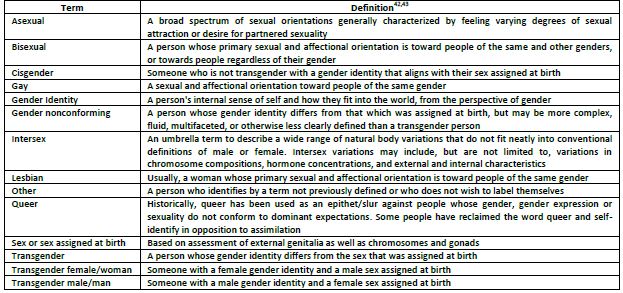
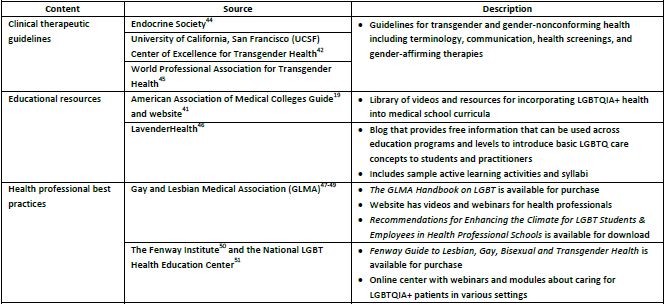
When choosing LGBTQIA+ content, the goal is to meet existing ACPE educational outcomes on cultural sensitivity and health disparities while also conveying knowledge needed to provide competent patient care. 8 To meet these outcomes, topics may include health disparities as well as gender-affirming language. Therapeutic topics could include preventive health and gender-affirming interventions, such as hormone therapy. These recommendations align with the aforementioned framework for inclusion into nursing curricula and suggestions by the Association of American Medical Colleges (AAMC). 19, 22
Topics related to LGBTQIA+ care do not necessarily need to be integrated into one course but rather should be examined to determine where they may fit in naturally across the curriculum. For pharmacotherapy courses in reproductive health, consider a comparison between contraceptives for cisgender patients and hormone therapy for transgender females. 32 During a mental health course, illustrate disparities of LGBTQIA+ patients, particularly transgender patients. 2 Continuous professional development courses, or other courses that include health disparities, are ideal for incorporating LGBTQIA+ patients into preexisting lectures. 28 Similarly, communication courses could incorporate gender-affirming language. Coordination with the curriculum committee and course coordinators may be necessary to ensure integration throughout the curriculum.
Five main strategies can be adopted to include LGBTQIA+ content in the curriculum: 1) integration into interprofessional courses, 2) didactic courses, 3) skills-based laboratory courses, 4) elective courses, or 5) a combination of these strategies for integration into multiple courses throughout the curriculum. 19, 20, 22, 24- 39 Before implementing these strategies, a curriculum mapping to assess current LGBTQIA+ content and identify potential gaps is necessary. This may also open communication for faculty interested in incorporating this content into their courses, depending on available time constraints. Various methods have been implemented, such as a one-day session focused on LGBTQIA+ health varying from 75 minutes to 10 hours. 24- 26 However, students expressed a desire for more real-world application examples after a 75-minute session and a disconnect between knowledge and application scores in the post-training assessment reinforced that more time was needed. 25 On the other hand, having an 8 or 10-hour day can contribute to learner fatigue. 24, 26 Students may not become confident on LGBTQIA+ content after only one lecture and activity; thus, utilizing multiple strategies to incorporate this content into the curriculum may be beneficial. 32
Interprofessional education represents an opportunity to include LGBTQIA+ training across multiple professions, such as medicine, dentistry, pharmacy, nursing, physical therapy, and social work. 8, 24- 26, 33 Combining multiple ACPE standards for cultural competence and interprofessional education within a course may generate more support to integrate LGBTQIA+ health into the curriculum. 7 Students have responded positively and demonstrated increased scores in comfort, knowledge, and skill in interacting with LGBTQIA+ patients following case-based discussions or performance-based assessments with standardized patients. 24- 26
Performance-based assessments utilizing standardized patients allow interprofessional student teams to interview a patient while applying appropriate communication skills as a team. 24 Alternatively, depending on the practicality of implementing standardized patients, team problem-based activities can foster discussions among students regarding interprofessional roles and apply LGBTQIA+ patient care content. 25, 26 Such cases may include transgender medical care, challenges faced by intersex patients, substance-use disorders, and other health disparities. 24- 26 Making these sessions a required component of pharmacy curricula will be crucial to ensure each member of the graduating class is exposed to the material. 24
Traditional lectures on LGBTQIA+ content have resulted in improvements in nursing and medical students’ knowledge and confidence. 20, 38 However, participant feedback indicated a desire for additional time and practice opportunities. 20, 38 Particularly, problem-based learning is preferred over traditional lecture alone to develop critical thinking skills.( 34, 35, 39) Medical schools have used patient panels, case studies, and role-play in addition to traditional lecture to successfully engage their students. 29, 41 Additionally, a take-home reflective writing assignment may introduce LGBTQIA+ content outside of class time. 37
Pharmacy didactic teaching may include terminology jeopardy, patient story videos, patient panels, role-playing, and case-based questions. 27, 28, 31 Didactic lectures, in a flipped-classroom model, can provide more opportunities for discussion during class time. 27 Personal testimonies, through panels or patient videos, may help students relate to this patient population, better understand the importance of the content, and reflect on their own biases. 24, 26- 30 However, patient panels and videos alone may not be enough to educate students on the medical aspects of LGBTQIA+ patient care, specifically hormone therapy for gender-nonconforming patients. 27, 28, 31 Feedback supports the notion that more than one didactic class is needed to become confident in providing care to LGBTQIA+ patients. 27, 28, 31
Skills-based laboratory courses allow students to apply communication skills and knowledge, similar to patient simulation cases in nursing and medical programs. 18, 40 One pharmacy program implemented objective structured clinical examination (OSCE) of hormone therapy with a transgender patient to allow students to demonstrate their knowledge in a safe environment. 23 Team-based learning may also be incorporated through case-based questions within a pharmacy skills-based laboratory course, but students may miss the opportunity to practice their individual counseling skills. 32 These practice-based activities may be coordinated with content taught in a therapeutics course or paired with a clinical pearls presentation within the laboratory. 32
Elective courses dedicated to this topic improved student knowledge and confidence in LGBTQIA+ content. 23, 24, 26 An elective course may allow for additional opportunities for active learning and ongoing exposure to the content over the course of a semester. 23, 24, 26 For example, students may participate in topic discussions, take part in counseling sessions with a transgender patient, and hear from guest speakers from the LGBTQIA+ community. 23 Pharmacy students who participated in such an elective demonstrated improvement in knowledge and skills regarding the health of LGBTQIA+ patients, but only 36 students took the course over two semesters. 23 Therefore, an elective course is an opportunity for a more in-depth knowledge of this population but should not be the sole provider of LBGTQIA+ content since not all graduated pharmacists would have had exposure to the content.
The AAMC encourages integration of LGBTQIA+ content throughout the curriculum with case-based learning, OSCE labs, standardized patient interviews, didactic lectures, lunch and learns, and journal clubs. 19 Pharmacy student feedback and reported confidence levels reveal that more than one exposure to LGBTQIA+ health content is needed to feel comfortable in providing competent care to this patient population. 23, 25, 27, 28, 31, 32 This can be achieved by a purposeful incorporation of LGBTQIA+ content across multiple courses throughout the curriculum, specifically into therapeutics courses and skills-based laboratory course activities. 27, 29, 39, 41 McDowell et al. illustrate a framework for incorporating transgender health throughout existing nursing curricula by including key points in standard lectures providing more diverse and inclusive patient cases, which was well received by faculty and students alike. 22
Health care practitioners are not adequately trained to meet LGBTQIA+ patient needs, resulting in feelings of isolation and mistrust among patients. LGBTQIA+ content is not currently an ACPE requirement, even though practicing pharmacists and students require and request additional training. Integrating this content throughout the curriculum rather than in one course or an elective is supported by AAMC as a strategy to ensure that each student is exposed to the content. A mixture of teaching methodologies may be used to incorporate LGBTQIA+ health into pharmacy school curricula. Schools of Pharmacy should consider proactive incorporation of LGBTQIA+ content throughout their curricula to generate well-trained practitioners who are able to provide high quality care to LGBTQIA+ patients.
