Original article
Assessing the Impact of the COVID-19 Pandemic on Nutrition in Older Adults in Japan: Insights from a Mini-Nutrition Assessment Short Form Survey
Evaluación del impacto de la pandemia de COVID-19 en la nutrición de los adultos mayores en Japón: Perspectivas de una encuesta breve de evaluación de la nutrición
Assessing the Impact of the COVID-19 Pandemic on Nutrition in Older Adults in Japan: Insights from a Mini-Nutrition Assessment Short Form Survey
Iberoamerican Journal of Medicine, vol. 5, no. 4, pp. 143-149, 2023
Hospital San Pedro

Esta obra está bajo unaLicencia Creative Commons Atribución 4.0 Internacional.
Received: 17 April 2023
Corrected: 29 June 2023
Accepted: 15 August 2023
Abstract:
Introduction: The coronavirus disease-2019 pandemic has changed the daily lives of older adults in Japan, requiring them to wear masks and limit their movements. As lifestyle changes affect people's health, it is likely that some changes have occurred in their nutrition, which is the foundation of health. Therefore, this study aimed to examine the nutrition of older adults living at home during the pandemic period and identify the impact of the pandemic.
Material and methods: The nutrition of older adults living at home was surveyed using the Mini-Nutrition Assessment Short Form (MNA-SF®). The target population was older adults living at home who were independent or in need of care. Surveys were conducted before and during the pandemic. Associations between the two survey periods and the MNA-SF® (nutrition assessment, sub-item) were analysed using χ-square or Fisher's test. The analysis was conducted separately for independent older adults and older adults in need of care.
Results: Regarding nutrition assessment, our survey results indicated that 39.5% of older adults were considered "well-nourished," 46% were "at risk for malnutrition," and 14.5% were "malnourished" during the pandemic period. The analysis showed no significant differences in nutrition assessment by survey period for all participants. However, differences were observed in the sub-items before and during the pandemic. Significant differences were observed in neuropsychological problems and body mass index among independent older adults, and in neuropsychological problems, mobility, and reduced food intake among older adults in need of care.
Conclusions: Our results suggest that the pandemic has changed the risk factors for undernutrition among older adults living at home, and that these changed factors may differ in part depending on whether they need care.
Keywords: Elderly, COVID-19, Nutritional status, MNA®-SF.
Resumen:
Introducción: La pandemia de la enfermedad por coronavirus-2019 ha cambiado la vida cotidiana de los adultos mayores en Japón, requiriendo que usen máscaras y limiten sus movimientos. Dado que los cambios en el estilo de vida afectan la salud de las personas, es probable que se hayan producido algunos cambios en su nutrición, que es la base de la salud. Por lo tanto, este estudio tuvo como objetivo examinar la nutrición de los adultos mayores que viven en el hogar durante el período de la pandemia e identificar el impacto de la pandemia.
Material y métodos: Se encuestó la nutrición de los adultos mayores que viven en el hogar mediante el Mini-Nutrition Assessment Short Form (MNA-SF®). La población objetivo fueron los adultos mayores que vivían en su hogar, que eran independientes o necesitaban cuidados. Las encuestas se realizaron antes y durante la pandemia. Las asociaciones entre los dos períodos de la encuesta y el MNA-SF® (evaluación nutricional, subelemento) se analizaron mediante la prueba de χ-cuadrado o de Fisher. El análisis se realizó por separado para adultos mayores independientes y adultos mayores con necesidad de atención.
Resultados: En cuanto a la evaluación de la nutrición, los resultados de nuestra encuesta indicaron que el 39,5% de los adultos mayores se consideraban "bien nutridos", el 46% estaban "en riesgo de desnutrición" y el 14,5% estaban "desnutridos" durante el período de pandemia. El análisis no mostró diferencias significativas en la evaluación de la nutrición por período de encuesta para todos los participantes. Sin embargo, se observaron diferencias en los subítems antes y durante la pandemia. Se observaron diferencias significativas en problemas neuropsicológicos e índice de masa corporal entre adultos mayores independientes, y en problemas neuropsicológicos, movilidad e ingesta reducida de alimentos entre adultos mayores necesitados de cuidados.
Conclusiones: Nuestros resultados sugieren que la pandemia ha cambiado los factores de riesgo de desnutrición entre los adultos mayores que viven en el hogar, y que estos factores modificados pueden diferir en parte dependiendo de si necesitan atención.
Palabras clave: Ancianos, COVID-19, Estado nutricional, MNA®-SF.
INTRODUCTION
In December 2019, the world's first case of coronavirus disease-2019 (COVID-19) was reported. Subsequently, within a few months, COVID-19 became a global pandemic. During the pandemic, poor nutrition among children and people in low socioeconomic areas was reported [1]. In addition, common malnutrition indicators such as weight loss [2] and malnutrition or risk of malnutrition in 80% of older adults and hospitalized patients [3] have been reported among COVID-19-infected patients. Furthermore, it was also revealed that malnutrition was significantly associated with a poor prognosis of COVID-19 [4], indicating that diet and nutrition are important infection prevention measures [5, 6, 7].
In Japan, the first case of infection was confirmed in January 2020, and in April 2020, Japan's first state of emergency was declared, which resulted in restrictions imposed on daily activities. Since then, until the end of 2022, eight waves of new cases of infection have occurred, and four emergency declarations have been issued. The pandemic has changed the daily lives of Japanese people, necessitating the use of masks and restriction of movement. Since lifestyle changes affect people's physical and mental health, it is likely that some changes have also occurred in their nutrition, which is the foundation of health. Japan has a high aging population and, as older adults are more susceptible to the effects of the social environment, there is concern that their nutrition may be adversely affected. Surveys of frail older adults in Japan have revealed changes in dietary habits, including decreased intake of meat, fish, seaweed, mushrooms, and fruits due to the pandemic [8]. However, data on the nutrition of older adults at home, who are less likely to go out during the pandemic, are limited, which limits our understanding of the extent of the problem.
Therefore, this study aimed to examine the nutritional habits of older adults residing in their homes, both before and during the COVID-19 pandemic, and to identify changes in this status.
MATERIAL AND METHODS
PARTICIPANTS
The targets of the study were older adults aged 65 years and above living at home in a medium-sized city in Japan, and who consented to the survey. Independent older adults were approached at the community centers they visited daily and were asked to participate in the survey. Those requiring nursing care were asked to participate at the day-care facilities they used.
SURVEY PERIODS
The survey was conducted from 2014 to 2018, before the COVID-19 pandemic, and from 2021 to 2022, during the COVID-19 pandemic.
SURVEY METHODS
An anonymized questionnaire survey was conducted, which participants completed independently, if possible. If a participant required assistance, an assistant was present to listen and record their responses. Questionnaires were collected in boxes. The boxes were kept there for 1 month after the questionnaires were distributed.
SURVEY ITEMS
The survey items were basic attributes and nutrition of the participants.
BASIC ATTRIBUTES
The participants’ age, sex, and need of care were surveyed. In Japan, certification for “in need of care” is conducted under a national system. Therefore, in this study, older adults certified as needing care were defined as "in need of care" and those not certified were defined as "independent.
NUTRITION
Nutrition was assessed using the Mini-Nutrition Assessment Short-Form (MNA®-SF) [9, 10], designed for older adults. This assessment form consists of six sub-items that include the characteristics of older adults from a nutritional perspective, with the sub-items being risk factors for undernutrition. These were food intake, weight loss, mobility, psychological stress or acute neuropsychological problems, and body mass index (BMI). Food intake, weight loss, physical activity, and psychological stress were each assessed using questionnaire responses. In this study, neuropsychological problems were assessed using the revised Hasegawa Brief Intelligence Rating Scale [11], the Geriatric Depression Scale [12], and clinical judgment by doctors or occupational therapists, and BMI was calculated from the responses to a question asking about height and weight. The six sub-items have score response options from 0 to 3 points. The screening score (0–14 points) is calculated by totalling the sub-item scores. Nutrition assessment is based on a screening score range: a score of 12-14 indicates good nutritional status, a score of 8-11 indicates at risk for malnutrition, and a score of 0-7 indicates malnutrition.
STATISTICAL ANALYSIS
Only the data for which responses were obtained for all six items of the MNA®-SF were included in the analysis. To analyse the association between the period of the survey and the MNA-SF® (nutrition assessment, sub-item) for older adults who were independent or needed care, the χ-square or Fisher's test was used. The significance level in the analysis was set at < 0.05. IBM SPSS Ver. 29.0 (SPSS Inc., Tokyo, Japan) was used for statistical analysis.
ETHICAL CONSIDERATIONS
The study purpose, procedure, optional nature of study participation, protection of personal information, and publication of results were fully explained to the participants prior to taking the survey. The willingness to consent to participate in the study was confirmed by signing a consent form. The survey was conducted after obtaining appropriate approval from the Research Ethics Review Committee.
RESULTS
BASIC ATTRIBUTES AND NUTRITION
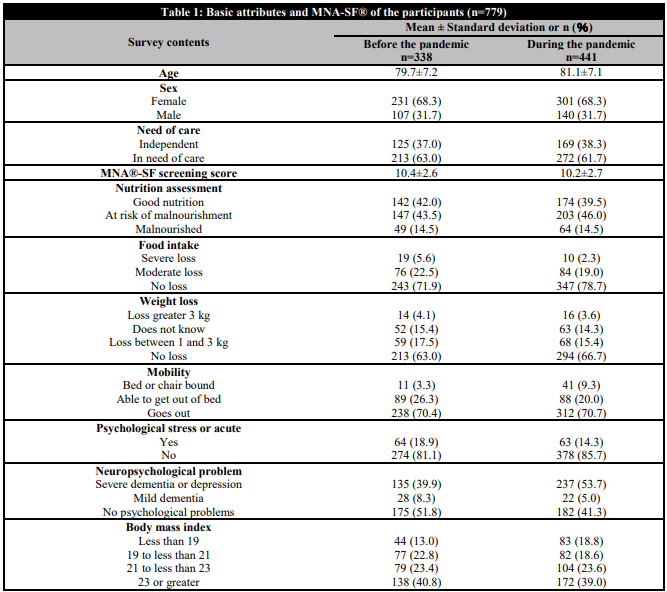
The basic attributes and MNA-SF® of the participants are summarized in Table 1.
BEFORE THE COVID-19 PANDEMIC
Responses were obtained from 338 participants. The mean age was 79.7 ± 7.2 years, with 231 (68.3%) female and 107 (31.7%) male participants. Of these, 125 (37.0%) were independent and 213 (63.0%) needed care.
The mean MNA®-SF screening score was 10.4±2.6; 142 (42.0%) were in “good in nutrition," 147 (43.5%) were "at risk of malnutrition," and 49 (14.5%) were "malnourished".
DURING THE COVID-19 PANDEMIC
Responses were obtained from 441 older adults. The mean age was 81.1 ± 7.1 years, with 301 (68.3%) female and 140 (31.7%) male participants. Of these, 169 (38.3%) were independent and 272 (61.7%) needed care.
The mean MNA®-SF screening score was 10.2±2.7; 174 (39.5%) were in “good nutrition," 203 (46.0%) were “at risk of malnutrition," and 64 (14.5%) were “malnourished.”
ANALYSIS RELATED TO NUTRITION
We analysed the survey period and MNA®-SF (nutrition assessment, sub-item) for each care need using the χ-square or Fisher’s test.
INDEPENDENT OLDER ADULTS
The nutrition assessment of independent older adults did not differ before or during the pandemic. However, there were significant differences in the assessment sub-items "neuropsychological problems" (p<0.001) and "BMI" (p=0.020), with higher rates of dementia and depression and higher BMI values during the pandemic compared to before the COVID-19 pandemic. These data are presented in Table 2.
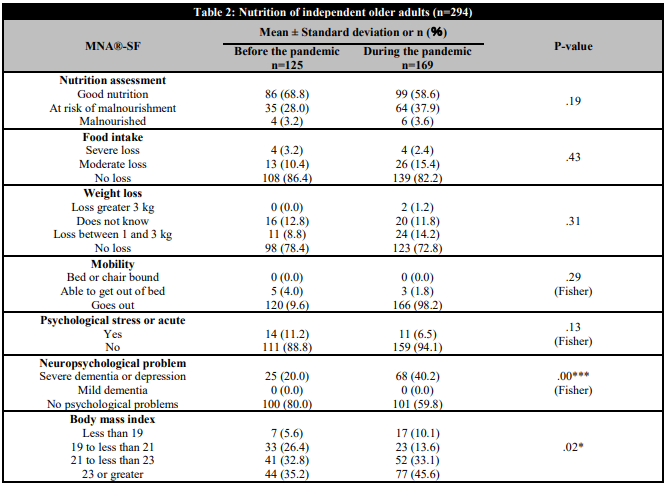
* and *** represent P < 0.05 and P <0.001. P-values were calculated using the χ-square test or Fisher’s test.
OLDER ADULTS IN NEED OF CARE
No differences in the nutrition assessment f older adults in need of care were observed before or during the pandemic. However, there were significant differences in the assessment sub-items "neuropsychological problems" (p=0.042), "mobility" (p=0.001), and "food intake" (p=0.002) compared to before the pandemic. During the pandemic, higher rates of dementia and depression, increased rates of being bedridden and chair-bound, and less decline in food intake were observed. These data are presented in Table 3.
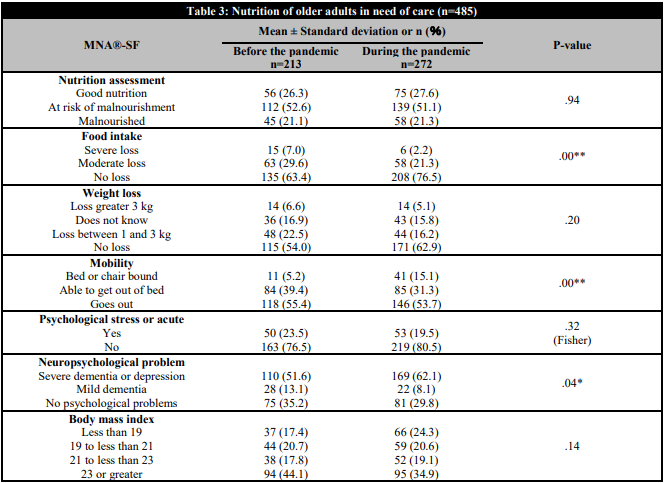
* and ** represent P < 0.05 and P <0.01. P-values were calculated using the χ-square test or Fisher’s test.
DISCUSSION
The nutrition of older adults in this study was assessed using the MNA®-SF and we observed that their nutrition assessment results during the pandemic did not differ significantly from those before the pandemic. However, some of the risk factors for malnutrition among older adults, which are components of the MNA®-SF-underwent significant changes. We believe that these factors highlighted the problem faced by the at-risk population severely affected by the COVID-19 pandemic.
The study showed that at-home older adults, regardless of their care needs, had increased rates of dementia and depression during the pandemic. The COVID-19 pandemic has increased social isolation among older adults [13, 14]. Social isolation has previously been shown to cause various health problems [15, 16] and has been reported to be associated with cognitive decline and depression [17, 18]. Similarly, the COVID-19 pandemic is thought to have a negative impact on mental health owing to social isolation. This is evident not only in Japan but also in surveys in other countries [19, 20, 21, 22], where COVID-19 has impacted the mental health of older adults.
Increased BMI values were observed in independent older adults. Several adult studies have reported weight gain during the pandemic period [23, 24]. Social isolation leads to inactivity [20, 25], and behavioural restrictions reduce physical activity, resulting in fewer calories consumed and increased weight gain. Because Japanese older adults are in many ways younger than they used to be [26, 27], it is possible that the impact of the pandemic on independent older adults could be similar to that on adults.
No change in BMI was observed in older adults in need of care. However, in older adults in need of care, mobility decreased with a higher percentage of bed or chair-bound participants during the pandemic period. This is thought to be due to the limitation of activity caused by self-restraint, resulting in decreased muscle strength and decreased range of motion of the joints. Thus, it was suggested that the impact of reduced activity due to behavioural restrictions brought about by the COVID-19 pandemic differed depending on the independent status of the older adults, with independent older adults gaining weight and the elderly in need of nursing care becoming bedridden.
Although the COVID-19 pandemic has reportedly had a negative impact on various aspects of the health of older adults [19], the changes in risk factors for malnutrition in this study suggest that they may be in a potential risk state for malnutrition. Therefore, problems related to nutrition may become more apparent in the future, and it is necessary to continue monitoring the nutrition of older adults at home and to screen them on an ongoing basis. In addition, the results suggest that some of the factors that affect the nutrition of older adults may differ depending on the care needs of the target older adults; therefore, it is necessary to monitor the changes in older adults not in a uniform manner, but on a case-by-case basis. Since the pandemic has had a significant impact on the daily lives of people around the world, especially those in densely populated countries such as Japan, we believe it is important for healthcare professionals to consider this information in clinical situations, such as health examinations.
The limitations of this study include the fact that the target older adults were from a limited number of regions in Japan; therefore, the results do not represent the nutrition of all older adults in Japan. In addition, it is possible that the food intake of older adults in need of care hardly decreased during the pandemic, and the cause of this decrease needs to be clarified.
ACKNOWLEDGEMENTS
We thank the older adults living at home who participated in this study. This study was funded by a grant-in-aid for research at Himeji University.
CONFLICT OF INTERESTS
The authors have no conflict of interest to declare. The authors declared that this study has received no financial support.
REFERENCES
1. Headey D, Heidkamp R, Osendarp S, Ruel M, Scott N, Black R, et al. Impacts of COVID-19 on childhood malnutrition and nutrition-related mortality. Lancet. 2020;396(10250):519-21. doi: 10.1016/S0140-6736(20)31647-0.
2. Di Filippo L, De Lorenzo R, D'Amico M, Sofia V, Roveri L, Mele R, et al. COVID-19 is associated with clinically significant weight loss and risk of malnutrition, independent of hospitalisation: A post-hoc analysis of a prospective cohort study. Clin Nutr. 2021;40(4):2420-6. doi: 10.1016/j.clnu.2020.10.043.
3. Li T, Zhang Y, Gong C, Wang J, Liu B, Shi L, et al. Prevalence of malnutrition and analysis of related factors in elderly patients with COVID-19 in Wuhan, China. Eur J Clin Nutr. 2020;74(6):871-5. doi: 10.1038/s41430-020-0642-3.
4. Wei C, Liu Y, Li Y, Zhang Y, Zhong M, Meng X. Evaluation of the nutritional status in patients with COVID-19. J Clin Biochem Nutr. 2020;67(2):116-21. doi: 10.3164/jcbn.20-91.
5. Iddir M, Brito A, Dingeo G, Fernandez Del Campo SS, Samouda H, La Frano MR, et al. Strengthening the Immune System and Reducing Inflammation and Oxidative Stress through Diet and Nutrition: Considerations during the COVID-19 Crisis. Nutrients. 2020;12(6):1562. doi: 10.3390/nu12061562.
6. Gasmi A, Noor S, Tippairote T, Dadar M, Menzel A, Bjørklund G. Individual risk management strategy and potential therapeutic options for the COVID-19 pandemic. Clin Immunol. 2020;215:108409. doi: 10.1016/j.clim.2020.108409.
7. Calder PC, Carr AC, Gombart AF, Eggersdorfer M. Optimal Nutritional Status for a Well-Functioning Immune System Is an Important Factor to Protect against Viral Infections. Nutrients. 2020;12(4):1181. doi: 10.3390/nu12041181.
8. Kinoshita K, Satake S, Arai H. Impact of Frailty on Dietary Habits among Community-Dwelling Older Persons during the COVID-19 Pandemic in Japan. J Frailty Aging. 2022;11(1):109-14. doi: 10.14283/jfa.2021.45.
9. Kaiser MJ, Bauer JM, Ramsch C, Uter W, Guigoz Y, Cederholm T, et al. Validation of the Mini Nutritional Assessment short-form (MNA-SF): a practical tool for identification of nutritional status. J Nutr Health Aging. 2009;13(9):782-8. doi: 10.1007/s12603-009-0214-7.
10. Soysal P, Veronese N, Arik F, Kalan U, Smith L, Isik AT. Mini Nutritional Assessment Scale-Short Form can be useful for frailty screening in older adults. Clin Interv Aging. 2019;14:693-9. doi: 10.2147/CIA.S196770.
11. Jeong JW, Kim KW, Lee DY, Lee SB, Park JH, Choi EA, et al. A normative study of the Revised Hasegawa Dementia Scale: comparison of demographic influences between the Revised Hasegawa Dementia Scale and the Mini-Mental Status Examination. Dement Geriatr Cogn Disord. 2007;24(4):288-93. doi: 10.1159/000107592.
12. Yesavage JA, Brink TL, Rose TL, Lum O, Huang V, Adey M, et al. Development and validation of a geriatric depression screening scale: a preliminary report. J Psychiatr Res. 1982-1983;17(1):37-49. doi: 10.1016/0022-3956(82)90033-4.
13. Wu B. Social isolation and loneliness among older adults in the context of COVID-19: a global challenge. Glob Health Res Policy. 2020;5:27. doi: 10.1186/s41256-020-00154-3.
14. Brooke J, Jackson D. Older people and COVID-19: Isolation, risk and ageism. J Clin Nurs. 2020;29(13-14):2044-6. doi: 10.1111/jocn.15274.
15. Shankar A, McMunn A, Banks J, Steptoe A. Loneliness, social isolation, and behavioral and biological health indicators in older adults. Health Psychol. 2011;30(4):377-85. doi: 10.1037/a0022826.
16. Holt-Lunstad J, Smith TB, Baker M, Harris T, Stephenson D. Loneliness and social isolation as risk factors for mortality: a meta-analytic review. Perspect Psychol Sci. 2015;10(2):227-37. doi: 10.1177/1745691614568352.
17. Nicholson NR. A review of social isolation: an important but underassessed condition in older adults. J Prim Prev. 2012;33(2-3):137-52. doi: 10.1007/s10935-012-0271-2.
18. Santini ZI, Jose PE, York Cornwell E, Koyanagi A, Nielsen L, Hinrichsen C, et al. Social disconnectedness, perceived isolation, and symptoms of depression and anxiety among older Americans (NSHAP): a longitudinal mediation analysis. Lancet Public Health. 2020;5(1):e62-e70. doi: 10.1016/S2468-2667(19)30230-0.
19. Sepúlveda-Loyola W, Rodríguez-Sánchez I, Pérez-Rodríguez P, Ganz F, Torralba R, Oliveira DV, et al. Impact of Social Isolation Due to COVID-19 on Health in Older People: Mental and Physical Effects and Recommendations. J Nutr Health Aging. 2020;24(9):938-47. doi: 10.1007/s12603-020-1469-2.
20. Hämmig O. Health risks associated with social isolation in general and in young, middle and old age. PLoS One. 2019;14(7):e0219663. doi: 10.1371/journal.pone.0219663.
21. Robb CE, de Jager CA, Ahmadi-Abhari S, Giannakopoulou P, Udeh-Momoh C, McKeand J, et al. Associations of Social Isolation with Anxiety and Depression During the Early COVID-19 Pandemic: A Survey of Older Adults in London, UK. Front Psychiatry. 2020;11:591120. doi: 10.3389/fpsyt.2020.591120.
22. Torales J, O'Higgins M, Castaldelli-Maia JM, Ventriglio A. The outbreak of COVID-19 coronavirus and its impact on global mental health. Int J Soc Psychiatry. 2020;66(4):317-20. doi: 10.1177/0020764020915212.
23. Pellegrini M, Ponzo V, Rosato R, Scumaci E, Goitre I, Benso A, et al. Changes in Weight and Nutritional Habits in Adults with Obesity during the "Lockdown" Period Caused by the COVID-19 Virus Emergency. Nutrients. 2020;12(7):2016. doi: 10.3390/nu12072016.
24. Bhutani S, vanDellen MR, Cooper JA. Longitudinal Weight Gain and Related Risk Behaviors during the COVID-19 Pandemic in Adults in the US. Nutrients. 2021;13(2):671. doi: 10.3390/nu13020671.
25. Almandoz JP, Xie L, Schellinger JN, Mathew MS, Gazda C, Ofori A, et al. Impact of COVID-19 stay-at-home orders on weight-related behaviours among patients with obesity. Clin Obes. 2020;10(5):e12386. doi: 10.1111/cob.12386.
26. Makizako H, Nishita Y, Jeong S, Otsuka R, Shimada H, Iijima K, et al. TRENDS IN THE PREVALENCE OF FRAILTY IN JAPAN: A META-ANALYSIS FROM THE ILSA-J. J Frailty Aging. 2021;10(3):211-8. doi: 10.14283/jfa.2020.68.
27. Suzuki T, Nishita Y, Jeong S, Shimada H, Otsuka R, Kondo K, et al. Are Japanese Older Adults Rejuvenating? Changes in Health-Related Measures Among Older Community Dwellers in the Last Decade. Rejuvenation Res. 2021;24(1):37-48. doi: 10.1089/rej.2019.2291.
Author notes
naoko_morisaki@koutoku.ac.jp