Review
Working conditions, vocal health and work ability in teachers: an integrative review
Condiciones de trabajo, salud vocal y capacidad laboral en profesores: una revision integradora
 Luis Miguel Cárdenas-Castellanos
Working conditions, vocal health and work ability in teachers: an integrative review
Iberoamerican Journal of Medicine, vol. 7, núm. 1, pp. 17-24, 2025
Hospital San Pedro
Recepción: 10 Agosto 2024
Corregido: 07 Noviembre 2024
Aprobación: 18 Noviembre 2024
Abstract:
Introduction: Work Ability (WA) is the balance between job demands and a worker's individual resources to satisfy those demands. Teachers who have health problems related to musculoskeletal disorders (MSD) and respiratory diseases (RD) have their WA affected.
Objective: To understand the relationship between working conditions, vocal health, and WA in teaching work according to literature.
Methods: An integrative review was carried out with a search of the scientific literature in 7 databases: Medline Complete, Proquest, Pubmed, Sciencedirect, Scopus, Virtual Health Library (VHL) and Web of Science (WOS). Original studies in Spanish, English and Portuguese related to the topic were included.
Results: 7 studies were analyzed in this review. Results show Giannini and Vertanen-Greis as the main authors who have published about the topic. 100% of the studies of this review have investigated the topic in primary and secondary teachers. Teachers with voice problems are almost three times more likely to lose their WA than those without voice problems, and there is a stronger association between loss of WA and voice problems.
Conclusions: Studies related to working conditions, vocal health and WA in teaching work are recent and the evidence is scarce. To date, greater decreases in WA have been found in teachers who report high levels of stress, poor air quality, and have a diagnosed voice problem.
Keywords: Working conditions , Vocal health , Work ability , Teachers.
Resumen:
Introducción: La Capacidad Laboral (CL) es el equilibrio entre las demandas laborales y los recursos individuales de un trabajador para satisfacer esas demandas. Los profesores que tienen problemas de salud relacionados con trastornos musculoesqueléticos (TME) y enfermedades respiratorias (ER) tienen afectada su CL.
Objetivo: Comprender la relación entre las condiciones de trabajo, la salud vocal y la CL en la labor docente según la literatura.
Métodos: Se realizó una revisión integrativa con búsqueda de la literatura científica en 7 bases de datos: Medline Complete, Proquest, Pubmed, Sciencedirect, Scopus, Biblioteca Virtual en Salud (BVS) y Web of Science (WOS). Se incluyeron estudios originales en español, inglés y portugués relacionados con el tema.
Resultados: En esta revisión se analizaron 7 estudios. Los resultados muestran a Giannini y Vertanen-Greis como los principales autores que han publicado sobre el tema. El 100% de los estudios de esta revisión han investigado el tema en profesores de primaria y secundaria. Los profesores con problemas de voz tienen casi tres veces más probabilidades de perder su CL que aquellos sin problemas de voz, y existe una asociación más fuerte entre la pérdida de la CL y los problemas de voz.
Conclusiones: Los estudios relacionados con las condiciones laborales, la salud vocal y la CL en la labor docente son recientes y la evidencia es escasa. Hasta la fecha, se han encontrado mayor disminución en la CL en profesores que reportan altos niveles de estrés, mala calidad del aire y tienen un problema de voz diagnosticado.
Palabras clave: Condiciones de trabajo , Salud vocal, Capacidad laboral , Profesores.
Work Ability (WA) is the balance between job demands and a worker's individual resources to satisfy those demands. [1]. WA contributes to workplace well-being and reduces the risk of musculoskeletal diseases, sick leave, and early retirement. A low WA affects the company's productivity and its capacity to compete in the market [2]. Workers who have a physically strenuous job have a significantly lower WA than those who have a light job [3]. Some authors have reported that employees that lose WA are at risk of suffering from depression, therefore, these people require psychological support to overcome its effects [4]. Furthermore, WA decreases markedly in workers who present severe and persistent neck and shoulder pain [5]. On the other hand, it has been found that it is necessary to change work schedules, improve sleep quality, limit working hours, and not schedule sensitive people for night shifts to improve WA [6]. In case of teachers, those who present greater emotional exhaustion [7], stress [8] and burnout [9], have lower WA. Teachers who have health problems related to musculoskeletal disorders (MSD) and respiratory diseases (RD) also have their WA affected [10]. Likewise, the coexistence of MSD and depression affects WA and reduces teachers' efficiency [11]. Moreover, there is a relationship between decrease in WA, voice problems, stress, and poor quality of the indoor environment in the teachers' workplace [12]. Work Ability Index (WAI) may be used at the individual and collective level; individually to identify workers with compromised functional capacity and adopt support measures, at a collective level, it allows identifying a general profile of WA and factors that affect it to generate corrective measures [13]. Additionally, WAI is valid to predict work disability, quality of life after retirement, mortality, and positive work reintegration [14]. For these reasons and to understand the importance of WA and vocal health in teachers, this review aimed to understand the relationship between working conditions, vocal health, and WA in teaching work according to literature.
METHODS
An integrative review of literature was carried out based on six stages proposed by Botelho, Cunha and Macedo (2011) [15].
1. Initially, the guiding question was formulated: How are working conditions and vocal health related to WA?
2. To answer the question, a search of scientific literature was carried out in 7 databases: Medline Complete, Proquest, Pubmed, Sciencedirect, Scopus, Virtual Health Library (VHL) and Web of Science (WOS). The terms “work ability”, “voice disorders” and “teachers” were used with the Boolean operator AND to construct the following search equations: ("work ability") AND ("voice disorders") AND (teachers) and work ability AND voice disorders AND teachers.
3. After search, duplicate records were eliminated using Zotero bibliographic manager version 6.0.30.
4. Likewise, the following inclusion criteria were considered: studies in Spanish, English and Portuguese no publication time limit related to working conditions, vocal health, and WA in teachers. Studies related to other occupational voice users and studies related to WA in teachers that considered other health conditions were excluded. Moreover, conference proceedings, letters to editor, book chapters, books, dissertations, master's or doctoral theses, review articles, reflection articles, essays, articles that did not allow downloading or reading full text and articles published in other languages than those previously referred to were also excluded.
5. During preselection stage, title, abstract and keywords were read to verify inclusion and exclusion criteria to organize and select studies that were read in full text to perform data extraction.
Finally, to extract data from the studies, a matrix was created in Microsoft Excel 365 to organize and synthesize the information of the following variables: main author, year of publication, journal of publication, objective, methodology (type of study, sample) and main results.
RESULTS
During search, 148 records were identified, of which 59 were duplicates. In screening, 74 records that did not meet the inclusion criteria were excluded. In eligibility stage, 15 articles were read in full text. Ultimately, seven studies were included and were analyzed in this review (Figure 1).
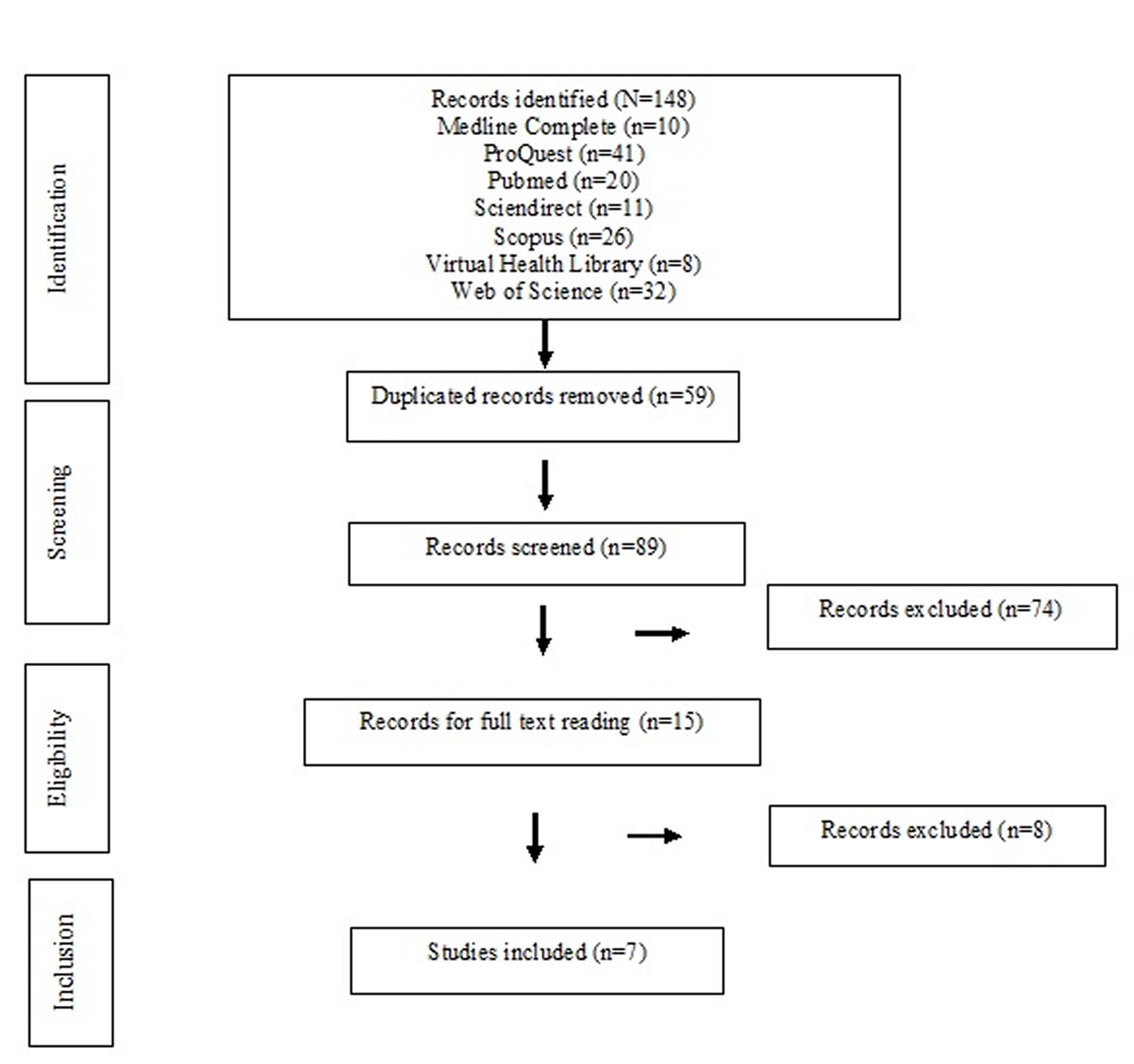
Figure 1
Flowchart of included studies
Results show Giannini and Vertanen-Greis as the most notable authors with two (25.8%) studies. The first research related to the topic was published in 2013. Studies have been carried out in only two countries, Brazil, and Finland. Three descriptive observational studies (42.8%), three analytical observational studies (42.8%) and one comparative analytical observational study (14.2%) have been published. Among institutional affiliations of the main authors stands out, Pontifícia Universidade Católica de São Paulo [16, 17, 18, 19], University of Turku [8, 12] and Helsinki University Hospital [20]. Studies have been published in 6 journals, highlighting Journal of Voice [12, 18] from United States, Revista CEFAC [16], CoDAS [17] and Saúde e Sociedade [19] from Brasil. 100% of studies have investigated the topic in primary and secondary teachers (Table 1).
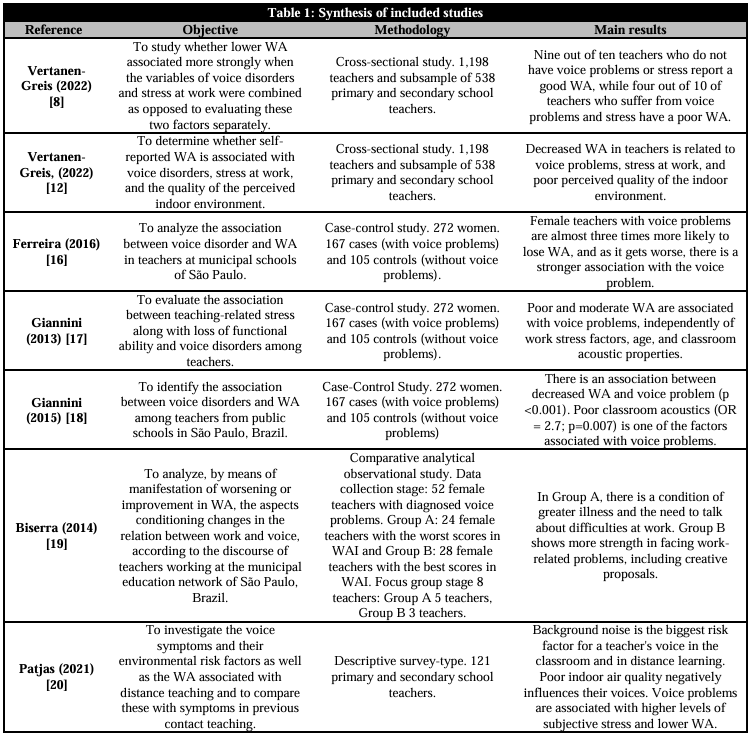
WA: Work ability; WAI: Work ability index
DISCUSSION
CHARACTERISTICS OF STUDIES INCLUDED
This review aimed to understand the relationship between working conditions, vocal health, and WA in teaching work according to literature. As observed, research topic is of recent, and little has been investigated in this regard. Only seven studies met the inclusion criteria. Results show Brazil and Finland as countries that contribute with research on the subject. The included studies focus on primary and secondary teachers. There are no studies in teachers of other levels of education. Six studies have considered a quantitative approach, and one has developed a comparative analytical observational approach with two stages, collection stage and focus group stage. Quantitative studies are cross-sectional studies [8, 12] survey study [20] and case-control studies [16, 17, 18]. Overall, working conditions have been studied through self-reported questionnaires that reveal working environment conditions [16, 17, 20], working organization conditions [17, 18], stress [8, 16, 20], work ergonomics [20] and air quality [8, 12, 20]. Voice is studied through laryngoscopy and perceptual-auditory assessment [16, 17, 18] using GRBAS-I (Grade, Roughness, Breathiness, Asteny, Strain, Instability) scale [21]. In addition, Condição de Produção Vocal do Professor (CPV-P) questionnaire [22] and other questionnaires to know the frequency of voice problems and vocal symptoms have been used [8, 12]. On the other hand, Voice Handicap Index (VHI-10) [23] has been used to know perception of teachers' vocal disability [18]. Besides, WAI [24] translated and validated in Portuguese version [16, 17, 19] and Work Ability Score (WAS) [25] have been used in Finland to assess teachers' WA [8, 19, 20].
WORKING CONDITIONS
The included studies emphasize in unsatisfactory classroom acoustics as one of working conditions that most affects teachers' voices with a statistically significant association (p<0.001; OR=2.7) [17], (p =0.007) [18]. Another working condition that may affect vocal health is noise. This condition is associated with subjective voice problems and higher VHI-10 scores [20]. Furthermore, poor indoor air quality perceived by teachers with voice problems and ergonomic deficiencies in school (electrically adjustable desks) also influence teachers' voices [20]. Stress in one of the working conditions most reported by teachers, which reaches up to 65% [20]. Job Stress Scale (JSS) developed by Paker & Decotiis in 1983 [26] shows that teachers with acute fatigue are 2.2 times more likely to develop voice problems than teachers with mild fatigue [17], which resembles to the results found in soccer coaches, who present an association between stress and frequent vocal symptoms [27]. Moreover, it has been found that women suffer from voice problems and stress more frequently than men [8].
VOCAL HEALTH CONDITIONS
Study of vocal health conditions includes reporting of vocal symptoms [17, 18], vocal disability [20], prevalence of voice problems [8, 12] and improvement in vocal production after teachers were in a therapeutic program [19]. Teachers report vocal symptoms such as hoarseness [17, 18], loss of voice [17, 18], shortness of breath when speaking [17, 18], rough voice [17], voice changes [17], weak voice [17], pain when talking [18], tiredness when speaking [18], throat tension when speaking [18], dry throat [18], tight throat [18] and phlegm [18] more frequently in teachers with a diagnosed voice problem. It is observed in statistically significant differences (p<0.001) in relation to group of teachers without a diagnosed voice problem at the time of the analysis [18]. It is also important to highlight that 71% of teachers experience vocal symptoms in regular teaching and 44% of teachers experience them in distance teaching during the time of COVID-19 pandemic, indicating that distance teaching is usually more beneficial for teachers compared to regular teaching [20] and voice quality improves in remote education [28]. Other authors have concluded that teachers with and without voice complaints have a different incidence of vocal symptoms, but these symptoms are usually similar in both groups, including, hoarseness, shortness of breath, tone changes and vocal fatigue with statistically significant differences (p<0.005) between the compared groups [29]. In addition, other studies show that teachers who have suffered from some vocal pathology during their career tend to present more symptoms than those who have only presented some vocal pathology during the previous semester of their work [30], standing out primary schoolteachers above kindergarten teachers. Another study has also identified that almost half of schoolteachers present voice problems at the time of the research and almost three quarters have had vocal symptoms throughout their careers [31]. It confirms that voice problems have an impact on the personal and professional lives of teachers and imply a significant financial burden for society [32] and in the same way impact quality of life of these workers [33]. At the same time, it is highlighted that the voice production of female teachers with a diagnosed voice problem improves during therapy. However, it is found that almost half of female teachers still report recent voice problems due to factors such as the presence of depressive symptoms, effect of dryness of the vocal folds due to taking medication for depression, intense vocal demand and the presence of laryngopharyngeal reflux and some of them report the need to return to therapy [19]. In this sense, some authors emphasize that voice therapy is a strong predictor of maintaining employability among teachers with dysphonia if it is performed early [34]. It is common to abandon vocal therapy process, which generates poor adherence to the treatment, and it may increase the risk of a greater recurrence of voice problem and patients may suffer from a more complex pathology in the future [35]. On the other hand, previous studies that have used VHI show that 70% of teachers have a voice alteration [36] and have a greater perception of vocal disability [37], however, one of the included studies shows that this perception decreases during distance learning [20]. According to above, prevalence of voice problems in teachers is high; it is found at 52.42% [8] and 53.17% respectively [12] in two of the included studies and is confirmed by results in public schoolteachers (47.52%) [38] and in university professors, which may reach up to 41% [39].
WORK ABILITY AND VOCAL HEALTH
Results of included studies recognize that teachers who report voice problems and present an associated diagnosis (cases) have their WA reduced [8, 16, 17, 18, 20]. Three of case-control studies in Brazil show that 67.4% of sick teachers (cases) consider WA as bad or moderate and 66.6% of healthy teachers (controls) rate it as good or very good [16, 17, 18], which implies that teachers with a better vocal health condition have a better WA. In addition, female teachers with voice problems are almost three times more likely to lose WA, and as it gets worse, there is a stronger association with the voice problem [16]. The above has similar results with the descriptive studies carried out in Finland, since the 69% [8] and 71% [12] of teachers with self-report of voice problems present good WA. However, it is necessary to carry out more studies with different methodological designs to measure WA and vocal health conditions in teachers due to the little evidence found in this review. On the other hand, it was observed that women report a lower WA than men [8, 12]. Low physical and mental WA, according to other results, show a significant association with factors such as physical and verbal violence in kindergarten and primary schoolteachers [40]. Furthermore, teachers over 45 years old present deterioration of WA due to effects of various diseases, which indicates that teachers in aging process see their WA affected, mainly when high rates of psychosomatic, RD and even hearing impairment occur [41]. Additionally, there are other variables that are significantly associated with a decrease in WA in teachers. It includes the perception of a worsening health situation, having children, difficulty sleeping well at night, a history of physical pain in the previous six months, be a teacher with a contract and work as a teacher for longer [42]. Above provides interesting data to conduct more research that studies other factors that may be associated with WA in teachers and that may affect their vocal health.
RELATIONSHIP BETWEEN WORKING CONDITIONS, VOCAL HEALTH, AND WORK ABILITY
There is a significant association between voice problems and workplace stress, as well as between voice problems and WA loss among female teachers [17]. Besides, the presence of voice problems in teachers is associated with higher levels of stress and lower WA [20]. Decreased WA in teachers is also related to voice problems, work stress and self-reported poor air quality [12], which is consistent with a recent study [43]. One of included studies shows that teachers with a diagnosed voice problem and worse scores on WA present associated factors such as difficulties in relationships, lack of support from colleagues and the school directors [19]. Presence of voice problems and its significant association with WA decreased (p<0.001) may eventually compromise the ability for teachers continue working. [18]. It is noteworthy that, nine out of ten teachers who do not have voice problems or stress report a good WA, while four out of ten teachers who suffer from voice problems and stress have a poor WA [8]. It indicates that teachers who report work stress are more likely to report voice problems [44] and teachers with a voice problem have worse psychosocial conditions than those who have a healthy voice [45], which may impact WA. At last, the results obtained emphasize that teachers with voice problems are almost three times more likely to lose their WA than those without voice problems, and there is a stronger association between the loss of WA and voice problems [16].
According to results above, some limitations are presented. It is unknown if there are studies published in other languages than English and Portuguese. Research has prioritized self-report of working conditions, vocal health related mainly to stress and poor air quality in primary and secondary schoolteachers. There is a lack of evidence that allows us to know more in depth about the relationship between working conditions, vocal health, and WA in teachers.
In conclusion, research on working conditions, vocal health and WA in teaching is recent and the evidence found is scarce. Included studies have been carried out only in Brazil and Finland. More than 50% of studies inquired about WA in teachers with a diagnosis of an associated voice problem (cases). To date, greater decreases in WA have been found in teachers who report high levels of stress, poor air quality, and have a diagnosed voice problem. It is important to carry out more studies on teachers of different levels of education with and without diagnosed voice problems that allow us to reach more compelling conclusions. Finally, it is suggested to develop more research with different methodological designs that identify early voice problems and working conditions that may generate loss of WA in teachers of different levels of education. It may improve their vocal health, quality of life, productivity and in this way to decrease prevalence of voice problems, work absenteeism, sick leave, and rates of return to work related to an occupational voice disorder.
ACKNOWLEDGEMENTS
Special thanks to professors Sandra Paola Loaiza, Elbert Rincón Perilla, Mildred Karola López López Juanita Porras Sepúlveda and Jimmy Esteban Moreno Rojas from the UNITEC University Corporation for their permanent support in the process.
CONFLICT OF INTERESTS
The authors have no conflict of interest to declare. The authors declared that this study has received no financial support.
REFERENCES
1.Ilmarinen J, Tuomi K, Klockars M. Changes in the work ability of active employees over an 11-year period. Scand J Work Environ Health. 1997;23 Suppl 1:49-57.
2.Vänni K, Virtanen P, Luukkaala T, Nygård CH. Relationship between perceived work ability and productivity loss. Int J Occup Saf Ergon. 2012;18(3):299-309. doi: 10.1080/10803548.2012.11076946.
3.Punakallio A, Lusa S, Ala-Mursula L, Ek E, Nevanperä N, Remes J, et al. Personal meaning of work and perceived work ability among middle-aged workers with physically strenuous work: a Northern Finland Birth Cohort 1966 Study. Int Arch Occup Environ Health. 2019;92(3):371-381. doi: 10.1007/s00420-019-01412-9.
4.Lee SA, Ju YJ, Han KT, Choi JW, Yoon HJ, Park EC. The association between loss of work ability and depression: a focus on employment status. Int Arch Occup Environ Health. 2017;90(1):109-16. doi: 10.1007/s00420-016-1178-7.
5.Hallman DM, Holtermann A, Dencker-Larsen S, Birk Jørgensen M, Nørregaard Rasmussen CD. Are trajectories of neck-shoulder pain associated with sick leave and work ability in workers? A 1-year prospective study. BMJ Open. 2019;9(3):e022006. doi: 10.1136/bmjopen-2018-022006.
6.Mokarami H, Kalteh HO, Marioryad H. The effect of work-related and socio-demographic factors on Work Ability Index (WAI) among Iranian workers. Work. 2020;65(1):137-43. doi: 10.3233/WOR-193066.
7.Neto LB, Christofoletti G, de Alencar GP, Burke TN. Burnout syndrome, work ability, quality of life and physical activity in teachers during the COVID-19 pandemic in Campo Grande, Brazil. Work. 2024;78(1):45-53. doi: 10.3233/WOR-220187.
8.Vertanen-Greis H, Löyttyniemi E, Uitti J, Putus T. The interaction between voice disorders and stress for work ability of teachers. Logoped Phoniatr Vocol. 2024;49(1):11-6. doi: 10.1080/14015439.2022.2085787.
9.Hlaďo P, Dosedlová J, Harvánková K, Novotný P, Gottfried J, Rečka K, et al. Work Ability among Upper-Secondary School Teachers: Examining the Role of Burnout, Sense of Coherence, and Work-Related and Lifestyle Factors. Int J Environ Res Public Health. 2020;17(24):9185. doi: 10.3390/ijerph17249185.
10.Ünlü H, Filiz B. Work Ability of the Turkish Physical Education Teachers. Res Q Exerc Sport. 2019;90(4):666-77. doi: 10.1080/02701367.2019.1642995.
11.Alajmi DM, Abdulaziz MSB, Saeed NSB, Almutairi AS. Musculoskeletal disorders associated with depression and psychosocial risk factors among female teachers in riyadh region, Saudi Arabia. J Family Med Prim Care. 2022;11(7):3754-60. doi: 10.4103/jfmpc.jfmpc_188_22.
12.Vertanen-Greis H, Loyttyniemi E, Uitti J, Putus T. Work ability of teachers associated with voice disorders, stress, and the indoor environment: A questionnaire study in Finland. J Voice. 2022;36(6):879.e5-879.e11. doi: 10.1016/j.jvoice.2020.09.022.
13.Martinez MC, Dias de Oliveira Latorre MR, Fischer FM. [Validity and reliability of the Brazilian version of the Work Ability Index questionnaire]. Rev Saúde Pública. 2009;43(3):525-32. doi: 10.1590/S0034-89102009005000017.
14.van den Berg TI, Elders LA, de Zwart BC, Burdorf A. The effects of work-related and individual factors on the Work Ability Index: a systematic review. Occup Environ Med. 2009;66(4):211-20. doi: 10.1136/oem.2008.039883.
15.Botelho LLR, Cunha CCdA, Macedo M. [The integrative review method in organizational studies]. Gestão E Sociedade. 2011;5(11):121-36. doi: 10.21171/ges.v5i11.1220.
16.Ferreira LP, Giannini SPP, Alves NLL, Brito AF de, Andrade BMR de, Latorre M do RD de O Distúrbio de voz e trabalho docente. Rev CEFAC. 2016;18(4):932-40. doi: 10.1590/1982-0216201618423915.
17.Giannini SP, Latorre Mdo R, Ferreira LP. Factors associated with voice disorders among teachers: a case-control study. Codas. 2013;25(6):566-76. doi: 10.1590/S2317-17822014000100009.
18.Giannini SP, Latorre Mdo R, Fischer FM, Ghirardi AC, Ferreira LP. Teachers' voice disorders and loss of work ability: a case-control study. J Voice. 2015;29(2):209-17. doi: 10.1016/j.jvoice.2014.06.004.
19.Biserra MP, Giannini SPP, Paparelli R, Ferreira LP. [Voice and work: a study of determinants of changes through teachers’ discourse]. Saúde Soc. 2014;23(3):966-78. doi: 10.1590/S0104-12902014000300019.
20.Patjas M, Vertanen-Greis H, Pietarinen P, Geneid A. Voice symptoms in teachers during distance teaching: a survey during the COVID-19 pandemic in Finland. Eur Arch Otorhinolaryngol. 2021;278(11):4383-90. doi: 10.1007/s00405-021-06960-w.
21.Sataloff RT, Hawkshaw MJ, Divi V, Heman-Ackah YD. Physical examination of voice professionals. Otolaryngol Clin North Am. 2007;40(5):953-69, v-vi. doi: 10.1016/j.otc.2007.05.004.
22.Ferreira LP, Giannini SPP, Latorre MRDO, Simões-Zenari M. Distúrbio de voz relacionado ao trabalho: proposta de um instrumento para avaliação de docentes. Dist. Comum.2007;9(1):127-136.
23.Rosen CA, Lee AS, Osborne J, Zullo T, Murry T. Development and validation of the voice handicap index-10. Laryngoscope. 2004;114(9):1549-56. doi: 10.1097/00005537-200409000-00009.
24.Oakman J, Neupane S, Proper KI, Kinsman N, Nygård CH. Workplace interventions to improve work ability: A systematic review and meta-analysis of their effectiveness. Scand J Work Environ Health. 2018;44(2):134-46. doi: 10.5271/sjweh.3685.
25.van Schaaijk A, Nieuwenhuijsen K, Frings-Dresen MHW. Work ability and percentage of hours worked related to limitations in patients with upper extremity musculoskeletal disorders: a cross-sectional cohort study. BMC Musculoskelet Disord. 2020;21(1):389. doi: 10.1186/s12891-020-03387-y.
26.Parker DF, DeCotiis TA. Organizational determinants of job stress. Organ Behav Hum Perform. 1983;32(2):160-77. doi: 10.1016/0030-5073(83)90145-9.
27.Fellman D, Simberg S. Prevalence and Risk Factors for Voice Problems Among Soccer Coaches. J Voice. 2017;31(1):121.e9-121.e15. doi: 10.1016/j.jvoice.2016.02.003.
28.Nemr K, Simões-Zenari M, Cologis VCA, Martins GA, Saito IT, Gonçalves RDS. COVID-19 and Remote Learning: Predictive Factors of Perceived Improvement or Worsening of the Voice in Brazilian Teachers. J Voice. 2024;38(1):246.e27-246.e38. doi: 10.1016/j.jvoice.2021.08.010.
29.Faham M, Jalilevand N, Torabinezhad F, Silverman EP, Ahmadi A, Anaraki ZG, et al. Relationship between Voice Complaints and Subjective and Objective Measures of Vocal Function in Iranian Female Teachers. J Voice. 2017;31(4):507.e1-507.e6. doi: 10.1016/j.jvoice.2016.10.011.
30.Tao Y, Lee CT, Hu YJ, Liu Q. Relevant Work Factors Associated with Voice Disorders in Early Childhood Teachers: A Comparison between Kindergarten and Elementary School Teachers in Yancheng, China. Int J Environ Res Public Health. 2020;17(9):3081. doi: 10.3390/ijerph17093081.
31.Menon UK, Raj M, Antony L, Soman S, Bhaskaran R. Prevalence of Voice Disorders in School Teachers in a District in South India. J Voice. 2021;35(1):1-8. doi: 10.1016/j.jvoice.2019.07.005.
32.Van Houtte E, Claeys S, Wuyts F, Van Lierde K. The impact of voice disorders among teachers: vocal complaints, treatment-seeking behavior, knowledge of vocal care, and voice-related absenteeism. J Voice. 2011;25(5):570-5. doi: 10.1016/j.jvoice.2010.04.008.
33.Nusseck M, Spahn C, Echternach M, Immerz A, Richter B. Vocal Health, Voice Self-concept and Quality of Life in German School Teachers. J Voice. 2020;34(3):488.e29-488.e39. doi: 10.1016/j.jvoice.2018.11.008.
34.Rinsky-Halivni L, Klebanov M, Lerman Y, Paltiel O. Adherence to Voice Therapy Recommendations Is Associated With Preserved Employment Fitness Among Teachers With Work-Related Dysphonia. J Voice. 2017;31(3):386.e19-386.e26. doi: 10.1016/j.jvoice.2016.09.011.
35.Malebrán Bezerra de Mello MC, Contreras Zamora I. [Characteristics of teachers who consults for vocal complaints at IST Viña del Mar between 2012 and 2017]. RIICS. 2020;2(2):31-43. doi: 10.46634/riics.37.
36.Lia L, De Francesco S, Mannocci A, Di Nucci V, La Torre G. A cross sectional study on the vocal handicap index applied to a sample of teachers in nurseries and primary school. Ann Ig. 2019 May-;31(3):230-5. doi: 10.7416/ai.2019.2285.
37.Natour YS, Sartawi AM, Al Muhairy O, Efthymiou E, Marie BS. Emirati Teachers' Perceptions of Voice Handicap. J Voice. 2016;30(3):378.e13-20. doi: 10.1016/j.jvoice.2015.04.001.
38.Feng S, Weng C, Cai S, Yang Z, Wu M, Kang N. The prevalence and risk factors for perceived voice disorders in public school teachers. Laryngoscope Investig Otolaryngol. 2022;7(3):790-8. doi: 10.1002/lio2.803.
39.Azari S, Aghaz A, Maarefvand M, Ghelichi L, Pashazadeh F, Shavaki YA. The Prevalence of Voice Disorders and the Related Factors in University Professors: A Systematic Review and Meta-Analysis. J Voice. 2024;38(5):1103-14. doi: 10.1016/j.jvoice.2022.02.017.
40.de Ceballos AGC, Carvalho FM. Violence Against Teachers and Work Ability: A Cross-Sectional Study in Northeast Brazil. J Interpers Violence. 2021;36(19-20):NP11218-NP11237. doi: 10.1177/0886260519881002.
41.Vangelova K, Dimitrova I, Tzenova B. Work ability of aging teachers in Bulgaria. Int J Occup Med Environ Health. 2018;31(5):593-602. doi: 10.13075/ijomeh.1896.01132.
42.Vedovato TG, Monteiro I. Health conditions and factors related to the work ability of teachers. Ind Health. 2014;52(2):121-8. doi: 10.2486/indhealth.2013-0096.
43.Vertanen-Greis H, Löyttyniemi E, Uitti J, Putus T. Self-reported voice disorders of teachers and indoor air quality in schools: a cross-sectional study in Finland. Logoped Phoniatr Vocol. 2023;48(1):1-11. doi: 10.1080/14015439.2021.1953132.
44.Carrillo-Gonzalez A, Camargo-Mendoza M, Cantor-Cutiva LC. Relationship Between Sleep Quality and Stress with Voice Functioning among College Professors: A Systematic Review and Meta-analysis. J Voice. 2021;35(3):499.e13-499.e21. doi: 10.1016/j.jvoice.2019.11.001.
45.de Alvear RM, Martínez-Arquero G, Barón FJ, Hernández-Mendo A. An interdisciplinary approach to teachers' voice disorders and psychosocial working conditions. Folia Phoniatr Logop. 2010;62(1-2):24-34. doi: 10.1159/000239060.
Notas de autor
haroldaborda@unitec.edu.co
Información adicional
redalyc-journal-id: 6920