Original article
Recepción: 03 Febrero 2025
Corregido: 10 Marzo 2025
Aprobación: 13 Marzo 2025
DOI: https://doi.org/10.53986/ibjm.2025.0010
Abstract:
Introduction: Dental extraction is a surgical procedure that varies in terms of indications, access, and quality of healthcare services, depending on the country and the clinical and sociodemographic factors of each individual. The aim of this study is to characterize the demographic and clinical variables of patients undergoing dental extraction at Universidad San Gregorio de Portoviejo during the period from March 2023 to March 2024
Material and methods: A descriptive and retrospective study was conducted. The population consisted of 2,381 medical records of adult patients, and the sample included 331, determined through probabilistic sampling. Demographic, clinical, and radiographic variables were analyzed. Descriptive statistics, frequency, and percentage were applied.
Results: 176 (53.2%) were male patients, and 155 (46.8%) were female. The highest number of extractions was performed in the 45-54 age group: 78 (23.5%) patients. The most frequent indication for extraction was dental caries, in 455 (79.6%) teeth. The majority of patients did not have systemic disease, 216 (65.2%), nor toxic habits, 207 (62.5%). A total of 571 teeth were extracted, with the first upper molar being the most frequently extracted tooth (9.9%).
Conclusions: The behavior of dental extractions aligns with international studies, indicating the need to improve health promotion and disease prevention actions in the treated population to reduce tooth loss and enhance people's quality of life.
Keywords: Dental extraction, Tooth, Risk facotrs, Dental caries, Oral health, Toxic habits, Tooth loss.
Resumen:
Introducción: La extracción dental es un procedimiento quirúrgico que en términos de indicaciones, acceso y calidad de los servicios de salud, varía dependiendo del país y de los factores clínicos y sociodemográficos de cada persona. El objetivo de este estudio es caracterizar variables demográficas y clínicas de los pacientes sometidos a extracción dentaria en la Universidad San Gregorio de Portoviejo durante el periodo marzo 2023 – marzo 2024.
Material y métodos: Se realizó un estudio descriptivo y retrospectivo. La población estuvo constituida por 2381 historias clínicas de pacientes adultos, y la muestra de 331, determinada mediante un muestreo probabilístico. Se analizaron variables demográficas, clínicas y radiográficas. Se aplicó la estadística descriptiva, frecuencia y porcentaje.
Resultados: 176 (53,2 %), pertenecían a pacientes del sexo masculino y 155 (46,8 %) del femenino. En el grupo de edad de 45 a 54 años fue donde más exodoncias se realizaron: 78 (23,5 %) pacientes. La indicación más frecuente de la extracción fue la caries dental, en 455 (79,6 %) dientes. La mayoría de los pacientes no tenían enfermedad sistémica, 216 (65,2 %), ni hábitos tóxicos, 207 (62,5 %). Se extrajeron un total de 571 dientes y el primer molar superior fue el diente más extraído (9,9 %).
Conclusiones: El comportamiento de las extracciones dentales se corresponde con lo reportado por estudios internacionales, e indica la necesidad de mejorar las acciones de promoción de salud y prevención de enfermedades bucales en la población atendida, para reducir la pérdida dentaria y mejorar la calidad de vida de las personas.
Palabras clave: Extracción dental, Diente, Factores de riesgo, Caries dental, Salud bucal, Hábitos tóxicos, Pérdida de dientes.
INTRODUCTION
Dental extraction or exodontia is a procedure that involves the avulsion of the dental organ from its respective alveolus using surgical techniques; its most common indications are associated with dental caries and periodontal disease [1, 2] In this regard, the World Health Organization (WHO), in its 2022 oral health report, states that the status of oral health is alarming and acknowledges the high prevalence of dental caries and periodontal disease. This implies that dental extraction is one of the most frequently performed dental procedures and one of the basic competencies of general practice dentists [3].
Different studies indicate that, in terms of indications, access, and quality of healthcare services, dental extraction varies depending on the country and the clinical and sociodemographic factors of each individual [1, 4, 5, 6, 7]. In the province of Manabí, Ecuador, few studies have been conducted on the behavior of dental extractions in the population, an aspect that should be considered in planning health promotion, prevention, and treatment of oral diseases.
Mastering the simple dental extraction technique is considered a fundamental competency of the general practice dentist, which is why great importance is placed on its improvement in undergraduate studies at various universities and dental schools [8].
In the Dentistry program at Universidad San Gregorio de Portoviejo (USGP), as part of their basic undergraduate training, students perform pre-professional dental extraction practices on adult patients starting from the sixth level. As part of the continuous improvement process of teaching and clinical practice, the following study was conducted with the objective of characterizing demographic and clinical variables of patients undergoing dental extraction in the USGP dental clinics during the period from March 2023 to March 2024.
MATERIAL AND METHODS
This research followed a descriptive, observational, and retrospective design. The unit of analysis comprised the medical records of adult patients who underwent dental extractions at the teaching assistance clinics of Universidad San Gregorio de Portoviejo from March 2023 to March 2024. The population consisted of 2,381 medical records, and the sample of 331 was determined through probabilistic sampling. Prior calibration was conducted using the finite equation formula, with a 95% confidence interval and a 5% margin of error, employing the EPIDAT 3.1.316 software.
Demographic variables included age and sex, while clinical variables comprised the indication for dental extraction, extracted tooth, systemic diseases, chronic medication use, and toxic habits.
The anatomical risk of the extracted tooth was evaluated in radiographic studies attached to the medical records, considering proximity to the maxillary sinus, proximity to the inferior dental canal, alterations in dental morphology, and malposition within the dental arch.
Inclusion criteria for the study were adult patients with properly recorded clinical files. Exclusion criteria included poorly preserved radiographs.
Data processing was performed using SPSS software version 20.0, applying descriptive statistics to determine absolute and relative frequencies (percentages).
This study was conducted following the ethical guidelines established in the Helsinki Declaration on human studies. Confidentiality and data security were handled with sensitivity. The study was approved by the Scientific Committee of the Dentistry program at the university and, finally, by the Ethics Committee for Research on Human Beings at Universidad Técnica de Manabí (CEISH-UTM), which granted the approval code CEISH-UTM-EXT_24-04-05_EDFG.
RESULTS
After reviewing medical records, clinical and demographic data were obtained on adult patients who underwent dental extractions at USGP’s teaching assistance clinics (Table 1).
Patients attending sex and age
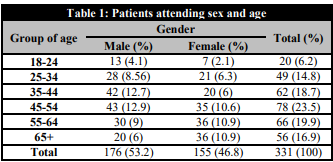
Table 1 shows that during the study period, the medical records of 331 patients were analyzed. Of these, 176 (53.2%) were male and 155 (46.8%) were female. The majority of patients were in the older age groups, with 78 (23.5%) in the 45-54 age group, followed by 66 (19.9%) in the 55-64 age group and 56 (16.9%) in the 65 and older age group.
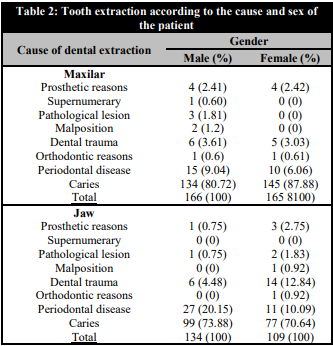
In Table 2, the indications for dental extractions are represented according to sex. In both sexes, the most frequent indication was dental caries, with 455 teeth (79.6%), affecting both maxillary and mandibular teeth. This was followed by periodontal disease, with 63 (11%) teeth, and dental trauma with 31 (5.4%) teeth. To a lesser extent, extractions were performed due to pathological lesions in 18 (3.1%) teeth, prosthetic reasons in 12 (2.1%) teeth, orthodontic reasons in 4 (0.7%) teeth, and one supernumerary tooth (0.1%).
Tooth extraction according to the cause and sex of the patient
Most patients did not have systemic diseases, 216 (65.2%). Hypertension was the most common systemic disease in both sexes, 53 (16.1%), with 29 female patients (8.9%) and 24 male patients (7.2%). This was followed by patients who reported a history of both diabetes mellitus and hypertension, with 31 cases (9.3%), 15 (4.5%) male patients and 16 (4.8%) female patients (Table 3).
Patients by sex and systemic diseases
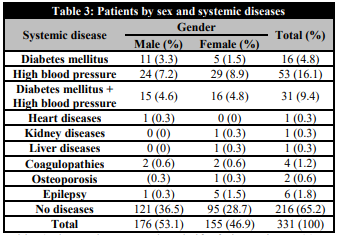
Table 4 shows that more than half of the patients, 207 (62.5%), had no toxic habits. Smoking was reported by 45 (13.6%) patients, 25 (7.5%) female and 20 (6.1%) male, while alcohol consumption was reported by 41 (12.4%) patients, 28 (8.5%) female and 13 (3.9%) male.
Patients by sex and toxic habits
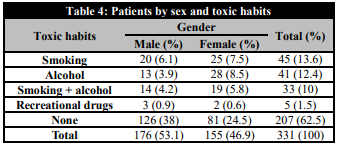
Table 5 shows that a total of 571 teeth were extracted, and in order of frequency, the upper first molar was the most extracted tooth, 57 (9.9%), followed by the upper lateral incisor, 55 (9.8%), and the upper first premolar, 49 (8.5%).
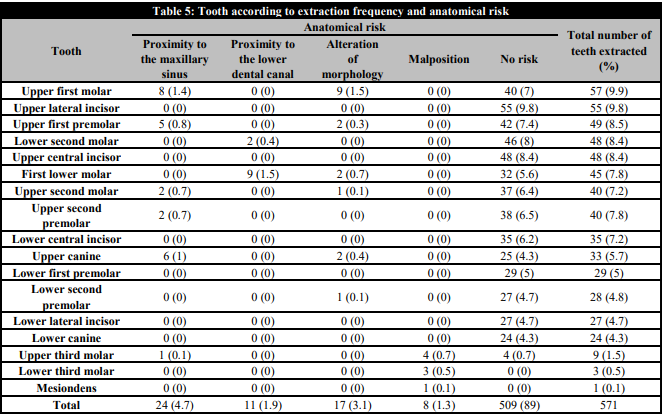
The analysis of the radiographic studies showed that most of the extracted teeth, 509 (89%), did not present any risks associated with anatomical structures or morphological alterations. The roots of 24 (4.7%) teeth were close to the maxillary sinus, 17 (3.1%) teeth had morphological alterations, and the roots of 11 (1.9%) teeth were close to the inferior dental canal.
The upper first molar was the tooth with the most morphological alterations, 9 (1.5%), and had the roots closest to the floor of the maxillary sinus, 8 (1.4%). The lower first molar was the tooth with roots closest to the inferior dental canal, 9 (1.5%). Only 8 (1.3%) teeth were mislocated in the dental arch.
DISCUSSION
Tooth extraction is a basic skill of dental professionals at the primary healthcare level, and therefore, one of the most important activities in the clinical practice of the dental program at USGP, which should be continuously monitored for improvement.
The analysis of medical records shows that there is no significant difference between the sexes of patients who visit USGP for tooth extractions. Of the 331 patients, 176 (53.2%) were male and 155 (46.8%) were female; it was also observed that as age increases, more extractions are performed, particularly in the 45-54 years age group, 78 (23.5%), and the 55-64 years age group, 66 (19.9%).
Tooth loss is considered one of the main indicators of oral health worldwide [2, 5] These results are related to the cumulative harmful effect of the most prevalent oral diseases, such as dental caries and periodontal diseases, which in this study were the primary indications for tooth extraction: dental caries (79.6%), followed by periodontal disease (11%).
The results of studies on the behavior of tooth extraction vary according to the social and economic characteristics of the context in which they were conducted [1, 5, 6] Dena [1] from Kuwait University reported that most of the patients who had dental extractions at the university clinic were male (54.7%), with an average age of 43.4 ± 11.4, although no marked difference between the sexes was observed. In another study, Ahmed et al. [6] in Pakistan reported that 57.1% of the patients treated for tooth extraction were female.
Some studies suggest a relationship between the cause of tooth loss and sex. In females, the primary cause would be dental caries, while in males, it would be periodontal disease. Additionally, various studies consider that male sex is a key risk factor for tooth extraction because, in general, men show less concern for oral health and have more toxic habits than women [1, 4, 5].
Research published in other countries shows that the highest rate of tooth mortality is due to dental caries and periodontal disease, but its incidence varies according to the sociodemographic characteristics of the studied population [4, 5].
Socioeconomic disparities can influence the epidemiology of tooth extractions. Populations with low socioeconomic levels face greater challenges in accessing regular dental care and receiving preventive and restorative treatments, leaving tooth extraction as the only treatment option. Meanwhile, populations with higher socioeconomic levels, although dental caries and periodontal disease remain indications for tooth extraction, frequently report other causes, such as orthodontic treatment, aesthetics, prosthetic rehabilitation, or failures in endodontic treatments [1, 7].
Suzuki et al. [7], in their article, the Second National Survey on the Reasons for Tooth Extraction in Japan, report that although dental caries remains the primary indication for tooth extraction in the population under 54 years old, it has decreased compared to the first survey conducted in 2005. They also indicate that periodontal disease is the main cause of tooth extraction in the population over 55 years old. They also point out that indications for extraction due to root fractures from endodontic treatments are higher in Japan than in other countries, attributing this to the characteristics of the healthcare system in that country and the accessibility of the population to oral healthcare. As a result, Japanese patients have a higher prevalence of teeth with endodontic treatment than in the rest of the world, including the United States and Europe.
The factors mentioned above indicate that the high number of teeth extracted due to dental caries or periodontal disease in patients visiting USGP is related to deficiencies in health promotion actions and the prevention of oral diseases, as well as access to restorative treatments.
Systemic diseases and toxic habits are transoperative and postoperative risk factors for patients who will undergo tooth extraction. A careful preoperative evaluation of each patient is a key factor in reducing the complications described in the scientific literatura [1, 5, 6]. In this study, most patients did not report systemic diseases or toxic habits.
Hypertension was reported by 53 (16.1%) patients. These results are consistent with the epidemiological behavior of hypertension in Ecuador, where 9.3% of the population between 18 and 59 years old is hypertensive, increasing its prevalence to 40% in those over 65 years old [9].
Hypertension is a surgical risk condition during and after tooth extraction due to the possibility of bleeding and myocardial alterations. Several studies show that elevated blood pressure is more associated with the pain and anxiety caused by the procedure than with the use of local anesthetics with vasoconstrictors [10, 11, 12]. Haydar et al. [11] in their study concluded that anxiety caused by tooth extraction is significantly related to heart rate and myocardial activity, influenced by various factors such as age, sex, previous pain experience, and the association with chronic diseases that affect the autonomic nervous system, such as diabetes mellitus.
In this regard, it is essential to correctly apply anxiety management protocols before, during, and after a tooth extraction, regardless of the personal and clinical history of each patient.
Diabetes mellitus associated with hypertension was reported in 31 (9.3%) patients. Diabetes mellitus is a chronic disease with high prevalence worldwide and in Ecuador, which has a bidirectional relationship with oral health, as it is associated with the development of periodontal disease, one of the main causes of tooth extraction in older ages. Additionally, diabetic patients are highly prone to postoperative complications after tooth extraction due to alterations in the healing of the remaining dental socket. [13].
The habit of smoking has a negative effect on oral health and is associated with a high risk of tooth loss due to its relationship with the etiology of periodontal disease and dental caries. Furthermore, chronic smoker patients have a higher risk of transoperative and postoperative complications during tooth extraction, such as the need for larger amounts of local anesthetics and the development of dry socket [2, 14].
Another aspect that should be considered in the preoperative period of tooth extraction is the tooth to be extracted. Through radiographic study, the morphology of the tooth, its position in the dental arch, and its relationship with important anatomical structures such as the maxillary sinus or inferior dental canal should be evaluated. Based on this evaluation, the degree of operative difficulty and the possible complications that may arise during the procedure or in the postoperative period can be established, with the goal of adequate surgical preparation and minimizing patient harm.
There is a relationship between the causes of tooth extraction, the extracted tooth, and the possibility of complications during the extraction procedure. In this study, the upper first molar was the most extracted tooth and the one that presented the greatest anatomical risk due to the proximity of its roots to the maxillary sinus and the alterations in its morphology. In this regard, it coincides with Ali [1] and Chraibi et al. [2], who consider that the upper first molar, due to its anatomy, presence of grooves and fissures on the occlusal surface, and being the first tooth of the permanent dentition to erupt, is the most vulnerable to the action of the etiological agents of dental caries, which was the main indication for tooth extraction in this study.
Furthermore, it coincides with Lehner et al. [15], in that the extraction of the upper first molar is one of the main causes of oroantral communication due to the anatomical relationship of its roots with the floor of the maxillary sinus. This should be considered an important surgical risk factor, indicating the need for adequate management to prevent harm to the patient, such as the development of odontogenic sinusitis.
This study had limitations in establishing the socioeconomic characteristics of the patients. Although, in practical terms, it is known that most patients have low income, the medical records do not include information about their origin, educational level, or occupation. These limitations highlight the need to improve the clinical history model and conduct research that includes a comprehensive evaluation of patients, with a biopsychosocial approach.
CONCLUSIONS
The results of this research indicate that the behavior of dental extractions at USGP aligns with findings reported by international studies. Dental caries was the primary cause of tooth extraction across all age groups. Hypertension and smoking were identified as some of the main systemic risk factors present in the patients. The most extracted tooth was the upper first molar, which presented the highest anatomical risk for extraction.
It is necessary to expand research in this field to properly contextualize surgical procedures, apply patient management protocols correctly, and optimize the teaching-learning process.
The obtained results also emphasize the need to improve health promotion actions and the prevention of oral diseases in the population served, aiming to reduce dental loss and improve the quality of life of individuals.
CONFLICT OF INTERESTS
The authors have no conflict of interest to declare. The authors declared that this study has received no financial support.
REFERENCES
1.Ali D. Reasons for Extraction of Permanent Teeth in a University Dental Clinic Setting. Clin Cosmet Investig Dent. 2021;13:51-7. doi: 10.2147/CCIDE.S294796.
2.Chraibi R, Baaddi H, Akerzoul N, Touré B. Reasons behind permanent tooth extraction at a dental university hospital in Morocco: a survey among patients of the International Faculty of Dental Medicine of Rabat. Pan Afr Med J. 2023;46:73. doi: 10.11604/pamj.2023.46.73.38768.
3.World Health Organization. Global oral health status report: towards universal health coverage for oral health by 2030: executive summary. Available from: https://www.who.int/publications/i/item/9789240061569 (accessed June 2024).
4.Chaple A, Pérez G, Williams T. Reasons of tooth mortality by continents in the last 20 years. Rev Cubana Estomatol. 2022;59(1): e4335.
5.Passarelli PC, Pagnoni S, Piccirillo GB, Desantis V, Benegiamo M, Liguori Aet al. Reasons for Tooth Extractions and Related Risk Factors in Adult Patients: A Cohort Study. Int J Environ Res Public Health. 2020;17(7):2575. doi: 10.3390/ijerph17072575.
6.Ahmed N, Lal A, Shakeel M, Cyrus D, Tuz Zehra F, Ayub A. Prevalence of Types, Frequency and Risk Factors. Pakistan J Med Dent. 2021;10(1): 44-8. doi: 10.36283/PJMD10-1/008.
7.Suzuki S, Sugihara N, Kamijo H, Morita M, Kawato T, Tsuneishi M, et al. Reasons for Tooth Extractions in Japan: The Second Nationwide Survey. Int Dent J. 2022;72(3):366-72. doi: 10.1016/j.identj.2021.05.008.
8.Ali K, Siddiqi KM, Qazi HS. Developing Competence in Tooth Extractions during Undergraduate Dental Education – A Qualitative Study. South-East Asian Journal of Medical Education. 2021;15(2):27-33. doi: 10.4038/seajme.v15i2.299.
9.Pico AL, Reyes EY, Anchundia DA, Moreno MdA. [Epidemiological behavior of arterial hypertension in Ecuador]. Recimundo. 2023;7(4):299-307. doi: 10.26820/recimundo/7.(4).oct.2023.299-307.
10.Alcudia R, Ríos M, Ramírez M. [Behavior of blood pressure and heart rate in the presence of local anesthetics]. Revista mexicana de medicina forense. 2022;7(2):1-21
11.Haydar M, Marwan S, Al-Nimer B. Patient's experience with pain influences the pain, anxiety and cardiovascular responses during extraction of tooth. Rev Latinoam Hipertens. 2021;16(1):77-82 doi: 10.5281/zenodo.5111001.
12.Qin Z, Zhou C, Zhu Y, Wang Y, Cao H, Li W, et al. Virtual Reality for Hypertension in Tooth Extraction: A Randomized Trial. J Dent Res. 2022;101(4):400-6. doi: 10.1177/00220345211049393.
13.Fathima T, Kumar MPS. Evaluation of quality of life following dental extraction. J Adv Pharm Technol Res. 2022;13(Suppl 1):S102-S107. doi: 10.4103/japtr.japtr_361_22.
14.Al-Noori NM, Ibraheem NS, Abdulmunem MM. The impact of cigarette smoking on the efficiency of local anesthesia during simple tooth extraction. Saudi Dent J. 2021;33(7):674-8. doi: 10.1016/j.sdentj.2020.04.011.
15.Lehner J, Gellée A, Levy-Bohbot A, Pomes B, Goudot P, Bertolus C. Cirugía de las comunicaciones buconasosinusales. J Dent Res. 2024;25 (1):1-14. doi: 10.1016/S1635-2505(24)49034-8.
Notas de autor
carlosadp41163@gmail.com
Información adicional
redalyc-journal-id: 6920
