Original article
Recepción: 08 Mayo 2025
Corregido: 14 Agosto 2025
Aprobación: 02 Septiembre 2025
DOI: https://doi.org/10.53986/ibjm.2025.0021
Abstract:
Introduction: Excessive video gaming is a problem between adolescent. COVID-19 increased this problem during the pandemic. This study aimed to assess how the COVID-19 pandemic influenced the gaming behaviors of adolescents who engaged in excessive video gaming.
Material and methods: Conducted between June and July 2021, this research constitutes the second phase of a pre-pandemic study involving adolescents aged 11–18 who had previously been identified as playing video games for more than two hours daily. In this phase, the same participants were re-evaluated during the pandemic to assess changes in their gaming habits and associated risk factors. Adolescents who played less than two hours per day served as the control group. Data collected included screen time, substance use, exercise and nutrition habits, and scores from the Internet Gaming Disorder Scale–Short Form (IGDS9-SF), Pittsburgh Sleep Quality Index (PSQI), and Children’s Depression Inventory (CDI).
Results: Among excessive video game players, both screen time (p < 0.001) and daily exercise duration (p = 0.001) increased significantly during the pandemic. There was also an increase in the popularity of online multiplayer and fantasy games. Although excessive players scored significantly higher than the control group on the PSQI and IGDS9-SF, no significant difference was observed in CDI scores (p = 0.091).
Conclusions: Despite the increase in screen time among excessive players, problematic gaming behaviors did not escalate. These participants had received at least one motivational interviewing session following their initial identification of problematic video gaming behavior in the first phase of the study. This intervention may have served as a protective factor against the potential negative effects of the pandemic on problematic gaming, depressive symptoms, sleep disturbances, and sedentary behavior.
Keywords: Adolescents, Gaming behaviors, Pandemic, Excessive video gaming.
Resumen:
Introducción: El uso excesivo de videojuegos es un problema entre los adolescentes. La COVID19 agravó este problema durante la pandemia. Este estudio tuvo como objetivo evaluar cómo la pandemia de COVID-19 influyó en el comportamiento de juego de los adolescentes que jugaban videojuegos en exceso.
Material y métodos: Realizada entre junio y julio de 2021, esta investigación constituye la segunda fase de un estudio prepandémico en adolescentes de 11 a 18 años que previamente habían sido identificados por jugar videojuegos durante más de dos horas diarias. En esta fase, los mismos participantes fueron reevaluados durante la pandemia para evaluar los cambios en sus hábitos de juego y los factores de riesgo asociados. Los adolescentes que jugaban menos de dos horas al día sirvieron como grupo de control. Los datos recopilados incluyeron el tiempo frente a la pantalla, el consumo de sustancias, los hábitos de ejercicio y nutrición, y las puntuaciones de la Escala de Trastorno por Juego en Internet - Versión Corta (IGDS9-SF), el Índice de Calidad del Sueño de Pittsburgh (PSQI) y el Inventario de Depresión Infantil (CDI).
Resultados: Entre los jugadores excesivos de videojuegos, tanto el tiempo frente a la pantalla (p < 0,001) como la duración diaria del ejercicio (p = 0,001) aumentaron significativamente durante la pandemia. También se observó un aumento en la popularidad de los juegos multijugador en línea y de fantasía. Si bien los jugadores excesivos obtuvieron puntuaciones significativamente más altas que el grupo control en el PSQI y el IGDS9-SF, no se observaron diferencias significativas en las puntuaciones del CDI (p = 0,091).
Conclusiones: A pesar del aumento del tiempo frente a la pantalla entre los jugadores excesivos, las conductas problemáticas de juego no se intensificaron. Estos participantes habían recibido al menos una sesión de entrevista motivacional tras la identificación inicial de conductas problemáticas de juego en la primera fase del estudio. Esta intervención podría haber servido como factor protector contra los posibles efectos negativos de la pandemia en la conducta problemática de juego, los síntomas depresivos, los trastornos del sueño y el sedentarismo.
Palabras clave: Adolescentes, Comportamientos de juego, Pandemia, Videojuegos excesivos.
INTRODUCTION
Problematic gaming behavior (PGB) refers to cognitive and behavioral symptoms such as excessive preoccupation with gaming, a progressive loss of control, and the development of tolerance and withdrawal symptoms, which result in significant impairment or distress [1]. While PGB can occur at any age, adolescents are particularly at risk due to the developmental characteristics of this life stage [2, 3]. Research has identified strong associations between PGB and various risk factors, including insomnia, depressive symptoms, loneliness, low self-esteem, increased substance use, and reduced academic performance [4].
During the pandemic, there has been a notable increase in video gaming and related psychosocial risks, particularly among adolescent and young adult males [5]. A study conducted in South Korea reported a rise in PGB prevalence from 1.2% to 4.9% during the pandemic [6]. Similarly, research involving children and adolescents in China revealed a significant increase in both time spent gaming and the severity of PGB during the pandemic [7]. This study also found that pre-pandemic depressive and anxiety symptoms were strong predictors of PGB severity during this period. In another study involving school-age children in China, time spent on social media increased, while time spent gaming remained unchanged [8].
In this study, our aim was to examine the effects of the COVID-19 pandemic on excessive video gaming behaviors and associated risk factors among adolescents who had previously been identified as playing video games for more than two hours per day. Based on this, we hypothesized the following:
Hypothesis 1: The COVID-19 pandemic has led to an increase in video gaming time among adolescents.
Hypothesis 2: In response to the need for socialization during the pandemic, adolescents have shown a preference for multiplayer video games over single-player alternatives.
Hypothesis 3: Adolescents who engage in excessive video gaming exhibit higher levels of depressive and anxiety symptoms, poorer sleep quality, reduced physical activity, and a greater likelihood of substance use compared to those who do not play video games.
MATERIAL AND METHODS
Study sample and study design
This study was conducted as the second phase of research involving 75 adolescents aged 11–18 who visited the Adolescent Medicine Clinic at Hacettepe University Children’s Hospital during the pre-pandemic period (April 2019 to January 2020) and were identified as playing video games for more than two hours daily. All adolescents and their families who participated in the initial phase were contacted by phone, and 55 agreed to participate in this follow-up study, conducted during the pandemic between June and July 2021. The "pre-pandemic" and "pandemic" data of this study group were analyzed and compared.
Additionally, a control group was formed consisting of 32 healthy adolescents who visited the Adolescent Medicine Clinic between June and July 2021 for routine health check-ups and reported a daily video gaming screen time of less than two hours. All adolescents were screened for video gaming behaviors and associated risk factors, including sleep quality, physical activity, cigarette smoking, alcohol use, excessive caffeine consumption, and the presence of depressive symptoms.
The pandemic-period data of the excessive video game players were compared both with their own pre-pandemic data and with the data of the control group. Assent was obtained from all adolescents, and informed consent was obtained from their parents.
The study protocol was approved by the Local Ethics Committee of Hacettepe University (GO 21/251).
General characteristics of sample
Demographic data included age, gender, school grade, self-reported year-end academic scores before and during the pandemic, and monthly family income. Socioeconomic status was determined based on monthly household income [9]. According to the Turkish Ministry of Health, individuals aged 5–17 should engage in at least 60 minutes of moderate-intensity physical activity daily, and perform vigorous physical activity at least three times per week [10]. Based on this, physical activity was classified as low (1–2 days/week), moderate (3–4 days/week), or high frequency (≥5 days/week) [11].
Data on cigarette use, number of cigarettes smoked per day, alcohol use and its frequency, use of substances other than tobacco and alcohol, names and frequency of use of such substances, and consumption of caffeine-containing products were recorded. Daily caffeine intake exceeding 100 mg was considered excessive [12].
Evaluation of video gaming behavior
Video gaming screen time was reported by both adolescents and their parents. They were asked how many days per week (never to every day) and how many hours per day the adolescent played video games. The higher value between the two reports was used. Average daily video gaming time was calculated by dividing total hours by the number of days played.
The titles of video games played were documented and categorized into four main genres: action, strategy, fantasy, and simulation. Sub-genres such as multiplayer online battle arena (MOBA), massively multiplayer online role-playing games (MMORPG), and battle royale were classified separately.
Problematic gaming behavior was assessed using the Internet Gaming Disorder Scale – Short Form (IGDS9-SF) [13, 14], a self-reported tool developed in accordance with DSM-5 criteria [15]. This unidimensional scale includes 9 items rated on a 5-point Likert scale, with total scores ranging from 9 to 45. Scores above 32 indicate the presence of internet gaming disorder (IGD). The Turkish version of the scale has demonstrated good reliability, with a Cronbach’s alpha coefficient of 0.82 and a Guttman split-half reliability coefficient of 0.75 [15].
Evaluation of sleep
Sleep quality and duration were assessed using the Pittsburgh Sleep Quality Index (PSQI). This self-reported questionnaire evaluates the previous month's sleep characteristics across seven components: subjective sleep quality, sleep latency, sleep duration, habitual sleep efficiency, sleep disturbances, use of sleep-inducing substances, and daytime dysfunction or sleepiness. Total scores range from 0–21, with scores ≥5 indicating poor sleep quality. The PSQI has demonstrated adequate internal consistency, test-retest reliability, and validity [16]. Agargün et al. conducted the Turkish validation, with a Cronbach’s alpha of 0.80 [17].
Evaluation of depressive symptoms
Depressive symptoms were assessed using the Children's Depression Inventory (CDI), a widely used tool for children aged 6–17 years [18]. The inventory consists of 27 items assessing affective, cognitive, and behavioral symptoms of depression. Respondents select one of three statements best describes their experience over the past two weeks. Each item is scored from 0 to 2, for a total score ranging from 0 to 54, with higher scores indicating greater severity. Oy, who established a cut-off score of 19 for depressive disorder [19], conducted the Turkish validity and reliability study.
Motivational interview data
Retrospective data regarding the number of motivational interviews conducted were collected. All interviews were performed by the same experienced adolescent medicine specialist. Core principles and techniques of motivational interviewing were applied throughout.
The number of sessions was determined based on the adolescent’s stage of change and progress. Each session lasted 45–60 minutes and was conducted separately with the adolescent, with the parents, and then jointly. Sessions addressed screen time education and limitation, nutrition education and motivation for healthy eating, mealtime structuring, sleep hygiene and regulation, physical activity motivation, and restructuring of daily routines to include academic work, hobbies, recreational activities, and family time [10].
Statistical analysis
All data were analyzed using IBM SPSS version 22 (SPSS Inc., Chicago, IL, USA). Descriptive statistics were calculated, with numerical variables presented as mean ± standard deviation and categorical variables as frequencies and percentages. The normality of continuous variables was assessed using the Kolmogorov-Smirnov test.
To eliminate the potential influence of age-related developmental factors, correlations between age and other numerical variables were analyzed using Pearson correlation coefficients. CDI (r = 0.006, p = 0.969), IGDS9-SF (r = 0.142, p = 0.302), and PSQI (r = -0.159, p = 0.257) scores were not significantly correlated with age.
Changes in CDI, PSQI, and IGDS9-SF scores were assessed using the paired sample t-test for normally distributed data and the Wilcoxon signed-rank test for non-parametric data. A one-way ANCOVA was used to compare CDI, PSQI, and IGDS9-SF scores between excessive video game players and the control group, controlling for gender. The independent sample t-test was used for normally distributed data, while the Mann-Whitney U test was applied when normality assumptions were not met. Categorical variables were analyzed using the chi-square test or McNemar test, as appropriate.
Ethics approval
The study was approved by the Local Ethics Committee of Hacettepe University (GO 21/251).
RESULTS
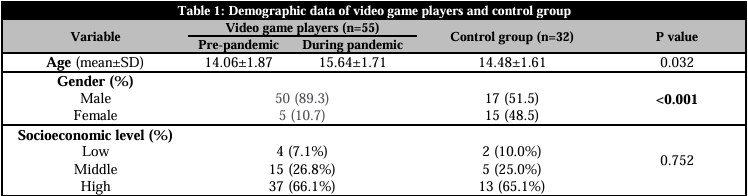
The mean age of the video game players (n = 55) was 14.06 ± 1.87 years before the pandemic and 15.64 ± 1.71 years during the pandemic. The mean age of the control group (n = 32) was 14.48 ± 1.61 years. The proportion of male participants was higher in the video game group. Demographic characteristics of the video game players and the control group are presented in Table 1.
Demographic data of video game players and control group
When comparing the pre-pandemic and pandemic data of the video game players, no significant changes were observed in PSQI and IGDS9-SF scores. There was a slight increase in depressive symptoms, which approached statistical significance (p = 0.058). According to parent reports, recreational screen time unrelated to video games significantly increased during the pandemic (p = 0.002).
Based on adolescents’ self-reports, both video game playing time (p = 0.037) and other types of screen time (p < 0.001) increased during the pandemic. A significant increase was also observed in the number of adolescents engaging in regular physical activity during the pandemic (p = 0.001). Pre- and during-pandemic comparisons are summarized in Table 2.
Evaluations of video game players before and during the pandemic (n=55)
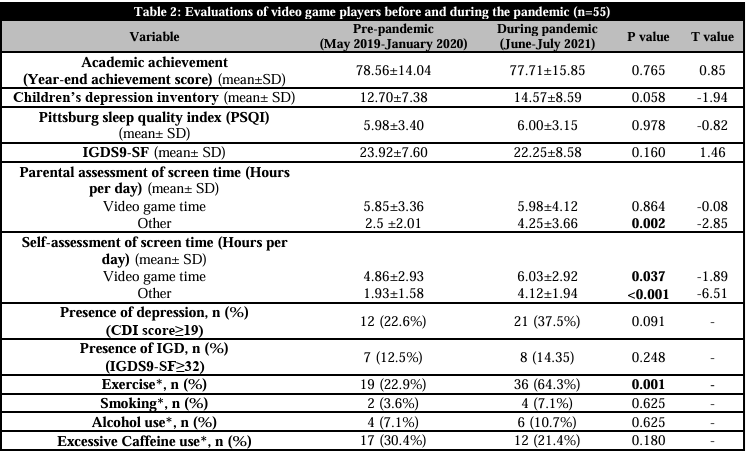
*: present; CDI: Children's Depression Inventory; IGD: Internet Gaming Disorder; IGDS9-SF: Internet Gaming Disorder ScaleShort Form; PSQI: Pittsburgh Sleep Quality Index
Motivational interviews were conducted once for 32 adolescents (58.18%), twice in 14 (25.45%), three times in 3 (5.45%), four times in 4 (7.27%), and five times in 2 (3.63%) adolescents (median: 1, IQR: 1–2).
When compared to the control group and adjusting for gender, adolescents with excessive video gaming had significantly higher CDI [F(1,85) = 16.195, p < 0.001], PSQI [F(1,85) = 13.393, p < 0.001], and IGDS9-SF [F(1,85) = 8.948, p = 0.004] scores. Recreational screen time unrelated to video games did not differ significantly between the two groups (p > 0.05). The comparison of the video game players and the control group is presented in Table 3.
Comparison of parameters between video game players and control group during the pandemic
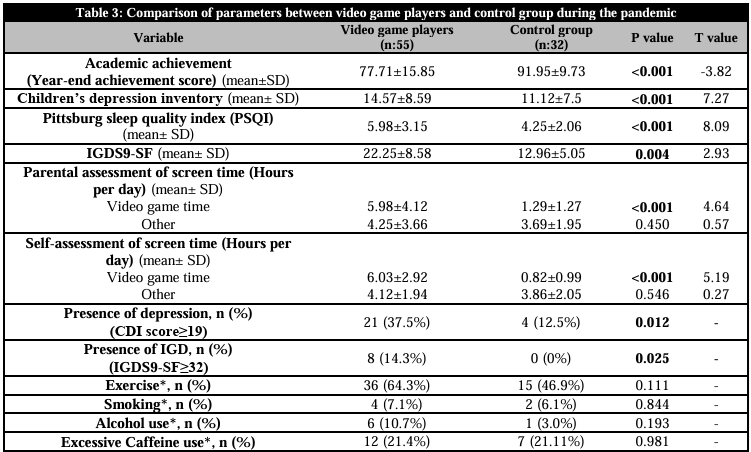
*: present; CDI: Children's Depression Inventory; IGD: Internet Gaming Disorder; IGDS9-SF: Internet Gaming Disorder ScaleShort Form; PSQI: Pittsburgh Sleep Quality Index
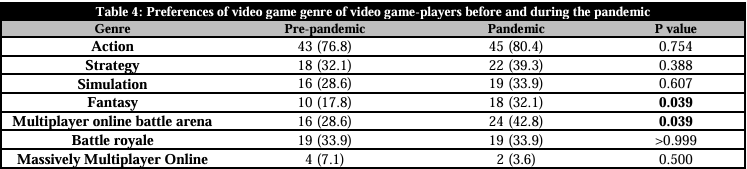
When evaluating video game genre preferences before and during the pandemic, an increase in multiplayer and fantasy games was observed. Pre- and during-pandemic video game genre distributions are shown in Table 4.
Preferences of video game genre of video game-players before and during the pandemic
DISCUSSION
Our findings revealed that self-reported video game time and other recreational screen time significantly increased among excessive players during the pandemic. In the control group, non-video game recreational screen time was comparable to that of the video game players, indicating excessive screen exposure in both groups. However, among video game players, problematic gaming behavior (PGB), depressive symptoms, school performance, sleep quality, and the use of cigarettes, alcohol, or excessive caffeine did not significantly worsen during this period. Nevertheless, when compared to the control group, video game players exhibited lower academic performance, poorer sleep quality, higher PGB scores, and more pronounced depressive symptoms. Interestingly, a notable increase in physical activity was observed among video game players during the pandemic.
The pandemic had a profound physical and psychosocial impact on adolescents [20]. Excessive video game players may have been more susceptible to these effects due to the presence of associated risk factors. Previous studies have demonstrated increases in video game use and PGB among adolescents during the pandemic [21, 22]. Similarly, depressive disorders have become more prevalent, often linked to reduced life satisfaction as a result of lifestyle restrictions, fear of infection, heightened anxiety, increased negative life events, school closures, and social isolation [23]. Adolescents who spend more time online are particularly vulnerable to depression, especially those experiencing PGB [24, 25, 26]. Furthermore, the pandemic has contributed to sleep disturbances and academic decline, two domains where individuals with PGB were already at elevated risk [27]. While substance use is another risky behavior associated with PGB, some studies reported a decrease in its prevalence during the pandemic due to restrictions on access and social interaction [28].
In our study, no significant changes were observed in PGB, depressive symptoms, sleep problems, alcohol use, smoking habits, or academic performance among excessive video game players during the pandemic. This finding may suggest that the motivational interventions implemented in our clinic provided a protective effect against the disruptive consequences of the pandemic, although they were not sufficient to produce significant improvements. Motivational interviewing (MI) has demonstrated effectiveness as a standalone or adjunct intervention for behavioral addictions, lifestyle modification, and treatment adherence [29]. A recent study also highlighted the significant efficacy of MI in reducing symptoms of PGB, depression, and anxiety [30]. However, limited data exist regarding the impact of the pandemic on PGB symptoms in individuals who have undergone such interventions.
Another possible protective factor may have been increased parental monitoring and enhanced parent–adolescent interaction during quarantine [31]. Motivational interviewing may have increased parents’ awareness of strategies for monitoring and managing risky behaviors. On the other hand, the limited overall effectiveness of the intervention may be attributed to the variable number of MI sessions conducted with each participant.
Beyond the potential protective role of motivational interviewing, some studies suggest that the pandemic positively affected mental health and sleep quality in certain adolescents. Adolescents who interpreted the pandemic positively, appreciated home quarantine, or benefited from additional personal time may have been more resilient to depression, anxiety, and stress. It is also worth noting that the pandemic’s impact on sleep quality was not uniform [32]. One study reported that one in four individuals with pre-pandemic clinical insomnia experienced significant improvements in sleep, with 86.9% reporting better sleep quality during the pandemic. These improvements were limited to adolescents and did not extend to young adults [32].
The literature highlights a bidirectional relationship between problematic internet use, sleep disturbances, depression, and physical inactivity. Night-time gaming has been shown to negatively affect sleep onset, duration, and efficiency. Conversely, sleep problems are also known to exacerbate PGB [33]. These findings underscore the need to address both physical and mental health behaviors in adolescents with excessive gaming. Encouraging physical activity has also been demonstrated to be protective against PGB [34].
In our study, we observed a significant increase in physical activity among excessive video game players during the pandemic. While motivational interviewing appears to have contributed to this outcome, other factors may have played a role. It is possible that adolescents found more time for exercise during school closures. Although many studies have shown that social restrictions during the COVID-19 pandemic reduced physical activity and increased sedentary behavior [34], one study reported that while 50% of adolescents reduced their physical activity, 20% actually became more active. That study noted that adolescents who became less active were generally overweight and did not have regular exercise habits, while those who increased their activity cited having more free time due to quarantine and school closures as a contributing factor [35].
Additionally, our findings indicated that MOBA and fantasy game genres became more popular during the pandemic. Game companies reported a threefold increase in online video game participation during this period [36]. The most commonly preferred game genres were first-person shooters (35%), sports games (26%), and simulation games (7%) [37]. From a developmental perspective, adolescents naturally shift their focus from family to peers, aiming to build independent social relationships and establish roles within peer groups [38]. This developmental drive may explain why social isolation led many adolescents to choose game genres that facilitate social interaction. Online communication platforms embedded in multiplayer online (MMO) and role-playing games may have helped adolescents feel more socially connected during the pandemic [39].
CONCLUSIONS
Despite the increase in video game use and other forms of recreational screen time, we did not observe a significant rise in problematic gaming behavior (PGB), depressive symptoms, sleep disturbances, alcohol consumption, or smoking behaviors during the pandemic. However, adolescents who engage in video gaming demonstrated lower academic performance, poorer sleep quality, and more pronounced depressive symptoms compared to the control group. These findings highlight the importance of providing psychosocial support to adolescents at risk of PGB. Early intervention during adolescence is critical, as untreated depression and anxiety frequently persist into adulthood without appropriate psychological support. We believe that this study underscores the importance of closely monitoring adolescents with PGB, especially during high-risk periods such as a pandemic.
CONFLICT OF INTERESTS
The authors have no conflict of interest to declare. The authors declared that this study has received no financial support.
REFERENCES
1.Villanueva-Blasco VJ, Eslava D, Ibor Bernalte E, Isorna Folgar M, Rial-Boubeta A. School prevention programs for problematic Internet use, problematic gambling and video game addiction in Spain: A systematic review. Adicciones. 2025;37(2):155-72. doi: 10.20882/adicciones.2045.
2.Pluhar E, Kavanaugh JR, Levinson JA, Rich M. Problematic interactive media use in teens: comorbidities, assessment, and treatment. Psychol Res Behav Manag. 2019;12:447-55. doi: 10.2147/PRBM.S208968.
3.Hu Y, Chen S, Qi D, Zhu S. Problematic Gaming and Self-Control Among Adolescents and Emerging Adults: A Systematic Review and Meta-Analysis. Cyberpsychol Behav Soc Netw. 2025;28(5):301-17. doi: 10.1089/cyber.2024.0537.
4.Gentile DA, Bailey K, Bavelier D, Brockmyer JF, Cash H, Coyne SM, et al. Internet Gaming Disorder in Children and Adolescents. Pediatrics. 2017;140(Suppl 2):S81-S85. doi: 10.1542/peds.2016-1758H.
5.King DL, Delfabbro PH, Billieux J, Potenza MN. Problematic online gaming and the COVID-19 pandemic. J Behav Addict. 2020;9(2):184-6. doi: 10.1556/2006.2020.00016.
6.Kim D, Lee J. Addictive Internet Gaming Usage among Korean Adolescents before and after the Outbreak of the COVID-19 Pandemic: A Comparison of the Latent Profiles in 2018 and 2020. Int J Environ Res Public Health. 2021;18(14):7275. doi: 10.3390/ijerph18147275.
7.Teng Z, Pontes HM, Nie Q, Griffiths MD, Guo C. Depression and anxiety symptoms associated with internet gaming disorder before and during the COVID-19 pandemic: A longitudinal study. J Behav Addict. 2021;10(1):169-80. doi: 10.1556/2006.2021.00016.
8.Chen IH, Chen CY, Pakpour AH, Griffiths MD, Lin CY, Li XD, et al. Problematic internet-related behaviors mediate the associations between levels of internet engagement and distress among schoolchildren during COVID-19 lockdown: A longitudinal structural equation modeling study. J Behav Addict. 2021;10(1):135-48. doi: 10.1556/2006.2021.00006.
9.Dinçer B, Kolan HI. Relationship Between Computer Game Addictions Level and Responsibility Behaviour of Secondary School Students. Kastamonu Education Journal. 2020;28;2319-30. doi: 10.24106/kefdergi.833550.
10.Demirel H, Kayıhan H, Ozmert EN, Dogan A. Turkey Physical Activity Guide, Physical Activity in Children and Adolescents. 2nd ed. Ankara: TR Ministry of Health; 2014.
11.Alghadir AH, Iqbal ZA, A Gabr S. The Relationships of Watching Television, Computer Use, Physical Activity, and Food Preferences to Body Mass Index: Gender and Nativity Differences among Adolescents in Saudi Arabia. Int J Environ Res Public Health. 2021;18(18):9915. doi: 10.3390/ijerph18189915.
12.Temple JL. Review: Trends, Safety, and Recommendations for Caffeine Use in Children and Adolescents. J Am Acad Child Adolesc Psychiatry. 2019;58(1):36-45. doi: 10.1016/j.jaac.2018.06.030.
13.Tudor-Locke C, Johnson WD, Katzmarzyk PT. Accelerometer-determined steps per day in US children and youth. Med Sci Sports Exerc. 2010;42(12):2244-50. doi: 10.1249/MSS.0b013e3181e32d7f.
14.Lemmens JS, Valkenburg PM, Gentile DA. The Internet Gaming Disorder Scale. Psychol Assess. 2015;27(2):567-82. doi: 10.1037/pas0000062.
15.Arıcak OT, Dinç M, Yay M, Griffiths MD. Adaptation of the Internet Gaming Disorder Scale Short Form (İOOBÖ9-SF) into Turkish: A validity and reliability study. Addicta: The Turkish Journal on Addictions. 2019;6:1-22. doi: 10.15805/addicta.2018.5.4.0027.
16.Buysse DJ, Reynolds CF 3rd, Monk TH, Berman SR, Kupfer DJ. The Pittsburgh Sleep Quality Index: a new instrument for psychiatric practice and research. Psychiatry Res. 1989;28(2):193-213. doi: 10.1016/0165-1781(89)90047-4.
17.Agargun M, Kara H, Anlar O. The reliability and validity of the Pittsburgh Sleep Quality Index. Turkish Journal of Psychiatry. 1996;7:107-15.
18.Kovacs M. The Children's Depression, Inventory (CDI). Psychopharmacol Bull. 1985;21(4):995-8.
19.Oy B. Depression scale for children: A study of validity and reliability. Turkish Journal of Psychiatry. 1991;2:132-6.
20.Solmi M, Estradé A, Thompson T, Agorastos A, Radua J, Cortese S, et al. Physical and mental health impact of COVID-19 on children, adolescents, and their families: The Collaborative Outcomes study on Health and Functioning during Infection Times - Children and Adolescents (COH-FIT-C&A). J Affect Disord. 2022;299:367-76. doi: 10.1016/j.jad.2021.09.090.
21.Haug E, Mæland S, Lehmann S, Bjørknes R, Fadnes LT, Sandal GM, et al. Increased Gaming During COVID-19 Predicts Physical Inactivity Among Youth in Norway-A Two-Wave Longitudinal Cohort Study. Front Public Health. 2022;10:812932. doi: 10.3389/fpubh.2022.812932.
22.Masaeli N, Farhadi H. Prevalence of Internet-based addictive behaviors during COVID-19 pandemic: a systematic review. J Addict Dis. 2021;39(4):468-88. doi: 10.1080/10550887.2021.1895962.
23.Männikkö N, Ruotsalainen H, Miettunen J, Pontes HM, Kääriäinen M. Problematic gaming behaviour and health-related outcomes: A systematic review and meta-analysis. J Health Psychol. 2020;25(1):67-81. doi: 10.1177/1359105317740414.
24.Morgan C, Cotten SR. The relationship between internet activities and depressive symptoms in a sample of college freshmen. Cyberpsychol Behav. 2003;6(2):133-42. doi: 10.1089/109493103321640329.
25.Coutelle R, Balzer J, Rolling J, Lalanne L. Problematic gaming, psychiatric comorbidities, and adolescence: A systematic review of the literature. Addict Behav. 2024;157:108091. doi: 10.1016/j.addbeh.2024.108091.
26.Nagata JM, Lee CM, Hur JO, Baker FC. What we know about screen time and social media in early adolescence: a review of findings from the Adolescent Brain Cognitive Development Study. Curr Opin Pediatr. 2025;37(4):357-64. doi: 10.1097/MOP.0000000000001462.
27.Jahrami HA, Alhaj OA, Humood AM, Alenezi AF, Fekih-Romdhane F, AlRasheed MM, et al. Sleep disturbances during the COVID-19 pandemic: A systematic review, meta-analysis, and meta-regression. Sleep Med Rev. 2022;62:101591. doi: 10.1016/j.smrv.2022.101591.
28.Pelham WE 3rd, Tapert SF, Gonzalez MR, McCabe CJ, Lisdahl KM, Alzueta E, et al. Early Adolescent Substance Use Before and During the COVID-19 Pandemic: A Longitudinal Survey in the ABCD Study Cohort. J Adolesc Health. 2021;69(3):390-7. doi: 10.1016/j.jadohealth.2021.06.015.
29.Chebli JL, Blaszczynski A, Gainsbury SM. Internet-Based Interventions for Addictive Behaviours: A Systematic Review. J Gambl Stud. 2016;32(4):1279-304. doi: 10.1007/s10899-016-9599-5.
30.Dieris-Hirche J, Bottel L, Pape M, Te Wildt BT, Wölfling K, Henningsen P, et al. Effects of an online-based motivational intervention to reduce problematic internet use and promote treatment motivation in internet gaming disorder and internet use disorder (OMPRIS): study protocol for a randomised controlled trial. BMJ Open. 2021;11(8):e045840. doi: 10.1136/bmjopen-2020-045840.
31.Kim D, Lee J. Addictive Internet Gaming Usage among Korean Adolescents before and after the Outbreak of the COVID-19 Pandemic: A Comparison of the Latent Profiles in 2018 and 2020. Int J Environ Res Public Health. 2021;18(14):7275. doi: 10.3390/ijerph18147275.
32.Kocevska D, Blanken TF, Van Someren EJW, Rösler L. Sleep quality during the COVID-19 pandemic: not one size fits all. Sleep Med. 2020;76:86-8. doi: 10.1016/j.sleep.2020.09.029.
33.Chen YL, Gau SS. Sleep problems and internet addiction among children and adolescents: a longitudinal study. J Sleep Res. 2016;25(4):458-65. doi: 10.1111/jsr.12388.
34.Bates LC, Zieff G, Stanford K, Moore JB, Kerr ZY, Hanson ED, et al. COVID-19 Impact on Behaviors across the 24-Hour Day in Children and Adolescents: Physical Activity, Sedentary Behavior, and Sleep. Children (Basel). 2020;7(9):138. doi: 10.3390/children7090138.
35.Ng K, Cooper J, McHale F, Clifford J, Woods C. Barriers and facilitators to changes in adolescent physical activity during COVID-19. BMJ Open Sport Exerc Med. 2020;6(1):e000919. doi: 10.1136/bmjsem-2020-000919.
36.Thorne HT, Smith JJ, Morgan PJ, Babic MJ, Lubans DR. Video game genre preference, physical activity and screen-time in adolescent boys from low-income communities. J Adolesc. 2014;37(8):1345-52. doi: 10.1016/j.adolescence.2014.09.012.
37.Donati MA, Guido CA, De Meo G, Spalice A, Sanson F, Beccari C, et al. Gaming among Children and Adolescents during the COVID-19 Lockdown: The Role of Parents in Time Spent on Video Games and Gaming Disorder Symptoms. Int J Environ Res Public Health. 2021;18(12):6642. doi: 10.3390/ijerph18126642.
38.Kanbur N, Akgül S. Quaranteenagers: A Single Country Pandemic Curfew Targeting Adolescents in Turkey. J Adolesc Health. 2020;67(2):296-7. doi: 10.1016/j.jadohealth.2020.05.007.
39.Chen F, Zheng D, Liu J, Gong Y, Guan Z, Lou D. Depression and anxiety among adolescents during COVID-19: A cross-sectional study. Brain Behav Immun. 2020;88:36-8. doi: 10.1016/j.bbi.2020.05.061.
Notas de autor
dr.ziraatci@hotmail.com
Información adicional
redalyc-journal-id: 6920
