2021
121
25072020
28012021
 Andrey Mikhailitchenko mikhaili@csus.edu
California State University, USA, Estados Unidos de América
Abstract: The internationalization processes of small and medium-sized enterprises (SMEs) differ across economic and cultural environments. Creating an operationalizable and predictive framework to explain them has long been a challenging research task. This task is particularly relevant in an era of reconfiguration of globalization, which directly affects the small business sector. This study proposes a model which includes networking, attitudinal, cultural, and environmental factors as antecedents of the degree of SME internationalization. We collected data and tested this model in three distinct cul- tural environments: the USA, China, and Russia. The results suggest that attitudinal characteristics of managers, such as global mindset and relationship commitment, condition SMEs network involvement. The influence of network involvement on the degree of SMEs internationalization becomes stronger with increasing environmental turbulence. This study’s findings have practical implications for businesses operating in different countries, as well as governmental organizations and educational institutions.
Keywords: small and medium enterprises, internationalization, networking, USA, China, Russia.
Articles
Antecedents and Outcomes of Network Involvement in the Internationalization Process: A Case of SMEs from the USA, China, and Russia
Andrey Mikhailitchenko mikhaili@csus.edu

Recepción: 25 Julio 2020
Aprobación: 28 Enero 2021
In the last few decades, the internationalization of small and medium-sized enterpris- es (SMEs) has been a hot topic among scholars (Coviello & Munro, 1995; Etemad & Wright, 2003; Matlay et al., 2006). The main reason for this interest is the role that SMEs play in the world economy, contributing up to 60% of the workforce and 40% of GDP (Bell, 2015), and the multiplicity of the pathways and antecedents of their inter- nationalization. The current tectonic changes in the world economy will likely attract further interest in the internationalization of SMEs on the part of both scholars and practitioners.
Major research questions regarding SME internationalization in the following years will likely be focused on the degree to which globalization reconfiguration will affect the small business sector. Some researchers point to the beginning of a virtual revolu- tion that will lead to comprehensive de-globalization (Sułkowski, 2020) or a new dis- ruptive paradigm in globalization (Díaz et al., 2020). Others argue that new patterns of world trade will be introduced, which will make some businesses, industries, and economies winners and some losers (Barua, 2020).
In the current environment, a host of research questions are particularly relevant. Will the effect of the global crisis on SME internationalization be critical and long-term or relatively easy to overcome and short-term? Will it hamper the efforts of millions of SMEs to enter the global market or just modify the pathways of these efforts? Will SMEs become a factor further eroding the fabric of the world economy or, on the con- trary, reinforce it by creating new non-traditional internationalization links? Finally, af- ter the recession, will the small and medium-sized business sector move forward or fall behind other sectors in reinstating international business networks?
These questions and the necessity to provide answers have aroused a renewed re- search interest in the mechanisms of SME internationalization to explore the forces that drive this process, other than current market opportunities and immediate profit con- siderations (Alayo et al., 2019; Nummela et al., 2020; Supardi, 2020). These questions can be approached from various theoretical perspectives, one of which is a networking approach that attempts to establish the causality between the internal (domestic) and external (global) networks of which an enterprise can be a part (Galkina & Chetty, 2015; Hånell et al., 2018).
Considering the importance of the research topics mentioned above, this study fo- cused on the networking mechanisms of SME internationalization and their anteced- ents in managerial practices. We aimed to contribute to creating a testable and quan- tifiable framework to explain networking in the context of SME internationalization, thus continuing the stream of research examining whether and how networks matter in enterprises’ internationalization (Musteen et al., 2014; Sedziniauskiene et al., 2019; Senik et al., 2011). We used survey data collected in multiple stages from textile SMEs in three countries radically different economically and culturally: the USA, China, and Russia. This study also focused on a comparison between a developed (USA) and two emerging (China and Russia) economies
The most prominent developments in firms’ internationalization research, as summa- rized by Malhotra et al. (2003), Knight and Liesch (2016), and Dabić et al. (2020), include the theory of stages ( Johanson & Vahlne, 1990, 2009), international product life cycle theory (Toyne & Walters, 1993; Vernon, 1966), strategic behavior theory (Casson, 1987; Jain et al., 2015), transaction cost theory (Contractor, 2007; William- son, 1975), resource advantage theory (Hunt, 2002), the born global view (Cavusgil & Knight, 2015), the overarching eclectic approach (Dunning, 1995, 2000), and the network approach (Achrol & Kotler, 1999; Jones et al., 2011). This study adopted the network approach.
The networking aspect of SME internationalization has been explored by several scholars (Achrol & Kotler, 1999; Galkina & Chetty, 2015; Slotte-Kock & Coviello, 2010). In a broad sense, a networking component is embedded in various theoreti- cal approaches, especially stage-based, such as the Uppsala model (Chen et al., 2019; Galkina & Chetty, 2015).
The networking approach has its roots in social exchange theory, which views firms as parts of multiple internal (interpersonal) and external (interorganizational) networks (Chetty & Patterson, 2002). The basic conceptual component of the network model is firms’ dependency upon resources possessed or controlled by other firms (Borgatti & Foster, 2003). The only way to gain access to these resources is to establish relationships with customers, suppliers, families, and friends within the network (Collinson & Houl- den, 2005; Mort & Weerawardena, 2006).
The main benefit of networks in the process of internationalization is that they pro- vide firms with market knowledge and help them identify new opportunities (Åkerman, 2015; Coviello & Munro, 1995; Tiwari & Korneliussen, 2018). Previous studies have established the relationship between a firm’s networking and the marketing strategy that it pursues (Goldenberg et al., 2009; Stremersch et al., 2007). In the case of SMEs, these activities often lead to a reduced perception of the related risks and a stronger predisposition to commit resources to internationalization (Chetty & Patterson, 2002; Coviello & Munro, 1995). Networking relationships help small firms accelerate the internationalization process and gain the knowledge necessary for risk minimization (Holm et al., 1996).
Overall, the usefulness and applicability of the network approach to explaining the internationalization process of SMEs is well documented. However, it is not without limitations. A major limitation of the networking perspective noted by some studies is its explanatory rather than predictive nature (Malhotra et al., 2003). Nevertheless, it is one of the most dynamically developing schools of thought in internationalization research, especially related to the small business sector (Mort & Weerawardena, 2006). One of the most attractive elements of the network approach is that it can explain the non-rational and non-economic motives of small business owners and managers in volved in the internationalization process (Chetty & Holm, 2000; Kalinic et al., 2014). However, Zahoor et al. (2020) identified gaps in internationalization research based on the networking perspective, noting that “we know little about how the quality and intensity of networks, as well as entrepreneurs’ personality characteristics, can influ- ence the effectual and causal approach to network building for internationalization” (p. 447). This study aimed to fill this gap.
The theoretical framework upon which the hypothesized effects are based is social capital theory. Nahapiet and Ghoshal (1998) conceptualize social capital as resources that become available through networking. One of the key components of social cap- ital is relational embeddedness characterized by trust (Musteen et al., 2014). Another core element is information benefit. A diversity of network links facilitates access to information (McKeever et al., 2014). Within this framework, we consider two basic variables that underlie these two core components of social capital. One is relationship commitment, which reflects the relational dimension of social capital acquired through network interactions (Rhinesmith, 1992), and the other is global mindset, which re- flects the informational dimension (Nummela et al., 2003). The research model with the hypothesized relationships between the exogenous and endogenous variables is shown in Figure 1.
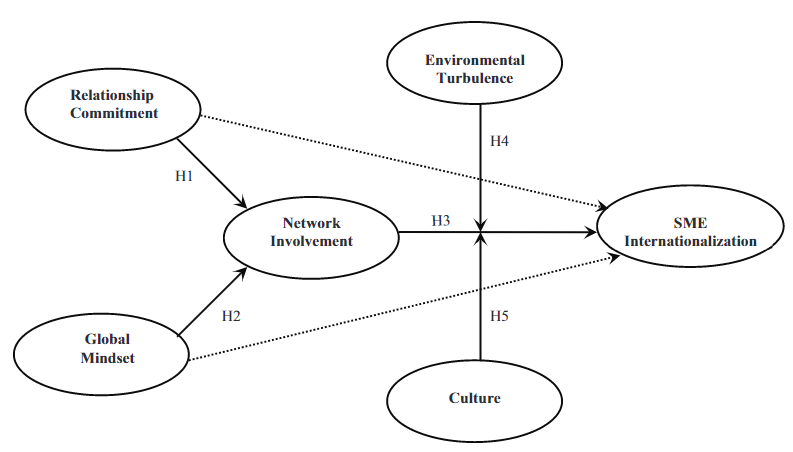
Relationship commitment and global mindset are attitudinal variables and are de- rivatives of the personality traits of a business owner or manager. The choice of attitudi- nal constructs is consistent with the interactionist approach built on the tenets of social capital theory (Burt, 1997). This approach links personality characteristics to network dimensions such as size, functions, social role, and informational capabilities (Ander- son et al., 2007). Global mindset is a person’s predisposition to openness to the out- side world conditions network diversity (i.e., network width) (Gustafsson et al., 2005), while relationship commitment contributes to the quality and functional role of the ties involved in it (i.e., network depth) (Ehret, 2004).
Morgan and Hunt (1994) conceptualize relationship commitment as an understand- ing of the key importance of the relationship with an exchange partner and the related willingness to expend maximum effort on it. Ritter et al. (2004) distinguish between different relationship levels and posit that the network structure is conditioned by the strength and depth of these relationships. Mechanisms of distribution and balance of resources involved in a network are directly affected by relationship commitment. Galimberti and Wazlawick (2016) researched the influence of relationship clusters on software SMEs’ networking and internationalization processes. Studies on the banking (Kassim & Abdulla, 2006) and manufacturing sectors (Braziotis & Tannock, 2011) have documented the empirical link between relationship commitment and network- ing. Thus, we propose the following hypothesis:
H1: An SME’s relationship commitment positively influences the degree of its network in- volvement.
Kedia and Mukherji (1999) conceptualize global mindset as a sum of strategic and cul- tural factors on the individual and organization levels. It influences the size of a firm’s network (Stam & Elfring, 2006), its limits and boundaries (Kyvik, 2011), and the ties needed to enter the global market (Oviatt & McDougall, 2005). Felício et al. (2016) documented the relationship between individual and corporate global mindsets and SMEs’ internationalization process. Thus, our next hypothesis is as follows:
H2: An SME’s global mindset positively influences the degree of its network involvement.
Network interactions create the conditions for leveraging resources through collabora- tions with external agents and provide a stimulus to search for new partners (del Car- men & Holgado, 2019; Maurer et al., 2011). The acquisition of social capital is accom- panied by mimicking the networking patterns of other network participants (Aarstad et al., 2010). In the case of successful internationalization, this mimicry plays the role of an additional “pull” factor for network members to go global. This occurs when the network as a whole aims to enter new markets (e.g., a group of Taiwanese textile enter- prises starting to export to China), and the networking collaboration mechanisms en- hance the new market entry process for any given network member (Tellis et al., 2009). Even in the case of domestic networking relationships, smaller firms often form indirect links with a wider network of globally connected firms (Tiwari et al., 2016). Thus, we formulate the following hypothesis:
H3A: An SME’s internationalization is positively influenced by its degree of network in- volvement.
Previous studies have provided evidence in favor of the link between attitudinal charac- teristics of an SME’s owner/manager and a firm’s degree of internationalization (DOI) (Hutchinson et al., 2007; Kuemmerle, 2005). Based on this link, we argue that a firm’s network involvement mediates the relationship commitment–DOI and global mind- set–DOI relationships and suggest a model of mediating effects. A variable has a medi- ator function if it is both the result of the determinant factors and the antecedent of the result (Baron & Kenny, 1986). Thus, we propose two hypotheses particularly related to the network’s mediator effect:
H3B: Network involvement acts as a mediator between relationship commitment and SME internationalization.
H3C: Network involvement acts as a mediator between global mindset and SME interna- tionalization
Environmental conditions affect the collective and interorganizational actions of firms, especially SMEs (Ambroise et al., 2018; Rialp-Criado & Komochkova, 2017). Networking behavior is particularly prevalent in turbulent conditions (Coviello & McAuley, 1999). The social capital perspective explains the influence of environmental turbulence on the content and role of network relationships (Westhead et al., 2004). In turbulent conditions, networking interactions start playing a wider role in SMEs’ decision-making process (Karami et al., 2020), and their importance as a source of ca- pabilities, resources, and situation-specific knowledge increases (Kamasak et al., 2016). Therefore, we hypothesize a moderating effect as follows:
H4: The link between an SME’s degree of network involvement and its internationalization is stronger under a high level of environmental turbulence
The role of cultural differences in interorganizational networks has been researched ex- tensively. Social capital such as “guanxi” (relationships maintained within a network in Chinese cultural contexts) has been considered in analyses of Chinese economic col- laboration patterns (Nolan & Rowley, 2020; Wu & Wang, 2016). Recent studies on SME networks in Japan (Khare, 2012), India (Narasimhan et al., 2015), Brazil (Figal et al., 2015), Poland (Bylok et al., 2016), and Lithuania (Diskienė et al., 2018) have em- phasized the influence of cultural factors. Evidence suggests that the content of network links and social capital associated with them differs between cultures. In societies with higher individualism scores (Hofstede, 1980), network links tend to be more formal- ized. Their role is usually limited to business functions and does not extend to personal life (Dodd & Patra, 2002). Conversely, in collectivistic cultures, the role of networks tends to be more comprehensive, as they provide not only business but also social sup- port for their members (Nakata & Sivakumar, 2001). Therefore, we postulate that the role of networks in internationalization differs between highly collectivistic (China), moderately collectivistic (Russia), and individualistic (USA) cultures and propose the following hypothesis:
H5: The link between an SME’s network involvement and its degree of internationalization is stronger in China, followed by Russia, and weak in the USA.
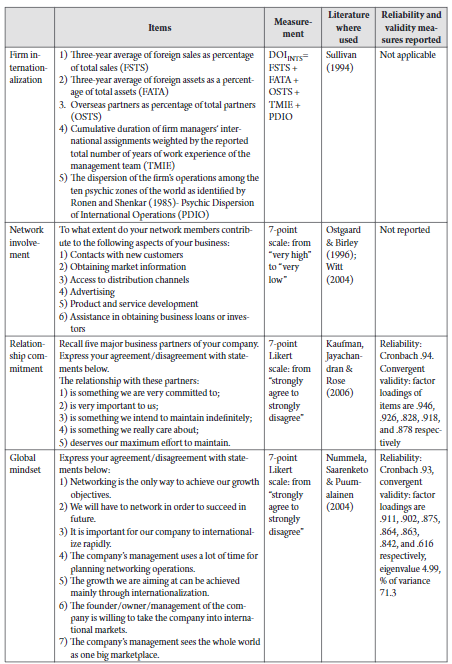
To measure the DOI, we used Sullivan’s (1994, 1996) five-dimensional scale (percent- ages of foreign sales, assets, and overseas subsidiaries, managers’ international experi- ence, and number of psychic zones in which a company operates). For network involve- ment, we used Ostgaard and Birley’s (1996) scale adapted from Birley et al. (1991).
The two attitudinal constructs have well-established measures: Kaufman et al.’s (2006) five-item scale for relationship commitment and Nummela et al.’s (2004) sev- en-item scale for global mindset. For environmental turbulence, we used Burton et al.’s (2002) three-item scale measuring predictability, complexity, and equivocality. Three control variables were measured: the number of a firm’s employees, the time of its es- tablishment, and the time of global market entry. The constructs’ measurement instru- ments are presented in Table 1.
According to Craig and Douglas (2000), a major sampling challenge in cross-cultur- al research is to maintain a balance between cross-national comparability and with- in-country representativeness. The major decision conditioned by this consideration is that the sample should represent enterprises from the same industry. We chose the
textile industry because in all three countries included in the study, it relies on SMEs to a high degree (Collinson & Houlden, 2005). Another important consideration is that the sample frames from all countries should be compatible. The selected sample frames were the Textile Yellow Pages for the USA, the Chamber of Commerce list of domestic manufacturers for China, and the list of Textile Trade Fair Participants for Russia, with 6,283, 17,565, and 1,621 firms, respectively. The data were collected via an internet sur- vey of SME owners/managers in multiple stages between 2005 and 2018. The number of responses used in the study were 293, 244, and 287, respectively. The total sample size (824 respondents) fit the requirements of structural equation models. Summarized sample statistics are displayed in Table 2
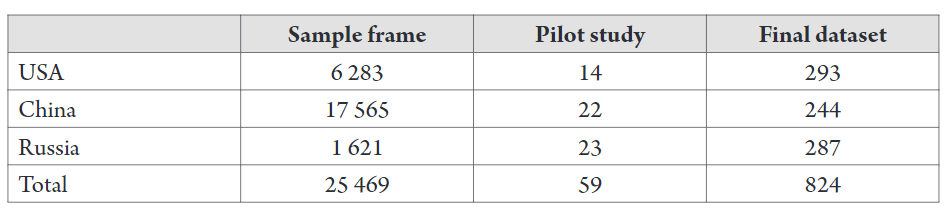
Based on the procedure proposed by Cadogan et al. (1999), pretesting was performed on a sample of 59 SMEs (14 from the USA, 22 from China, and 23 from Russia). We evaluated the wording of the questionnaire, cross-cultural appropriateness, and the di- mensionality of constructs. The validity and reliability of the scales were pretested using Sin et al.’s (2005) methodology.
Reliability and discriminant and convergent validity issues were addressed using the same methodology as in the pretest stage. Cross-cultural stability was evaluated with factor analyses performed on the three countries’ datasets separately. The reliability co- efficients in each sample were higher than .70 for all multi-item variables (Nunnally, 1978).
Structural equation modeling was used as a hypothesis testing tool. The goodness of fit evaluation was based on Hair et al.’s (1992) cutoff criteria. The model showed good fit. A chi-squared test produced values not significant at the .01 level indicators yielded good data fit as well
The obtained regression weight estimates were positive and significant for the fol- lowing hypothesized relationships: network involvement  , relationship commitment–network involvement,
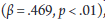 and global mindset– network involvement
 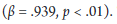 These results supported H1, H2, and H3A, respectively.
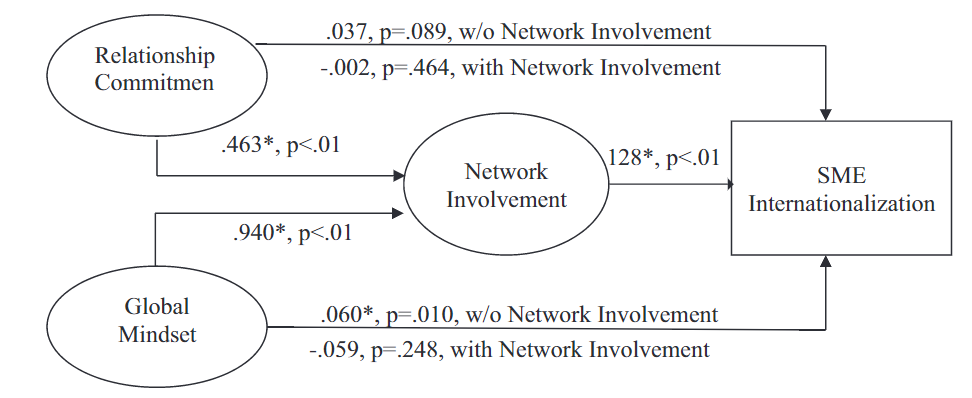
The mediating effect of network involvement in the relationship commitment–DOI and global mindset–DOI relationships (H3B and H3C) was tested based on Baron and Kenny’s (1986) methodology. A significant relationship between global mindset and DOI was found, supporting H3B 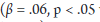 with network involvement in the model and
  without it). In contrast, the relationship commit- ment–DOI
  link was insignificant both with and without network involvement in the model, respectively), failing to support H3C (Figure 2).
To test interaction effects (H4 and H5), we followed a procedure based on multiple group analysis and a nested goodness-of-fit strategy (Kline & Dunn, 2000). The turbu- lence summary score was converted to a grouping variable (high vs. low turbulence). The hierarchy of the models with increasing constraints on the number of invariant parameters (Table 2) suggested that the factor structure differed between low and high environmental turbulence groups. The network involvement–DOI coefficient was
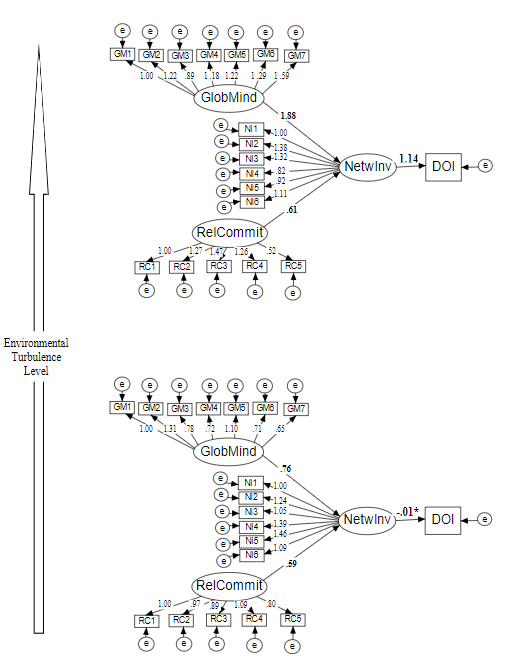
significant in the high-turbulence group 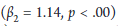 and insignificant in the low-turbulence group
 , suggesting a moderating effect, thus sup- porting H4 (Figure 3).
To test the significance of the interaction effect involving country variables, three groups of observations on the USA, China, and Russia subsamples were used. The dif- ference between the CFI values did not meet the cutoff criterion of .01 ; Table 3)

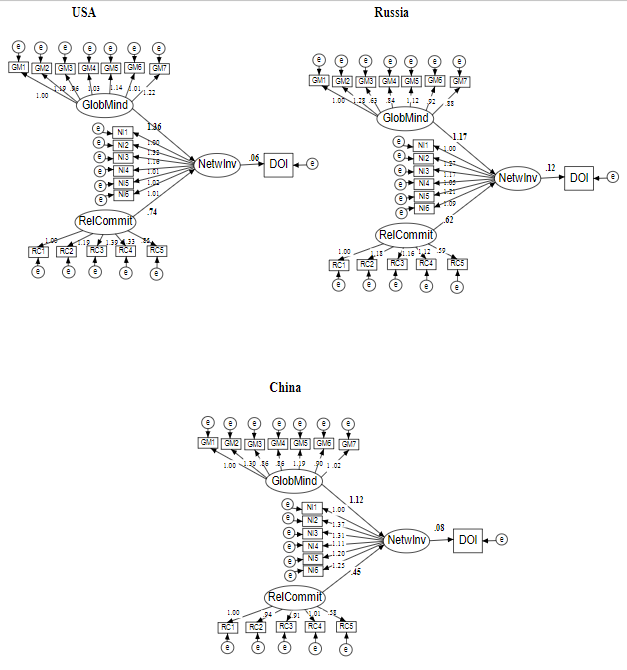
Moreover, a path coefficient analysis for each of the three country subsamples re- vealed no substantial differences in cross-cultural model performance (Figure 4). Therefore, a moderating effect of the country variable (H5) was not confirmed, demon- strating the configural equivalence of the model across the three cultural subsamples.
The effects of three control variables (firms’ age, size, and time of entry to a foreign market) were tested using Bettencourt et al.’s (2001) hierarchical regression method. Evidence of the unique variance beyond one explained by control variables was ob- tained (Table 4)

This study provides clear evidence of a positive link between the degree of network involvement and SMEs internationalization. We demonstrate that in studying the antecedents of SMEs gravitation to the world market, not only market conjuncture considerations but also networking and attitudinal factors such as global mindset and relationship commitment should be investigated. Accordingly, the intention to inter- nationalize should be seen as conditioned not only by external (market) but also by internal (managerial and cultural) factors. Overall, our results are consistent with recent research showing that SME internationalization is a process influenced by multiple fac- tors extending far beyond current market attractiveness ( Javalgi & Grossman, 2014; Schu & Morschett, 2017; Šarapovas et al., 2016).
The main theoretical contribution of this study is that it takes another step in the direction of using the networking approach to explain SME internationalization. We attempted to investigate both outcomes and antecedents of SMEs’ networking by in- corporating it with attitudinal and environmental variables into a single framework. The proposed model was validated on a sample highly diversified culturally, historical- ly, politically, and economically, including a developed economy (the USA) and two emerging economies, one of which (China) is the largest in the world and is based on the manufacturing sector, and the other is mid-range and based on exports of natural resources (Russia).
An unexpected result of this study was that we found no significant differences be- tween the three countries in the strength of the network involvement–internationalization link. A possible explanation could be that cross-industry differences of this link prevail over cross-cultural differences—a phenomenon observed in other studies as well (e.g., Winsted, 1999)—and since all SMEs in the sample belonged in the same in- dustry (textile), the link did not differ significantly between the three countries. To test this proposition, further comparative research with samples from different industries and countries is needed.
The main limitation of this study is that only one industry was represented in the sam- ple. Going forward, research should expand to other industries, first of all belonging to the knowledge-intensive cluster that is predisposed to and dependent upon networking relationships to a higher degree than the manufacturing sector (Coviello & McAuley, 1999; Galimberti & Zanella, 2019; Jain et al., 2015).
Another sampling limitation of this study is that it was based on samples from only three countries and therefore does not provide sufficient grounds for worldwide gen- eralization. Further research should include more countries to test the model in more culturally, politically, and economically diverse environments. Analyses should also include countries representing different psychic zones as conceptualized by Sullivan (1994)
¡Advertencia! Recuerde marcar el "Título del artículo" en las referencia tipo "REVISTA". Aceptar
In a broad macroeconomic sense, this study’s results provide insights into the mech- anisms predisposing SMEs to internationalization under COVID-19 pandemic con- ditions as well. As a contributor to turbulence in the world economy, the pandemic can be considered a factor that either disrupts internationalization processes or lays the groundwork for a new digital globalization from which many SMEs can benefit (Schil- irò, 2020).
Based on the study’s results, one can speculate that the global economic crisis caused by the COVID-19 pandemic will not fundamentally affect the SME internationaliza- tion process in the long term but will become a powerful, albeit secondary (compared to the predisposition to network involvement), factor. Environmental turbulence acts as a moderator rather than a causal trigger of network involvement and internationaliza- tion. Boosting SMEs’ performance through internationalization, given proper consid- eration and support by national governments, may become a major factor in stabilizing nations’ socioeconomic situation after the pandemic, as well as one of the leverages of global economic recovery as a whole
