Article
Vegetation and Palynological Record in Sediments of the Camorim Dam, Pedra Branca State Park, Rio de Janeiro, Brazil
Vegetação e Registro Palinológico em Sedimentos da Represa Camorim, Parque Estadual da Pedra Branca, Rio de Janeiro, Brasil
 Ortrud Monika Barth monikabarth@gmail.com
Cynthia Fernandes Pinto da Luz cyluz@yahoo.com.br
Shana Yuri Misumi smisumi@yahoo.com.br
Edson Farias Mello mello@geologia.ufrj.br
Ortrud Monika Barth monikabarth@gmail.com
Cynthia Fernandes Pinto da Luz cyluz@yahoo.com.br
Shana Yuri Misumi smisumi@yahoo.com.br
Edson Farias Mello mello@geologia.ufrj.br
Vegetation and Palynological Record in Sediments of the Camorim Dam, Pedra Branca State Park, Rio de Janeiro, Brazil
Anuário do Instituto de Geociências, vol. 46, 54699, 2023
Universidade Federal do Rio de Janeiro
Received: 25 September 2022
Accepted: 22 January 2023
Funding
Funding source: CNPq/Brazil
Contract number: 301992/2017-7
Funding
Funding source: Research Productivity
Contract number: 304271/2019-5
Funding
Funding source: FAPERJ
Contract number: E-26/101.568/2010-13
Abstract: Pedra Branca State Park is situated near urban areas of Rio de Janeiro city. Several rivers descend towards the Atlantic Ocean and the damming of some ones, by the end of the 19th century, aimed to provide drinking water to the population. To the present day, Camorim dam is in operation and since its inception in 1908, the surrounding humid tropical forest has recovered, evidenced by the present palynological study of a core withdrawn from the dam’s northwestern part. The six analyzed levels showed pollen grains from botanical taxa characteristic of Rain Forest, Forest Pioneers, Campo vegetation, although less frequent, and Exotic plants. The palynomorphs concentration fluctuated throughout the core, which was attributed to a variation in sedimentation due to large floods that from time to time punished this region, but never decimated the forest around the Camorim dam and its contributing river basin.
Keywords: Palynological analysis, Sediment core, Late Holocene.
Resumo: O Parque Estadual da Pedra Branca está situado próximo a áreas urbanas da cidade do Rio de Janeiro. Vários rios dali descem em direção ao oceano Atlântico. O represamento de alguns deles no final do século XIX visava fornecer água potável à população. Até hoje a represa do Camorim está em operação. Desde a sua criação em 1908, a mata tropical úmida em seu entorno recuperou-se, evidenciado pela presente análise de um testemunho obtido na sua porção noroeste. Os seis níveis analisados apresentaram grãos de pólen de táxons botânicos característicos de Mata Atlântica, Pioneiras de Mata, Campo e Exóticos, embora estes eram raros. A concentração de palinomorfos flutuava ao longo do testemunho. Isto atribuiu-se a uma variação na sedimentação devido às chuvas torrenciais que de tempo em tempo castigaram a região, mas nunca dizimaram a floresta em volta da represa do Camorim e sua bacia de rios contribuintes.
Palavras-chave: Análise palinológica, Testemunho sedimentar, Holoceno Tardio.
1 Introduction
From the 16th to the 18th century, the Rio de Janeiro city Western Zone was known as the plain of the eleven mills, basically occupied by sugarcane plantations and livestock. There was a brief period in the 17th century of coffee production (Fridman 1999; Montezuma 2012). The forest provided water and energy to the city. In the mid19th century, coal workers, most of them former ex-slaves, worked in the Pedra Branca Geological Complex forests. They transformed the area into a coal production hub, which, along with firewood, was the energy matrix of Rio de Janeiro city. Both were used for domestic consumption, civil construction forges, industrial steam boilers, and railway locomotives. More than 157 old coal mills were found in the forest and responsible for the deforestation of about 80 hectares. A significant loss of plant species due to the exploitation of firewood for coal production may have occurred (Oliveira 2012). The history of the Pedra Branca Massif Atlantic Forest protection was a combination of factors over time (Ribeiro 2012). By the end of the 19th century, water availability was necessary for the survival and development of Rio de Janeiro city and its consequent increasing population. As a solution, the federal government acquired water source areas in the city, including the Rio Grande and the Camorim river basins, aiming to improve the water catchment and distribution system and protect the forest water potential (Magalhães-Corrêa 1936).
Major tragedies related to rainfall and environmental impacts have been recorded in the history of Rio de Janeiro city. In January 1967, an extreme episode became one of the greatest disasters ever. Intense rainfall from the north coast of São Paulo State to Rio de Janeiro State caused significant landslides in the latter. The Serra das Araras disaster in 1967 (Piraí city, Rio de Janeiro State) (https://www.deviante.com.br/noticias/tragedias-climaticas-no-brasil-1967-serra-dasararas) was one of the most striking in terms of rain volume, landslides occurrence and number of victims (1,700). In Rio de Janeiro city, the Tijuca rainfall station recorded about 558 mm of precipitation in 48 hours. A disastrous event in Rio de Janeiro occurred later in 2011 (Dourado, Arraes & Silva 2012). At the beginning of the 20th century, nine major floods were recorded in Rio de Janeiro city, one every five and a half years. However, after 1950, this frequency increased to one every three years on average. The Camorim dam, whose construction was completed in 1908, was violently affected, mainly in 1966, 1967, and 1988 during the summer rainfalls (Dereczynski, Calado & Bodstein-de-Barros 2017; Ferreira 2016; Fialho 2012).
The Pedra Branca State Park (PBSP) foundation process began in April 1963, by Decree No. 1,634, which stated the region as a public utility area for expropriation purposes. However, only in 1974 the Pedra Branca State Park was created, through State Law No. 2,377, of June 28, 1974, including several government-protected forests. Afterward, the landscape was almost entirely recomposed and the forest functionality recovered due to ecological succession processes (Oliveira 2012). Currently, the PBSP holds the title of the largest urban forest in the world (INEA 2022). However, being located inside a densely populated metropolitan region, the PBSP suffers real estate pressure, in addition to illegal hunting and planting activities, which conflict with the environmental preservation purposes of this forest remnant (Magalhães-Corrêa 1933; 1936; Oliveira 2005; Solórzano 2006).
Aiming to evaluate the behavior of the vegetation around the Camorim dam in the last hundred years, the present study used palynological analysis of pollen grains and Pteridophytes and Bryophytes spores recovered from a sediment core withdrawn from the dam’s deepest area. The research is justified by the scarcity of information about the previous vegetation dynamics in the PBSP.
2 Study Area
Pedra Branca mountainous massif, delimited between 23°52' to 23°04' S and 43°23' to 43°32' W (Figure 1), presents granitic, crystalline, and crystallophilian rocks, mainly facoidal gneiss, interspersed with basic rocks, such as diabase (Galvão 1957). It presents a much-diversified topography. All the Pedra Branca massif hills and slopes are located inside the PBSP, extending over 125 km2 and bordering several neighborhoods in the West Zone and the Jacarepaguá Plain of Rio de Janeiro city. Most of the mountains are arranged in a west-east direction, separated by deep valleys. The PBSP comprises the highest altitude point of Rio de Janeiro city, the Pedra Branca Peak (1024m), and it is the largest water-dispersing center in the municipality, with three hydrographic basins flowing into Guanabara Bay, Jacarepaguá Plain, and Sepetiba Bay.
Jacarepaguá Plain is delimited by the Pedra Branca and Tijuca massifs, and was developed by intense erosion processes of these slopes after the last marine regression (approximately 3,500 years BP). It currently presents accentuated growth in urban occupation and it is subjected to frequent flooding (Maia et al. 1984; Togashi, Montezuma & Leite 2012).
Northern slopes face Realengo, Bangu, and Campo Grande neighborhoods, such as Bangu Mountain Range and Viegas Mountain Range, are quite degraded, due to irregular human occupation and the replacement of the original vegetation by grasses.
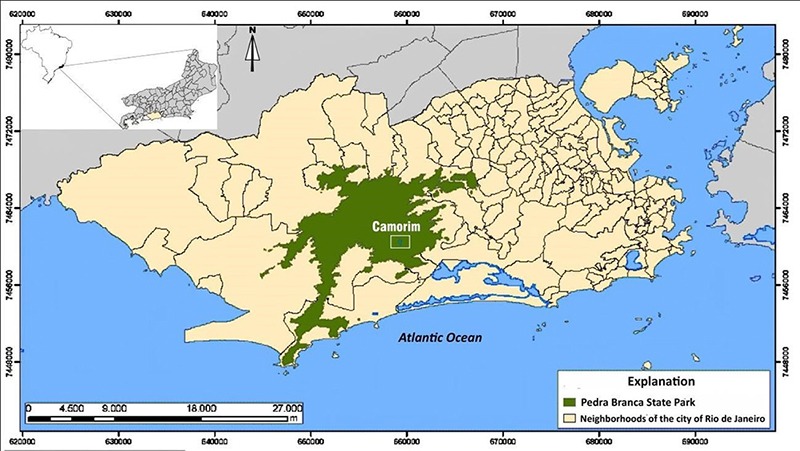
Figure 1
Location of the Camorim dam inside the Pedra Branca State Park, in Rio de Janeiro city.
The Camorim dam is located in the PBSP, on the southeastern slope of the Pedra Branca massif, at altitude of 436m, and occupies an area of 350 ha. Its construction was completed in 1908 aiming to supply the Jacarepaguá region with drinking water. With a volume of 210,000 m³, 18 meters of depth, and a water storage capacity of 2.4 million m³, the Camorim reservoir represents the largest water source of the Jacarepaguá group and is surrounded by the Atlantic Forest in several successional stages (Figures 2 and 3).
The vegetation in the study area and its surroundings is dominated by a humid tropical forest, inserted in the Atlantic Rain Forest domain. According to IBGE (1992), the area is characterized as a Submontane Dense Ombrophilous Forest, with a subhumid climatic typology, with little or no water deficit. It is an exuberant secondary forest directed towards the PBSP Atlantic slope and it is the largest remaining fragment of the Atlantic Rain Forest in Rio de Janeiro city with 12,500 ha, occupying about 10% of the city’s total area. Botanical studies and surveys have been carried out over the years, including the vegetation of surroundings river basins and isolated hills adjacent to the PBSP, as in the Capoeira Grande Mountain Range State Environmental Protection Area (Bruni 2002; Freire 2010; Freire et al. 2009; INEA 2022; Oliveira 2007; Oliveira et al. 1995; Peixoto et al. 2004; 2005; Santos et al. 2006).
The PBSP climate is characterized by an average annual temperature of 23.6 ºC; February is the hottest month (mean temperature of 26.7ºC) and June the coldest (average of 21.0ºC). The median annual total precipitation is 1,027.2 mm. Rainfall is abundant in the summer and scarce in the winter, with a water deficit from July to October (Peixoto et al. 2004). According to the Köppen system, the region’s climate is classified as Aw - Tropical Rainy Climate. In addition to the N-NE winds coming from the regional atmospheric circulation, the Pedra Branca massif harbors a very dynamic local wind system, determined by its mountains and valleys location. It is intensely subject to polar fronts influence.
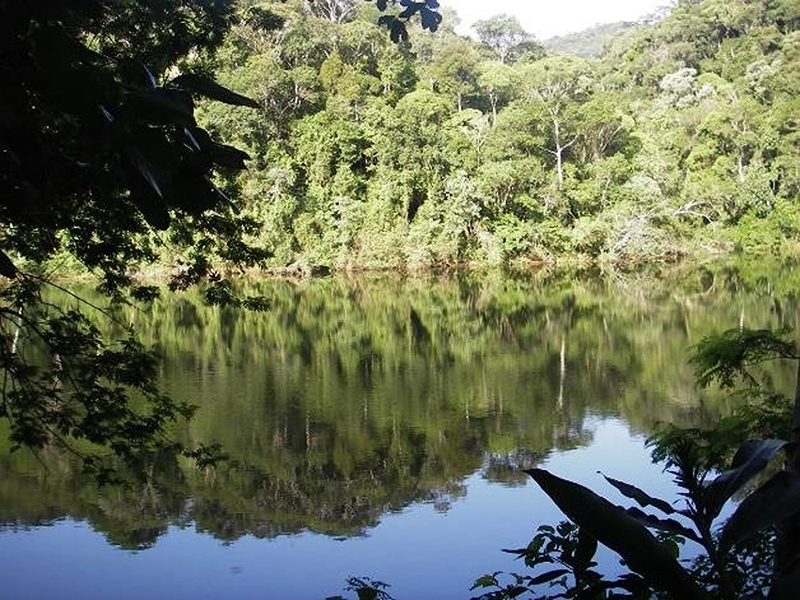
Figure 2
Camorim dam, seen from the retaining wall: water mirror and forest.
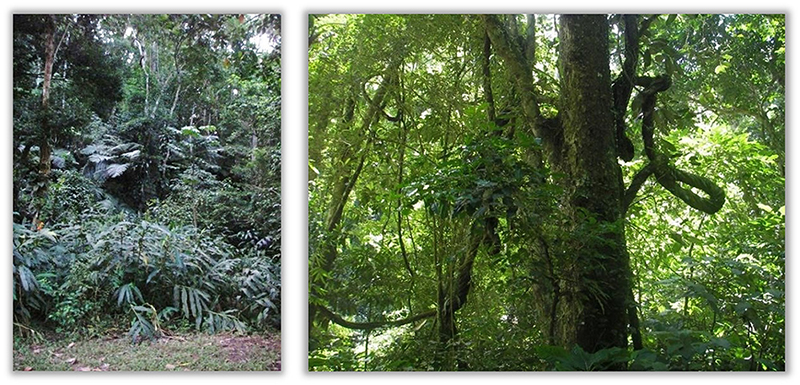
Figure 3
Aspects of the Atlantic Forest low and high vegetation around the dam.
3 Material and Methods
A sediment core was withdrawn from the Camorim dam’s northwestern side (Figures 4 and 5). This area was well preserved and was invaded by semi-submerged and rooted vegetation. The core upper part was unconsolidated and discarded so a 30 cm long column was retrieved (Figures 6 and 7). Eight cm3 sediment samples were taken from six levels each, corresponding to 0, 10, 15, 20, 25, and 30 cm depth from top to bottom. The 5 cm level was not appropriate for sampling.
The sample preparation followed the standard methodology for the Quaternary proposed by Ybert et al. (1992). The chemical treatment included the addition of Lycopodium clavatum spores, 40% HF, 10% HCl, 10% KOH, glacial acetic acid, and classical acetolysis successively. Three microscope slides were prepared for each sample using glycerin-gelatin and sealed with paraffin.
Palynomorph counting and photomicrographs were carried out using 400x and 1000x magnifications. Specialized literature like Barth et al. (1962-2014, see Appendix); Lorente et al. (2017); Luz, Barros and Barth (2018); Roubik and Moreno (1991), and Ybert et al. (2016-2018, see Appendix), and the pollen slides collection of the Palynology Laboratory at Federal University of Rio de Janeiro/IGEO were used for palynomorphs identification.
The collected data evaluation was performed using Tilia and Tilia Graph softwares (Grimm 1992) yielding palynomorphs relative percentages and concentrations diagrams.
It is noteworthy that pollen grains of several tropical botanical families do not resist the described chemical treatment due to their delicate exine. Therefore, many pollen grains from plants like hydrophilic monocots and Lauraceae and Musaceae species that occur nowadays in the Atlantic Forest could be present in the analyzed sediments but were not found.
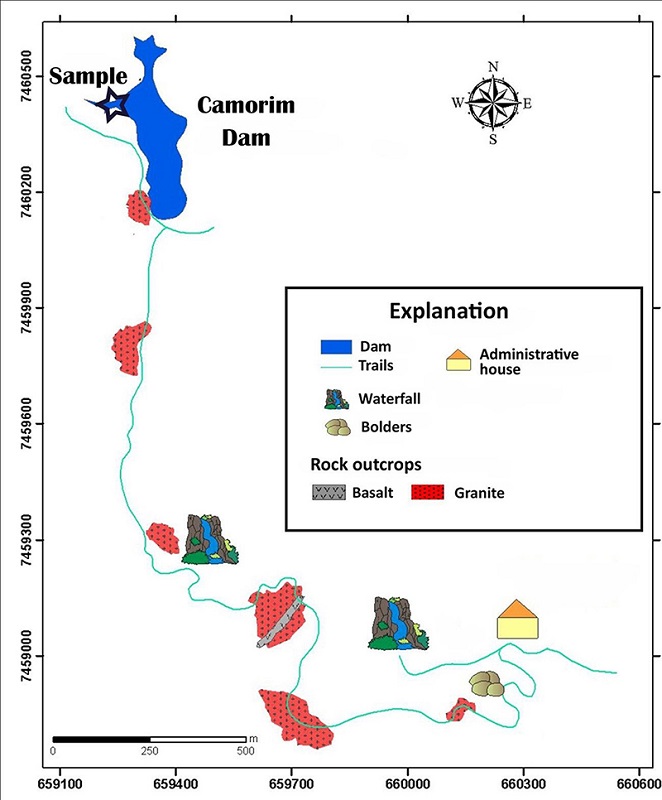
Figure 4
Location of the collected core at the Camorim dam.
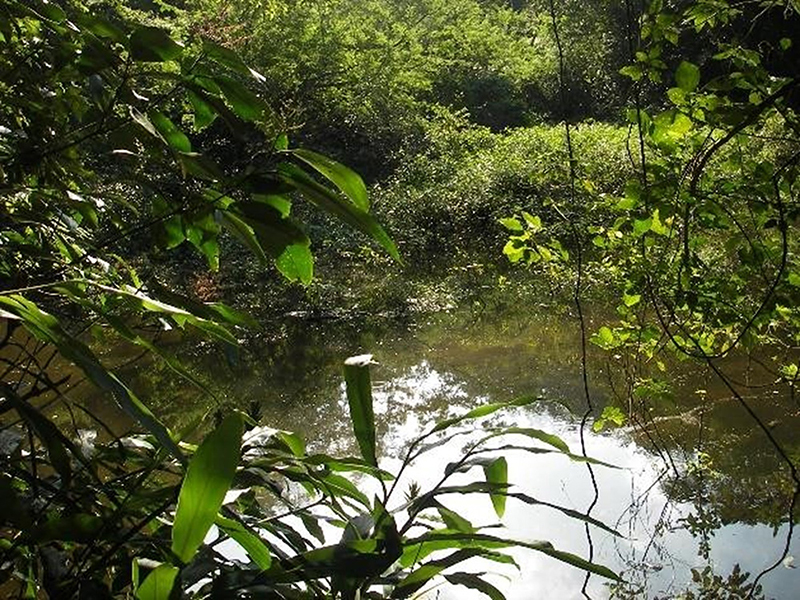
Figure 5
Core’s withdrawal location.
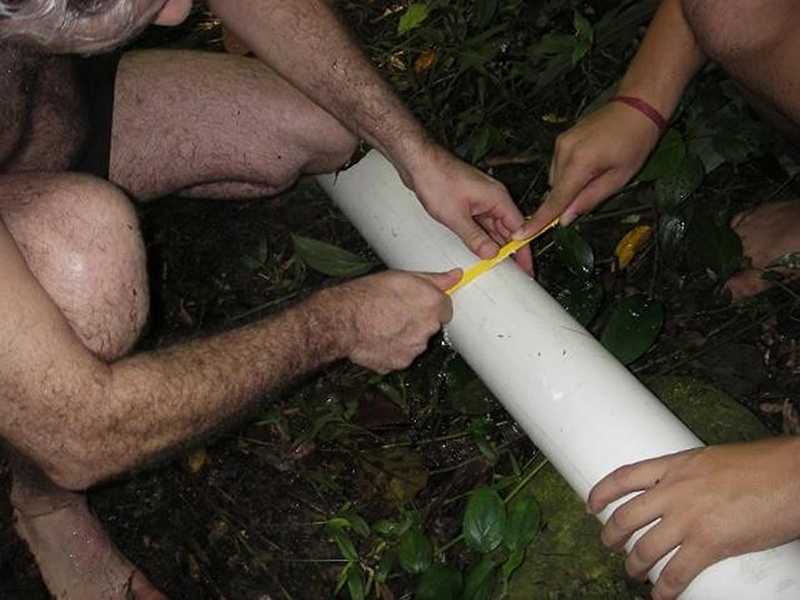
Figure 6
Core conditioning for transport.
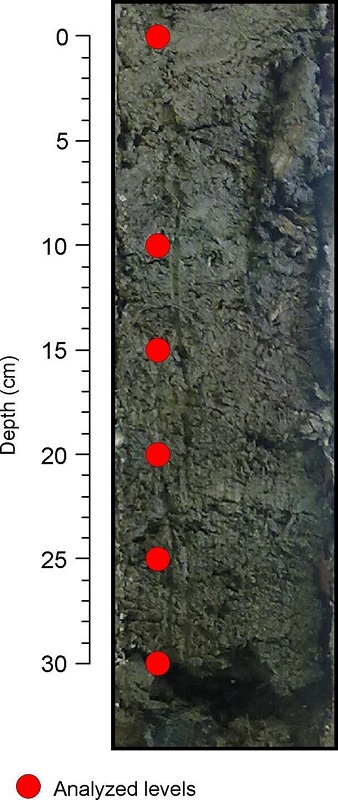
Figure 7
Core internal aspect and the levels for sample extraction.
4 Results
The Camorim dam core (Figure 7) consisted mainly of dark-brown amorphous compacted decomposed organic material, streaky with roots and plant fragments. Sandy sediments were absent at the top, present only below the 35 cm level. Several types of vegetation cover the study area actually which composition, according to the families and botanical species considered in the present study, is shown in Table 1.
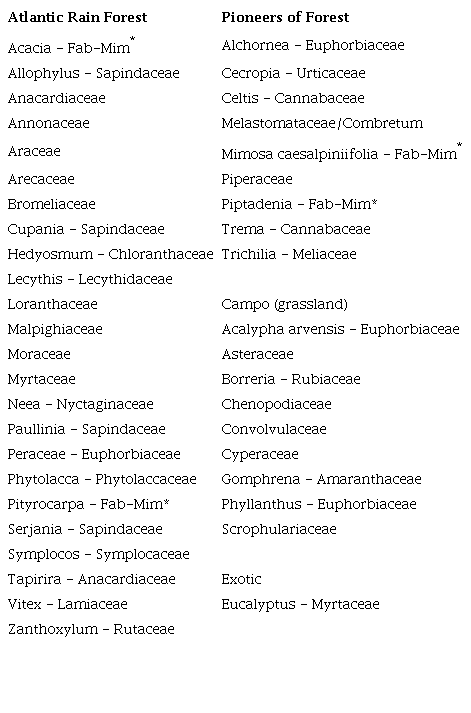
*Fab-Mim = Fabaceae-Mimosoideae
The recovered finely granulated sediment, pollen grains and spores were well dispersed inside the slides. The palynological analysis of the six samples showed well preserved to corroded, oxidized, and mechanically damaged pollen grains and spores. Pollen taxa were identified, corresponding to the Atlantic Rain Forest, Pioneers of Forest, Campo (grassland), Wide distribution and Exotic ecological groups, as well as fern and mosses (Tables 1 and 2, Figures 8, 9, 10 and 11).
The 0 cm and 10 cm levels contained few pollen grains, most belonging to pioneer plants. In terms of frequency, Alchornea predominated, followed by Myrtaceae (Myrcia type), Araceae, and Melastomataceae/Combretum.
Further down, at the 15 cm level, the diversity of pollen grain taxa exploded. Among the forest elements, Allophylus, Araceae, Cupania, Malpighiaceae, Myrtaceae, Myrsine, and Sapotaceae stood out. Rare pollen grains of Moraceae occurred. Amid the forest pioneers, in addition to those already mentioned in the two upper levels, Cecropia, several species of Fabaceae-Mimosoideae and Piper were more frequent. Plants characteristic of campo vegetation were mainly represented by Asteraceae, Cyperaceae, Gomphrena, and Poaceae. Fern and mosses spores were also quite significant. The next level below, the 20 cm, is poorer in pollen grains, presenting reduced forest and forest pioneer elements, but a greater relative frequency of campo taxa, such as Asteraceae, Gomphrena, and Poaceae. Pteridophyte and Bryophyte spores continued to be frequent.
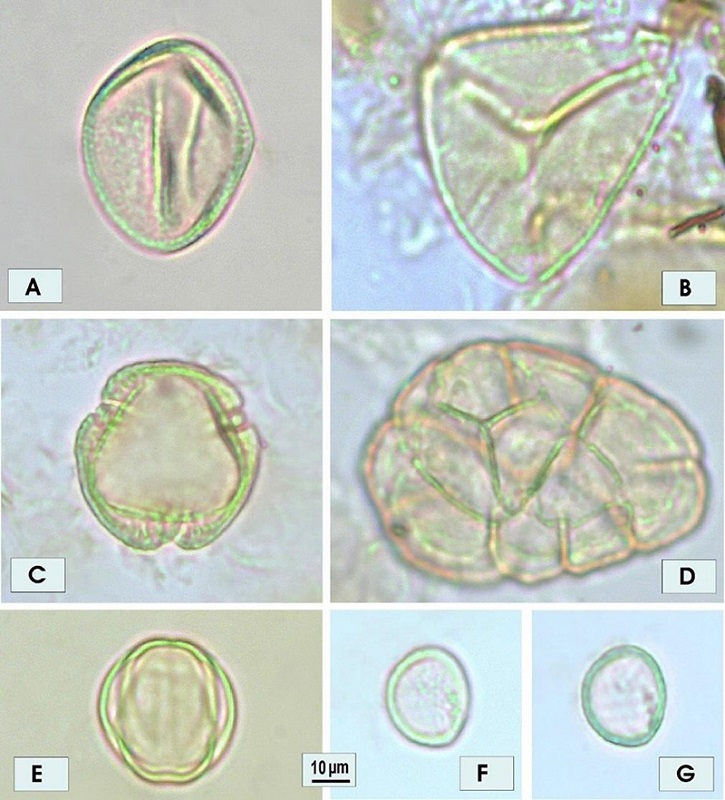
Figure 8
Examples of pollen grains characteristic of: A-B. Forest; C-G. Forest pioneers; A. Araceae; B. Myrcia pollen type; C. Alchornea; D. Anadenanthera pollen type; E. Melastomataceae pollen type; F. Piper, surface and colpus; G. Piper, optical cut.
At the 25 cm level, there was once more an increase in pollen grains diversity. The forest species continued to be the same, with a significant increase in representatives of forest pioneers. Campo species were still present and Pteridophyte spores were much more frequent than those of Bryophytes.
The base level, 30 cm, presented lower pollen grains diversity than the one above, maintaining forest and forest pioneer elements, and Campo species represented only by Asteraceae and Poaceae. Pteridophytes and Bryophytes spores were not observed.
Typha pollen was found at 15 cm and 25 cm levels at very low relative frequency. Eucalyptus pollen was not frequent but was detected at 15, 25, and 30 cm levels.
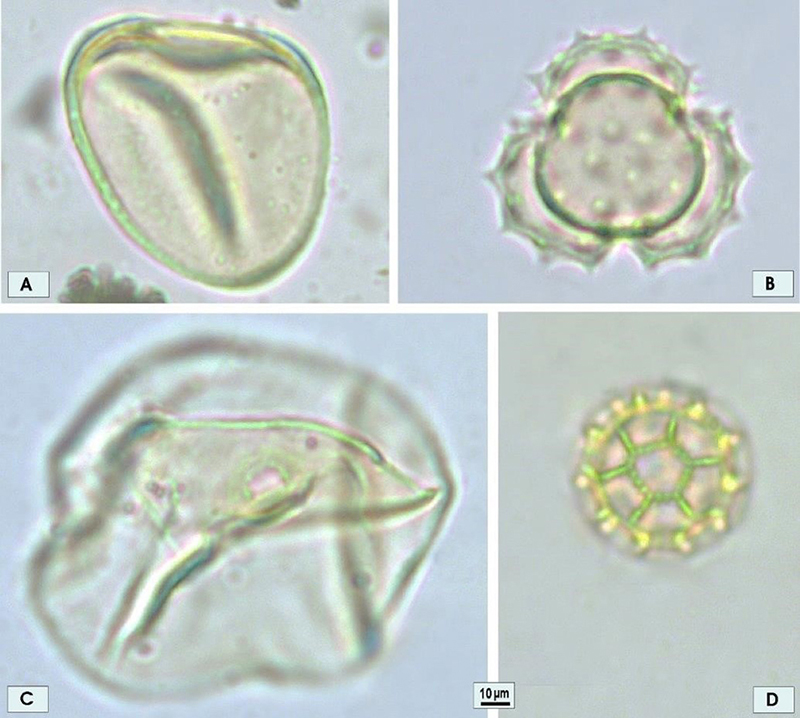
Figure 9
Examples of campo characteristic pollen grains: A. Cyperaceae; B; Artemisia pollen type; C. Bambusa; D. Gomphrena.
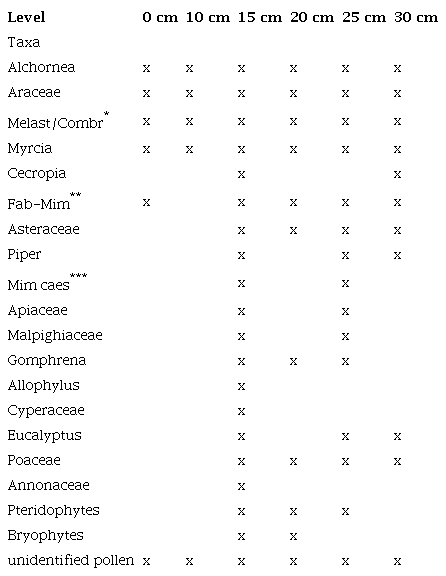
*Melast/Combr = Melastomataceae/Combretum; ** Fab-Mim = Fabaceae-Mimosoideae; ***Mim caes = Mimosa caesalpiniifolia.
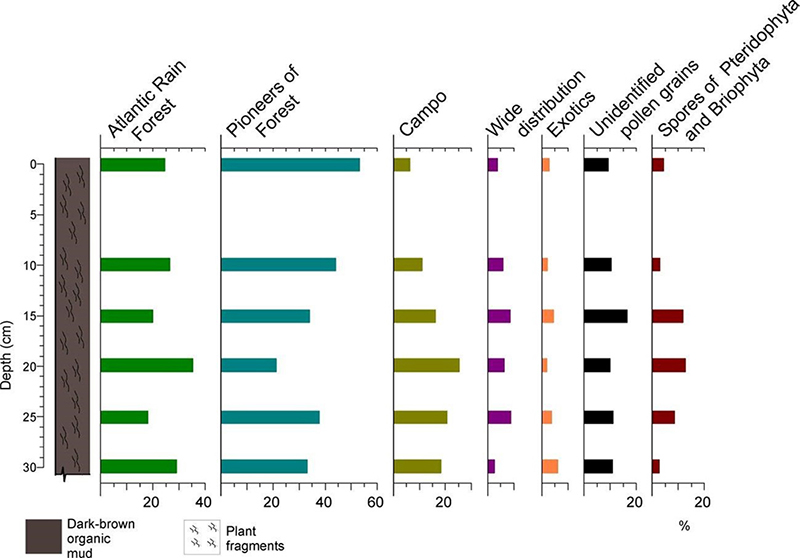
Figure 10
Relative frequency (%) diagram of palynomorphs according to the established groups for the Camorim dam core.
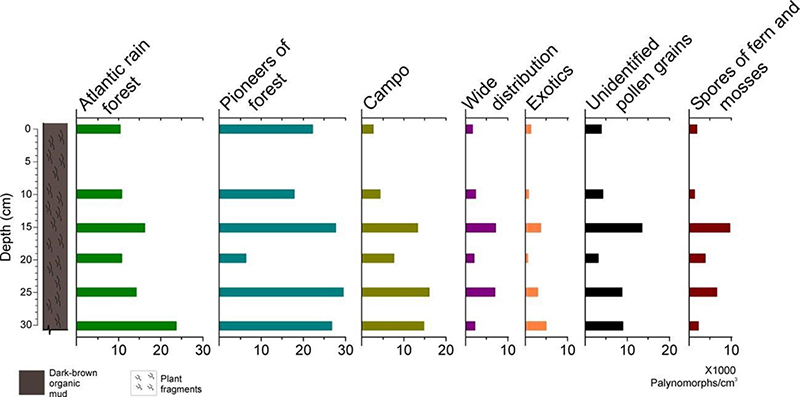
Figure 11
Concentration diagram of palynomorphs/cm3 according to the established groups for the Camorim dam core.
5 Discussion
The palynological analysis of the Camorim dam core documented the preservation of the secondary Atlantic Rain Forest, the largest plant community within the Pedra Branca State Park (Oliveira et al. 1995; Solórzano, Guedes-Bruni & Oliveira 2012) throughout the study. The six sampled levels were similar in their palynological composition.
The greatest pollen types richness stood out in the 15 cm sample, followed by the 25 cm sample. These two were interspersed by the 20 cm sample, poor on palynomorphs, which was evidenced in Table 2 and Figures 10 and 11. The lowest number of botanical taxa corresponded to the 0 cm and 10 cm samples in the core upper part, indicating bad preservation conditions.
Common pollen taxa presenting more than 10% relative frequency were recognized in all six samples. The forest taxa belonged to Araceae and Myrtaceae (Myrcia type) families. Fabaceae-Mimosoideae (Anadenanthera and Piptadenia) also occurred at all analyzed levels, but at the 10 cm level, this pollen taxon remained below 10% relative frequency. In addition to these forest taxa, several others could be recognized, at low frequency, standing out respectively of Allophylus, Cupania and Serjania (Sapindaceae), Myrsine (Primulaceae), Annonaceae, Malpighiaceae, Moraceae, and Sapotaceae pollen types.
Along the core, there was a predominance of pollen grains from pioneer forest plants, commonly represented in all samples by Alchornea and Melastomataceae/Combretum pollen types. Important taxa like Mimosa caesalpiniifolia (Mimosaceae) and Piper (Piperaceae) also occurred but at a lower frequency. Interestingly, Cecropia (Urticaceae) pollen, an indicator of secondary forest, was detected at the 15 cm and 30 cm levels, more significantly at the former, indicating a possible good recovery of the forest.
Representatives of Campo vegetation belonged to anemophilous plants, such as Asteraceae, Poaceae, and Cyperaceae. These pollen grains possibly came from more distant areas by wind and water inflow, as no Campo vegetation occurred in the vicinity of the dam.
Pollen grains of Eucalyptus, which is an exotic genus, also showed low representation, but its presence demonstrated the human influence on the region. Plants characteristic of the rain forest, such as Araceae species from a high humid vegetation, were less frequent than pioneer ones.
Regarding the palynomorphs concentration, a significant decrease in palynological deposition occurred at the 20 cm level. Considering the dam’s age (built in 1908), this deposition gap could be attributed to torrential rain events with landslides that occurred in Rio de Janeiro city in 1966 and 1967 (Braga 2012; Dereczynski, Calado & Bodstein-de-Barros 2017; Dourado, Arraes & Silva 2012; Ferreira 2016; Ferreira & Cunha 1996; Fialho 2012).
Furthermore, after a large deposition and good preservation of palynomorphs at the 15 cm level, the palynological concentration and relative frequency decreased at 0 cm and 10 cm levels reflecting a long period of few catastrophic events since 1967. After 1988 and several frequent rainfall peaks at shorter intervals, like the 1996 event, (Dereczynski, Calado & Bodstein-de-Barros 2017; Ferreira 2016; Fialho 2012) that may have mobilized the dam bottom sediments, the Park vegetation got better protected under the 1974 legislation.
6 Conclusions
Despite the Pedra Branca massif diverse environmental history, including being a major coal production hub until the beginning of the 20th century, the Pedra Branca State Park forest recovered well after the end of coal production and the acquisition by the federal government in 1974. However, the predominance of pioneer plant pollen grains and spores deposited in the Camorim dam highlighted the low representation in the ecological succession of climax species, demonstrating the marks in the forest’s structural attributes throughout the secular history of human interventions. The palynological analysis data validated the predominance of a secondary forest, with exotic plant species, and the local absence of open areas.
The vegetation maintained a relatively constant composition, so the lower richness of botanical taxa observed in two levels could be explained by the occurrence of large catastrophic events as in 1966/1967 and 1988. It is possible to affirm that, during the last hundred years, there was no significant change in the vegetation composition of the Camorim dam region, but the sediments and pollen deposition varied due to torrential and prolonged rainfalls that punished the Atlantic slope of the Pedra Branca State Park.
7 Acknowledgements
We are grateful to the Instituto Estadual do Ambiente (INEA) represented by Me. Cristiana Pompeo do Amaral Mendes for the invitation to carry out Palynology studies in the Pedra Branca State Park.
The authors are grateful to the Conselho Nacional de Desenvolvimento Científico e Tecnológico (CNPq/Brazil) for the financial support through a research grant in the category Senior Researcher to O.M. Barth (Process number 301992/2017-7) and a Research Productivity grant to C.F.P. Luz (Process number 304271/2019-5). Also to the Fundação de Amparo à Pesquisa do Estado do Rio de Janeiro Carlos Chagas Filho (FAPERJ) for financial support (Process number E-26/101.568/2010-13).
8 References
Braga, D.D. 2012, 'Inundações no Rio de Janeiro (1850-1930): Um caso de injustiça ambiental?', Anais do XV Encontro Regional de História ANPUH-RIO, Rio de Janeiro, pp. 1-10.
Dereczynski, C.P., Calado, R.N. & Bodstein-de-Barros, A. 2017, 'Chuvas extremas no município do Rio de Janeiro: histórico a partir do Século XIX', Anuário do Instituto de Geociências, vol. 40, no. 2, pp. 17-30, DOI:10.11137/2017_2_17_30.
Dourado, F., Arraes, T.C. & Silva, M.F. 2012, 'O mega desastre da região Serrana do Rio de Janeiro - as causas do evento, os mecanismos dos movimentos de massa e a distribuição espacial dos investimentos de reconstrução no pós-desastre', Anuário do Instituto de Geociências, vol. 35, no. 2, pp. 43-54, DOI:10.11137/2012_2_43_54.
Ferreira, L.C. 2016, 'Pior enchente de Rio de Janeiro completa 50 anos', Reportagem de 09/01/2016 por Edição Amanda Cieglinski, (dados do Corpo de Bombeiros).
Ferreira, F.P.M. & Cunha, S.B. 1996, 'Enchentes no Rio de Janeiro: efeitos da urbanização no rio Grande (arroio fundo) - Jacarepaguá', Anuário do Instituto de Geociências, vol. 19, pp. 79-92, DOI:10.11137/1996_0_79-92.
Freire, J.M., Oliveira, R.R., Lima, E.R. & Braga, J.M.A. 2009, 'Árvores do Parque Estadual da Pedra Branca: florística e estrutura', I Encontro Científico do Parque Estadual da Pedra Branca, Rio de Janeiro, pp. 44-6.
Freire, J.M. 2010, 'Fitossociologia e estrutura do componente arbóreo de um remanescente de floresta urbana no maciço da Pedra Branca, Rio de Janeiro', PhD thesis, Universidade Federal Rural do Rio de Janeiro, Rio de Janeiro.
Fialho, E.F. 2012, 'A dinâmica plúvio-financeira no estado do Rio de Janeiro', Revista de Ciências Humanas, vol. 12, no. 1, pp. 181-201.
Fridman, F. 1999, Donos do Rio em nome do Rei: uma história fundiária da cidade do Rio de Janeiro, Jorge Zahar, Rio de Janeiro.
Galvão, M.C. 1957, 'Lavradores brasileiros e portugueses na Vargem Grande', Boletim Carioca de Geografia - AGB, vol. 10, no. 3-4, pp. 36-60.
Grimm, E.C. 1992, TILIA, versão 2.0.b.4 (Computer Software), Illinois State Museum, Research and Collection Center, Springfield.
IBGE - Instituto Brasileiro de Geografia e Estatística 1992, Manual Técnico da Vegetação Brasileira, IBGE, Rio de Janeiro.
INEA - Instituto Estadual do Ambiente 2022, Portal, viewed 9 July 2022, <INEA - Instituto Estadual do Ambiente 2022, Portal, viewed 9 July 2022, http://www.inea.rj.gov.br/biodiversidadeterritorio/conheca-as-unidades-de-conservacao/parque-estadual-da-pedra-branca>.
Lorente, F.L., Buso-Junior, A.A., Oliveira, P.E. & Pessenda, L.C.R. 2017, Atlas Palinológico, FEALQ, Piracicaba.
Luz, C.F.P., Barros, M.A. & Barth, O.M. 2018, 'Morfologia polínica de eudicotiledôneas arbóreas da Serra da Capoeira Grande, Maciço Geológico da Pedra Branca, Rio de Janeiro, Brasil', Iheringia Série Botânica, vol. 73, no. 3, pp. 308-28, DOI:10.21826/2446-8231201873308.
Maia, M.C.A.C., Martin, L., Flexor, J.M. & Azevedo, A.E.G. 1984, Evolução holocênica da planície costeira de Jacarepaguá (RJ), Congresso Brasileiro de Geologia, 33., Rio de Janeiro, Rio de Janeiro, pp. 105-18.
Magalhães-Corrêa, A. 1933, 'O sertão carioca', Revista do Instituto Histórico e Geográfico Brasileiro, vol. 167, 312.
Magalhães-Corrêa, A. 1936, O sertão carioca, Instituto Histórico e Geográfico do Brasil, Imprensa Nacional, Rio de Janeiro.
Montezuma, R.C.M. 2012, 'Funcionalidade e estabilidade ecológica na Região Metropolitana do Rio de Janeiro: o caso da Baixada de Jacarepaguá', GeoPuc, vol. 4, no. 7, pp. 153-93.
Oliveira, R.R. 2005, As marcas do homem na floresta. História ambiental de um trecho de Mata Atlântica, Pontifícia Universidade Católica do Rio de Janeiro, Rio de Janeiro.
Oliveira, R.R. 2007, 'Mata atlântica, paleoterritórios e história ambiental', Ambiente & Sociedade, vol. X, no. 2, pp. 11-23.
Oliveira, R.R. 2012, 'O metabolismo de uma floresta e de uma cidade: as carvoarias do Maciço da Pedra Branca no Rio de Janeiro', História, Natureza e Espaço, vol. 1, no. 1, 5, DOI:10.12957/hne.2012.4364.
Oliveira, R.R., Lima, D.F., Vianna, M.C., Silva, I.M. & Delamonica, P. 1995, Levantamento florístico do Parque Estadual da Pedra Branca, Relatório de Acompanhamento, Fundação Estadual de Engenharia do Meio Ambiente, Departamento de Planejamento Ambiental, Divisão de Estudos Ambientais, Serviço de Ecologia Aplicada, Rio de Janeiro.
Peixoto, G.L., Martins, S.V., Silva, A.F. & Silva, E. 2004, 'Composição florística do componente arbóreo de um trecho de floresta atlântica na área de proteção ambiental da Serra da Capoeira Grande, Rio de Janeiro, RJ, Brasil', Acta Botanica Brasílica, vol. 18, no. 1, pp. 151-60. DOI:10.1590/S0102-33062004000100013.
Peixoto, G.L., Martins, S.V., Silva, A.F. & Silva, E. 2005, 'Estrutura do componente arbóreo de um trecho de Floresta Atlântica na Área de Proteção Ambiental da Serra da Capoeira Grande, Rio de Janeiro, RJ, Brasil', Acta Botanica Brasílica, vol. 19, pp. 539-47, DOI:10.1590/S0102-33062005000300015.
Roubik, D.W. & Moreno, J.E.P. 1991, Pollen and spores of Barro Colorado Island, Missouri Botanical Garden, Missouri.
Santos, F.V., Solórzano, A., Guedes-Bruni, R.R. & Oliveira, R.R. 2006, 'Composição do estrato arbóreo de um paleoterritório de carvoeiros no Maciço da Pedra Branca, RJ', Pesquisas Botânica, vol. 57, pp. 181-92.
Solórzano, A. 2006, 'Composição florística, estrutura e História Ambiental em áreas de Mata Atlântica no Parque Estadual da Pedra Branca, RJ', Master thesis, Instituto de Pesquisas Jardim Botânico do Rio de Janeiro, Rio de Janeiro.
Solórzano, A., Guedes-Bruni, R.R. & Oliveira, R.R. 2012, 'Composição florística e estrutura de um trecho de floresta ombrófila densa atlântica com uso pretérito de produção de banana, no parque estadual da Pedra Branca, Rio de Janeiro, RJ', Revista Árvore, vol. 36, no. 3, pp. 451-62, DOI:10.1590/S0100-67622012000300007.
Togashi, H.F., Montezuma, R.C.M. & Leite, A.F. 2012, 'Precipitação incidente e fluxo de atravessamento das chuvas em três estágios sucessionais de floresta atlântica no Maciço da Pedra Branca, Rio de Janeiro', Revista Árvore, vol. 36, no. 5, pp. 907-17, DOI:10.1590/S0100-67622012000500013.
Ybert, J.P., Salgado-Labouriau, M.L., Barth, O.M., Lorscheiter, M.L., Barros, M.A., Chaves, S.A.M., Luz, C.F.P., Ribeiro, M., Scheel, R. & Vicentini, K. 1992, 'Sugestões para padronização da metodologia empregada em estudos palinológicos do Quaternário', Revista do Instituto Geológico, vol. 13, no. 2, pp. 47-9, DOI:10.5935/0100-929X.19920009.
Appendix
Barth, O.M. et al. 1962-2014, Catálogo Sistemático dos Pólens do Brasil Meridional, 40 published parts by botanical families.
Parte 1 - Veloso, H.P. & Barth, O.M. 1962, 'Catálogo sistemático dos pólens das plantas arbóreas do Brasil Meridional - I. Magnoliaceae, Annonaceae, Lauraceae e Myristicaceae', Memórias do Instituto Oswaldo Cruz, vol. 60, no. 1, pp. 59-93.
Parte complementar - Barth, O.M. 1962a, 'Catálogo sistemático dos pólens das plantas arbóreas do Brasil Meridional - Parte Complementar: Coniferales', Memórias do Instituto Oswaldo Cruz, vol. 60, no. 2, pp. 199-208.
Parte 2 - Barth, O.M. 1962b, 'Catálogo sistemático dos pólens das plantas arbóreas do Brasil Meridional - II. Monimiaceae e Dilleniaceae', Memórias do Instituto Oswaldo Cruz, vol. 60, no. 3, pp. 405-20.
Parte 3 - Barth, O.M. 1963, 'Catálogo sistemático dos pólens das plantas arbóreas do Brasil Meridional - III. Theaceae, Marcgraviaceae, Ochnaceae, Guttiferae e Quiinaceae', Memórias do Instituto Oswaldo Cruz, vol. 61, no. 1, pp. 89-110.
Parte 4 - Barth, O.M. & Silva, S.A.F. 1963, 'Catálogo sistemático dos pólens das plantas arbóreas do Brasil Meridional - IV. Cunoniaceae, Rosaceae e Connaraceae', Memórias do Instituto Oswaldo Cruz, vol. 61, no. 3, pp. 411-33.
Parte 5 - Barth, O.M. 1964, 'Catálogo sistemático dos pólens das plantas arbóreas do Brasil Meridional - V. Leguminosae: Papilionatae', Memórias do Instituto Oswaldo Cruz, vol. 62, pp. 95-123.
Parte 6 - Barth, O.M. & Bouzada, C.P. 1964, 'Catálogo sistemático dos pólens das plantas arbóreas do Brasil Meridional - VI. Leguminosae: Caesalpinioideae', Memórias do Instituto Oswaldo Cruz, vol. 62, pp. 169-92.
Parte 7 - Barth, O.M. & Silva S.A.F. 1965, 'Catálogo sistemático dos pólens das plantas arbóreas do Brasil Meridional - VII. Thymelaeaceae, Lythraceae, Lecythidaceae, Rhizophoraceae e Combretaceae', Memórias do Instituto Oswaldo Cruz, vol. 63, pp. 255-73.
Parte 8 - Barth, O.M. & Yoneshigue, Y. 1966, 'Catálogo sistemático dos pólens das pantas arbóreas do Brasil Meridional - VIII. Leguminosae: Mimosoideae', Memórias do Instituto Oswaldo Cruz, vol. 64, pp. 79-111.
Parte 9 - Barth, O.M. 1971, 'Catálogo sistemático dos pólens das plantas arbóreas do Brasil Meridional - IX'.
'Complemento à parte VII: Cuphea (Lythraceae)', Memórias do Instituto Oswaldo Cruz, vol. 69, no. 1, pp. 93-105.
Parte 10 - Barth, O.M. 1971, 'Catálogo sistemático dos pólens das plantas arbóreas do Brasil Meridional - X Proteales', Memórias do Instituto Oswaldo Cruz, vol. 69, no. 3, pp. 437-47.
Parte 11. - Barth, O.M. 1972, 'Catálogo sistemático dos pólens das plantas arbóreas do Brasil Meridional - XI. Loranthaceae e Olacaceae', Memórias do Instituto Oswaldo Cruz, vol. 70, no. 1, pp. 49-67.
Parte 12 - Barth, O.M. & Barbosa, A.F. 1971, 'Catálogo sistemático dos pólens das plantas arbóreas do Brasil Meridional - XII. Palmae', Memórias do Instituto Oswaldo Cruz, vol. 69, no. 3, pp. 425-33.
Parte 13 - Barth, O.M. 1972, 'Catálogo sistemático dos pólens das plantas arbóreas do Brasil Meridional - XIII. Flacourtiaceae e Caricaceae', Memórias do Instituto Oswaldo Cruz, vol. 70, no. 1, pp. 1-13.
Parte 14 - Barth, O.M. & Barbosa, A.F. 1972a, 'Catálogo sistemático dos pólens dass plantas arbóreas do Brasil Meridional - XIV. Nyctaginaceae e Phytolaccaceae', Memórias do Instituto Oswaldo Cruz, vol. 70, no. 3, pp. 241-67.
Parte 15 - Barth, O.M. & Barbosa, A.F. 1972b, 'Catálogo sistemático dos pólens das plantas arbóreas do Brasil Meridional - XV. Myrtaceae', Memórias do Instituto Oswaldo Cruz, vol. 70, no. 4, pp. 467-98.
Parte 16 - Barth, O.M. & Barbosa, A.F. 1972c, 'Catálogo sistemático dos pólens das plantas arbóreas do Brasil Meridional - XVI. Ericaceae', Memórias do Instituto Oswaldo Cruz, vol. 70, no. 4, pp. 555-75.
Parte 17 - Barth, O.M. & Barbosa, A.F. 1973, 'Catálogo sistemático dos pólens das plantas arbóreas do Brasil Meridional - XVII. Elaeocarpaceae e Tiliaceae', Memórias do Instituto Oswaldo Cruz, vol. 71, no. 3, pp. 203-17.
Parte 18 - Barth, O.M. 1975, 'Catálogo sistemático dos pólens das plantas arbóreas do Brasil Meridional - XVIII, Malvaceae', Memórias do Instituto Oswaldo Cruz, vol. 73, no. 1-2, pp. 1-30.
Parte 19 - Barth, O.M. & Barbosa, A.F. 1975a, 'Catálogo sistemático dos pólens das plantas arbóreas do Brasil Meridional - XIX. Melastomataceae', Memórias do Instituto Oswaldo Cruz, vol. 73, no. 1-2, pp. 39-60.
Parte 20 - Barth, O.M. & Barbosa, A.F. 1975b, 'Catálogo sistemático dos pólens das plantas arbóreas do Brasil Meridional - XX. Chloranthaceae e Piperaceae', Memórias do Instituto Oswaldo Cruz, vol. 73, no. 1-2, pp. 101-8.
Parte 21 - Barth, O.M. & Barbosa, A.F. 1976a, 'Catálogo sistemático dos pólens das plantas arbóreas do Brasil Meridional - XXI. Canellaceae', Memórias do Instituto Oswaldo Cruz, vol. 74, no. 2, pp. 147-52.
Parte 22 - Barth, O.M. & Barbosa, A.F. 1976b, 'Catálogo sistemático dos pólens das plantas arbóreas do Brasil Meridional - XXII. Linaceae-Humirioideae e Erythroxylaceae', Memórias do Instituto Oswaldo Cruz, vol. 74, no. 3-4, pp. 203-12.
Parte 23 - Barth, O.M. 1976a, 'Catálogo sistemático dos pólens das plantas arbóreas do Brasil Meridional - XXIII. Moraceae', Memórias do Instituto Oswaldo Cruz, vol. 74, no. 3-4, pp. 295-309.
Parte 24 - Barth, O.M. 1976b, 'Catálogo sistemático dos pólens das plantas arbóreas do Brasil Meridional - XXIV. Urticaceae', Memórias do Instituto Oswaldo Cruz, vol. 74, no. 3-4, pp. 341-6.
Parte 25 - Bove, C.P. & Barth, O.M. 1992, 'Catálogo sistemático do pólen das plantas arbóreas do Brasil Meridional - XXV. Bignoniaceae', Revista Brasileira de Biologia, vol. 52, no. (2), pp. 283-92.
Parte 26 - Barth, O.M. & Costa, K.M.R. 1993, 'Catálogo sistemático do pólen das plantas arbóreas do Brasil Meridional - XXVI. Aquifoliaceae', Revista Brasileira de Biologia, vol. 53, no. 2, pp. 305-9.
Parte 27 - Bove, C.P. 1993, 'Catálogo sistemático do pólen das plantas arbóreas do Brasil Meridional - XXVII. Bombacaceae, Caprifoliaceae e Styracaceae', Revista Brasileira de Biologia, vol. 53, no. 4, pp. 87-101.
Parte 28 - Barros, M.A. & Barth, O.M. 1994, 'Catálogo sistemático do pólen das plantas arbóreas do Brasil Meridional - XXVIII. Burseraceae e Clethraceae', Revista Brasileira de Biologia, vol. 54, no. 2, pp. 317-22.
Parte 29 - Scheel, R. & Barth, O.M. 1995, 'Catálogo sistemático do pólen das plantas arbóreas do Brasil Meridional - XXIX. Boraginaceae', Revista Brasileira de Biologia, vol. 55, no. 4, pp. 769-76.
Parte 30 - Barth, O.M., Justo, R.L. & Barros, M.A. 1998, 'Catálogo sistemático do pólen das plantas arbóreas do Brasil Meridional. XXX: Meliaceae', Revista Brasileira de Biologia, vol. 58, no. 3, pp. 497-509.
Parte 31 - Barth, O.M., Leite, G.M. & Bove, C.P. 1997, 'Catálogo sistemático do pólen das plantas arbóras do Brasil Meridional. XXXI: Rhamnaceae', Leandra (UFRJ), vol. 12, pp. 45-53.
Parte 32 - Barros, M.A., Justo, R.L. & Barth, O.M. 1999, 'Catálogo sistemático do pólen das plantas arbóreas do Brasil Meridional - XXXII. Anacardiaceae', Leandra (UFRJ), vol. 14, pp. 17-24.
Parte 33 - Luz, C.F.P. & Barth, O.M. 1999, 'Catálogo sistemático do pólen das plantas arbóreas do Brasil Meridional - XXXIII. Sapindaceae', Leandra (UFRJ), vol. 14, pp. 25-36.
Parte 34 - Barth, O.M. & Justo, R.L. 2000, 'Catálogo sistemático do pólen das plantas arbóreas do Brasil Meridional - XXXIV. Sapotaceae', Leandra (UFRJ), vol. 15, pp. 35-45.
Parte 35 - Coelho, L.G. & Barth, O.M. 2002, 'Catálogo Sistemático do Pólen das Plantas Arbóreas do Brasil Meridional. XXXV - Euphorbiaceae: Alchornea, Aparisthmium, Bernardia e Pera', Leandra (UFRJ), vol. 17, pp. 35-44, (volume de 2002 publicado em 2006).
Parte 36 - Barth, O.M. & Duarte, S.G. 2008, 'Morfologia polínica de espécies arbóreas de Solanaceae ocorrentes no Estado de Santa Catarina, Brasil', Hoehnea, vol. 35, no. 3, pp. 379-86, (Catálogo Parte XXXVI).
Parte 37 - Barth, O.M. & Luz, C.F.P. 2008, 'Morfologia polínica das espécies arbóreas de Apocynaceae do Estado de Santa Catarina, Brasil', Hoehnea, vol. 35, no. 4, pp. 575-80, (Catálogo Parte XXXVII).
Parte 38 - Sales, E.O., Barreto, C.F. & Barth, O.M. 2011, 'Morfologia polínica de espécies de Euphorbiaceaes.l. arbóreas ocorrentes no Estado de Santa Catarina, Brasil', Hoehnea, vol. 38, no. 3, pp. 493-8, (Catálogo Parte XXXVIII).
Parte 39 - Barth, O.M. & Luz, C.F.P. 2014, 'Pollen morphology of Vochysiaceae tree species in the State of Santa Catarina, Southern Brazil', Revista de Biologia Tropical, vol. 62, no. 3, pp. 1209-15, (Catálogo Parte XXXIX).
Parte adicional - Barth, O.M. & Musumi, S.Y. 2021, 'Morfologia polínica de espécies adicionais não publicadas (Famílias: Araliaceae, Asteraceae, Lamiaceae, Primulaceae, Rubiaceae, Sabiaceae, Verbenaceae)', (Catálogo Parte XL, finalizada, mas ainda não publicada).
Ybert J.-P. et al. 2016-2018:
Ybert, J.-P., Scheel-Ybert, R. & Carvalho, M.A. 2016, Grãos de pólen de plantas vasculares dicotiledôneas do Estado do Rio de Janeiro, Brasil: volume I, Museu Nacional, Rio de Janeiro, 293 p.
Ybert, J.-P., Bove, C.P. & Carvalho, M.A. 2017a, Esporos e grãos de pólen de plantas aquáticas da planície costeira do Sudeste do Brasil, Museu Nacional, Rio de Janeiro, 64 p.
Ybert, J.-P., Carvalho, M.A. & Scheel-Ybert, R. 2017b, Grãos de pólen de plantas vasculares do Estado do Rio de Janeiro, Brasil: volume II, Museu Nacional, Rio de Janeiro, 289 p.
Ybert, J.-P., Scheel-Ybert, R. & Carvalho, M.A. 2017c, Grãos de pólen de plantas vasculares do Estado do Rio de Janeiro, Brasil: volume III, Museu Nacional, Rio de Janeiro, 289 p.
Ybert, J.-P., Scheel-Ybert, R. & Carvalho, M.A. 2018, Grãos de pólen de plantas vasculares do Estado do Rio de Janeiro, Brasil: volume IV, Museu Nacional, Rio de Janeiro, 236 p.
Funding informatio
Data availability statement
Author notes
Corresponding author:Ortrud Monika Barth;monikabarth@gmail.comE-mail: monikabarth@gmail.comE-mail: cyluz@yahoo.com.brE-mail: smisumi@yahoo.com.brE-mail: mello@geologia.ufrj.br
Conflict of interest declaration