Article
The Role of Clay Minerals in the Petrophysical Properties of Carbonate Rocks from the Cotinguiba Formation (Sergipe-Alagoas Basin, Brazil)
Importância dos Minerais de Argila nas Propriedades Petrofísicas dos Carbonatos da Formação Cotinguiba (Bacia de Sergipe-Alagoas, Brasil)
 Clarissa Oliveira Da Luz luz.clarissa@hotmail.com
Gerson Cardoso Da Silva gerson@acd.ufrj.br
Marilea Gomes Santos Ribeiro mcd.marilea@gmail.com
Clarissa Oliveira Da Luz luz.clarissa@hotmail.com
Gerson Cardoso Da Silva gerson@acd.ufrj.br
Marilea Gomes Santos Ribeiro mcd.marilea@gmail.com
The Role of Clay Minerals in the Petrophysical Properties of Carbonate Rocks from the Cotinguiba Formation (Sergipe-Alagoas Basin, Brazil)
Anuário do Instituto de Geociências, vol. 46, 48599, 2023
Universidade Federal do Rio de Janeiro
Received: 07 December 2021
Accepted: 09 November 2022
Abstract: The Cotinguiba Formation, of Cretaceous age, located in the Sergipe-Alagoas Basin, Brazilian Northeastern coast, comprises carbonate breccias and carbonate shales interlayered with fine to coarse clastic sediments (mudstones, marls), deposited in the maximum sea level episode during the Cenomanian-Coniacian transgressive event. Core sections were selected from the formation materials, from which 20 plugs were obtained, representing the main carbonate horizons present in Cotinguiba Formation. The selected samples were analyzed with petrophysical and physical methods (air porosimetry, mercury injection, and acoustic wave velocity) and mineralogical methods (optical microscopic analysis, x-ray diffraction (XRD) and scanning electron microscopy (SEM)). Results showed that the clay minerals’ content in the carbonates varies from 2% to 20%, with illites/micas and interstratified illite/smectite as the most abundant clay minerals, containing also traces of chlorite and kaolinite, and presence of palygorskite varying from trace to 8%. According to the percentages of calcite, dolomite, and siliciclastic + clay minerals obtained in the XRD analysis, the carbonates were lithologically identified as limestone, impure limestone, dolomitic limestone, impure dolomitic limestone, impure calcitic dolostone, and impure dolostone. The rocks have a good porosity, varying from 6% to 20% in the carbonates, predominantly related to microporosity. Clay minerals' content influenced the grain density and acoustic properties, albeit not having the same role with porosity and permeability. SEM images, though, show that they have an important role in microporosity. Grain density variation related to phyllosilicate content was observed more significantly in impure limestones with a clay content higher than 8%, and a more pronounced decrease was observed in samples with palygorskite. Microporosity is the main factor for reducing Vp and Vs velocities in those carbonates, with values not exceeding 5341 m/s for Vp and 3026 m/s for Vs but, when clay content is higher than 4%, the Vp and Vs wave velocities do not exceed 4100 m/s and 2480 m/s, respectively. Therefore, the research allowed evaluating the influence of mineralogical and textural properties in the petrophysical properties of Cotinguiba Formation.
Keywords: Cretaceous carbonates, Rock porosity, Mineralogical analyses.
Resumo: A Formação Cotinguiba, de idade Cretácea, localizada na Bacia de Sergipe-Alagoas, litoral do Nordeste brasileiro, compreende brechas e folhelhos carbonáticos intercalados com sedimentos clásticos (argilitos, margas), depositados no máximo nível do mar durante o evento transgressivo Cenomaniano-Coniciano. A partir dos materiais da formação, selecionaram-se seções de testemunhos, dos quais foram obtidos 20 plugues, representando os principais horizontes carbonáticos da Formação Cotinguiba. As amostras foram analisadas por métodos petrofísicos e físicos, como porosimetria de ar, injeção de mercúrio e velocidade de onda acústica; e com métodos mineralógicos, por meio de análises de microscopia ótica, difração de raios X (DRX) e microscopia eletrônica de varredura (MEV). Os resultados obtidos mostraram um conteúdo de argilominerais nos carbonatos variando de 2% a 20%, sendo as ilitas/micas e ilita/esmectita interestratificada os mais abundantes, com traços de clorita e caulinita, mais paligorsquita variando de traço a 8%. Segundo as porcentagens de calcita, dolomita e argila + siliciclásticos obtidas na análise de DRX, os carbonatos identificados foram calcário, calcário dolomítico, calcário dolomítico impuro, dolomito calcítico impuro e dolomito impuro. Evidenciou-se uma boa porosidade nas rochas, com percentuais de 6% a 20% nos carbonatos, com a microporosidade predominante. O teor de minerais da argila influenciou na densidade de grãos e nas propriedades acústicas, não tendo o mesmo papel na porosidade e permeabilidade. Imagens de MEV mostram que eles têm um papel importante na microporosidade. A variação da densidade de grãos em relação ao conteúdo de filossilicatos foi observada em calcários impuros com teor de argila superior a 8%, com maior decréscimo observado nas amostras com paligorsquita. A microporosidade é o principal fator para reduzir as velocidades Vp e Vs nesses carbonatos, com valores não superiores a 5341 m/s para Vp e 3026 m/s para Vs, mas quando o teor de argila é superior a 4%, observa-se que as velocidades de onda Vp e Vs não excedem 4100 m/se 2480 m/s, respectivamente. Portanto, a pesquisa permitiu avaliar a influência das propriedades mineralógicas e texturais nas propriedades petrofísicas da Formação Cotinguiba.
Palavras-chave: Carbonatos cretáceos, Porosidade de rochas, Análises mineralógicas.
1 Introduction
Carbonate rocks have a large diversity of depositional facies and a very complex porosity system. Knowing the properties of these rocks is a continuous process of analysis and research in development, since the complexity of these rocks makes their study extremely challenging (Spadini & Marçal 2005).
The Sergipe-Alagoas Basin is located in the Northeastern region of Brazil and presents the most complete sedimentary succession along the basins of the Brazilian continental east margin with twenty-three depositional sequences. Initially, the basin lithostratigraphy was characterized by Feijó (1994) and revised by Campos Neto, Lima and Cruz (2007). During the Upper Cenomanian transgressive event, extending until the Coniacian, the sedimentation process resulted in the deposition of the carbonatic ramp of the Cotinguiba Formation (Koutsoukos 1989; Monteiro et al. 2019).
Bandeira Jr. (1977) identified that the Cotinguiba Formation consists of layers of carbonates locally interspersed with fine to coarse clastic sediments, and is divided into two members: Aracaju and Sapucari. Aracaju member is composed of fossiliferous micrites and biomicrites, with calcispheres, planktonic foraminifera, fragments of pelecypods, equinoids and ostracod shells. The carbonates from this member are interlayered with unconsolidated gray to dark brown calciferous shales and moderately friable gray to green shales. Clayey cryptocrystalline limestones grading to marl, dolomitic limestones and dolomites form the Sapucari member (Bandeira Jr. 1977).
Cotinguiba Formation hosts the generator rocks for the Cotinguiba-Calumbi oil system, and can also behave as a reservoir when naturally fractured, which can be observed in the field of Angelim. Considering the importance of these rocks as hydrocarbon bearing reservoirs, the petrophysical characterization of this formation becomes essential to obtain a better evaluation of the reservoir’s oil producing potential.
With the aim to pursue a better understanding of how petrophysical parameters are influenced by clay minerals in the carbonates of Cotinguiba Formation, the main carbonate types identified were analyzed through air porosimetry, mercury injection and acoustic wave velocity to identify petrophysical and physical properties; and with optical microscopic analysis, X-ray diffraction and scanning electron microscopy, for a mineralogical characterization.
2 Methods
Nineteen core sections that represented the main carbonates from Cotinguiba Formation were selected from the well 2-LRJ-01-SE drill cores. That well was drilled in a limestone mine at Nossa Senhora do Socorro in Sergipe, Brazil, belonging to Votorantim S.A., a cement manufacturer. From the selected core section 20 plugs with 1.5-inch diameter were obtained, passed through extraction in a Soxhlet apparatus using methanol to remove inorganic salt and then placed in a humid oven at 60 °C. Laboratory analyzes comprehended petrophysical-physical acquisition, with air porosity-permeability, mercury injection porosimetry, and acoustic wave velocity; and mineralogical data acquisition, with X-ray diffraction plus scanning electron microscopy. Analytical program was mainly carried out at Stratum Reservoir Brazil and Houston (SEM and XRF), also with the support of Rock Physics Laboratory of Leopoldo Américo Miguez de Mello Research Center (CENPES) for acoustic wave analysis.
The porosimeter - permeameter DV-4000 was used for air porosity-permeability analysis, where it was possible obtain grain density, air porosity and air permeability. Grain density was calculated from the division of the sample weight by the grain volume, which is obtained by injecting helium gas into a chamber with the sample and using Boyle's Law. Porosity and permeability tests were performed with samples confined at pressures from 500 psi to 1400 psi, according with the sample original depth. Pore volume was measured using gas expansion’s technique by injection of helium gas in the chamber where the sample is confined, applying Boyle's Law. Permeability is determined considering Darcy’s Law by decay of unstable pressure with the use of nitrogen gas. Nitrogen is injected (upstream pressure) into the sample and the nitrogen outlet pressure (downstream pressure) is measured.
Mercury Intrusion Porosimetry (MIP) was introduced in the petroleum industry in 1949 by Purcell, developing Washburn's initial proposal to determine the pore distribution from the mercury injection data in a porous material (Toledo, Scriven & Davis 1994). Mercury is a non-wetting fluid, such as oil, making it possible to determine the saturation during its intrusion under pressure on a rock (Schön 2014). This analysis provides porosity, calculated permeability, capillary pressure curve, and pore throat radius distribution. MIP was performed on Micromeritics Autopore IV equipment. The mercury intrusion in the porous structure of the sample is divided into low pressure phase, going up to 30 psi, and high pressure, that ranges from 30 psi to 60.000 psi. Mercury porosimetry is based on the capillary’s law that regulates the penetration of fluids into small pores (Schön 2014).
Ultrasonic Longitudinal and Transverse Wave Propagation Velocity tests were performed with the AutoLab 1000 system and the PS2 ultrasonic transducer, produced by NER (New England Research). The PS2 transducer is one of the detectors of the system specially designed for the ultrasonic waves tests, where the longitudinal wave velocity (Vp) and two transverse wave propagation velocities (Vs1 and Vs2) are measured, perpendicular to each other. During the analysis, the samples were subjected to hydrostatic pressure of 500 psi followed by 1000 psi, returning to 500 psi to finalize the analysis. Propagation velocities were measured by the more traditional method used in laboratory experiments, detecting the first peak or the first break. The "picking" of the first break is the time of the first oscillatory energy through the sample (Morschbacher, Vasquez & Justen 2010).
For X-ray diffraction, samples were analyzed with the diffractometer Bruker D4. where the powder method was applied for a whole mineralogical analysis (bulk analysis) and Filter Transfer method, described by Moore and Reynolds (1997), for clay minerals characterization. Sample preparation start with the separation of approximately 8 grams of sample, this volume will be divided between the two-diffraction analysis. Material was initially fragmented using a hammer and the fragments were dry milled with an agate mortar and pestle until fin sand granulometry (100 mesh sieve). Approximately 2 grams of the powder material were separated for total mineralogical analysis (powder method) and the remaining material was separated to prepare the clay slides used for the clay mineral characterization. The powder separated for total mineralogical analysis was subjected to grinding by a micronizer mill (McCrone) and was side loaded into sample holder. For the clay analysis preparation, it was used approximately 4 grams of powder. The carbonate present in the samples was partly removed by acid treatment with hydrochloric acid (10% concentration) for 10 to 15 minutes, after the acid digestion the samples are washed using a centrifuge. Acid washing is done in the centrifuge at 4000 RPM for 50 seconds, using distilled water at a 15ml falcon tube. In order to suspend the clays, the material was treated with deflocculant sodium hexametaphosphate, and subjected to ultrasound bath for 15 minutes followed by centrifuge rotation at 750 RPM for 3 minutes. This sequence was repeated until the supernatant became cloudy (suspension clays). The supernatant containing the clay fraction was filtered in a vacuum equipment, concentrating the clay on a cellulose membrane (0.45 μm diameter) positioned at the base of the filter. Then, the clay was deposited on a glass slide for oriented slide preparation. The clay fraction was examined after two different treatments for a better clay mineral recognition: (1) ethylene glycol solvation; and (2) heat treatment at 400 oC and 550 oC. Bruker D4 Endeavor is an automated X-ray diffraction equipment with slit systems to improve data quality and a scintillation counter as detector. The equipment used has a cupper radiation tube and a goniometer radius of 200.5 mm. For the methodology applied two parameters were adopted, first for powder analysis acquisition started at 5° 2-θ and ended at 70° 2-θ with step size of 0.02 and time/step at 1sec. The clay samples were analyzed at 2° 2-θ to 40° 2-θ with 0.024 step size and time/step 0.5 sec. Detailed results are in Table 1.
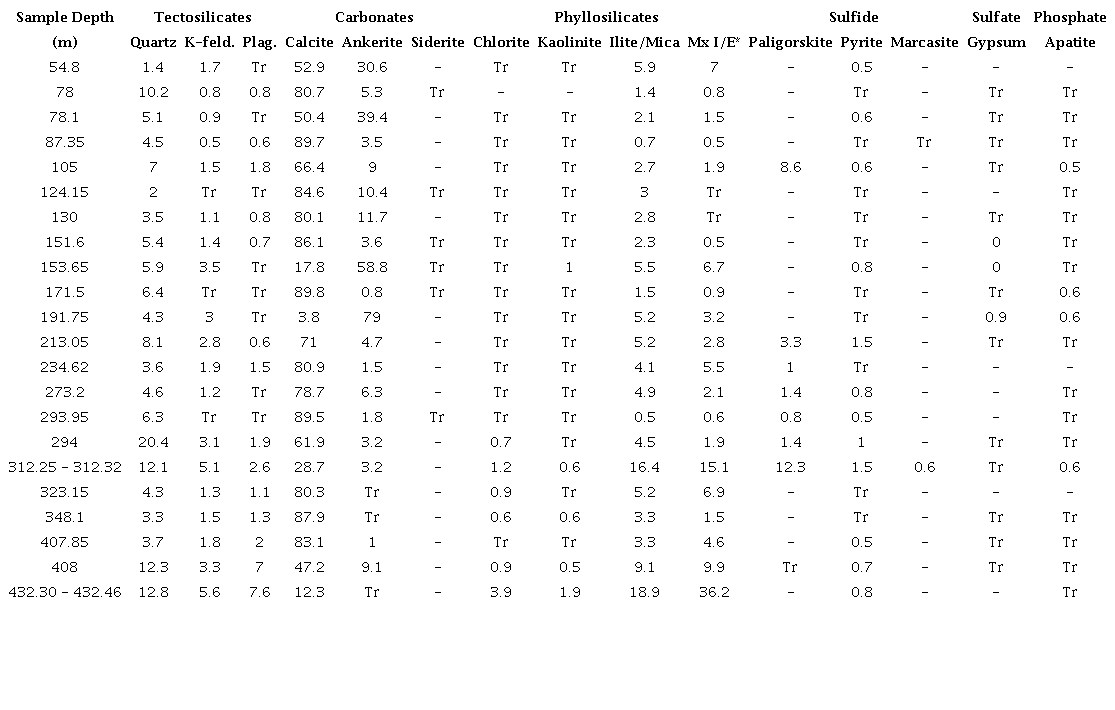
Bulk and clay diffractograms were evaluated using Jade software (MDI - Materials DataTM) with the PDF-4 + database (ICDD - International Centre for Diffraction Data), for a qualitative evaluation. TOPAS software (Coelho 2020) was used to quantify the minerals from the bulk analysis by Rietveld method, as this methodology is the most recommended to quantify crystalline phases. Whereas for clay diffractograms the quantification was performed by the Reference Intensity Ratio (RIR) method (Zhou et al. 2018). The RIR is a more traditional methodology and is based on measuring the intensity of one or more peaks for each mineral present and the added internal standard (Hiller 2000). Those intensity ratios are obtained by running homogeneous mixtures of the clay minerals with known concentrations and calculating ratio for each. Considering that, the ratios used should be the ones obtained in the exact equipment we run the experiment. RIR methodology was chosen for clay quantification as multiple diffractograms are generated for the clay analysis, and the peaks and areas selected for quantification are based on Moore and Reynolds (1997) and internal studies developed by Stratum Laboratories. Rietveld and RIR quantification were correlated to obtain the mineral percentages in the samples.
Scanning electron microscopy (SEM) is a method based on the emission of electron beams on a surface for imaging. Electrons interact with the sample producing various signals that can be used to obtain information about the surface of the sample. Rock fragments from the selected samples were polished to better expose the analyzed surface, then it was coated with gold by a metallization process. The metallization process initially clears the rock by an ionic discharge process and then performs a gold coating, which aims to improve the reading of the detector. The samples were analyzed with a FEI Model 200 Digital Scanning Electron Microscope and Oxford INCA Energy Dispersive Spectrometer (EDS). The images were generated using an Everhart-Thornley detector (ET detector) under high vacuum conditions and a low field Large Field Detector (LFD) with typical magnifications (at a working distance of 10 mm) ranging from 40X to approximately 6.000X.
3 Results
Samples were classified as sparse biomicrite, packed biomicrites, poorly washed bioesparite and dolostones, through microscopic description. The limestones are predominantly constituted by micrite with some non-carbonate content in the matrix (impure limestones), planktonic and benthic foraminifera, phosphatic fragments, quartz grains, feldspars, micas, and calcispheres as the most frequent particles in these rocks.
The carbonates were lithologically classified considering the terminology by Giannini (2000) as pure limestones, impure limestones, dolomitic limestones, impure dolomitic limestones, impure dolostone and impure calcitic dolostones. This mineralogical general composition is presented in Figure 1 using the X-ray diffraction data.
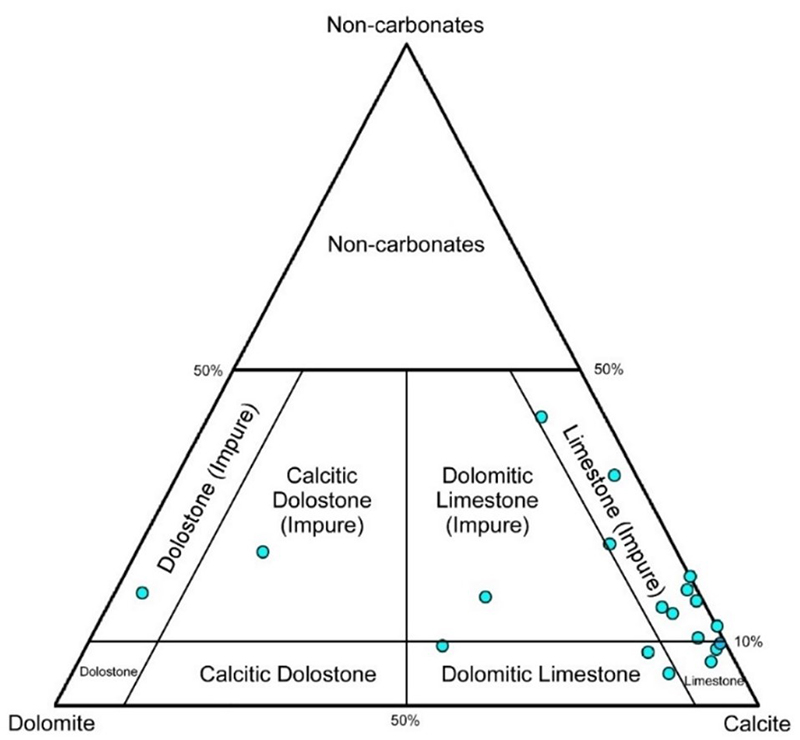
Figure 1
Compositional ternary diagram of carbonates from Cotinguiba Formation, considering Gianni (2000) terminology. Data based on X-ray diffraction.
The X-ray diffraction data confirmed the impurity of the limestones, consisting mainly of calcite (with contents of 50% to 90% of the bulk) with a variation in the clay mineral percentage of 1% to 20%. In the dolostones, between 59% and 79% of dolomite content can be observed with 13% and 8% of clay minerals, respectively. It was also observed the presence of quartz ranging from 4 to 20%, feldspar ranging from trace to 5%, and accessory minerals with trace contents such as siderite, apatite, pyrite, marcasite and gypsum. The dolomite present in all samples is ferroan dolomite (identified by x-ray analysis), a mineral of the group of dolomites previously known generically as ankerite, with ankerite currently reserved to the specimens having a Fe > Mg content.
The clay minerals identified in the carbonates were: (1) chlorite; (2) kaolinite; (3) illites and micas; (4) illite and smectite interstratified; and (5) palygorskite. The illites / micas and illites / smectite interstratified are the main clay minerals found, with contents varying from 1% to 16%. Palygorskite presence was evidenced in seven of the studied samples with levels ranging from trace to 12%. The chlorite and kaolinite have trace contents, and the main clay minerals are not present.
Clay minerals occurrences can be evidenced in different ways in the analyzed samples: (1) clay films disseminated in the matrix and covering bioclasts; (2) clay lenses forming irregular laminations; (3) clay sheets in the micrite; (4) clay grains with intragranular porosity (Figure 2).
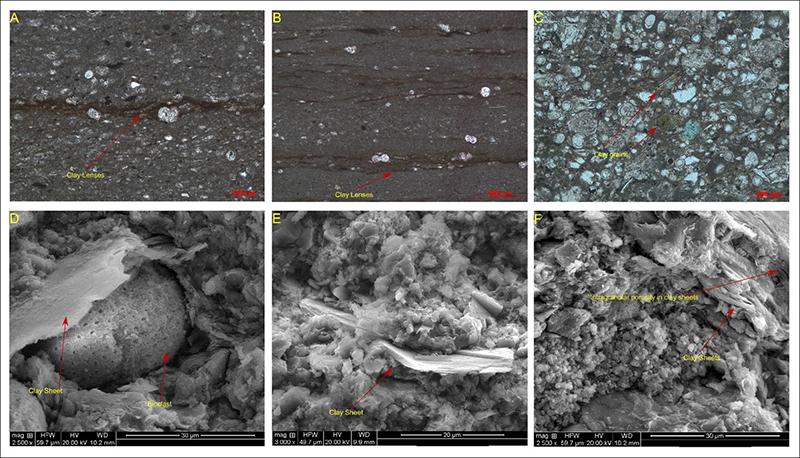
Figure 2
Different occurrences of clays in the carbonates: A. Photomicrography in parallel nicols, clay films covering bioclasts; B. Photomicrography in parallel nicols, clay lenses disseminated in the matrix forming lamination; C. Photomicrography in parallel nicols, with detailed view of clay grains; D. Backscattered SEM image of clay sheets covering bioclasts; E. Backscattered SEM image clay sheets in the micrite; F. Backscattered SEM image clay sheets with intragranular porosity.
Relationship between grain density and clay mineral content is presented in Figure 3. It shows that dolostones and dolomitic limestones keep high density (higher than 2.71 g/cm3) independent of the clay content. Pure limestones have a density of 2.69 and 2.70 g/cm3. with little contribution of the secondary mineral composition of these rocks.
Impure limestones have density ranging from 2.64 and 2.71 g/cm3. The mineralogical constitution of these rocks is more variable and there is no linear correlation between density decrease and increase of clay content. However, the following relations can be considered: limestones with less than 8% of clay maintain high densities between 2.70 and 2.71 g/cm3; and presence of palygorskite in the samples somewhat decreased the density of the samples, with values of 2.64 to 2.68 g/cm3.
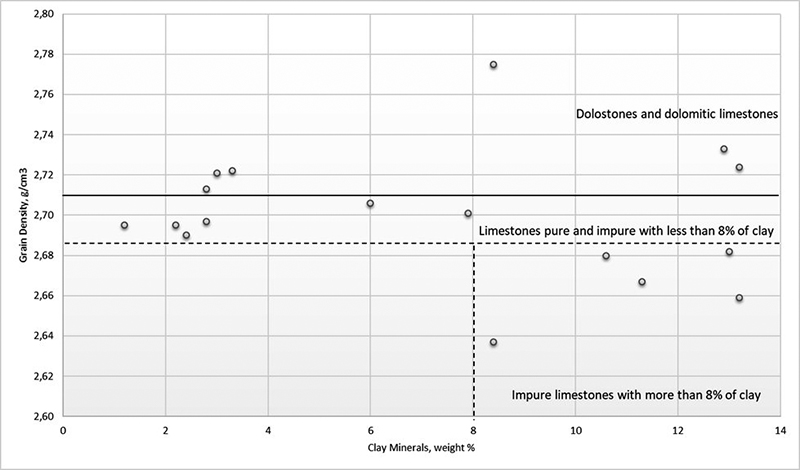
Figure 3
Relationship between grain density and clay mineral content. Presenting separation between dolostones and dolomitic limestones with densities higher than 2.71 g/cm3; pure limestones and impure limestone with less than 8% of clay and density ranging 2.69 and 2.71 g/cm3 impure limestone with more than 8% of clay and density ranging 2.64 and 2.69 g/cm3.
The pores observed by microscopy varies to fractures, interparticle, and moldic, with intercrystalline and intraparticle pores being the most common. The porosity of rocks is often reduced by calcite and pyrite cementation, and more rarely by gypsum, that is also observed replacing calcite present in fractures. The determination of porosity and gas permeability showed that the limestones analyzed had a percentage of effective porosity from 8.4% to 9.1%; in impure limestones it varied from 6.4% to 19.3%; in dolomitic limestones it varied from 8.6% to 19.8%, and dolostones have porosity of 18.4% to 19.1%. Despite the good pore quality of the samples, the permeability (k) values found were low, with values of k = 0.0056 mD to 0.0099 mD for limestones, k = 0.0038 mD to 0.3041 mD for impure limestones, k = 0.0081 mD to 0.0713 mD for dolomitic limestones, and k = 0.1859 mD to 0.0979 mD for dolostones (Figure 4).
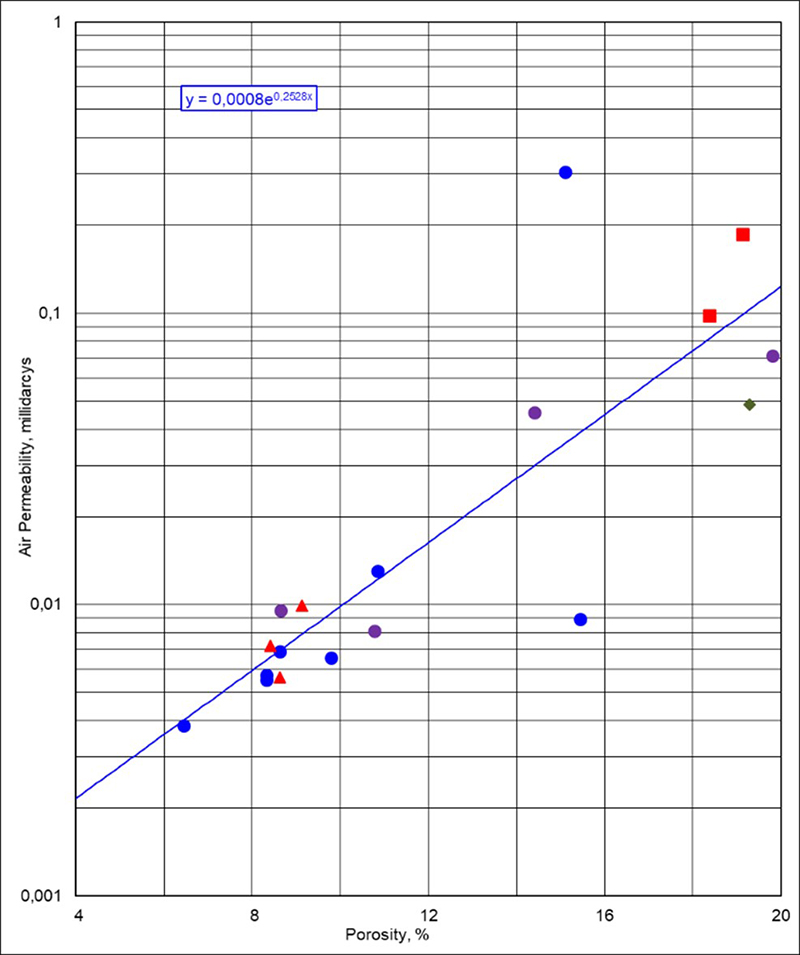
Figure 4
Cross plot between porosity (%) and permeability (mD) of limestone (blue circle), impure limestone (purple circle), dolomitic limestone (red square), impure dolostone (red triangle).
Even though clay content can influence porosity and permeability depending on amount, size and distribution, that characteristic was not observed in the samples analyzed. When correlating porosity data as a function of clay mineral percentages, the variation is not significant, demonstrating in some samples that high clay content does not mean low porosity (Figure 5). Figure 6 shows that the little relationship between clay mineral content and perm-porous properties extends to the permeability results, where it is observed that an increase in clay content does not have a linear impact to the permeability values.
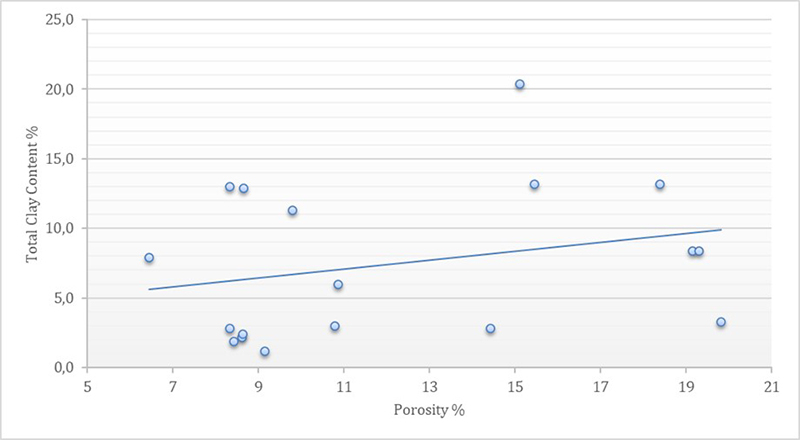
Figure 5
Relationship between porosity and clay mineral content. Presenting a nonlinear correlation between the clay content and porosity.
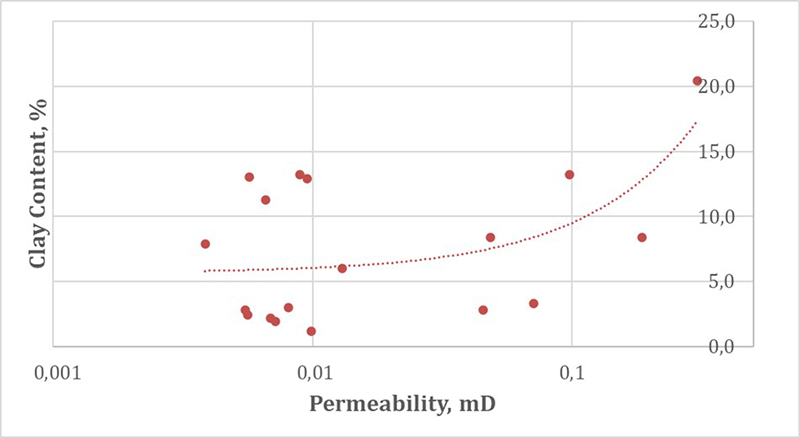
Figure 6
Relationship between porosity and clay mineral content. Presenting a nonlinear correlation between the clay content and porosity.
Pore Throat Radius distribution obtained by mercury injection was classified considering Carbonate Advisor (Schlumberger 2008) and Cantrell and Hagerty (1999), confirming the predominance of microporosity (smaller than 0.5 µm), with limestones showing percentages of 99% to 100% of micropores and dolostones with 98% to 99% of micropores (Figure 7). Three main types of microporosity were observed: porous matrix, porous grains (carbonate and siliciclastic), and cement with intercrystalline pores (Figure 8).
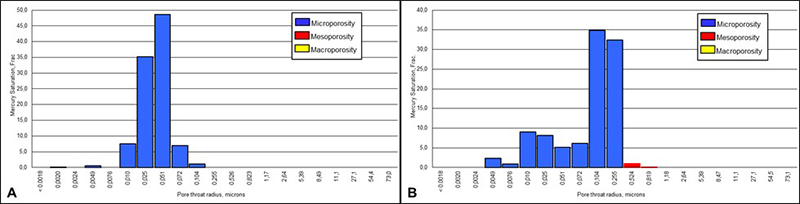
Figure 7
Histogram of limestone with: A. 100% microporosity; B. 99% microporosity and 1% mesoporosity.
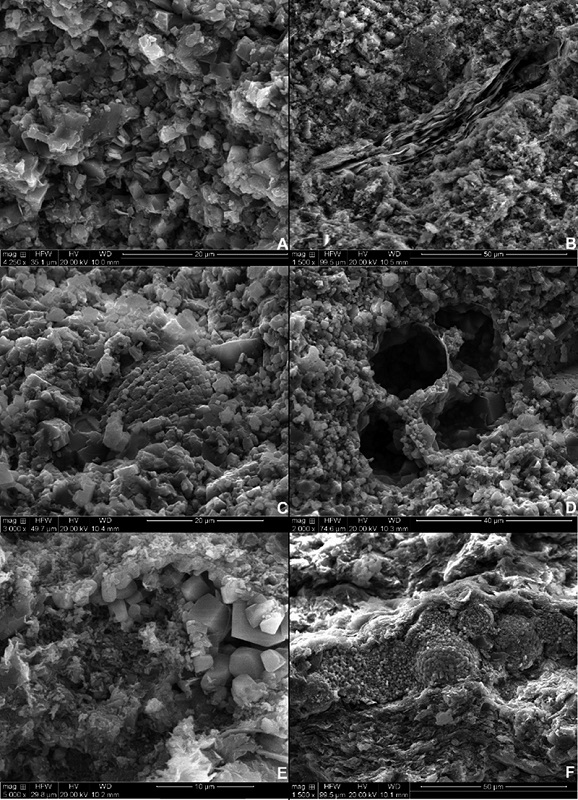
Figure 8
Backscattered SEM images with evidence of micropores: A. Porous matrix; B. Porous matrix with clay lenses with intragranular pores; C. Porous bioclast; D. Porous bioclasts with intragranular porosity; E. Calcite cement with intercrystalline pores; F. Framboidal pyrite cement with intercrystalline pores.
Eberli et al. (2003) demonstrated that the porosity type is one of the most important factors influencing the acoustic wave velocity in carbonates. Sonic velocity is a response related to the relationship between diagenesis and porosity, and in carbonates these velocities have a wide range in which the compressional wave velocity (Vp) can vary from 1700 to 6600 m/s, and shear wave velocity (Vs) from 600 a 3500 m/s.
As evidenced by Baechle, Eberli and Weger (2008), samples with more than 80% of microporosity display the lowest velocities at a given porosity. The microporosity can cause lowering in the velocity independent of the predominant mineralogy, for example the calcitic dolostone that could reach high velocity values if related only to its mineralogy, has a Vp of 3541 m/s. Similar results were observed by Baechle, Eberli and Weger (2008) where dolomites and packstones with high percentages of microporosity have velocities approximately 2500 m/s and 3000 m/s, respectively. Thus, the microporosity of the carbonates of this formation is a main characteristic to reduce the acoustic velocities not exceeding 5341 m/s for Vp and 3026 m/s for Vs.
Figure 9 presents the results of Vp and Vs of the studied rocks separated into two groups. Group I with Vp values less than 4500 m/s and Vs equal or less than 2500 m/s; and Group II with Vp higher than 4500 m/s and Vs higher than 2500 m/s.
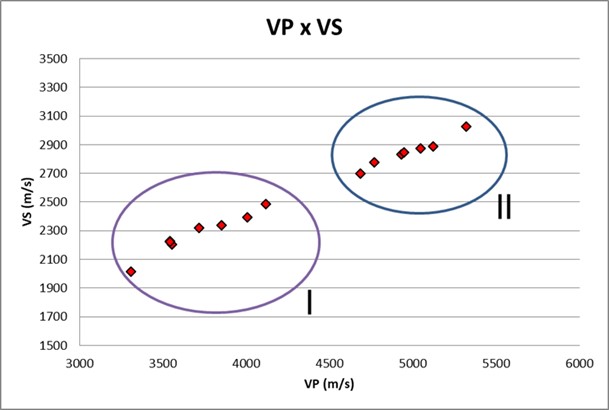
Figure 9
Graph Vp x Vs1 with separation of two identified groups.
Eberli et al. (2003) concluded in their study on the factors controlling elastic properties in carbonates, that siliciclastic content in carbonates is a much less important factor. Nevertheless, it was pointed in their paper that insoluble components (mainly clay) decrease velocity in carbonates and velocities faster than 4000 m/s are only reached if the clay content is below 5%.
Cross plot between clay mineral content and Vp showed that rocks with faster velocities have a clay mineral content lower than 3% (Figure 10). There is no linear relationship between the increase of clay minerals and their influence on velocity, but together with the other parameters, the argilosity of the carbonaceous rocks can influence the acoustic properties.
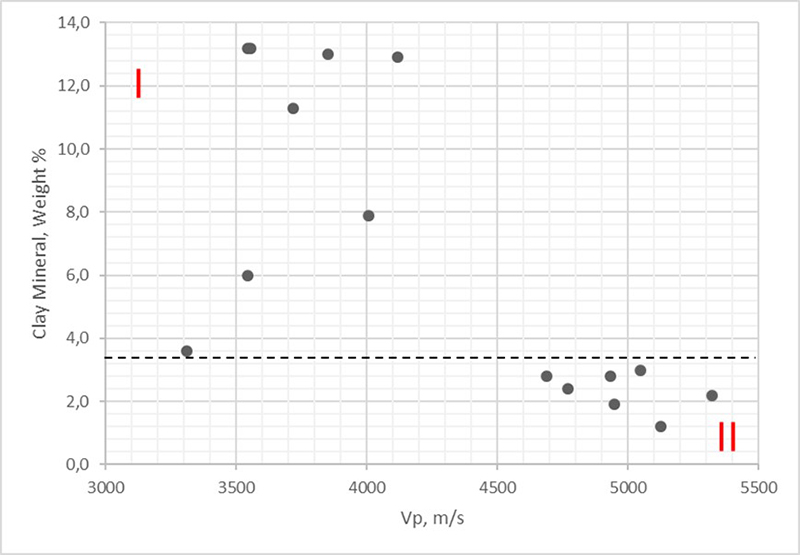
Figure 10
Relationship between clay mineral content and Vp, with separation of two identified groups.
4 Conclusion
The carbonate rocks from Cotinguiba Formation showed: (1) density of 2.70 and 2.71 g/cm3 due to the calcite and dolomite content; (2) good porosity of the rocks predominantly related to microporosity; (3) low permeability due to the low connectivity of these pores; and (4) acoustic waves segregated in two groups.
The presence of non-carbonate constituents in limestones and dolostones between 5% and 43% shows the importance of these minerals in the formation of the studied rocks. Through the results it was possible to confirm the influence of clay minerals on the physical and petrophysical properties of the carbonates from Cotinguiba Formation. The most abundant clay minerals in most rocks are illites/micas and interstratified illite/smectite, with the trace chlorite and kaolinite in most samples. The palygorskite was found in seven samples with varying levels of trace to 12%.
Clay significance was more evident in grain density and acoustic properties. The grain density variation in relation to clay mineral content was observed more significantly in impure limestones with a clay content higher than 8%, mainly in the samples that present palygorskite, with values varying between 2.64 and 2.68 g/cm3. Clay contents higher than 4% lowered acoustic waves Vp and Vs, that do not exceed 4100 m/s and 2480 m/s, respectively, in this case.
The correlation between clay content with porosity and permeability values showed that the influence of these minerals in micritic carbonaceous rocks does not have an inverse proportional linearity, and clay content is not a main factor in the decrease of porosity and permeability. However, SEM images showed the presence of clay sheets filling intercrystalline and intraparticle pores, as well as having intragranular pores between the clay sheets, demonstrating their influence on the predominant microporosity in these samples.
Therefore, we managed to show here that the presence of clay minerals in the carbonate rocks of the Cotinguiba Formation is common and with a differentiated mineralogical variation, having palygorskite in part of the samples. The petrophysical and physical properties of these samples do not vary directly or inversely proportional to the increase of the mineral content of clay, but they influence mainly density and acoustic velocities.
5 References
Baechle, G.T., Eberli, G.P. & Weger, J. 2008, 'Effects of microporosity on sonic velocity in carbonate rocks', The Leading-Edge Special Section: Carbonates, vol. 27, no. 8, pp.1012-8, DOI:10.1190/1.2967554.
Bandeira Jr., A.N. 1977, 'Sedimentologia e microfacies calcárias das Formações Riachuelo e Cotinguiba da Bacia Sergipe/Alagoas', Dissertação de Mestrado, Universidade de São Paulo.
Campos Neto, O.P.A., Lima, W.S. & Cruz, F.E.G. 2007, 'Bacia de Sergipe-Alagoas', Boletim de Geociências Petrobrás, vol. 15, no. 2, pp. 405-15.
Cantrell, D.L. & Hagerty, R.M. 1999, 'Microporosity in Arab Formation Carbonates, Saudi Arabia', GeoArabia, vol. 4, no. 2, pp. 129-54.
Carbonate Advisor Schlumberger 2008, Quantitative producibility and textural analysis for carbonate reservoirs, viewed 05 Maio 2017, <Carbonate Advisor Schlumberger 2008, Quantitative producibility and textural analysis for carbonate reservoirs, viewed 05 Maio 2017, https://www.slb.com/-/media/files/fe/brochure/carbonate-advisor-br>.
Coelho, A.A. 2020, TOPAS - Academic Technical Reference Version 7, Bruker-AXS, viewed 05 Maio 2017, < 2020, TOPAS - Academic Technical Reference Version 7, Bruker-AXS, viewed 05 Maio 2017, http://www.topas- academic.net/Technical_Reference.pdf>.
Eberli, G.P., Baechle, G.T., Anselmetti, F.S. & Incze, M.L. 2003, 'Factors controlling elastic properties in carbonate sediments and rocks', The Leading Edge, vol. 22, no. 7, pp. 654-60.
Feijó, F.L. 1994, 'Bacia de Sergipe e Alagoas', Boletim de Geociências Petrobrás, vol. 8, pp. 149-61.
Flügel, E. 2004, Microfacies of Carbonate Rocks. 2nd edn, Springer, Heidelberg.
Giannini, P.C.F. 2000, 'Depósitos e rochas sedimentares', in W. Teixeira, T.R. Fairchild, M.C. Toledo & F. Taioli (eds), Decifrando a Terra, Editora Oficina de Textos, São Paulo, pp. 301.
Hiller, S. 2000, 'Accurate quantitative analysis of clay and other minerals in sandstones by XRD: comparison of a Rietveld and a reference intensity ratio (RIR) method and the importance of sample preparation', Clay Minerals, vol. 35, no. 1, pp. 291-302.
Koutsoukos, E.A.M. 1989, 'Mid- to Late Cretaceous microbiostratigraphy, palaeo-ecology and palaeogeography of the Sergipe Basin, northeastern Brazil', Tese de Doutorado, University of Plymouth Research Theses.
Monteiro, R.S., Favoretto, J., Lopes, J.N. & Borghi, L. 2019, 'Análise Microfaciológica de uma Seção em Testemunho da Formação Cotinguiba, Cretáceo da Bacia de Sergipe-Alagoas', Geociências, vol. 38, no. 2, pp. 391-407, DOI:10.5016/geociencias.v38i2.12432.
Moore, D.M. & Reynolds, R.C. 1997, X-Ray Diffraction and the Identification and Analysis of the Clay Minerals, Oxford University Press, Oxford.
Morschbacher, M.J., Vasquez, G.F. & Justen, J.C.R. 2010, 'Metodologias de estimativa das velocidades sísmicas em ensaios de laboratório', 4º Simpósio Brasileiro de Geofísica, Brasília.
Schön, J.H. 2014, Propriedade Física das Rochas Aplicadas à Engenharia, Elsevier, São Paulo.
Spadini, A.R. & Marçal, R.A. 2005, 'Porosidade em reservatórios carbonáticos: algumas considerações', Boletim de Geociências da Petrobras, vol. 13, no. 1, pp. 129-38.
Toledo, P.G., Scriven, L.E. & Davis, H.T. 1994, 'Pore-Space Statistics and Capillary Pressure Curves from volume-controlled porosimetry', SPE Formation Evaluation, vol. 9, no. 1, pp. 46-54.
Zhou, X., Liu, D., Bu, H., Deng, L., Liu, H., Yuan, P., Du, P. & Song, H. 2018, 'XRD-based quantitative analysis of clay minerals using reference intensity ratios, mineral intensity factors, Rietveld, and full pattern summation methods: a critical review', Solid Earth Sciences, vol. 3, no. 1, pp. 16-29.
Funding information
Data availability statement
Author notes
E-mail:luz.clarissa@hotmail.comE-mail:gerson@acd.ufrj.brE-mail:mcd.marilea@gmail.com
Conflict of interest declaration