ARTIGO
GAME MECHANICS FOR STORYTELLING TO SUPPORT STUDENTS WITH DYSLEXIA: TEACHERS AND STUDENTS’ PERSPECTIVES
MECÁNICA DE JUEGO EN NARRATIVA PARA APOYAR A ESTUDIANTES CON DISLEXIA: PERCEPCIONES DE ALUMNOS Y PROFESORES
MECÂNICA DE JOGO EM NARRATIVA PARA APOIO DE ALUNOS COM DISLEXIA: PERCEPÇÕES DE DISCENTES E DOCENTES
 Jailma Bulhões Campos
Ana Margarida Pisco Almeida
Jailma Bulhões Campos
Ana Margarida Pisco Almeida
GAME MECHANICS FOR STORYTELLING TO SUPPORT STUDENTS WITH DYSLEXIA: TEACHERS AND STUDENTS’ PERSPECTIVES
Revista Práxis Educacional, vol. 17, no. 45, pp. 195-218, 2021
Universidade Estadual do Sudoeste da Bahia
Received: 15 September 2020
Accepted: 05 December 2020
Abstract: This paper presents the development and testing process of a gamified storytelling tool aimed to support students with dyslexia. Motivation, engagement and learning were the domains measured from the students and teachers’ perspectives, considering their feedback gathered with scales and opened interviews. Interviews were registered in audio after testing of the prototype, transcribed and analysed using the content analysis technique, and scales were also applied after testing. The design process of the gamified prototype is presented, highlighting its framework, design principles and game strategies. The main findings show that the game design elements applied to the prototype contributed to the motivation and engagement of the students and also provide indications of learning outcomes.
Keywords: Gamified storytelling, Game mechanics, Learners with dyslexia.
Resumo: Este artigo apresenta o processo de desenvolvimento e testagem de um protótipo de uma narrativa gamificada, que visa apoiar a aprendizagem de leitura de alunos com dislexia. Motivação, engajamento e aprendizagem foram os domínios medidos a partir das perspectivas dos participantes coletados por meio de escalas e entrevistas abertas. Os dados das entrevistas foram registrados em áudio após a testagem do recurso e, posteriormente, transcritos e analisados por meio da técnica análise de conteúdo. Quanto as escalas, estas foram aplicadas após a testagem. São apresentados o processo de design, destacando o framework e os princípios e estratégias de game utilizados. Os resultados principais mostram indicadores da contribuição dos elementos de jogo aplicados ao recurso para os domínios avaliados.
Palavras-chave: Narrativa gamificada, Mecânicas de jogo, Aprendentes com dislexia.
Resumen: Este artículo presenta el proceso de desarrollo y prueba de un prototipo de narrativa gamificada que tiene como objetivo apoyar el aprendizaje de la lectura de estudiantes con dislexia. La motivación, el compromiso y el aprendizaje fueron los dominios medidos desde las perspectivas de los participantes recogidas a través de escalas y entrevistas abiertas. Los datos de la entrevista fueron grabados en audio después de la prueba del recurso y, posteriormente, transcritos y analizados mediante la técnica de análisis de contenido. En cuanto a las escalas, estas se aplicaron después de la prueba. Son presentados el proceso de diseño, destacando el marco, y los principios y estrategias del juego utilizados. Los principales resultados muestran indicadores de la contribución de los elementos del juego aplicados al recurso para los dominios evaluados.
Palabras clave: Narrativa gamificada, Mecánicas de juego, Estudiantes con dislexia.
Introduction
Motivation and engagement are the main goals in using gamification (KAPP; BLAIR; MESCH, 2014; ZICHERMMAN; CUNINGHAN, 2011). Gamification is about the use of game mechanics and game thinking in non-game contexts (DETERDING; DIXON; KHALED; NACKE, 2011) to any projects, even in education (WERBACH; HUNTER, 2012). According to Kapp (2013), this strategy can improve learners’ performance in learning. The purpose of the work described in this paper is to understand if the use of a game design strategy can help adolescent Brazilian students with dyslexia to be motivated and engaged in a reading activity, and also to verify if it helps to increase students’ awareness about their dyslexic difficulties.
Gamification is not about points, badges, leader boards or programs that help students to have fun or fulfil activities at school; instead, it is about being involved with compromise and feeling motivated (VILLAGRASA; FONSECA; REDONDO, 2014). In the specific case of students with dyslexia, motivation is essential because these learners are constantly feeling demotivated in academic activities (CARVALHAIS, 2010). Hence, they need to feel they can overcome their difficulties in reading, to develop new skills and learn new skills.
This paper presents a study developed with students with dyslexia and teachers of special education of two schools located in the city of Belém, in Brazil, and describes part of a PhD research entitled Gamification in the learning of reading of Brazilian Students with dyslexia, developed in the Doctoral Programme of Multimedia in Education of Aveiro University, Portugal. Its methodology applied is qualitative: scales and opened interviews were applied aiming to get feedback of the participants about the test of a prototype described as a gamified storytelling tool. Specifically, the study aimed to understand if: (i) the inclusion of game design elements provides more engagement and motivation; (ii) the use of a gamified storytelling contributes to students’ learning. Data was collected through the students and teachers’ perspectives about the game mechanics used in the prototype.
The first section of this paper presents a briefly overview about the concept of gamification, research on gamification and dyslexia, and game design elements. Section named Procedures and Study Design includes the design of the prototype - a gamified storytelling resource. The main results are present subsequently; and a discussion and conclusions about the participants understanding of the contributions of the game mechanics to motivation, engagement and learning is presented in the last session.
Gamification
Concept of gamification
The basic idea of gamification refers to the use of game elements in non-game contexts (DETERDING; DIXON; KHALED; NACKE, 2011), for other non-entertainment purposes and with other aims besides the game itself (SAILER; HENSE; MANDL; KLEVERS, 2013). In this definition, three important components may be outlined, as described below.
-
- Game elements: games are composed by essential elements found in several kind of games (SIMÕES; REDONDO; VILLAS, 2015), and help to distinguish gamification from serious games (SAILER; HENSE; MANDL; KLEVERS, 2013);
-
-Non-game contexts: the area of the use of gamification is broad, therefore, gamification involves the application of game mechanics in various areas as marketing, business and education (WERBACH; HUNTER, 2012;ALVES, 2014);
-
-Non entertainment purposes: gamification is used with diverse aims making this strategy different of common games (SAILER; HENSE; MANDL; KLEVERS, 2013).
This concept helps to understand that gamification does not refer to a complete game (DETERDING; DIXON; KHALED; NACKE, 2011), being necessary to differentiate it from “other concepts related to gaming and provides a basis for investigations without constricting the phenomenon” games (SAILER; HENSE; MANDL; KLEVERS, 2013, p. 30). The purpose in using gamification is, therefore, to use game mechanics, dynamics and aesthetics to promote users’ motivation and engagement (ZICHERMMAN; CUNINGHAN, 2011), in solving problems, and also too support learning (KAPP; BLAIR, 2014). Gamification is an instrument focused on people and supposed to be an effective strategy to explorer the levels of engagement of an individual and, so that foster motivation (KAPP, 2013; WERBACH; HUNTER, 2012).
Research on gamification and dyslexia
According to Marques (2014), games are seen as relevant tools to support the learning process of students with dyslexia, since they can contribute to the development of reading skills. In the educational field there are various works describing games potential to support children/teenagers with dyslexic difficulties to overcome their literacy difficulties.
Specifically, literature show how video-games can help in reading accuracy and attention (FRANCESCHINI et al., 2015), and in supporting grapheme-phoneme correspondences skills of decoding and second-grade learners with impairment in reading (RONIMUS; EKLUND; PESU; LYYTINEN, 2019). The serious games have also been described as important tools to detect dyslexic difficulties in pre-readers (GAGGI et al, 2012), as well as the game apps to perform phonological exercises (RELLO; BAYARRI; GORRIZ, 2012) and the web-based games to early identifying dyslexia (RELLO et al, 2016).
Despite these findings, there is a restricted number of studies focusing on game design when describing gamification solution to support the learning process of students with dyslexia. Authors as Gooch, Vasalou and Benton (2016) used the platform ClassDojo with children with dyslexia in order to verify how gamification can provide learner’s motivation due to the pedagogic appropriation and creative use of the platform by teachers. Also, Saputra (2015) created a gamified tool named Lexipal to foster engagement of children with dyslexia. Rello et al (2016) with the purpose of predicting risk of dyslexia in Spanish children also tested an online gamified tool. Additionally, the company Learning Dragon announced, in 2018, the creation of gamified platform - dyslexia dragon- with the purpose of helping learners with dyslexia in reading and spelling skills (KRONK, January 11, 2018)
In view of the contributions presented above, there are reasons to deepen knowledge on the role of gamification to help students with dyslexia, namely as a learning strategy to: promote motivation and engagement (ZICHERMMAN; CUNNINGHAN, 2011); monitor and assess learning achievements of students’ engagement in learning of reading skills (SAPUTRA, 2015); and support reading in a faster and efficiently manner (FRANCESCHINI et al., 2015).
It’s, therefore, important, to better understand how gamification can be used in special education as an effective tool to monitor and assess learners’ difficulties and needs and to improve their skills. Gamified should be tested in order to ensure that they are aligned to pedagogic purposes, and that they present effective contributions to affective and learning achievements.
Materials and Methods
Case Selection: participants
The study design that supported the research presented in this paper was based on an immersive process developed with 4 participants: two adolescent Brazilian students with dyslexia of two Brazilian Elementary Schools and four teachers, aimed to conceptualize and test a gamified storytelling tool.
Study Design
This study follows a qualitative approach, which means it is interested on creating meaning as a central concept (COUTINHO, 2016), and on building of meanings in the context investigated. Its main methodological inspiration is Design Thinking, an iterative and human-centred approach applied to define solutions with the purpose of solving problems (CARROL, 2014). The research process was conducted in four adapted phases, as seen in figure 1:
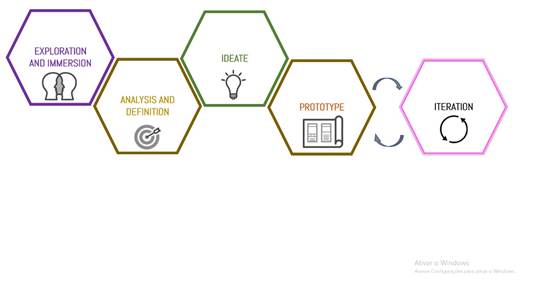
Figure 1
Research phases
Source: Elaborated by the authors
These phases represent the process of creation of a gamified prototype and each one of them fulfilled specific functions, as shown in table 1:

Source: Elaborated by the authors
The phases of the whole process resulted in the creation and testing of a prototype of a gamified storytelling.
Data Collection
Participants took part in sessions of activities during the prototyping phase of the gamified tool. Along with these sessions, questionnaires and opened interviews were applied after testing the digital-version of the prototype.
These instruments were used to collect the participants’ perspectives. Interviews were conducted to assess the use of game elements, as challenges and levels/progression, feedback reaction, etc. Interviews were recorded in audio and subsequently transcribed. They lasted between 12-20 minutes each one.
Data Analysis
In the questionnaires’ analysis, values were assigned to each agreement according to table 2:

Source: Elaborated by the authors
Data was tabbed by using simple statistics with the agreement value multiplied by the number of answers received, and also the agreements average.
As to opened interviews, the content analysis technique (BARDIN, 2009) was used in three analytical phases: pre-analysis, material exploration and results treatment and interpretation.
The first phase permitted us to develop the indicators, that is, the theme elements that were frequently repeated over the text that would enable us to discuss the results.
In second stage, with the purpose to understand the meaning ascribed to the data, after proceeding with exploration of the data, it was possible,
to stablish two main classifications: (i) the recording units - sentences related to the perceptions of the students repeated throughout the text, which allows to trace thematic units about the investigation; and (ii) the context units - the text segments used as unit of comprehension to identify the sentences defined as recording units;
To enumerate the recording units. This process was developed by quantifying the presence or absence of units.
To categorize the content, an operation was used to classify the units in classes that bring together data information for each conception and organize the messages (BARDIN, 2009). Category system was defined in the process of treatment of results and interpretations. The study allowed to build sub-categories emerged from the content. The frequency of indicators of the categories was identified.
The Gamified prototype
Type of tool: a storytelling gamified
A narrative named Piazinho em uma Aventura com Seres Fantásticos da Amazônia (Piazinho in an adventure with fantastic beings of the Amazon) was created. It is based on Amazon legends, as MatintaPerera, Fogo do Campo, Mãe D’agua and Boitatá stories. Its main character is named Piazinho, a slender boy whose adventures in the small village Caetés help to show the importance of protecting forest and its flora. The story is divided in 13 main chapters and three bonus scenes.
This narrative plays an important role, since it is the foundation on the resource. From specific chapter seven challenges were created to help students with reading skills, as summarized in table 3:
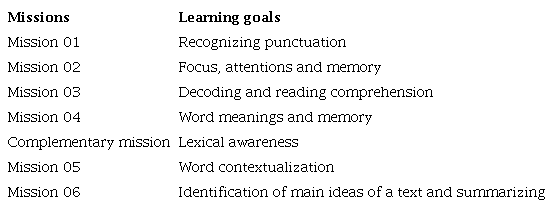
Source: Elaborated by the authors
In the final of each mission, students get a verbal feedback of the tool in three different ways: verbal incentives, with the purpose of keep them in game, badges and punctuations, representing achievements, and hints, giving them suggestions about a better production.
The framework
The creation of this prototype was inspired by the design framework of Werbach and Hunter (2012) namely in what concerns the implementation of the gamification design. Figure 2 presents our basic framework:
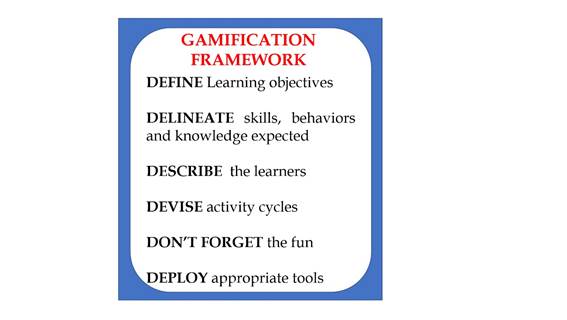
Figure 2
The Design Framework
Source: Elaborated by the authors
The framework generated a gamified design founded in six actions:
-
DEFINE learning objectives: provide motivation and engagement and expand student’s awareness about their reading difficulties;
-
DETERMINE skills, behaviour and knowledge aligned with learning goals;
-
DESCRIBE learners, which included the type of players they are;
-
DEVISE activity loops of fun: mobilized the creation of challenges and levels of difficulties;
-
DON’T FORGET the fun allowed the accomplishment of features as, collections of badges, progress display, which help student to keep engaged; creation of challenges; use of rewards, as points and badges; constant feedback; and inclusion of a learning curve (challenges with different levels of difficult);
-
DEPLOY the gamified system, which consists in the creation of the structure and content of the gamified storytelling. This whole work allowed the creation of a paper-version prototype and, subsequently, a digital version one.
Gamification design
Table 4 presents design principles of game strategies and game mechanics used in the gamified prototype:
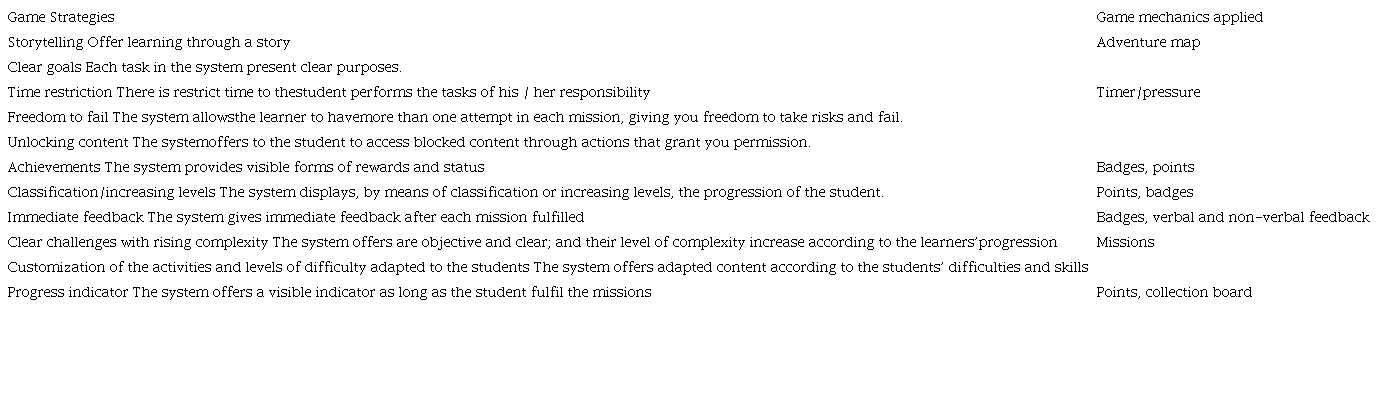
Source: Elaborated by the authors
Structure of the Narrative Journey was also produced, as presented in figure 3:
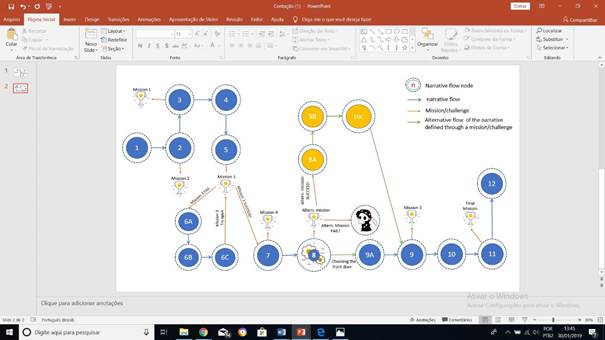
Figure 3
Narrative journey
Figure 3 illustrates the structure of the whole gamified tool, in which circles represent the chapters, trophies pose the missions, figure of death symbolizes fail and narrows represent ways. The figure also demonstrates tan alternative path with alternative chapters signalized by the orange circles.
The gamified tool prototypes
Prototyping is consolidating, what involves getting ideas and making them tangible and actionable (SCHEER; NOWESKI; MEINEL, 2012). As result of this designing iterative process, a gamified storytelling tool was produced.
The prototypes were developed using a three-stage approach: consolidation (the creation of the concrete prototype), test (with the purpose to provide feedback, in order to know what work or not and then iterate and redefine the prototype) and evaluation (which provided participants’ assessment of the prototype by the application of interviews). As main results, two subsequent versions were created, as described in the next paragraphs:
#1. Paper-version prototype
This version provided the elements would be used in the final version as follows:
- The adventure map produced based on the narrative journey planned, as seen in figure 4:
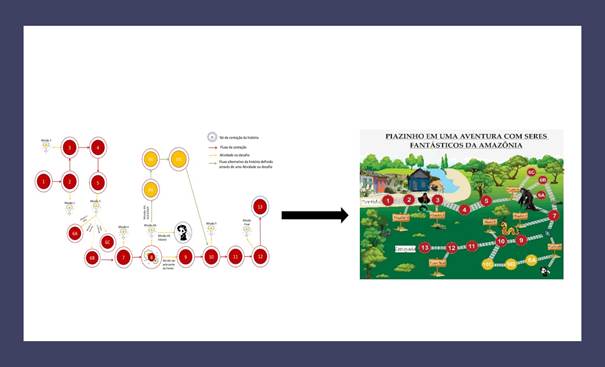
Figure 4
Adventure map
- A main character avatar, the badges, the achievements representation, and the collection map were also produced, as shown in figures 5:
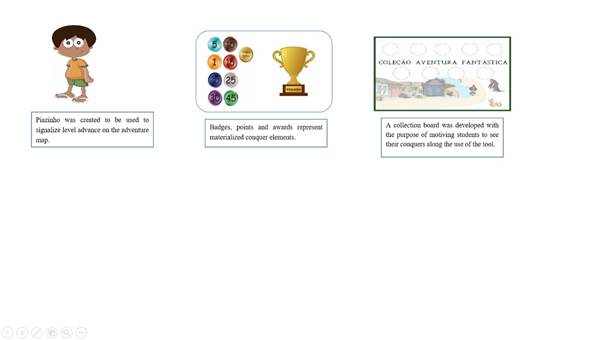
Figure 5
Paper-version prototype tools
All of these tools were printed in paper in order to test with the same participants. This test was recorded in video, but those findings are not focused in this article. It is important to say that participants contributed with information to the next step of prototyping.
#2 Digital-version prototype
The final prototyping resulted in a digital gamified storytelling, which can be downloaded and locally accessed at a computer. In this version, an adventure map is showed as the menu, a kind of game board from which each chapter of the story is reached, as illustrated in figure 6.
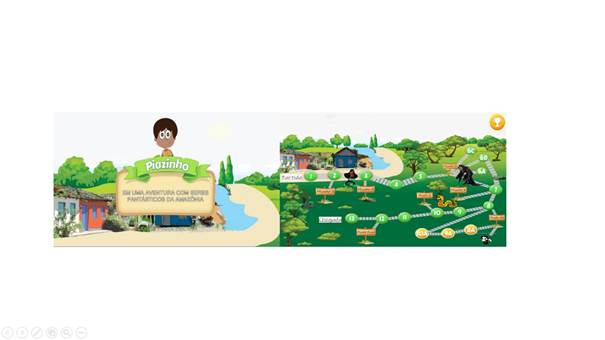
Figure 6
First page of the Digital gamified storytelling
Source: Elaborated by the authors
After the creation of the prototype, the testing stage was conducted. Different iterations took place, allowing testing and getting feedback of students and teachers about the prototype in order to redefine it.
Results
This gamified tool was created according to students reading experience and difficulties; hence it is adapted to their skills and reading level. Along testing, they were challenge to face their difficulties when trying to comply with the missions. In order to help them in this goal, teachers assumed the hole of guides by helping in word recognition, text and missions’ comprehension, and mainly giving sustained feedback.
Tests were developed in a reading process split in three steps:
Pre-reading: it was made prediction about theme and content, and activation of previous knowledge from the application of activities with figures and title analysis;
Reading: this part meant the reading of the chapters and accomplishment of all missions;
Post-reading: application of scales and interviews, in order to get participants evaluation.
Tests mainly provided participants evaluation about the contributions of game mechanics to affective and learning domain.
Questionnaires’ results
Questionnaires’ were applied only to the students. Data was tabbed by using simple statistics with the agreement value multiplied by the number of votes received, and also the agreements average.
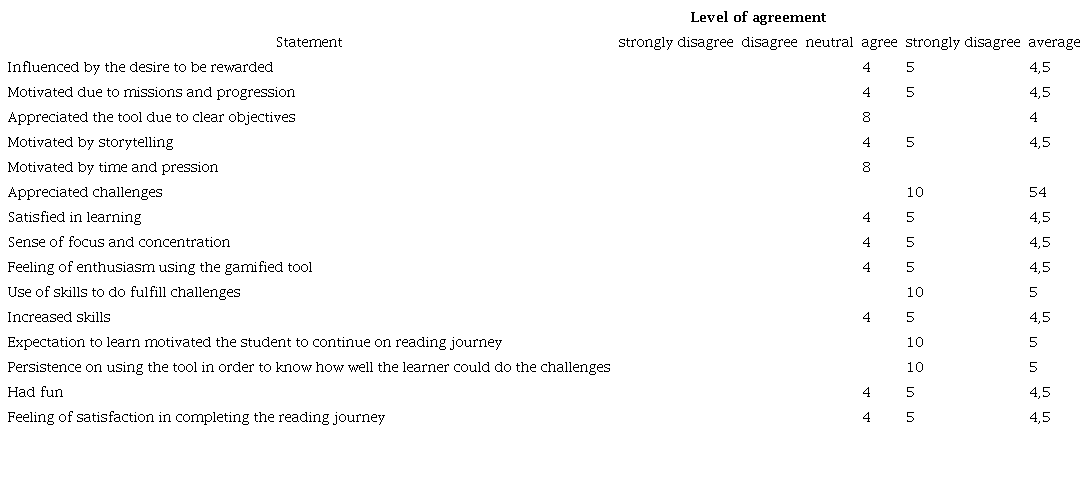
Table 5 summarizes results of motivation and engagement scale:
Source: Elaborated by the authors
As evidence, motivation and engagement are on average from 4 to 5: these results are perceptibly positive representing students’ agreement with statements about contributions of the gamified storytelling to the affective domain.
Table 6 presents results of students’ perceived learning scale:

Source: Elaborated by the authors
Findings of table 6 reveal an average from 3,5 to 5, demonstrating more agreement with the statements. Student of Case 01 could not give opinion about two statements ‘Connect parts of the text’ and ‘Use of adjectives in description text’; hence she selected the neutral value. Most of values express agreement, that is, a positive evaluation about the contribution of the gamified storytelling to learning.
Open-ended interviews results
This instrument was applied to teachers and students, since it was aimed to know their verbalization about the use of the tool.
The results of the content analysis for students and teachers are presented in tables 7 and 8. Shortened terms are used in tables in order to identify the participant’s frequency of utterances: S1 (student 1), S2 (student 2), T1 (teacher 1) and T2 (teacher 2):
STUDENTS
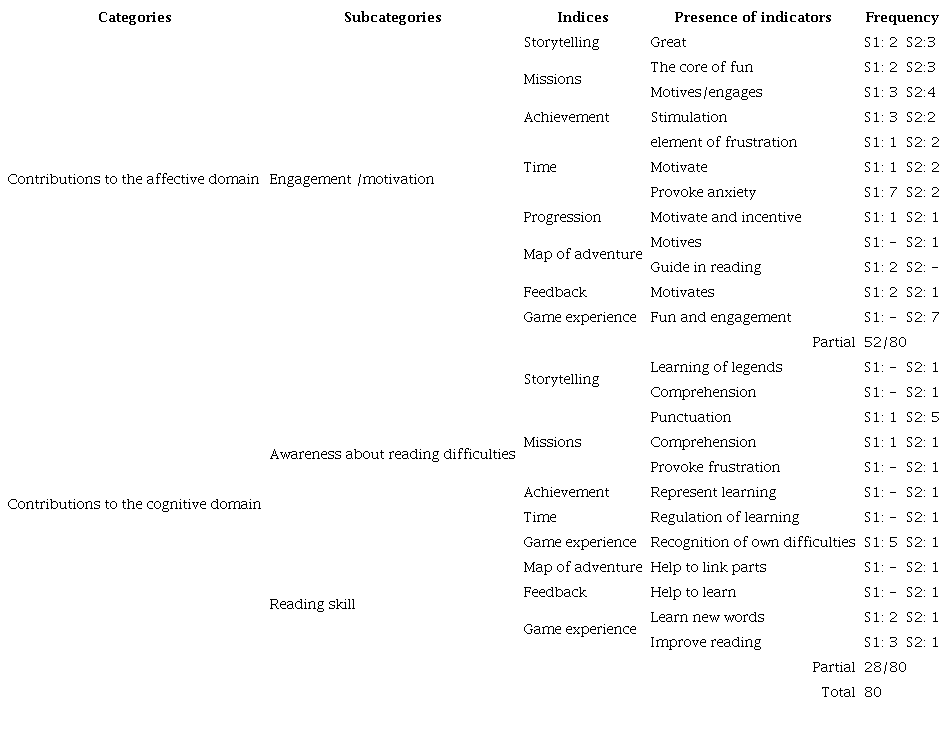
Source: Elaborated by the authors
TEACHERS

Source: Elaborated by the authors
Comparing data in table 7 allows verifying that some frequencies detach the type of game design element that seems to contribute more to motivation and engagement: missions, at first, and subsequently storytelling, game experience and time. Regarding the cognitive domain, student 1 reveals more awareness about her difficulties along the use of the prototype than student 2. The latter was able to relate the game elements individually, at least once, with some types of learning.
In table 8, the most prominent findings in teachers’ verbalization demonstrate that these participants perceived more contributions of game mechanics to motivation and engagement than to reading learning.
Discussion and conclusions
Participants were able to assess the contributions of the game mechanics applied to the prototype from their experience to the cognitive and affective domain.
Interpretations and Inferences
Returning to the central questions of this work, it is possible to say that results provided suggestive answers about the application of a lay of game elements/structure to a narrative to the motivation/engagement and learning. Therefore, let is focus on these main domains below.
Contributions to the affective domain
In both scale and opened-interview, students were able to have a sense of enjoyment and motivation by exploring the gamified tool and progressing through chapters representing levels. As widely discussed in literature of gamification in education (ZICHERMMAN; CUNNINGHAN, 2011; LI; GROSSMAN; FITZMAURICE, 2012; DETERDING; DIXON; KHALED; NACKE, 2011), this strategy is used to foster motivation and engagement. Hence, in the context of special education, it was scrutinized how individual game elements impact of students’ motivation and engagement.
Analysis of scales indicates that students perceived this application of gamification as providing strong motivational effects. In the course of the analysis, it was identified that all the game strategies used positively influenced motivation in that particular teaching environment. Thus, the tool seems to have potential to increase affective domain, mainly as for fun and enjoyment.
In general, participants commented that the game and the storytelling were fun and interesting as a reading activity, as presented in table 9:

Source: Elaborated by the authors
References to fun in these kind of tools reveals the test of the gamified tool as an enjoyable experience, and this exactly what was planned to this tool to be for the participants. According to Zichermman and Cunninghan (2011), fun must be the first the “job #1” when planning an educational resource, in order to provoke this sensation of enjoyment.
As these students have reading impairments, one of the main purposes of this work was add a lay of game mechanics to try to give fun to an academic practice. However, diversion is not the core of this proposal, it is about to make reading more effective. Additionally, Alves (2014) claims that diversion can be associated with engagement and motivation to learning, therefore the use of game design to try to become a reading activity funnier seemed successfully achieved in these gamified prototype’s tests.
Content analysis allowed to comprehend how the gamified tool influenced positively students along the use of the prototype. Some positive words/expressions were highlighted in verbalizations, as shown in figure 7:
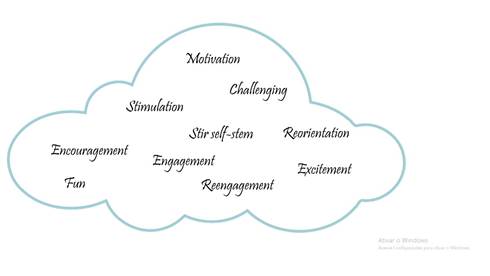
Figure 7
Positive words of the use of the gamified storytelling
Source: Elaborated by the authors
These kind of utterances from participants’ evaluation were related to game elements, as missions, achievement, time, progression, map of adventure, feedback and also to the game experience itself. These game mechanics are the tools that yielded “meaningful responses (aesthetics)” (ZICHERMMAN; CUNINGHAN, 2011) from the students. Learners perceived themselves as motivated and engaged in the process, as seen in table 10:

Source: Elaborated by the authors
Although students with dyslexia have impairments in reading (CARVALHAIS, 2010), learners during this study showed to be perseverant in tasks and made effort to use organizational and memory skills when testing the prototype, which demonstrate their engagement in doing the missions and fulfil the whole narrative journey.
These tools offered by gamification make students “forwards and become more interested and stimulated to learn” (MUNTEAN, 2011) that is, according to students’ perspectives, gamification turned reading more fun and engaging.
Both students declared they were very happy with the narrative itself because it was interesting and about Amazon legends, which helps to conclude that offer a story is one of most important aspects of a game design (DIANA; GOLFETTO; BALDESSAR; SPANHOL, 2014)
Additionally, teachers, as mediators and advisors in testing of the prototype, also made considerations as presented in table 11:

Source: Elaborated by the authors
These utterances reveal teachers’ perspectives about two important points:
-
how the game mechanics harmonically work to motivate learners to focus on the process and progress (MUNTEAN, 2011);
-
the feeling of failure (MUNTEAN, 2011), that is, to feel free to fail and to be (re) motivated and engaged in the process from the feedback.
Hence, the primary game elements added to the prototype were able to work properly to increase student’s interest in the reading activity. Nonetheless, learner’s perception about the gamification needed to be more researched in order to help us to better understand the of the effect of game structures in motivation and engagement.
b) Contributions to the cognitive domain
When studying gamification, it is more common to research about the effective contributions to the affective domain; nevertheless, this strategy can also help in the process of learning. Therefore, as for the knowledge learning outcomes (SCHMITIZ et al, 2012) results show that students perceived contributions to awareness about reading difficulties, as seen in table 12:

Source: Elaborated by the authors
The teacher who worked directly with student 02 stated that the prototype helped with improvement of vocabulary, comprehension and decoding; nevertheless, it was found that learners’ difficulties were more visible to the teacher than to the students. On the other side, the teacher who guided the student 01 during the session perceived that she was able to talk about her difficulties with comprehension and punctation after accomplished the activity, as seen in table 13.

Source: Elaborated by the authors
In sum, questionnaires and opened-interviews results converge to a comprehension about the potential of gamified reading to motivation, enjoyment and engagement, and learning outcomes as well. The participants’ agreeable responses to scales and statements in opened interviews provided little evidence that game mechanics applied to reading can provide better learning to students with dyslexia because of their engagement and interest in the whole process of being challenging and completing missions.
With regard with these two domains, it seems that they are connected, since motivation seems to be vital to the process of learning (SCHMITZ; KLEMKE; SPECHT, 2012), that is, enjoyment and motivation become a ground to learning, specifically in this scenario of special education with students who need to feel more interested and engaged in academic tasks.
Conclusions and Future Work
In this paper, the procedures and design framework of a gamified prototype were presented, and the applied game mechanics to a storytelling approach were described. Data was collected from interviews applied to students with dyslexia and their teachers after testing the prototype. The main findings answer our initial questions indicating that the game design elements applied to the prototype contributed to the motivation and engagement of the students and also provided indicators of learning outcomes. On this matter it is important to underline that it was not the purpose of this paper to discuss the learning outcomes or to explore what kind of extrinsic motivation the game mechanics applied to the gamified storytelling resource could be generated.
The main results show that the inclusion of game design elements provide more engagement and motivation, and contribute to students learn as well. Nonetheless, it is not intended to generalize these results, since they represent the perspectives of participants of a specific educational context.
From the findings of testing of the prototype, it can be concluded that missions, feedback, storytelling, game experience and time were the game design elements that seem to contribute more to motivation and engagement. Students perceived themselves as motivated and engaged in the process and showed to be perseverant in tasks and made effort to use organizational and memory skills when testing the prototype, which demonstrate their engagement in doing the missions and fulfil the whole narrative journey. Teachers’ perspectives show that these participants perceived more contributions on motivation and engagement than on reading learning. To offer a story seems to be one of most important dimensions to consider when designing a game and, according to students’ perspectives, the experience of using the prototype turned reading more fun and engaging.
In the future, further work should be done in order to provide more comprehensive data about the use of game mechanics, their function and contributions to cognitive learning. It would be interesting to better understand how the use of game mechanics in reading activities of poor readers could provide learning outcomes. Moreover, it would be important to conduct a study focusing on these students’ emotions when using gamified solutions at school.
Finally, it would be interesting to apply game mechanics of cooperation/collaboration, so that the prototype could storage the points and badges of the students and create a kind of leader board that could be used to verify the contribution of these elements to the motivation and engagement of pupils with dyslexic difficulties.
REFERENCES
ALVES, F. Gamification: como criar experiências de aprendizagem engajadoras. São Paulo: DVS Editora, 2014.
BARDIN, L. Análise de conteúdo. 4ª. ed. Lisboa: Edições 70, 2009.
CARROL, M. P. Shoot For The Moon! The Mentors and the Middle Schoolers Explore the Intersection of Design Thinking and STEM. In: Journal of Pre-College Engineering Education Research, v. 4, n. 1, 2014. Disponível em: Disponível em: https://docs.lib.purdue.edu/cgi/viewcontent.cgi?article=1072&context=jpeer. Acesso em 20 abr. 2019.
CARVALHAIS, L. Construção de instrumentos de avaliação da dislexia. 375 f. Tese (Doutorado em Psicologia da Educação) - Departamento de Ciência da Educação, Universidade de Aveiro, Aveiro, 2010.
COUTINHO, C. Metodologia de investigação em ciências sociais e humanas: teoria e prática. 2. ed. Coimbra: Edições Almedina, 2016.
DETERDING, S.; DIXON, D.; KHALED, R.; NACKE, L. From game design elements to gamefulness: Defining gamification. In: MINDTREK 2011, 11., 2011, Tampere. Anais […]. Tampere: DBLP 2011. p. 9-15. Disponível em: Disponível em: https://dblp.org/db/conf/mindtrek/mindtrek2011. Acesso em 20 de abr. de 2019.
DIANA, J.; GOLFETTO, I.; BALDESSAR, M.; SPANHOL, F. Gamification e teoria do flow. In: FADEL, M.; ULBRIGHT, R.; BATISTA, R.; VANZIN, T. (eds.). Gamificação na Educação. São Paulo: Pimenta Cultural, 2014.
FRANCESCHINI, S.; GORI, S.; RUFFINO, M.; VIOLA, S.; MOLTENI, M.; FACOETTI, A. Action Video Games Make Dyslexic Children Read Better. In: Current Biology, n. 23, v.6, p. 462-466. Doi:10.1016/j.cub.2013.01.044. Acesso em 13 de abr. 2019.
GAGGI, O.; GALIAZZO, G.; PALAZZI, C.; FACOETTI, A.; FRANCESCHINI, S. A Serious Game for Predicting the Risk of Developmental Dyslexia in Pre-Readers Children. In: Anais […] (ICCCN), 2012. https//:doi:10.1109/icccn.2012.6289249. Acesso em 30 de mar. 2018.
GOOCH, D., VASALOU, A., BENTON, L., KHALED, R. Using gamification to motivate students with dyslexia, 2016. Disponível em: Disponível em: https://www.researchgate.net/publication/291116195_Using_Gamification_to_Motivate_Students_with_Dyslexia. Acesso em: 17 mar. 2017.
KAPP, K.; BLAIR, L.; MESCH, R. The gamification of learning and instruction: game-based methods and strategies for training and education. São Francisco: Wiley & sons, 2014.
KAPP, K. The Gamification of Learning and Instruction Field book: into Practice. São Francisco: John Wiley & Sons, 2013.
Kronk, H. Dyslexia dragon develops a gamified platform to help learners read and spell. Elearning Inside. 2018. Disponível em: Disponível em: https://news.elearninginside.com/dyslexia-dragondevelops-gamified-platform-help-learners-read-spell/. Acesso em 14 de ag. 2019.
LI, W.; GROSSMAN, T.; FITZMAURICE, G. Gamicad Tutorial system for first time AutoCAD users. In: Anais do UIST’12, Massachusetts: Cambridge, 2012. Disponível em: Disponível em: https://www.researchgate.net/publication/262333846_GamiCAD_A_gamified_tutorial_system_for_first_time_AutoCAD_users/link/57. Acesso em 20 de abr. 2019.
MARQUES, D. A. O Jogo no Desenvolvimento da Criança Disléxica. Dissertação de Mestrado em Ciências da Educação na Especialização em Educação Especial: Domínio Cognitivo e Motor. Escola Superior de Educação João de Deus, Lisboa, 2014.
MUNTEAN, C. Raising engagement in e-learning through gamification. In: Anais […], Bucharest, 2011, p. 323-329. Disponível em: Disponível em: https://www.academia.edu/36387149/Raising_engagement_in_e_learning_through_gamification. Acesso em 14 de mai. 2018.
RELLO, L.; BALLESTEROS, M.; ALI, A.; SERRA, M.; SÁNCHEZ, D.; BIGHAM, J. Dytective: Diagnosing Risk of Dyslexia with a Game, 2016. https://doi: 10.1145/1235. Acesso em 20 de abr. 2019.
RELLO, L., BAYARRI, C.; GORRIZ, A. What is Wrong with this Word? Dyseggxia: A Game for Children with Dyslexia Categories and Subject Descriptors. In Anais […].,6-7. Disponível em: http://www.luzrello.com/Piruletras_(Dyseggxia)_files/assets2012dyseggxia.pdf. Acesso em: 6 jun. 2018.
ROMINUS, M.; EKLUND, K.; PESU, L.; LYYTINEN, H. (Supporting struggling readers with digital game-based learning. In: Education Tech Research Dev, 67, 639-663, 2019. https://doi.org/10.1007/s11423-019-09658-3. Acesso em 12 de nov. 2019.
SAILER, J.; HENSE, H.; MANDL, H.; KLEVERS, M. Psychological Perspectives on Motivation through Gamification. In: Interaction Design and Architecture(s) Journal, n. 19, p. 28-37, 2013. Disponível em: Disponível em: https://core.ac.uk/download/pdf/26951671.pdf. Acesso em 13 de dez. 2020.
SAPUTRA, M. LexiPal: Design, Implementation and Evaluation of Gamification on Learning Application for Dyslexia. In: International Journal of Computer Applications, n. 131, v. 7, p. 0975-8887, 2015. Doi: Doi: https:// 10.5120/ijca2015907416. Acesso em 13 de dez. 2020.
SCHEER, A.; NOWESKI, C.; MEINEL, C. Transforming Constructivist Learning into Acion: Design Thinking in Education. In: Design and Technology Education: An International Journal, n. 17, v. 3, p. 8-12, 2012. Disponível em: Disponível em: https://files.eric.ed.gov/fulltext/EJ996067.pdf. Acesso em: 6 jun. 2018.
SCHIMITZ, B., KLEMKE, R., SPECHT, M. Effects of mobile gamifying patterns on learning outcomes: A literature review. In: Int. J. Technology Enhanced Learning, n. 4, v. 5/6, p. 345-358, 2012. Doi: Doi: https:// 10.1504/IJTEL.2012.051817. Acesso em 6 jun. 2018.
SIMÕES, J., REDONDO, R., VILAS, A. Using Flow as a Measurement of Students engagement in a Gamified Social Learning Environment. In: Anais do ICERI 2015, Sevilha, 2015., p. 0291-0301. Disponível em: Disponível em: https://library.iated.org/view/SIMOES2015USI. Acesso em 6 de jun. 2018.
WERBACH, K.; HUNTER, D. For the win: how game thinking can revolutionize your business. Filadélfia: Wharton Digital Press, 2012.
VILLAGRASA, S.; FONSECA, D.; REDONDO, E. Teaching Case of Gamification and Visual Technologies for Education. Journal of Cases on Information Technology, v. 16, n. 4, p. 38-57, 2014. Doi: Doi: htpps:// 10.4018/jcit.2014100104. Acesso em 13 abr. 2018.
ZICHERMANN, G.; CUNNINGHAM, C. Gamification by design: Implementing. game mechanics in web and mobile apps. Sebastopol, Canadá: Reilly Media, 2011.
Author notes