2022
7III
13102022
15112022
Abstract: Dearing report by Higher Education Funding Council for England, 2006, suggested that in the times of intensified global competition, high- level skills and knowledge would become pertinent and indispensable for the country‟s economic success. The SECI model of knowledge conversion given by Nonaka and his colleagues, is extensively used across industries and nations to explore the knowledge creation dimension of knowledge management. Areas of KM such as creation of novel knowledge and knowledge as intellectual capital require a lot of work and consideration from both theoretical as well as applied perspectives. With this in mind, the present study seeks to explore the social enablers or success factors contributing to knowledge creation in the higher education institutions in India. The findings suggest that the social success factors in the study significantly impact the process of knowledge creation. Moreover, different social enablers contribute significantly to different modes of the process of conversion and creation of new knowledge. The pragmatic implication of the present study could guide institutions to assess the prevalence of knowledge creation practices and success factors to be emphasized more to increase knowledge conversion and creation with respect to their organization.
Keywords: KM enablers, KM success factors, social- technological approach, Knowledge creation process, SECI model, higher education, organization structure, t- shaped skills.
A STUDY OF SOCIAL SUCCESS FACTORS OF KM FOR CREATION OF NEW KNOWLEDGE IN HIGHER EDUCATION

Recepción: 13 Octubre 2022
Aprobación: 15 Noviembre 2022
Publicación: 30 Noviembre 2022
The timeline of the concept of KM dates back to the 1950‟s where it was popularly termed as quantitative management and EDP; furthering into conglomeration in the 1960‟s, strategic planning and portfolio management in 1970‟s, total quality management of the 1980‟s. Then came the internet boom in 1990‟s and the concept of KM turned to intranets, extranets, www. “KM” is, however, popularly being used since the 2000‟s (Dhamdhere, 2015). The 21st century is also characterized as a time of knowledge- based societal evolution. In the age of data and knowledge, only those businesses will succeed in the global information society that can recognize, value, develop or create and advance their knowledge resources (Rowley, 2000b). Popular contributors of academic fields like Drucker and Senge, already realized the essence of modern business and described knowledge as the most meaningful economic resource, even more than labor or capital (Drucker, 1993), and companies suffering from learning disabilities had found it challenging to function (Senge, 1990). Organizations today are more focused on “reinventing the wheel” which is expensive and inefficient process. Rather, organization should focus on optimization of knowledge base and re-use of their knowledge in efficient and effective manner (Dhamdhere, 2015). Firms‟ abilities in attaining, retaining, integrating and creating knowledge are principal skills for developing competitive edge over competitors (Hidayat et al., 2020). Having said that, the understanding of KM, KM practices and type of knowledge to be managed has also drastically altered, especially in the past decade, with digitalization coming into full force (Inkinen et al., 2017).
In today‟s world, KM is being applied across all industries and sectors; private and public organizations, international charities and humanitarian organizations (Dhamdhere, 2015). Dearing report by Higher Education Funding Council for England, 2006, suggested that in the times of intensified global competition, high- level skills and knowledge would become pertinent and indispensable for the country‟s economic success. In another review article based on higher education sector in the UK, Rowley, 2000, concluded that the core activities of higher education institutions were to be associated with creation and dissemination of knowledge and learning. It was also suggested that the applicability of KM in higher education has certain specific objectives such as managing knowledge as an asset, creating knowledge base, improving access to knowledge and enhancement of the overall knowledge environment. These objectives clearly provide the diversified nature and perspectives of the concept (Rowley, 2000b). All universities differ in their journey and growth graph because of multiple factors such as location, financial resources, ideologies, genesis and history and thus are not on same positions (Cranfield and Taylor, 2007; Dhamdhere, 2015). However, it is interesting to know how various factors influence the institutions‟ ability to effectively and efficiently respond to the competitive markets? It is of vital importance to understand that how the institutions perceive KM? KM areas such as accessing knowledge and developing knowledge base or repositories have gained much light in the education sector and good progress have been made in terms of theoretical research as well as practical implications, however, creation of new knowledge and knowledge as intellectual capital still needs quite a lot of work and consideration (Rowley, 2000). Keeping this in mind, the researcher aimed to fulfil the following objective through the present research:
(i) To identify the social success factors of KM.
(ii) To assess the impact of social success factors on the different modes of knowledge creation process.
There are several philosophies related to knowledge creation such as knowledge- based view, resource- based view and resource advantage theory that considered knowledge as a crucial resource for developing competitive advantage (Hidayat et al., 2020). Kogut & Zander, 1993, suggested the knowledge- based perspective, wherein businesses, specifically MNCs, are considered as “social communities” that specialized in creation and internal transfer of knowledge. How an MNC or its subsidiary creates new knowledge is a pertinent question in view of knowledge-based theory. To this query, a key premise is suggested that organizations create new knowledge by recombination of existing knowledge from various resources (Grant, 1996; Verbeke, 2009; I. Nonaka, R. Toyama, and N. Konno, 2000). Cohen & Levinthal, 1990; Colakoglu et al., 2014; Phene & Almeida, 2008 contributed knowledge creation as a function of (a) existing knowledge inflows (organizational learning theories) and (b) absorptive capacity of knowledge creating unit (absorptive capacity theories). Another perspective for knowledge creation is submitted under the resource- based view and dynamic capability theory both of which contributes enhanced firms‟ performance to firms‟ resources. Barney, 1991, argued that heterogenous set of firm resources gave firm competitive edge in the market. Under the effect of dynamic environment conditions, firms‟ resources determine the market position of the firm (Teece, Pisano, and Shuen, 1997). An extended outlook of the resource- based view is provided by the dynamic capability view, which suggests that a firms‟ internal capabilities can contribute in positive renewal of firm outcomes by reconfiguring, transforming and combining resources that then become valuable, inimitable, rare and non- substitutable (VRIN). Teece et al., 1997; Winter 2003, concluded that such dynamic capabilities are engrained in the procedural, regular and formalized activities that are performed with an objective to renew firm performance. However, many researchers contribute firm performance to both internal and external resources optimization and utilization (Chesborough, 2003; Lin, 2003). Knowledge creation is that part of management of knowledge that deals with creation of fresh novel and original knowledge (Hidayat et al. 2020). I. Nonaka and H. Takeuchi, 1995, termed “knowledge creation as a continuous, uninterrupted and dynamic interaction between the tacit and the explicit knowledge”. I. Nonaka, R. Toyama, and N. Konno, 2000, suggested that creation of new knowledge happens when tacit and explicit knowledge comes into interaction. This interaction is also termed as “knowledge conversion”. I. Nonaka, R. Toyama, and N. Konno, 2000, in the seminal work, suggested four modes of knowledge conversion. Tacit knowledge converted to new tacit knowledge is the process acknowledged as “Socialization”. Tacit knowledge when converted to explicit form is the process of “Externalization”. Explicit knowledge converted to one or more explicit forms of knowledge is known as “Combination”. And lastly, explicit knowledge converted to tacit knowledge is considered as “Internalization”. The entire combined process is popularly termed as the SECI model or the knowledge conversion process. In the present study, the researcher has adopted the SECI framework of knowledge creation pertaining to the following reasons: firstly, the model provides awareness on both creation as well as transferring or sharing of knowledge within the firm. Secondly, this model has been popularly explored in context of knowledge creation, organizational learning and new product development across industries and nations (Chang, Hung & Lin, 2014; Li, Huang, & Tsai, 2009; Richtnér, Åhlström & Goffin, 2014). Lastly, the model is considered to be exploring relationship between tacit and explicit knowledge (Hidayat et al., 2020). In the present study, the SECI model by Nonaka is taken as indicators for knowledge creation. In order to categorize the success factors or enablers of KM are related, socio- technological theory approach was adopted.
Chen & Burstein (2006) and Aswath & Gupta (2009) suggested three crucial components for KM i.e., people, processes and technology. The “people” component related to knowledge workers (teachers, library professionals, administrative staff), students, technology experts; “processes” component related to the technical know- how, communication tools, hardware and software used for documentation, managing and processing data and sharing of data and information. Another important component was “culture” (HUI King-Chung, 2001) that facilitates sharing of information, openness, motivation and support from management, teamworking etc. (Dhamdhere, 2015). Rowley, 2000, suggested for effective management of knowledge, significant changes should be ensured in culture and values of the organization, reward and incentive systems and organization structures.
(thesis) Pan, S., and Scarbrough, H., 1998, suggested that an organization is an integration of social and technological elements. It has social elements such as people and processes and the technology element which is an indispensable system for effective functioning and integration of people and processes. Based on this socio- technological approach, in the present study, only social success factors were considered for assessing their relationship and impact on the process of KC.
Hurley, R., and Hult, T., 1998, observed “collaboration” to be the degree of people associating and assisting enthusiastically in one another‟s work. An organization having a collaborative culture enjoys the benefits of people sharing and nurturing ideas, knowledge, decreases fear and promotes openness (Krogh, G., 1998; Nahapiet, J., and Ghoshal, S., 1998). In his research, Zucker et al., 1996, confirmed the significance of a collaborative culture for effective KC. Similarly, importance of shared understanding for generation of knowledge was highlighted in a study by Hedlund, G., 1994 and Fahey, L., & Prusak, L., 1998. Thus, the researcher proposes the following hypothesis:
H1: There is significant positive relationship of collaboration with the process of KC.
Trust can be defined as reciprocal faith in one another‟s behaviors (Kreitner, R., and Kinicki, A., 1992). It is proposed that trust may enable functional as well as practical and powerful exchange of knowledge (Nelson, K.M., & Cooprider, J.G, 1996, and O‟Dell, C., & Grayson, J., 1999). Robert J., 2000, suggested that high level of mutual trust also decreases the risk of market exchange in global economies due to willingness of sharing information. In similar line of thought, Szulanski, G., 1996, pointed taxing and arduous relationships between people is, particularly, a barrier to KC. The following hypothesis is proposed:
H2: There is significant positive relationship of trust with the process of KC.
The perception of top management encouragement towards intent to diffuse and share knowledge is essential for developing a knowledge sharing culture (Lin and Lee, 2004). Echoing the same, Lin, 2006, argued that to develop adequate resources and nurture organization- wide supportive climate, the support of top management is crucial. Hence, the following hypothesis is proposed:
H3: There is significant positive relationship of top management support with the process of KC.
An organization always in a learning mode is a learning organization (Sarayreh, Mardawi & Dmour, 2012). Organizational learning is expressed in terms of the degree of learning encouraged in any the organization (Hurley, R., and Hult, T, 1998). It is the process of building new knowledge that has the potential to influence organization behavior (Huber, 1991). In order to facilitate KC, Quinn et al, 1996, proposed that organization should lay emphasis on developing and creating a profound culture of learning. In similar vein, Kanevsky and Housel, 1998, pointed out that time spent on learning deeds or activities is directly influenced by the amount of accumulated knowledge. Thus, the following hypothesis is proposed:
H4: There is significant positive relationship of learning on the process of KC.
Centralization refers to the accumulation of decision-making authority in an organization (Caruana, A.; Morris, M.H.; and Vella, A.J., 1998). It refers to the extent to which decision- making is controlled and power is poised in the top positions of the management ladder (Islam, Jasimuddin and Hasan, 2015). Graham and Pizzo, 1996, suggested that distribution of decision- making powers to the middle and lower end of the management hierarchy facilitated creativity, spontaneity and provide conducive environment for fostering creation of novel ideas and knowledge. Echoing the same, Woodman, R.; Sawyer, J.; and Griffin, R., 1993, approved that highly centralized organization structures act as a prominent barrier in communication, and sharing of ideas, usually by creating longer, time- consuming channels and well gives ways to distortion of message as well. Therefore, the following hypothesis is proposed:
H5: There is significant negative relationship of centralization on the process of KC.
Formalization is described as the degree to which decision- making and relationships in an organization are governed by rules, regulations and policies (Holsapple and Joshi, 2001). It is suggested that creation of knowledge require more flexibility and not as much policies and regulations (Ichijo, K.; Krogh, G.; and Nonaka, I., 1998). Flexibility of work assist in better, innovative methods of doing things and also gives ways to creative ways of solving problems (Ichijo, K.; Krogh, G.; and Nonaka, I., 1998). Visualizing a contemporary thought, Wilkstrom, S., and Norman, R., 1994, puts forwards that knowledge creation requires disarray, discrepancies and distortions. Thus, the following hypothesis is proposed:
H6: There is significant negative relationship of formalization on the process of KC.
The human capital, i.e., people with their skills, competency and knowledge, contributes towards generating novel ideas, information, perspectives and knowledge (Bassi, 1997). T- shaped skills are described as a metaphor used to define the abilities of a person. The vertical bar of “T” represents the depth of a person‟s knowledge and skills associated with his field of expertise and the horizontal bar of “T” denotes his ability to cooperate across disciplines with experts of other fields and apply ideas in practice (David Guest in 1991). Leonard-Barton. D., 1995, supported that a people possessing T- shaped skills are essential for developing novel knowledge as they have the potential to harness specific domain knowledge and its applicability in specific products. Thus, the following hypothesis was proposed:
H7: There is significant positive relationship of T- shaped skills with the process of KC.
The present study was descriptive in nature. The respondents were teachers of higher education institutions in Delhi NCR. A sample of 408 academic (teaching) staff was obtained for the study. This is based on the understanding that teachers are primary point of contact in an educational institution where generation of new knowledge takes place regularly. Whether it be teacher- student interaction taking place during the teaching- learning process, student mentoring and counselling, self- learning and development of teachers from research standpoint, sharing of contextual knowledge among formal/ informal interactions in the organization etc. are all practices that lead to generation of new knowledge. The data collection timeframe coincided with the Covid-19 post- pandemic times in the year 2021. Second wave of Corona virus and subsequent lockdowns and surviving situations presented a huge challenge for obtained appropriate amount of data. Roughly, the entire data collection process took about a year from March 2021 to March 2022. An e- mail survey (google form) was adopted as a medium for collecting data. The sampling technique used was convenience sampling. For measurement of various construct in the study standardized and prior published measurement scales were used. Social success factors namely collaboration, trust, learning, centralization, formalization and T- shaped skills were adopted from Lee & Choi, 2003; top management support (Lin, 2007) & ICT support scale (Lee & Choi, 2003). The SECI model measurement scale was adopted from Lee & Choi, 2003. IBM SPSS Software v. 21 was used to performed analysis techniques on the data for the present study.
The respondents were asked questions related to the following demographic components: age, gender, educational qualification, academic work experience, job position, location, type of institution, nature of course. The respondent base constituted total 40.94%males and 59.06% females. 49.52% in the age bracket of 23 – 30 years and 26.23% in the age bracket of 31 – 40 years, then 18.62%) in the age range of 41– 50 years and 5.63% in the age range of 51- 60 years. 55.40% respondents were the ones who had completed post- graduation and 44.60% completed MPhil/ PhD. Respondents also had a good mix of academic work experience with 33.08% having 0–5 years of experience, 29.92 in the 6 – 10 years of range, 23.28% in the 11 – 15 years of range, 7.84% in the 16 – 20 years of range and 5.88% having 20 + years of academic work experience. The job position category had more than half Assistant Professors, i.e., 53.18%, 32.60% were Associate Professors and 14.22% were of Professor level. The majority of respondents were covered under Delhi NCR area covering 77.70%, 15.19% from Gwalior region and 7.11% from other states and cities including Punjab, Mumbai and Agra. Further, it was noted that majority of respondents were from private / self- financed institutions i.e., 88.24% and remaining from Government aided colleges i.e., 11.76%. 60.30% were faculty members teaching management courses, 34.81% were faculty members teaching technical courses and about 4.89% were faculty members teaching other courses.
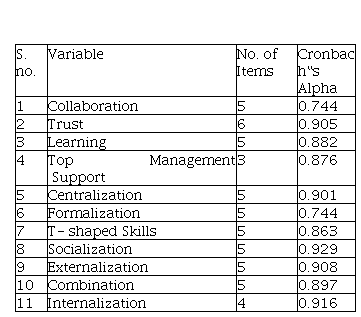
Checking the internal consistency of a scale is known as reliability analysis. In research methodology by Kumar. R (2000), “it is stated that the idea behind internal consistency reliability is that the items measuring the same phenomenon should practice similar results.” The most popular standard for internal consistency reliability measurement is Cronbach‟s Alpha coefficient (Cronbach, 1951). Typically, a Cronbach‟s alpha value of equal to or greater than 0.7 is considered acceptable as good reliability statistics (Nunnally & Bernstein, 1994; Hair et al. 2010). Table 1 shows reliability statistics for various predictors and dependent variables. Validity means the extent to which the instrument measured the right elements that needed to be measured. Experts in the field of research and knowledge management were reached out to provide face and content validity for the survey questionnaire used in the present study.
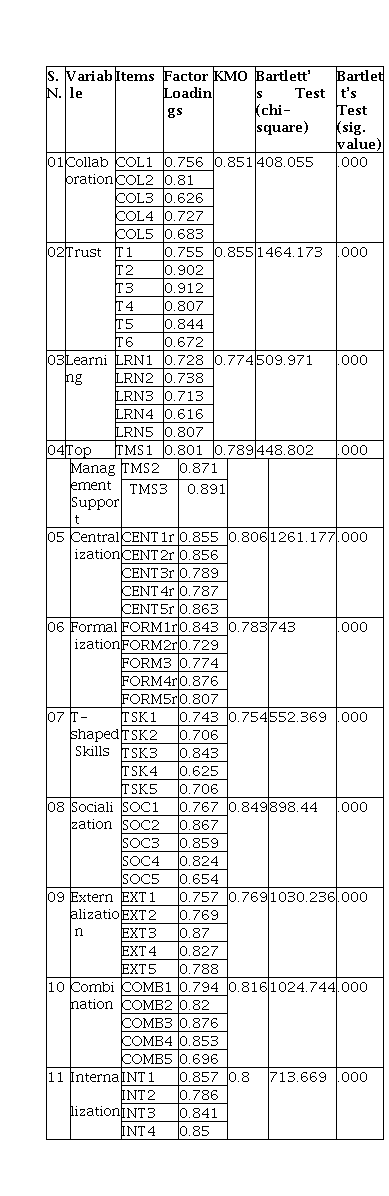
EFA, with PCA technique and varimax rotation was performed on the standardized scales to find out the factor loadings of various constructs. KMO and Bartlett‟s test of sphericity was performed to establish that the sample is adequate and the researcher can proceed for further analysis on the obtained dataset. Commonly, a KMO value > 0.6 is acceptable as an adequate sample. Bartlett‟s test of sphericity exhibits validity of the collected responses. A significance (p- value) of < 0.05 is ideal for Bartlett‟s test to be acceptable. Table 2 shows KMO values for various constructs which is above the stated threshold of 0.6 and Bartlett‟s test of sphericity was also significant.
In order to test the hypotheses derived based on objective 2, linear regression of each predictor variable on individual modes of KCP was performed using SPSS. The output came in the form of three tables, model summary table, ANOVA table and coefficients table. The results of all output tables are represented in Table 3.
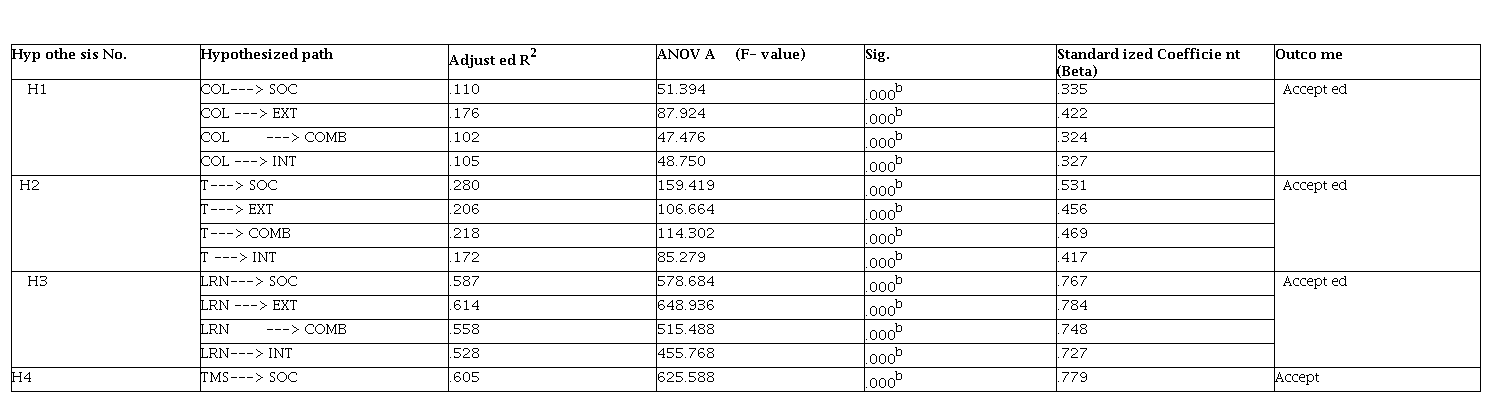
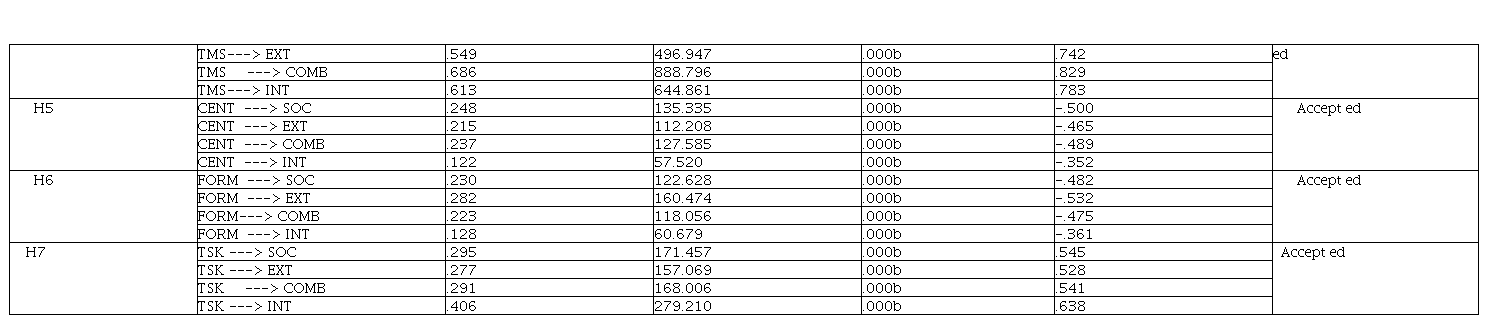
The above summary table shows that none of the hypothesis was rejected. This indicate that social success factors including organizational and individual factors have significant impact on the different modes of KCP. Organizational factors such as learning and top management support, however, have significantly greater contribution in knowledge creation in comparison with collaboration and trust. Organization structure factors such as centralization and formalization are significantly and negatively impacting the knowledge creation process. The individual related factor, i.e., T- shaped skills is also significantly and positively influencing the KCP. Further, to identify the relative impact of the different social success factors upon various modes of knowledge creation process, step- wise regression was performed.
The results of stepwise regression of all social success factors as predictor variables and socialization as the outcome variable resulted into four models. Model 1 having top management support as the most important predictor variable resulted in an adjusted R square value of .605 indicating almost 60% of the variance in socialization is being explained by top management support variable with an f- change 625.588 significant at .000. In model 2, formalization along with top management support resulted in an adjusted R square of .688 with R square change of .083 with a significant f- change value 108.715. In model 3, learning is added with top management support and formalization resulting into an adjusted R square of .712 with a change in R square of .025 i.e., 2.5% with f- change 35.014 which is significant at .000. Finally, model 4 which emerged as a four-variable model upon adding trust along with top management support, formalization, and learning resulted in an adjusted R square of .721 with a R square change of .009 which is having significant f- change 13.251. The success factors in model 4 accounted for higher variance (72.1%) than previous other models, i.e., model 1, model 2 and model 3. In line with previous research, Lee & Choi, 2003, findings suggest that knowledge creation through socialization process requires consistent top management support, well- distributed task and controlled freedom to the employees, trust among the employees and a focus towards learning by socializing. in order to focus more upon socialization aspect of knowledge creation. The social success factors namely collaboration (Beta = .002, t- stat = .053, p- .958), centralization (Beta = .073, t- stat =1.637, p- .102) and T- shaped skills (Beta = .053, t- stat = 1.448, p - .148) were excluded from the final model. This indicates that social enablers like collaboration, centralization and t- shaped skills are not significant predictors of socialization in the higher education institutions. Talaskou & Belhcen, 2019, suggested for to develop an organization culture of different informally engaged activities for socialization such as informal meetings for sharing experiences, outside of workplace team- building events and does not indicate toward formal collaborative activities as much. Centralization, a component of organization structure, refers to power and control in the organization which inhibits knowledge sharing and creation (Talaskou & Belhcen, 2019). This may be an outcome of restricted socialization among people due to greater control.
The results of stepwise regression of all social success factors as predictor variables and externalization as the outcome variable were categorized by forming 7 models. Model 1 Learning as predictor variable had the highest statistical significance and resulted in an adjusted R square value of .614 indicating almost 61% of the variance in externalization is being explained it with an f- change 648.936 significant at .000. In model 2, formalization along with learning resulted in an adjusted R square of .692 with R square change of .079 with a significant f- change value 103.949. In model 3, learning, formalization and top management support resulted into an improved adjusted R square of .724 with a change in R square of .033, f- change 47.989 significant at <.05. In the 4th model collaboration was also included along with learning, formalization and top management support and resulted in an adjusted R square of .744 with a R square change of .020 which is having significant f- change 32.512. Model 5 had included learning, formalization, top management support, collaboration and T- shaped skills as predictor variables and resulted in an adjusted R square of .752 with R square change of .008 (f change- 13.767, p- .000). Model 6 had an added variable centralization that again slightly improved the adjusted R square to .763 i.e., 76.3% with R square change of .011 with f change 18.950 significant at <.05. Lastly, the final model included the final factor that was Trust and had a very slight but significant change in adjusted R square .765 with R square change of .003 and f change 5.562 significant at .019. The success factors in model 7 achieved the highest percentage of variance (76.5%) than rest of the models. The findings are in sync with previous research and indicates that factors of organizational culture are important for externalization of knowledge (Hendriarto & Irma Susanty, 2003). Organization structure component, i.e., formalization and centralization also contribute significantly to this particular mode of knowledge creation as decentralized (Lee & Choi, 2003) and deformalized (Hendriarto & Irma Susanty, 2003) structure facilitate better flow of knowledge and thus contribute in building new knowledge. The individual or people factor, i.e., T- shaped skills are also crucial for externalization of knowledge in order to create new knowledge (Lee & Choi, 2003). There were no variables excluded in the final model. This indicates that all social factors i.e., collaboration, trust, learning, top management support, centralization, formalization and t- shaped skills significantly impact externalization in the higher education institutions (Lee & Choi, 2003).
The results of stepwise regression of all social success factors as predictor variables and combination as the outcome variable categorized into 3 models. In model 1, top management support as predictor variable carried the highest statistical significance with an adjusted R square .686 indicating almost 68% variance explained in the outcome variable of combination. The F change value is 888.769 which is significant at p <.05. In model 2, top management support along with formalization leads to an improved adjusted R square of .757 with a R square change of .072 i.e., 7.2%, F- change value 120.213 significant at p value .000. In the final model, highest variance explained is achieved, with three predictor variables, namely, top management support, formalization and learning. The adjusted R square (.759) has not improved drastically from model 2. However, the R square change (.003) and f- change (4.919) are significant at p value .027 which is less than .05. This indicates that the final model predictor variables top management support, formalization and learning significantly impact combination mode of the KCP. Combination is the process which required collection or combining, reconfiguration and documentation of the articulated knowledge (Bangotra & Chahal, 2016). The findings are in line with the research studies which supports that support from the management, formalized process for proper documentation and attitude towards learning are desired for combination mode of knowledge creation (Bangotra & Chahal, 2016). The social success factors namely collaboration (Beta = .018, t- stat = .690, p - .490), trust (Beta = .222, t- stat = .756, p - .450), centralization (Beta = .079, t- stat =1.937, p- .054) and T- shaped skills (Beta = .015, t- stat = .465, p - .642) were excluded from the final model representing that they are not significant predictors of combination in the higher education institutions. The reason could be the fact that combination is more of a process for documentation, collection and making repositories of data, information and knowledge which is more powered by the technical aspects and hence culture and structure aspects may not be contributing significantly to this particular mode of knowledge creation.
The results of stepwise regression of all social success factors as predictor variables and internalization as the outcome variable categorized into four distinct models. In model 1, top management support as the predictor variable carried the highest statistical significance with an adjusted R square .613 indicating almost 61% variance explained in the outcome variable. The F change value is 644.861 which is significant at p < .05. In model 2, top management support along with t- shaped skills leads to an improved adjusted R square of .670 with a R square change of .058 i.e., 5.8%, the F- change value 70.829 significant at p value .000. In the third model it is clearly represented that addition of another predictor variable to model 2, again slightly improved the explained variance. Top management support, t- shaped skills and formalization together contributed to an adjusted r square of .677 with R square change .008 and F- change 9.775 significant at p- value <.05. In model 4, where highest variance explained is observed, with four predictor variables, namely, top management support, T- shaped skills, formalization and learning, the adjusted R square (.679) has not improved drastically from model 3. However, f- change of 4.230 remains significant at p value .040 which is less than .05. This indicates that the final model predictor variables top management support, t- shaped skills, formalization and learning significantly impact internalization mode of the KCP. Internalization, is closely related to “learning by doing” (Bangotra & Chahal, 2016). The newly learned knowledge is applied and utilized through action and practice in order to make it one‟s own knowledge (Nonaka, I. & Toyama, R., 2003). Hence, individual t- shaped skills are significant in this process. Similarly, support of top management and freedom of doing task and learning are essential practices in order to promote internalization mode of knowledge creation. The factors namely collaboration (Beta = .008, t- stat = .248, p- .804), trust (Beta = .056, t- stat = 1.582, p - .115), and centralization (Beta = -.013, t- stat =-.265, p- .791) were excluded from the final model representing that they are not significant predictors of internalization in the higher education institutions.
HEIs acts as the vehicles for generating and disseminating knowledge. They are designed with the primary objective of creating and sharing information and knowledge and implementation of appropriate KM strategies does support this objective. Nevertheless, its worth, KM is poorly regarded, implemented and managed in HEIs. There are numerous reasons for the same and a topic for another study. Research suggests, while industry counterparts have been proactive in managing and implementing KM strategies, very few empirical studies have been performed to explore the existence, implementation and management of knowledge conversion and creation practices in HEIs. Hence, the present study was designed in a manner to explore the process of KC in HEIs. It majorly explored the success factors or enablers of KM, specifically the social dimension. In addition, the study also discovered the impact of the social factors on different modes of the knowledge creation process.
Interestingly, the pointing out of specific enablers for various modes of the knowledge creation process may assist institutions to emphasize more on what is lacking behind in their organization. For instance, if internalization process is weaker in an institution, then top management support for more activities oriented towards individual learning and development could be targeted. Or, if an organization finds itself lagging behind in the socialization element and thus find challenging the task of creation of knowledge, then that organization may emphasize upon building an organization culture of trust, learning and collaboration, with lessened formalization and more freedom of engagement on informal level among the employees. Future research can be encouraged in the areas exploiting other tools and techniques such as structural equation modelling to find the direct and partial effects of the social enablers on individual modes of KCP. Also, impact of demographic dividend can be analyzed on the process of KCP.

