INTRODUCCIÓN
Passion and persistence are related constructs that have often been perceived as essential qualities for people to achieve their long-term aims (Hatch & Garcia, 2017; Vallerand et al., 1997, 2003). Indeed, both concepts have been widely related to positive outcomes, not only in the educational context (e.g., Bonneville-Roussy et al., 2011; Schneider & Preckel, 2017; Vallerand et al., 2007), but also as pertains to people’s lives in general (e.g., Carpentier et al., 2012; Chichekian & Vallerand, 2022; Ho et al., 2018; St-Louis et al., 2016). In addition, several studies have analyzed the relationship between passion and persistence, usually placing the former as a predictor of the latter (e.g., Bonneville-Roussy et al., 2013; Cardon & Kirk, 2015; Feng & Chen, 2020; Vallerand et al., 2003).
Although the literature on passion mainly consists of research conducted under the Dualistic Model of Passion (Vallerand et al., 2003) and the existence of two types of passion —harmonious and obsessive— is widely accepted, studies on persistence have rarely been focused on persistence regarding its quality. As a consequence, studies have not analyzed the persistence construct from a dualistic position. In other words, little research has been conducted on the different types of persistence that may exist and how they may prompt different outcomes. Consequently, Chichekian and Vallerand (2022) have recently introduced a new perspective, proposing the existence of two types of persistence, namely flexible and rigid, that vary in quality. In that study, Chichekian and Vallerand validated a scale to measure the construct and the outcomes supported the existence of two types of persistence, both predicted by the different types of passion and leading to different outcomes. The Flexible and Rigid Persistence Scale has been shown to be a valid and reliable instrument to assess both types of persistence in education with students (see Chichekian & Vallerand, 2022; Vallerand et al., 2022), and there is no Spanish version available. Thus, the main aim of this study was to analyze the relationships between flexible and rigid persistence, harmonious and obsessive passion, and adaptive university teacher outcomes. The secondary aim was to translate the scale into Spanish and to assess its psychometric properties.
On the concept of persistence
Most of the research on persistence highlights its relevance in helping people achieve long-term objectives (Chichekian & Vallerand, 2022). Persistence has been broadly defined as a stable commitment toward a goal, as well as a willingness to maintain a permanent effort to achieve a specific aim regardless of the hardship, obstacles or fear involved (e.g., Gimeno et al., 1997; Schmidt et al., 2017). In recent years, a growing body of literature involving persistence has mainly been carried out under the construct of grit, which is defined as the “perseverance and passion for long-term goals” (Duckworth et al., 2007). In this regard, grit generally describes the capacity to commit and persevere thought adversity (Robertson-Kraft & Duckworth, 2014; Stoffel & Cain, 2018), and most evidence suggests that it involves a combination of two components: “perseverance of effort” and “consistency of interest over time” (see Credé et al., 2016; Stoffel & Cain, 2018). Specifically, the perseverance component refers to the tendency to work hard despite hardship, and the consistency component denotes the maintenance of long-term interests and goals.
To date, numerous studies have widelyevidencedthatthegreaterthe persistence, the more the academic achievement, deliberate practice or effectiveness (e.g. Duckworth et al., 2011; Robertson-Kraft & Duckworth, 2014; Schneider & Preckel, 2017; Strayhorn, 2014). However, the majority of this literature, i.e. those works including grit, has only focused on intensity as the main trait of persistence, essentially showing that people who present a high degree of persistence are more likely to achieve a goal or to display better outcomes (Chichekian & Vallerand, 2022). In this sense, previous studies have mainly focused on the intensity of persistence, but far fewer research works have considered the quality part of the construct. Perhaps bearing in mind the quality part of persistence could explain why some studies, especially in the academic context (see Credé et al., 2016), have not found positive relations between persistence and success.
As seen above, Chichekian and Vallerand (2022) proposed the existence of qualitative differences regarding how people persist toward a given goal or purpose. Although qualitative differences on persistence have been noted before by other authors (e.g. Brandtstädter, 2009; Wrosch et al., 2003), they were mainly focused on different ways to persist through modification of the original goal or even abandoning it if necessary. However, the view posited by Chichekian and Vallerand (2022) highlights that persistence may also vary in terms of quality while pursuing a given goal, and that two types of persistence may exist depending on the type of passion underlying them.
On persistence and the Dualistic Model of Passion
Passion for an activity has been widely associated with persistence (e.g., Bonneville-Roussy et al., 2013; Cardon & Kirk, 2015; Feng & Chen, 2020; Vallerand et al., 2003), the literature generally supporting that the more passion, the more persistence toward an activity. In the Dualistic Model of Passion (Vallerand et al., 2003), passion is defined as a strong inclination toward a self-defining activity that one likes or even loves, finds important, and in which someone invests a significant amount of time and energy”. Based on this model, Vallerand et al. (2003) proposed the existence of two types of passion, harmonious and obsessive, each type associated with different outcomes and processes to internalize the activity into the person’s identity. In detail, the harmonious passion comes from an autonomous internalization of the activity that leads people to freely engage in it. When engaged in the activity with this type of passion, people feel that the activity they love is consistent with their values and that it is in harmony with the other aspects or activities of their life (Bouizegarene et al., 2017; Vallerand et al., 2003). On the contrary, obsessive passion comes from a controlled internalization of the activity into the person’s identity, and people engage in the activity that they love in part because of external or internal contingencies (e.g.: social acceptance or feelings of self-esteem). Moreover, with obsessive passion people tend to feel an uncontrollable urge to engage in the beloved activity, and they experience conflicts between the activity they love and other elements of their lives (Vallerand, 2015; Vallerand et al., 2003). Hence, people with obsessive passion usually ruminate about their passionate activity when they are not engaged in it (Vallerand, 2015, p. 79).
In view of the above, it is to be expected that harmonious and obsessive passion may lead to different outcomes, both while doing the passionate activity and also in other areas of people’s lives. Research has indeed shown that harmonious passion leads to adaptive outcomes, such as flow (Vallerand et al., 2003), high levels of concentration (Mageau et al., 2005) or well-being (Bonneville-Roussy et al., 2011, 2013; Vallerand et al., 2007). Conversely, obsessive passion is associated with fewer adaptive outcomes, such as difficulties in maintaining concentration (Vallerand et al., 2015, p. 65), defensiveness (Donahue et al., 2009; Lafrenière et al., 2011) or anxiety (Rousseau & Vallerand, 2003). Consequently, it would be also expected that persistence, as a passion’s outcome, could be affected not only in terms of intensity (e.g., Cardon & Kirk, 2015; Feng & Chen, 2020), but also in terms of quality depending on the type of passion underlying it (Chichekian & Vallerand, 2022).
In light of the above, Chichekian and Vallerand (2022) conducted the first research to empirically evidence the existence of the two types of persistence, flexible and rigid, how they are predicted by harmonious and obsessive passion, and how they lead to different activity and life outcomes. According to Chichekian and Vallerand (2022), because flexible persistence is underpinned by harmonious passion, it allows people to persist toward the passionate activity with an open focus and to attend to other life goals. Thus, people can fully persist toward the passionate activity experiencing adaptive outcomes inside and outside the activity, and so have a more successful life. Conversely, because obsessive passion leads to rigid persistence and obsessively passionate people experience conflicts between the passionate activity and other areas in their life (Vallerand et al., 2003), rigid persistence is not expected to be related to positive outcomes outside the activity (Chichekian & Vallerand, 2022). In two studies with students, Chichekian and Vallerand (2022) validated a two-factor scale to assess both flexible and rigid persistence toward one’s studies. In addition, the authors also evidenced that flexible persistence was positively predicted by harmonious passion and negatively predicted by obsessive passion. Furthermore, rigid persistence was mainly predicted by obsessive passion and, to a lesser degree, by harmonious passion. In turn, both types of persistence were related to the achievement of the activity goals and to adaptive outcomes while engaging in the activity one is passionate about. However, only harmonious passion predicted positive life outcomes, such as life vitality, outside the activity.
The present research
The main goal of this study was to test the relationships between flexible and rigid persistence, harmonious and obsessive passion, and adaptive teacher outcomes inside and outside the activity of teaching. We conducted a structural equation modeling (SEM) involving passion, persistence, and two types of outcomes, namely activity and life outcomes. Overall, it was hypothesized that the presence of the two types of persistence, flexible and rigid, would be uncovered and they would be uniquely related to harmonious and obsessive passion as predicted, and would predict activity and life outcomes as in the Chichekian and Vallerand (2022) study. Second, due to the absence of an instrument in Spanish to measure flexible and rigid persistence, the secondary goal of this research was to translate and analyze the psychometric properties of the Spanish version of the “Flexible and Rigid Persistence Scale” (Chichekian & Vallerand, 2022; Vallerand et al., 2022). However, whereas students served as participants in the Chichekian and Vallerand (2022) studies, in the present study, teachers were used as participants. For this purpose, we analyzed the evidence of construct validity by conducting a confirmatory factor analysis (CFA), reliability by assessing the internal consistency of the scale, and the scale invariance across sex by conducting a multi-group Exploratory Structural Equation Modeling (ESEM).
METHOD
This study is based on a quantitative cross-sectional methodological design.
Participants
A total of 201 teachers (56.2% women, 43.8% men) from 20 public universities in Spain took part in the study. Age range was between 26 and 71 years, mean age 52.19 years (SD = 9.5 years). Participants had been working as university teachers on average for 16.54 years (SD = 10.00 years); 85.6% were full-time teachers and 14.4% were part-time. Participants teach in-person. Information regarding the programs that teachers taught was not required. The non-probabilistic criterion of purposive convenience sampling was used to recruit participants.
Procedure
Questionnaires were administered by an online platform. We contacted the administrative staff from faculties and universities and asked them to distribute an e-mail with the online questionnaire to teachers. Questionnaires were also distributed through social networks and colleagues from different universities. To diminish the possible effect of social desirability, participants were informed about the data confidentiality and that their participation was strictly voluntary. Participants were also informed of the instructions for the proper completion of the questionnaire, and they were requested to respond as honestly as possible. In case of doubts, participants could contact a researcher via an email provided in the questionnaire. Although there was no limit to completing the questionnaire, the estimated average to complete them was about 10 minutes. The research was conducted in accordance with the ethical guidelines of the Declaration of Helsinki.
Instruments
Participants completed an online questionnaire with demographic questions and measures of persistence, passion, vitality, and intention to stay. Participants were asked to complete the scales based on their agreement with the statements. Scales were rated on a 7-point Likert-type scale ranging from 1 (I do not agree at all) to 7 (I strongly agree).
Persistence: To measure persistence we used Vallerand et al. (2022) 8-item Flexible and Rigid Persistence Scale. The scale has two subscales of four items each to assess flexible persistence (e.g.: ‘I work hard at my work goals, but other things matter as well’) and rigid persistence (e.g.: ‘I am willing to do anything to reach the top at work’). Following Muñiz et al. (2013; see also Vallerand, 1989) we first translated the scale into Spanish. Then, bilingual researchers back-translated the items into English, comparing them and checking the equivalence of meaning of the original and retranslated version. Researchers were recruited based on their bilingual content expertise, knowledge of assessment principles, and experience in the content of the test. We performed a qualitative pilot study (Muñiz & Fonseca, 2019) in which seven participants with similar characteristics to the final sample completed the scale and discussed about different aspects. All participants considered the scale easy to understand, any semantic or grammatical inconsistency was detected and it was estimated around ten minutes to complete the scale. The psychometric properties of the scale are presented in the results section.
Passion: We used 12 items from the Spanish version (Chamarro et al., 2015) of the Passion Scale (Marsh et al., 2013; Vallerand et al., 2003). This scale consists of two subscales to assess Harmonious Passion (e.g. ‘This activity is in harmony with the other activities in my life’) and Obsessive Passion (e.g. ‘I have difficulties controlling my urge to do my activity’). McDonald’s Omega was .89 for Harmonious Passion and .82 for Obsessive Passion. McDonald’s Omega for the whole scale was .92.
Subjective vitality: We used seven items (e.g. ‘I feel full of energy’) from the Spanish version (Balaguer et al., 2005) of the Subject Vitality Scale (Ryan & Frederick, 1997). McDonald’s Omega was .94.
Intention to stay: We reverted the scores of the scale developed by Gálvez (2006). This scale consists of four items (e.g. ‘I have had a desire to leave the profession’, reverse scoring) used to measure people’s intention to remain in the organization in which they currently work. McDonald’s Omega was .74.
Preliminary analyses
Statistical analyses were carried out using SPSS 24 and Mplus 8.3. To determine the evidence of construct validity of the Spanish version of the Flexible and Rigid Persistence Scale we conducted an Exploratory Structural Equation Modeling (ESEM). To examine the scale reliability, we used Average Variance Extracted (AVE), Composite Reliability (CR), and McDonald’s Omega (1999). This index has shown better accuracy than Cronbach’s Alpha (McNeish, 2017; Revelle & Zinbarg, 2009), and it does not require data to be continuous (Bonanomi et al., 2015) or factor loadings to be equal for all items (Zhang & Yuan, 2016). Following the two-step procedure proposed by Anderson and Gerbing (1988) we first analyzed the measurement model, which provides information about construct validity to the instruments. For the ESEM we used CFI, TLI and RMSEA as fit indexes. The model fits well when CFI and TLI > .90, and RMSEA ≤ .05. We examined the scale invariance across sex using multi-group Exploratory Structural Equation Modeling (ESEM). This approach differs from CFA in that all factor loadings are estimated, and all cross-loadings are not constrained to be zero (Asparouhov & Muthén, 2009).
Main analysis
We performed a structural equation analysis (SEM) in which we hypothesized that the two types of passion would lead to the two types of persistence. Specifically, we hypothesized that harmonious passion would positively predict flexible persistence and negatively predict rigid persistence, whereas obsessive passion would positively predict rigid persistence and negatively predict flexible persistence. In turn, we hypothesized that both types of persistence would predict intention to stay (activity outcome), but only flexible persistence would predict subjective vitality (life outcome). We used CFI, TLI, and RMSEA as fit indexes. The model fits well when CFI and TLI > .90, and RMSEA ≤ .05. Regarding the estimation method, we used the Weighted Least Squares Means and Variance Adjusted (WLSMV), which is more accurate than the Maximum Likelihood Method when assessing ordered-categorical variables (Schmitt, 2011), provides robust estimates under small sample size bias (Byrne, 2012), and is robust to violations of the assumption of normality (Flora & Curran, 2004). We handled missing data using the WLS estimation method (Asparouhov & Muthén, 2010). To complete our model, we test the mediational effect of persistence following the recommendations of Hayes (2018). We computed the indirect effects and standard errors using the delta method (Sobel, 1982).
RESULTS
Preliminary results
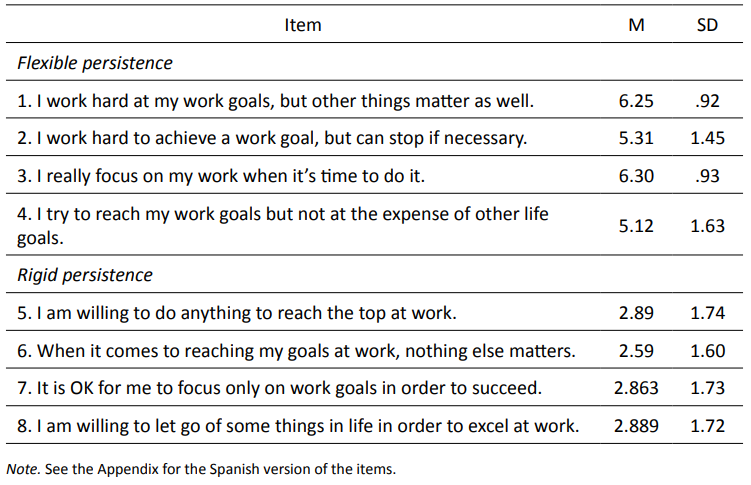
Descriptive statistics (means and standard deviations) of the Flexible and Rigid Persistence Scale items are shown in Table 1.
Table 1
Descriptive statistics of all the items
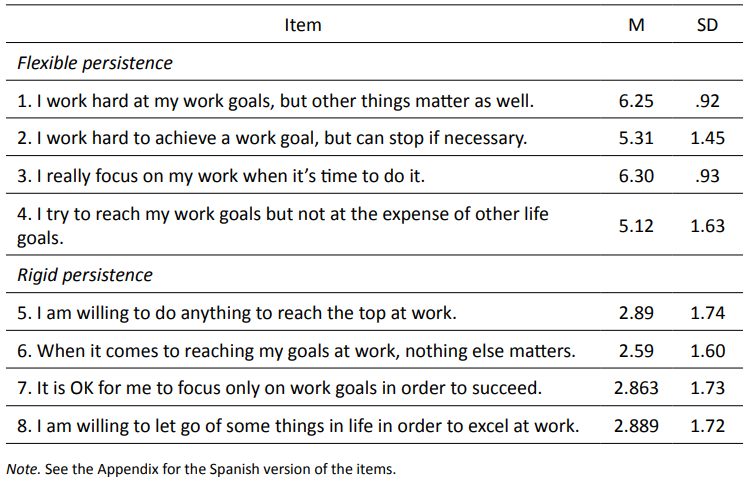
To determine the evidence of construct validity, we used an ESEM to assess the factor structure of the scale. The scale included two latent variables: flexible persistence and rigid persistence. The results of the ESEM indicated a good fit index: (200.13) = 33.741 (p = .001), RMSEA = .090, CFI = .98, TLI = .96, and SRMR = .02. The factor loadings of the items (Table 2) ranged from .537 (item 3) to .960 (item 6), and all of them were significant (p < .01).
Table 2
Factor loadings for each item
To analyze the internal consistency of the Flexible and Rigid Persistence Scale, we used McDonald’s Omega (1999), Average Variance Extracted (AVE), and Composite Reliability (CR) McDonald’s Omega values of each subscale were .74 for Flexible Persistence, and .85 for Rigid Persistence, AVE was .44 for Flexible Persistence and .62 for Rigid Persistence, and CR was .75 for Flexible Persistence and .86 for Rigid Persistence.
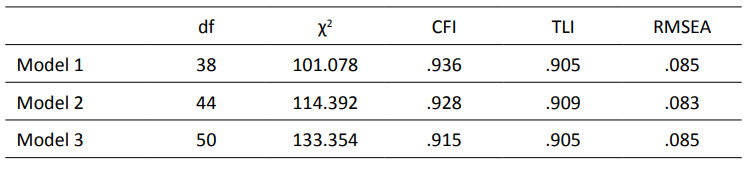
We examined the scale invariance across sex following Vandenberg and Lance (2000)’s sequence. We used ESEM and compared progressively more restrictive nested models across groups. Model 1 (CONFIGURAL) has factor means fixed to zero, and factor loadings, intercepts and residual variances free across groups. Model 2 (METRIC) has factor means fixed at zero in all groups, factor loadings constrained to be equal across groups and intercepts and residual variances free across groups. Model 3 (SCALAR) has factor means fixed to zero in one group, factor loadings and intercepts constrained to be equal across groups and residual variances free across groups. A decrease in CFI > .01 or TLI > .01 or an increase in RMSEA > .015 across models indicates a significant decrement of fit and, in turn, non-invariance (Cheung & Rensvold, 2002). Overall, the results for all models had good fit indexes and showed non-significant differences for gender (Table 3). However, there was a difference of .013 in CFI and a significant χ2 change between models 2 and 3, which might be evidence for partial scalar invariance.
Structural Equation Model
Descriptive statistics and correlations among the variables were calculated (Table 4). Then, we used a structural equation analysis to test the relationships between the variables tested. We ran an SEM. Following the theoretical framework, we hypothesized that Harmonious Passion would positively predict Flexible Persistence and negatively predict Rigid Persistence, and that Obsessive Passion would positively predict Rigid Persistence and negatively predict Flexible Persistence. In turn, Flexible Persistence and Rigid Persistence would lead to Intention to Stay (activity outcome), but only Flexible Persistence would predict subjective vitality (life outcome). The results revealed adequate fit indexes for the model: χ2 (200, 413) = 987,757 (p < .001), RMSEA = .08, CFI = .938, TLI = .930. As shown in Figure 1, Harmonious Passion was positively associated with Flexible Persistence (β = .804; SE = .041; p < .01) and negatively associated with Rigid Persistence (β = -.115; SE = .060; p = .05). Regarding Obsessive Passion, it positively predicted Rigid Persistence (β = .684; SE = .060; p < .01), and negatively predicted Flexible Persistence (β = -.312; SE = .070; p < .01). Regarding the outcomes, Flexible Persistence significantly predicted Subjective Vitality (β = .721; SE = .039; p < .01) and Intention to Stay (β = .641; SE = .065; p < .01). However, Rigid Persistence was related to a much lesser extent to Intention to Stay (β = .091; SE = .077; p = .241). To complete our model, we looked at the mediational pathways of flexible persistence in the relationship between harmonious passion and the outcomes. The unstandardized indirect effects were significantly different from zero only for subjective vitality (β = .376; SE = .103; p < .001).
The direct effects from harmonious passion to subjective vitality (β = .244; SE = .116; p = .036) and intention to stay (β = .496; SE = .094; p < .001) were significantly different from 0.
Table 4
Means, standard deviations, and correlations among major variables
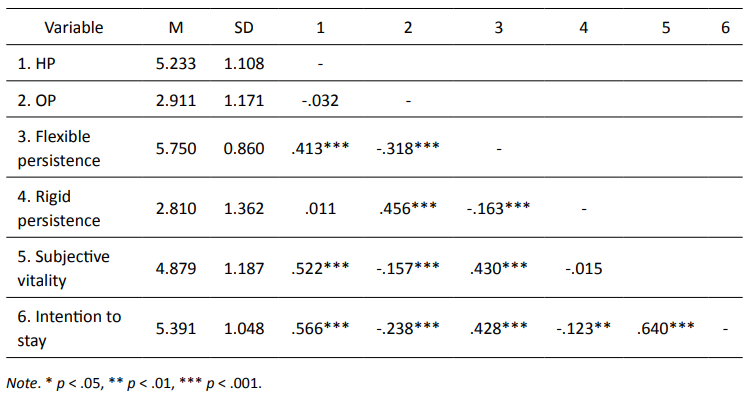
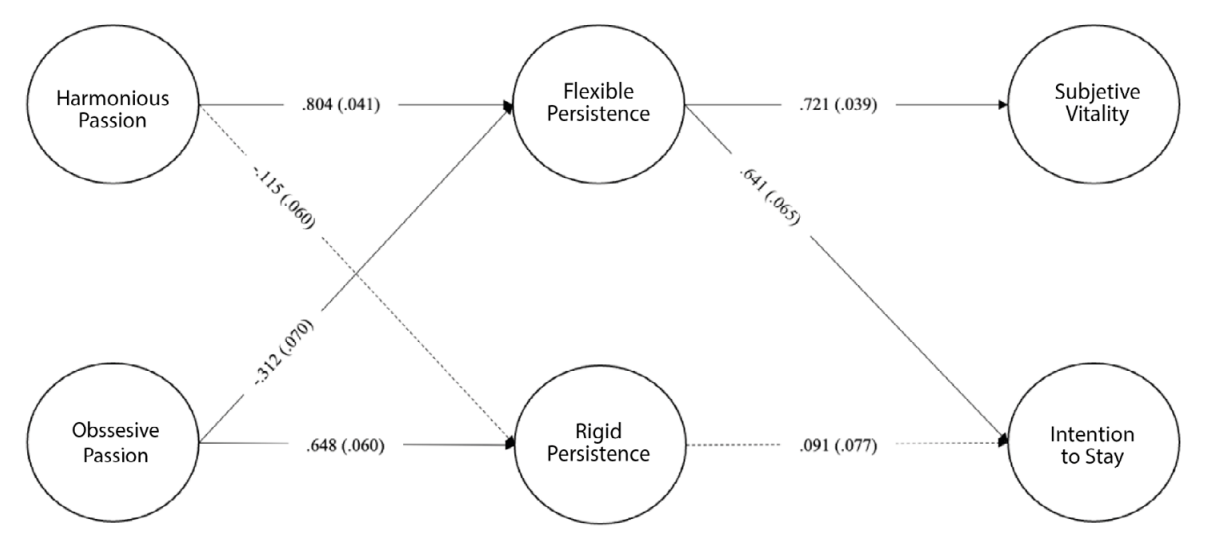 Figure 1
Results of the structural equation model with university teachers. The standardized parameters are above the arrows; standard errors are between parentheses.
Figure 1
Results of the structural equation model with university teachers. The standardized parameters are above the arrows; standard errors are between parentheses.
DISCUSSION AND CONCLUSIONS
The aim of this study was twofold. First, we tested the relationships between flexible and rigid persistence, harmonious and obsessive passion, and adaptive outcomes inside and outside the activity of teaching. Second, we analyzed the psychometric properties of the Spanish version of the Flexible and Rigid Persistence Scale (Chichekian & Vallerand, 2022; Vallerand et al., 2022). Overall, the results supported the hypotheses tested. We tested the validity of a structural equation model on the role of passion and persistence in activity and life outcomes. In line with the Dualistic Model of Passion (Vallerand, 2015) and the findings from Chichekian and Vallerand (2022), we hypothesized that harmonious passion would positively lead to flexible persistence and, to a lesser degree, to rigid persistence, and that obsessive passion would positively predict rigid persistence and negatively predict flexible persistence. In turn, we also hypothesized that both types of persistence would predict intention to stay (activity outcome). However, only flexible persistence was expected to predict subjective vitality (life outcome). These hypotheses were all supported except for one. Specifically, harmonious passion was not found to significantly relate to rigid persistence. Regarding the secondary aim, results evidenced the psychometric adequacy of the Spanish version of the scale. Specifically, results supported the two-factor structure of the scale by ESEM, which indicated a satisfactory fit.
Results showed similar factor loadings and replicated the two-factor structure proposed by Chichekian and Vallerand (2022) and Vallerand et al. (2022). These findings support the existence of a bi-factorial scale structure regarding the two forms of persistence. Second, regarding the evidence of internal consistency, we used AVE, CR, and McDonald’s Omega (1999), whose values are interpreted in a similar way to those of Cronbach’s Alpha. Nevertheless, this index seems to be more accurate (Yang & Green, 2010), as it does not require data to be continuous (Bonanomi et al., 2015; Elosua & Zumbo, 2008) and does not state that the factor loadings of all items are equal (McNeish, 2017). Internal consistency revealed adequate levels for the scale and both types of persistence subscales, and scores for flexible persistence were even slightly lower. These results are similar to those found in the original version and present preliminary evidence of validity and reliability. Lastly, although the invariance test across sex had good fit indexes and showed, overall, non-significant differences for gender, a significant χ2 change between models 2 and 3 could evidence a partial scalar invariance, suggesting being cautious about supporting the assumption of gender invariance.
These findings lead to four important conclusions. The first conclusion is that as hypothesized by Vallerand (2015), the two types of persistence lead to different outcomes. Specifically, whereas the two types of persistence positively predict persisting at work, only flexible persistence predicted psychological wellbeing in one’s life. These findings are line with the Dualistic Model of Passion that posits that with harmonious passion, people display some flexible persistence thereby fostering full engagement and wellbeing in the process. With obsessive passion, however, rigid persistence is achieved within the passionate activity but very often at the expense of wellbeing in one’s life. The results of the present study are consistent with those of Chichekian and Vallerand (2022). Specifically, in two studies, these authors found positive and significant relationships between harmonious passion and flexible persistence, as well as between obsessive passion and rigid persistence. However, Chichekian and Vallerand also obtained a smaller link between harmonious passion and rigid persistence. Future research is necessary to establish if this difference is due to the types of participants (teachers v. students) or to some other variable. Regarding the outcomes, our results are also partially consistent with Chichekian and Vallerand (2022). As in the present findings, these authors found that both flexible and rigid persistence led to adaptive outcomes while performing the activity one is passionate about (in this study, intention to stay at work), whereas only flexible persistence was related to positive outcomes outside the activity (in this study, subjective vitality). Following Chichekian and Vallerand (2022), this was expected because flexible persistence is underpinned by harmonious passion, so the passionate activity is in harmony with the other areas of people’s lives. Harmonious passion allows people to persist toward the passionate activity while attending to other experiences, activities, or life goals. However, the present results showed that the relationship between rigid persistence and the activity outcome (intention to remain at work) was only tangentially significant. Future research is necessary to replicate these findings. Finally, the present findings provide support for the validity and reliability of the Flexible and Rigid Persistence Scale in Spanish. Results of a ESEM and reliability analyses supported the two-factor structure of the scale.
Although findings of our study provide evidence that show that the Spanish version of the scale may be used to assess both types of persistence, it has some limitations. First, due to the small sample size, we must be cautious about the evidence of validity and reliability. Future research should conduct studies with larger and more diversified samples (e.g., high school teachers) Second, the constructs in this research were all measured using self-reported instruments. Although our findings are in line with theory (Vallerand, 2015) and previous research (Chichekian & Vallerand, 2022), we encourage future studies to also use other measures such as informants and even physiological measures (Vallerand et al., 2022). Third, because we used a cross-sectional design, we cannot make inference of causality between the variables tested. We propose that future research use longitudinal studies to test the relations between both types of passion, both types of persistence and different outcomes. Fourth, since one of the researchers who contribute to the translation process was an expert regarding the content of the construct measured and the original version, we missed providing content validity regarding the Flexible and Rigid Persistence Scale. Finally, the present research did not use the quadripartite approach of passion (Schellenberg et al., 2019) because it sought to test the pure effects of each of the harmonious and obsessive passions on flexible and rigid persistence. Future research should do so.
To conclude, in general, the present results yielded preliminary evidence of the reliability and validity of the persistence construct in line with those of the original version (Vallerand et al., submitted). These findings suggest that the scale is ready to be used in future research, thereby leading to new and exciting research on the role of flexible and rigid persistence in education.
Implications for educational practice
This study provides practical implicational for the educational context. Because it is generally accepted that the more passion and persistence, the better the success, people sometimes keep persisting in a passionate activity even while suffering or experiencing negative outcomes or costs. Although previous studies have widely shown that the different types of passion, harmonious and obsessive, lead to different outcomes, this novel perspective of persistence extends the knowledge and contributes to previous research by dealing with the distinction between different types of persistence in terms of their quality. Evidencing that flexible persistence leads to achieving the activity goals and allows satisfaction with other areas of life could help to design and implement more specific training programs to show teachers the importance of harmonious passion and flexible persistence, both for their teaching practice and for their life. In terms of knowing how to improve teachers’ satisfaction and well-being is relevant, among others, because it is related (e.g. Pascual-Gómez & Arteaga-Martínez, 2020) to their students’ optimal achievement and performance.
 Zuleica Ruiz-Alfonso

