Artículos/articles
The use of the additional field player in handball: analysis of the Rio 2016 Olympic Games
El uso del jugador adicional en el balonmano: análisis de los Juegos Olímpicos de Río 2016
The use of the additional field player in handball: analysis of the Rio 2016 Olympic Games
RICYDE. Revista Internacional de Ciencias del Deporte, vol. XV, no. 57, pp. 295-306, 2019
Editorial Ramón Cantó Alcaraz

This work is licensed under Creative Commons Attribution-NonCommercial-NoDerivs 3.0 International.
Received: 22 January 2019
Accepted: 26 March 2019
Abstract: This study aims at analyzing the effectiveness of using an additional field player, when goalkee- per is replaced, during the positional attack in the case of numerical equality, superiority or inferiority and when counterattacks are suffered. The sample consisted of 841 attack actions collected from eight games of men’s teams in the knockout phase of the Rio 2016 Olym- pic Games. The number of goals scored and the counterattacks suffered in symmetrical and asymmetrical situations were checked for both situations: using the additional player or not. Was performed the chi-square test (Φ) and the effect power was calculated using Phi (x2). The analysis of the attack showed that there was no association between goal-making and the use of the additional field player in different asymmetric situations. There was no association be- tween the reach of the goal in case of opponent’s counterattack substitution of the goalkeeper with the additional field player or not as well as no association between punishment and goal achievement in different offensive situations. The use of an additional field player did not benefit the team in attack actions and brought no disadvantages in the scoreboard. These results show that, in this championship, such strategy did not produce significant changes in decisive games of men’s handball.
Keywords: Handball, notational analysis, additional field player, attack asymmetric.
Resumen: Este estudio tiene como objetivo analizar la efectividad del uso de un jugador adicional, cuando se reemplaza al portero, durante el ataque de posición en el caso de igualdad, superioridad o inferioridad numérica y cuando se sufren contraataques. La muestra consistió en 841 acciones de ataque recolectadas de ocho juegos de equipos masculinos en la fase eliminatoria de los Juegos Olímpicos Rio 2016. El número de goles marcados y los contraataques sufridos en situaciones simétricas y asimétricas se verificaron en ambas situaciones: con el jugador adicional o no. Se realizó la prueba de chi-cuadrado (x2) y la potencia del efecto se calculó utilizando Phi (Φ). El análisis del ataque mostró que no había asociación entre el establecimiento de objetivos y el uso del jugador de adicional en situaciones asimétricas. En el contraataque no hubo asociación entre sufrir o gol y sustituir al portero por el jugador adicional o no, así como no hubo asociación entre las puniciones y la realización del gol en diferentes situaciones ofensivas. El uso de un jugador adicional no benefició al equipo en las acciones de ataque y no trajo desventajas en el marcador. Estos demuestran que, en este campeonato, dicha estrategia no produjo cambios significativos en los juegos decisivos del balonmano masculino.
Palabras clave: Balonmano, notational analysis, jugador de campo adicional, ataque asimétrico.
Introduction
The evolutionary process of sport is constant and most transformations occur from changes to the way of playing, influenced by technical, tactical and strategic improvements or by the elaboration and insertion of new rules (Seco, 2006). Variations in tactical and technical structures occur continuously in handball and different factors, such as changes to rules and increased performance of athletes, directly influence these changes. For this reason, game analysis is an important way to verify these changes and research studies on this theme demonstrate the current panorama of the sport’s modalities.
Observational analysis is a scientific procedure which highlights the occurrence of conduct in real or organized situations. In habitual situations, actions are systematically recorded, qualitatively or quantitatively, using observational designs based on well-defined criteria and parameters (Anguera & Hernandez-Mendo, 2014).
Notational analysis is a powerful approach to evaluate both individual’s and teams’ performances, providing information for training and competitions (Bilge, 2012; Gómez- Ruano, 2017). This approach allows researchers to obtain data on tactical organization, assisting in the development of teaching and learning methodologies for team sports, facilitating comparative analysis of teams and players, examining the interactions between players and their individual skill elements with the game, improving the quality of educational interventions, and contributing to the teams’ strategic–tactical performances (Daza, Andrés, & Tarragós, 2017; Prieto, Goméz, & Sampaio, 2015a).
Therefore, information from game analysis has assisted in the identification of actions and situations that significantly influence the final result in handball matches (Daza et al., 2017; Debanne, 2017; Karastergios, Skandalis, Zapartidis, & Hatzimanouil, 2017). Evidence has shown that teams that have more efficient attacks are more successful in matches (Costa et al. 2017; Rogulj, Vuleta, Milanović, Čavala, & Foretić, 2011). In addition to the positional attack, the counterattack is very significant for success in handball matches (Srho, Rogulj, & Katić, 2011). Studies have shown that counterattack is a very important action for winning matches between elite teams that have well-structured attack positioning (Daza et al., 2017; Saavedra, Þorgeirsson, Kristjánsdóttir, Chang, & Halldórsson, 2017; Musa et al., 2017).
These proofs were demonstrated before the rule changes in 2016 (IHF, 2016). Before the changes, the attack consisted of a maximum of six players plus a goalkeeper; now, it is possible to have up to seven attackers. Thus, the possibility of having an additional field player in the attack may cause changes in the tactical behaviour of teams in both attack and defence, because the spatial and temporal structure is directly related to the tactical behaviour and the interaction of the players within the context of the match (Srho et al., 2011).
In this sense, rule changes, such as the use of an additional field player in the attack can provide opportunities for substantial changes in the game of handball (Sevim & Bilge, 2007). Considering that this change in the regulation interferes directly with the strategic–tactical structures of the game, creating opportunities for new individual and group actions in the organization of offensive and defensive systems, situational performance analysis becomes crucial (Taylor, Mellalieu, James, & Shearer, 2008) to understanding the game complexity.
Thus, this study intends to analyse additional field player effectiveness in building offensive actions through the observation of positional attacks and counterattacks of men’s teams at the knockout stages of the Rio 2016 Olympic Games, the first official competition which used the updated rules (IHF, 2016), thus contributing to the understanding of handball through the game’s evolution after the introduction of this new rule.
Observational Design
Material and Methods
Observational Design
This study was designed to analyse the attack and the main criterion of analysis was a situation in which the substitution of a goalkeeper by an additional field player did or did not occur. Other variables were collected in order to verify the effectiveness of the attack, because the emergence of regularities or certain game patterns can be explained by counterattacks and numerical situations.
Sample
The sample was created from the mens’ teams of the eight games observed of the knockout stages of the Rio 2016 Olympic Games: four quarter-finals, two semi-finals, a pickup game for third place, and the final game.
We would like to clarify that this was the first championship in which the rule of replacing the goalkeeper by an additional player in the field was implemented, which is the reason for the small number of games analysed.
The games played by the national team selections of Qatar (8th place), Brazil (7th place), Slovenia (6th place), Croatia (5th place), Poland (4th), Germany (3rd), France (2nd), and Denmark (1st) were included, which enabled analysis of 841 attack actions.
Data collection procedure
The eight games were analysed based on official IHF images, available on the internet. Two independent observers, who were physical education graduates with more than five years of experience coaching handball, observed and analysed the data. Reliability was achieved by analysing and reviewing the video recordings of one random match, which included 222 attack actions (26% of the total), which exceeded the 10% reference value (Tabachnick & Fidell, 2013). The time difference between the first and second observations was 30 days. Cohen’s kappa values for inter and intraobserver were 0.92 and agreement with the IHF scores was greater than 95%. The reliability values were above the reference value, which was 0.75 (Fleiss, 2003).
Independent variables
-
Offensive situation: The time interval from the recovery of ball possession until a registered action in which there is a situation of total loss of possession, either by finalization or fault.
-
Counterattack: The counterattack is defined as the phase of the game in which the defending team switch over to attack when they regain ball possession, and results in a goal without the opposing team’s defence being organized (Calin, 2009). In the same way, we understand in our analysis that the counterattack can occur in the following situations:
-
The first movement to regain ball possession is a shot directly into the goal, without a pass, from where it was situated;
-
When a goalkeeper's throw or a throw from the player with the ball to a player in displacement results in that player receiving and shooting, before defence organization;
-
A fast attack, with more passing and collaboration between attacking players; however, the completion of the goal still occurs with an unstructured defence – that is, when there is one or more defenders, but there is still no systemized defensive organization.
-
-
The game situation in the attack: For game situation analyses, we considered the relation between the number of attackers and defenders, disregarding the goalkeeper. Thus, the following categories were established:
-
Numerical equality: both teams had the same number of field players, which is the same number of players on offense and defence, not counting the goalkeeper.
-
Numerical inferiority: when the attack had fewer players than the defence.
-
Numerical superiority: when the attack had more players than the defence.
-
These asymmetrical situations were considered when a player’s exclusion occurred in the match: i.e., when a defensive player suffered exclusion and the attack had numerical superiority, but also in situations in which there was a substitution of the goalkeeper by a field player.
Dependent variable
-
Finalization Effect: for this analysis, we adapted the instrument proposed by Costa et al. (2017), obtaining the following categories:
-
Goal (yes): Occurs when the ball passes the goal line completely, without any rule infraction by the attacker or by any team member before or during the throw.
-
Goal (no): Goal is not scored because of defence of the goalkeeper or fault. This occurs when the finalization is defended by the goalkeeper, preventing goal realization, or during ball finalization when it goes outside or hits the goalpost, with the condition of the goalkeeper not touching the ball.
-
Statistical Procedures
For the exploratory analysis, we used descriptive statistics, obtaining the frequencies and the respective percentages for each study variable category. To associate the studied variables, we used the chi-square test (𝜒2), with the Monte Carlo correction when less than 20% of the cells had a value under 5. If less than 80% of cells had n less than 5, we used Fisher's exact test. The residual adjustments were calculated to identify which cells had significance in the statistical explanation from the relation between two variables and the effect power was calculated using Phi (ɸ). In the data treatment, the value of 5% significance (p ≤ 0.05) was adopted and IBM SPSS for Windows version 21 (Armonk, NY: IBM Corp.) was used.
Results
Figure 1 presents the efficiency of the attack and also the risk of suffering counterattack in relation to use or no use of the additional field player, in percentages. It can be observed that the percentage difference between the two attack situations is small for both attack and counterattack.
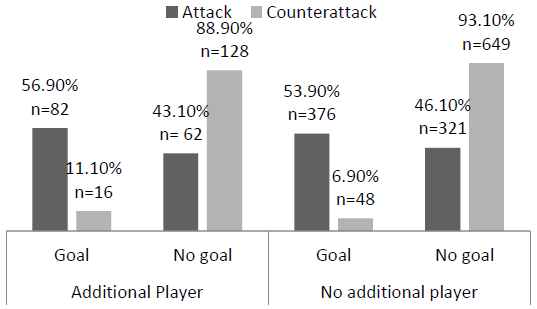
Figure 1
Percentage of goals and non-goals in attack, and counterattacks suffered in situations with and without the additional field player.
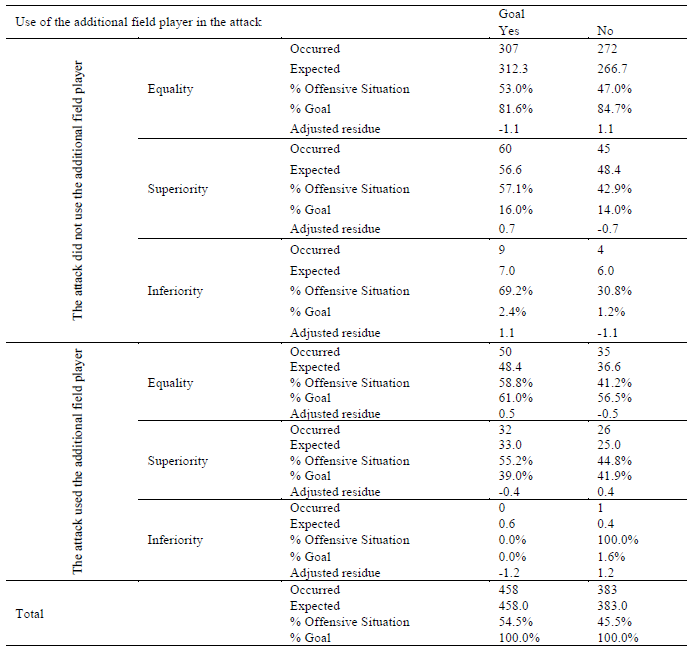
Table 1 presents the statistical analyses related to attacking efficiency with or without an additional field player, showing that there was no association between goal scoring and the use or not of the additional player in different offensive situations (numerical equality, superiority, or inferiority) (𝜒2=0.932; p=0.627; ɸ=0.03).
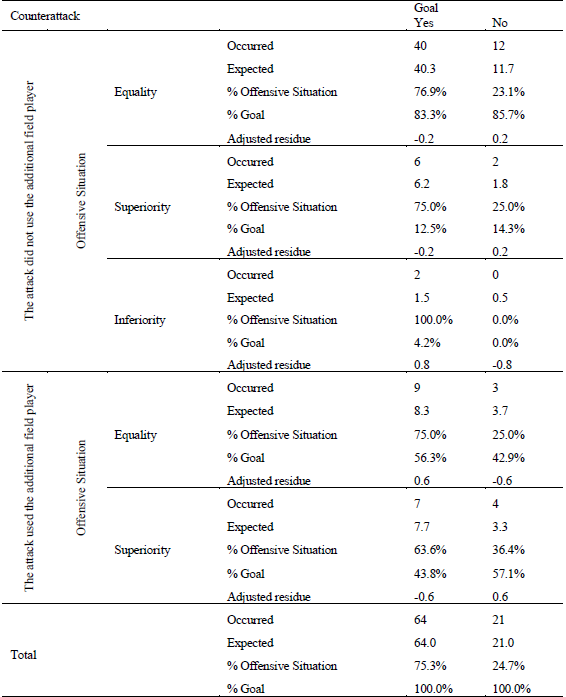
The counterattack analysis (Table 2) shows that there was no association between goal achievement during counterattacks when the team that lost ball possession in the attack used or did not use the additional field player in different offensive situations (𝜒2=1.194; p=0.55; ɸ=0.12).
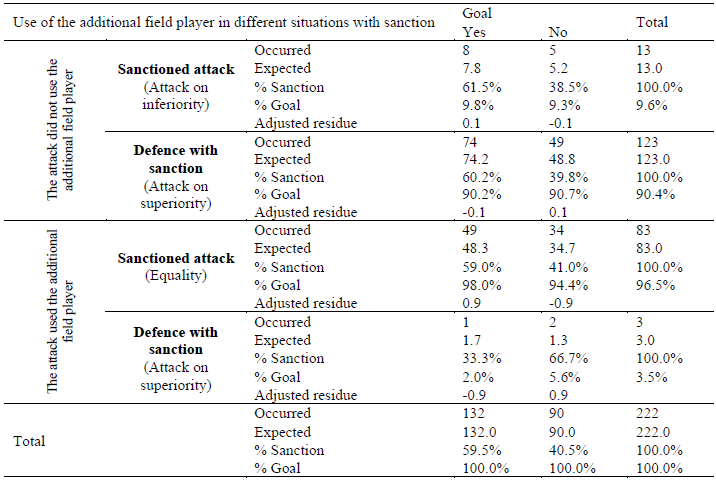
The additional field player analyses (Table 3) show that there was no association between the use of the additional field player in sanction situations and goal achievement in different offensive situations (Fisher’s exact test: 𝜒2=2.216; p=0.32; ɸ=0.05).
Discussion
This study aimed to verify the attack efficiency associated with goalkeeper substitution by a field player, which allows teams to attack with up to seven players, thus increasing the numerical occurrence from asymmetry situations in handball matches. In addition, playing with seven players in the attack is a risk for teams because it is necessary to leave the goal without a goalkeeper. This condition, theoretically, can increase the numbers of direct throws towards the goal, due to the fact that the goal is unprotected; in situations of recovery of possession of the ball by the defence, when there is no goalkeeper, it is ideal for the player to shoot from his own area if possible.
Is this sense, the results show that there was no association between the attack effectiveness and the use of an additional field player: i.e., the numerical superiority imposed by an additional player of the attack did not bring direct use benefits. Also, it was shown that in situations when suffering counterattack, for throwing with or without a goalkeeper there was no statistical difference in matches of men's Olympic Games handball.
In this context, there are no studies that can support the present research findings due to the recent rule change. In addition, studies on handball game analysis do not consider symmetries or asymmetries in the attack (Debanne, 2017; Oliveira, Gómez, & Sampaio, 2012), making it necessary to evaluate the effectiveness of offensive actions as the constraint condition (Sierra- Guzmán, Sierra-Guzmán, Sánchez, & Sánchez, 2015; Gutiérrez-Aguilar, Fernández-Romero, & Borrás-Rocher, 2010).
Thus, when analysing attacks and their relationship with numerical symmetry and asymmetries, this study shows that the offensive action does not depend on the number of players for different situations of the game, proving that there is no difference in setting up the attack to achieve goals in numerical inferiority situations, equality, or superiority, and that there is no relation with the substitution of the goalkeeper by an additional field player. This information corroborates the findings of Gutiérrez-Aguilar et al. (2010), who showed that there were no substantial differences in the result for the offensive processes with numerical superiority, because these temporary situations do not have any influence on an elite male handball team match such as the European and World Championships.
Gutiérrez-Aguilar et al. (2010) and Silva and Anzano (2018) showed that winning teams have greater attack effectiveness when compared with losing teams in both numerical superiority and inferiority, suggesting that the victory depends on the tactical, technical, and physical quality of the players, as well as on their ability to adapt to various constraint conditions, especially in the numerical asymmetry situation. In this context, one can see that the players' behaviour is conditioned by the momentary tactics and the unpredictability of the game and, based on ecological theory, tactical–technical behaviour emerges from the relationships between the bodies and are dependent on environmental changes (Seifert, Araújo, Komar, & Davids, 2017).
In handball game analysis, the positional game in numerical equality is often what determines the winner or loser of the match (Gutiérrez-Aguilar et al., 2010). Due to this trend in the game, it is possible that for elite teams, with a structured game form, the success of the match is determined by counterattacks (Daza et al., 2017; Saavedra et al., 2017; Jarque & Foguet, 2012). Thus, after the analysis of goals in counterattacks, we found no significant differences between the number of goals against teams that used or did not use the goalkeeper substitution in numerical equality, inferiority, or superiority. Also, the counterattack situations were similar, with or without the goal being protected by the goalkeeper.
Therefore, the results partly corroborate the literature, because Musa et al. (2017) showed that the finalist teams of the 2016 European Championships preferred to use the false goalkeeper in the last minutes of the game, although Garcia and Lorenzo (2010) demonstrated that the use of this strategy in the final minutes of the match does not bring benefits to the teams that use it.
It was not the object of this study to verify the use of the additional player minute by minute; rather, the additional player’s efficiency is being examined. However, we realized in this study that the use of the additional attacker strategy is still scarce; this strategy was used in only 144 attacks (17%).
Of these 144 attacks with an additional field player, 85 were to maintain the numerical equality of the attackers – that is, to balance the attack with the defence in situations of exclusion. Regarding players’ exclusion (sanctions), using or not using the additional field player did not interfere with the attack effect. In addition, the results show that there were few attacks with a seventh field player, which demonstrates that coaches tend to use the substitution of a goalkeeper by a field player to maintain numerical equality and the descriptive analysis shows that this feature was used, although it did not raise the offensive efficiency.
These results are in accordance with Garcia and Lorenzo (2010), who suggest that the use of the false goalkeeper is a strategy which should be explored in order to balance the attacking team in cases of exclusion, because the positional game in numerical equality can be a decisive aspect for defining the winner or loser of the match (Gutiérrez-Aguilar et al., 2010).
In addition, Musa et al. (2017) found that the use of a false goalkeeper is ineffective for offensive efficiency, resembling the findings of our study and demonstrating that, in cases of exclusion, the substitution of the goalkeeper is a strategy that does not result in score differences in elite handball matches.
Play with seven players in the attack is not something new in handball because, before the rules changed in 2016, the teams used what is called a ‘false goalkeeper’. This was used in situations of numerical equality, with the objective of creating numerical superiority situations for the attack, or in situations of numerical inferiority, for the attacking team to equalize the number of players during the construction of the positional game (Garcia & Lorenzo, 2010; Musa et al., 2017). Thus, the use of an additional field player in the attack can be a way to prevent the opposing team advancing on the scoreboard during periods of exclusion, because studies have shown that defending in numerical superiority has a decisive effect on the final results of the game (Maféti, 2013; Prieto, Goméz, & Sampaio, 2015b).
However, we verified in our study that the efficiency of the attack was independent of the numerical asymmetries; that is, it made no difference for the teams to have more or less players on the court. Also, our data show that although coaches use this strategy, there is no difference in attack efficiency between using an additional player to succeed or not; this corresponds with the studies by Musa et al. (2017).
However, our data show that in the Rio 2016 Olympic Games there was no clear advantage in the use of the additional field player in handball, because there were no significant differences in this action when compared with other game situations. It is possible that because this was the first official championship in which the rule was applied, no teams have developed new offensive tactics with this additional player; thus, the substitution remained a strategy for situations of sanction and for maintenance of numerical equality.
This rule, however, allows any player to be replaced by a specialist goalkeeper, making the action faster and more dynamic; this may be relevant to holding steady the number of goals suffered by teams that choose to realize the substitution of the goalkeeper because of his quick return to the court and the reduction of risks for these actions. This result reflects the tactical, physical, and technical teams’ level and, despite our small sample, demonstrates this tendency in the first official championship of the use of the new rule, which could still produce changes in current tactical structures.
This also reflects the interaction between the various factors which are part of the coach's decision to use this strategy and which is derived from a contextual analysis for its use, such as which moment to use it, which players to replace, and which opponents' defence may offer more risks (Musa et al., 2017).
We should emphasize that in this study we analyse the games of the eliminatory phase of the Olympic Games, because this is a phase in which a tie cannot occur in the game and, in this way, there is pressure for victory due to the eminent possibility of elimination from the competition. This influences the results, because it presents which strategies were best used by the teams.
In the group phase, all the teams play the same number of games; however, only the best scoring teams move to the knockout phase. Also, this study analysed the teams participating in the knockout phase; Denmark, France, Germany, and Poland had more games analysed due to their greater number of wins (three matches each) because these teams were finalists. Less games were analysed for Croatia, Slovenia, Brazil, and Qatar; these countries only played one game each. On the other hand, having more games with these teams shows how the finalist teams behaved concerning the additional field player.
Future studies are needed to verify the technical and tactical structures of high-level teams in handball after adaptation of the new rule. Also, studies are required to verify specific tactical behaviour in the different situations, such as which movements occur more frequently and where more throws occur, among other factors that are determinant of efficiency in handball matches.
Our results bring a practical application to elite coaches because with these findings they can more often exploit the use of the additional field player when they realize the small amount of risk which exists in this regard.
Conclusion
We can conclude that the replacement of the goalkeeper with an additional field player either to achieve numerical superiority or to equalize the number of players in the attack in exclusion situations did not benefit teams that used this feature in the Rio 2016 Olympic Games. On the other hand, there were no disadvantages caused by an unprotected goal, which suggests that the use of this player instead of a goalkeeper did not bring significant changes in decisive handball matches for the men’s teams in this championship and can be a resource used in critical and specific moments of the games to maintain the team performance trend throughout the match.
Also, because these data arise from the first official championship where the rule was applied, there is a need for future studies to be carried out to further explore this issue.
Acknowledgments
The authors thank Espaço da Escrita – Pró-Reitoria de Pesquisa - UNICAMP - for the language services provided, and proof-reading-service.com Ltd for reviewing the translation.
References
Anguera, M. T., & Hernández Mendo, A. (2014). Metodología observacional y psicología del deporte: Estado de la cuestión. Revista de psicología del deporte, 23(1), 0103- 109.
Bilge, M. (2012). Game analysis of Olympic, World and European Championships in men’s Handball. Journal of Human Kinetics, 35(1), 109-118. https://doi.org/10.2478/v10078-012-0084-7
Calin, R. (2010). The analysis of the efficiency of using fast breaks in female handball during the World Championship in China, 2009. Science, Movement and Health, 2(1), 594-599.
Costa, G. D. C. T.; Pedrosa, G. F.; Souza, N. P. D.; Gemente, F. R. F.; Freire, A. B., & Castro, H. D. O. (2017). Type of game practiced in handball according to the positions of the attackers: analysis of the Women’s World Handball Championship 2015. International Journal of Performance Analysis in Sport, 17(3), 360-373. https://doi.org/10.1080/24748668.2017.1345197
Daza, G.; Andrés, A., & Tarragós, R. (2017). Match Statistics as Predictors of Team’s Performance in Elite competitive Handball. RICYDE. Revista Internacional de Ciencias del Deporte, 13(48), 149-161. https://doi.org/10.5232/ricyde2017.04805
Debanne, T. (2017). Effects of game location, quality of opposition and players’ suspensions on performance in elite male handball. RICYDE. Revista Internacional de Ciencias del Deporte., 14(51), 71-83. https://doi.org/10.5232/ricyde2018.05106
Fleiss, J. L.; Levin, B., & Paik, M. C. (2003). Statistical methods for rates and proportions. Wiley series in probability and statistics. (3rd ed.). Hoboken, NJ: Wiley- Interscience.
Garcia, A., & Lorenzo, J. (2010). Uso del" portero falso" en inferioridad numérica atacante:¿ nueva aportación táctico-estratégica? E-Balonmano.com: Revista de Ciencias del Deporte, 6(1), 3-27.
Gómez-Ruano, M. Á. (2017). La importancia del análisis notacional como tópico emergente en Ciencias del deporte. RICYDE. Revista Internacional de Ciencias del Deporte, 13(47), 1-4. https://doi.org/10.5232/ricyde2017.047ed
Gutiérrez-Aguilar, Ó.; Fernández, J. J., & Borrás, F. (2010). Use of the effectiveness of the game situations in inequality numerical in handball as predictive value of the final score. E-balonmano.com: Revista de Ciencias del Deporte, 6(2), 67-77.
International Handball Federation (IHF). Rules of the game. Edition of 1 July 2016
Jarque, D. L., & Foguet, O. C. (2012). Eficacia de los sistemas ofensivosen balonmano. Apunts. Educación física y deportes, 2(108), 70-81. https://doi.org/10.5672/apunts.2014-0983.es.(2012/2).108.08
Karastergios, A.; Skandalis, V.; Zapartidis, I., & Hatzimanouil, D. (2017). Determination of technical actions that differentiate winning from losing teams in woman's handball. Journal of Physical Education and Sport, 17(3), 1966-1969. https://doi.org/10.7752/jpes.2017.03194
Maféti, E. (2013). Assessing defence strategies whilst in numerical superiority, European Handball Federation, Master Coach Theses from the Hungarian National Course: Master Coaches' Theses – Part 2.
Musa, V.; Modolo, F.; Tsuji, G.; Barreira, C.; Morato, M., & Menezes, R. (2017). Participation of the goalkeeper-field in handball: Analysis from game time, numerical ratio, specific position and match status [Portuguese]. Revista Portuguesa de Ciências do Desporto, S1, 213-221.
Oliveira, T.; Gómez, M., & Sampaio, J. (2012). Effects of game location, period, and quality of opposition in elite handball performances. Perceptual and motor skills, 114(3), 783-794. https://doi.org/10.2466/30.06.PMS.114.3.783-794
Prieto, J.; Gómez, M. A., & Sampaio, J. (2015). From a Static to a Dynamic Perspective in Handball Match Analysis: a Systematic Review. The Open Sports Sciences Journal, 8(1), 25-34. http://dx.doi.org/10.2174/1875399X01508010025
Prieto, J.; Gómez, M. A., & Sampaio, J. (2015). Players’ exclusions effects on elite handball teams’ scoring performance during close games. International Journal of Performance Analysis in Sport, 15(3), 983-996. https://doi.org/10.1080/24748668.2015.11868845
Rogulj, N., Vuleta, D., Milanović, D., Čavala, M., & Foretić, N. (2011). The efficiency of elements of collective attack tactics in handball. Kinesiologia Slovenica, 17(1), 5–14.
Saavedra, J. M.; Þorgeirsson, S.; Kristjánsdóttir, H.; Chang, M., & Halldórsson, K. (2017). Handball game-related statistics in men at Olympic Games (2004-2016): Differences and discriminatory power. Retos: nuevas tendencias en educación física, deporte y recreación, 32(2), 260-263.
Seco, J. D. D. R. (2006). The beginnings of the XXI century: evolution and tendencies of the game. E-Balonmano.com: Revista de Ciencias del deporte; .(2), 3-20.
Sevim, Y., & Bilge, M. (2007). The comparison of the last Olympic, World and European Men Handball Championships and the current developments in World Handball. Research Yearbook, 13(1), 70-76.
Seifert, L.; Araújo, D.; Komar, J., & Davids, K. (2017). Understanding constraints on sport performance from the complexity sciences paradigm: An ecological dynamics framework. Human movement science, 1(56), 178-180. https://doi.org/10.1016/j.humov.2017.05.001
Silva, A. T., & Anzano, A. P. (2018). Offensive Efficacy in Numerical Inequality Situations in Female Handball. Apunts: Educació Física i Esports, 1(131), 95-107. http://dx.doi.org/10.5672/apunts.2014-0983.es.(2018/1).131.07
Sierra-Guzmán, R.; Sierra-Guzmán, S.; Sánchez, F., & Sánchez, M. (2015). Analysis of the offensive tactical situations used by the Spanish men handball team in numerical inequality during the European Championships of Serbia 2012 and Denmark 2014. E- balonmano. com: Revista de Ciencias del Deporte, 11(1), 55-72.
Srhoj, V.; Rogulj, N., & Katić, R. (2001). Influence of the attack end conduction on match result in handball. Collegium antropologicum, 25(2), 611-617.
Tabachnick, B., & Fidell, L. (2013). Using multivariate statistics (6th ed.). Boston, MA: Allyn and Bacon.
Taylor, J.; Mellalieu, S.; James, N., & Shearer, D. (2008). The influence of match location, quality of opposition, and match status on technical performance in professional association football. Journal of Sports Sciences, 26(9), 885–895. https://doi.org/10.1080/02640410701836887
Author notes
Additional information
Conflict of interest: The authors state no conflict of interest.
Disclosure statement: No author has any financial interest or received any financial benefit from this research.