Article
THE ENCHANTMENT OF ARCHAEOLOGICAL SITES AND THE QUEST FOR PERSONAL TRANSFORMATION
EL ENCANTAMIENTO DE LOS SITIOS ARQUEOLÓGICOS Y LA BÚSQUEDA DE LA TRANSFORMACIÓN PERSONAL
O ENCANTAMENTO DE SÍTIOS ARQUEOLÓGICOS E A BUSCA DA TRANSFORMAÇÃO PESSOAL
THE ENCHANTMENT OF ARCHAEOLOGICAL SITES AND THE QUEST FOR PERSONAL TRANSFORMATION
Ciencias Sociales y Religión / Ciências Sociais e Religião, vol. 23, pp. 1-27, 2021
Universidade Estadual de Campinas
Received: 30 January 2021
Accepted: 16 July 2021
ABSTRACT: Ethnographical studies increasingly testify the conversion of archaeological sites into places used for a myriad of spiritual purposes associated to the culture of personal transformation. Analyzing data gathered at contemporary spiritual practices held in Carnac, a megalithic site located in northwest France, this article argues that the resignification of ancient places as ‘sacred’ and ‘energetic’ is a strategy to develop and enact inner search and work on the self. Collected data provides understanding on the actor’s conceptualizations and uses given to this place, while also suggesting further inquiries to assess the relations between spirituality, personal transformation and the enchantment of archaeological sites.
KEYWORDS: Energy, sacredness, personal transformation, megaliths, carnac.
RESUMEN: Los estudios etnográficos atestiguan cada vez más la conversión de sitios arqueológicos en lugares utilizados para una miríada de propósitos espirituales asociados a la cultura de la transformación personal. Analizando los datos recopilados en las prácticas espirituales contemporáneas llevadas a cabo en Carnac, un sitio megalítico ubicado en el noroeste de Francia, este artículo sostiene que la re-significación de los lugares antiguos como ‘sagrados’ y ‘energéticos’ es una estrategia para desarrollar y representar la búsqueda interior y el trabajo en uno mismo. Los datos recopilados proporcionan comprensión sobre las conceptualizaciones y usos que los actores le otorgan a dicho lugar, al tiempo que sugiere nuevas líneas de investigación para evaluar las relaciones entre espiritualidad, transformación personal y el encantamiento de los sitios arqueológicos.
PALABRAS CLAVE: Energía, sacralidad, transformación personal, megalitos, carnac.
RESUMO: Os estudos etnográficos atestam cada vez mais a conversão de sítios arqueológicos em lugares utilizados para uma miríade de propósitos espirituais associados à cultura da transformação pessoal. A partir da análise de dados coletados sobre as práticas espirituais contemporâneas realizadas em Carnac, um sítio megalítico localizado no noroeste da França, este artigo argumenta que a ressignificação de lugares antigos como «sagrados» e «energéticos» é uma estratégia para desenvolver e representar a busca interior e o trabalho de si mesmo. Os dados coletados permitem compreender as conceitualizações e utilizações que os atores dão ao referido lugar, ao mesmo tempo que sugerem novas linhas de investigação para avaliar as relações entre espiritualidade, transformação pessoal e o encantamento de sítios arqueológicos.
PALAVRAS CHAVE: Energia, sacralidade, transformação pessoal, megálitos, carnac.
Introduction
When I asked Marie, a psychologist in her mid-forties who hailed from Paris, why she comes annually to the megalithic site of Carnac since 2012 to attend one of the many energetic workshops held here regularly, she explained:
The discovery of this energetic place was a revelation for me. Beyond simple stones and trees, I was able to see the full extent of this resourcing, invigorating and soothing nature. This sacred place awakened in me different sensations. Like humility, simplicity, benevolence and joy. I was able to be fully present in the moment, I learned to communicate with the spirits who live here, I was in contact with nature (Marie, 6th May 2017).1
Marie, as other persons who regularly come here to engage in practices promoting self-improvement and holistic healing,2 considered this archaeological site to be a sacred and energetic place. Here, human beings seek to connect with ‘nature spirits’ and ‘earth energies’ through ritual practices. The purposes that draw them to visit this place are mainly spiritual, because they searched to communicate with divine forces, to seek their ‘true self’ and experience personal change. By embracing both sacred and energetic characteristics, they are able to navigate various spiritual and scientific domains while also emphasizing personal transformation as a conscious goal (Fedele, 2014: 156). Between the winter of 2015 and the summer of 2018, I joined twenty groups composed of French specialists and participants who came to the Carnac’s megaliths to execute ritual practices inspired by New Age and contemporary-Pagan ideologies.3 Fieldwork was part of my doctoral research. Drawing upon ethnographical analysis of energy and sacredness discourses regarding nature and archaeological sites (Bowman, 2005; Fedele, 2014; Ivakhiv, 2003), I will analyze data gathered in Carnac’s archaeological site to show how the resignifications of ancient places are being used as strategies to experience, develop and enact personal transformation.
The contemporary enchantment of archaeological sites is a phenomenon that can be traced back to the end of the 1960s when the idea of a network that connects the ‘high energy places’ of the planet arose in the United States. It was conveyed through esoteric publications like that of John Michell entitled The View over Atlantis(1969), which embraced the idea that ‘ancient mysteries’ and ‘powers’ were contained inside ancient structures such as pyramids and megaliths. There is evidence showing that since the 1970s, travelers were visiting places considered as ‘sacred’ or ‘powerful’ to draw on their ‘energy’ (Fedele, 2014: 152-155; Ivakhiv, 2003: 95-96). The idea of ‘high places of energy’ was taken up by Californian youth of the sixties and seventies, who found themselves faced with a new urgency to think about globality and social complexity.4 Clearly, it was this youth who began to regard certain places on Earth as “powerful” or “alive”, seeing them as niches of sacred energy (English, 2002: 8). At the time, the “re-enchantement of nature” as a process produced diverse contemporary devotions where nature was considered to be a source of beneficial and restorative powers (Chanvallon, 2011; Harvey, 1997; Heintzmann, 2009). These ideas gradually spread in the popular consciousness of Western societies through an event that I consider decisive, the Harmonic Convergence of August 16th and 17th, 1987. This event of planetary scale took place simultaneously in natural sites and archaeological sites, attracting media and bringing people together in the act of simultaneous meditation (Ivakhiv, 2003: 96).
The re-signification of archaeological sites as sacred and energy places was accompanied by the emergence of a culture of personal transformation. This one focused on the renovation of the self by combining spirituality and psychotherapy (Partridge, 2005). The personal transformation culture braked with the disenchanted and materialistic mentality of modernity and recovered the experience of transcendence, in the context of a spirituality emancipated from institutionalized religion that encouraged the inner search and work on the self (López, 2012: 78). Personal transformation has been understood as an individual trajectory towards self-development and personal growth which has an indeterminate duration and is developed by engaging in a wide range of activities. These include Western forms of meditation, reiki and yoga, or spiritual forms of psychotherapy and reflexology, among others. It is oriented towards potentializing the person’s capacities through the transformation of their cognitive, emotional and energetic structures (Heelas, 2009: 759). What is spiritual about personal transformation? Numerous scholars have explored the relations between practice and spiritual meaning in contemporary spiritualities (Coco & Woodward, 2007; De la Torre, 2011; Heelas & Woodhead, 2005; Possamaï, 2005; Wood, 2007). Some findings have identified the multiplication and differentiation of discourses practitioners use to signify practices as ‘spiritual’ without feeling the need to qualify this term (Sutcliffe & Gilhus, 2014: 5). Other scholars have established that the ‘spiritual’ meaning given to personal transformation practices resides in its purpose: transforming the quality of the person’s relationships with the world, its inhabitants, institutions and environment (Heelas, 2009: 759).
Following the demand for spaces where to engage in personal transformation, numerous archaeological sites have been being reconverted into material supports for non-institutionalized spiritualities in the last sixty years. These sometimes converge in the quest for an enchanted nature, an identitary inscription in ancient lineages and a connection with cosmic and earthly dimensions (De la Torre, 2019: 14). Nowadays, specific locations are identified as ‘high places of energy’ where sacred beings and energies dwell (Lucas, 2007) and humankind can have access to telluric energies (MacDonald, 1995; Ivakhiv, 2003; Rountree, 2006). Considering nature as a source of knowledge, millenary places are regarded as the work of ancient builders who had «other» comprehension about their environment and considered nature’s energies when building their temples (Timothy & Conover, 2006: 144). Since the nineties diverse problematics associated to this phenomenon have been analyzed by scholars, when ethnographic research on the New Age (Heelas, 1996; Hanegraaff, 1996) and the renewal of pagan traditions (York, 1995) started to develop. Studies carried in Europe have shown that practitioners gather at megalithic sites like Stonehenge to mobilize a variety of doctrines, practices and a symbolic heritage mainly resulting from the intersection between contemporary ecological movements and the reinvented Druidic tradition (Blain & Wallis, 2004; Bowman, 2002; Harvey, 1997; Hutton, 2009; Leskovar & Karl, 2018; Lucas, 2007; Rountree, 2015; Owen & Taira, 2015; White, 2018).5 Along with the enchantment of archaeological sites, spiritual seekers have reformulated scientific knowledge about these places (Insoll, 2012) while reinterpreting them through esoteric doctrines and New Age discourses (Card, 2019). In Latin-American, scholars have analyzed neo-Indian ceremonies taking place in pre-Columbian pyramids. These events allowed the participants to engage in a «dynamic process of symbolic appropriation of the past» (Galinier & Molinié, 2006: 19) by celebrating an idealized vision of the preColumbian societies and the cycles of nature, all while mixing elements from indigenous cosmogonies and New Age ideologies (De la Peña, 2012: 128; De la Torre & Gutiérrez Zúñiga, 2011).
Today, the adoption of archaeological sites as sacred and energetic places has been mobilized for a myriad of spiritual purposes. For example, Glastonbury and its landscape are considered connected to a variety of world religious traditions. Pilgrims arrive there seeking to recapture the experience, both subjective and somatic, granted to past and present spiritual traditions that promote holistic and symbiotic relations between humans and nature (Bowman, 2005: 177, 181). In the case of the Sedona, the sacredness of the place is related to the qualities given to nature as object, spirit and resource. For those who come here with the ‘right attitude’, meaning mainly humility and respect, Sedona holds the promise of an embodied and spiritual encounter with the beneficial energy of the Earth (Ivakhiv, 2003: 104-105). The energy discourse is also present in alternative pilgrimages to Catholic shrines, where participants change the institutionalized meanings ascribed to places they visit in order to experience mental, spiritual, and physical healing (Fedele, 2014: 157, 163).
In this article, I will first highlight the cultural context of Carnac and its contemporary conversion into a place regarded as ideal for executing contemporary spiritual practices. Following, a characterization of the specialists and the participants is provided, accompanied by a description of the ethnographic methods applied. Next, I address how the sacred and energetic characteristics given to Carnac are understood and enacted by actors. I then turn to the uses given to both conceptualizations as tools to engage in personal transformation. Finally, considerations on how personal transformation is experienced at the Carnac stones will be addressed, accompanied by further inquiries on the relationship between the categories of sacred and energetic.
Carnac’s cultural context and conversion to an ‘alternative healing mecca’
The megaliths of Carnac constitute an archaeological site located in the region of Brittany in Northwest France. Is one of the prime megalithic sites in the world due to the quantity and scale of Neolithic monuments and their size.6 Local megaliths are approximately 7000 years old and are scattered through the territory, sometimes concentrated in large quantities as in the case of the Carnac’s alignments (Figure 1).
Since the eighteenth-century, the region of Brittany where the megaliths of Carnac are located has been regarded as France’s most culturally distinctive and tradition-bound region (Bertho, 1980; Le Coadic, 2001). Even though Catholicism has been fervently practiced in the Carnac territory for centuries, at the end of the nineteenth-century, folkloric studies conducted in the region demonstrated the existence of Pagan remnants concealed in local beliefs about the megaliths (Guénin, 1936). Tales and stories collected by folklorists about these stones mentioned the existence of gnomes, goblins, and fairies who inhabited them (Sébillot, 1911). Catholic pilgrims used to visit local megaliths during patronal feasts dedicated to local saints in order to rub their bodies on the standing stones, a practice that, according to them, avoided infertility and healed muscle aches (Picquenard, 1910). In the early twentiethcentury, ethnographic research provided local peasant’s accounts on rural therapeutic practices in the megaliths (Boismoreau, 1917). Informants recounted that young women used to visit the megaliths at night to rub their naked bodies on the stones’ surface to avoid infertility. Sick persons rubbed other parts of the bodies in order to cure fever, fatigue, deafness, and a large variety of diseases (Ibid.).
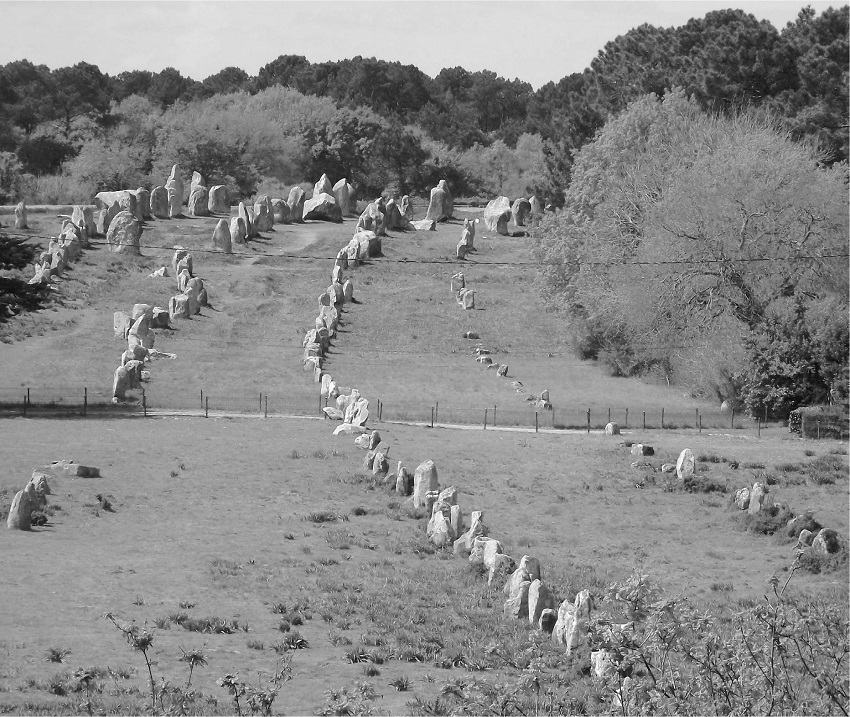
Figure 1
Carnac’s alignments. Source: Author, July 2016.
During the same period, Carnac’s megaliths were used as ritual supports for neo-druidic ceremonies. Dressed in long white tunics, several local associations gathered around numerous megaliths, such as those in Carnac, in order to perform pagan rituals mainly during the summer (Le Stump, 1998). One of these associations was a conservative political party that harbored disagreement with the French government (Ibid.: 444-445). Aiming to maintain close links with other populations who shared cultural elements and spoke Celtic languages, such as Brittany’s local Breton dialect, its members established contacts with Irish, Scottish, and Welsh Celtomaniacs (Rubio, 2011: 134).7 Intellectuals of the British Isles at the time perceived Brittany as a privileged repository of the Celtic idiom and race.8 Searching to reinforce their local identity and cultural relations with other Celtic nations, members adopted the ritual design that guided neo-druidic ceremonies held in the British Isles megaliths during the eighteenth century.9
In the second half of the twentieth-century, traditional therapeutic practices observed by ethnologists in the 1900s were present in the collective memory of local inhabitants, who started to reinterpret them mainly in New Age and contemporary-Pagan terms.10 In Brittany, as in the rest of France, both phenomena first arrived in the 1960s in the form of books and magazines that addressed the questions of how suprahuman agents and forces contained in nature could enable persons to be physically and psychologically healthy, understand their personality, or make sense of their lived experiences (Voisenat, 2005: 23-24). Within this wave of esoteric literature, several publications regarding the ‘secret powers of megaliths’ and the ‘enigmas of the Earth’ appeared.11 The diffusion of these types of notions fueled the emergence of a pseudoscientific field called geobiology. Regardless of its appropriation of the scientific terms of geology and biology, scholars agree it’s based on the idea that certain disturbances on the human body are caused by magnetic and electric currents that flow through Earth’s magnetic field (Kivari, 2016; Schmitz, 2006: 104).
Until I began my doctoral research, New Age and contemporaryPagan practices concerning Carnac’s megaliths had only been explored by Ellen Badone (1991). She arrived in Carnac in 1983, searching to explore alternative therapeutic practices. The inhabitants she interviewed had the belief that local megaliths had the power of providing ‘beneficial energies’ that could improve their physical and psychological wellbeing. In order to have access to these energies, her informants used to approach the megaliths slowly and to follow a zig-zag course to avoid disturbing the energy field. Next, they touched the stone with the palms, the forehead and the torso to bring their vital organs in direct contact with the stone’s surface. Last, they stayed there for a few minutes to incorporate the megalith’s invisible energy into their body (Ibid.: 525).
During the last fifteen years, several actors proposing ‘Earth energy healing and self-knowledge experiences’ have been established around Carnac’s megaliths. Nowadays, this archaeological site has become an ‘alternative healing mecca,’ a category it shares with places such as Glastonbury and Sedona where droves of people arrive searching for new experiences, insights, and ‘tools for transformation’ (Bowman, 2005; Ivakhiv, 2003). A flourishing local spiritual market has been established (Dansac, 2020a).12 Access to practices is made through virtual channels mainly exemplified via websites where future participants can choose among a variety of ‘experiences’ that may differ in duration, the number of megalithic sites visited, or spiritual orientation such as Yoga, Carlos Castaneda’s Tensegrity or Shiatsu, among others.
Conducting ethnographic research about the enchantment of Carnac’s megaliths
The groups who perform contemporary spiritual practices at the megaliths of Carnac are led by specialists who are primarily men, aged between forty and seventy years-old, and come from Paris. They have trained abroad often, and they rarely establish social relations with other colleagues.13 Nevertheless, all specialists share similar techniques and discourses because their knowledge on the subject usually derives from the same sources.14 Therefore, they follow a similar ritual design or pattern of execution while conducting the practices. When in front of the group, they present themselves as specialists and underline their degree of expertise by briefly recounting personal life-changing experiences, neoshamanic travels among non-Western societies, or their sensorial skills. Outside the practices, some of them work as therapists, neo-shamans, or life coaches. Participants are mainly women between twenty-four and seventy years-old who hold university degrees and live in the Carnac region. Practitioner’s attraction to Carnac arises from their interests in a wide range of subjects such as archaeology, esoteric beliefs, astrology, occultism, or personal development. By taking part in the prevailing ethos of contemporary spirituality, participants create and develop a personally-crafted package that is their individual quest (Bowman, 2005: 169). Practices allowed them to fulfill their expectations and desires, encounter the place through ritual practices and elaborate a meaningful experience (Ivakhiv, 2003: 106). Any person can become a participant, as long as they pay the established fee.
As part of my research, I conducted participant observations in twenty workshops, which allowed me to gather information about the discourses associated with Carnac during practices. I also conducted ten semi-structured and five in-depth interviews. The firsts consisted of exchanges that took place during or at the end of practices and were guided toward two main themes: the theoretical and practical foundations of the participants before, during and after participating, and the participant’s spiritual experiences regarding the megaliths. The responsiveness of the informant determined the order of topics covered. The in-depth interviews took place outside of practices and allowed me to deepen my knowledge of both themes. In this article, I will use data mainly from my fieldwork carried between 2015 and 2018, and citations derived from several semistructured and in-depth interviews.
Understanding what is considered sacred or energetic and how it is enacted
The sacred characterization given to a place generally draws from the myths, traditions and ancient rituals associated with the objects it contains (Bowman, 2005: 178). But in the case of Carnac’s megalithic landscape, discourses about sacredness are mainly permeated by references to energy. According to Nicolas, an hypno-therapist conducting practices in Carnac since 2016, a sacred place contains natural energies and wellbeing properties without the need for human intervention. His interpretation draws from New Age nature spiritualities that imbues nature as an object with a meaningful quality (Ivakhiv, 2003: 110). For Nicolas, Carnac was sacred before the arrival of the ancient builders, and it has always had the ‘natural’ potential of restoring the human being’s mental, physical and spiritual health. As he noted,
I choose to conduct my workshops in Carnac, in Brittany, because it is my favorite sacred place. A sacred place is first and foremost an intermediate place located between cosmic and earthly dimensions. It’s a place that was sacred long before being used by our ancestors. By appropriating Carnac to exercise their cults and carry out their rites, the ancient builders came to consolidate the natural function of this place. Conversely, the monuments they built have no power and are proven ineffective to us without the energy of the place. When we combine the presence of our body, the sacred place and the sacred megalith, we witness what many call a miracle: a sense of spiritual and physical reconditioning which is only caused by the action of the nature’s energies. (Nicolas, 6th May 2017)
The association between sacredness and energy becomes even more evident in Eric’s answer to the question: “Why did you choose this place to do your workshops?” (author, 13th December 2015). For this specialist who organizes practices in Carnac since 2012, this place had the energy characteristics the ancient builders were searching to locate their megaliths. According to Eric, the powers granted to the stones as providing what Nicolas verbalized as ‘a sense of spiritual and physical reconditioning’, are ascribed to the pre-existence of natural energies contained in this megalithic landscape. As he explained,
The natural-sacred landscape of Morbihan, characterized by these megaliths, serves as a scenario for us to balance our energies in order to align our physical, mental and emotional structure by doing breathing and movement exercises, as well as reflect on our life. Indeed, the megaliths of Carnac had all the characteristics necessary to be chosen by the ancient builders as the ideal place to achieve a sacred geometry. This landscape was already sacred before the arrival of man, because it has extraordinary vibrational and energetic power. The megaliths were built in order to heal the earth and trigger the energy contained underground (Eric, 13th December 2015).
In New Age terms, the energy granted to Carnac’s megaliths takes the form of universal life-force energy that can be sensed with the human body (Albanese, 2000: 36). By engaging in energy healing practices here, participants can access a wide range of techniques leading to the reparation of broken or disfigured auras, which promotes general healing (Ibid., 30-33). Energy language appropriates terms related to mathematics and physics (Charuty, 1990: 4); this allows participants to engage in practices without constraints because esoteric theories regarding the megaliths are permeated by the language of science (Bastide, 2010). Sometimes, participants use energy language in order to make sense of their personal experiences and the ancient therapeutic practices mentioned in section 1. This was the case of Anne, a saleswoman that attended the practice for the first time in 2018. When I asked her, “Did you already know these stones have special properties?” (author, 30th June 2018), she described to me her relationship with the megaliths, highlighting the ignorance of the energy potential of the place by the ancient generations. As she noted,
These stones have always been here. I have seen them all my life. They are part of our daily lives. They want to be touched. They like people coming to visit them now and then. As you may have already heard from other people, our grandfathers and greatgrandfathers used to visit the megaliths when they felt tired or sick. They knew there was something special here, although they did not know why. At the time, they just came here, touched the stones for a while, and then left feeling revitalized, reinvigorated, restored. Now we know why our grandfathers used to do that. There are some very strong magnetic and energetic fields in this place. The megalith’s position is linked to the stars, the universe, and the earth’s energies. It is a place to heal, to connect, to find yourself (Anne, 30th June 2018)
In order to experience the ‘sacred’ and ‘energetic’ qualities given to the Carnac megaliths, participants engage in practices that share a homogeneous ritual design illustrated and analyzed by Dansac (2020b). Specifically, participants walk in silence around the megaliths, then touch them with their palms, torso, forehead or back, and finally engage in verbal exchanges with others in order to compare their somatic sensations.15 The objective of these actions is to access the local megalith’s ‘healing powers’ through the intervention of non-human entities, called ‘spirits of the place,’ associated with the stones. Practices include a variety of exercises including visualization, New Age styles of Reiki, energy healing techniques and Western forms of meditation.16
Before walking in silence around the megaliths, specialists generally justified practices by mentioning that our lives have been “problematized” because our closeness to technology and urban life has distanced us from nature and our ‘true self’. Solutions are offered through the practice of energy healing techniques that aim to repair the person’s auras or energy fields,17 and encounter this ‘true self’. This kind of self has a tripartite configuration (Ivakhiv, 2003: 108; Hanegraaff, 1996: 215-218). It comprises the essential self which is concentrated in the aura of the person; the ‘multiple self’, which can take the form of ‘nature’s spirits’ and energies; and the ‘cosmic’ or ‘higher’ self is rooted in the cosmos and directs the persons towards the development of their spiritual consciousness. The first discourse of the specialists leading the practice also includes theoretical principles which not only extensively claim New Age notions of aura, ‘energetic healing’, and different kinds of ‘selves’, but also include certain precepts that are at the heart of Contemporary Paganism. Participants are encouraged to establish a relationship with non-human beings and incorporate a “re-enchanted” view of the world (Moscovici, 2002).18 This is looked upon as inhabited by human and nonhuman beings.
Once the theoretical principles are settled, specialists ask the group to call upon the nature spirits silently and individually, with closed eyes, in order to ask for permission to touch the stone. These non-human beings are the only ones capable of releasing the energy contained in the megaliths. In order to visualize the spirit, the specialist describes it to the group as a fairy, a goblin, a gnome, or another type of creature mentioned in local folk tales of the early twentieth century (Sébillot, 1911; Guénin, 1911). Actors considered the invoked spirits as living beings who possess knowledge, emotions, and reflexivity. Only by considering them as beings in their own right,participants can relate to them, communicate with them, and experience them during practices (Butler, 2004: 109).
After this silent moment, specialists invite the participants to walk to the megalith through the open space surrounding it. Without any indication, most participants walk slowly in a zigzag pattern, while approaching the stone. We could consider these actions, and many others executed during the practice, as ‘acts of sacralization’ that “make distinctions between spaces, mark them for specific uses, create visible and invisible boundaries, and establish cultural conventions of behavior to deal with those boundaries” (Anttonen, 2005: 198). Once they arrive at the megaliths, some participants lay down on their backs, their arms aligned against the body, in the standing stones on the ground. Others stand up, with their arms also aligned against the body, and they rest their forehead against the surface of the standing stone (figure 2). This moment, which lasts about fifteen minutes, is characterized by the virtual absence of verbal exchanges between the participants. After this exercise, specialists usually gather the participants in a circle and asked them what they felt. Participants generally share their somatic experiences finding similarities with others (Dansac, 2020b). Before departing, the specialist proceeds to the closing of the practice by verbally thanking the megaliths and the energies of nature which accompanied us through the experience.
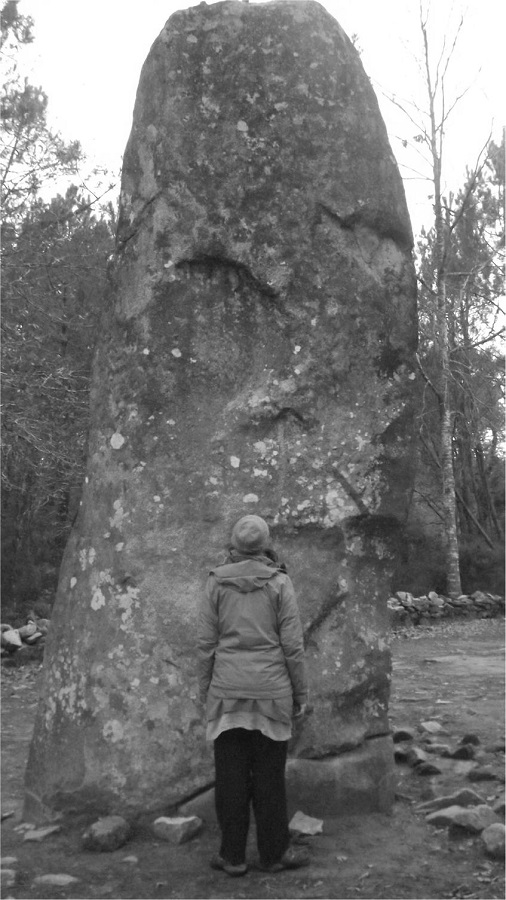
Figure 2
A participant touching the megalith with her forehead.
Source: Author, 12th December 2015.
Enchanting an archaeological site to experience personal transformation
For those who engage in these practices, the human body, earth and nature are considered in energetic terms. If nature and the earth are regarded as living beings, then it is reasonable to suppose that lifeenergy flows through them and into the human body. In this sense, “a healthy body is one in which the flow of life-energy is unimpeded” (Ivakhiv, 2003: 111). Testimonies gathered at fieldwork emphasize three spiritual purposes associated with the culture of personal transformation. I will address them separately.
One of the main goals during practices is addressed in terms of an ‘energy alignment’ which is often associated with cleansing the body energies and reconditioning chakras (Albanese, 2000: 36). This purpose is often stated from the beginning of practices and at every exercise. As highlighted by Jean, a geobiologist organizing practices in Carnac for the last five years, to ‘align’ means to synchronize our body, spirit and mind. He usually refers to the alignments of megaliths (Figure 1) to help us visualize this alignment. As he explained:
To begin our workshop, you will go to the Carnac alignments to align yourself. Imagine that you have several characters in you who do not always choose the same path. To align is to say to your little inner world: let’s take the same direction together. We will walk in silence through this field of stones, until we reach the very end. The telluric currents here are such that your body is now starting to recharge its batteries. These energies have the ability to cleanse and realign your body, mind and spirit. The Carnac alignments contribute enormously to the scale of Brittany. It is a place of great power. Under the stones of Carnac, there are telluric currents that have an impact on a planetary scale. This is how the Earth breathes, by means of sacred sites erected in very specific places. It is in this magic that you will align yourself (Jean, 5th March 2016).
According to Jean and other specialists, humans can gain healing and insight by availing themselves of the energy present in these megaliths. The emphasis on the place’s energetic qualities is often mentioned to invite the participants to be conscious of their body and their emotions. Specialists have an active role in constructing the participant’s experiences, mentioning specific emotions and sensations that can be attained here. The same specialist noted this during practice in the next speech:
All of these stones are powerful. But some attract us more than others because of their size or their energies. Some give us a feeling of calm and relaxation; others cause vibrations in the body. This site has lived a lot. It is a highly vibratory place that allows your energies to align in the heart. Here, some stones have special properties. They can heal parts of your body. Some have the ability to calm the mind, others allow your bodies to relax, others can cleanse your chakras. Depending on the needs of each, you will be in contact with certain stones. Here again, the spirits of nature will be very present. We will walk to the end of the lines, in silence. Please focus, concentrate, get in tune with nature and the spirits that inhabit this place (Jean, 5th March 2016).
For participants, by engaging in practices where sacred energy discourses are omnipresent, they were able to experience a state of wellbeing. By practicing in Carnac, they learn how to emotionally relate to a ‘sacred’ and ‘energetic’ landscape, but also to ‘transform’ their physical, mental and spiritual state. This interpretation was shared by Florian, an engineer who discovered these practices for the first time in 2016. He explained that these experiences made it possible for him to receive beneficial energies that acted in his body, mind and spirit. These kinds of purposes are also mentioned by people who engage in alternative pilgrimages (Fedele, 2014: 156). As Florian stated:
The visit of these high places makes it possible for me to feel various energies at physical, psychic or spiritual levels. I am able to discharge a large part of the bad energies that usually disturb me, and to recharge myself with good energies that bring me balance (Florian, 20th May 2017).
For other participants, personal transformation is mainly related to acquiring more knowledge about themselves and the world they inhabit. Because actors mobilize a contemporary-Pagan worldview often disregarded outside practices (Houseman, 2016: 215), participants valued the encounter with others who, like them, invest their time and financial resources to experience a communion with non-human beings. For Josephine, a merchant who has been attending these practices since 2013, her regular visits to the Carnac megaliths have allowed her to discover and communicate with energies and nature spirits, but also to get to know other persons with whom she can share her experiences without fear of being mocked or criticized. As she shared:
During meetings, we get to know so many things around us, that have always been there. The life of the earth, the vibrations, the energies, the spirits of nature. All of this life around us, that we believe it or not, exists. We learn to communicate with them, and we learn to accept them. And at the end, we leave this place carrying a wonderful knowledge. We really take our life in our hands, and we continue our journey with new ideas and new skills. The richest thing I found here was to be surrounded by others who, like me, are here to get to know themselves better (Josephine, 21th June 2018).
As illustrated through the actor’s discourses, the enchantment of archaeological sites is a phenomenon that accompanies the development and enactment of the culture of personal transformation. Ancient places such as the Carnac stones are continuously being invested in sacred and energy terms in order to incite practitioners to engage in holistic practices.
Final considerations and further inquiries
Ethnographic fieldwork of contemporary spiritual practices held at Carnac’s megaliths has provided significant insights into the practitioner’s conceptualizations of Carnac’s megaliths as being ‘sacred’ and ‘energetic’. According to testimonies I gather among my informants, both elements sometimes engage in a syncretic relationship. They can also be experienced separately during practice, allowing participants to engage in a dual/singular interaction with this place. For Marie and Eric, both characteristics served the purpose of providing an experience both ‘spiritual’ and ‘therapeutic’. For Florian, Anne and Pierre, the ‘energetic’ characteristic of the place was essential for experiencing the states of wellbeing, relaxation and healing associated with practices. These uses of energy discourse have also been gathered among pilgrims influenced by the international Goddess movement, who mobilize energy notions to make sense of their travel experiences and focus on their personal transformation (Fedele, 2014: 162). In Carnac, collected data also points out to the enchantment of archaeological sites as a strategy to pursue this goal.
Furthermore, my research indicates that participants’ interpretations of the specialist’s theories regarding Carnac’s megaliths are the main tool used to attain the objective of these activities. Considering that my informants hailed primarily from Western, inherently individualistic societies, they placed great importance on their knowledge and experience by relating it to their “notions of person in constant development, always heading toward some kind of self-realization” (Abrahams, 1986: 50). Discourses mobilized during practices allowed participants to come in with different interpretations or simply without interpretations. Some of them had read New Age and contemporary-Pagan oriented literature regarding megalithic sites,19 had previously participated in similar experiences in or outside Europe or had heterogeneous notions about energy and sacredness of a place. Others arrived without knowing what these practices were specifically about, but they knew it was a ‘different’ kind of visit or tour around Carnac’s megaliths. In both cases, with or without previous knowledge, the participants may or may not constitute or reconstitute their own interpretations of the place using what they think it is, what others say to them it represents, and discourses of the specialists.
Further inquiries are necessary to better understand how personal transformation is experienced in archaeological sites, compared to other places. It would be useful to explore energy and sacredness discourses in different latitudes in order to analyze how both categories are enacted through different practices. Social dynamics and hierarchies of knowledge existing between local and non-local participants, specialists and nonpractitioners could also provide a more accurate frame for understanding the relevancy of local folklore, traditional practices, and New Age and contemporary-Pagan notions in the process of the enchantment of archaeological sites.
Acknowledgements
This article was first presented as a paper at the panel entitled “(Re) animating Heritage: Deconstructing Time, Place and Being(s)” organized by Hilary Morgan V. Leathem and Pedro Guillermo Ramon Celis at the 5th Biennial Conference of the Association of Critical Heritage Studies, University College London in 2020. I thank the peer reviewers for encouraging me to improve this article by providing critical discussions of the content.
Bibliographical references
ABRAHAMS, Roger D.. Ordinary and Extraordinary Experience. In: TURNER, Victor W.; BRUNER, Edward M. (org.). The Anthropology of Experience. Urbana & Chicago: University of Illinois Press, pp. 45-72, 1986.
ALBANESE, Catherine L. The Aura of Wellness: Subtle Energy Healing and New Age Religion. In: Religion and American Culture: A Journal of Interpretation, v.10, n.1, pp. 29-55, 2000.
ANDERSON, Terry H.. The Movement and the Sixties: Protest in America From Greensboro to Wounded Knee. Oxford: Oxford University Press, 1995.
ANTTONEN, Veikko. Space, Body, and the Notion of Boundary: A Category-theoretical Approach to Religion. In: Temenos, v.41, n.2, pp. 185-201, 2005.
BADONE, Ellen. Ethnography, Fiction and the Meanings of the Past in Brittany. In: American Ethnologist, v.18, n.3, pp. 518-545, 1991.
BASTIDE, Roger. Le sacré sauvage. In: SociologieS [on line], Découvertes / Redécouvertes, Roger Bastide, 2010, put online on September 8 2010, accessed August 1 2018: http://journals.openedition.org/sociologies/3238
BERTHO, Catherine. L’invention de la Bretagne : Genèse sociale d’un stéréotype. In: Actes de la Recherche en Sciences Sociales, v.35, n.1, pp. 45-62, 1980.
BLAIN, Jenny; Robert J. WALLIS. Sacred Sites, Contested Rites / Rights. Contemporary Pagan Engagements with the Past. In: Journal of Material Culture, v.9, n.3, pp. 237-261, 2004.
BOISMOREAU, Émile. Notes à propos de l’utilisation thérapeutique des mégalithes dans la Bretagne. In: Bulletin de la Société Préhistorique de France, v.14, n.3, pp. 158-160, 1917.
BONVIN, Jacques. Mégalithes. Lieux d’énergie. Paris: Mosaïque, 2008.
BOWMAN, Marion. Contemporary Celtic spirituality. In: PEARSON, Joanne (org.). Belief Beyond Boundaries. London: Ashgate & The Open University, pp. 55-101, 2002.
Ancient Avalon, New Jerusalem, Heart Charkra of the Earth: The Local and the Global in Glastonbury. In: Numen International Review for the History of Religions, v.52, n.2, pp. 157-190, 2005.
BUTLER, Jenny. Neo-pagan ritual practice as Visual Culture and Creative Expression of Identity. In: KOCKEL, Ullrich; NIC CRAITH, Mairead (orgs.). Communicating Cultures. London: Transaction Publishers, pp. 108-128, 2004.
CARD, Jeb J.. Archaeology and New Religious Movements. In: Nova Religio: The Journal of Alternative and Emergent Religions, v.22, n.4, pp. 5-12, 2019.
CHANVALLON, Stéphanie. L’homme et la nature: en quête/enquête sensible. In: Nature, Sciences, Sociétés, v.19, n.4, pp. 355-364, 2011.
CHARUTY, Giordana. De la preuve à l’épreuve. In: Terrain, v.14, pp. 4759, 1990.
CHRYSSIDES, George D. Defining the New Age. In: KEMP Daren; LEWIS James R. (ed.). Handbook of New Age. Leiden: Brill, pp. 5-24, 2007.
COCO Angela; WOODWARD, Ian. Discourses of Authenticity Within a Pagan Community: The Emergence of the ‘Fluffy Bunny’ Sanction. In: Journal of Contemporary Ethnography, v.36, pp. 479-504, 2007.
DANSAC, Yael. La marchandisation des pratiques rituelles alternatives dans les mégalithes du Morbihan, France. In: Carta Tepa Mayo 4, Revista de Ciencias Sociales, v.2, n.1, pp. 107-121, 2020a.
Embodiment Engagements with the megaliths of Carnac: Somatic Experience, Somatic Imagery and Bodily Techniques in Contemporary Spiritual Practices. In: Journal of Religion in Europe, v.13, n.3/4, pp. 300324, 2020b.
DE LA BORDERIE, Arthur le Moyne. Histoire de la Bretagne, Rennes: H. Vatar, 1905.
DE LA TORRE, Renée. Les rendez-vous manqués de l’anthropologie et du chamanisme. In: Archives de sciences sociales des religions, v.153, pp. 145-158, 2011.
Los nuevos santuarios de una espiritualidad global: resignificaciones y apropiaciones contemporáneas de los sitios arqueológicos. In Ark Magazine. Espiritualidad y Arqueología, v.7, n.27, pp. 14-20, 2019.
DE LA TORRE, Renée; GUTIÉRREZ ZÚÑIGA, Cristina. La neomexicanidad y los circuitos New Age: ¿Un hibridismo sin fronteras o múltiples estrategias de síntesis espiritual? In: Archives de sciences sociales des religions, n.153, pp. 183-206, 2011.
DE LA PEÑA, Francisco. Profecías de la mexicanidad: entre el milenarismo nacionalista y el New Age. In: Cuicuilco, v.19, n.55, pp. 127-143, 2012.
DEMOULE, Jean-Paul. Naissance de la figure de l’art du paléolithique à l’âge de fer. Paris: Gallimard, 2017.
ENGLISH, Penny. Disputing Stonehenge: law and access to a national symbol. In: Entertainment Law, v.1, n.2, pp. 1-22, 2002.
FEDELE, Anna. Energy and transformation in alternative pilgrimages to Catholic shrines: deconstructing the tourist/pilgrim divide. In: Journal of Tourism and Cultural Change, v.12, n.2, pp. 150-165, 2014.
FELDER, Dominique. Les mutants pacifiques: expériences communautaires du «New age» en Californie. Lausanne: Éditions d’en bas, 1985.
GALINIER, Jacques; Antoinette MOLINIÉ. Les néo-Indiens. Une religion du IIIe millénaire. Paris: Odile Jacob, 2006.
GAUTHIER, Thierry. L’énergie des lieux sacrés. Rennes: éditions Ouest France, 2019.
GIBSON, Margaret. Memorialization and Immortality: Religion, Community and the Internet. In: HUME, Lynne; MCPHILLIPS, Kathleen (orgs.). Popular Spiritualities: The Politics of Contemporary Enchantment. London: Routledge, pp. 63-76, 2006.
GUÉNIN, George. Les rochers et les mégalithes de Bretagne (Légendes, traditions et superstitions). In: Bulletin de la Société Académique de Brest, v.43, pp. 191-280, 1911.
Pierres à légendes de la Bretagne. Paris: Les éditions Émile Nourry, 1936.
GUYONVARC’H, Christian J.; LE ROUX, Françoise. Les Druides. Rennes: éditions Ouest France, 1986.
HANEGRAAFF, Wouter J.. New Age Religion and Western Culture: Esotericism in the Mirror of Secular Thought. Leiden, New York & London: Brill, 1996.
HARVEY, Graham. Contemporary Paganism. Listening People, Speaking Earth. New York: New York University Press, 1997.
HEELAS, Paul. The New Age Movement: Religion, Culture and Society in the Age of Postmodernity, London: Wiley-Blackwell, 1996.
Spiritualities of Life. In: CLARKE, Peter (org.). The Oxford Handbook of the Sociology of Religion. Oxford: Oxford University Press, pp. 758-782, 2009.
HEELAS, Paul; WOODHEAD, Linda. The Spiritual Revolution: Why Religion is Giving Way to Spirituality. Oxford: Blackwell Publishing, 2005.
HEINTZMAN, Paul. Nature-Based Recreation and Spirituality: A Complex Relationship. In: Leisure Science, v.32, pp. 72-89, 2009.
HOUSEMAN, Michael. Comment comprendre l’esthétique affectée des cérémonies New Age et néopaïennes? In: Archives de sciences sociales des religions, v.174, pp. 213-237, 2016.
HUTTON, Ronald. Modern Druidry and Earth Mysteries. In: Time & Mind. The Journal of Archaeology, Consciousness and Culture, v.2, n.3, pp. 313331, 2009.
INSOLL, Timothy (org.). The Oxford Handbook for the Archaeology of Ritual and Religion. Oxford: Oxford University Press, 2012.
IVAKHIV, Adrian. Nature and Self in New Age Pilgrimage. In: Culture and Religion, v.4, n.1, pp. 93-18, 2003.
KIVARI, Kristel. Dowsing as a link between natural and supernatural. Folkloristic reflections on water veins, earth radiation and dowsing practice. Tartu: University of Tartu Press, 2016.
LE COADIC, Ronan. Le fruit défendu : Force de l’identité culturelle bretonne et faiblesse de son expression politique. In: Cahiers Internationaux de Sociologie, v.111, n.2, pp. 319-339, 2001.
LE STUMP, Philippe. Le Néo-Druidisme en Bretagne : Origine, naissance et développement, 1890-1914. Rennes: Éditions Ouest-France, 1998.
LÉONARD, Alexis. ‘Nos ancêtres les gaulois’: la celtomanie en France. In: BURLE-ERRECADE, Élodie; NAUDET, Valérie (orgs.). Fantasmagories du Moyen Âge. Entre médiéval et moyen-âgeux. Aix-en-Provence: Presses Universitaires de Provence, pp. 183-190, 2010.
LESKOVAR, Jutta; KARL, Raimund (orgs.). Archaeological Sites as Space for Modern Spiritual Practice. Cambridge: Cambridge Scholars Publishing, 2018.
LÓPEZ, Joaquín P. Espiritual pero no religiosa: la cultura de la transformación personal. In: Revista de Ciencias de las Religiones, v.17, pp. 77-99, 2012.
LUCAS, Phillip Charles. Constructing Identity in the Dreamstones: Megalithic Sites and Contemporary Nature Spirituality. In: Nova Religio. The Journal of Alternative and Emergent Religions, v.11, n.1, pp. 31-60, 2007.
MACDONALD, Jeffrey. Inventing Traditions for the New Age: A case of Study of the Earth Energy Tradition. In: Anthropology of Consciousness, v.6, n.4, pp. 31-45, 1995.
MAGLIOCCO, Sabina. Reconnecting to Everything: Fairies in Contemporary Paganism. In: OSTLING, Michael (org.). Fairies, Demons and Nature Spirits. ‘Small Gods’ at the Margins of Christendom. London: Palgrave Macmillan, pp. 325-347, 2018.
MICHELL, John. The View over Atlantis. London: Sago Press, 1969.
MOSCOVICI, Serge. Réenchanter la nature. Paris: éditions de l’aube, 2002.
NIEL, Fernand. Connaissance des mégalithes. Paris: Éditions Robert Plafond, 1976.
NORA, Pierre. La mémoire collective. In: LE GOFF, Jacques (org.). La nouvelle histoire. Paris: Retz-CEPL, pp. 389-401, 1978.
OWEN, Suzanne; TAIRA, Teemu. The category of “Religion” in Public classification: Charity Registration of the Druid Network in England and Wales. In: STACK, Trevor; GOLDENBERG, Naomi; FITZGERALD, Timothy (org.). Religion as a category of Governance and Sovereignty, London: Brill, pp. 90-114, 2015.
PICQUENARD, Charles Armand. Notre enquête sur les pardons bretons. In: Revue Morbihannaise, n.6, pp. 301-308, 1910.
PARTRIDGE, Christopher. The Re-Enchantment of the West: Alternative Spiritualities, Sacralization, Popular Culture and Occulture, London: T&T Clark, 2005.
POSSAMÏ, Adam. Religion and Popular Culture: A Hyper-Real Testament. Brussels: Pie-Peter Lang, 2005.
POSTIC, Fañch; LAURENT, Donatient; SIMON, Jean-François. Reconnaissance d’une culture régionale: la Bretagne depuis la Révolution. In: Ethnologie Française, v.33, n.3, pp. 381-389, 2003.
ROUNTREE, Kathryn. Performing the Divine: Neo-Pagan Pilgrimages and Embodiment at Sacred Sites. In: Body and Society, v.12, n.4, pp. 95-15, 2006.
Introduction. Context Is Everything: Plurality and Paradox in Contemporary European Paganisms. In: ROUNTREE, Kathryn (org.). Contemporary Pagan and Native Faith Movements in Europe: Colonialist and Nationalist Impulses. New York & Oxford: Berghahn, pp. 1-23, 2015.
RUBIO, José Antonio. El espejo irlandés: Panceltismo y nordismo en el discurso nacionalista de Bretaña (1845-1945). In: Ayer, v.84, n.4, pp. 131-158, 2011.
SÉBILLOT, Paul. La Bretagne pittoresque et légendaire. Paris: H. Daragon, 1911.
SCHMITZ, Olivier (org.). Géobiologie, ondes négatives et discours de légitimation. In: Les médecines en parallèle. Multiplicité des recours au soin en Occident. Paris: Karthala, pp. 103-119, 2006.
SUTCLIFFE, Steven J.; GILHUS, Ingvild. Introduction: “All Mixed Up”- Thinking about Religion in Relation to New Age Spiritualities. In: ______ (orgs). New Age spirituality: Rethinking Religion. New York: Routledge, pp. 17-34, 2014.
TIMOTHY, J. Dallen; CONOVER, Paul J.. Nature religion, self-spirituality and New Age tourism. In: DALLEN, Timothy; OLSEN, Daniel (orgs.). Tourism, Religion and Spiritual Journeys. London: Routledge, pp. 139155, 2006.
YORK, Michael. The Emerging Network: A sociology of New Age and NeoPagan Movement. Boston: Rowman and Littlefield Publishers, 1995.
VOISENAT, Claudie. Introduction. In: LAGRANGE, Pierre; VOISENAT, Claudie (orgs.). L’ésotérisme contemporain et ses lecteurs. Entre savoirs, croyances et fictions. Paris: éditions de la Bibliothèque Publique d’Information, pp. 15-116, 2005.
WEBER, Max. From Max Weber: Essays in Sociology. London: Routledge & Wright Mills, 1991.
WHITE, Ethan Doyle. Around the Witches’ Circle: Exploring Wicca’s Usage of Archaeological Sites. In: LESKOVAR, Jutta; KARL, Raimund (orgs.). Archaeological Sites as Space for Modern Spiritual Practice. Cambridge: Cambridge Scholars Publishing, pp. 182-193, 2018.
WOOD, Matthew. Possession, Power and the New Age: Ambiguities of Authority in Neoliberal Societies. Aldershot: Ashgate, 2007.
Notes