Article
CHALLENGING RELIGIOUS HEGEMONY: ETHNO-PAGAN STRATEGIES FOR IDENTITY CONSTRUCTION
DESAFIANDO LA HEGEMONÍA RELIGIOSA: ESTRATEGIAS ETNO-PAGANAS PARA LA CONSTRUCCIÓN DE LA IDENTIDAD
DESAFIANDO A HEGEMONIA RELIGIOSA: ESTRATÉGIAS ETNO-PAGÃS PARA A CONSTRUÇÃO DA IDENTIDADE
CHALLENGING RELIGIOUS HEGEMONY: ETHNO-PAGAN STRATEGIES FOR IDENTITY CONSTRUCTION
Ciencias Sociales y Religión / Ciências Sociais e Religião, vol. 23, pp. 1-26, 2021
Universidade Estadual de Campinas
Received: 05 February 2021
Accepted: 15 May 2021
ABSTRACT: This work applies the theoretical framework of the religious marketplace to examine the religious landscape of Lithuania as a hegemonic field where the dominant Catholicism is regarded as an integral part of the national identity. The research interest aims at exploring the Ethno-Pagan movement Romuva and its strategies to counteract the social authority of the Catholic Church and build legitimacy through maximization of cultural capital. I advance the hypothesis that the ritualized form of the celebration of the spring holiday Jorė could be regarded as an attempt to construct an alternative, counterhegemonic narrative of identity, which portrays a worldview where the ethnical, cultural, natural and political aspects of Lithuanian reality come together to form a comprehensive unity under the guidance of the Ethno-Pagan religion.
KEYWORDS: Ethno-Paganism, religious hegemony, religious marketplace, identity construction.
RESUMEN: Este trabajo aplica el marco teórico del mercado religioso para examinar el panorama religioso de Lituania como campo hegemónico en el que el catolicismo dominante se considera parte integrante de la identidad nacional. El interés de la investigación se centra en explorar el movimiento etno-pagano Romuva y sus estrategias para contrarrestar la autoridad social de la Iglesia católica y construir legitimidad mediante la maximización del capital cultural. Adelanto la hipótesis de que la forma ritualizada de la celebración de la fiesta de la primavera Jorė podría considerarse como un intento de construir una narrativa alternativa y contrahegemónica de la identidad, que retrata una visión del mundo en la que los aspectos étnicos, culturales, naturales y políticos de la realidad lituana se unen para formar una unidad integral bajo la guía de la religión etno-pagana.
PALABRAS CLAVE: Etno-paganismo, hegemonía religiosa, mercado religioso, construcción de la identidad.
RESUMO: Este artigo aplica o marco teórico do mercado religioso para examinar a paisagem religiosa da Lituânia como um campo hegemônico em que o catolicismo dominantes é considerado parte integrante da identidade nacional. O interesse de pesquisa visa explorar o movimento etno-pagão Romuva e suas estratégias para atuar contra a autoridade social da Igreja Católica e construir legitimidade por meio da maximização de capital cultural. Proponho a hipótese de que a forma ritualizada de celebração da festa da primavera Joré poderia ser considerada uma tentativa de construir uma narrativa de identidade alternativa e contrahegemônia, que retrata uma visão de mundo em que aspectos éticos, culturais, naturais e políticos da realidade lituânia são reunídos para se formar uma unidade integral sob a orientação da religião etno-pagã.
PALAVRAS CHAVE: Etno-paganismo, hegemonia religiosa, mercado religioso, construção de identidade.
Introduction
When reflecting upon modern times, we often tend to think in terms of economy-related concepts such as free market, unlimited offers, or fair competition. The popular perceptions, fed by the narratives of pluralism and diversity, imagine life as a journey where each individual, liberated from the restraints of the traditional society, is free-floating between different options in attempt to construct their own unique identity. The idea of the “massive subjective turn of modern culture” (Taylor, [1991] 2003: 26) implies inclinations toward personal interpretation and overindividualization of content consumption and puts an emphasis on the individual’s self-creation. According to Peter Berger, one of the most significant transformations of the human condition in modern times is the “transition from fate to choice” (Berger, 1979: 10). The heretical imperative of modernity, the sociologist argues, rejects the idea of predetermination and obliges people to make choices, instead of adhering to inherited norms of behavior. Thus, the never-ending variety of options in the capitalist world is believed to be turning life into a constant process of identity redefinition. As Lyotard argues (1984), the 20th century has seen the end of the grand narratives of legitimation that have given way to a fragmented reality, providing various options for self-definition.
Could the same explanatory framework be applied to the field of religion as well? Is novelty so easily integrated into it? Is it susceptible to short-term trends? The concepts of pluralist environment and open market, dominated by the logic of capitalism, have led researchers to explore the connection between religion and economics and to advance the model of a competitive religious marketplace (Stark & Finke, 2000), drawing on the rational choice theory’s (Becker, 1975) assumption that people attempt to make rational choices by maximizing their social capital. In these terms, believers seeking religious affiliation are compared to customers making strategical decisions about their commitments.
Stark and Finke (2000: 36), however, do not absolutize the element of rationality and reject the rational choice theory as too simplistic. The authors acknowledge that religious affiliation couldn’t be explained on purely rational grounds since there is a number of social and cultural factors which influence and modify people’s decision-making process. They add to the principle of human rationality the clarification that humans make choices “within the limits of their information and understanding, restricted by available options, guided by their preferences and tastes” (Ibid.: 38). In the development of their research, another important feature of the religious economy is incorporated: the assumption that pluralism can be distorted by the tradition of establishment (Ibid.: 201). This suggestion is crucial for the current research and deserves further investigation.
Identifying religious hegemony
Indeed, the process of globalization, understood as “the breakdown of taken-for-granted traditions and the opening up of multiple options for beliefs, values, and lifestyles” (Berger, 2002: 16), has led to inevitable transformations of the European religious realm, namely the undermining of majority churches’ authority, the intrusion of alternative religious communities, and the formation of a pluralist environment. However, the overemphasis put on pluralism and diversification of the religious field, i.e. the amount of offers available on the market, bears the risk of neglecting the historical perspective and the persistence of long-established ideas within society. The appearance of new firms in the economy cannot erase so easily the impact of the preceding centuries of Christian dominance both in terms of belief system and in terms of cultural knowledge. The historically dominant position of Christianity, despite being contested by a number of social forces, persists and determines the hierarchical structure of the religious marketplace, rejecting the possibility of ‘fair’ competition between the alternative religious offers.
Today, the fight against discrimination and the promotion of equality make a crucial part of the European Union’s policies. The Charter of Fundamental Rights gives particular attention to the freedom of thought, conscience, and religion, including the freedom to change one’s religion or belief and to observe the corresponding practices of worship (Official Journal of the European Union, 2012). The promotion of religious tolerance is supposed to ease the integration of alternative ideas within society, encourage diversity and thus help shape the religious landscape as a liberal, pluralist environment. Within this framework, it is sometimes easy to overlook the existence of dominant tendencies, masked behind the widespread narratives of diversity and inclusion.
Despite the processes of secularization, understood both in terms of loss of authority on the part of the institutionalized religion, and in terms of growing religious indifference on the part of the population (Schröder, 2012: 27), the general European context is far from being religiously neutral. Christianity, in its different denominations, has been deeply intertwined with the European culture, art, philosophical thought, political power, and social life for centuries. Consequently, the sense of affiliation with the historically dominant churches, if not driven by genuine belief, then at least stimulated by the desire for cultural continuity, remains relatively strong among the majority of the population. Statistics show that, although the levels of participation and personal involvement are in general decline, a steady number of people maintain their Christian identity and even use it as a moral compass when shaping their views about a number of social issues (Pew Research Center, 2018).
Berger and Luckmann outline the supremacy of the social consensus over the empirical evidence for the validation of the commonsense knowledge of reality (Berger & Luckmann, [1966] 1991: 137). Not only the general norms of behavior but also the self-image of the group depend upon the taken-for-granted social conventions that are naturalized to the extent that people do not question their legitimacy. History, tradition, and established ideas play a significant role in what will be accepted as the social norm. Therefore, even in a liberal and pluralist society, the majority church poses a challenge to the idea of fair competition of offers on the religious marketplace. A useful theoretical tool in this respect is the concept of religious hegemony. According to Ingo Schröder,
hegemony creates a religious culture that couches the dominance of a church in such pervasive yet mundane terms that a challenge to this church’s authority is made to appear like a break with culture (Schröder, 2012: 26).
This perspective does not deny the existence of religious pluralism or the possibility of conversion to a different faith. It does, however, imply that the competing options on the religious market are hierarchical and do not retain the same levels of plausibility within society. Thus, the dominant church maintains a privileged, i.e. hegemonic, position against any alternative religious offer, since it has an important advantage in terms of historically accumulated understandings. Simply put, as argued by Stark and Finke, “monopoly religious traditions die hard” (Stark & Finke, 2000: 247) because their rhetoric and symbols have been consistently integrated into the public sphere to the point of becoming part of the social consensus. Before taking a closer look at the Lithuanian context regarding this topic, I will briefly describe the methodology and scope of the conducted research.
Methodological approach of the research
Within the scope of the current research, I will attempt to examine the religious landscape of Lithuania as a hegemonic field dominated by the majority Roman Catholic Church and provide a broader sociocultural and historical contextualization in order to assess the current situation in the country. Then, the attention will be focused on the case study of the Ethno-Pagan movement Romuva and its strategies to build plausibility by maximizing existing cultural capital. The movement’s self-portrayal during the celebration of the spring holiday Jorė will be analyzed as an example of the construction of an alternative narrative of identity. This particular event has been chosen because it incorporates a comprehensive picture of the Lithuanian reality where the ethnical, cultural, natural and political aspects come together and blend into a single unity under the guidance of the Ethno-Pagan religion, revealing Romuva’s counterhegemonic potential.
The main methodology of the conducted research includes ethnographical approach and participant observations. The reflection is based on the analysis of primary and secondary sources discussing the contemporary religious field of Lithuania, as well as my own observations of the Lithuanian sociocultural setting (including attending the celebration of the Restoration of the State Day), collected during my academic exchange at Vytautas Magnus University in Kaunas (January - June 2019). The empirical data is collected during the 2019 celebration of Jorė organized by Romuva near the village of Kulionys. The techniques used for data collection include taking field notes and audiovisual materials, keeping a research diary, and informal conversations with local participants of the attended events.
I would like to stress out that, although I am applying the concept of invented traditions as a theoretical tool in an attempt to better understand the movement’s strategies, which could otherwise remain hidden behind the claims of direct continuity with the ancient practices, I do not aim at assessing or evaluating the authenticity of the practices or judge their scholarly accuracy. My main goal is to observe and reflect upon the produced narratives, rhetoric and public self-presentation of Romuva with regard to its discursive techniques (Taira, 2010), i.e. the use of religion as a “tactical tool for making things happen” (Taira, 2013: 490).
Understanding the Lithuanian religious landscape
Although the diversification of the religious field of Lithuania in the past decades is undeniable, with a number of new religious movements arising and becoming subjects of anthropological studies, the country remains majority Catholic. In the 2001 official census of Lithuania, 79 percent of the population indicated being Roman Catholics, while in 2011, this number was 77.2 percent (Official Statistics Portal, 2013). Despite the slight decline registered over the decade, over three-quarters of the residents still proclaimed Catholic religious identification. While it is true that these numbers fail to reflect the ongoing decline in church attendance and personal commitment on the part of the believers, they clearly demonstrate the predominant social tendency. Even when their attitude toward the institutional church has become problematic, the majority of Lithuanians choose to maintain their religious identification with the dominant religion rather than confessing to a different one or declaring themselves unaffiliated.
The “statistical” (i.e. non-practicing) Catholics are people who instinctively associate themselves with the long-established religion they consider to be an inherent part of their cultural and national identity. Especially in a country with one historically dominant church, which is the case of Lithuania, no other new religion poses a threat to the hegemonic position. After the Christianization of Lithuania in 1387, Catholicism has gradually become an important part of the country’s politics and public life, e.g. by contributing to the “creation and consolidation of the early modern mythologem of [the Polish-Lithuanian Commonwealth] as a bulwark” (Chmiel, 2019: 62) protecting Christian Europe against the advances of the Ottoman Empire. This process eventually culminated in the “convergence of emerging Lithuanian nationalism and Catholicism” (Streikus, 2012: 37) in the nineteenth century under the attempts of the Tsarist government to enforce the Russian culture on ethnic minorities. During the subsequent Soviet period of Lithuania, Catholicism, being oppressed and persecuted by the communist authorities, has become a symbol of resistance against the dominant political ideology. In this manner, the religious affiliation to the Catholic Church became an integral part of the national identity and could be regarded as a survival strategy against the influence of the Russian Orthodoxy (Ibid.). Currently, even though the dominant church struggles against the challenges of the modern era, namely the forces of globalization and secularization, the breakdown of traditions, the growing religious indifference, the tendencies toward individualization of spiritual consumption, it still maintains certain prestige and plays a role in the construction of group identity.
A notable example in this respect is the celebration of the Restoration of the State Day I attended in the city of Kaunas on February 16, 2019.
The festival was organized on an impressively large scale and involved a variety of social actors, which indicates its significance for the national consciousness. The program included all kinds of activities and events happening across the city, such as jogging competition, solemn parade through the main streets, several concerts, football matches, exhibition inaugurations, free admission to all museums, etc. Worthy of mention is that the opening event of the celebration was the Holy Mass at the St. Michael the Archangel Church, where a significant number of soldiers in military uniforms were gathered. The depicted bond between the church, as a guardian of the national identity, and the army, as a protector of sovereignty, conveys the idea that the collective imagination regards Catholicism as deeply entrenched in the national consciousness.
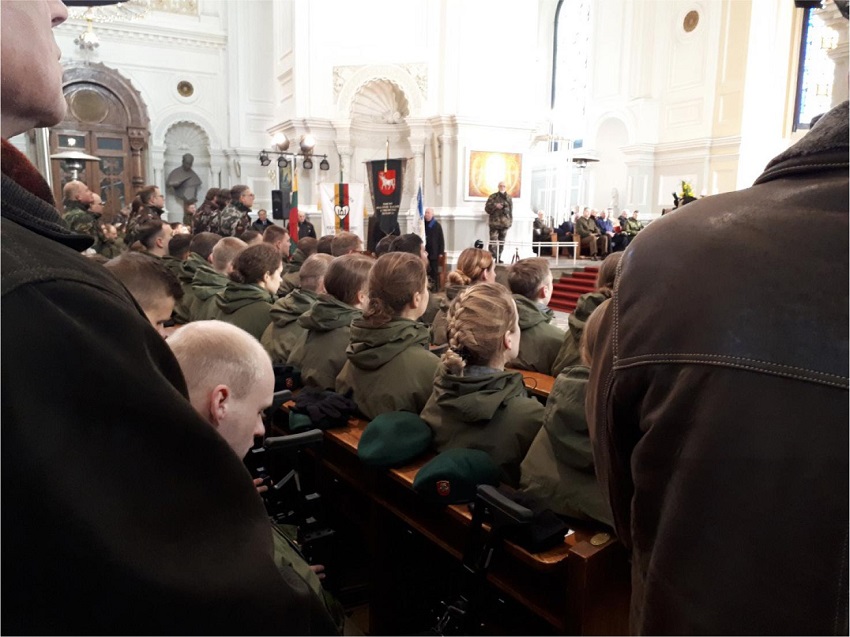
Figure 1
Lithuanian military forces gathered at the St. Michael the Archangel Church (Kaunas), February 16, 2019.
Source: Personal archive of the author.
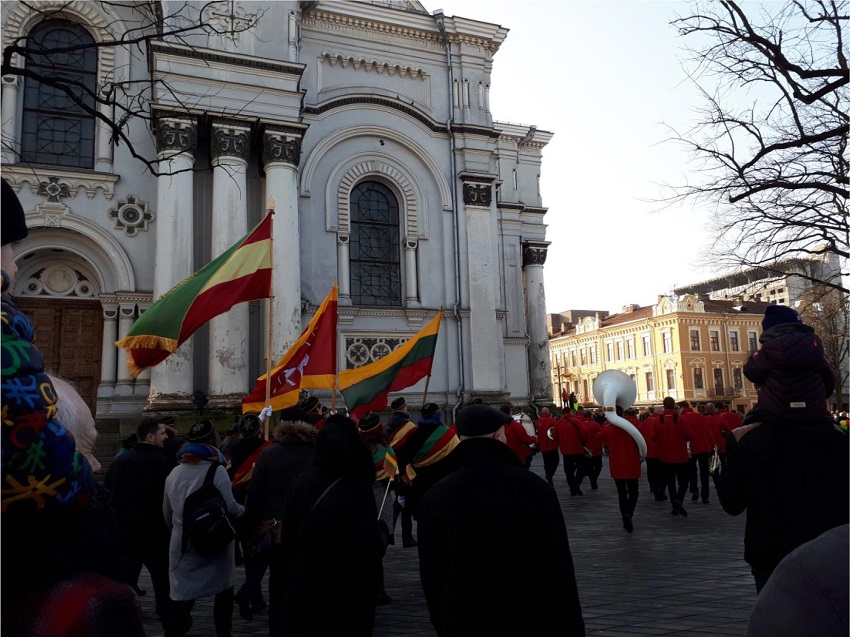
Figure 2
Parade for the Restoration of the State Day (Kaunas), February 16, 2019.
Source: Personal archive of the author.
Along this line of reasoning, it can be concluded that the persistence of religious hegemony is determined by the fact that Catholicism still represents an integral part of the dominant narrative about what it means to be Lithuanian. In a context vastly dominated by one hegemonic religion, the minority religions are seeking to construct persuasive strategies of legitimating their authenticity vis-à-vis the dominant narrative (Ališauskienė, 2012: 153). Or, in the case of Lithuania, they either need to find a way to challenge the publicly constructed vision of convergence between Catholicism and “Lithuaniannes”, or to convince their potential followers to make the perceived “break with culture” pointed out by Schröder. The particular case of the Ethno-Pagan organization Romuva discussed in this paper deserves scholarly attention with regard to the concepts related to the religious marketplace model because it represents a unique example of an alternative religious offer, which contests the hegemonic position of the Catholic Church while also allowing for maximization of cultural capital. Let us first briefly outline the key aspects of Ethno-Paganism as contemporary religious phenomena before coming back to the conducted case study.
Ethno-Paganism and the invention of traditions
The roots of contemporary Paganism emerged as a Romantic counterreaction against the positivist agenda of the Enlightenment and the subsequent tendencies toward rationalization and disenchantment of the world. Driven by the desire for spiritual renovation, the emerging interests in folklore and cultural heritage, and the growing nationalist impulses of the 19th century, it flourished as a polyvalent religious movement throughout the 20th century from the “yearning for cultural elements which have been lost or repressed, and an attempt to recreate them, or an approximation of them, in a contemporary context” (Magliocco, 2009: 229).
Within the European context, Povedák and Hubbes make an important distinction between the Western and the Central/Eastern form of Paganism. While the former is closely linked to the spiritual revolution of the 1960s, the latter, which they label as Ethno-Paganism, mainly focuses on identity reconstruction and involves “the mingling of religious and national elements where religious doctrine builds upon the concept of the sacralization of the nation” (Povedák & Hubbes, 2014: 148). In these terms, Ethno-Paganism goes beyond the spiritual sphere, forming a comprehensive, multifaceted unity which incorporates “lingual, ethnic, religious and even political identity” (Bako & Hubbes, 2011: 134) in an attempt to build credibility.
These specific features of the Ethno-Paganism involve the revitalization of centuries-old practices which are often scarce, fragmented, or poorly preserved in the oral tradition. Consequently, their revival in the present requires a process of recreation and adaptation to the contemporary needs which makes it convenient to integrate the theoretical framework of invented traditions. As argued by Hobsbawm, these traditions are “responses to novel situations which take the form of reference to old situations” (Hobsbawm, 1983: 2), aiming at establishing continuity with the past as a legitimating strategy. In the case of EthnoPaganism, the implied repetition of ancient local practices provides people with a sense of stability by reinforcing their bond with the native land and the worldview of the ancestors (Harvey, 2007: 287). The element of invention, i.e. of novelty, is often denied by the followers of EthnoPagan movements, since it problematizes their claims at authenticity by undermining the intended cultural continuity. Nevertheless, it is a useful theoretical tool to observe the strategies of self-presentation, which sometimes remain hidden behind the assertion that the performed practices are a meticulous repetition of centuries-old traditions.
Brief insights into the Lithuanian Ethno-Paganism
The contemporary form of Lithuanian Ethno-Paganism Romuva emerged in the 1960s, during the Soviet regime in the Baltic States, as part of the intelligentsia’s efforts to strengthen the national consciousness against the proletarian internationalism promoted by the USSR authorities. The movement was initially founded by ethnologist Jonas Trinkūnas under the disguise of a folkloristic organization, devoted to collecting ethnographic evidence for research purposes. Unofficially, the members were investigating the national folklore heritage with the aim to explore the pre-Christian faith of the Baltic people and revitalize it as a religious practice. They believed that the ancient outlook of the ancestors, suppressed by the church, was preserved in the oral tradition - the old songs, tales, and customs - and passed down from generation to generation as an uninterrupted spiritual tradition. The driving impulse behind these efforts to revive the native religion was the desire to protect the ethnic uniqueness by filtering out all foreign influences. As stated by Trinkūnas, “[h]aving lost these spiritual, cultural feelings, the nation or ethnic community would lose its identity and become a different community of impoverished people” (Trinkūnas, 1999: 141). The religious path advanced by Romuva is based upon the ancient Baltic polytheistic mythology and incorporates the concepts of harmony (lit. darna), ethical living, respect for the ancestors and reconnection with the natural world which is considered to reveal the immanent presence of divinity (Strmiska & Rudra Dundzila, 2005; Aleknaite, 2017).
After Lithuania gained independence, Romuva was officially registered as a religious organization in 1992 and openly declared its pagan orientation. The name chosen for the organization is important because it refers to one of the ancient Prussian centers of religious worship - a Baltic nation that was colonized and eventually assimilated by foreign invaders. As suggested by researchers Michael Strmiska and Vilius Rudra Dundzila, the name is used as a “reminder of the possibility of total extinction” (Strmiska & Rudra Dundzila, 2005: 2-46) that threatens every people who fails to preserve their identity as a community. Currently, it is the main visible community in the country declaring itself as EthnoPagan. A notable mark for their strength, as pointed out by Piotr Wiench (2014), is their participation in official public ceremonies, including the presidential inauguration of Algirdas Brazauskas in 1993.
Romuva’s counterhegemonic potential
In his reflection upon the success or failure of new religious movements, Rodney Stark indicates that keeping cultural continuity with the social conventions plays an important role for any movement that seeks to attract followers in a given community. He justifies this statement by referring to the concept of maximization, i.e. conservation of acquired capital. Since socialization into a particular culture requires an investment of time and efforts, “maximization of cultural capital leads people to prefer to save as much of their cultural capital as they can and to expend as little investment in new capital as possible” (Stark, [1996] 2003: 261). In other words, according to the sociologist, when making choices of religious affiliation, people would be more likely to stick to the known path, rather than going for unfamiliar alternatives, which also explains the stable position of the historically dominant churches.
With that being said, the biggest advantage Ethno-Paganism has, compared to all other new religions competing for followers, relies on its capacity to conserve the acquired cultural capital, that is, the commonsense knowledge of reality. In Gramscian terms, the common sense encompasses “the incoherent set of generally held assumptions and beliefs common to any given society” (Gramsci, 1971: 323). It is rooted in the everyday understandings and helps people shape their ways of perceiving the world. Common sense could be considered as a potentially subversive force in regard to hegemony, since it opposes the dogmatic Catholicism by incorporating multiple contradictory elements accumulated throughout the centuries of cultural history, including religious remnants of the pre-Christian period (Pranaitytė-Wergin, 2012: 74).
Since the historically dominant church wields the authority of tradition, the minority religions usually need to find other grounds on which to build their legitimacy. The case of Romuva represents an interesting exception in this regard since the movement portrays itself in the same way as the hegemonic Catholicism - as a “natural” choice for anyone seeking to stay true to their Lithuanian identity. The organization justifies its legitimacy with the claim that the ethnic religion offers a way to return to the most authentic, purely Lithuanian form of religious worship. The narratives of authenticity and antiquity, common for a number of invented traditions, as well as the emphasis on the local character of the movement, are used to foster the intended cultural continuity.
In this Ethno-Pagan perspective, common to a number of contemporary Pagan traditions (see e.g. Västrik, 2015; Stasulane, 2019), Christianity is regarded as a foreign ideology imposed by fire and sword that, in the past, has led the country to a gradual decline and eventual loss of sovereignty (Trinkūnas, 1999: 140). It is portrayed as a threat to the ethnic uniqueness because it attempts to substitute the local worldview of the ancestors with a universalistic belief system. Moreover, according to Trinkūnas, Catholicism “usurped or destroyed all aspects of the traditional Lithuanian celebrations” (Ibid.: 125), while its doctrine of the transcendence of God caused alienation from the surrounding natural world and cut the sacred bond between man and land. Thus, in Romuva’s rhetoric, the dominant religion is represented as an unauthentic, extrinsic foreign agent and it is disassociated from the Lithuanian identity through a “Us vs. Them” dichotomy.
Romuva’s claim to authenticity is reinforced by the use of scholarly sources, written by well-renown Lithuanian academics such as archeologist Marija Gimbutas, folklorist Norbertas Vėlius or historian Gintaras Beresnevičius. The movement also incorporates traditional customs and folk songs in its ritual practices. The stated intention is to ascribe a new meaning to the existing traditions and to “restore them to a position of prestige within the society” (Strmiska, 2012: 129) by revitalizing their dormant religious layer and turn it into a living heritage.
Below, I will present and analyze the process of ritual creation.
The choice of place
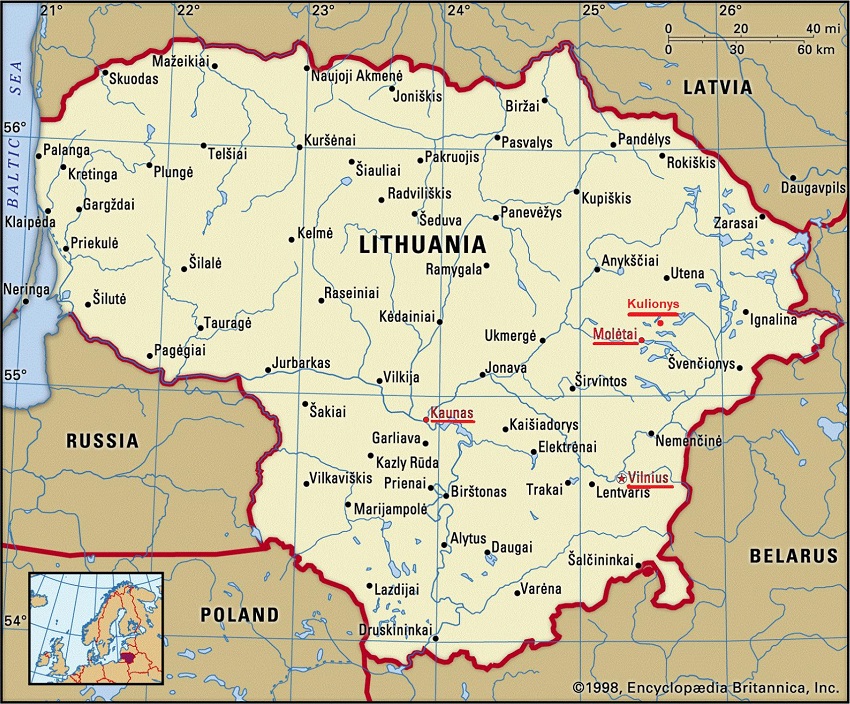
Figure 3
Map of Lithuania showing the geographic position of the village of Kulionys (Molėtai District).
Source: Encyclopaedia Britannica [< https://www.britannica.com/place/Lithuania >]
In the beginning, it is important to focus the attention on the particularities of the place chosen to hold the celebration, since the locality bears an important symbolic capital, encompassing a few notable points of interest. The initial gathering takes place at an ethnographic homestead, part of the Molėtai Regional Museum, that comprises a traditional Aukštaitija-region farmhouse and an Ancient Observatory of Celestial Bodies. The ethnographic museum organizes exhibitions and courses in traditional crafts throughout the year and functions as an educational center, while the sky observation post is considered to be a sacred place. It was installed in 1996 with the aim to recreate the way the ancient Lithuanians used to count time and observe the night sky.
The observatory represents a circle of 10 wooden pillars, engraved with the ancient Baltic calendar sign, and a fire altar placed at the center for the purpose of conducting rituals. Nearby, a temple of stacked stones, dedicated to the ancient Baltic god of fire, thunder, and lightning Perkūnas, is being built progressively by the community of Romuva.
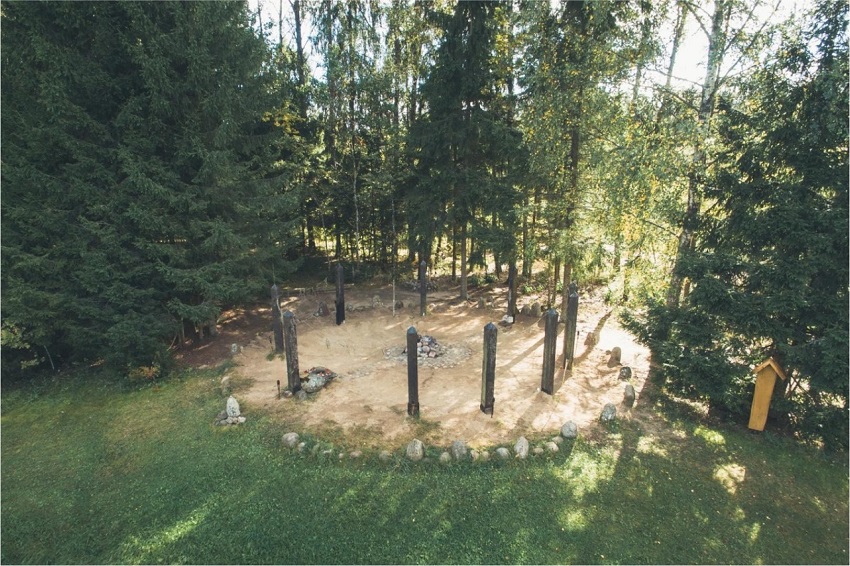
Figure 4
The Ancient Observatory of Celestial Bodies.
Source: Aukštaitija Website [< https://www.visitaukstaitija.lt/data/tourism_objects/large/img_0156.jpg >]
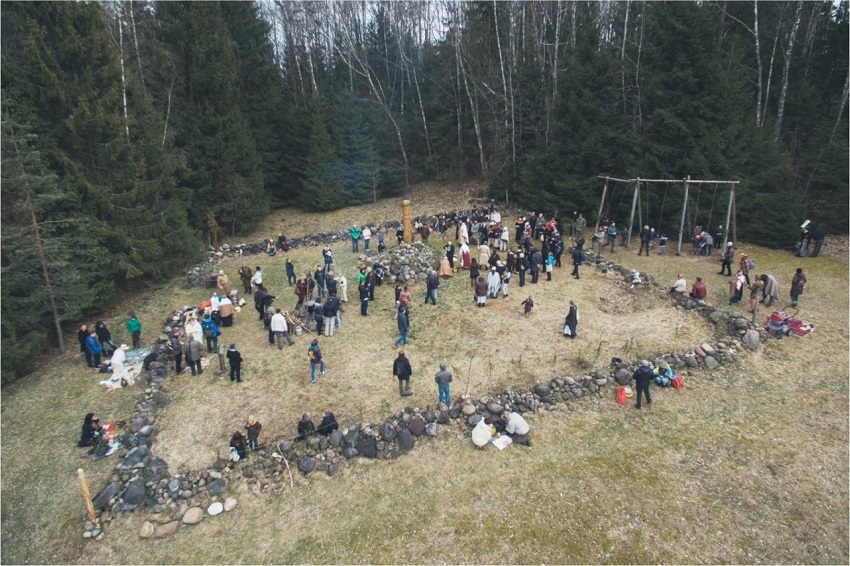
Figure 5
People gathered at the temple of Perkūnas.
Source: Aukštaitija Website. [< https://www.visitaukstaitija.lt/data/tourism_objects/large/img_0239.jpg >]
The homestead is situated amidst nature, at the shores of Lenktinis Lake, in close proximity to the castle mound of Kulionys. The first excavation of this site was conducted in 1931 by archaeologist Petras Tarasenka, who discovered an important cultural layer containing remnants of an ancient settlement and embankment structures dating back to the pre-Christian period of Lithuania. It is believed that the mound, apart from its defense function, was also used as a ritual place because of its symbolic elevation over the surrounding landscape. For this reason, the archaeological site is incorporated in the celebration of Jorė as a space for ritual practices and historical combat reenactments, aiming at establishing a connection with the ancestors.

Figure 6
Visual representation of the geographical area with main points of interest marked as follows: 1. Ethnographic farmhouse; 2. Temple of Perkūnas; 3. Ancient Observatory of Celestial Bodies; 4. Kulionys castle mound.
Source: Google Maps Satellite imagery.
To sum up, the locality itself integrates a number of aspects that are crucial for the movement’s construction of authenticity. The linkage to the museum, wielding the authority of the scholarly knowledge, supports the idea that the reproduced practices are historically-accurate. The archaeological site provides a sense of connection with the community’s ancestors and traditional past. The sacred spaces assume the presence of the gods and the possibility of entering into communication with them. Last but not least, the surrounding natural landscape takes people away from urban life and reconnects them with a more simplistic mode of existence.
The celebration of Jorė
The ethnic religion puts a particular emphasis on the veneration of nature as a source of all life. It aims at reminding people that they are part of the natural world and need to maintain a harmonious relationship with it to achieve an authentic way of being. The festival of Jorė is a significant holiday in the annual calendar since it celebrates the first green of spring, regarded as the great awakening of nature, and also metaphorically, as a spiritual awakening of the people (VideoAlkas, 2020). It is believed that people need to spend as much time in the surrounding of nature as possible, in order to recharge their energy after the long winter and reconnect to the Earth Mother - goddess Žemyna. This deity is venerated and asked to enlarge the harvest and strengthen the health. The typical blessing related to this holiday - “Gyvo žalio!” (eng. “Living green”) - is incorporated into the songs and prayers; it is also used as a greeting between the community members to express their wish for good health and abundant crops.
The annual celebration of Jorė in the last weekend of April takes place at the ethnographic homestead of Kulionys since 1997. The event is open to the wide public free of charge and participation does not require any form of affiliation to the movement. It is a family-oriented gathering where people tend to bring their children, camp amidst nature, and partake in the communal meal. The festival, led by the high priestess (lit. krivė) of Romuva Inija Trinkūnienė, unites representatives of all distinct communities belonging to the movement from across Lithuania. Among the participants, there are also guests from the neighboring country of Latvia who observe their local version of the ancient Baltic faith called Dievturība, as well as ordinary visitors from various religious and cultural backgrounds. The practicing members of Romuva are easily distinguished from the ordinary visitors by their unicolor linen clothing, tightened with an ornamented sash - historical reconstructions of traditional folk costumes. They also wear brass jewelry and accessories depicting Baltic religious symbols, such as the Tree of Life (lit. Austras Koks), the Morning Star (lit. Ausekla Zvaigzne), the Grass Snake (lit. Žaltys), the Swastika, etc. Some of the women cover their heads with kerchiefs, as per the usual folk practice.
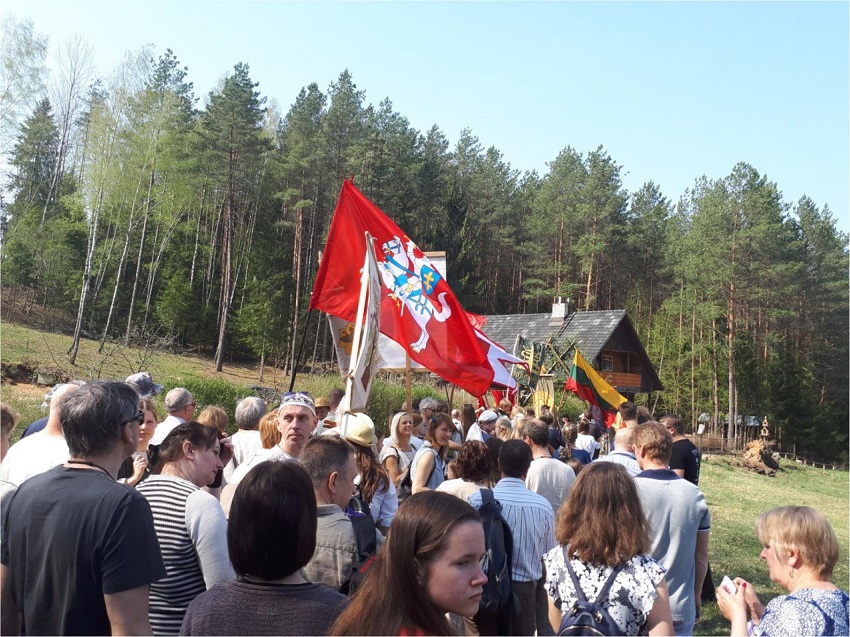
Figure 7
Procession from the Ancient Observatory to the castle mound, April 27, 2019.
Source: Personal archive of the author.
Noteworthy are the particularities of the procession from the ancient observatory to the castle mound. It is accompanied by a musical background performed by the folklore ensemble Kūlgrinda, which creates an immerging festive ambiance. Many flags with the emblems of the distinct communities of Romuva are seen, as well as the national flag of Lithuania, the old state emblem “Vytis” and the country’s historical coat of arms “Pillars of Gediminas”. The procession somehow resembles the parade celebrating the Restoration of the State Day mentioned above. The act of displaying the symbols of statehood puts a particular emphasis on the local character of Romuva and is meant to foster its claim to incarnate the essence of the Lithuanian people.
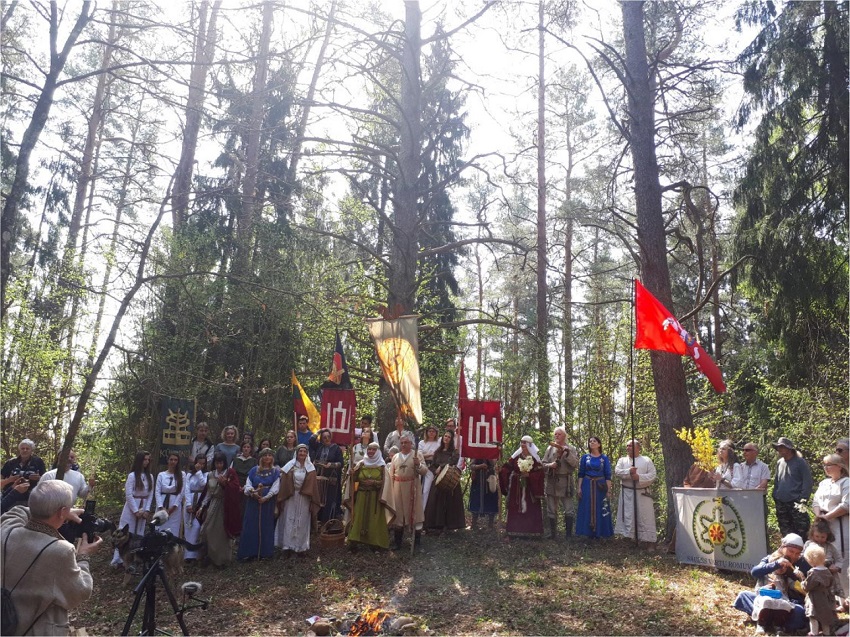
Figure 8
Rituals at the castle mound, April 27, 2019.
Source: Personal archive of the author.
Upon arrival at the ritual place on the top of the mound, a fire is lit to invoke the presence of the fire goddess Gabija who acts as a mediator to the divine world. Ritual fires represent an important feature in many contemporary forms of Paganism (see e.g. Winslade, 2009), including the Baltic tradition where the fire is considered to be of supernatural origin, bearer of protective and purifying powers. During the celebration of Jorė, Gabija is asked to bring harmony (lit. “Tebūnie Darna!”, eng. “Let there be harmony!”) to the community. Traditional folk songs (lit. dainos) are performed and accompanied by ritual actions, such as walking around the fire, touching and kissing the ground, and pouring libations to venerate the deities. The combat reenactments, performed in the presence of the ancestors, are a way to express gratitude to the ones who spilled their blood protecting freedom. It also allows the immersion of participants in the ancient way of living and acting in the world.
The ritual part at the mound ends with a solemn initiation of the neophytes into the religious community. They are asked to take a collective oath addressing the gods, the ancestors, and the community, after which the priest (lit. vaidila) welcomes them as members of Romuva.
The procession, carrying the sacred flame, returns to the homestead where the holy altar is lit and the communal feasting begins. Stone offerings are made to the temple of Perkūnas, who is believed to strengthen the vital powers of the people. The shared feast includes celebratory stew, scrambled eggs, bread, and mead. It is meant to create a bond between the participants, the gods, and the ancestors. Traditional festive activities, such as swinging on swings, dancing, and rolling of decorated eggs, are also performed to ensure continuity with the folk practices. Altogether, the celebration of Jorė is an important community gathering that incorporates various elements: religious rituals, musical performances, combat reenactments, different forms of entertainment. It is meant to remind participants of their traditional ethnic heritage, align them with the natural rhythms, and bring the values of the past into today’s life.
Concluding remarks: A counterhegemonic narrative?
The hegemonic position of the Catholic Church is based upon the naturalized and taken-for-granted by the vast majority of the population assumption that Catholicism is one of the foundational elements of the Lithuanian identity. The existence of an established social consensus on this matter is visible in the publicly produced narratives of identity, of which the celebration of the Restoration of the State Day is an eloquent example. Consequently, Catholicism is granted a privileged place in the religious economy of the country, which enforces relations of inequality between the variety of offers on the religious marketplace. From this perspective, I argue that Romuva’s self-presentation strategy could be regarded as an attempt to construct an alternative, counterhegemonic narrative.
The described celebration symbolically incarnates the totality of the Lithuanian reality - cultural history, folklore, spiritual heritage, markers of statehood and national identity, which allows the maximization of cultural capital and helps build plausibility on the religious marketplace. The identification with the ancestors, for its part, acts as a source of legitimation for the movement’s claim to authenticity. In the course of the festival, the religious community, imagined as a true warden of the Lithuanian ethnic heritage, is symbolically united under the national flag. The rituals are closely tied to the geographical locality and organically ascribed into the natural landscape. Consciously performed and incorporated into the ritual practices, the old songs and customs are refilled with spiritual meaning.
Therefore, the celebration of Jorė could be regarded as an illustration of Romuva’s counterhegemonic potential. Within this narrative, the preChristian past is glorified and romanticized as a period of purer, simpler existence, built on the harmonious relationship between the ancestors and their native land. Hence, the celebration represents a symbolical inversion of the dominant narrative of identity, where Catholicism is erased, while Ethno-Paganism is portrayed as deeply intertwined with the Lithuanian identity. In this worldview, the ethnical, cultural, natural and political aspects of Lithuanian reality come together to form a harmonious unity whose cohesion is guaranteed by the ethnic religion.
Bibliographical references
ALEKNAITE, Egle. Baltic Paganism in Lithuanian Neoshamanic Communities: Neoshamanic Interpretations of a Local Indo-European Religious Tradition. In: Nova Religio: The Journal of Alternative and Emergent Religions, v.20 n.3, pp. 13-35, 2017.
ALIŠAUSKIENĖ, Milda. The New Age Milieu in Lithuania: Popular Catholicism or Religious Alternative? In: SCHRÖDER, Ingo; ALIŠAUSKIENĖ, Milda (orgs.). Religious Diversity in Post-Soviet Society: Ethnographies of Catholic Hegemony and the New Pluralism in Lithuania. Farnham/Burlington: Ashgate, pp. 151-167, 2012.
BAKO, Rozalia; HUBBES, László-Attila. Religious Minorities’ Web Rhetoric: Romanian and Hungarian Ethno-Pagan Organizations. In: Journal for the Study of Religions and Ideologies, v.10, n.30, pp. 127-158, 2011.
BECKER, Gary. Human Capital: A Theoretical and Empirical Analysis, with Special Reference to Education. New York: Columbia University Press, 1975.
BERGER, Peter. The Heretical Imperative: Contemporary Possibilities of Religious Affirmation. New York: Anchor Press, 1979.
Introduction: The Cultural Dynamics of Globalization. In: BERGER, Peter; HUNTINGTON, Samuel (orgs.). Many Globalizations: Cultural Diversity in the Contemporary World. Oxford: Oxford University Press, pp. 1-16, 2002.
BERGER, Peter; LUCKMANN, Thomas. The Social Construction of Reality: A Treatise in the Sociology of Knowledge. London: Penguin Books, 1991 [1966].
CHMIEL, Piotr. Rethinking the Concept of Antemurale: Venetian Diplomacy in Respect of the Ottoman World (1573-1645). Rome: Accademia Polacca Roma, 2019.
GRAMSCI, Antonio. Selections from the Prison Notebooks, ed. and trans. Quintin Hoare and Geoffrey Nowell Smith. New York: International Publishers, 1971.
HARVEY, Graham. Inventing Paganisms: making nature. In: LEWIS, James R.; HAMMER, Olav (orgs.). The Invention of Sacred Tradition. Cambridge: Cambridge University Press, pp. 277-290, 2007.
HOBSBAWM, Eric. Introduction: Inventing Traditions. In: HOBSBAWM, Eric; RANGER, Terence (orgs.). The Invention of Tradition. Cambridge: Cambridge University Press, pp. 1-14, 1983.
LYOTARD, Jean-François. The postmodern condition: A report on knowledge. UK: Manchester University Press, 1984.
MAGLIOCCO, Sabina. Reclamation, Appropriation and the Ecstatic Imagination in Modern Pagan Ritual. In: LEWIS, James R.; PIZZA, Murphy (orgs.). Handbook of Contemporary Paganism. Leiden/Boston: Brill, pp. 223-240, 2009.
POVEDÁK, István; HUBBES, László-Attila. Competitive pasts. Ethnopaganism as a placebo-effect for identity reconstruction processes in Hungary and Romania. In: Religiski-filozofiski raksti, n.17, pp. 133-152, 2014.
PRANAITYTĖ-WERGIN, Lina. “We Are All in Exile Here”: Perceptions of Death, the Soul, and the Afterlife in Rural Lithuania. In: SCHRÖDER, Ingo; ALIŠAUSKIENĖ, Milda (orgs.). Religious Diversity in Post-Soviet Society: Ethnographies of Catholic Hegemony and the New Pluralism in Lithuania. Farnham/Burlington: Ashgate, pp. 57-77, 2012.
SCHRÖDER, Ingo. Catholic Majority Societies and Religious Hegemony: Concepts and Comparisons. In: SCHRÖDER, Ingo; ALIŠAUSKIENĖ, Milda (orgs.). Religious Diversity in Post-Soviet Society: Ethnographies of Catholic Hegemony and the New Pluralism in Lithuania. Farnham/Burlington: Ashgate, pp. 17-36, 2012.
STARK, Rodney. Why Religious Movements Succeed or Fail: A Revised General Model. In: DAWSON, Lorne (org.). Cults and New Religious Movements: A Reader. Malden/Oxford: Blackwell Publishing Ltd., pp.259270, 2003 [1996].
STARK, Rodney; FINKE, Roger. Acts of Faith: Explaining the Human Side of Religion. Berkeley/Los Angeles/London: University of California Press, 2000.
STASULANE, Anita. A Reconstructed Indigenous Religious Tradition in Latvia. In: Religions, v.10, n.3, 2019.
STREIKUS, Arūnas. The History of Religion in Lithuania since the Nineteenth Century. In: SCHRÖDER, Ingo; ALIŠAUSKIENĖ, Milda (orgs.). Religious Diversity in Post-Soviet Society: Ethnographies of Catholic Hegemony and the New Pluralism in Lithuania. Farnham/Burlington: Ashgate, pp. 37-56, 2012.
STRMISKA, Michael; DUNDZILA, Vilius Rudra. Romuva: Lithuanian Paganism in Lithuania and America. In: STRMISKA, Michael (org.). Modern Paganism in World Cultures: Comparative Perspectives. Santa Barbara, CA: ABC-CLIO, pp. 241-298, 2005.
STRMISKA, Michael. Romuva Looks East: Indian Inspiration in Lithuanian Paganism. In: SCHRÖDER, Ingo; ALIŠAUSKIENĖ, Milda (orgs.). Religious Diversity in Post-Soviet Society: Ethnographies of Catholic Hegemony and the New Pluralism in Lithuania. Farnham/Burlington: Ashgate, pp. 125150, 2012.
TAIRA, Teemu. Religion as a Discursive Technique: The Politics of Classifying Wicca. In: Journal of Contemporary Religion, v.25, n.3, pp. 379-394, 2010.
The category of ‘invented religion’: A new opportunity for studying discourses on ‘religion’. In: Culture and Religion, v. 14, n. 4, pp. 477-493, 2013.
TAYLOR, Charles. The Ethics of Authenticity. Cambridge/London: Harvard University Press, 2003 [1991].
TRINKŪNAS, Jonas. Of Gods and Holidays: The Baltic Heritage. Vilnius: Tvermė, 1999.
VÄSTRIK, Ergo-Hart. In Search of Genuine Religion: The Contemporary Estonian Maausulised Movement and National Discourse. In: ROUNTREE, Kathryn (org.). Contemporary Pagan and Native Faith Movements in Europe: Colonialist and Nationalist Impulses. Oxford: Berghahn, pp. 130153, 2015.
WIENCH, Piotr. A postcolonial key to Understanding Central and Eastern European Neopaganisms. In: AITAMURTO, Kaarina; SIMPSON, Scott (orgs.). Modern Pagan and Native Faith Movements in Central and Eastern Europe, London/NY: Routledge, pp. 10-26, 2014.
WINSLADE, J. Lawton. Alchemical rhythms: Fire circle culture and the pagan festival. In: LEWIS, James R.; PIZZA, Murphy (orgs.). Handbook of Contemporary Paganism. Leiden/Boston: Brill, pp. 241-282, 2009.
Online Sources
Being Christian in Western Europe. Pew Research Center. 29 May 2018. Available at: < https://www.pewforum.org/2018/05/29/being-christianin-western-europe/ > (Accessed 27/01/2021).
Charter of Fundamental Rights of The European Union. Official Journal of the European Union. 26 Oct. 2012. Available at: < https://eur-lex europa.eu/legal-content/EN/TXT/?uri=CELEX:12012P/TXT > (Accessed 26/12/2020).
Dokumentinis filmas „Gyvo žalio!“. YouTube. Uploaded by VideoAlkas. 29 Sept. 2020. Available at: < https://www.youtube.com/ watch?v=fF8ttoA3yYg > (Accessed 31/01/2021).
Population and social statistics: Ethnicity, mother tongue and religion. Official Statistics Portal. 15 March 2013. Available at: < https://osp stat.gov.lt/en/web/guest/informaciniai-pranesimai?articleId=223122 > (Accessed 27/01/2021).