Perspectiva
What do teachers need to know about neuroscience?
¿Qué necesitan saber los profesores sobre neurociencia?
O que os professores precisam saber sobre neurociência?
What do teachers need to know about neuroscience?
MedUNAB, vol. 27, núm. 3, pp. 251-257, 2024
Universidad Autónoma de Bucaramanga

Esta obra está bajo una Licencia Creative Commons Atribución-NoComercial 4.0 Internacional.
Recepción: 16 Diciembre 2024
Aprobación: 18 Marzo 2025
Abstract: This article describes the key premise behind the field of educational neuroscience. It explores how the interface of neuroscience and education may be navigated. Considering the brain as the basis of learning introduces a wider, more holistic conception than that conveyed by a focus on memory and cognition, one that draws attention to the physical, emotional, and social context of learning. I outline some key principles of how the brain works and how these link to principles of teaching. However, educational neuroscience should not be viewed as an attempt to reduce education to the individual or to biology; the individual child is nested within the context of the school, family, society, and culture. Educational neuroscience is part of the science of learning and an evidence-informed approach to education. I argue the evidence-informed approach may require some rethinking of national structures and the relationship between government, schools, and universities. In this context, educational neuroscience is part of the ‘research and development’ wing of education, involved in generating new insights and innovation. An example is outlined from a project using neuroscience principles to design a new classroom activity to support the learning of counterintuitive concepts in science and mathematics in primary age children. I conclude by proposing the level at which teachers should engage with neuroscience to best inform their practice.
Keywords: Brain, Cognition, Learning, Children, Education.
Resumen: Introducción. Este artículo describe la premisa clave que subyace al campo de la neurociencia educativa. Explora cómo se puede navegar por la interfaz de la neurociencia y la educación. Objetivo. Considerar el cerebro como la base del aprendizaje introduce una concepción más amplia y holística que la que transmite un enfoque centrado en la memoria y la cognición, una concepción que llama la atención sobre el contexto físico, emocional y social del aprendizaje. Temas de reflexión. Se esbozan algunos principios clave sobre el funcionamiento del cerebro y su relación con los principios de la enseñanza. Sin embargo, la neurociencia de la educación no debe verse como un intento de reducir la educación al individuo o a la biología; el niño individual está anidado en el contexto de la escuela, la familia, la sociedad y la cultura. La neurociencia educativa forma parte de la ciencia del aprendizaje y de un enfoque de la educación basado en pruebas. Se discute que el enfoque basado en evidencia puede requerir un replanteamiento de las estructuras nacionales y de la relación entre el gobierno, las escuelas y las universidades. En este contexto, la neurociencia educativa forma parte del ala de «investigación y desarrollo» de la educación, que participa en la generación de nuevos conocimientos e innovaciones. A modo de ejemplo, se expone un proyecto en el que se utilizaron los principios de la neurociencia para diseñar una nueva actividad en el aula destinada a apoyar el aprendizaje de conceptos contraintuitivos de ciencias y matemáticas en niños de primaria. Conclusiones. Se concluye que se debe proponer un nivel, en el que los profesores deban comprometerse con la neurociencia para informar mejor su práctica.
Palabras clave: Encéfalo, Cognición, Aprendizaje, Niño, Educación.
Resumo: Introdução. Este artigo descreve a premissa principal subjacente ao campo da neurociência educacional. Explora-se como navegar na interface da neurociência e da educação. Objetivo. Considerar o cérebro como a base da aprendizagem introduz uma compreensão mais ampla e holística do que aquela transmitida por uma abordagem focada na memória e na cognição, uma concepção que chama a atenção para o contexto físico, emocional e social da aprendizagem. Tópicos para reflexão. Alguns princípios fundamentais sobre a função cerebral e sua relação com os princípios de ensino são apresentados. No entanto, a neurociência da educação não deve ser vista como uma tentativa de reduzir a educação ao indivíduo ou à biologia; a criança, individualmente, está inserida no contexto da escola, da família, da sociedade e da cultura. A neurociência educacional faz parte da ciência da aprendizagem e de uma abordagem educacional baseada em evidências. Argumenta-se que uma abordagem baseada em evidências pode exigir uma reformulação das estruturas nacionais e da relação entre governo, escolas e universidades. Nesse contexto, a neurociência educacional faz parte da ala de “pesquisa e desenvolvimento” da educação, que está envolvida na geração de novos conhecimentos e inovações. Como exemplo, é apresentado um projeto no qual os princípios da neurociência foram usados para elaborar uma nova atividade em sala de aula, destinada a apoiar a aprendizagem de conceitos contraintuitivos em ciências e matemática em crianças do ensino fundamental. Conclusões. Conclui-se que deve ser proposto um nível em que os professores se envolvam com a neurociência para melhor fundamentar sua prática.
Palavras-chave: Encéfalo, Cognição, Aprendizagem, Criança, Educação.
Introduction
The interface between neuroscience and education has been given multiple names, among them educational neuroscience, neuroeducation, mind brain and education, and neurodidactics. Perhaps none of these names yet satisfactorily capture the relationship between the fields. But the premise behind all of them is the same. Teachers are concerned with altering their students’ brains through teacher practice, to give students new knowledge and skillst neuroscientists have gained insights into neural mechanisms of learning; perhaps some of these insights might be useful for teachers in the classroom. Yet the relationship between neuroscience and education is also predicated on a dialogue, a key feature of which is to allow the current classroom challenges that teachers face to shape future research priorities in cognitive neuroscience.
Of course, teachers already have some knowledge from cognitive psychology. Typically, this involves a focus on memory, and the ways that knowledge from teachers can be transferred to students’ long-term memories. This perspective focuses on factors such as students’ prior knowledge, methods to convey knowledge in a way that does not exceed presumed limits on the students’ working memories, schedules to present the knowledge via repetition or interleaving material to optimise its encoding, and ways to ensure retention, such as practising retrieval of information. For example, this type of cognitive framing is prominent in the UK government’s document on what teachers should know about how learning works (1). In the current article, I will argue that this is a good start, but that teachers’ practice can be enriched by the broader understanding of factors that influence learning provided by neuroscience.
Topics for Reflection
1. How much of education is about the brain?
At the core of educational neuroscience are insights about how the brain works – but how much of education is actually about the brain? It is important to recognise that there are multiple nested factors that support or hinder children’s learning outcomes (2). At the centre are child factors, including levels of motivation and attention, ability, health and nutrition. Children’s learning outcomes will also be affected by school factors, including teacher skill, teaching materials, classroom environment and school policy. However able or motivated a child is, their learning outcomes will not be optimised if their school does not have well trained teachers or rich materials. Child and school factors also nested within society and family factors, including how economically well-resourced families are, cultural influences such as attitudes to learning, and society factors such as the presence of technology such as, mobile phones and artificial intelligence tools. An able child in a good school may still be held back if their families are not in a position to support the children’s learning, or enable a good diet and sufficient sleep. Lastly, the broadest set of factors lie at a national, government level. How does a government choose to resource its schools, recruit and train teachers, decide what should fall in the curriculum, and other policy decisions. While the brain is important, it only pertains to individual child factors, while school, family, society, and government factors are also influential on learning outcomes.
This means that educational neuroscience needs to be understood separately in each national context. For example, in the United Kingdom, a recent survey of over 1000 teachers and school leaders indicated that a third were aware of educational-neuroscience-informed pedagogical approaches, though they ranked behind inquiry-based learning, collaborative learning, and reflective approaches. But it also found that the context within which any of these pedagogical approaches fell was one where concerns about teachers’ workloads, funding cuts to school budgets, and student behaviour in the classroom were of higher priority to teachers. Understanding how children learn, then, is important but can only enhance educational outcomes if other factors at school and government level are also addressed.
2. Why is it important to know how the brain works?
The added value of neuroscience is to give teachers an understanding of key concepts such brain plasticity and the range of mechanisms the brain brings to classroom learning. A neuroscience approach emphasises several key dimensions that represent the brain’s respective processing priorities (which can be loosely assessed by the amount of neural tissue dedicated to each function). Respectively, these are sensorimotor processing, emotion, socialisation, and cognition. These dimensions therefore emphasise in turn the importance of the physical sensory environment for learning, both in providing rich multi- modal information and in reducing sensory distractions. The importance of emotion, which leads rather than follows learning. Thus, curiosity can enhance learning, but anxiety can be a barrier, a phenomenon much studied in mathematics (3). And the importance of the social element, where peer support can boost learning but in the wrong context, peers can distract from learning by, for example, disapproving of too much effort, or talking in class. These priorities precede cognition, the core aspects of knowledge and reasoning that drive educational abilities. As a result, the neuroscience approach represents a more holistic perspective on learning which draws attention to the physical, emotional, and social context of learning, even before considering the cognitive skills needed to engage with topics such as mathematics or art (4).
Because educational neuroscience is predicated on an understanding of brain development, there is a greater focus on developmental change, for example in cognitive control skills such as inhibition and switching, and in knowledge structures which support new learning. Development is not a passive process that happens to a child, rather it is experience driven, where the child is an active learner who engages in and experiments with information and the environment. The domain where neuroscience has perhaps altered our perspective. the most is adolescence. Studies employing structural and functional brain imaging have revealed that the brain is still developing into the early 20s, leading to extended developmental trajectories of skills such as decision making around risk, resisting undue influence of peer approval on performance, and understanding other people’s perspectives (5).
Finally, because the brain is a biological organ, neuroscience also stresses the notion of brain health, as we consider the importance of diet, fitness, sleep, and stress to influencing learning outcomes and wellbeing in young people. The brain like any other tissue has metabolic needs. Children’s brains need to be in the best condition to learn when they enter the classroom.
Nevertheless, perhaps greatest challenge facing educational neuroscience is to turn the insights into neural mechanisms of learning into actionable principles or activities that are useful to teachers in the classroom. This translation depends on a dialogue between researchers and practitioners, and an exploration of the interface between neuroscience and pedagogy. Neuroscience relies on a suite of methods to reveal the brain mechanisms that support cognition, from molecular studies to single cell research and the investigation of neural circuits, to animal models, studies of neuroanatomy, and in vivo studies of brain function in humans using imaging methodologies such as magnetic resonance imaging and electrophysiology. Yet the data that emerge from such studies are rarely directly relevant to the classroom, and a key function of researchers in educational neuroscience is to integrate findings and communicate them in a way that is useful for teachers. Tables 1and 2 demonstrate examples of attempts to identify key principles of how brains work and to draw implications of neuroscience for teachers (4).
| Table 1. Key principles for teachers on how the brain works. |
| Ten key takeaways for teachers about how the brain works |
| The brain is always paying attention |
| The brain likes to make things automatic |
| The brain can’t help making predictions about what is going to happen |
| Emotions are not an ‘optional extra’. Physical and mental health, emotions and cognition: these are not separable |
| Counting on your fingers is a good example of how the brain bolsters abstract learning with concrete examples. It’s not cheating |
| The brain builds itself and changes throughout life. Different parts change at different speeds at different ages |
| The brain undergoes enormous repurposing during adolescence which triggers a burst of socioemotional learning |
| Practice makes permanent – so make sure you’re practising the right thing |
| Learning is a lifelong activity for the brain. The more you do, the more effective it is |
| Novelty makes learning facts harder but remembering events easier |
| Source: taken from Rogers & Thomas, 2022, Educational Neuroscience: The Basics (4) |
| Table 2. Ten principles for teaching based on educational neuroscience |
| Ten principles of teaching |
| Plan for repetition, within and between lessons, terms, and years |
| Feedback often, with kindness and specifics |
| Train students to think about their thinking – make thinking visible |
| Use testing to improve learning (as well as to measure) |
| Encourage students to work in groups with shared learning goals |
| Take time to work out what motivates each child |
| Treat physical activity seriously (while making it fun) |
| Teach the same thing in different ways |
| Welcome in the physical world, with cues and examples |
| Create an environment where errors can be celebrated |
| Source: taken from Rogers & Thomas, 2022, Educational Neuroscience: The Basics (4) |
There are, in addition, potential risks and distractions in integrating neuroscience into education. For example, neuroscience will not be useful for educators if it only serves to relabel concepts from psychology with the names of neuroanatomical structures (such as replacing the term ‘executive function’ with ‘prefrontal cortex’, or ‘anxiety’ with ‘amygdala’). It won’t be useful if it merely spawns myths through poor communication, as found in neuro- myths such as the existence of ‘left-brain thinkers’ and ‘right-brain thinkers’ or the myth that we ‘only use 10% of our brains’ (6). It won’t be useful if neuroscience is used by commercial providers merely as a form of marketing to make certain educational techniques more believable (7). And it won’t be useful if it reflects a reductionist urge among scientists to explain all phenomena at the lowest level of description. As we have stressed, education must be construed in terms of multiple interacting levels, each equally influential in children’s educational outcomes.
3. Evidence and evaluation
Educational neuroscience is part of a broader approach within education to be evidence-informed, that is, to evaluate what pedagogical approaches are most effective, and which child factors and teacher factors are most important (8). Evaluation can span small qualitative studies to large randomised-controlled trials (9). The goal is to accumulate an evidence base of effective practices – as well as the contexts with which they interact – to support gradual improvement in educational outcomes and wellbeing among students. Systematic evaluation of educational approaches and methods is important because it is easy for educators in the classroom to mislead themselves into thinking that an approach or method works by only looking for confirmatory or anecdotal evidence that supports their prior beliefs. The result is educational fashions and a lack of progress in improving outcomes. Without an evidence base, expertise often resides in the hands of experienced teachers who develop their own best practice, but this expertise is lost when the individual ultimately leaves the workplace.
However, the evidence-informed approach to education requires some rethinking of national structures, and the relationship between government, schools, and universities. Schools and universities must be partners, whereby the universities are the ‘research and development’ (R&D) wing of education driving insight and innovation. Research literacy needs to be built into teacher training so that educators can make use of the evidence-base and how to use it to guide decisions about their practice. And the government needs to fund a gatekeeper organisation to compile the evidence base of what works in education (such as the Education Endowment Foundation in the UK). Figure 1 depicts this idealisation (10).
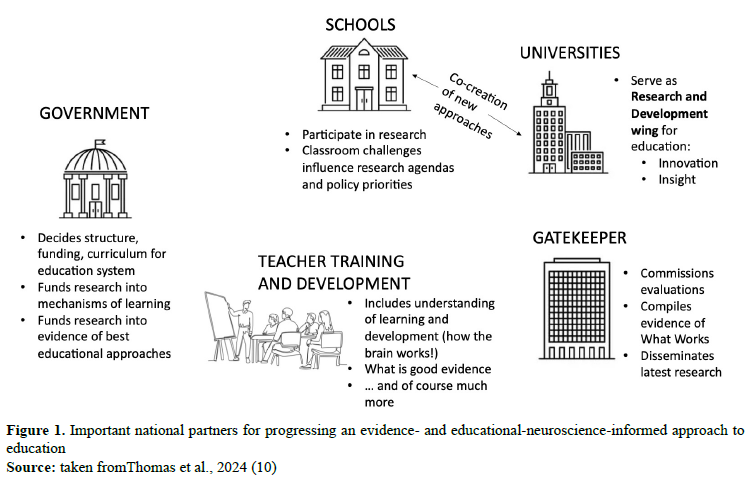
Figure 1. Important national partners for progressing an evidence- and educational-neuroscience-informed approach to education
Figure 1.Important national partners for progressing an evidence- and educational-neuroscience-informed approach to education
Source: taken fromThomas et al., 2024 (10)
4. An example educational neuroscience project
One example of an educational neuroscience project that illustrates the R&D role that universities can play is the UnLocke project (https://unlocke.org/) run by the University of London Centre for Educational Neuroscience. The project, which has been running for over a decade, was funded by the Educational Endowment Foundation and Wellcome Trust and delivered with the support of the charity Learnus. The project began with a specific classroom challenge – children sometimes struggle to learn counterintuitive concepts in mathematics and science (11). For example, a child must learn that dolphins are not fish even though they resemble fish, inhabit similar environments, and behave like fish. They must learn that the Earth rotates on its axis while the Sun is still, even though they can see Sun travelling across the sky each day. And after a child has learned the number sequence so that itbecome intuitive – that 4, for example, is obviously more than 3 – they must then go on to learn that minus 4 is now less than minus 3, and that 1 over 4 (a quarter) is less than 1 over 3 (a third). The classroom challenge is that intuitive knowledge gained from experiencing the world, or gained from prior learning, then interferes with the learning of new concepts.
Two principles from neuroscience lead to an insight into how children may be supported in learning new counterintuitive concepts. The first principle is that key to learning new counter-intuitive knowledge is the ability to inhibit previous intuitive concepts – to suppress the old knowledge so that it doesn’t interfere with the new (12). Technically, this skill is called inhibitory control, one aspect of executive functioning. Importantly, executive function skills are trainable (13). The second principle is that because the brain uses circuits that are specific to particular content, such training must take place embedded in the content domain in which it is to be used (14,2).
This translates to the insight that children must practice inhibitory control skills while reasoning about scientific and mathematical concepts (15). Based on this insight, a new classroom activity was co-designed with teachers to support primary-age children in learning counterintuitive concepts in maths and science. It was implemented as a computer game that if played for a few minutes at the beginning of science or maths lessons throughout a term, showed end of year improvements on maths and science tests (16).
This project required extensive collaboration with teachers and schools, starting with small studies with perhaps 20 children to test the feasibility of the ideas, then the development of a computer game in collaboration with teachers, then testing that the game was effective on a pilot sample of over 800 children, to a full randomised controlled efficacy trial with 6000 children in 80 schools across the UK, and then a follow-up effectiveness trial across 150 schools, to ensure it really worked (16,17). Evaluation cannot be the final stage, however, as further work needs to be done to turn the classroom activity into a polished form that is attractive to teachers, easy to access and use in the classroom, and comes with integrated lesson plans, to support uptake of new approaches.
Conclusion
Educational neuroscience is predicated on the view that insights into brain mechanisms of learning will support the work of teachers, while accepting the many other factors that influence educational outcomes at the school, social, and cultural level. But what do teachers need to know about neuroscience? Teachers do not need to know the details of neuroanatomy or neuroscience methods. They need to understand the characteristics of the brain’s approach to learning, and the factors that enhance or undermine learning, as well as how these may differ across children. To use a metaphor, if the brain were a car, they would need to read the driver’s manual but not the mechanic’s manual. This places the onus on educational neuroscientists to translate the key principles of brain function into a form that is both comprehensible and applicable for teachers. The result is a broader conception of learning and child development beyond memory and cognition, one that encompasses sensory, motivational, emotional, social, and health elements. Lastly, educational neuroscience is one element of the broader science of learning, which advocates for an evidence-informed approach to education. Another way that teachers can support their practice is by understanding how to use evidence, what sources of evidence to trust, and how to evaluate the impact of approaches and methods on the educational outcomes and wellbeing of their own students.
References
1. Bauckham SI, Gill R, Hamer M, Hood M, Moore R, Paterson C, et al. Initial Teacher Training and Early Career Framework. Education Endowment Foundation [Internet]. 2024. Available from: https://assets.publishing.service.gov.uk/media/661d24ac08c3be25cfbd3e61/Initial_Teacher_Training_and_Early_Career_Framework.pdf
2. Thomas MSC, Ansari D, Knowland VCP. Annual Research Review: Educational neuroscience: progress and prospects. J Child Psychol Psychiatry [Internet]. 2019;60(4):477-492. doi: https://doi.org/10.1111/jcpp.12973
3. Szucs D, Toffalini E. Maths anxiety and subjective perception of control, value and success expectancy in mathematics. R Soc Open Sci [Internet]. 2023;10(11):231000. doi: https://doi.org/10.1098/rsos.231000
4. Rogers C, Thomas MSC. Educational Neuroscience: The Basics [Internet]. USA: Routledge Publishers; 2022. Available from: https://www.routledge.com/Educational-Neuroscience-The-Basics/Rogers-Thomas/p/book/9781032028552?srsltid=AfmBOoq8Fq_MXyhHNsep1978oTGgf_UwnThXseCy3Nqi1ft882T8Q9B7
5. Blakemore SJ. Inventing ourselves: The secret life of the teenage brain [Internet]. London: Black Swan Publishers; 2018. Available from: https://www.amazon.com/Inventing-Ourselves-Secret-Teenage-Brain/dp/1610397312
6. Grospietsch F, Lins I. Review on the Prevalence and Persistence of Neuromyths in Education – Where We Stand and What Is Still Needed. Front Educ [Internet]. 2021;6:665752. doi: https://doi.org/10.3389/feduc.2021.665752
7. Weisberg DS, Keil FC, Goodstein J, Rawson E, Gray JR. The Seductive Allure of Neuroscience Explanations. J Cogn Neurosci [Internet]. 2008;20(3):470–477. doi: https://doi.org/10.1162/jocn.2008.20040
8. Duraiappah A, van Atteveldt N, Asah S, Borst G, Bugden S, Buil JM, et al. The International Science and Evidence-based Education Assessment. npj Sci Learn [Internet]. 2021;6:7. doi: https://doi.org/10.1038/s41539-021-00085-9
9. Bowen AEJ, Palmer LRJ, Perry RC, Thomas MSC, Tolmie A, Borst G, et al. Evaluating What Works in the Classroom: Best Practice and Future Opportunities. Mind Brain Educ [Internet]. 2024;18(4):474-484. doi: https://doi.org/10.1111/mbe.12430
10. Thomas MSC, Howard-Jones P, Dudman-Jones J, Palmer LRJ, Bowen AEJ, Perry RC. Evidence, Policy, Education and Neuroscience – The State of Play in the UK. Mind Brain Educ [Internet]. 2024;18(4):461-473. doi: https://doi.org/10.1111/mbe.12423
11. Stavy R, Tirosh D. How Students (Mis-)Understand Science and Mathematics: Intuitive Rules [Internet]. EEUU: Teachers College Press; 2000. Available from: https://www.researchgate.net/publication/31735228_How_Students_Mis-Understand_Science_and_Mathematics_Intuitive_Rules
12. Mareschal D. The neuroscience of conceptual learning in science and mathematics. Current Opinion in Behavioural Sciences [Internet]. 2016;10:114-118. doi: https://doi.org/10.1016/j.cobeha.2016.06.001
13. Diamond A. Activities and Programs That Improve Children’s Executive Functions. Curr Dir Psychol Sci [Internet]. 2012;21(5):335-34. doi: https://doi.org/10.1177/0963721412453722
14. Sala G, Gobet F. Does Far Transfer Exist? Negative Evidence From Chess, Music, and Working Memory Training. Curr Dir Psychol Sci [Internet]. 2017;26(6):515-520. doi: https://doi.org/10.1177/0963721417712760
15. Tolmie A, Dundar-Coecke S. Lifespan conceptual development in science: Brain and behaviour. In: Thomas MSC, Mareschal D, Dumontheil I. Educational Neuroscience: Development across the lifespan [Internet]. USA: Routledge Publisher; 2020. Available from: https://psycnet.apa.org/record/2020-28429-008
16. Roy P, Rutt S, Easton C, Sims D, Bradshaw S, McNamara S. Stop and Think: Learning Counterintuitive Concepts: Evaluation Report. Education Endowment Foundation [Internet]. 2019. Available from: https://www.nfer.ac.uk/media/uqapkjif/learning_counterintuitive_concepts_evaluation_report_-final.pdf
17. Wilkinson HR, Smid C, Morris S, Farran EK, Dumontheil I, Mayer S, et al. Domain-Specific Inhibitory Control Training to Improve Children’s Learning of Counterintuitive Concepts in Mathematics and Science. J Cogn Enhanc [Internet]. 2020;4(3):296-314. doi: https://doi.org/10.1007/s41465-019-00161-4
Información adicional
How to reference.: Thomas MSC. What do teachers need to know about neuroscience? MedUNAB [Internet]. 2024;27(3):251-257. doi: https://doi.org/10.29375/01237047.5392
Author Contributions: MSCT. Conceptualization, writing - original draft, writing - review & editing
Información adicional
redalyc-journal-id: 719
Enlace alternativo
https://revistas.unab.edu.co/index.php/medunab/article/view/5392 (html)
https://revistas.unab.edu.co/index.php/medunab/article/view/5392/4178 (pdf)
https://revistas.unab.edu.co/index.php/medunab/article/view/5392/4222 (xml)