Introduction
Aging is a natural process, with structural losses (reduction in the size and number of type II fibers, increase in body fat, loss of elasticity, and increase in arterial stiffness) followed by functional impairments (loss of muscle strength, decreased ability to carry out daily activities, increased blood pressure), consequently increasing the risk of cardiovascular death (1-5). It is estimated that the number of older adults (60–79 years) with hypertension will increase from roughly 494 million in 2015 to 1.07 billion in 2050 (6). Additionally, in the state of Maranhão, Brazil, a worrying prevalence of individuals with high blood pressure was found, with an expressive number of females (7). The percentage of hospitalizations in the state of Maranhão (Brazil) due to hypertension between 2014 and 2024 was 14.1% for individuals aged 80 or over, 20.2% for individuals aged between 70 and 79 years, and 21.8% for older adults aged between 60 and 69 years (7).
A body of evidence demonstrated the benefits of exercise training on cardiovascular and functional parameters in older adults(8-15). Studies have found positive effects of resistance training and endurance training on older adults’ blood pressure (BP), maximal cycling power output, and peak oxygen uptake, physical function biomarkers, functioning, physical fitness, muscle morphology and metabolic parameters (8-15).
Hence, such findings recommend concurrent training (resistance training associated with endurance training to improve older people’s health parameters (16). In addition to CT, Izquierdo et al. (16) also recommends power training for optimal aging and maintenance of functional capacities. Other studies likewise demonstrate the benefits of concurrent training involving power training with endurance training on older people’s cardiovascular and functional variables (8-11,13-15,17). Additionally, improvements in hemodynamic parameters in older adults were demonstrated after short periods of concurrent training (8,9).
Nevertheless the benefits demonstrated and there are recommendations for RT (frequency ≥ 2 to 3 days/week, low-moderate intensity, 2 to 4 sets of 8 to 12 repetitions) and endurance training (frequency ≥ 5 days/week, moderate intensity, ≥ 30 minutes/day of continuous or cumulative physical exercise) for older adults with hypertension (18), little is known about elastic-band power training interspersed with aerobic exercise on hemodynamic parameters in this population.
Thus, this research aimed to investigate the effects of elastic-band power training interspersed with aerobic exercise on hemodynamic parameters and lower-limb function in older adults.
Methodology Experimental design
This interventional controlled randomized trial was conducted upon approval by the Ethics Committee at CEUMA University (Sao Luis, MA, Brazil). All participants signed an informed consent form after learning about the study approach and procedures they would undergo and the potential risks and benefits. The study was conducted following the Helsinki Declaration of 1975.
Participants
Sample size calculation was performed using G*Power software (Heinrich-Heine-Universität Düsseldorf, Düsseldorf, Germany, release 3.1.9.4, 2019) before conducting further statistical analyses. Based on input parameters of effect size (large) (8), α = 0.05, power = 0.95, and recommendations by Beck (19), a total of 12 participants per group were calculated to assess the effects of elastic-band PT interspersed with aerobic exercise on hemodynamic parameters and lower- limb function in older adults. To account for possible dropouts, 13 participants per group were selected.
Inclusion criteria consisted of being 60 years old or above, able to walk with or without assistance, performing basic daily activities, and not having engaged in regular exercise training for the past 6 months. Exclusion criteria included experiencing disabling pain during exercise, inability to perform exercise sessions, and inability to participate in evaluations.
Twenty-six older adults were recruited by publicizing the project through digital media (e.g., Instagram). The inclusion criteria will be applied after recruitment. The 26 selected older adults were randomized with a computer-generated list of random numbers, and allocation concealment was ensured using opaque and sequentially numbered sealed envelopes. They were randomly assigned to the control group (CG) (n = 13) and the intervention group (IG) (n = 13).
Procedures
All assessments (hemodynamic parameters, and function of the lower limbs) were performed before and after 8 weeks of training by the same experienced exercise physiologists using identical procedures. Experiments were performed in a quiet air-conditioned room (22 to 24°C) always in the mornings (08:00 to 10:00 AM) in the Laboratory of Assessment and Physiology of Ceuma University, in four distinct phases.
During the initial phase (familiarization, 2 weeks), participants underwent an orientation period to familiarize themselves with the assessments and proper exercise techniques. In the second phase (2 weeks), experienced exercise physiologists administered the initial assessments. In the third phase (8 weeks), experienced exercise physiologists assisted with the protocol. Finally, in phase four (2 weeks), experienced exercise physiologists administered the final assessments.
Assessments
Anthropometric
The participants’ total body mass in kilograms (kg) and height in centimeters (cm) were measured with a properly calibrated (NBR ISO/IEC 17025:2005) anthropometric scale (PL-200, Filizola S.A. Pesagem e Automação Sao Paulo, SP, Brazil), with an accuracy of 50 grams and 0.1 cm. BMI was determined by body mass (kg) divided by the square of height (m2).
Hemodynamic measures
Systolic blood pressure (SBP) and diastolic blood pressure (DBP) were measured according to the procedures detailed in the 2023 Brazilian guidelines for in-office and out-of- office blood pressure measurement (20). Pulse pressure (PP) was calculated as the difference between SBP and DBP (20,21). The automated monitor can be used as an alternative for the evaluation of BP in the office. According to research conducted by Eguchi, (22) the ICC were 0.953 for SBP and 0.906 for DBP.
Lower limb functional capacity
5-Repetition Sit-To-Stand (5XSTS) test: 5XSTS was performed according to Guralnik (23) e Bohannon (24). For this test, the mean adjusted intraclass correlation coefficient (ICC) reported for this test was 0.81 (24).
Intervention Group
Considering frequency, intensity, type and time (duration) of exercise (FITT), the protocol was performed twice a week with rest intervals of 48 hours between sessions in the same week, with moderate intensity, concurrent training practice (practicing power exercises with elastic bands interspersed with aerobic exercise), lasting approximately 30 to 40 minutes (from the first to the eighth week).
The protocol was described following the recommendations of the Basic Guidelines for the Application of the Main Variables of RT in the Elderly (25). Protocol consisted of multiarticular and monoarticular exercises (vertical chest press, plantar flexion, seated row, hip abduction, trunk flexion, and squat on the chair) performed with elastic bands (strong) (LIVEUP® SPORTS, Araucária, PR, Brazil), with intensity moderate, controlled using the rating of perceived effort (RPE) (26). At the end of each exercise set participants were asked to provide their RPE (easy, low, moderate, hard, maximal) for the last repetition of the set. For example, whenever the intensity was reported as easy or low in the previous set of exercise, the participant’s elastic band tension was adjusted (increased) in the upcoming training session to provide a moderate intensity (26).
During the protocol familiarization period (2 weeks, 6 sessions), elastic bands offering moderate intensity were used to familiarize the participants with the initial and final positions of the exercises (e.g., reduce and increase elastic band tension; concentric and eccentric movement speed). The exercise professionals controlled the concentric and eccentric movement speed through verbal/tactile cues.
Except for the squat on the chair exercise, all exercises were performed with a full range of motion, with concentric contractions performed as fast as possible, while the eccentric contractions were performed slowly within 3 seconds. The protocol consisted of a sequence of five combinations of muscle power exercises interspersed with aerobic exercise without intervals of absolute rest throughout the session. The protocol consisted of, that is, two sets
1. vertical chest press interspersed with aerobic exercise (Walking with the same duration as the power exercise set);
Vertical Chest Press interspersed with aerobic exercise (Walking with the same duration as the power exercise set).
2. plantar flexion interspersed with aerobic exercise (Walking with the same duration as the power exercise set);
plantar flexion interspersed with aerobic exercise (Walking with the same duration as the power exercise set).
3. seated row interspersed with aerobic exercise (Walking with the same duration as the power exercise set);
seated row interspersed with aerobic exercise (Walking with the same duration as the power exercise set).
4. hip abduction interspersed with aerobic exercise (Walking with the same duration as the power exercise set);
hip abduction interspersed with aerobic exercise (Walking with the same duration as the power exercise set).
5. trunk flexion interspersed with aerobic exercise (Walking with the same duration as the power exercise set); trunk flexion interspersed with aerobic exercise (Walking with the same duration as the power exercise set).
The target perceived exertion level during walking was set at 3 (intensity moderate) on an adapted Borg Scale, which ranges from 1 to 10 (27).
Protocol was performed two times per week over 8 weeks, with a minimum 48-hour rest interval provided between each exercise session in the same week. The exercise training volume was increased over the 8 weeks as shown below:
4 weeks: 3 sets x 12 reps;
4 weeks: 4 sets x 12 reps.
Control Group
Participants were instructed not to participate in any systematic exercise program for 8 weeks.
Statistical analysis
Statistical analysis was performed using Prism software (GraphPad Inc., San Diego, CA, USA, version 8.4.3, 2020). The normality of the distribution and the homogeneity of the outcome measures were tested using the Shapiro-Wilk and Levene tests, respectively. Means and standard deviations were calculated for each dependent variable. A two-way (“group” x “time”) analysis of variance (ANOVA) with repeated measures was used to evaluate training-related effects over time or between groups. The Greenhouse- Geisser was used to assess changes in the outcomes; when a significant interaction effect was found, a Bonferroni post hoc test was applied to check for intragroup differences over time. All measurements were two-tailed, and p-values calculated with significance levels set at 5%. The effect size (ES) was determined using partial eta-squared (η2p) values (28). According to Espírito Santo and Daniel (29), values of η2p ≥ 0.01 were considered small ES, η2p ≥ 0.06 was considered medium ES, and η2p ≥ 0.14 was considered large ES.
This project was approved by the Ethics and Research Committee of Ceuma University (CAAE: 12699519.7.0000.5084). All participants provided written informed consent after being fully briefed on the study’s objectives, procedures, and potential risks and benefits. The study adhered to the principles of the Declaration of Helsinki (1975).
Results Participants
Two participants withdrew before the assessments due to unavailability to train during the research program.
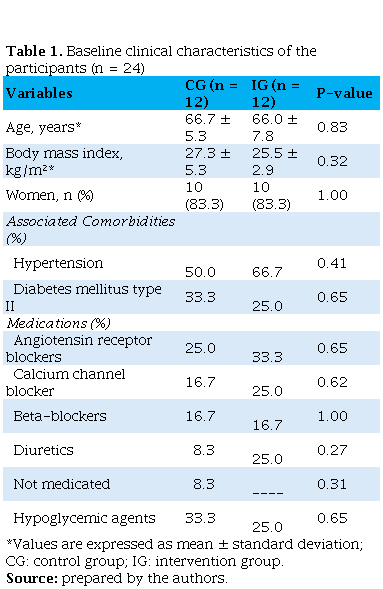
Twenty-four older adults completed the pre-8 and post- 8-week measurements and had their data included in the statistical analysis (CG: n = 12; IG: n = 12). Twenty-four participants attended 80% of the training sessions. Their clinical characteristics are shown in Table 1.
Table 1. Baseline clinical characteristics of the participants (n = 24)
Table 1. Baseline clinical characteristics of the participants (n = 24)
Table 1. Baseline clinical characteristics of the participants (n = 24)
*Values are expressed as mean ± standard deviation; CG: control group; IG: intervention group.
Source: prepared by authors.* Values are expressed as mean ± standard deviation; CG: control group; IG: intervention group.
|
| Table 1. Baseline clinical characteristics of the participants (n = 24) |
| Variables | CG (n = 12) | IG (n = 12) | P-value |
| Age, years* | 66.7 ± 5.3 | 66.0 ± 7.8 | 0.83 |
| Body mass index, kg/m²* | 27.3 ± 5.3 | 25.5 ± 2.9 | 0.32 |
| Women, n (%) | 10 (83.3) | 10 (83.3) | 1.00 |
| Associated Comorbidities (%) | | | |
| Hypertension | 50.0 | 66.7 | 0.41 |
| Diabetes mellitus type II | 33.3 | 25.0 | 0.65 |
| Medications (%) | | | |
| Angiotensin receptor blockers | 25.0 | 33.3 | 0.65 |
| Calcium channel blocker | 16.7 | 25.0 | 0.62 |
| Beta-blockers | 16.7 | 16.7 | 1.00 |
| Diuretics | 8.3 | 25.0 | 0.27 |
| Not medicated | 8.3 | ---- | 0.31 |
| Hypoglycemic agents | 33.3 | 25.0 | 0.65 |
| *Values are expressed as mean ± standard deviation; CG: control group; IG: intervention group. |
| Source: prepared by the authors. |
Pulse pressure, systolic and diastolic blood pressures
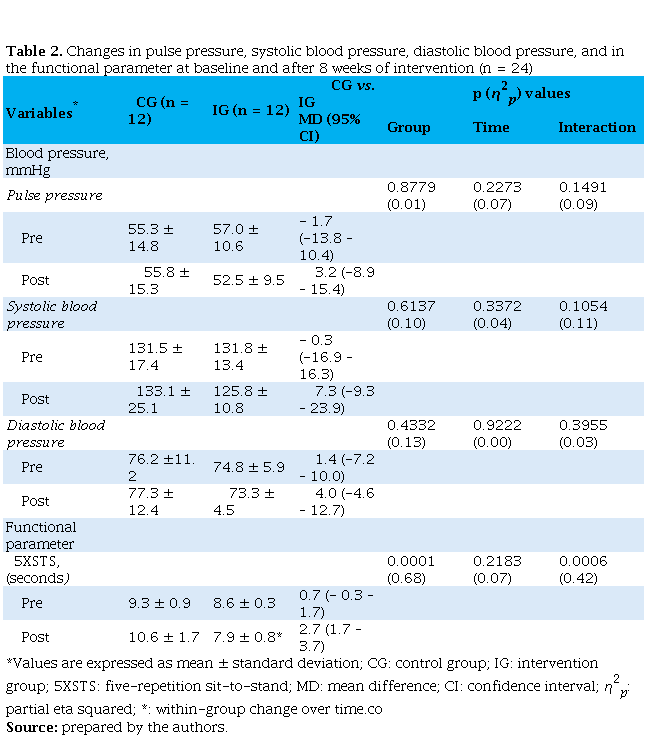
The results of the ANOVA indicated no significant differences statistically for PP (p > 0.05) (Table 2). In addition, SBP and DBP remain unchanged (p > 0.05) post the experimental period (Table 2).
Functional capacity
The results of the ANOVA indicated statistically significant time vs. group interaction (P<0.05) for the five- repetition sit-to-stand test (Table 2). Post hoc analyses further confirmed significant improvements in functional parameters. In addition, an important clinical was found in for the five-repetition sit-to-stand test. (time × group interaction: η2p = 0.63) (Table 2).
Discussion
Although the benefits of concurrent training on hemodynamic parameters in older adults have been demonstrated in some studies, there is still no consensus on the subject. Additionally, little is known about the effects of practicing power exercises with elastic bands interspersed with aerobic exercise on hemodynamic parameters in older adults. This research aimed to investigate the effects of elastic-band power training interspersed with aerobic exercise on hemodynamic parameters and lower- limb function in older adults. The main finding of this research was the absence of improvement in hemodynamic parameters after 8 weeks of intervention.
Despite not finding significant differences in hemodynamic parameters, an important clinical reduction in systolic blood pressure (Δ= - 6.0 mmHg) was observed in the sample. These findings have significant clinical implications, since a reduction of 5 mmHg in SPB has led to a 14% decrease in stroke-related mortality, a 9% decrease in mortality due to coronary heart disease, and a 7% decrease in all-cause mortality (30).
Although studies have demonstrated the benefits of concurrent training on older people’s health parameters (31), there is no consensus on the effects of concurrent training on blood pressure in this population (8,9,11,17,32-37). This may be due to the different characteristics of the sample (i.e., normotensive, hypertensive, sedentary, and previously trained older adults) and different exercise interventions (i.e., concurrent training with different resistance training protocols).
One hypothesis to explain our findings is the baseline blood pressure levels. The participants in this research did not present high blood pressure levels, as observed in Table 2. In line with these findings, in another study conducted by our group, no improvement in hemodynamic parameters was demonstrated in older adults with controlled blood pressure levels after the practice of concurrent training (11). On the other hand, contrary to our findings, an improvement in hemodynamic parameters was observed in older adults with high blood pressure (8,32,33). Additionally, studies have demonstrated improvements in hemodynamic parameters in hypertensive older adults after practicing concurrent training (34,35).
Table 2. Changes in pulse pressure, systolic blood pressure, diastolic blood pressure, and in the functional parameter at baseline and after 8 weeks of intervention (n = 24)
Table 2. Changes in pulse pressure, systolic blood pressure, diastolic blood pressure, and in the functional parameter at baseline and after 8 weeks of intervention (n = 24)
Table 2.Changes in pulse pressure, systolic blood pressure, diastolic blood pressure, and in the functional parameter at baseline and after 8 weeks of intervention (n = 24)
*Values are expressed as mean ± standard deviation; CG: control group; IG: intervention group; 5XSTS: five-repetition sit-to-stand; MD: mean difference; CI: confidence interval; η2p: partial eta squared; *: within-group change over time.co
Source: prepared by authors.* Values are expressed as mean ± standard deviation; CG: control group; IG: intervention group; 5XSTS: five-repetition sit-to-stand; MD: mean difference; CI: confidence interval; η2p: partial eta squared; *: within-group change over time.co
|
| Table 2. Changes in pulse pressure, systolic blood pressure, diastolic blood pressure, and in the functional parameter at baseline and after 8 weeks of intervention (n = 24) |
| Variables* | CG (n = 12) | IG (n = 12) | CG vs. IG | | p (η2p) values |
| MD (95% CI) | Group | Time | Interaction |
| Blood pressure, mmHg | | | | | | |
| Pulse pressure | | | | 0.8779 (0.01) | 0.2273 (0.07) | 0.1491 (0.09) |
| Pre | 55.3 ± 14.8 | 57.0 ± 10.6 | - 1.7 (-13.8 – 10.4) | | | |
| Post | 55.8 ± 15.3 | 52.5 ± 9.5 | 3.2 (-8.9 – 15.4) | | | |
| Systolic blood pressure | | | | 0.6137 (0.10) | 0.3372 (0.04) | 0.1054 (0.11) |
| Pre | 131.5 ± 17.4 | 131.8 ± 13.4 | - 0.3 (-16.9 – 16.3) | | | |
| Post | 133.1 ± 25.1 | 125.8 ± 10.8 | 7.3 (-9.3 – 23.9) | | | |
| Diastolic blood pressure | | | | 0.4332 (0.13) | 0.9222 (0.00) | 0.3955 (0.03) |
| Pre | 76.2 ±11.2 | 74.8 ± 5.9 | 1.4 (-7.2 – 10.0) | | | |
| Post | 77.3 ± 12.4 | 73.3 ± 4.5 | 4.0 (-4.6 – 12.7) | | | |
| Functional parameter | | | | | | |
| 5XSTS, (seconds) | | | | 0.0001 (0.68) | 0.2183 (0.07) | 0.0006 (0.42) |
| Pre | 9.3 ± 0.9 | 8.6 ± 0.3 | 0.7 (- 0.3 – 1.7) | | | |
| Post | 10.6 ± 1.7 | 7.9 ± 0.8* | 2.7 (1.7 – 3.7) | | | |
| *Values are expressed as mean ± standard deviation; CG: control group; IG: intervention group; 5XSTS: five-repetition sit-to-stand; MD: mean difference; CI: confidence interval; η2p: partial eta squared; *: within-group change over time.co |
| Source: prepared by the authors. |
In addition to having observed a significant clinical reduction in SBP, in the present research, found an improvement in lower limb functional capacity – which agrees with several studies on concurrent training and older people’s functional parameters (12-14). This finding also corroborates a study conducted by our group, which found an improvement in older people’s functional capacity in two tests, namely: rising from the prone position and the timed up-and-go (TUG) dynamic balance test (11). The improvement in lower limb function observed in this study also has important clinical implications, since increased muscle strength reduces the risk of mortality (38). Additionally, in agreement with a systematic review and meta-analysis by Shailendra et al. (39), the practice of RT is associated with decreased cardiovascular mortality risk.
The characteristic of muscle power training is particularly interesting to improve older adults’ functional capacity because the type of muscle action performed mainly stimulates type IIX fibers. Literature traditionally describes this muscle fiber subtype as the most impacted by the aging process, and its reduction is associated with a higher risk of falls and mortality from all causes in older people (40).
The present study has limitations, such as its short duration (8 weeks) and heterogeneous sample (normotensive and hypertensive older adults). Nonetheless, this study has strengths, including the use of elastic bands, a low-cost and easy-to-handle option to improve functional parameters in older adults. Finally, considering that the proposed protocol is easy to access, low-cost, and widely applicable, further studies about the topic covered are needed with longer duration and more homogeneous samples. Probably, with longer duration (e.g., 12, 16 weeks) could allow greater physiological adaptations, possibly influencing hemodynamic parameter responses.
In addition, the protocol approach used in the present study has other advantages, which makes it a promising alternative for this population. These include greater dynamism in training since the combination of exercises with different characteristics, performed sequentially and without breaks, can help their adherence to practicing exercises. In this sense, studies comparing this protocol of this research with other exercise programs are needed to confirm the potential for adherence when alternating power exercises with aerobic exercise.
Conclusions
Our findings show that the combination of elastic- band power training interspersed with aerobic exercise effectively improves the lower limb functional capacity of older adults’ lower limbs. Although no significant differences were found in hemodynamic parameters, it is important to highlight the important clinical reduction in systolic blood pressure (Δ= -6.0 mmHg), with the consequent reduction in the risk of cardiovascular mortality in the sample investigated. Importantly, no adverse effects were observed, considering that the sample consisted of normotensive older adults and those with hypertension, a condition of cardiovascular risk. In this sense, the results of this study apply to normotensive older adults or those with controlled blood pressure, and that effectiveness may vary in populations with different risk profiles.
Conflicts of interest
The authors declare that they have no conflicts of interest.
Funding
No external funding was provided to the authors for this study
References
1. Sauaia BA, Gambassi BB. Envelhecer: uma transformação natural, aos olhos da microscopia. Rev Investig Biomédic [Internet]. 2015;7(1):91-97. doi: https://doi.org/10.24863/rib.v7i1.23
2. Cheitlin MD. Cardiovascular physiology-changes with aging. Am J Geriatr Cardiol [Internet]. 2003;12(1):9-13. doi: https://doi.org/10.1111/j.1076-7460.2003.01751.x
3. Pugh KG, Wei JY. Clinical implications of physiological changes in the aging heart. Drugs Aging [Internet]. 2001;18(4):263276. doi: https://doi.org/10.2165/00002512-200118040-00004
4. Faulkner JA, Larkin LM, Claflin DR, Brooks SV. Age-related changes in the structure and function of skeletal muscles. Clin Exp Pharmacol Physiol [Internet]. 2007;34(11):1091-6. doi: https://doi.org/10.1111/j.1440-1681.2007.04752.x
5. Schosserer M, Grillari J, Wolfrum C, Scheideler M. Age-Induced Changes in White, Brite, and Brown Adipose Depots: A Mini-Review. Gerontol [Internet]. 2018;64(3):229-236. doi: https://doi.org/10.1159/000485183
6. Egan BM, Mattix-Kramer HJ, Basile JN, Sutherland SE. Managing Hypertension in Older Adults. Curr Hypertens Rep [Internet]. 2024;26(4):157-167. doi: https://doi.org/10.1007/s11906-023-01289-7
7. Pereira GH, Lobato-Ribeiro LA, Azevedo-Amorim MA, Sousa-Garcia C, Madeira-Ribeiro RI, Costa-Machado L, et al. Análise da morbidade hospitalar de pacientes com Hipertensão Arterial Essencial na Macrorregião Norte do Estado do Maranhão entre 2014 a 2024. Res Soc Dev [Internet]. 2024;13(11):e113131147450-e113131147450. doi: https://doi.org/10.33448/rsd-v13i11.47450
8. Bavaresco-Gambassi B, Costa-Chaves LF, daSilva-Sousa TM, Silva-Ribeiro MJ, Souza TA, Schwingel PA. Short-duration dynamic power training with elastic bands combined with endurance training: a promising approach to hypertension management in older adults. J Hypertens [Internet]. 2024;42(4):735-742. doi: https://doi.org/10.1097/hjh.0000000000003681
9. Costa-Chaves LF, Bavaresco-Gambassi B, Cadore EL, Sotão S, Sousa TM, da Silva-Dias D, et al. Power exercises with elastic bands combined with endurance training improve pulse pressure, systolic blood pressure, and functional parameters in older adults. Blood Press Monit [Internet]. 2025;30(2):49-56. doi: https://doi.org/10.1097/mbp.0000000000000733
10. Bavaresco-Gambassi B, Nobre I, Prazeres J, de Melo MH, Bianco R, Novais TM, et al. Impact of dynamic explosive resistance exercise with elastic bands on pulse pressure in hypertensive older adults: a randomized crossover study. Blood Press Monit [Internet]. 2023;28(4):208-214. doi: https://doi.org/10.1097/mbp.0000000000000650
11. Bavaresco-Gambassi B, Cadore EL, Costa-Chaves LF, da Silva-Sousa TM, Texeira-Mostarda C, Lopes-de Siqueira AF, et al. Effects of combined muscle power and endurance training with different volumes on functional and hemodynamic parameters in previously trained older adults. Aging Clin Exp Res [Internet]. 2023;35(11):2623-2631. doi: https://doi.org/10.1007/s40520-023-02572-y
12. Carneiro MAS, Oliveira-Júnior G, Castro-E-Souza P, Oliveira AA, Nunes PRP, Izquierdo M, et al. Impact of exercise intervention-based changes on physical function biomarkers in older adults after hospital discharge: A systematic review with meta-analysis of randomized clinical trials. Ageing Res Rev [Internet]. 2022;80:101673. doi: https://doi.org/10.1016/j.arr.2022.101673
13. Müller DC, Pinto-Boeno F, Izquierdo M, Aagaard P, Lopes-Teodoro J, Grazioli R, et al. Effects of high- intensity interval training combined with traditional strength or power training on functionality and physical fitness in healthy older men: A randomized controlled trial. Exp Gerontol [Internet]. 2021;149:111-321. doi: https://doi.org/10.1016/j.exger.2021.111321
14. Müller DC, Izquierdo M, Pinto-Boeno F, Aagaard P, Lopes-Teodoro J, Graziolo R et al. Adaptations in mechanical muscle function, muscle morphology, and aerobic power to high-intensity endurance training combined with either traditional or power strength training in older adults: a randomized clinical trial. Eur J Appl Physiol [Internet]. 2020;120:1165-1177. doi: https://doi.org/10.1007/s00421-020-04355-z
15. Teodoro JL, Izquierdo M, da Silva LXN, Baroni BM, Grazioli R, Lopez L, et al. Effects of long- term concurrent training to failure or not in muscle power output, muscle quality and cardiometabolic risk factors in older men: A secondary analysis of a randomized clinical trial. Exp Gerontol [Internet]. 2020;139:111023. doi: https://doi.org/10.1016/j.exger.2020.111023
16. Izquierdo M, Merchant RA, Morley JE, Anker SD, Aprahamian I, Arai H, et al. International Exercise Recommendations in Older Adults (ICFSR): Expert Consensus Guidelines. J Nutr Health Aging [Internet]. 2021;25(7):824-853. doi: https://doi.org/10.1007/s12603-021-1665-8
17. Bavaresco-Gambassi B, Schwingel PA. Dynamic power training combined with endurance training reduces arterial stiffness and improves hemodynamic parameters in older adults diagnosed with grade 1 hypertension?. J Hypertens [Internet]. 2024;42(8):1461-1462. doi: https://doi.org/10.1097/hjh.0000000000003754
18. Liguori G. Diretrizes do ACSM para os testes de esforço e sua prescrição. Rio de Janeiro: Guanabara Koogan; 2023. Cap 6-9.
19. Beck TW. The importance of a priori sample size estimation in strength and conditioning research. J Strength Cond Res [Internet]. 2013;27(8):2323-37. doi: https://doi.org/10.1519/jsc.0b013e318278eea0
20. Feitosa ADM, Seba-Barroso WK, Mion-Junior D, Nobre F, Mota-Gomes MA, Veiga-Jardim PCB, et al. Brazilian guidelines for in-office and out-of-office blood pressure measurement - 2023. Arq Bras Cardiol [Internet]. 2024;121(4):e20240113. doi: https://doi.org/10.36660/abc.20240113
21. Woo J, Yau F, Leung J, Chan R. Peak oxygen uptake, six-minute walk distance, six-meter walk speed, and pulse pressure as predictors of seven year all-cause and cardiovascular mortality in community-living older adults. Exp Gerontol [Internet]. 2019;124:110645. doi: https://doi.org/10.1016/j.exger.2019.110645
22. Eguchi K, Kuruvilla S, Ishikawa J, Ogedegbe G, Gerin W, Schwartz JE, et al. Correlations between different measures of clinic, home, and ambulatory blood pressure in hypertensive patients. Blood Press Monit [Internet]. 2011;16(3):142-8. doi: https://doi.org/10.1097/mbp.0b013e328346d669
23. Guralnik JM, Simonsick EM, Ferrucci L, Glynn RJ, Berkman LF, Blazer DG, et al. A short physical performance battery assessing lower extremity function: association with self-reported disability and prediction of mortality and nursing home admission. J Gerontol [Internet]. 1994;49(2):M85–M94. doi: https://doi.org/10.1093/geronj/49.2.m85
24. Bohannon RW. Test-retest reliability of the five- repetition sit-to-stand test: a systematic review of the literature involving adults. J Strength Cond Res [Internet]. 2011;25(11):3205–2307. doi: https://doi.org/10.1519/jsc.0b013e318234e59f
25. Bavaresco-Gambassi B, Lopes-dos Santos MD, Furtado-Almeida FJ. Basic guide for the application of the main variables of resistance training in elderly. Aging Clin Exp Res [Internet]. 2019;31:1019-1020. doi: https://doi.org/10.1007/s40520-019-01181-y
26. Colado JC, Furtado GE, Teixeira AM, Flandez J, Naclerio F. Concurrent and Construct Validation of a New Scale for Rating Perceived Exertion during Elastic Resistance Training in The Elderly. J Sports Sci Med [Internet]. 2020;24;19(1):175-186. Available from: https://pmc.ncbi.nlm.nih.gov/articles/PMC7039017/
27. Borg G. Borg’s perceived exertion and pain scales. 1ª ed. Chicago: Human Kinects;1998. p. 1-101.
28. Lakens D. Calculating and reporting effect sizes to facilitate cumulative science: a practical primer for t-tests and ANOVAs. Front Psychol [Internet]. 2013;4:863. doi: https://doi.org/10.3389/fpsyg.2013.00863
29. Espirito-Santo HMA, Daniel F. Calcular e apresentar tamanhos do efeito em trabalhos científicos (3): Guia para reportar os tamanhos do efeito para análises de regressâo e ANOVAs. Rev Port Inv Comp Soc [Internet]. 2018;4(1):43–60. doi: https://doi.org/10.31211/rpics.2018.4.1.72
30. Whelton PK, He J, Appel LJ, Cutler JA, Havas S, Kotchen TA, et al. Primary prevention of hypertension: clinical and public health advisory from The National High Blood Pressure Education Program. JAMA [Internet]. 2002;288(15):1882-1888. doi: https://doi.org/10.1001/jama.288.15.1882
31. Sardeli AV, Griffth GJ, Abreu-Dos Santos MVM, Ito MSR, Chacon-Mikahil MPT. The effects of exercise training on hypertensive older adults: an umbrella meta-analysis. Hypertens Res [Internet]. 2021;44(11):1434-1443. doi: https://doi.org/10.1038/s41440-021-00715-0
32. Dos Santos ES, Asano RY, Filho IG, Lopes NL, Panelli P, Nascimento Dda C, et al. Acute and chronic cardiovascular response to 16 weeks of combined eccentric or traditional resistance and aerobic training in elderly hypertensive women: a randomized controlled trial. J Strength Cond Res [Internet]. 2014;28(11):3073-84. doi: https://doi.org/10.1519/jsc.0000000000000537
33. Roberson KB, Potiaumpai M, Widdowson K, Jaghab AM, Chowdhari S, Armitage C, et al. Effects of high- velocity circuit resistance and treadmill training on cardiometabolic risk, blood markers, and quality of life in older adults. Appl Physiol Nutr Metab [Internet]. 2018;43(8):822-832. doi: https://doi.org/10.1139/apnm-2017-0807
34. Figueroa A, Park SY, Seo DY, Sanchez-Gonzalez MA, Baek YH. Combined resistance and endurance exercise training improves arterial stiffness, blood pressure, and muscle strength in postmenopausal women. Menopause-J N Am Menopause Soc [Internet]. 2011;18(9):980-984. doi: https://doi.org/10.1097/gme.0b013e3182135442
35. Masroor S, Bhati P, Verma S, Khan M, Hussain ME. Heart Rate Variability following Combined Aerobic and Resistance Training in Sedentary Hypertensive Women: A Randomised Control Trial. Indian Heart J [Internet]. 2018;70:S28-S35. doi: https://doi.org/10.1016/j.ihj.2018.03.005
36. Sardeli AV, Griffith GJ, Abreu-Dos Santos MVM, Ito MSR, Nadruz W, Chacon-Mikahil MPT. Do baseline blood pressure and type of exercise influence level of reduction induced by training in hypertensive older adults? A meta-analysis of controlled trials. Exp Gerontol [Internet]. 2020;140:111052. doi: https://doi.org/10.1016/j.exger.2020.111052
37. Sardeli AV, Gáspari AF, Dos Santos WM, De Araujo AA, De Angelis K, Mariano LO, et al. Comprehensive Time-Course Effects of Combined Training on Hypertensive Older Adults: A Randomized Control Trial. Int J Environ Res Public Health [Internet]. 2022;19(17):11042. doi: https://doi.org/10.3390/ijerph191711042
38. Sasaki KI, Fukumoto Y. Sarcopenia as a comorbidity of cardiovascular disease. J Cardiol [Internet]. 2022;79(5):596-604. doi: https://doi.org/10.1016/j.jjcc.2021.10.013
39. Shailendra P, Baldock KL, Li LSK, Bennie JA, Boyle T. Resistance training and mortality risk: a systematic review and meta-analysis. Am J Prev Med [Internet]. 2022;63(2):277-285. doi: https://doi.org/10.1016/j.amepre.2022.03.020
40. Frontera WR, Suh D, Krivickas LS, Hughes VA, Goldstein R, Roubenoff R. Skeletal muscle fiber quality in older men and women. Amer J of Physiol Cell Physiol [Internet]. 2000;279(3):C611–8. doi: https://doi.org/10.1152/ajpcell.2000.279.3.c611
Notas de autor
professorbrunobavaresco@gmail.com
Información adicional
How to reference. : Gomes LT, Chaves LFC, Sousa TMS, Seguins SS, Rodrigues CS, da Silva ARM, et al. Effects of elastic-band power training interspersed with aerobic exercise on hemodynamic parameters and lower-limb function in older adults. MedUNAB [Internet]. 2025;28(1):26-35. doi: https://doi.org/10.29375/01237047.5125
Author Contributions: LTG, LFCC, TMSS, SSS, CSR, ARMS, LPCC, PAS, and BBG contributed to the conceptualization and methodology. PAS, and BBG contributed to the formal analysis. LTG, LFCC, TMSS, SSS, CSR, ARMS, LPCC, and BBG performed the investigation. BBG performed supervision and project administration. LTG, LFCC, TMSS, SSS, CSR, ARMS, LPCC, PAS, and BBG contributed to original draft. BBG performed writing - review & amp; editing.
Información adicional
redalyc-journal-id: 719
Enlace alternativo
https://revistas.unab.edu.co/index.php/medunab/article/view/5125 (html)
https://revistas.unab.edu.co/index.php/medunab/article/view/5125/4208 (pdf)
https://revistas.unab.edu.co/index.php/medunab/article/view/5125/4257 (xml)