Development and validation of the scale of psychological abuse in intimate partner violence (EAPA-P)
Desarrollo y validación de la Escala de Abuso Psicológico Aplicado en la Pareja (EAPA-P)]
Development and validation of the scale of psychological abuse in intimate partner violence (EAPA-P)
Psicothema, vol. 28, no. 2, pp. 214-221, 2016
Colegio Oficial de Psicólogos del Principado de Asturias
Received: 22 July 2015
Accepted: 04 February 2016
Abstract: Background: In the context of intimate partner violence, psychological abuse (PA) has progressively gained scientifi c relevance. Even so, a greater effort is needed to defi ne and evaluate psychological intimate partner abuse. A new exhaustive and operative taxonomy of PA strategies leads to the contribution of a new evaluation instrument. Method: Participants were 101 women between 24 and 82 years old, who were abused by their partners and attended to in different municipal Catalan services, specialized in the topic. Results: The analyses have shown the suitability of a 19-item instrument divided into two factors: (1) direct PA strategies and (2) indirect PA strategies. The former includes strategies that affect the emotional, cognitive and behavioral dimension of the victim. The latter includes items that measure the amount of control and domination over the victim’s context. This scale has adequate psychometric properties in terms of score reliability and the validity of the relationship with other women’s health variables. Conclusions: The EAPA-P, created based on a new defi nition and taxonomy of the forms of PA, is presented as a valid instrument to detect and measure intimate partner PA.
Keywords: Psychological abuse, scale, instrumental studies, validation, intimate partner violence.
Resumen: Antecedentes: en el contexto de la violencia en la pareja, la de tipo psicológico ha ido ganando relevancia científi ca. Aun así, es preciso un mayor esfuerzo para delimitar y evaluar el abuso psicológico (AP) en la pareja. Una nueva taxonomía de estrategias de AP da pie a la aportación de un nuevo instrumento de evaluación. Método: han participado 101 mujeres maltratadas por su pareja, de entre 24 y 82 años, y atendidas en diferentes servicios municipales especializados en el tema. Resultados: los análisis han mostrado la idoneidad de un instrumento de 19 ítems distribuidos en dos factores: (1) estrategias directas de AP y (2) estrategias indirectas de AP. El primero agrupa las estrategias que inciden en la dimensión emocional, cognitiva y conductual de la víctima. El segundo recoge aquellas que persiguen el control y la dominación sobre el contexto de la misma. Dicha escala posee propiedades psicométricas adecuadas en lo que se refiere a la fiabilidad de las puntuaciones y la validez de relación con otras variables relacionadas con la salud. Conclusiones: la EAPA-P se presenta como herramienta válida para detectar y medir el AP en la pareja.
Palabras clave: abuso psicológico, escala, estudio instrumental, validación, violencia de pareja.
A Spanish survey on intimate partner violence against women showed that, among women over 17 years old, the prevalence of psychological abuse (PA) ranged between 40.3 and 44.7%, and reached 15.2% in the case of severe PA ( Medina-Ariza & Berberet, 2003 ). In addition, the results of the study carried out by Amor, Echeburúa, de Corral, Sarasua, and Zubizarreta (2001) showed that 38% of the female victims of intimate partner violence stated that they had suffered PA exclusively. The rest (62%) reported that they had received physical abuse and PA simultaneously. The study by Matud (2004) reported that 46% of the abused women suffered physical abuse and PA; 33% suffered physical, psychological and sexual abuse; 16% indicated that they had only experienced PA; and finally, 5% said they had experienced PA and sexual abuse.
Some studies state that PA has at least as much of an impact on the victim’s mental health as physical aggression. The results of the study by Matud (2004) pointed out that women abused by their partners presented, among other health problems, more symptoms of depression (17.4%) and anxiety (15.8%) than women who had not experienced abuse. Moreover, in the case of depression, signifi cant differences were obtained between the women who had been separated from their partners for some time and those who were involved in the separation process, with the former showing signifi cantly lower depression levels than the latter.
Regarding the Post-traumatic Stress Disorder (PTSD), Jones, Hughes, and Unterstaller (2001) reported that this type of disorder usually appears in 33 to 84% of abused women. A greater presence of sexual or physical abuse is usually considered a distinctive trait in women with PTSD diagnostic criteria, although they can appear after experiencing any type of abuse ( Calvete, Estévez, & Corral, 2007 ). In the study carried out by these authors, the results showed that women with PTSD scored signifi cantly higher on the other variables (e.g., physical aggression, sexual aggression, abandonment, failure and imperfection/guilt), but signifi cant scores were not obtained in the case of PA or on the schemas of failure and emotional deprivation.
If the study of the conceptualization and defi nition of intimate partner PA has presented certain discrepancies, the study of the evaluation of this phenomenon confi rms them. In spite of these diffi culties, efforts have been made to develop scales that evaluate violence in general, including items to detect some form of PA (for an exhaustive review, see Almendros, Gámez-Guadix, Carrobles, Rodríguez-Carballeira, & Porrúa, 2009 ). An example is the Confl ict Tactics Scale, original (CTS) and revised versions (CTS2) ( Straus, 1979 ; Straus, Hamby, Boney-McCoy, & Sugarman, 1996 ), which have been the most widely used in the area of intimate partner violence ( Rathus & Feindler, 2004 ). Another scale with a strong impact in the scientifi c context is the Index of Spouse Abuse (ISA) by Hudson and MacIntosh (1981) , which evaluates intimate partner violence in general, and the magnitude and severity of PA in particular. In addition, it is necessary to add those created to measure PA exclusively, validated in English-speaking samples. Some of the most important are the Psychological Maltreatment of Women Inventory (PMWI) by Tolman (1989) , the Subtle and Overt Psychological Abuse of Women Scale (SOPAS) by Marshall (1999) , which was proposed to measure the presence of open or manifest PA and subtle or hidden PA, and the Across Groups Psychological Abuse and Control Scale (AGPAC) by Wolfson (2002) , which was created for application to ex-members of cults and female victims of partner abuse in order to discriminate between the two groups and establish similarities and differences. Regarding the development of instruments that specifi cally measure PA in the Spanish setting, some stand out, such as the Scale to Assess Women’s Maltreatment by their Partners [Escala para Evaluar el Maltrato a la Mujer por parte de su Pareja – APCM] ( Matud, Carballeira, & Marrero, 2001 ) and the Inventory of Psychological Abuse in Intimate Relationships [Inventario de Abuso Psicológico en las Relaciones de Pareja – IAPRP) by Calvete, Corral, and Estévez (2005) .
When reviewing the studies on classifi cations of the PA components, a notable divergence is observed in the spectrum of these classifi cations and the number and labeling of the strategies included in them. Some authors view this construct as unifactorial (e.g., Calvete et al., 2005 ). However, it has been considered a set of components or factors, and thus, a multifactorial construct ( Kelly, 2004 ). In this sense, various studies have yielded different classifi cations that include the strategies that would supposedly defi ne the fi eld of action of PA, although there are still important discrepancies among them. One of the most recent classifi cations, which includes an exhaustive collection of PA strategies, from the most overt to the most subtle, was developed by Rodríguez-Carballeira, Porrúa-García, Escartín, Martín-Peña, and Almendros (2014) . This taxonomy contributes the operative defi nitions for each PA category and sub-category, and it hierarchizes them according to their severity. The breadth and operativity of this taxonomy provides a solid base for the elaboration of a scale to measure PA, defi ned by the authors of this study as the continued application of strategies of pressure, control, manipulation and coercion with the purpose of dominating and subjugating the partner. This domination can be attempted with direct strategies, affecting the partner’s emotions, cognitions and behaviors, or with indirect ones, by controlling the partner’s immediate environment.
The aim of this study is to resolve some of the limitations shown by other intimate partner PA measurement instruments, basically stemming from the use of partial approaches that do not take into account the entire range of forms of abuse, from the most overt to the most subtle. To do so, it was necessary to elaborate and validate a new PA scale, mainly incorporating: (1) items that refl ect all the PA strategies contemplated in the recent exhaustive taxonomy by Rodríguez-Carballeira et al., (2014) ; (2) items that clearly refl ect the action of the abusive strategies applied, without confusing them with the consequences or other possible collateral effects on the victims.
As a result, this study proposes the following objectives: (a) develop and validate an instrument that offers a valid and reliable measure of the PA applied in the context of heterosexual intimate partner violence and in the Spanish-speaking population. In addition, the study aims to: (b) achieve a balance between the quality of the psychometric properties and the length of the instrument.
Method
Participants
The sample consisted of 101 women residing in Spain, 75% of them of Spanish origin and 25% from other places (15% are Spanish-speaking: Argentina, Bolivia, Colombia, Peru, Puerto Rico and Venezuela; 10% are non Spanish-speaking: Belgium, Morocco, Rumania and the Ukraine, but understand Spanish suffi ciently). The latter was verifi ed through a prior interview to fi nd out whether the woman could hold a fl uid conversation in Spanish. These experts in treating battered women had previously diagnosed the women as abused by their partners. The age of the participating women ranged from 24 to 82 years old, with a mean age of 51.29 years (SD = 13.04). When the abuse began, most of the women reported having a medium socioeconomic level (53%), followed by a medium-low level in 17%, a low level in 16%, and a medium-high level in 14%. Regarding the couple’s situation and the beginning of the abuse, 39% were living together, 36% were married, and 25% were engaged but without living together. With regard to the self-perception of the abuse experienced, 76% of the total sample said they had suffered physical violence, 65% said they had been the victim of sexual aggression, and all of the women interviewed (100%) reported having experienced PA.
Instruments
The following battery of instruments was applied:
Ad hoc questionnaire on sociodemographic aspects and characteristics of the abuse and its context.
Scale of Psychological Abuse in Intimate Partnert Violence [Escala de Abuso Psicológico Aplicado en la pareja – EAPA-P]. It originally consisted of 47 Likert-type items with a response range from 0 = never to 4 = continually. After performing different types of analyses, which are explained in this study, the instrument was reduced to 19 items. Cronbach’s alpha was .92 for the complete scale.
Subtle and Overt Psychological Abuse Scale (SOPAS; Marshall, 1999 ), composed of 35 items that provide a measure of the subtle and overt forms of PA. The response range is from 0 = never to 4 = continually. The Spanish version by Almendros, Rodríguez-Carballeira, Porrúa, Carrobles, and Gámez-Guadix (2010) was used. The alpha coeffi cient for this sample was .97.
Hospital Anxiety and Depression Scale (HAD), consisting of 14 items that detect the existence of anxiety and depression. Each of these two subscales contains 7 items with a response range from 0 to 3. The Spanish adaptation by López-Roig et al. (2000) was used. Cronbach’s alpha for the present sample was .94.
Davidson Trauma Scale (DTS), in its Spanish version, translated and validated by Bobes et al. (2000) , and composed of 17 items with a response range from 0 to 3. Cronbach’s alpha for the present sample was .97.
Procedure
To elaborate the preliminary version, the guidelines recommended by Abad, Olea, Ponsoda, and García (2011) were followed. First, the purpose of the instrument was defi ned, that is, to evaluate the frequency with which PA strategies are applied in intimate partner relationships. Second, the construct to be evaluated was specifi ed, using the taxonomy of AP strategies created by Rodríguez-Carballeira et al., (2014) . The next step was to create a set of items that would be capable of collecting the abusive behaviors that correspond to the abuse strategies contained in this taxonomy and could be adequately responded to by female victims of partner violence. An effort was made to present the content of the items as precisely and clearly as possible, avoiding any diffi culties in comprehending the ideas they include, as recommended by various experts (e.g. Haladyna, Downing, & Rodríguez, 2002 ). The items were written based on the abuse strategy referred to, instead of using specifi c forms of abuse. The proposal was to write at least two items for each strategy. The result was a scale with 47 items (see Tables 1 and 2 ).
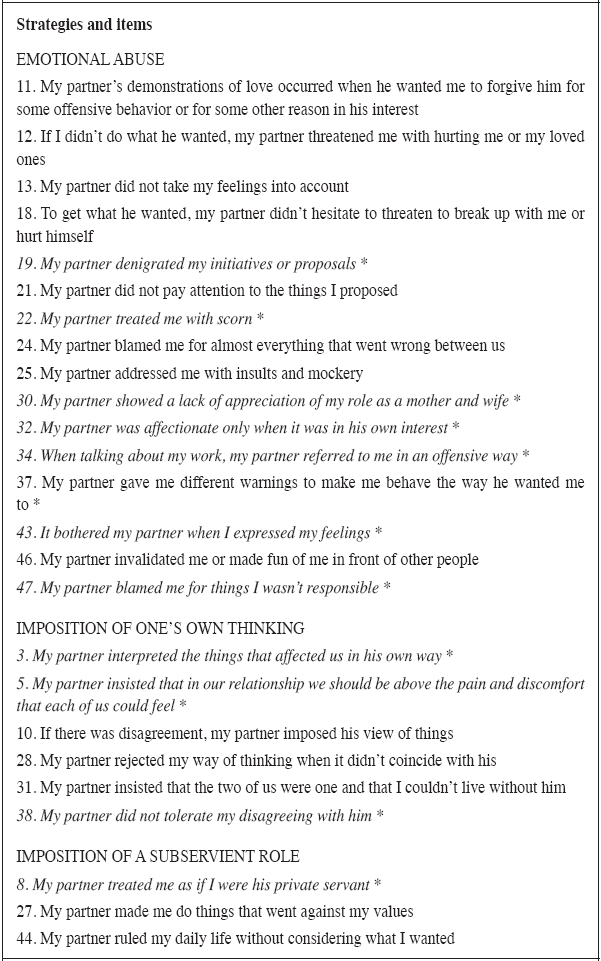
Note: *: item that forms part of the reduced version of the EAPA-P (19 items)
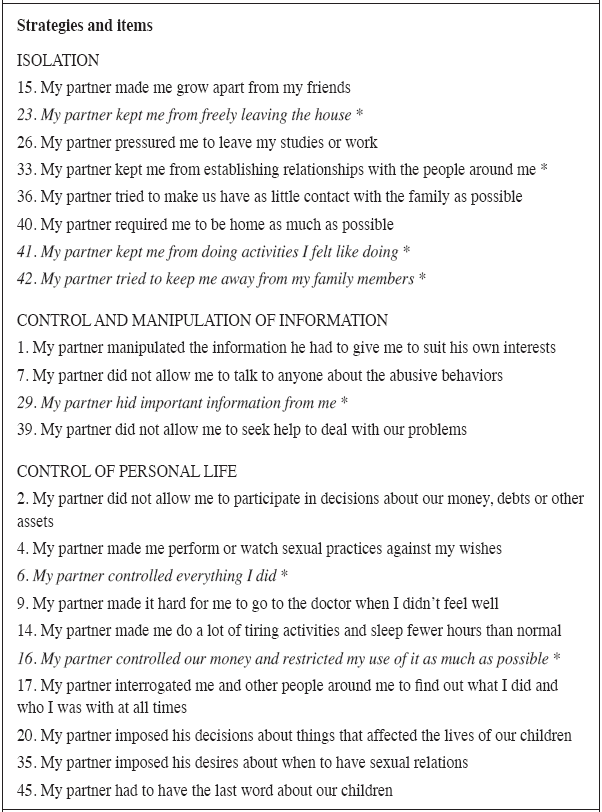
Once the item construction process had ended, the items were distributed to four professionals from the academic world, experts in partner violence, for review. The purpose was to detect the existence of redundant items. In this end, the professionals related each of the 47 items with the corresponding strategy, providing the scale with a form that was considered theoretically sound.
Later a pilot test was carried out by applying the scale to fi ve women who were victims of partner violence. Afterwards, they were asked to explain whether they had found it diffi cult to respond to these items.
Contact with the women was made through the professionals responsible for the different municipal services that attend to these victims (women’s associations, women’s shelter, municipal centers for battered women, health clinics, private psychology clinics, and points of information and attention to women). The participating women gave their consent, knowing that their identities would remain confi dential, with anonymity guaranteed at all times. The same person administered all the questionnaires. The specifi c time when each woman attended depended on her availability and the schedule of the service. None of the women received any type of incentive.
Data analysis
The responses collected were introduced in a database created with the SPSS 18 computer software, which was also used to perform the different statistical analyses.
Regarding the treatment of the missing values of the sample, as the total amount was less than 2% of the sample, these values were substituted by the mean of the scores obtained.
Item exclusion took place in the following way: based on the women’s responses to the items on the fi rst version of the EAPA-P, a descriptive analysis was performed. In addition, the corrected item-total correlation index between the items and the subscales to which they theoretically belonged was taken into account, based on the same criterion. The fl oor effect was considered, and those items to which more than 50% of the participants responded not at all were susceptible to being eliminated. Meanwhile, a qualitative analysis was carried out based on the information from the notes taken in the different applications about the questions and comments made by the women as they responded to the items and/or the comments they made after completing the battery of instruments. The purpose of the analyses was to fi nd a balance among the items that make up the scale, maintaining those that best explain its dimensionality. Afterwards, a factorial analysis was performed, as well as an analysis of the wording and content of the remaining items to select those that would make up the defi nitive version of the instrument. Thus, in the fi rst place, an initial approach was made to the internal structure of each of the dimensions through a series of exploratory factorial analyses (EFA). The estimation method selected was Weighted Least Squares (WLS), which is preferable to other methods due to its robustness when there is a lack of normality or small sample sizes ( Ferrando & Anguiano-Carrasco, 2010 ). Second, a pre-selection was made of the items in each dimension that would be included in the fi nal version of the instrument, attending to the following qualitative criteria: (a) select the items that best refl ect the core of the abuse strategy in question; (b) select the items with simpler wording; (c) maximize the representation of the theoretical subcategories of each category, trying to select at least one item from each sub-category; and (d) avoid conceptual overlapping. One important aspect was the fact that the items selected presented the greatest factorial weights and higher corrected item-dimension correlations, especially when there was more than one item to be included in the defi nitive version and they had similar qualitative quality. By proceeding in this way, the intention was to maximize the validity of the instrument, while taking its reliability into account. Later, a confi rmatory factorial analysis (CFA) was performed to validate one of the models proposed in this study. For this purpose, the LISREL program, version 8.8 ( Jöreskog & Sörbom, 2006 ) was used. To carry out this CFA, the maximum verisimilitude method was used, as other authors have used it when the condition of data normality is not met (e.g., Savalei, 2008 ). In addition, Schermelleh-Engel, Moosbrugger, and Müller (2003) recommend taking into account the following indices to determine which model presents the best fi t: Satorra- Bentler Scaled Chi-Square (χ2, p>.05), Standardized Root Mean Square Residual (SRMR < .08), Root Mean Square Error of Approximation (RMSEA < .08), Non-Normed Fit Index (NNFI > .90) and Comparative Fit Index (CFI > .95). These fi t indices are currently the most widely used, and the information they provide together seems to be suffi cient to make a decision about model fit. (e.g., McDonald & Ho, 2002 ).
Results
Descriptive analysis of the items
The total item-scale and subscale correlation values were, in general, adequate. Only two items showed a coeffi cient slightly below .40, which was the minimum value established as suitable. These items were: Item 11 (rc = .38) and Item 18 (rc = .39). Regarding the corrected item-total correlations between the items and the subscales to which they theoretically belonged, only one item (18) also presented a lower value (rc = .35) of item-total correlation with its theoretical subscale.
The EFA performed with the 47 items showed a consistent internal structure (alphas above .70 and explained variances (EV) also above 50% in all the factors. In the case of the direct PA strategies, thirteen (11, 12, 13, 18, 21, 24, 25, 46, 10, 28, 31, 27 and 44) of the twenty-fi ve items that make up this block presented lower factorial weights. Regarding the items that refer to the indirect PA strategies, fifteen (15, 26, 36, 40, 1, 7, 39, 2, 4, 9, 14, 17, 20, 35 and 45) of the twenty-two in this sub-category also presented lower factorial weights.
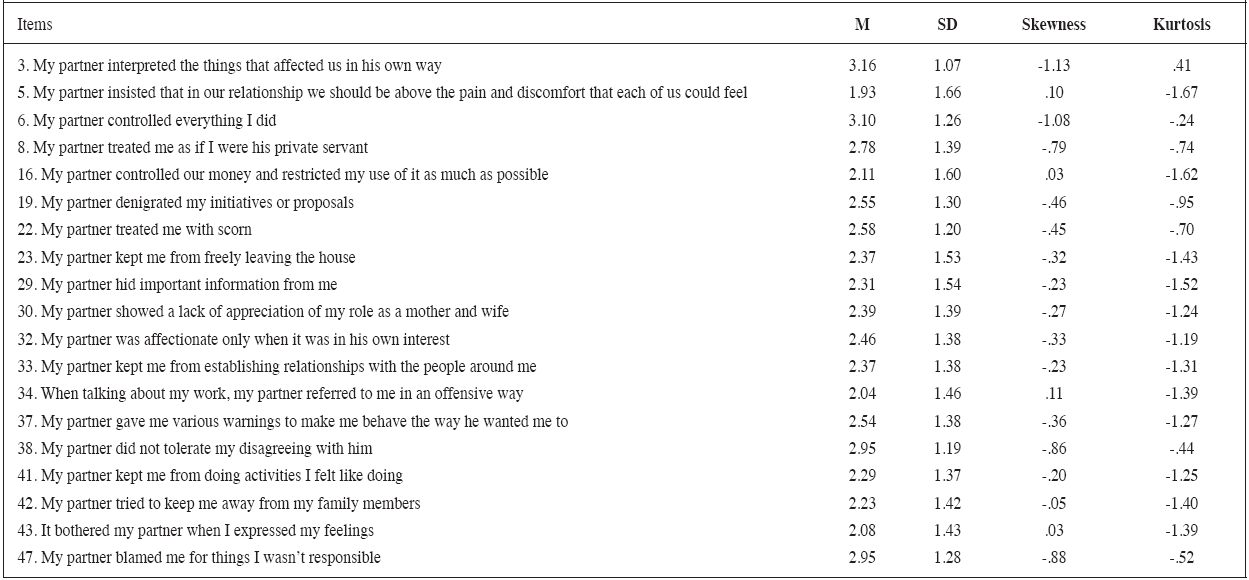
As a final result of this first analysis, a scale was obtained that went from the initial 47-item scale to a 19-item reduced scale, with the latter being used to perform the confi rmatory factorial analysis. Tables 1 and 2 show the items that are excluded and maintained. Tables 3 and 4 present the descriptive analysis of the 19 items and the other instruments.

Confirmatory factorial analysis
To obtain the structure of the reduced scale, a confi rmatory factorial analysis was carried out (see Table 5 ). For this purpose, it was considered relevant to propose the following models: (a) a one-factor model, called PA; (b) a model composed of two factors called Direct PA strategies and Indirect PA strategies; (c) a model with three factors: Context, Emotion and Behavior-cognition; and fi nally (d) a model that defends the existence of factors called Isolation, Control, Emotion and Cognition. All of them coincide with the taxonomy of PA strategies proposed (see Table 6 ). The resulting fi t indices (see Table 6 ) indicated that the two-factor model fi t the data well and was better than the other proposed models. Below, information is presented about what type of item is included in each of the two factors of the chosen model.
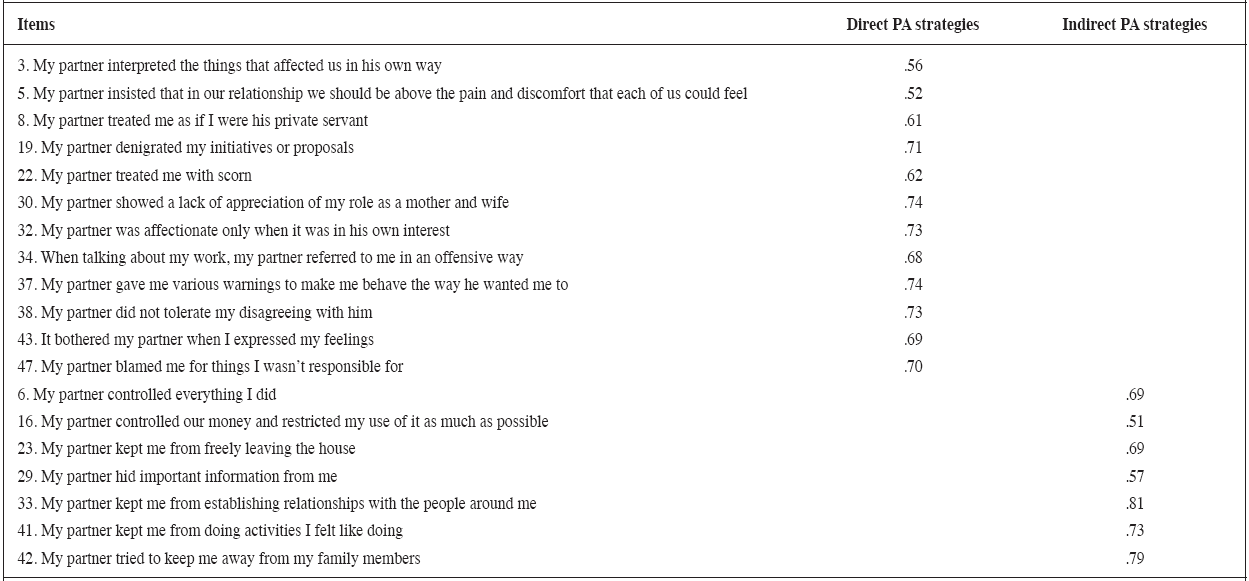
Note: (3, 5, 8,…): numbering of the items on the preliminary version (47 items)

Note : * Model that obtains better índices
- 1. Direct PA strategies: includes the items that focus more directly on the affected person. In this case, the actions are related to either emotional, cognitive or behavioral aspects of the victim.
- 2. Indirect PA strategies: includes the items that focus on the victim’s context. In this case, the woman is controlled and dominated through actions directed to third-parties or indirectly to her.
Score reliability
The reliability of the scores on the EAPA-P was examined by calculating their internal consistency by means of Cronbach’s alpha coeffi cient. The values obtained showed good internal consistency for the whole scale (a = .93).
Validity of the relationship with other variables
Given that the EAPA-P is designed to measure different types of intimate partner PA strategies, a high correlation was expected between this scale and another existing PA instrument: the SOPAS (Marshall, 1999). Table 7 presents the correlation values found between the SOPAS and the EAPA-P total scale. High signifi cant correlation values were found with the whole scale (r = .88).
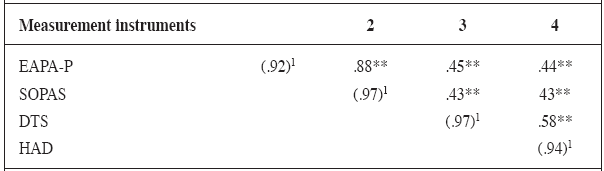
Note: (…)1correspond to the Alpha; ** p<.01 (two-sided); * p<.05 (two-sided)
In addition, we examined to what degree the scores on the EAPA-P refl ected the relationships found in other empirical studies with the scores on other variables. As evidence of internal structure, the relationship of the EAPA-P with other theoreticallyrelated variables was examined: post-traumatic stress disorder, anxiety and depression (see Table 7 ). The global EAPA-P was signifi cantly correlated with these variables.
Discussion
The aim of this study was to develop and validate a new scale based on a recent taxonomy of intimate partner PA strategies, according to a new defi nition of this phenomenon. This taxonomy provides an exhaustive classifi cation of the forms of PA and a new and precise defi nition of the phenomenon. The breadth and detail of this defi nition, including the operative defi nition of each abuse strategy, offers a good opportunity to create a new PA measurement instrument. The instrument created is composed of two factors that include the direct and indirect PA strategies. The fact that the two factors, revealed by the CFA, are moderately correlated with each other suggests that aggressors usually use both direct and indirect abuse strategies, thus affecting the victim’s context, emotion, cognition and behavior, making it easy to have complete control of the partner.
The Direct PA strategies factor obtained in this study includes dimensions identifi ed by other authors, such as: emotional abuse ( Wolfson, 2002 ), mental degradation ( Sonkin, Martin, & Walker, 1985 ), minimizing/blaming and performance orientated ( Ward, 2000 ), emotional abuse ( Hegarty, Sheehon, & Shonfeld, 1999 ; Hegarty, Bush, & Sheehon, 2005 ; Borjesson, Aarons, & Dunn, 2003 ).
By contrast, the factor called Indirect PA strategies, which focuses on the victim’s context, includes forms of PA related to overt acts carried out to supervise the woman’s behavior ( Marshall, 1999 ), and to the abuse of control the batterer has over his victim, a factor refl ected in the study by Pitzner and Drummond (1997) . It also includes abusive behaviors that coincide with those pointed out by other authors, such as the control factor by Vázquez, Estébanez, and Cantera, (2008) , external control by Walker (1985) , environment control by Ward (2000) , and isolation control activity by Wolfson (2002) . Likewise, there is agreement with the abuses mentioned in the isolation factor by Jones, Davidson, Bogat, Levendosky, and von Eye (2005) , and in isolation and control by Kasian and Painter (1992) , in isolating by Marshall (1999) , in isolation by Sonkin et al., (1985) , in domination/isolation by Tolman (1989) , in isolation by Vázquez et al., (2008) and in social isolation by Walker (1979) .
Regarding evidence about the internal structure, it can be stated that the EAPA-P was based on logical and empirical analyses of the adequacy with which the whole scale represents the content domain. In addition, after examining the relationships between the scores on the scale and the scores on the SOPAS scale, the results showed that the EAPA-P is highly correlated with the SOPAS scale, which shows that the items on the former are capable of evaluating PA strategies applied to the partner.
In the case of the relationships between PA evaluated with the EAPA-P and Post-traumatic Stress Disorder, anxiety and depression, the fi ndings revealed that the correlations between the EAPA-P and the other scales are signifi cant, which means that the scale created presents a series of psychometric characteristics that support its usefulness for evaluating this particular phenomenon.
The proposed PA scale can be useful as an instrument to evaluate the abuse experienced. With it, professionals from different disciplines can detect and evaluate which PA strategies victims have experienced and how often they have experienced them. With this information, the professional can better judge the degree of psychological damage, depending on the type of PA strategy applied to the victim. This information is useful for proposing a good action plan to treat the people involved and help them to recover.
Study limitations and future lines of research
One limitation of this study has to do with the type of study used and the interpretation of the results. The results of the present study only provide information about the existence of a signifi cant correlation between the EAPA-P and the variables of post-traumatic stress, anxiety and depression, but it is impossible to determine a cause-effect relationship between them. Second, in relation to the sample selection, it is important to mention that the sampling method used in this study contributed to having a small total sample. In turn, this limitation can be explained by the diffi culty of contacting a large number of female abuse victims, mainly due to the fear they might have of being judged by third parties or of being punished by the abusive partner.
Various aspects came to light that require further study. We think it is necessary to more closely examine the different cultural, socioeconomic, family and ethnic aspects that infl uence the perception of the damage or degree of tolerance to certain abusive acts infl icted by the partner.
It would be relevant to complete these new studies with the development of a severity index of these behaviors. In addition, PA should be studied in same-sex couples, an area of study that has received little attention so far.
All of this has great relevance for the practice of professionals dedicated to detecting, caring for and treating people associated with this global social problem, whether victims, aggressors or people at risk of becoming one or the other.
Acknowledgement
The study was partially supported by Ministry of Economy and Competitiveness [Ministerio de Educación y Competitividad] (PSI2010-16098), and by Catalan Women’s Institute [Instituto Catalán de las Mujeres] (U-103/10).
References
Abad, F., Olea, J., Ponsoda, V., & García, C. (2011). Medición en Ciencias Sociales y de la Salud [Measurement in social sciences and health]. Madrid: Síntesis.
Almendros, C., Gámez-Guadix, M., Carrobles, J.A., Rodríguez-Carballeira, A., & Porrúa, C. (2009). Abuso psicológico en la pareja: aportaciones recientes, concepto y medición [Psychological abuse in the couple: Recent contributions, concept and measurement]. Psicología Conductual, 17(3), 433-451.
Almendros, C., Rodríguez-Carballeira, A., Porrúa, C., Carrobles, J.A., & Gámez-Guadix, M. (2010, July). Evidencias psicométricas preliminares de la Escala de Abuso Psicológico Sutil y Manifi esto [Preliminary psychometric evidence of the Scale of Psychological Abuse and Manifest Sutil]. Paper presented at the 7th Congreso Iberoamericano de Psicología, Oviedo, Spain].
Amor, P.J., Echeburúa, E., Corral, P., Sarasua, B., & Zubizarreta, I. (2001). Maltrato físico y maltrato psicológico en mujeres víctimas de violencia en el hogar [Physical abuse and psychological abuse on women victims of domestic violence]. Revista de Psicopatología y Psicología Clínica, 6, 167-178.
Bobes, J., Calcedo-Barba, A., García, M., François, M., Rico-Villademoros, F., González, M.,…, Bousoño, M. (2000). Evaluation of the psychometric properties of the Spanish version of 5 questionnaires for the evaluation of post-traumatic stress syndrome. Actas Españolas de Psiquiatría, 28, 207-218.
Borjesson, W.I., Aarons, G. A., & Dunn, M.E. (2003). Development and confirmatory factor analysis of the Abuse within Intimate Relationship Scale. Journal of Interpersonal Violence, 18, 295-309.
Calvete, E., Corral, S., & Estévez, A. (2005). Desarrollo de un inventario para evaluar el abuso psicológico en las relaciones de pareja [Development of an inventory to assess psychological abuse in people living together]. Clínica y Salud, 16, 203-221.
Calvete, E., Estévez, A., & Corral, S. (2007). Trastorno por estrés postraumático y su relación con esquemas cognitivos disfuncionales en mujeres maltratadas [Posttraumatic Stress Disorder and its relationship with negative cognitive schemas in battered women]. Psicothema, 19(3), 446-451.
Ferrando, P.J., & Anguiano-Carrasco, C. (2010). El análisis factorial como técnica de investigación en Psicología [Factor analysis as a research technique in Psychology]. Papeles del Psicólogo, 31(1), 18-33.
Haladyna, T.M., Downing, S.M., & Rodríguez, M. (2002). A review of multiple-choice item-writing guidelines for classroom assessment. Applied Measurement in Education, 15(3), 309-334.
Hegarty, K., Bush, R., & Sheehan, M. (2005). The Composite Abuse Scale: Further development and assessment of reliability and validity of a multidimensional partner abuse measure in clinical settings. Violence & Victims, 20, 399-415.
Hegarty, K., Sheehan, M., & Schonfeld, C. (1999). A multidimensional definition of partner abuse: Development and preliminary validation of the Composite Abuse Scale. Journal of Family Violence, 14, 399-415.
Hudson,W. W., & McIntosh, S. R.(1981). The assessment of spouse abuse: Two quantifi able dimensions. Journal of Marriage and the Family, 43, 873-888.
Jones, S., Davidson, W.S., Bogat, G.A., Levendosky, A.A., & von Eye. A. (2005). Validation of the Subtle and Overt Psychological Abuse Scale: An examination of construct validity. Violence & Victims, 20, 407-416.
Jones, L., Hughes, M., & Unterstaller, U. (2001). Post-Traumatic Stress Disorder (PTSD) in Victim of Domestic Violence: A review of the research. Trauma, Violence, and Abuse, 2(2), 99-119.
Jöreskog, K., & Sörbom, D. (2006). LISREL 8.8 and PRELIS 2.8 [Computer Software]. Scientific Software International, Inc.: Lincolnwood, IL.
Kasian, M., & Painter, S.L. (1992). Frequency and severity of psychological abuse in a dating population. Journal of Interpersonal Violence, 7, 350-364.
Kelly, V.A. (2004). Psychological abuse of women: A review of the literature. The Family Journal, 12, 383-388.
López-Roig, S., Terol, M.C., Pastor, M.A., Neipp, M.C., Massutí, B., Rodríguez-Marín J.,…, Sitges, E. (2000). Ansiedad y depresión. Validación de la escala HAD en pacientes oncológicos [Anxiety and depression. Validation of the HAD scale in cancer patients]. Revista de Psicología de la Salud, 12, 127-155.
Marshall, L.L. (1999). Effects of men’s subtle and overt psychological abuse on low-income women. Violence & Victims, 14, 69-88.
Matud, M.P. (2004). Impacto de la violencia doméstica en la salud de la mujer maltratada [The Impact of Domestic Violence on the Health of Abused Women]. Psicothema, 16(3), 397-401.
Matud, M.P., Carballeira, M., & Marrero, R.J. (2001). Validación de un inventario de evaluación del maltrato a la mujer por su pareja: el APCM [Validation of an inventory assessing intimate partner maltreatment against women: The APCM]. Psicopatología Clínica, Legal y Forense, 3(1), 5-17.
McDonald, R. P., & Ho, M. H. R. (2002). Principles and practice in reporting structural equation analyses. Psychological Methods, 7, 64-82.
Medina-Ariza, J., & Berberet, M. (2003). Intimate Partner Violence in Spain. Findings from National Survey. Violence Against Woman, 9, 302-322.
Pitzner, J. K., & Drummond, P. D. (1997). The reliability and validity of empirically scaled measures of psychological/verbal control and physical/verbal abuse: Relationship between current negative mood and a history of abuse independent of other negative life events. Journal of Psychosomatic Research, 43, 125-142.
Rathus, J. H., & Feindler, E.L. (2004). Assessment of partner violence: A handbook for researchers and practitioners. Washington, DC: American Psychological Association.
Rodríguez-Carballeira, A., Porrúa-García, C., Escartín, J., Martín-Peña, J., & Almendros, C. (2014). Taxonomy and hierarchy of psychological abuse strategies in intimate partner relationships. Anales de Psicología, 30(3), 916-926.
Savalei,V. (2008). Is the ML Chi-square ever robust to non-normality? A cautionary note with missing data. Structural Equation Modeling, 15(1), 1-22.
Schermelleh-Engel, K., Moosbrugger, H., & Müller, H. (2003). Evaluating the fit of structural equation models: Tests of signifi cance and descriptive goodness-of-fi t measures. Methods of Psychological Research Online, 8(2), 23-74.
Sonkin, D. J., Martin, D., & Walker, L. E. A. (1985). The male batterer: A treatment approach. New York: Springer.
Straus, M. A. (1979). Measuring intrafamily confl ict and violence: The Confl ict Tactics Scales. Journal of Marriage and the Family, 41, 75-88.
Straus, M. A., Hamby, S. L., Boney-McCoy, S., & Sugarman, D. B. (1996). The Revised Confl ict Tactics Scales (CTS2): Development and preliminary psychometric data. Journal of Family Issues, 17, 283-316.
Tolman, R. M. (1989). The development of a measure of psychological maltreatment of women by their male partners. Violence & Victims, 4, 159-177.
Vázquez, N., Estébanez, I., & Cantera, I. (2008). Violencia psicológican en las relaciones de noviazgo: ¿Qué dicen ellas?, ¿Lo perciben?, ¿Lonaturalizan? [Psychological violence in dating relationships: What dowomen say? Do they notice it? Do they regard it as natural?]. Retrieved from:http://www.naroemakunde.com/media/contenidos/archivos/M%C3%B3d%20Psicosocial%20de%20Deusto_Dossier_08.pdf
Walker, L. E. A. (1979). The battered woman. New York: Harper & Row.
Walker, L. E. A. (1985). The battered woman syndrome. New York: Springer.
Ward, D. (2000). Domestic violence as a cultic system. Cultic Studies Journal, 17, 42-55.
Wolfson, L. B. (2002). A study of the factors of psychological abuse and control in two relationships: domestic violence and cultic systems. Dissertation Abstracts International, 63(8A), 2794.
Author notes
clapoga@gmail.com