Received: 25 November 2016
Accepted: 22 September 2017
Abstract: Background: Bullying as a construct is found to be related to a variety of individual, parental and academic factors. Familial factors include family environment, parenting style and parental involvement. The main aim of this study is to find out how Primary and Secondary Education students perceive parenting styles and social climate and if there are differences between pupils from these two educational stages. The study also considers the relationship between these perceptions of bullying victims and certain peer socio-affective factors. Method: Participants were 847 children and adolescents. School social climate and Family social climate were both evaluated using the Spanish version of Moos’ Family Social Climate Scale, and Parenting styles were evaluated according to the Parental Socialization Scale in Adolescence (ESPA29). Roles associated with bullying, and correlates of social reputation were measured using the Bull-S questionnaire. Results: There are differences in how primary and secondary education students perceive parenting styles and family climate. Conclusions: Parental factors are related to bullying victimization and socio-affective group variables (social preference, acceptance or rejection levels, and the number of friends). The study highlighs risk and protective factors for victimization.
Keywords: Bullying victimization, dimensions of parenting styles, social climate, primary education, secondary education.
Resumen: Antecedentes: considerado el bullying como constructo, encontramos relación con una variedad de factores individuales, parentales y académicos asociados. Los factores familiares incluyen el clima familiar y los estilos de crianza. El objetivo principal de este estudio es analizar cómo perciben los estilos de crianza y el clima social los estudiantes de Educación Primaria y Secundaria y si existen diferencias entre los estudiantes de estas dos etapas. El estudio también trata sobre la relación de estas percepciones entre las víctimas de bullying y ciertos factores socio-afectivos de los iguales. Método: participaron 847 jóvenes y adolescentes. El clima social familiar y escolar fueron evaluados utilizando la Escala de Clima Social Familiar de Moos y los estilos de Crianza de los Padres fueron evaluados de acuerdo a la Escala ESPA29. Roles asociados al bullying y reputación social se midieron mediante el cuestionario Bull-S. Resultados: se encuentran diferencias entre los estudiantes de Educación Primaria y Secundaria en la percepción de los estilos de crianza y clima familiar. Conclusiones: los factores parentales se relacionan con la victimización por bullying y con variables socio-afectivas del grupo (preferencia social, aceptación o rechazo y el número de amigos). Se señalan factores de riesgo y de protección de victimización.
Palabras clave: victimas de bullying, dimensiones de estilos de crianza, clima social, Educación Primaria, Educación Secundaria.
Parenting styles and social climate are the most important factors for social development in children, to the extent that the ways children relate to each other reflect the social climate they perceive in the family and the parenting approach underlying those (Smith & Moore, 2012).
Baumrind (1971) settled two dimensions in parenting styles-demandingness and responsiveness- that allowed the identification of four parenting styles: Authoritative (when parents show high levels of demandingness and responsiveness), Permissive (low levels of demandingness and high levels of responsiveness), Authoritarian (high levels of demandingness and low levels of responsiveness) and Neglectful (low levels of both dimensions). According to this quadrant, authoritative styles are the best way to encourage more positive socialization, although several studies carried out in Spanish population samples show that a certain level of authoritarianism promotes social development which is better adapted to norms (Musitu & García, 2004). Other studies conclude that a permissive parental style is the best predictor of bullying victimization, whereas an authoritarian style is significantly linked to aggressive behaviours (Georgiou, 2013).
In terms of family social climate, affection and communication are two of the main factors for adolescent adjustment. Thus, girls and boys who perceive more affection from their parents and enjoy a good relationship with them show better psychosocial development, higher emotional well-being and better behavioural adjustment (Oliva, Parra, Sánchez-Queija, & López, 2007). Some authors suggest that the differences between the social climates of bullies’ and victims’ families can be found in their parents’ degree of involvement and support, both being lower for the victims (Cerezo, Sánchez, Ruiz-Esteban, & Arense, 2015).
The second socialization source is found in the school environment, where dysfunctional interpersonal relationships stand out as the source of school conflict or bullying problems (Farrington, Loeber, Stallings, & Ttofi, 2011; Hong & Espelage, 2012). Bullying is an abusive behaviour that includes several strategies, from physical abuse to social exclusion, usually not exclusive, but concentrating different forms of abuse in the same victim, triggered by a feeling of peer rejection, which isolates and takes support away from the assaulted student (Salmivalli, 2010).
Some studies link school victimization to permissive parenting patterns (Estevez, Murgui, Moreno, & Musitu, 2007; Georgiou & Stavrinides, 2013). Other studies suggest that parental support and family relationships are not related to victimization (Baldry, 2004), whereas others conclude that victimization and deviant behaviour are influenced by negative control (Samper-García, Mestre-Escriva, Malonda-Vidal, & Mesurado, 2015) and parent-adolescent communication (Herrero, Estevez, & Musitu, 2006).
Focusing on age, most studies suggest that age can be an individual characteristic that empowers bullies (Pepler, Jiang, Craig, & Connolly, 2008). However, there is still certain controversy. Some surveys on the prevalence of bullying reveal a decrease in bullying from childhood through adolescence. Other studies show that primary education students are more victimized by their school peers than older students (Beran & Tutti, 2002). Middle school students reported less physical, verbal, and relational victimization than elementary school students (Varjas, Henrich, & Meyers, 2009). While Cerezo et al. (2015) do not find differences by age.
The main aim of this study is to find out how primary and secondary education students perceive parenting styles and social climate and if there are differences between pupils from these two educational stages. The study looks at how these perceptions relate to school victimization and certain peer socio-affective factors–such as social preference, acceptance or rejection levels, and the number of friends in the peer group–, and also considers risk and protective factors for victimization. This will allow us to suggest intervention guidelines.
Method
Participants
Participants were 847 children and adolescents belonging to 34 intact class-groups. Data was collected in state schools, among pupils of medium to medium-low socioeconomic status in two Spanish areas (Murcia and Valencia). Among them, 426 (50.9% girls and 49.1% boys) were in primary school (9- to 12-year-olds) and 421 (43% girls and 57% boys) in secondary school (13- to 18- year-olds), with the mean being 12.73 years of age (2.37 years).
Most of the subjects were Spanish (12% foreigners). Samples were incidentally selected.
Instruments Victimization
Bullying roles (not involved, bully, victim and bully-victim) and correlates of social reputation (acceptance, rejection and exclusion) were measured using the Bull-S (Cerezo, 2012), a sociometric questionnaire to evaluate violence among school peers. The test, in nominative form with 15 items, covers four dimensions. This study uses data from two of them: (1) Sociometric position or social reputation, 4 items with nominative responses (e.g. “Who would you choose as a group mate?”); (2) Aggression and victimization dynamics, 6 items with nominative responses (e.g. “Who normally starts the fights?”).This makes it easier to ascribe subjects to different roles, with significance given to subjects who obtain at least 25% of nominations as a bully, a victim or a bully- victim (when they appear both as a bully and as a victim), while the rest belong to the group of those not involved. The overall reliability of the questionnaire in our study has a Cronbach’s alpha of .73, .82 for items related to aggressive behaviours and .83 for victimization behaviours.
School Social Climate
School social climate (SSC) was evaluated using the Spanish version of Moos’ School Social Climate Scale, originally developed by Moos and Tricket, and adapted by Fernandez- Ballesteros and Sierra (1989). This questionnaire assesses the subjects’ perceptions of the student-teacher relationship and of the organizational structure of the class. It consists of 90 true/false items, grouped under 4 headings: Relationship (CES-RE), with 3 subscales: Involvement, Affiliation and Teacher Support; Personal Growth, with 2 subscales: Task Orientation and Competition; System Maintenance, with 3 subscales: Organization, Rule Clarity and Teacher Control; and Change, with a single subscale, Innovation (e.g. “In this class, students really get to know each other”). The overall reliability of the questionnaire in our study has a Cronbach’s alpha of .73, .82 for items related to aggressive behaviours and .83 for victimization behaviours.
To interpret the data, direct scores have been turned into standard scores.
Family Social Climate
Family social climate (FSC) was evaluated using the Spanish version of Moos’ Family Social Climate Scale, originally developed by Moos and Tricket, and adapted by Seisdedos, de la Cruz, and Cordero (1989). This questionnaire assesses interpersonal relationships between family members. It consists of 90 true/false items, grouped under 3 headings: Relationship (α= .75), with 3 subscales: Cohesion, Expressiveness and Conflict; Personal Growth (α = .70), with 5 subscales, although only the Independence subscale was used; and System Maintenance (α= .84), with 2 subscales: Organization and Control (e.g. “In my family, there is a strong sense of unity”). To interpret the data, direct scores were turned into standard scores following the scale guidelines.
Parenting Styles
Parenting styles were evaluated according to the Parental Socialization Scale in Adolescence (ESPA29) by Musitu and García (2001). This questionnaire has 29 items with a 4-point Likert-type scale response (never, sometimes, often and always). It provides an overall score for each parent in 2 dimensions: Acceptance/Involvement (α = .97), (e.g. “If I do what my mother/father tells me: they show affection; they are indifferent”), and Coercion/Imposition (α= .96) (e.g. “If I break or damage something at home, my mother/father: tells me off; hits me; deprives me of something; speaks to me; doesn’t care”). According to the scores in these two dimensions, each parent’s parenting style is classified as authoritative, permissive, authoritarian or neglectful. In our study, the styles of the mother and of the father were considered both separately and combined.
Procedure
School principals were contacted and informed about the aims of the study. We asked them for permission and the parents for their consent. Before carrying out the survey, students were informed of the aims of the study and of its voluntary nature. Emphasis was placed on the importance of sincerity when answering the questions and on the confidential nature of the information provided. Instruments were applied collectively in the students’ own classrooms by specifically trained people in two 50 minute sessions.
Data analyses
Descriptive analyses were used to find out the occurrence of victimization by gender and educational stage. Continuous dependent variables were non-normally distributed (Kolmogorov- Smirnov test). Statistical comparison was carried out by means of nonparametric tests: Mann-Whitney U test to compare values obtained between two groups. To find out how victimization was related to gender and educational stage, we used the χ2 statistic, along with an analysis of corrected standardized residuals to help understand the relationship.
Multiple logistic regression (LR) and a forward stepwise were used to compare victims with no-victims (regarding gender, educational stage, FSC, SSC and Parenting Styles), in order to find out protective or risk factors for victimization. Interaction criteria were revised. In the LR analysis, victim (yes/no) was used as response variable and no-victim as reference category. Variables associated with victimization in previous univariate analyses of relationship, system maintenance, the mother’s coercion/ imposition and the father’s coercion/imposition were scored in quartiles (low, moderate and high) and used as predictors. Low was set as the reference category. Odds ratios were adjusted for gender, educational stage and family social climate variables.
Statistical analyses were carried out using IBM SPSS 19.0 Statistics software.
Results
Differences by Educational Stage
The results of the analysis of differences in parenting styles, FSC and SSC according to educational stage are given in Table 1. On the evaluation of parenting styles, the values of the father’s acceptance and involvement reported by adolescents were much higher in primary school. A similar output was found for the mother’s acceptance and involvement. No significant differences were detected in coercion/imposition for either mothers or fathers by educational stage.
When analysing FSC, the results show that adolescents in primary school score lower than adolescents in secondary school in personal growth, conflict, system maintenance and cohesion. Differences in independence and expressiveness were not significant.
In SSC, adolescents in primary school scored better than adolescents in secondary school in all 4 subscales: relationship, personal growth, system maintenance and change.
Differences in school and family social climate and parenting styles’ dimensions by educational stage (Primary/Secondary)
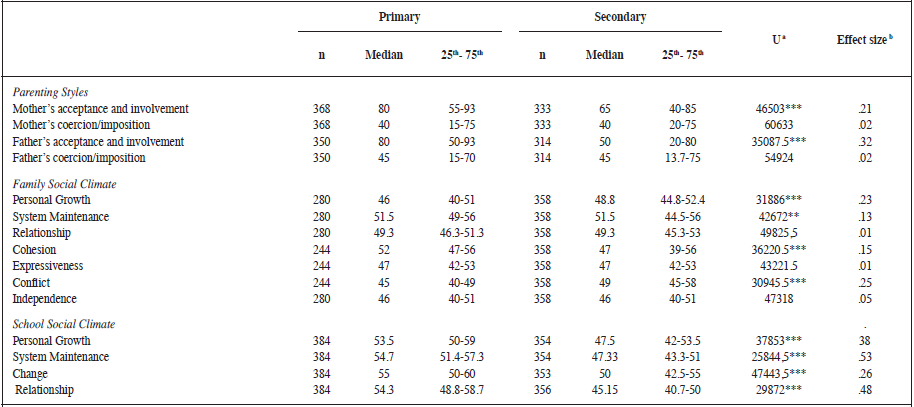
a U statistic for Mann-Whitney Testb Effect size measure was estimated using the expression Z/√N (Fritz, Morris, & Richler, 2012) *** p< 0.001, ** p < .01, p < .05
Bullying victims
Examining differences in parenting styles for victims and non- victims, victims showed significantly higher values compared to non-victims for the mother’s coercion and imposition and the father’s coercion and imposition, but no differences were found for the father’s acceptance and involvement and the mother’s acceptance and involvement.
As shown in Table 2, we did not find differences in FSC between victims and non-victims.
For SSC, differences were found in relationship and system maintenance, where victims scored lower compared to the non- victim group, although this did not happen for personal growth.
No significant associations between victimization and educational stage were detected [χ2 (1, N = 847) = 2.82, p < .093, V= 0.06], although results reveal a higher occurrence of victims in secondary school (8.3% vs. 5.4%). The occurrence of victims was higher by gender [χ2 (1, N = 847) = 3.91, p < .048; V = 0.07]: 8.5% males vs. 5% females, but these differences were not so significant for primary school (6.7% males vs. 4.1% females) and secondary school (10% males vs. 6.1% females).
Risk and Protective Factors for Victimization
Odds ratios (Model 1), adjusted odds ratios (Model 2) and their corresponding 95% confidence intervals (95% CI) from the multivariate analyses are detailed in Table 3. Interaction terms were not significant in any of the regressions performed.
Related to dimensions of parenting styles, a high value of coercion and imposition from the mother and father was positively linked to involvement in bullying as victims. Children with a high value of the mother’s coercion and imposition and a high value of the father’s coercion and imposition were more likely to be victims compared to those that perceived low-coercion and imposition. Adjusted odds ratios confirmed this. There was no difference between moderate coercion and imposition from the mother and father compared to low. Thus, our findings suggest that a high value of coercion/imposition from the mother and a high value of coercion/imposition from the father are risk factors for victimization.
Findings revealed that children who reported high-relationship and moderate-relationship were less likely to be victims compared to children who reported low-relationship. Adjusted odds ratios showed the same results for those reporting high relationship but not for those who reported moderate-relationship. Similarly, children who reported high and moderate system maintenance were less likely to be victims compared to children who reported low system maintenance. After adjustment, we obtained similar results. This output shows that high-relationship and high and moderate system maintenance are protective factors for victimization.
Conclusions
In line with its aims, this study suggests that there are differences in how primary and secondary education students perceive parenting styles and family climate. It also moves forward in relating these factors to school victimization and certain socio-affective group variables, such as social preference, acceptance or rejection levels, and the number of friends in the peer group.
In line with our findings, Méndez, Ruiz-Esteban, and López- García (2017) suggest that older students are more likely than younger students to experience bullying and perceive their school as unsafe.
In terms of differences in family climate perception according to the educational stage, we can conclude that smaller children score higher in system maintenance and cohesion, whereas secondary students score higher in personal growth and conflict.
Differences in school and family social climate and parenting styles’ dimensions by victimization
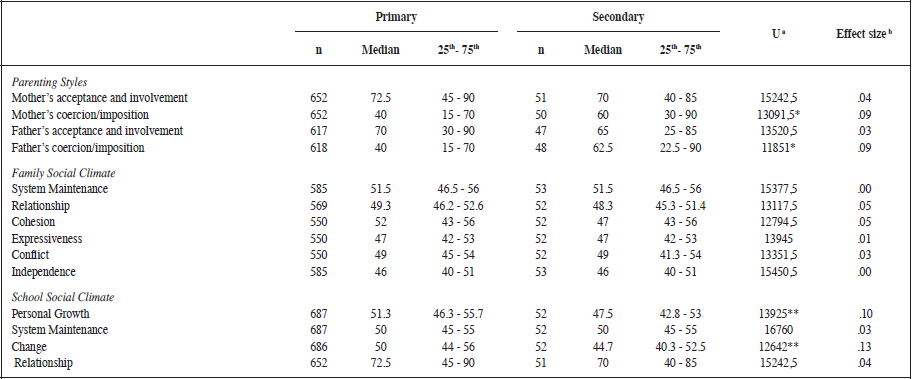
a U statistic for Mann-Whitney Testb Effect size measure was estimated using the expression Z/√N (Fritz, Morris, & Richler, 2012)
*** p< 0.001, ** p < .01, p < .05
Logistic regression model for the relationship of victimization with School Social Climate (SSC) and Parenting Styles’ Dimensions
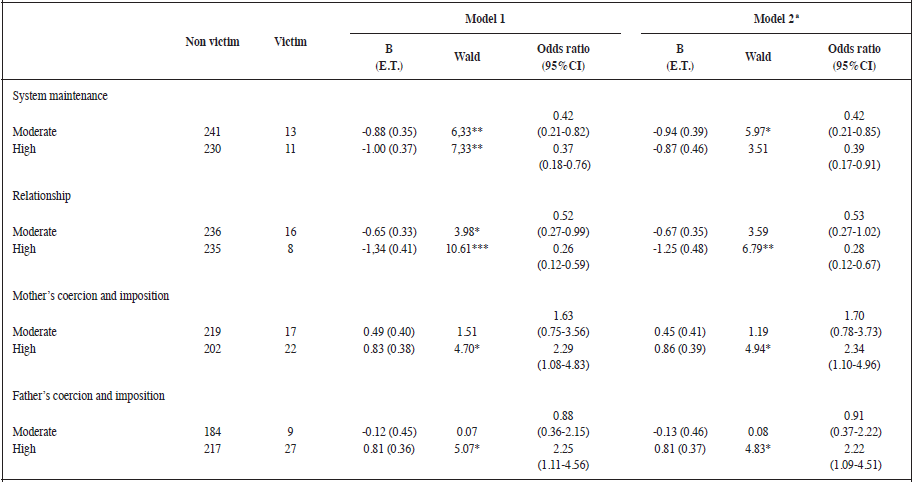
Note: Low is used as reference category a Odds Ratios adjusted by gender, educational stage and Family Social Climate variables
* p<.05; ** p<.01; *** p<.001
As for parenting styles, the acceptance and involvement of both the mother and the father were higher in the primary education stage. These results are in line with the studies by Polo, Fajardo, Martin, Gómez, and Leon (2012), which conclude that younger adolescent groups perceive more affection and communication with their parents than older adolescents.
Subjects in primary education have a different understanding of parenting styles to subjects in secondary education, where younger subjects have a more positive and balanced perception. This allows us to conclude that adolescence seems to be a time in which children grow apart from parental control, family acceptance and imposition. It is also a time in which personal growth stands out, involving independence, achievement, socialization and morality versus the control exerted so far by family members.
Scientific literature on parenting styles suggests that parents’ affection significantly correlates to peer attachment, thus cutting down the risk of aggressiveness and victimization, and increasing social adjustment (Gallego, Delgado, & Sánchez-Queija, 2011). However, it is not possible to confirm this hypothesis with our data, neither for general population nor by educational stages.
Our output supports the conclusion that a higher negative control on the part of mothers and fathers will turn into a risk factor for victimization, in the line of the findings of Samper- García, Mestre-Escriva, Malonda, and Mesurado (2015).
This study concludes that most parents have an authoritative parenting style. The prevalent style among those not involved in bullying is permissive; among bullies, the neglectful style prevails; among victims, the trend is for authoritarian or authoritative styles.
System maintenance in family relationships has been the distinguishing factor in family climate perception between victims and all other subjects, with victims having the lowest levels. These results allow us to conclude that adolescent subjects who are bullying victims perceive their family environment with a certain unbalance compared to those not involved or even to bullies. This makes us question if family organization and control, combined with an inconsistent parenting style –a neglectful father and a highly controlling mother– could be the factor supporting school victimization behaviours.
The educational stage is essential in SSC perception, being more favourable for the relationship, personal growth, system maintenance and change subscales in primary than in secondary. This suggests that children in primary and compulsory secondary education have different perceptions of peer relationships, classroom system maintenance, independence and the quality of the educational style.
There are no differences in the occurrence of victimization by educational stage, although we have detected a higher occurrence of victims in secondary school. There are no differences either in family social climate perception. However, we have found some discrepancies in school social climate, with victims scoring lower in relationship and system maintenance.
School relationships, understood in terms of involvement, affiliation and peer support during social development, establish the difference between victims and all other students, with the victims being more rejected and excluded.
Moreover, bullies present, on the one hand, better school relationships and, on the other, more consistency on parenting styles, with a trend to neglectfulness, and a positive perception of family environment, which puts them in a better affective and social position than victims.
Several studies report that a negative school environment can increase the frequency of bullying, while children with positive perceptions of their school environment are less likely to externalize behaviour problems (Atik & Güneri, 2013)
Relationship with peers and system maintenance stand out as protective factors. Hansen, Steenberg, Palic, and Elklit (2012) found that attachment may act as a risk/protective factor in becoming a victim of bullying, and negative affectivity may predispose some children to become victims of bullying, which is consistent with our results. Higher control by both parents (coercion/imposition) is among the risk factors (Pinquart, 2017). Boys who, as a result of their mother’s overprotection, are unable to develop a sense of independence –necessary to obtain and maintain their status in the peer group– are likely to be bullied and rejected by peers, while girls become victims due to poor emotional regulation and communication problems with their mothers (Duncan, 2004).
These results should have implications for educational policy and practice. It is necessary to prevent bullying victimization from the time they start school. Also, it is necessary to strengthen the emotional education and acquisition of social skills. At family level, it is recommended to promote schools for parents. It is important that society as a whole understands this problem.
Finally, it is important to acknowledge the multiple social contexts that influence the bullying and peer victimization cycle. The first thing we could do is create new bullying prevention programs, focused on the ecological model across all educational stages, from primary to secondary education, or even further. Preventive programs are of particular importance in primary and in the first years of compulsory secondary education, given the increase of this problem at these educational stages (Garaigordobil & Oñaderra, 2010).
As many other studies on this topic, the present research used a standard cross-sectional methodology. Even though it is an established methodology in social sciences, it shows limitations. Further studies using longitudinal methodology should be used in future research. In addition, the sample shows limitations due to its size and because it was incidentally selected.
References
Atik, G., & Güneri, O. Y. (2013). Bullying and victimization: Predictive role of individual, parental, and academic factors. School Psychology International, 34(6), 658-673. doi: http://dx.doi.org/10.1177/0143034313479699
Baldry, A. C. (2004). The impact of direct and indirect bullying on the mental and physical health of Italian youngsters. Aggressive Behavior, 30(5), 343-355.
Baumrind, D. (1971). Current patterns of parental authority. Developmental Psychology Monograph, 4, 1-103. doi: http://dx.doi.org/10.1037/h0030372
Beran, T. N., & Tutty, L. (2002). Children’s reports of bullying and safety at school. Canadian Journal of School Psychology, 17(2), 1-14.
Cerezo, F. (2012). Bull-S. Test de Evaluación de la Agresividad entre Escolares [Bull-S. Assessment Test of Aggressiveness among Students]. Madrid: Albor-Cohs.
Cerezo, F., Sánchez, C., Ruiz, C., & Arense, J. J. (2015). Adolescents and preadolescents’ Roles on Bullying, and Its Relation with Social Climate and Parenting Styles. Revista de Psicodidáctica, 20(1), 139-155. doi: http://dx.doi.org/0.1387/RevPsicodidact.11097
Duncan, R. D. (2004). The impact of family relationships on school bullies and victims (pp. 227-244). In Dorothy L. Espelage, Susan M. Swearer, Bullying in American schools: A social-ecological perspective on prevention and intervention. New York: Routledge.
Estévez, E., Murgui, S., Moreno, D., & Musitu, G. (2007). Estilos de comunicación familiar, actitud hacia la autoridad institucional y conducta violenta del adolescente en la escuela [Family communication styles, attitude towards institutional authority and adolescents’ violent behaviour at school]. Psicothema, 19(1), 108-113.
Farrington, D. P., Loeber, R., Stallings, R., & Ttofi, M. M. (2011). Bullying perpetration and victimization as predictors of delinquency and depression in the Pittsburgh Youth Study. Journal of Aggression, Conflict and Peace Research, 3(2), 74-81.
Fernández-Ballesteros, R.,& Sierra, B.(1989). Escalas de clima social FES, WES, CIES y CES [The FES, WES, CIES and CES Social Environment Scales]. Madrid: TEA.
Fritz, C.O., Morris, P.E., & Richler, J.J. (2012). Effect size estimates: Current use, calculations, and interpretation. Journal of Experimental Psychology: General, 14, 2-18. doi:http://dx.doi.org/10.1037/a0024338
Gallego, I. D., Delgado, A. O., & Sánchez-Queija, I. (2011). Apego a los iguales durante la adolescencia y la adultez emergente [Peer attachment during adolescence and emerging adulthood]. Anales de Psicología, 27(1), 155-163. Retrieved from http://revistas.um.es/analesps
Garaigordobil, M., & Oñaderra, J. A. (2010). La violencia entre iguales: revisión teórica y estrategias de intervención [Peer violence: Review and intervention strategies]. Madrid: Pirámide.
Georgiou, S. N., & Stavrinides, P. (2013). Parenting at home and bullying at school. Social Psychology of Education, 16(2), 165-179. doi:http://dx.doi.org/10.1007/s11218-012-9209-z
Hansen, T. B., Steenberg, L. M., Palic, S., & Elklit, A. (2012). A review of psychological factors related to bullying victimization in schools. Aggression and Violent Behavior, 17(4), 383-387.
Herrero, J., Estévez, E., & Musitu, G. (2006). The relationships of adolescent school-related deviant behaviour and victimization with psychological distress: Testing a general model of the mediational role of parents and teachers across groups of gender and age. Journal of Adolescence, 29(5), 671-690.
Hong, J. S., & Espelage, D. L. (2012). A review of research on bullying and peer victimization in school: An ecological system analysis. Aggression and Violent Behavior, 17(4), 311-322.
Méndez, I., Ruiz-Esteban, C., & López-García, J.J. (2017). Risk and protective factors associated to peer victimization. Frontiers in Psychology, 8, 441. doi: http://www.doi.org/10.3389/fpsyg.2017.00441
Musitu, G.. & García, J. F. (2001). Escala de estilos de socialización parental en la adolescencia (ESPA 29) [Parenting styles on adolescence Scale]. Madrid: TEA.
Musitu, G.. & García, J. F. (2004). Consecuencias de la socialización familiar en la cultura española [Consecuencies on familiar socialization in spanish culture]. Psicothema, 16(2), 288-293.
Oliva, A., Parra, A., Sánchez-Queija, I., & López, F. (2007). Estilos educativos materno y paterno: evaluación y relación con el ajuste adolescente [Maternal and paternal educative styles: Evaluation and relations with adolescents adjustment]. Anales de Psicología, 23(1), 49-56.
Pepler, D., Jiang, D., Craig, W., & Connolly, J. (2008). Developmental trajectories of bullying and associated factors. Child Development, 79(2), 325-338. doi: http://dx.doi.org/10.1111/j.1467-8624.2007.01128.x
Pinquart, M. (2017). Associations of parenting dimensions and styles with externalizing problems of children and adolescents: An updated meta- analysis. Developmental Psychology, 53(5), pp. 873-932 doi: http://dx.doi.org/10.1037/dev0000295.supp
Polo del Río, M. I., León del Barco, B., Gómez, T., Palacios, V., & Fajardo, F. (2013). Estilos de socialización en víctimas de acoso escolar [Socialization styles in bullying victims]. European Journal of Investigation in Health, Psychology and Education, 3(1), 41-49.
Salmivalli, C. (2010). Bullying and the peer group: A review. Aggression and Violent Behavior, 15, 112-120.
Samper-García, P., Mestre-Escrivá, V., Malonda, E., & Mesurado, B. (2015). Victimización en la escuela: relación de la crianza y variables funcionales disfuncionales del desarrollo [Victimization at school: Relationship of parenting and functional-dysfunctional developmental variables]. Anales de Psicología, 31, 849-858. doi: http://dx.doi.org/10.6018/analesps.31.3.173291
Seisdedos, N., de la Cruz, M. V., & Cordero, A. (1989). Escalas de clima social familiar (FES) [Family Social Environment Scales –FES–]. Madrid: TEA Ediciones.
Smith, D. E., & Moore, T. M. (2012). Parenting style and psychosocial outcomes in a sample of Jamaican Adolescents. International Journal of Adolescence and Youth, 18(3), 176-190. doi: http://dx.doi.org/10.1080/02673843.2012.682593
Steinberg, L., & Silk, J. S. (2002). Parenting adolescents. Handbook of parenting (Vol. I. Children and parenting). Mahwah, NJ: Lawrence Erlbaum Associates.
Varjas, K., Henrich, C. C., & Meyers, J. (2009). Urban middle school students’ perceptions of bullying, cyberbullying, and school safety. Journal of School Violence, 8(2), 159-176.
