MORAL EMOTIONS ASSOCIATED WITH PROSOCIAL AND ANTISOCIAL BEHAVIOR IN SCHOOL-AGED CHILDREN.
Emociones morales asociadas a la conducta prosocial y antisocial en escolares.
MORAL EMOTIONS ASSOCIATED WITH PROSOCIAL AND ANTISOCIAL BEHAVIOR IN SCHOOL-AGED CHILDREN.
Psicothema, vol. 30, no. 1, pp. 82-88, 2018
Colegio Oficial de Psicólogos del Principado de Asturias
Received: 10 May 2016
Accepted: 20 June 2017
Abstract: Background: The present study aims to explore the main effects and interactive effects of empathy, guilt, shame, pride (authentic and hubristic), and moral pride, on prosocial and antisocial behavior in children. Method: The sample group comprised 351 children aged between 10 and 14 selected from four schools in the Basque Country (Spain). Hierarchical multiple regression models were used in the statistical analyses. Results: Prosocial behavior was found to be predicted by the additive interaction between empathy and moral pride, by guilt and, to a lesser extent and negatively, by shame. In relation to antisocial behavior, children with a strong disposition to guilt scored lower for antisocial behavior, regardless of their empathy levels. Nevertheless, the combination of low empathy and low guilt levels was associated with highest antisocial behavior scores. As regards shame, this emotion was moderately associated with antisocial behavior. Conclusions: By exploring interactions the present study provided a more nuanced view of the emotional factors associated with children´s prosocial and antisocial behavior.
Keywords: Prosocial behavior, antisocial behavior, guilt, empathy, childhood.
Resumen: Antecedentes: el presente estudio pretendió investigar los efectos principales e interactivos de la empatía, la culpa, la vergüenza, el orgullo y específicamente el orgullo moral en la conducta prosocial y antisocial de los niños. Método: la muestra estuvo compuesta por 351 chicos y chicas de 10 a 14 años escolarizados/as en cuatro centros educativos del País Vasco (Spain). Para los análisis estadísticos se utilizaron los modelos de regresión jerárquica múltiple. Resultados: la conducta prosocial fue predicha por la interacción aditiva de la empatía y el orgullo moral, por la culpa y, en menor medida, por la vergüenza. Respecto a la conducta antisocial, los niños con elevada disposición a sentir culpa mostraron bajos niveles de conducta antisocial, independientemente de sus niveles de empatía. Sin embargo, la combinación de baja empatía y baja culpa se asoció con los mayores niveles de conducta antisocial. En cuanto a la vergüenza, se asoció moderadamente con la conducta antisocial. Conclusiones: la exploración de las interacciones ha proporcionado una perspectiva más matizada y compleja sobre las variables emocionales asociadas a la conducta prosocial y antisocial de los niños.
Palabras clave: conducta prosocial, conducta antisocial, culpa, empatía, infancia.
Children gradually internalize social values, and as their intrinsic motivation in the moral sphere develops, they are increasingly able to regulate their actions. It is in this sphere of intrinsic moral motivation that empathy and moral emotions come into play (Hoffman, 2000). While research into this field has increased considerably over recent years, the majority of studies have focused on the role of empathy and guilt in children’s prosocial and antisocial behavior, and little attention has been paid to other moral emotions such as pride and shame. Also, emotional variables have for the most part been analyzed independently in relation to predicting prosocial and antisocial behavior, without taking into account the interactions that may occur between them.
Empathy is an affective-cognitive response activated by and consistent with another person’s emotional state, which in turn guides the subject’s own behavior. Many studies have found a consistent relationship between this variable and prosocial behavior in both children and adolescents (Eisenberg, Spinrad, & Knafo, 2015; Garaigordobil & García de Galdeano, 2006; Mestre, Samper, & Frías, 2002; Ortiz, Apodaca, Etxebarria, Eceiza, Fuentes, & López, 1993; Roberts, Strayer, & Denham, 2014; Denham, 2014). Ample evidence also exists to support a negative association between empathy and antisocial behavior and aggression in both childhood and adolescence (Dinolfo & Malti, 2013; Garaigordobil, Álvarez, & Carralero, 2004; Malti & Krettenauer, 2013; Robinson, Roberts, Strayer, & Koopman, 2007; Van Noorden, Haselager, Cillessen, & Bukowski, 2014; Stavrinides, Geourgiou, & Thepfanus, 2010).
Guilt refers to a state of unease and repentance that occurs when the subject is aware that their action (or failure to act) has caused someone else to suffer, prompting a desire to make reparation (Tangney, Stuewig, & Mashek, 2007). From a developmental perspective, adaptive guilt is closely linked to empathy, with which it shares the quality of being other-oriented (Hoffman, 2000), and a strong association has been found between disposition to guilt and prosocial behavior in children (Caprara, Barbaranelli, Pastorelli, Cermak, & Rosza, 2001; Menesini & Camodeca, 2008; Roberts et al., 2014). Furthermore, guilt has also been found to inhibit antisocial behavior (Arsenio, 2014; Kochanksa, Barry, Jiménez, Hollatz, & Woodard, 2009; Malti & Krettenauer, 2013; Menesini & Camodeca, 2008; Ongley & Malti, 2014). In the meta-analysis carried out by Malti and Krettenauer (2013), feelings of guilt were found to be negatively associated with aggression, with a medium Cohen’s d effect size (d = .47).
Less attention has been paid to examining the interaction between these two emotions when predicting children’s behavior. Given the empathetic origins of adaptive guilt, an additive relationship between empathy and guilt may be expected, in which high levels of both would be associated with particularly high levels of prosocial behavior and particularly low levels of antisocial conduct. Nevertheless, research into this question has found compensatory effects between the two variables: high guilt levels are significantly associated with prosocial behavior and negatively associated with antisocial behavior, regardless of empathy (Colasante, Zuffiano, & Malti, 2016; Malti, Gummerum, Keller, & Buchmann, 2009; Ongley & Malti, 2014).
While guilt is elicited in response to a reprehensible act, in the case of shame what is reprehensible is the ego from other people’s point of view (Tangney et al., 2007). In relation to its adaptive value, the feeling of shame is a signal which prompts children to think about those values, roles or attributes of their identity that are not attractive to others, an exercise which leads to a readjustment designed to ensure social acceptance (Barrett, 1995; Gruenewald, Dickerson, & Kemeny, 2007). Nevertheless, research results in this sense are inconsistent. While the absence of shame in response to moral transgression has been associated with antisocial behavior (Ahmed & Braithwaite, 2006; Menesini & Camodeca, 2003), other studies have found positive links between shame, anger and indirect hostility (Tangney et al., 2007).
Pride is activated as a result of a positive assessment of one’s own actions (Lewis, 2000). Although it is habitually analyzed in relation to personal, achievement, evidence in adults suggests that unlike “hubristic” pride (pride in self), “authentic” pride (pride in behavior) may play a key motivational role in moral and prosocial behavior (Hart & Matsuba, 2007; Michie, 2009; Tangney et al., 2007; Tracy, Robins, & Tangney, 2007). However, little is known about the role of pride in moral behavior in children. Apart from the study conducted by Etxebarria, Ortiz, Apodaca, Pascual, & Conejero (2015), which supported the hypothesis that the pride experienced after a prosocial action strengthens the intention to engage in further prosocial behavior, no research has been carried out into the relationship between moral pride and prosocial and antisocial behavior in infancy.
Therefore, while various studies have provided valuable insight into emotional variables, such as empathy, and guilt, and prosocial and antisocial behaviour, some relatively unexplored aspects warrant further attention. First, it is unfortunate that research studies have tended to examine these emotional variables in isolation. Second, the role of some predictors, such as shame and pride is unclear, and we have no evidence on the role of moral pride in infancy. Finally, insufficient attention has been paid to how the aforementioned variables work in concert in the explanation of prosocial and antisocial behaviour in children. Although some studies have started to work in this direction, replicating findings in this type of studies is of paramount importance.
The aim of the current study is to simultaneously examine the contributions from a number of emotional variables, including empathy, guilt, shame, pride (authentic and hubristic), and moral pride, on prosocial and antisocial behavior in children and to explore how those factors interact in the explanation of children´s prosocial and antisocial behavior.
We expected these emotional variables, with the exception of the hubristic pride, to be positively associated with prosocial behavior and negatively associated with antisocial conduct. As regards their interactive effects, we remained open to both compensatory and additive perspectives. According to the compensatory hypothesis, high levels of guilt would be expected to offset low levels of empathy, thus resulting in high levels of prosocial behavior and low levels of antisocial behavior. For its part, according to the additive hypothesis, the combination of low empathy and guilt levels may foster extremely low levels of prosocial behavior and very high levels of antisocial behavior. There was no empirical basis for predicting the specific interactive effects of shame and pride.
Method
Participants
The sample group comprised 351 children (195 girls and 156 boys), aged between 10 and 14 (M= 12.25, SD= .33), from four schools in the Basque Country (Spain). 12 subjects were eliminated due errors. The sample group was selected on the basis of convenience, although an effort was made to ensure an adequate gender balance as well as equal representation from public and semi-private schools.
Instruments
Authentic Moral Pride Questionnaire (AMP), designed and validated by the authors themselves (Pascual, Etxebarria, Conejero, & Ortiz, 2016). This scale consists of 14 items to evaluate the pride generated by morally positive behavior (e.g., “I feel proud of myself when I do nice things for people before they even ask”) Children are asked to state, on a 4-point scale, the extent to which they feel the diverse statements would be true for them. Cronbach’s Alpha: .91.
Empathy Index for Children and Adolescents (IECA; Bryant, 1982; Spanish adaptation by Del Barrio, Aluja, & García, 2004). This scale consists of 19 items (e.g., “I feel sad when I see another child who has no one to play with.”) Children are asked to state, on a 4-point scale, the extent to which they agree with each of the statements. Cronbach’s Alpha: .80.
Test of Self-Conscious Affect for Children (Tangney, Wagner, Burggraf, Gramzow, & Fletcher, 1990). This instrument describes 15 scenarios which evaluate different emotional tendencies. Participants are asked to indicate how likely diverse statements would be true for them on a 5-point Likert-type scale. An example of a scenario is as follows: “You are on patrol duty and you turn in three kids.” The response options are: a) “I’d worry about what would happen to them” (guilt); b) “I’d think ‘I’m a tattletale’” (shame); d) “I would feel good about myself” (hubristic pride); e) “I would feel I did a good job” (authentic pride). The sub-scales “Shame” and “Guilt” have 15 items each, whereas “Hubristic Pride” and “Authentic Pride” have 5 items. Cronbach’s Alpha: .81 for “Guilt”, .45 for Shame, .46 for “Hubristic Pride”, and .48 for “Authentic Pride”. The low level of the pride measures is predictable considering the number of items, but the low level of shame calls for caution in the interpretation of the results.
Prosocial Behavior Questionnaire. An adapted children’s version (Garaigordobil & Pérez, 2005) of Weir and Duveen’s prosocial behavior scale (1981) was used in this study. This scale consists of 20 items (e.g., “If a new pupil joins our class, I ask them if they want to play with us”) Children are asked to indicate, on a 3-point scale, how often they would act as described in the statement. Cronbach’s Alpha: .83.
Antisocial Behavior Questionnaire for educators. The Antisocial Behavior scale of the Behavioral Problems Questionnaire (BPQ) by Navarro, Peiró, Llacer, and Silva (1993) was used. This scale comprises 17 items, the majority of which refer to aggressive behavior towards classmates (e.g., “He/she is cruel, a bully” or “He/she makes fun of others”). A few items refer to non-aggressive antisocial behavior (e.g., “He/she rebels against being told what to do”). Teachers indicate on a 6-point scale the frequency with which each child displays the described behavior. Cronbach’s Alpha: .88.
Procedure
Before starting the study, written consent was obtained from participants’ parents, and oral consent was obtained from the children themselves. On day 1, the children were asked to complete the prosocial behavior, moral pride and dispositional empathy questionnaires. On average, children completed each questionnaire in less than 15 min. One week later children were individually administered the Test of Self-Conscious Affect for Children (Tangney et al., 1990). Child interviews lasted approximately 30 minutes. The antisocial behavior questionnaire was completed by participants’ teachers.
Data analysis
Statistical analyses were conducted using IBM SPSS 22 and included preliminary descriptive analyses by sex and age, Student’s t-test and bivariate correlations between predictors and the dependent variables. Subsequently, hierarchical multiple regression analyses were used to analyze the relationships between predictors and the dependent variables prosocial and antisocial behavior, controlling for the effects of sex and age. In line with the aims of this study, interactions between the predictors were also analyzed.
Results
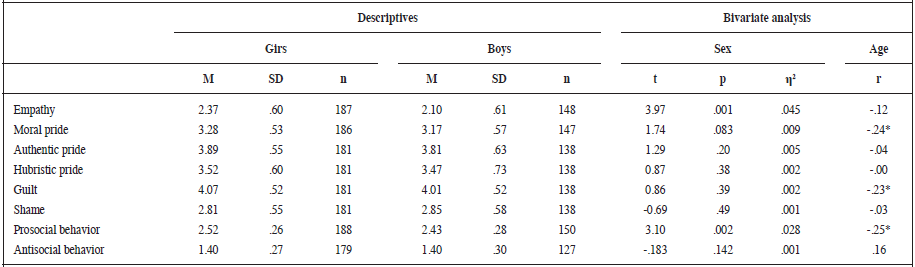
Descriptive and bivariate analyses of predictive and criterion variables by sex and age are presented in Table 1. Girls scored significantly higher than boys in both empathy and prosocial behavior, but the effect size was low. Moreover, significant negative correlations were found between age and guilt, moral pride and prosocial behavior.
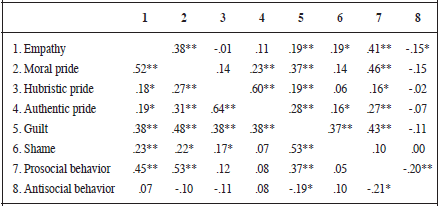
The correlational analysis (Table 2) revealed a significant and close correlation between moral pride, empathy and guilt. Guilt and shame were also found to be closely associated in both sexes. As regards the criterion variables, prosocial behavior was found to be significantly associated with empathy, moral pride and guilt. Moderate yet significant negative correlations were observed between antisocial behavior and guilt in boys, and between this behavior and empathy in girls.
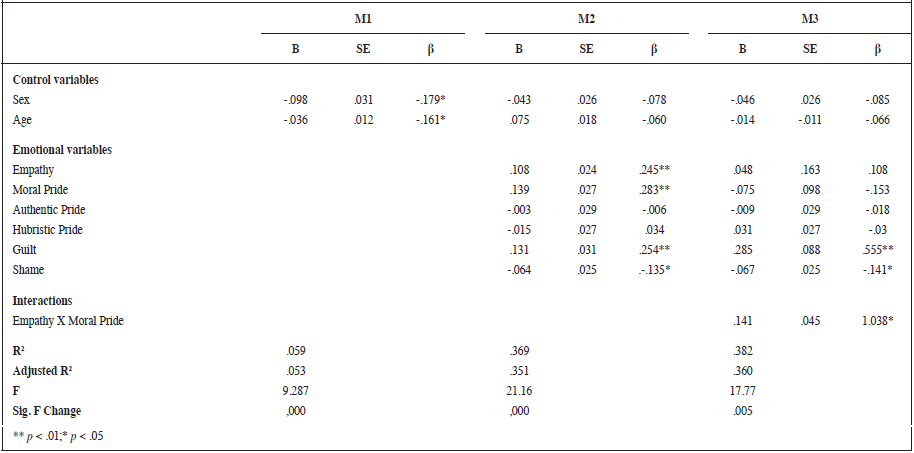
To analyze the capacity of emotional variables to predict prosocial behavior, a hierarchical regression analysis was carried out. In step 1, sex and age were included as control variables. In step 2, emotional predictors were included. In step 3, two and three-way interactions between predictor variables were included. All interactions were analyzed previously, and only those that were found to be significant were included in the final model (Dawson, n.d.).
As shown in Table 3, prosocial behavior was positively predicted by the interaction between empathy and moral pride; guilt also made a significant contribution to the explanation of prosocialness. Moreover, prosocial behavior was negatively predicted by shame. Neither age nor sex were significantly associated with prosocial behavior. R2 = .38, F= 17.7, p < .001.
The interaction between empathy and moral pride was represented using Dawson’s spreadsheet (n.d.). As recommended by Aiken and West (1991), in the absence of any scientific criterion for deciding which moderator values to use, levels +1SD and -1SD were used for empathy and moral pride. Next, the t-test values for the slope differences were calculated.
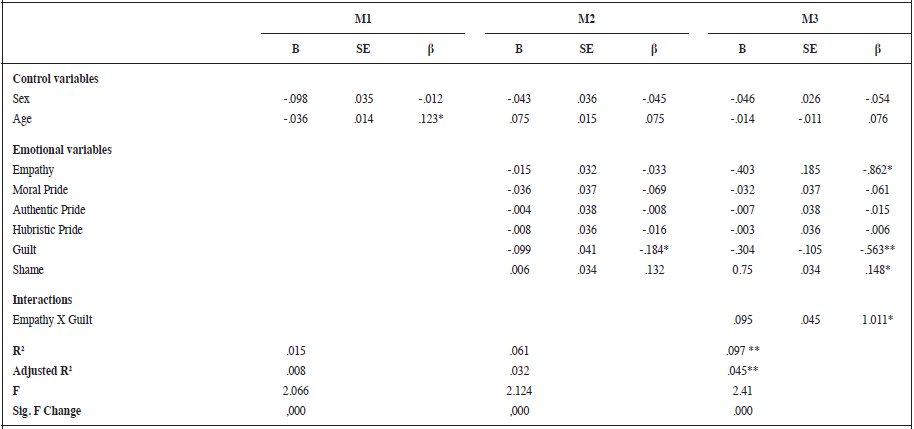
** p < .01;* p < .05
** p < .01;* p < .05
As shown in Figure 1, the relationship between moral pride and prosocial behavior is positive, but the simple slopes test indicated that having low versus high levels of moral pride was not significantly associated with prosocial behavior when empathy scores were low (t = 1.992, p = .056). However, in children with high empathy levels, high moral pride predicted significantly higher prosocial behavior scores (t = 3,462, p =.001).
A hierarchical regression analysis was conducted to determine the capacity of emotional variables to predict antisocial. The analysis followed the same step-wise procedure as that described above. As shown in Table 4, antisocial behavior was predicted by the interaction between empathy and guilt, as well as, to a lesser extent, by shame. R2 = .241, F = 2.415, p =.005.
As shown in Figure 2, high and low empathy levels were not found to affect antisocial behavior when children had high guilt levels (t = .046; p = .96). However, in children with low guilt levels, low empathy levels predicted significantly higher antisocial behavior scores (t = -2.81, p = .005).
Discussion
The present study analyzed the main and interactive effects of empathy, guilt, shame, pride (authentic and hubristic), and moral pride, on prosocial and antisocial behavior in children. As expected, some results tended to replicate well-known findings in this area. For example, our results are consistent with studies reporting that empathy and guilt are reliable predictors of prosocial and antisocial behavior in children. Importantly, however, the inclusion of moral pride and shame and the analysis of interactions between different variables in the present study provided a deeper and more nuanced view of the role played by the moral emotions, beyond the aforementioned general findings.
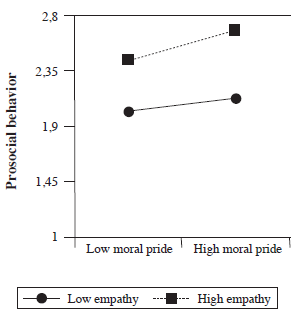
Figure 1.
Interaction between moral pride and empathy in predicting prosocial behavior
** p < .01;* p < .05
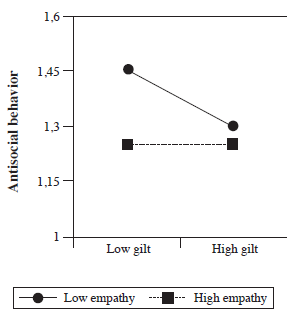
Figure 2.
Interaction between guilt and empathy in predicting antisocial behavior
As regards predicting children’s prosocial behavior, the interaction between empathy and moral pride, and independent effect of guilt are both worth highlighting. Our results support the idea that empathy is the basic motivator of children’s prosocial behavior, and moreover, indicate that the predictive capacity of empathy is considerably strengthened when this emotion is felt in combination with high levels of moral pride. These results support the idea of moral pride as an index of moral sensitivity. However, at the same time, they provide additional evidence that while moral pride fosters prosocial behavior only in empathetic childrens. Pride, including moral pride, is an emotion which is more focused on oneself than on others. This has its risks, as indeed a number of authors have pointed out (Lewis, 2000; Tracy et al., 2007). Consequently, moral pride is a very valuable promoter of prosocial behavior when it occurs in combination with the more other-oriented disposition to empathy.
As regards guilt, bearing in mind Hoffman’s approach (2000), which underscores the empathetic roots of this emotion, one might expect a strong tendency to experience guilt, in combination with high empathy levels, to predict very high levels of prosocial behavior. However, our results do not confirm this additive interaction. They have also failed to confirm the compensatory hypothesis, according to which high levels of guilt would be expected to offset low levels of empathy in predicting prosocial behavior. We agree with Hoffman (2000) that the roots of children’s interpersonal guilt are located in their capacity to empathize with other people’s pain following causal self-attribution. However, it is possible, and indeed our data point in this direction, that once guilt becomes part of children’s moral conscience, it becomes an autonomous affective motivator of prosocial behavior.
In relation to antisocial behavior, our results corroborate those reported by Colasante et al. (2016) regarding the interaction between empathy and guilt. Children with a strong disposition to guilt scored lower for antisocial behavior, regardless of their empathy levels.
Feelings of guilt are sequentially linked to antisocial behavior, and as Baudmister and Bushman (2003) point out, people learn from their experiences of guilt-inducing transgression. Guilt prompts the offender to not repeat their behavior, while at the same time helping them to internalize moral codes. As outlined above, it is possible that children with a strong disposition to guilt will have internalized a feeling of responsibility for moral codes which may function independently from the experience of vicariously feeling others’ pain and unhappiness when inhibiting antisocial behavior.
However, our findings do confirm an additive interaction when levels of both empathy and guilt are low. Specifically, low guilt and empathy levels combine to predict very high levels of antisocial behavior. These results prompt us to think about the conduct disorder subtype known as “callous-unemotional”, the main traits of which are a total absence of guilt and the incapacity to empathize; this disorder has been linked to proactive aggression and school bullying (Frick & White, 2008; van Noorden, Haselager, Cillessen, & Bukowski, 2014).
As regards shame, contrary to our expectations, this emotion is negatively associated with prosocial behavior and positively associated with antisocial behavior, although its predictive capacity is moderate. To our mind, these findings are connected with the measure used. Firstly, the low reliability level of this scale calls for caution, and secondly, the measure did not take into account the two-fold connotation of shame (moral and non-moral). Studies which have found this emotion to have a functional value in fostering prosocial behavior and controlling antisocial behavior have used moral transgression situations (Menesini & Camodeca, 2008).
Finally, it is important to mention some limitations. Firstly, the use of self-reports may constitute a limitation, since these measures are susceptible to the effects of the social desirability bias. We also believe that, the correlational nature of the study limits the causal inferences that may be drawn. From a social- constructivist perspective, the possibility of bidirectional effects cannot be dismissed, since prosocial behavior provides children with important opportunities for fostering empathy and moral pride. Similarly, in aggressive children, lack of guilt and empathy may constitute a defensive justification of their behavior. Finally, the low reliability level of the measure of shame suggests that shame may be controversial in situations in which the difference between neutral failure and moral transgression is unclear. Future studies should use more clearly defined moral situations when analyzing moral emotions as precursors of moral behavior.
Despite these limitations, however, our results are important not only for theoretical reasons, but also because they open up new directions for future research, and because of their relevance to intervention proposals designed to foster prosocial behavior and regulate antisocial behavior in children.
References
Ahmed, C., & Braithwaite, U. (2006). Forgiveness, reconciliation, and shame: Three key variables in reducing school bullying. Journal of Social Issues, 62(2), 347-370. doi:10.1111/j.1540-4560.2006.00454.x
Aiken, L. S., & West, S. G. (1991). Multiple regression: Testing and interpreting interactions. Thousand Oaks, CA: Sage.
Arsenio, W. (2014). Moral emotion attributions and aggression. In M. Killen & J. Smetana (Eds.), Handbook of moral development (pp. 235- 255). Mahwah, NJ: Lawrence Erlbaum.
Barrett, K. (1995). A functionalist approach to shame and guilt. In J. P. Tangney & K. W. Fischer (Eds.), Self-conscious emotions (pp. 25-63). New York: Guilford.
Baudmister, R. F., & Bushman, B. J. (2003). Emotions and aggressiveness. In W. Heitmeyer & J. Hagan (Eds.), International handbook of violence research: Vol. 1 (pp. 479-493). Dordrecht, the Netherlands: Kluwer Academic. doi:10.1007/978-0-306-48039-325
Bryant, B. K. (1982). An index of empathy for children and adolescents. Child Development, 53, 413-425. doi:10.2307/1128984
Caprara, C. V., Barbaranelli. C., Pastorelli, C., Cermak, R., & Rosza, S. (2001). Facing guilt: Role of negative affectivity, need for reparation, and fear of punishment in leading to prosocial behaviour and aggression. European Journal of Personality, 15, 219-237. doi:10.1002/per.402
Colasante, T., Zuffiano, A., & Malti, T. (2016). Do moral emotions buffer the anger-aggression link in children and adolescents? Journal of Applied Developmental Psychology, 41, 1-7. doi:10.1016/j.appdev.2015.06.001
Dawson, J. (n.d.). Interpreting interaction effects. Retrieved from www.jeremydawson.com/slopes.htm
Del Barrio, V., Aluja, A., & García, L. F. (2004). Bryant’s empathy index for children and adolescents: Psychometric properties in the spanish language. Psychological Reports, 95(1), 257-262. doi:10.1177/1073191107310310
Dinolfo, C., & Malti, T. (2013). Interpretive understanding, sympathy, and moral emotion attribution in oppositional defiant disorder symptomatology. Child Psychiatry and Human Development, 44(5), 633-645. doi:10.1007/s10578-013-0357-y
Eisenberg, N., Spinrad, T., & Kato A. (2015). Prosocial development. In M. E. Lamb & R. M. Lerner (Eds.), Handbook of Child Psychology and Developmental Science, Vol. 3: Social, Emotional and Personality Development (pp. 610-656). New York: Wiley. doi:10.1002/9781118963418
Etxebarria, I., Ortiz, M. J., Apodaca, P., Pascual, A., & Conejero, S. (2015). Pride as moral motive: Moral pride and prosocial behavior. Infancia y Aprendizaje, 38(4), 760-774. doi:10.1080/02103702.2015.1076267
Frick, P. J., & White, S. F. (2008). Research review: The importance of callous-unemotional traits for developmental models of aggressive and antisocial behavior. Journal of Child Psychology and Psychiatry, 49, 359-375. doi:10.1111/j.1469-7610.2007.01862.x
Garaigordobil, M., Álvarez, Z., & Carralero, V. (2004). Conducta antisocial en niños de 10 a 12 años: factores de personalidad asociados y variables predictoras [Antisocial behavior in children aged 10 to 12 years: Personality factors and predictive variables]. Análisis y Modificación de Conducta, 30(130), 241-271.
Garaigordobil, M., & García de Galdeano, P. (2006). Empatía en niños de 10 y 12 años [Empathy in children aged 10 to 12 years]. Psicothema, 18(2), 189-186
Gruenewald, T. L., Dickerson, S. S., Kemeny, M. E., et al. (2007). A social function for self-conscious emotions: The social self preservation theory. In J. L. Tracy, R. W. Robins, & J.P. Tangney (Eds.), The self- conscious emotions: Theory and research (pp. 68-87). New York: The Guilford Press.
Hart, D., & Matsuba, M. K. (2007). The development of pride and moral life. In J. L. Tracy, R. W. Robins, & J. P. Tangney (Eds.), The self- conscious emotions: Theory and research (pp. 114-133). New York: Guilford.
Hoffman, M. L. (2000). Empathy and moral development: Implications for caring and justice. New York, NY: Cambridge University Press.
Kochanska, G., Barry, R. A., Jiménez, N. B., Hollatz, A. L., & Woodard, J. (2009). Guilt and effortful control: Two mechanisms that prevent disruptive developmental trajectories. Journal of Personality and Social Psychology, 97, 322-333. doi:10.1037/a0015471
Lewis, M. (2000). Self-conscious emotions: Embarrassment, pride, shame, and guilt. In M. Lewis & J. M. Haviland-Jones (Eds.), Handbook of emotions (pp. 623-636). New York: Guilford Press.
Malti, T., Gummerum, M., Keller, M., & Buchmann, M. (2009). Children’s moral motivation, sympathy, and prosocial behavior. Child Development, 80, 442-460. doi:10.1111/j.1467-8624.2009.01271.x
Malti, T., & Krettenauer, T. (2013). The relation of moral emotion attributions to prosocial and antisocial behavior: A meta- analysis. Child Development, 84(2), 397-412. doi:10.1111/j.1467-8624.2012.01851.x
Menesini, E., & Camodeca, M. (2008). Shame and guilt as behaviour regulators: Relationships with bullying, victimization and prosocial behaviour. British Journal of Developmental Psychology, 26(2), 183- 196. doi:10.1348/026151007X205281
Mestre, M. V., Samper, P., & Frías, M. D. (2002). Procesos cognitivos y emocionales predictores de la conducta prosocial y agresiva: la empatía como factor modulador [Cognitive and emotional processes as predictors of pro-social behaviour and aggressive conduct: Empathy as a modulating factor]. Psicothema, 14(2), 227-232.
Michie, S. (2009). Pride and gratitude: How positive emotions influence the prosocial behaviors of organizational leaders. Journal of Leadership & Organizational Studies, 15, 393-403. doi:10.1177/1548051809333338
Navarro, A. M., Peiró, R., Llácer, M. D., & Silva, F. (1993). EPC. Escala de problemas de conducta [EPC. Behavior problems scale]. In F. Silva & M. C. Martorell (Eds.), EPIJ. Evaluación Infanto-Juvenil (pp. 31- 81). Madrid: MEPSA.
Ongley, S.F., & Malti, T. (2014). The role of moral emotions in the development of children’s sharing behavior. Developmental Psychology, 50(4) 1148-1159. doi:10.1037/a0035191
Ortiz, M. J., Apodaca, P., Etxebarria, I., Eceiza, A., Fuentes, M. J., & López, F. (1993). Algunos predictores de la conducta prosocial-altruista en la infancia [Some predictors of prosocial behavior in children]. Revista de Psicología Social, 8(1), 83-98.
Pascual, A., Etxebarria, I., Conejero, S., & Ortiz, M. (2016). Validation of the authentic moral pride (AMP) scale for children. Manuscript submitted for publication.
Roberts, W., Strayer, J., & Denham, S. (2014). Empathy, anger, guilt: Emotions and prosocial behaviour. Canadian Journal of Behavioural Science, 46(4), 465-474. doi:10.1037/a0035057
Robinson, R., Roberts, W. Strayer, R., & Koopman, R. (2007). Empathy and emotional responsiveness in delinquent and non-delinquent adolescents. Social Development, 16(3), 555-579. doi:10.1111/j.1467-9507.2007.00396.x
Tangney, J. P., Stuewig, J., & Mashek, D. J. (2007). What’s moral about the self-conscious emotions? In J. L. Tracy, R. W. Robins, & J. P. Tangney (Eds.), The self-conscious emotions (pp. 21-37). New York, NY: Guilford Press.
Tangney, J. P., Wagner, P. E., Burggraf, S. A., Gramzow, R., & Fletcher, C. (1990). The Test of Self-Conscious Affect for Children(TOSCA-C). Fairfax, VA: George Mason University.
Tracy, J. L., Robins, R. W., & Tangney, J. P. (2007). The self-conscious emotions: Theory and research. New York, NY: The Guilford Press.
Van Noorden, T. H., Haselager, G. J., Cillessen, A. H., & Bukowski, W. M. (2014). Empathy and involvement in bullying in children and adolescents: A systematic review. Journal of Youth and Adolescence, 44(3), 637-657. doi.org/10.1007/s10964-014-0135-6
Weir, K., & Duveen, G. (1981). Further development and validation of the prosocial behaviour questionnaire for use by teachers. Journal of Child Psychology and Psychiatry, 22(4), 357-374. doi:10.1111/j.1469-7610.1981.tb00561