THE SPANISH VERSION OF THE JOB CRAFTING SCALE.
Versión española de la Escala Job Crafting.
THE SPANISH VERSION OF THE JOB CRAFTING SCALE.
Psicothema, vol. 30, no. 1, pp. 136-142, 2018
Colegio Oficial de Psicólogos del Principado de Asturias
Received: 27 September 2016
Accepted: 21 November 2017
Abstract: Background: A literature review reveals that there is no measure of job crafting available in Spanish. This paper presents the translation, adaptation and validation of a scale to measure job crafting behaviors (i.e. the Spanish Job Crafting Scale – SJCS; Tims, Bakker, & Derks, 2012). Methods: The scale was applied to a sample of 896 employees in Spain (52.26% women and 47.4% men). We tested the reliability and factorial validity of the 21-item instrument. Results: After confirmatory factor analysis (CFI=.858, TLI= .838, IFI= .860, RMSEA= .067), the results show a structure consisting of four factors: Increasing structural job resources; Decreasing hindering job demands; Increasing social job resources; Increasing challenging job demands. These four factors demonstrate adequate reliability and evidence of validity with others scales that refer to Engagement at Work and Proactivity. Conclusion: The questionnaire may be a useful tool for the assessment of job crafting and for future research in Spanish speaking countries.
Keywords: Job crafting, scale validation, Job Demands-Resources theory, work engagement, proactivity.
Resumen: Antecedentes: una revisión de la literatura revela que no existen instrumentos de medida del job crafting en lengua española. Este artículo presenta la traducción, adaptación y validación de una escala para medir el comportamiento del job crafting (Spanish Job Crafting Scale -SJCS; Tims, Bakker, & Derks, 2012). Método: la escala fue aplicada a una muestra de 896 empleados (52,6% mujeres y 47,4% hombres). Se han testeado la fiabilidad y la validez factorial de un instrumento con 21 ítems. Resultados: después de realizar análisis confirmatorio (CFI= .858, TLI= .838, IFI= .860, RMSEA= .067), los resultados obtenidos confirman una estructura constituida por cuatro factores: Aumento de los recursos estructurales del empleo, Disminución de las demandas de trabajo, Aumento de los recursos sociales del empleo, Creciente demanda de desafíos en el trabajo. Estos cuatro factores tienen una fiabilidad adecuada y se constatan evidencias de validez con otras escalas que hacen referencia al Engagement en el trabajo y la Proactividad. Conclusiones: el cuestionario puede ser una herramienta útil para la evaluación del job crafting y para su uso en la investigación en el contexto de los países de lengua española.
Palabras clave: job crafting, validación de escalas, teoría Job-Demand Resources, work engagement, proactividad.
Job crafting refers to the self-initiated changes that employees make in certain (physical, cognitive or social) features of their jobs, without requiring their complete redesign (Berg & Dutton, 2008). It has been described as a form of discretionary behavior that is driven by the employee rather than by management (Grant & Ashford, 2008; Wrzesniewski & Dutton, 2001). The vast majority of studies conducted on job crafting using Wrzesniewski and Dutton’s (2001) approach are theoretical or qualitative in nature, with few quantitative studies (Berg, Grant, & Johnson, 2010; Lyons, 2008). However, the literature has highlighted the need for more work to be done on the quantitative empirical assessment of job crafting (Ghitulescu, 2006; Leana, Appelbaum, & Shevchuk, 2009; Slemp & Vella- Brodrick, 2013).
Tims, Bakker, and Derks (2012) followed a different approach to measuring job crafting, and developed and validated a generic scale to measure job crafting behaviors – the Job Crafting Scale (JCS). The JCS is based on Job Demands–Resources (JD-R) theory (Bakker & Demerouti, 2014; Bakker, Demerouti, & Sanz- Vergel, 2014). JD-R theory proposes job demands as elements of a job that require physical, emotional and/or cognitive effort (Demerouti, Bakker, Nachreiner, & Schaufeli, 2001). Job resources are elements of a job that enable goal attainment, as well as growth, learning and personal development (Bakker, Rodríguez- Muñoz, & Derks, 2012). Several studies have shown that job demands and job resources can predict significant organizational outcomes, including financial results, absenteeism, performance, and client satisfaction (Bakker, Demerouti, & Schaufeli, 2003; Hakanen, Bakker, & Schaufeli, 2006; see, for an overview Bakker et al., 2014). In this analytical framework, job crafting is defined as “the self-initiated changes that employees make in their own job demands and job resources to attain and/or optimize their personal (work) goals” (Tims et al., 2012, p. 173).
Empirically, Tims and her colleagues (2012) developed and validated the JCS in several studies conducted among employees in the Netherlands. In addition, the JCS has been used and adapted in other studies in The Netherlands (Petrou, Demerouti, Peeters, Schaufeli, & Hetland, 2012), and was slightly adjusted for blue-collar workers in Denmark (Nielsen & Abildgaard, 2012). However, this research has highlighted the need for more work to be done on the quantitative empirical assessment of job crafting. In this context, a literature review reveals that there is no measure of job crafting available in Spanish. Therefore, the validation of the JCS in a Spanish sample can help to empirically examine this phenomenon in Spanish speaking countries. In the present study, we adapt the scale to Spanish by drawing on a sample of employees from Spain in order to test the factorial model proposed by Tims et al. (2012). We hypothesize that we will find back the four dimensions in the Spanish version of the JCS:
Hypothesis 1: The JCS has a four-factor structure, including the dimensions Increasing structural job resources; Increasing social job resources; Increasing challenging job demands; and Decreasing hindering job demands.
Another aim of the present study is to examine the convergent validity of the JCS by correlating the job crafting dimensions with other, theoretically related constructs (Tims & Bakker, 2010). The literature has suggested that engaged employees are more proactive in changing their job resources (Hakanen, Perhoniemi, & Toppinen-Tanner, 2008; LePine, Podsakoff, & LePine, 2005), and their work environment in general (Xanthopoulou, Bakker, Demerouti, & Schaufeli, 2009). Job crafting in the form of increasing job resources and increasing challenge job demands is therefore expected to be positively related to employee well-being (increased work engagement and job satisfaction) (Tims, Bakker & Derks, 2013). Thus, it was hypothesized:
Hypothesis 2: Increasing (structural and social) job resources is positively related to vigor, dedication, and absorption (sub-scales of work engagement).
Hypothesis 3: Increasing challenging job demands is positively related to vigor, dedication, and absorption (sub-scales of work engagement).
Proactivity has been found to be a motivating agent for job crafting (Simmering, Colquitt, Noe, & Porter, 2003). Through job crafting, employees can proactively mobilize their skills and resources to satisfy their needs and prosper at work (Belschak & Den Hartog, 2010; Kristof-Brown, Zimmerman, & Johnson, 2005; Tims & Bakker, 2010). Therefore, employees who are characterized by a proactive personality are most likely to increase their structural and social job resources and increase their job challenges (Bakker, Tims, & Derks, 2012). Hence, it was hypothesized:
Hypothesis 4: Job crafting in the form of (a) Increasing (structural and social) job resources and (b) Increasing challenging job demands is positively related to proactive personality.
Method
Participants
The sample comprised 896 employees working for firms operating in Spain. The employees belonged to industrial and service sector firms, and with diverse tasks. In terms of gender, 52.6% of the sample was female. The employees’ mean age was 34.5 years (SD= 9.11). The participants were highly educated.
Most of them had completed at least a bachelor’s degree (62.5%). The mean job tenure was 6.5 years (SD= 6.33) and organizational tenure was 8.9 years (SD= 9.06).
Instruments
The JCS was adapted by following the steps shown in the literature (Muñiz, Elosua, & Hambleton, 2013). First, the items were translated from English into Spanish by research experts (university lecturers), and by language experts belonging to the Language Service at the Open University of Catalonia (UOC), Spain. Second, a focus group was held to discuss the translated items (equivalence of meaning, for example). Third, the language experts back-translated the items into English. Fourth and lastly, the equivalence of meaning of the original and adapted versions was checked.
We measured job crafting using the four-dimensional scale created by Tims et al. (2012). The JCS consisted of 21 items assessing four factors: Increasing structural job resources (5 items; e.g., “I try to develop my capabilities”); Decreasing hindering job demands (6 items; e.g., “I make sure that my work is mentally less intense”); Increasing social job resources (5 items; e.g., “I ask my supervisor to coach me”); and Increasing challenging job demands (5 items; e.g., “When an interesting project comes along, I offer myself proactively as project co-worker”). The original scale used a 5-point scale, but we rated on a 7-point frequency scale (1=never, 7=always) to ensure sufficient variability.
Regarding engagement, we used an adaptation of the Spanish version of the Utrecht Work Engagement Scale (Schaufeli & Bakker, 2003). This measure consists of 15 items (Salanova, Schaufeli, Llorens, Peiró, & Grau, 2000) that are rated on a 7-point Likert scale (1=strongly disagree, 7=strongly agree). This scale assesses three factors: vigor (5 items; e.g., “At my work, I feel bursting with energy”); dedication (5 items; e.g., “To me, my job is challenging”); and absorption (5 items; e.g., “When I am working, I forget everything else around me”).
Proactive personality was assessed using a 10-item shortened version of the Proactive Personality Scale (PPS) (Siebert, Crant, & Kraimer, 1999) (Spanish version). The authors presented evidence for the validity and reliability of the shortened scale. It employs a 7-point Likert scale, where 1=never and 7=always (e.g., “I am constantly on the lookout for new ways to improve my life”).
Procedure
Non-probabilistic sampling, also known as random accidental sampling (Kerlinger, 2001), was used to obtain the sample. The response rate was 83.7%. Cross-tabs and ANOVA analyses comparing participants and non-participants did not suggest significant differences regarding main socio-demographic characteristics. After contacting the employees selected to take part in the study, the anonymous scales were administered individually (without monetary and non-monetary rewards) during work time with the prior consent of the firms’ managers. They were also assured of the confidentiality and anonymity of the data obtained.
Data analysis
The following factorial models were tested. Model 1 (M1) is based on the empirical results of the first and second studies by Tims et al. (2012) and comprises four factors: Increasing structural job resources (F1), Decreasing hindering job demands (F2), Increasing social job resources (F3), and Increasing challenging job demands (F4). Model 2 (M2) is the initial formulation and comprises three factors: Increasing job resources (F1 and F3), Decreasing hindering job demands (F2), and Increasing challenging job demands (F4). These two models are therefore nested, and the factors are considered correlated in both models. Model 3 (M3) proposes that the items are explained by one general underlying dimension. In addition, two bifactor models were estimated in which it is assumed that a general factor underlies all items and four (Model 4, M4) or three (Model 5, M5) specific uncorrelated factors, which have been described in the previous M1 and M2.
The factor analyses were performed with EQS 6.1 software, using the Satorra-Bentler bias-corrected maximum likelihood estimation method, as the assumption of multivariate normality was not met (Finney & DiStefano, 2006). The models’ fit was evaluated using the same indices and criteria as those employed by Tims and her colleagues (2012) (Kline, 2008). When a model does not fit well, it is standard practice to incorporate a posteriori changes to achieve a satisfactory fit, provided that the changes have a reasonable theoretical foundation (Byrne, 2006). By doing so, the initial sample of 896 employees was divided into two sub-samples of 447 employees (sample A, calibration) and 449 employees (sample B, validation). Cronbach’s alpha and McDonald’s omega coefficients were used to describe the internal consistency of the JCS. In addition, an item response theory (IRT) analysis was performed to obtain the information function of the graded response model using the IRTPRO program (Cai, du Toit, & Thissen, 2011). Finally, Pearson correlations among JCS dimensions and criteria were calculated with SPSS 22 to test the validity.
Results
Confirmatory factor analysis (CFA)
The results show that bifactor model M4 is the better model (Table 1), but some goodness of fit indices are slightly below the established cut-off points (x2/df=2.62, CFI=.895, TLI=.868, RMSEA=.060). Moreover, considering the factor loadings, there is not a general factor but only a mixture of the factors 1 and 4 created by the moderately strong positive correlation (r=.57) between them, and this model does not have an adequate theoretical justification. The same applies to bifactor model M5. On the other hand, the four-factor model (M1) has a worse fit to the data than bifactor model M4 (ΔSBx2=120.8, df=15, p<.001), but it has reasonable fit values in some indices (X2/df=3.00, RMSEA=0.067) and previous empirical and theoretical support. The four-factor model is also significantly and substantially better than the three- factor model (M2, ΔSBX2=1,323.6, df=3, p<.001), and the one-factor model (M3, ΔSBX2=919.1, df=6, p<.001). Therefore, bifactor models are not consistent with an acceptable theory on job crafting and it is reasonable to continue doing an exploratory analysis modifying a model with a more solid justification as the M1 model.
The fit of the four-factor model (M1) can be improved considerably by taking into account that there are significant error covariances – according to the modification indices (Lagrange Multiplier Test, LMT) – between items (see the Spanish version of the items in Table 3) 6 and 7 (r = .40, p < .001), items 8 and 9 (r= .49, p < .001), and items 15 and 16 (r = 0.40, p < .001). The new model 6 (i.e. the modified M1) meets the goodness-of-fit criteria in all of its indices (Table 1). The original CFA of the JCS, which was conducted in The Netherlands, did not need to take into account any error covariances (Tims et al., 2012). However, recent studies validating the job crafting scale in other countries (e.g., Japan, South Africa) have suggested that posterior adaptations may be needed to obtain a good fit of the factor model to the data (Eguchi et al., 2016). Including these relationships is only legitimate if there is a theoretical justification for doing so. Covariances between the errors should be considered systematic rather than as random error, and may be due to specific characteristics of the items, such as a high degree of content redundancy or overlap (Byrne, 2008). This was found to be case in the pairs of items mentioned. Thus, if – as detected in the Spanish adaptation – these redundancies are taken into account, then it is possible to assert that the modified four-factor model (M4) satisfactorily describes the dimensional structure of the questionnaire in the Spanish sample.
Testing measurement invariance model
The confirmatory factor analysis performed on the validation sample (Table 2) indicates that the modified four-factor model (M4) has a reasonable fit to the data of the second sample (SBX2=431.8, df= 180, X2/df= 2.40, CFI= 0.90, TLI= 0.88, IFI= 0.90, RMSEA=0.06). The fit indices of the hierarchical models show a very good fit at each stage. The number of factors and their composition are the same in both models (stage 1: X2/df=2.21, CFI=0.91, MFI=0.78, TLI= 0.90, IFI=0.91, RMSEA=0.037), and when the loadings are allowed to differ, there are no significant differences (stage sample of Spanish employees has 21 items: 5 items for F1, 6 items 2 versus stage 1: ΔSBx2=30.21, df=20, p=0.067, ΔCFI= 0.002, ΔMFI=0.005). In addition, there are also no significant differences when the factors are allowed to have different variances or covariances (stage 3 versus stage 2: ΔSBX2=3.86, df=6, p=0.679, SBΔCFI<0.001, ΔMFI=-0.001). Thus, it can be concluded that factor loadings, structure, and correlations show invariance, and that the questionnaire measures four job crafting dimensions.
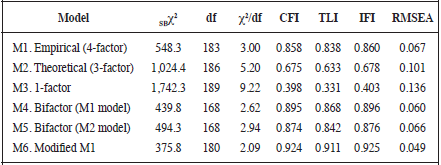
Note: SBχ2=Satorra-Bentler Chi-square, df=degrees of freedom, χ2/df=Chi-square/degrees of freedom ratio, CFI=comparative fi t index, TLI=Tucker-Lewis index, IFI=incremental fit index, RMSEA=root mean square error of approximation
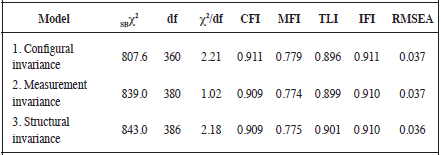
Note: SBχ2=Satorra-Bentler Chi-square, df=degrees of freedom, χ2/df=Chi-square/degrees of freedom ratio, CFI=comparative fit index, TLI=Tucker-Lewis index, MFI=McDonald fit index, IFI=incremental fit index, RMSEA=root mean square error of approximation
Factor loadings
As in Tims et al.’s (2012) original sample, four factors are obtained (Table 3): F1=Increasing structural job resources; F2=Decreasing hindering job demands; F3=Increasing social job resources; and F4=Increasing challenging job demands (hypothesis 1). Regarding the items, and after the confirmatory factor and invariance analyses, the final scale obtained for the sample of Spanish employees has 21 items: 5 items for F1, 6 items for F2, 5 items for F3, and 5 items for F4.
Reliability and measurement precision
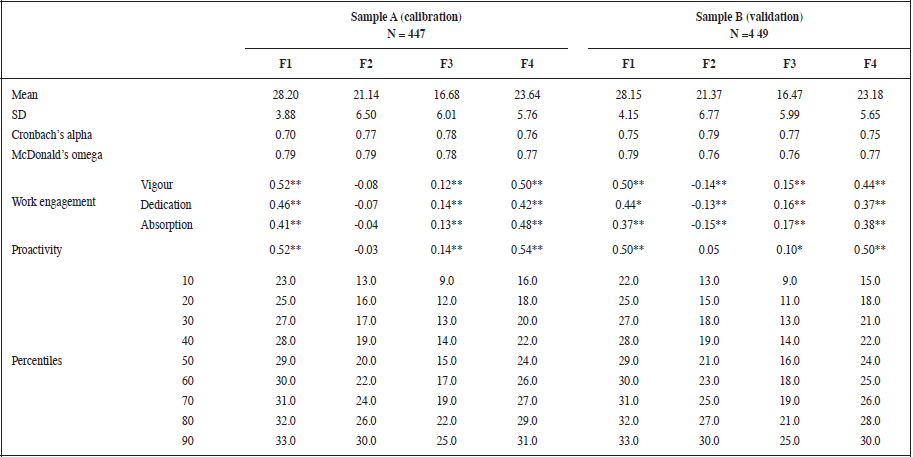
The internal consistency coefficients of Cronbach’s alpha and McDonald’s omega have acceptable values: The first coefficient has values between .70 and .79 and the second coefficient varies between .76 and .79 (Table 4). Regarding the IRT analysis (Figure 1), F1 and F4 are measured in a similar way: low and medium levels are measured more accurately than high levels (there are no adequate items). An inverse pattern occurs in the case of F3, whereas the precision is almost equal at most levels for the F2.
Sources of validity evidence
Regarding the convergent validity of the JCS-21 (Table 4), it is found that factors F1, F3 and F4 in the two sub-samples correlate positively with vigour, dedication and absorption (sub- scales of work engagement) (hypothesis 2 and 3) and proactivity (PPS) (hypothesis 4). In addition, factor F2 negatively with the sub-scales of work engagement, though only significantly in the validation sub-sample. No significant correlation between this factor and proactivity was found.
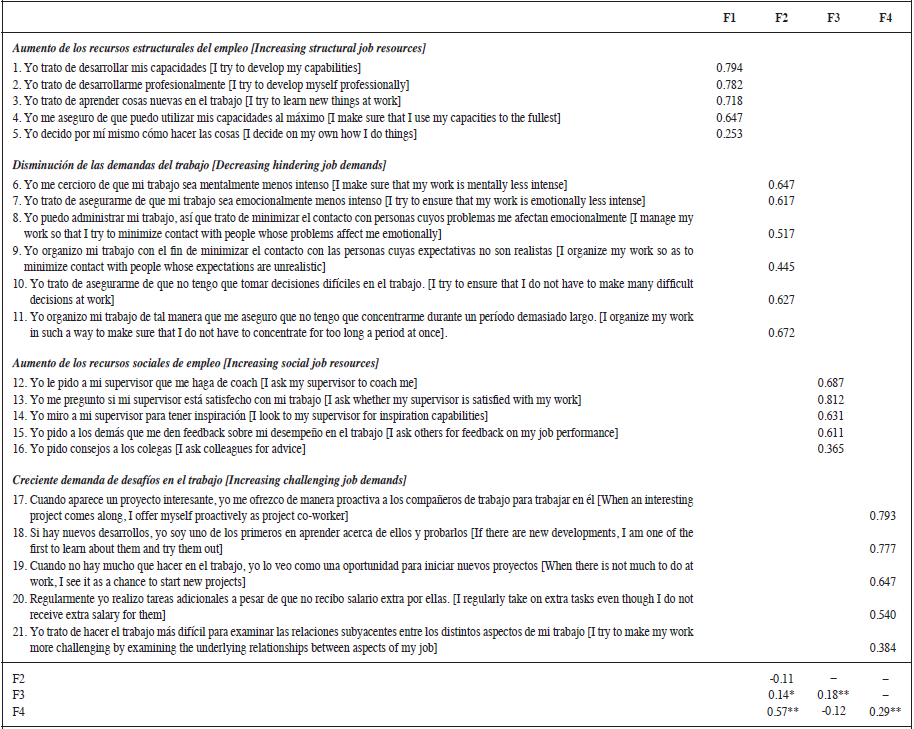
Note: * p<0.05, ** p<0.01; in all loadings, p<0.01.
Items adapted from Tims et al. (2012) based on interviews
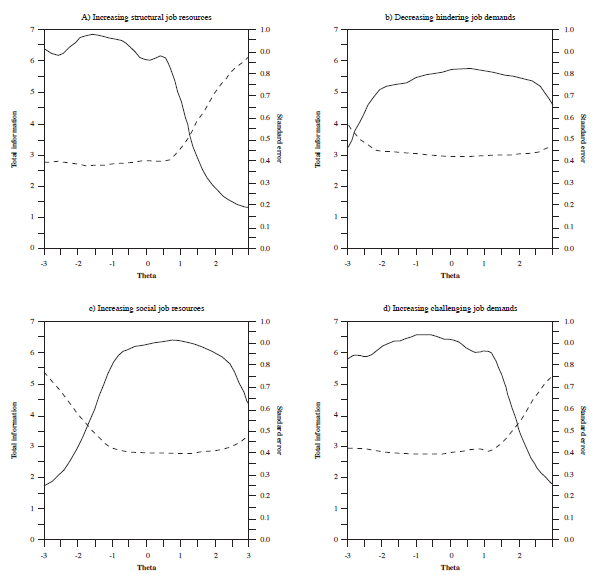
Figure 1.
Job Crafting Scale: Information function (continuous line) and standard error (dotted line)
Note: ** p<0.01; * p<0.05
(F1) Increasing structural job resources, (F2) Decreasing hindering job demands, (F3) Increasing social job resources, (F4) Increasing challenging job demands Validity: Application of Fisher’s z transformation (at 1%) between the two sub-samples There are no significant differences; the validity evidence is therefore stable
Discussion
The Spanish Job Crafting Scale (SJCS) may help researchers to empirically examine this phenomenon in Spain and other Spanish speaking countries to gain more knowledge about its antecedents and consequences. JD-R theory can be used to predict employee well-being and work performance (Bakker & Demerouti, 2014); and the scale’s four dimensions essentially point towards potential interventions that employees could make to influence their work environment through job crafting. In particular, this refers to every behavior and action aimed at increasing: their skills, learning and professional development (increasing structural job resources); their interaction with and inspiration drawn from supervisors and colleagues (increasing social job resources); and their proactivity in terms of developing new and interesting job demands (increasing challenging job demands).
The limitations of the present study will be taken as starting point for new research that we intend to conduct in the future. Basically, three lines of future research have been identified. First, it would be appropriate to carry on analysing the discriminant validity of the SJCS. In this respect, and as highlighted in recent research (Berg, Wrzesniewski, & Dutton, 2010; Berg, Dutton, & Wrzesniewski, 2013; Nielsen & Abildgaard, 2012), it is crucial to get a more in-depth understanding of how job crafting and its four dimensions can lead to the materialisation of development opportunities for different groups of employees. These distinct characteristics of employees and of their industrial relations, especially in a crisis scenario, may explain differential job crafting forms and behaviours.
Second, also worthy of note is the importance of considering the time dimension of job crafting. In the future, the research will be expanded with new samples of employees and a comparative time analysis. Self-reports are widely used in behavioural science research (Serrano-Fernández, Boada-Grau, Gil-Ripoll, & Vigil- Colet, 2016; Torrent-Sellens, Ficapal-Cusí, & Boada-Grau, 2016)- also in research on job crafting (Bakker, Tims, & Derks, 2012; Tims, Bakker, & Derks, 2013). The reason for using self-reports is that employees presumably know themselves best which behaviours they engaged in. Nevertheless, it may be useful to use other-ratings of job crafting or possible outcomes (e.g., job performance) in future research.
And third, further analysis of the validity of the SJCS criteria will need to be performed. In particular, we intend to look at the relationship between job crafting and employees’ intra-entrepreneurial and innovative attitudes as a mechanism for creating better quality jobs, and at the relationship between job crafting and organisational structures that offer the best assurances of securing employee work engagement, satisfaction and wellbeing.
Conclusion
The present study shows that the Spanish version of the Job Crafting Scale has good psychometric properties: the scale has the proposed four-factor structure, and the subscales show satisfactory reliabilities. The three expansion-oriented job crafting behaviors (increasing structural job resources, social job resources, and challenges) are positively related to work engagement. However, reducing hindrances is weakly negatively related to work engagement. We conclude that the JCS can be used in Spanish- speaking countries, but that the strategy of reducing job demands should be further investigated in order to reveal its impact on employee well-being and job performance.
References
Bakker, A.B., Demerouti, E., & Schaufeli, W. (2003). Dual processes at work in a call centre: An application of the job demands-resources model. European Journal of Work and Organizational Psychology, 12(4), 393-417.
Bakker, A. B., Rodríguez-Muñoz, A., & Derks, D. (2012). La emergencia de la psicología de la salud ocupacional positiva [The emergence of positive occupational health psychology]. Psicothema, 24, 66-72.
Bakker, A. B., Tims, M., & Derks, D. (2012). Proactive personality and job performance: The role of job crafting and work engagement. Human relations, 65, 1359-1378.
Bakker, A. B., & Demerouti, E. (2014). Job demands-resources theory. In P. Y. Chen & C. L. Cooper (Eds.), Work and Wellbeing: Wellbeing: A Complete Reference Guide. Volume III (pp. 37-64). Chichester, UK: Wiley-Blackwell.
Bakker, A. B., Demerouti, E., & Sanz-Vergel, A. I. (2014). Burnout and work engagement: The JD-R approach. Annual Review of Organizational Psychology and Organizational Behavior, 1, 389-411.
Belschak, F. D., & Den Hartog, D. N. (2010). Exploring positive, negative and context-dependent aspects of proactive behaviors at work. Journal of Occupational and Organizational Psychology, 83, 267-273.
Berg, J. M., & Dutton, J. E. (2008). Crafting a fulfilling job: Bringing passion into work. Michigan: Ross School of Business.
Berg, J. M., Grant, A. M., & Johnson, V. (2010). When callings are calling: Crafting work and leisure in pursuit of unanswered occupational callings. Organization Science, 21, 973-994.
Berg, J. M., Wrzesniewski, A., & Dutton, J. E. (2010). Perceiving and responding to challenges in job crafting at different ranks: When proactivity requires adaptivity. Journal of Organizational Behavior, 31, 158-186.
Berg, J. M., Dutton, J. E., & Wrzesniewski, A. (2013). Job crafting and meaningful work. In B. J. Dik, Z. S. Byrne, & M. F. Steger (Eds.), Purpose and meaning in the workplace (pp. 81-104). Washington, D.C.: American Psychological Association.
Byrne, B. M. (2006). Structural equation modeling with EQS: Basic concepts, applications, and programming. Mahwah: Erlbaum.
Byrne, B. M. (2008). Testing for multigroup equivalence of a measuring instrument: A walk through the process. Psicothema, 20, 872-882.
Cai, L., Thissen, D.,& du Toit, S.H.C.(2011). IRTPRO for Windows [Computer software]. Lincolnwood, IL: Scientific Software International.
Demerouti, E., Bakker, A. B., Nachreiner, F., & Schaufeli, W. B. (2001). The job demands-resources model of burnout. Journal of Applied Psychology, 86, 499-512.
Eguchi, H., Shimazu, A., Bakker, A. B., Tims, M., Kamiyama, K., Hara, Y., Namba, K., Inoue, A., Ono, M., & Kawakami, N. (2016). Validation of the Japanese version of the job crafting scale. Journal Occupational Health, 58, 231-240.
Finney, S. J., & DiStefano, C. (2006). Non-normal and categorical data in SEM. In G. R Hancock & R. O. Mueller (Eds.), Structural Equation Modeling: A second course (pp. 269-314). Greenwich: Information Age Publishing.
Ghiţulescu, B. E. (2006). Shaping tasks and relationships at work: Examining the antecedents and consequences of employee job crafting. Unpublished doctoral dissertation, University of Pittsburgh.
Grant, A. M., & Ashford, S. J. (2008). The dynamics of proactivity at work. Research in Organizational Behavior, 28, 3-34.
Hakanen, J. J., Bakker, A. B., & Schaufeli, W. B. (2006). Burnout and work engagement among teachers. Journal of School Psychology, 43, 495-513.
Hakanen, J. J., Perhoniemi, R., & Toppinen-Tanner, S. (2008). Positive gain spirals at work: From job resources to work engagement, personal initiative and work-unit innovativeness. Journal of Vocational Behavior, 73, 78-91.
Kerlinger, F. N. (2001). Research of Behavior: Research Methods in Social Sciences. New York, NY: McGraw-Hill.
Kline, R. B. (2008). Principles and practice of structural equation modeling. New York: Guilford Press.
Kristof-Brown, A. L., Zimmerman, R. D., & Johnson, E. C. (2005). Consequences of individuals’ fit at work: A meta-analysis of person- job, person-organization, person-group, and person-supervisor fit. Personnel Psychology, 58, 281-342.
Leana, C., Appelbaum, E., & Shevchuk, I. (2009). Work process and quality of care in early childhood education: The role of job crafting. Academy of Management Journal, 52, 1169-1192.
LePine, J. A., Podsakoff, N. P., & LePine, M. A. (2005). A meta- analytic test of the challenge stressor-hindrance stressor framework: An explanation for inconsistent relationships among stressors and performance. Academy of Management Journal, 48, 764-775.
Lyons, P. (2008). The crafting of jobs and individual differences. Journal of Business and Psychology, 23, 25-36.
Muñiz, J., Elosua, P., & Hambleton, R. K. (2013). International Test Commission Guidelines for test translation and adaptation: Second edition. Psicothema, 25, 151-157.
Nielsen, K., & Abildgaard, J. S. (2012). The development and validation of a job crafting measure for use with blue-collar workers. Work and Stress: An International Journal of Work, Health, and Organizations, 26, 365-384.
Petrou, P., Demerouti, E., Peeters, M. C. W., Schaufeli, W. B., & Hetland, J. (2012). Crafting a job on a daily basis: Contextual correlates and the link to work engagement. Journal of Organizational Behavior, 33, 1120-1141.
Salanova, M., Schaufeli, W. B., Llorens, S., Peiró, J. M., & Grau, R. (2000). Desde el “burnout” al “engagement”: ¿una nueva perspectiva? [From burnout to engagement: A new perspective?]. Revista de Psicología del Trabajo y las Organizaciones, 16, 117-134.
Schaufeli, W. B., & Bakker, A. B. (2003). Utrecht work engagement scale: Preliminary manual. Occupational Health Psychology Unit, Utrecht University, Utrecht.
Seibert, S. E., Crant, J. M., & Kraimer, M. L. (1999). Proactive personality and career success. Journal of Applied Psychology, 84, 416-427.
Serrano-Fernández, M.J., Boada-Grau, J., Gil-Ripoll, C., & Vigil-Colet, A. (2016). A predictive study of antecedent variables of workaholism. Psicothema, 28, 401-406. doi:10.7334/psicothema2015.345
Simmering, M. J., Colquitt, J. A., Noe, R. A., & Porter, C. O. L. H. (2003). Conscientiousness, autonomy fit, and employee development: A longitudinal field study. Journal of Applied Psychology, 88, 954- 963.
Slemp, G. R.,& Vella-Brodrick, D. A.(2013). The job crafting questionnaire: A new scale to measure the extent to which employees engage in job crafting. International Journal of Wellbeing, 3, 126-146.
Tims, M., & Bakker, A. B. (2010). Job crafting: Towards a new model of individual job redesign. South African Journal of Industrial Psychology, 36, 1-9.
Tims, M., Bakker, A. B., & Derks, D. (2012). Development and validation of the job crafting scale. Journal of Vocational Behavior, 80, 173- 186.
Tims, M., Bakker, A. B., & Derks, D. (2013). The impact of job crafting on job demands, job resources, and well-being. Journal of Occupational Health Psychology, 18, 230.
Torrent-Sellens, J., Ficapal-Cusí, P., & Boada-Grau, J. (2016). Dispositional employability and on-line training purchase. Evidence from employees’ behavior in Spain. Frontiers in Psychology, 7, 831. doi:10.3389/fpsyg.2016.00831
Wrzesniewski, A., & Dutton, J. E. (2001). Crafting a job: Revisioning employees as active crafters of their work. Academy of Management Review, 26, 179-201.
Xanthopoulou, D., Bakker, A. B., Demerouti, E., & Schaufeli, W. B. (2009). Reciprocal relationships between job resources, personal resources, and work engagement. Journal of Vocational Behavior, 74, 235-244.