Artículo de Investigación Científica o Tecnológica
Musculoskeletal symptoms in workers of a Colombian University in times of COVID-19
Síntomas musculoesqueléticos en trabajadores de una universidad colombiana en tiempos de COVID-19
Musculoskeletal symptoms in workers of a Colombian University in times of COVID-19
Revista Colombiana de Salud Ocupacional, vol. 12, no. 1, e-7364, 2022
Facultad Ciencias de la Salud, Universidad Libre
Received: 11 April 2021
Accepted: 28 February 2022
Abstract
Objective: To establish the factors associated with musculoskeletal symptoms in collaborators of a Colombian University in times of COVID-19.
Methods: Cross-sectional study, with 385 collaborators, the self-perception of musculoskeletal symptoms was investigated through an electronic survey.
Results: in teachers, 65.4% reported lumbar discomfort, and in administrative 65.6% discomfort in the wrist or hand. Statistically significant associations were found p <0.05 between the work and having shoulder and lumbar discomfort. Playing sports was a protective factor for lumbar discomfort, flexibility was a protective factor for neck discomfort, and poor muscle strength was a risk factor for shoulder discomfort (p<0.05).
Conclusion: there are protective and risk factors associated with musculoskeletal symptoms that have intensified in times of pandemic in university workers, such as office, sports, flexibility, and muscular strength, therefore, it is important to generate strategies to reinforce protective factors for better job performance.
Key words: Worker+ musculoskeletal+ injury+ absenteeism+ physical activity.
Resumen
Objetivo: Establecer los factores asociados a síntomas musculoesqueléticos en colaboradores de una Universidad Colombiana en tiempos de COVID-19.
Métodos: Estudio transversal, en 385 colaboradores. Se indagó a través de una encuesta electrónica la auto percepción sobre la sintomatología musculoesquelética.
Resultados: El 65.4% de los docentes informaron molestia lumbar y en los administrativos el 65.6% molestia en muñeca o mano. Se encontraron asociaciones estadísticamente significativas entre el cargo y presentar molestia de hombro y molestia lumbar. Realizar deporte fue un factor protector para molestias lumbares, la flexibilidad factor protector para molestia de cuello y la mala fuerza muscular factor de riesgo para molestia de hombro (p<0.05).
Conclusión: existen factores protectores y de riesgo asociados a la sintomatología músculo esquelética que se han intensificado en tiempos de pandemia en trabajadores universitarios, como el cargo, hacer deporte, flexibilidad y fuerza muscular. Es importante generar estrategias para reforzar los factores protectores para un mejor desempeño laboral.
Palabras clave: Trabajador, factores asociados, síntomas musculoesqueléticos, dolor lumbar, dolor hombro, actividad física.
Introduction
Musculoskeletal disorders (MSD) have been defined by the International Labor Organization (ILO) as one of the most relevant health problems and with the highest incidence in the workplace. They are defined as an alteration of the musculoskeletal system that groups various symptoms which they range from mild and momentary discomfort to irreversible diseases that can lead to disability. 1 These represent a serious health problem in the working population, constituting the first cause of morbidity and disability, and are the most frequent occupational pathology reported in high-income countries, particularly disorders of the back, neck, and upper limbs. 2 The previous situation is also described in Latin America and the European Union this implies economic consequences for both the worker and the companies.3 According to the reports of the European Commission, MSDs are the cause of most absences from work, 50% of all absences of more than three days, and of cases of permanent incapacity to work 60%. 4
Some studies conclude that a worker, on average, is absent about two days from work a year due to some type of musculoskeletal problem. 5 These disorders manifest themselves in medical costs and lost time of more than $ 12 million a year to the Employers’ State Fund, and are said to be responsible for more than 70,000 lost workdays per year. 1 For administrative workers, the use of computers and technological elements is essential in their daily work, despite the absence of physical efforts that require the application of muscular force, studies have shown that the constant use of these tools by administrative workers generate negative consequences such as pain, degeneration in the structures, loss of mobility and muscle hypertrophy. 6
The risk factors that are associated with musculoskeletal symptoms can be physical, psychosocial, and individual. Physical factors include repetitiveness, strength, and posture, sometimes associated with environmental factors such as vibration and cold; on the other hand, there are individual worker factors, such as their medical history, age, sex, and gender. Musculoskeletal symptoms occur 3-4 times higher in some sectors when compared with general population data. 7
On musculoskeletal pain and its association with ergonomic risk factors, in Colombian administrative workers, it revealed that 57% presented pain symptoms. The most frequent musculoskeletal injuries being a pain in the area lower back, upper back and neck, and evidence that there is an association between exposure to biomechanics risk factors and the presence of musculoskeletal injuries, indicating that forced labor positions mean greater risk. 8
The pandemic caused by the new coronavirus Sars-CoV-2 that causes the COVID-19 disease forced governments to declare measures of confinement, physical distancing, and restriction of outdoor activities, which brought with them psychological, social, and physical consequences in workers, the latter largely derived from the increase in physical inactivity, sedentary behaviors and the consumption of foods with high caloric intake, added to the incorporation of a new work modality mediated by teleworking through the use of ICT. 9
Many Higher Education Institutions have adopted teleworking as a work alternative with a view to continuing the training process of students and mitigating the economic effects of the pandemic. However, although it has been configured as an opportunity for workers and students, it entails health risks from an ergonomic point of view, due to the need to spend long hours sitting in front of computer equipment, which long-term can trigger transient or permanent musculoskeletal disorders. 10
The problem described suggests the importance of knowing the behavior of these events in specific populations of workers and thus contribute to the formulation of strategies for their prevention and interdisciplinary management, so the objective of this work is to establish the factors associated with symptoms musculoskeletal in collaborators of a Colombian University in times of COVID-19.
Materials and methods
Design and population
A descriptive cross-sectional study carried out in the Universidad Autónoma de Manizales in the city of Manizales, Caldas, Colombia.
The population consisted of 550 employees between 18 and 79 years old, who were asked to fill out a digital survey, the final sample of the study was made up of 385 people who completed the entire survey.
The inclusion criteria were being linked to the institution’s payroll, age over 18 years, participating voluntarily, and filling out the informed consent.
Procedures and ethics
Once the project was approved by the research committee, the first step was to request authorization from the directors of the institution, upon obtaining the endorsement, the questionnaire was sent by institutional email to all collaborators, their permanence on the web was from March 25 to May 9, 2020.
The technique used was the electronic survey designed on the google form platform; for this, two questionnaires were considered, the International Fitness Scale Questionnaire (IFIS) developed in the study by Ortega et al. 11, to assess the main health-related components of fitness easily, quickly, and economically. In Colombia, Español and Ramirez 12 reported that the 5-item version of the IFIS is a questionnaire with high reliability (Cronbach’s alpha> 0.80) and reproducibility (intra- class correlation coefficient between 0.90 and 0.96).
The instrument that assessed musculoskeletal symptoms were the Nordic questionnaire, 13 where the worker was questioned about the presence of discomfort or musculoskeletal pain in any part of the body during the last 6 months.
In the first part of the survey, sociodemographic and work variables were investigated and later it focused on healthy physical condition and musculoskeletal symptoms according to the questionnaires.
According to resolution 08430 14 of the Colombian Ministry of Health, the research was classified as safe, all the requirements established by the Declaration of Helsinki for human research were respected. 15 The project was approved by the institutional bioethics committee in minutes 096 of March 2020.
The information was analyzed in the SPSS version 26 program (licensed by the UAM). Univariate analysis was performed using absolute and relative frequency distributions and in the bivariate analysis the Ji2 test was calculated and the calculation of the OR value with its respective confidence interval was used as a measure of association strength.
Results
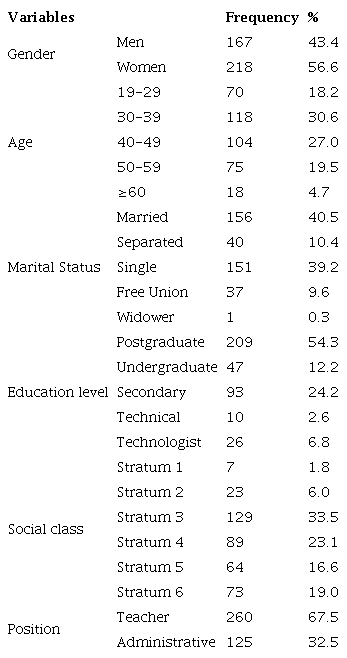
The mean age was 40.7 years +/-11.18 years, the highest percentage was between 30 and 49 years, 56.6% were women, the majority were married (40.5%) followed by single (39.2%), the highest percentage reported having postgraduate studies, 67.5% were teachers and 56.6% resided in socioeconomic strata 3 and 4 (Table 1).
The highest percentage of teachers and administrators reported feeling less discomfort in the elbow and forearm, teachers’ greater lumbar discomfort (65.4%), and administrators more discomfort in the wrist or hand (65.6%). A statistically significant association p <0.05 was found between the work and presenting shoulder and lumbar discomfort, finding an OR of less than 1 considered a protective factor (Table 2).
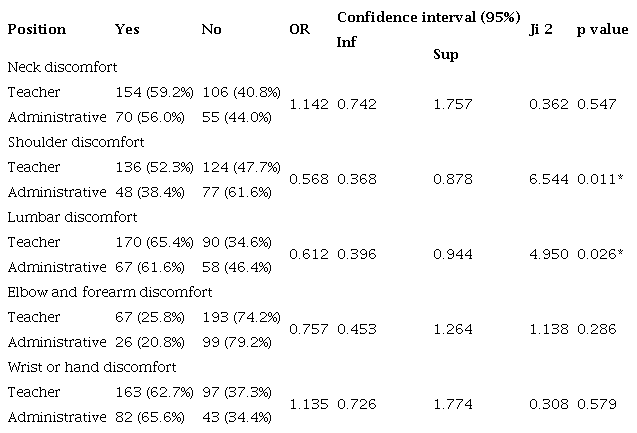
* Sig<0.05
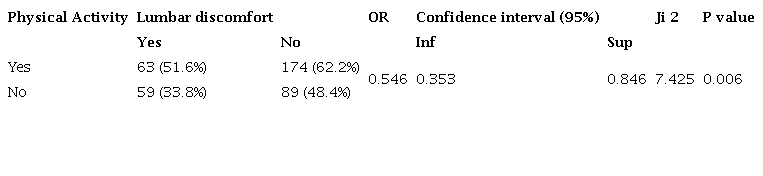
The 88.1% of the participants reported that they did a physical activity, 63.6% that they did physical exercise, and 31.7% sport. A statistically significant association p <0.05 was found between the practice of sports and the reduction of lumbar discomfort. (Table 3).
With respect to healthy physical condition, this was rated as good by most of the participants, general physical condition was reported as good by 84.4%, cardiorespiratory physical condition was good by 84.1%, muscular strength was rated as good by 82.6%, speed-agility was reported as good by 85.7% and flexibility by 74%. A statistically significant association p<0.05 was found between the flexibility component and neck discomfort, with an OR value of less than 1 considered a protective factor. Similarly, a statistically significant association p<0.05 was found between having low muscle strength and shoulder discomfort, with an OR of 1.576, considered a risk factor, a situation that could be explained in times of pandemic by the long periods of inactivity and the increase in screen work and the use of the mouse. (Table 4). Men reported greater discomfort in the wrist or hand (64.1%), and women reported greater discomfort in the elbow and forearm. No statistically significant association was found between sex and musculoskeletal symptoms.
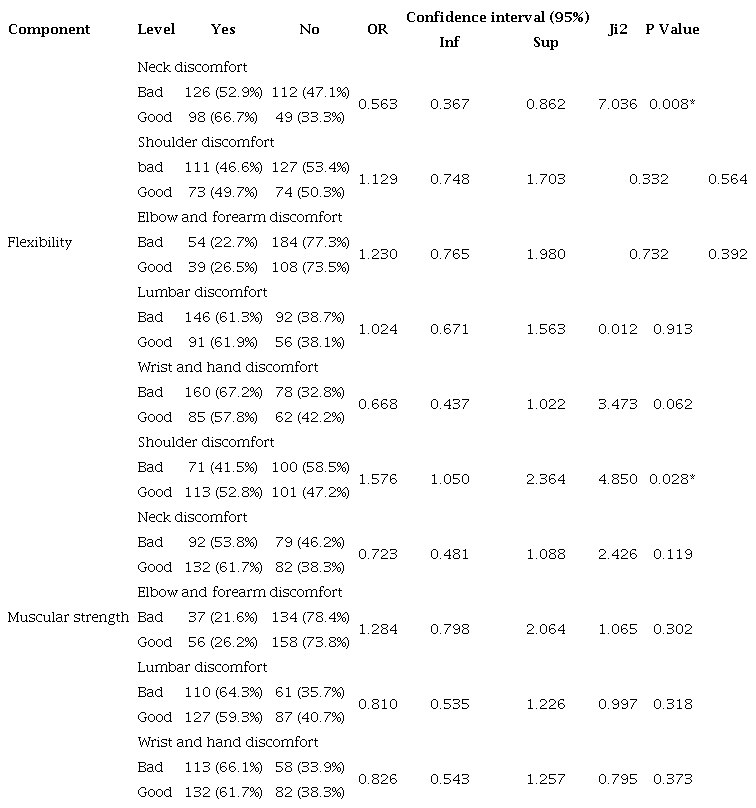
* Sig<0.05
Discussion
The results of the present study showed that posture type, sports practice, flexibility levels, and muscle strength were associated with musculoskeletal symptoms. Participants ranged in age from 19 to 79 years, with a mean of 40.7 +/- 11.18 years, data like those reported by Parra 16 in university workers, who present a mean age for administrators of 39.76 +/- 7.78 years and for teachers 42.67 +/- 7.50 years, in the same way, they coincide with the age range reported by Castaño et al. 17, from 22 to 72 years old.
In a greater proportion, the workers evaluated are teachers (67.5%) and female (56.6%), a situation that differs from that reported in workers from another higher education institution in the Colombian context, 18 where 92 7% were part of the administrative staff, and similarly, the majority of those evaluated were female (66.9%). Regarding educational level, 54.3% of the participants have a postgraduate degree, unlike the workers where 70.2% had an undergraduate degree. 18
According to the world health organization (WHO), 19 physical activity is considered as any body movement made by skeletal muscles that cause energy expenditure, which is present in everything a person does during the day except sleep or rest, based on the above, 88.1% of the respondents reported doing physical activity, data that are higher than those reported in a group of administrative officials where it was found that 72.4%, they do it. 20 It should be emphasized that, to obtain greater health benefits, adults should dedicate up to 300 minutes per week (1 hour daily for 5 days) to the practice of moderate physical activity. 21
Regarding physical exercise, this is considered a physical activity, said activity is mediated by structured and repetitive planning that aims to maintain or improve physical condition. Taking these characteristics into account, 63% of the participants in this study reported that they perform physical exercise, a figure higher than the 47% reported in university teachers in a health school, 22 who through the IPAQ reported performing vigorous physical activity.
Unlike physical activity and physical exercise, sport is classified according to the Colombian Sports Law 23 in article 15 as human behavior characterized by a playful attitude and competitive desire, verification or challenge expressed through physical exercise and mental, in this sense 31.7% of the participating population reported playing sports, being below 43.82% of the workers of a company “Petro Ecuador” who say they play sports. 24 This activity is the one that is carried out the least, perhaps due to its competitive and regulated nature.
The highest percentage of participants reported having a healthy physical condition between acceptable and good, for the variables of general physical condition (84.4%), cardiorespiratory physical condition (84.1%), muscular strength (82.6%), speed - agility (85.7%) and flexibility (74%); data that differ from those reported in a study conducted on university students in which the highest proportion of responses was found grouped into the good and very good qualification, in the IFIS categories speed/agility (64%), general physical condition (63%), cardiorespiratory fitness (54%) and muscular strength (53%). 25 On the contrary, the similarity is observed with young Chileans, the answers given in the IFIS questionnaire are located acceptable and good for both men and women. Although they are studies carried out in young people, they make it possible to compare the different components of healthy physical condition in addition to locating them by level according to the IFIS questionnaire. 26
The position is a protective factor (p <0.05) for low back and shoulder pain, data reinforced by the findings of Alcivar and Zurita who highlight the importance of teaching good posture habits in the working population to benefit the biomechanics of the lumbar spine. 27 Flexibility was found as a protective factor for neck discomfort, this coincides with the results of other studies that found that improving muscle flexibility reduces pain in the neck, improving the quality of life of the worker, 28,29 strength was identified as a risk factor for shoulder discomfort, in this regard studies such as the one carried out by Paredes and Vázquez showed that shoulder problems are usually those of greater labor origin, and they highlight how they generate high economic costs, 30 coinciding with the work carried out by Rodríguez et al, found that work activities that involve the application of force are considered a risk factor for shoulder pain. 31
Conclusions
As factors associated with the musculoskeletal symptomatology in times of COVID 19 are the type work, playing sports, and physical capacities such as strength and flexibility, which act as a protective factor and risk factor, the results suggest the Importance of proposing institutional strategies to strengthen protective factors and thus impact on absenteeism that may be generated when said symptomatology worsens, another aspect is framed in improving
ergonomic conditions and thus reducing additional problems that have arisen from the situation that is currently living derived from work at home.
Acknowledgments
The authors thank the collaborators of the institution who participated in the study.
References
Robles JB, Iglesias OJ. Relación entre posturas ergonómicas inadecuadas y la aparición de trastornos múculo-esqueléticos en los trabajadores de las áreas administrativas que utilizan pantallas de visualización de datos, en una empresa de la ciudad de Quito en el año 2015. Rev Cien Seguridad Defensa. 2019; IV(2): 158-181.
Rojas M, Gimeno D, Vargas S, Benavides FG. Dolor musculoesquelético en trabajadores de América Central: resultados de la I encuesta centroamericana de condiciones de trabajo y salud. Rev Panam Salud Publica. 2015;38(2):120-8.
Tatamuez RA, Domínguez AM, Matabanchoy SM. Revisión sistemática: Factores asociados al ausentismo laboral en países de América Latina. Univ Salud. 2019;21(1):100-112. DOI: 10.22267/ rus.192101.143
Organización Internacional del Trabajo. Prevención de enfermedades profesionales. 2013. Cited: 2020 July 22. available in: https://www.ilo.org/wcmsp5/groups/public/---ed_protect/-- -protrav/---safework/documents/publication/wcms_209555.pdf
Ordoñez CA, Gómez E, Calvo AP. Desórdenes músculo esqueléticos relacionados con el trabajo. Rev Colomb Salud Ocupacional. 2016; 6(1): 27-32
Andersen JH, Fallentin N, Thomsen JF, Mikkelsen S. Risk factors for neck and upper extremity disorders among computers users and the effect of interventions: an overview of systematic reviews. PLoS One. 2011; 6(5): e19691. doi: 10.1371/journal. pone.0019691.
Ministerio de la Protección Social. Guía de atención integral basada en la evidencia para hombro doloroso (GATI- HD) relacionado con factores de riesgo en el trabajo. Bogotá, Colombia: Ministerio de la Protección Social; 2006. Cited: 2020 April 13. Available in: https://www.minsalud.gov.co/Documentos%20 y%20Publicaciones/GATISO%20PARA%20HOMBRO%20 DOLOROSO.pdf
Vernaza P, Sierra C. Dolor musculoesquelético y su asociación con factores de riesgo ergonómicos, en trabajadores administrativos. Rev Salud Pública. 2005; 7(3): 317-326.
Mera A, Tabares E, Montoya S, Muñoz D, Monsalve F. Recomendaciones prácticas para evitar el desacondicionamiento físico durante el confinamiento por pandemia asociada a COVID-19. Univ Salud. 2020; 22(2): 166-177. DOI: 10.22267/ rus.202202.188
García-Salirrosas EE, Sánchez-Poma RA. Prevalencia de los trastornos musculoesquelético en docentes universitarios que realizan teletrabajo en tiempos de COVID-19. An Fac med. 2020; 81(3): 1-17. DOI: 10.1590/SciELOPreprints.1014
Ortega F, Ruiz J, España V, Vicente G, Martínez D, Manios Y, et al. The International Fitness Scale (IFIS): Usefulness of self- reported fitness in youth. Int J Epidemiol. 2011;40(3):701-11.
Español M, Ramírez R. Validación del cuestionario International Fitness Scale (IFIS) en sujetos colombianos de entre 18 y 30años de edad. Rev Esp Salud Publica. 2014;88(2):271-8.
Kuorinka I, Jonsson B, Kilbom A, Vinterberg H, Biering-Sørensen F, Andersson G, Jørgensen K. Standardised Nordic questionnaires for the analysis of musculoskeletal symptoms. Appl Ergonom. 1987; 18(3):233-237.
Ministerio de Salud. Resolución 8430 Por la cual se establecen las normas científicas, técnicas y administrativas para la investigación en salud. Bogotá: Ministerio de Salud; 1993. Disponible en: https:// www.minsalud.gov.co/sites/rid/Lists/BibliotecaDigital/RIDE/DE/ DIJ/RESOLUCION-8430-DE-1993.PDF.
Asociación Médica Mundial. Declaración de Helsinki: principios éticos para la investigación médica sobre sujetos humanos. 2000. Disponible en: https://www.wma.net/es/policies- post/declaracion-de-helsinki-de-la-amm-principios-eticos-para- las-investigaciones-medicas-en-seres-humanos/
Parra H. Prevalencia de síntomas musculoesqueléticos en trabajadores universitarios. Barquisimeto. 2014. Rev Venezolana Salud Públ. 2015;3 (1):15-22.
Cataño M, Echeverri MC, Penagos JC, Pérez K, Prisco JP, Restrepo D, Tabares Y. Riesgo biomecánico por carga estática y morbilidad sentida en docentes universitarios, Medellín 2018. Rev Cienc Salud. 2019;17(3):48-59. Doi: 10.12804/revistas.urosario. edu.co/revsalud/a.8359
Mendinueta M, Herazo Y. Percepción de molestias musculoesqueléticas y riesgo postural en trabajadores de una institución de educación superior. Salud Uninorte. 2014;30(2):170-179.
Organización Mundial de la Salud. La actividad física; 2020. Cited: 2020 June 3. Available in: https://www.who.int/es/news- room/fact-sheets/detail/physical-activity
Azofeifa C, Solano L, Salas J, Fonseca H. Comparison between job stress predictors based on physical activity, age, gender and seniority in a group of administrative officers from the costa rican public sector. Rev Movim Hum Sal. 2016; 13 (1): 1-19
Rosales Y, Orozco D, Yaulema L, Parreno A, Caiza V, Barragán V, et al. Actividad física y salud en docentes. Una revisión. Apunts Med Esport. 2017;52(196):159-166
Wilches LE, Hernández N, Chavarro P, Bernal J. Perfiles de riesgo cardiovascular y condición física en docentes y empleados no docentes de una facultad de salud. Rev Salud Públ. 2016; 18 (6):890. Doi: http://dx.doi.org/10.15446/rsap.v18n6.42708
Congreso de Colombia. Ley 181. Por la cual se dictan disposiciones para el fomento del deporte, la recreación, el aprovechamiento del tiempo libre y la Educación Física y se crea el Sistema Nacional del Deporte; de 1995. Available in: https://www. funcionpublica.gov.co/eva/gestornormativo/norma.php?i=3424
Agila-Palacios E, Colunga-Rodríguez C, González-Muñoz E, Delgado-García D. Síntomas músculo-esqueléticos en trabajadores operativos del área de mantenimiento de una empresa petrolera ecuatoriana. Cienc Trab. 2014; 16(51): 198-205.
Camacho D, Hernández JM, González K, Tordecilla A, Ramírez R. Una mejor auto-percepción de la condición física se relaciona con menor frecuencia y componentes de síndrome metabólico en estudiantes universitarios. Nutr Hosp. 2015; 31:1254-1263. DOI:10.3305/nh.2015.31.3.8398
Rufino P, Garcia J, Merellano E. Propiedades psicométricas de la escala International Fitness Scale en adolescentes chilenos. Retos. 2017; 31:23-27
Alcívar E, Zurita A. Lumbalgias en el medio laboral: factores de riesgo. Rev Ecuatoriana Ortop Traumatol. 2017; 6(1).
aubert FC, Valverde S, Gonçalves da Silva P, Cruz Robazzi ML. Isostretching en la reducción del dolor, fatiga y aumento de la flexibilidad en los trabajadores. Salud trab. (Maracay). 2018; 26(2): 138-148.
Almeida G, Ribeiro M, Silva M, Branco R, Pinheiro, F, Nascimento B. Patologias osteomusculares como causa de aposentadoria por invalidez em servidores públicos do município de São Luís, Maranhão. Rev Brasileira Med Trabal. 2016; 14(1), 37-44.
Paredes ML, Vázquez M. Estudio descriptivo sobre las condiciones de trabajo y los trastornos musculo esqueléticos en el personal de enfermería (enfermeras y AAEE) de la Unidad de Cuidados Intensivos Pediátricos y Neonatales en el Hospital Clínico Universitario de Valladolid. Med Segur Trab. 2018 ; 64(251):161-199.
Rodríguez GM, Lobato JR, Sánchez J, Ausó JR, Cardona AF. Influencia de las medidas preventivas ergonómicas en el desarrollo de secuelas por patología no traumática del hombro. Arch Prev Riesgos Labor. 2020; 23(2):196-210.
Author notes
Autor de correspondencia: Consuelo Vélez Álvarez: cva@autonoma.edu.co