Articles
An Online Course as a Way to Work on Socio Affective Learning Strategies in the EFL Classroom
Un curso online como forma de trabajar estrategias de aprendizaje socioafectivo en el aula de inglés como lengua extranjera
 Ilba-Yaneth Rodríguez-Tamayo ilba.rodriguez@uptc.educ.co
An Online Course as a Way to Work on Socio Affective Learning Strategies in the EFL Classroom
Saber, Ciencia y Libertad, vol. 19, no. 2, pp. 300-320, 2024
Universidad Libre
Received: 16 March 2024
Accepted: 03 June 2024
Abstract: This article is part of a research final results held in a Master's Program in Colombia. The aim was to describe the impact that the implementation of a socio-affective strategies (SAS) online course has on the language teachers' practices in the classroom. It was a qualitative action research and data were collected by teachers' artifacts, voice recordings a survey and an online course. Data were analyzed under the Thematic Analysis Method principles. Findings are presented in three big categories and five subcategories. The first category is related to the necessity for accepting students as they are and not as the professor wants. In the same way, this category is explained in terms of how success in SAS affects positively teachers and students, how the teacher has to deal with motivation and frustration and how educational policies interfere in teacher's wishes and what she or he has to do. The second category refers to the relevance of having symmetric relationships into the classroom and perceive it as a place where teachers and learners can learn together. Finally, the third category unveil why a teacher must be a warmhearted being. It was possible to conclude that language teachers' practices were influenced by a socio affective learning strategies online course strengthening different classroom areas, like teacher student relationships, the dichotomy of what teachers consider to do and what policies really expect, the analysis, reflection and impact about previous learning experience when teachers were students, and the acknowledgement of a variety of approaches for implementing these strategies constantly and in the classroom.
Keywords: Socio Affective Language Learning Strategies, implementation, moti, vation, teacher's role, affective domains, anxiety.
Resumen: Este artículo es parte de los resultados finales de una investigación que se desarrolló en un programa de maestría en Colombia. El objetivo principal fue describir el impacto de la implementación de un curso online sobre estrategias socio-afectivas en las prácticas de un grupo de profesores en el salón de clase. Fue una investigación acción de tipo cualitativo, en la que se utilizaron los trabajos de los profesores, grabaciones de voces, una entrevista y el curso online como instrumentos para recoger la información. Los datos se analizaron bajo los principios del Método de Análisis Temático. Los resultados se presentan en tres grandes categorías y cinco subcategorías. La primera categoría está relacionada con la necesidad de aceptar a los estudiantes como son y no como el profesor desea que sean. Igualmente, se explica como la implementación de las estrategias afectan positivamente a los profesores y estudiantes, a cómo el docente debe lidiar con la motivación y con la frustración y la manera como las políticas educativas interfieren en lo que el docente desea hacer y lo que debe hacer. La segunda categoría se refiere a la relevancia de tener relaciones igualitarias o simétricas dentro del salón de clase y como se percibe este lugar como un espacio en el que los profesores y estudiantes pueden aprender juntos. Finalmente, la tercera categoría revela las razones por las que el profesor debe ser un ser de buen corazón. Fue posible concluir que las prácticas de los docentes de lenguas fueron influenciadas por el curso online sobre estrategias de aprendizaje socio afectivas en diferentes áreas como la relación profesor - estudiante, la dicotomía de lo que el docente considera realizar y lo que las normas verdaderamente esperan: el análisis, reflexión e impacto de experiencias previas de aprendizaje cuando los docentes fueron estudiantes y en el reconocimiento de una variedad de enfoques para implementar esas estrategias de manera constante en el salón de clase.
Palabras clave: Estrategias de aprendizaje del lenguaje socio afectivo, implementación, motivación, rol del docente, dominios afectivos, ansiedad.
Introducción
Learning a language is an up and down process, it is dynamic according to Yang (2021). When learners idealize the learning process, they led aside important concerns such as failing as an outcome, a lack of motivation, participation and/or an anxiety crisis which may occur in the English classroom. Anxiety is just one of many issues EFL learners explore in their learning process. As a result, students find some tasks difficult or impossible to complete due to affective domains or emotional and motivational reactions. Most of the time, the majority of the learning processes has been directed at students, who are responsible for their own emotions and behaviors. However, the teacher's awareness and teaching strategies have been called into doubt on a few occasions. In a world where most students' worth is determined by quantitative results, reinforcing educational and pedagogical approaches is a need (Rubio, 2007). Even though experts in human behavior have expanded their studies on anxiety in students and self-esteem scarcity in students, educators have lagged in this subject, particularly in the language learning process.
In the need analysis carried out at beginning of the research, it was found that students struggle with handling their affective domain in class. Moreover, their teachers' awareness was scarce and the urgency to familiarize students and carry the socio-affective strategies out was perceptible. As a result, the purpose of the study was to analyze the impact that the development of a socio-affective strategies online course has on a group of language classroom teachers.
From the students' realities in three educational institutions in Boyacá- Colombia, the importance of some socio-affective language learning strategies helps them in regulating emotions that derive from language learning such as anxiety, low motivation, and negative attitudes (Oxford, 1990). Based on the previous concerns, a questionnaire was applied to 12 English and French teachers, who were part of private and public educational institutions. This questionnaire included 6 closed questions that allowed the analysis of the data statistically. However, every question introduced an option for justifying the answers given by the population surveyed and to analyze qualitatively. The purpose of this survey was to identify how teachers and students perceived and applied any type of socio affective strategy in the English process and how it may influence the classroom dynamic.
The survey asked for lack of students' participation reasons; if professors thought that the only factor that affects participation was the low level of English, and finally, teachers were asked about the current strategies they use in class. Teachers told that they explain the topics with others words when students do not participate and they said that issues like the lack of confidence, anxiety or self-esteem are other factors that influence students few participations. Among the strategies teachers are currently using are the implementation of feminist pedagogy, building reflecting scenarios, validating emotions, activating students' previous knowledge, and online platform handling, as Kahoot.
As a complement of the previous survey, another one was carried out with 18 students from different levels in order to see how they feel handling socio-affective strategies in the EFL class. The aim of this survey was to analyze the students' perceptions and understanding about the affective domain. It was also a method for helping to grasp the similarities and differences between teachers and students' viewpoints and in that way intending to identify which gaps need to be filled in terms of socio affective strategies in the classroom and their influence in the teachers' practice.
Among the answers the students provided the researchers found they do not like to participate because of they are afraid of being judged or because they may answer incorrectly. Notwithstanding, some of the interviewees told about the importance of participation in class. Likewise, students acknowledged that they need to be aware or concerned about their own learning process.
Based on teachers' answers above it was inferred how both (teachers and students) recognize that handling anxiety in the classroom and lack of participation are actions that should not be just the teacher's concern. Students complemented their answers by expressing the consequences of not participating such as lack of understanding, confusion and frustration. As errors are made, learners become more anxious, and the more anxious they are, the more errors they make. Therefore, high anxious learners will protect their social image with diminishing participation, Gregersen, (2003). Additionally, students expressed how important it is to work hand in hand with instructors receiving their support and feedback properly to participate and reduce anxiety levels in the classroom.
According to the answers, it was possible to interpret students' negative thoughts as issues that are not allowing them to improve, motivate, own their process and trust in themselves. On the contrary, they are increasing students' lack of confidence, anxiety episodes and wrong use of their affective domain. Moreover, student's pressure is another concern seen in the results. Getting a failing grade is the cause of arguing with their parents, or being judged by their classmates.
In order to see what strategies students took into account to improve their learning process in an autonomous way, they were asked about the strategies they implemented in order to reinforce their learning process. Students' surveyed use different tools such as You tube tutorials or English webpages for a better understanding of particular topics. Nevertheless, none mention socio-affective strategies as part of their methods to strengthen their learning a language process. With these answers, the researchers analyzed two hypotheses: students do not consider relevant socio-affective strategies or students do not know what these strategies mean and their importance in the classroom.
In agreement to students' statements in the survey and as a general conclusion, students were facing the consequences of the lack of knowledge in the implementation of socio-affective strategies in their learning process. Likewise, teachers were struggling to understand why students did not participate and why some of their strategies were not successful in the classroom. It seems to be a disconnection between students' needs and teachers' perceptions about students' affective domain and their implication in the language teachers' practices in the classroom.
In order to face this concern, the study proposed to implement an online course by modules as a strategic tool to address when the socio affective strategies are required in the EFL classroom. This proposal arose from the idea of taking advantage of Information Communication Technology Services (ICTS) for understanding teacher's experiences and easing teacher's time in their participation. The online course is split by modules; every module represents the socio affective strategies categorization proposed by the researchers in this study. Activities to implement, approaches, resources, and limitations are provided in this course. Based on Gregersen (2003) "Teachers have the responsibility to be more conscious of their role in reducing classroom tension and in creating a friendly, collaborative atmosphere that helps decrease students' fear of making errors" (p.26).
With the intention of a recognition and apprehension on the issue and taking students' and teachers' thoughts, the following research question arose: To what extent do the language teachers' practices could be influenced by a socio affective learning strategies online course?
Methodology
The approach employed in this research was the qualitative one. A group of educational participants were part of this study to analyze issues related to their strategies in the English classroom. In terms of paradigm, the researchers pursued the post-structuralist one. This research did not stand in just one truth, but it embraced any participant's reality and accepted what it made them feel and be who they are. The research method used in this investigation was the action research methodology, that deliberately engage people who do the work to create the change. (Wallerstein, et al., 2017).
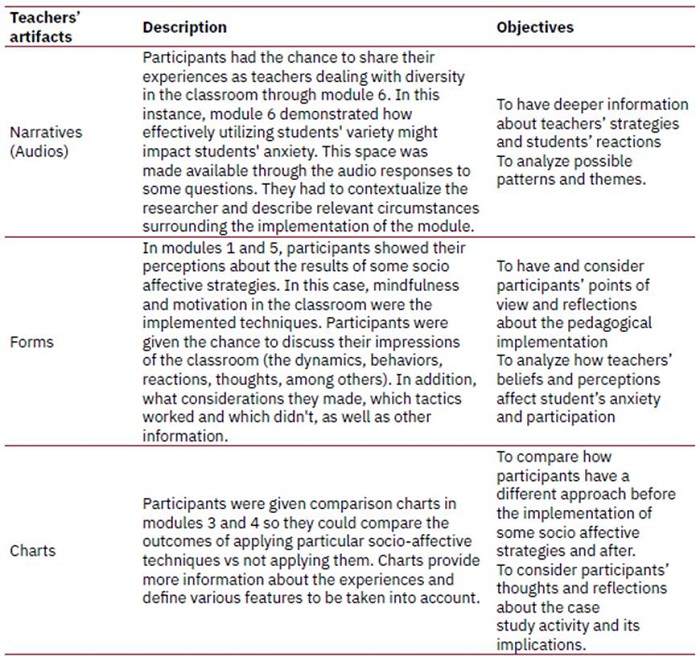
For this study, the data were gathered through surveys, voice recordings, the online course and teachers' artifacts with the intention of answering the research question. The survey was given to four English teachers in order to analyze how the implementation of socio-affective strategies through an online course could influence the teachers' practices in the classroom. The survey was conducted at the end of the 6th module implementation in a structured form to have a final and a general confirmation or verification of data collected during every module.
In this research, voice recording was used to help gather information about the preconceived notions participants have about socio affective strategies. At the beginning of each module, participants found questions related to their experiences and previous knowledge before starting to emerge on the module subject matter. The purpose of voice recordings was to analyze the position of the participants before exploring the module and had a contrast on how the information from the module affected their reflection and awareness of the topic at the end of it, with the aim of compering a difference after the course and notice if there was such influence.
Teachers' artifacts help the researchers identify and create a broader view related to teachers' perspectives. From different viewpoints and with the help of teachers' resources, it was enriched to notice how their realities and thoughts were connected each other. The teacher's artifacts were recollected through the online course which will be explained later on.
This study was carried out in Boyacá-Colombia with four teachers, two from high schools in public institutions, one from elementary and one from higher education in a university. Their ages ranged between 25 and 55 years old. They were from both genders. Participants were contacted in a genuine way by the researchers, who explained the main purpose of the study and also the online course, and voluntarily, decided to participate.
The Online Course
The online course is categorized by modules which represent the socio-affective strategies chosen by the researchers based on Oxford (1996) and Chamot and O'Malley (1994). The researchers did an exhaustive search based on the context and also teachers and students' needs to provide a suitable course. In every module presented, participants had the chance to develop some activities working with a specific socio-affective strategy. This, with the aim of seeing how well teachers acknowledged the strategies and also how pertinent they put them in to practice in the classroom. The course is the result of six modules in which the researchers joined efforts to get information about previous teachers' experiences, interests, thoughts and also expectations about the course. On the other hand, a participation section was considered in which teachers were asked to provide specific artifacts.
The online course design implied creating, choosing, and organizing resources to introduce and familiarize the participants with the use of Socio Affective Learning Strategies (SALLS) in the classroom. There was a need to articulate the highlights and similarities of both theories by Oxford (1990) and Chamot & O'Malley (1994) in the implementation of SALLS in the classroom. As a result, the researchers conducted a broad analysis and a new category proposal arose in order to fully fulfill the goal of the study, a total of 10 socio-affective strategies were planned.
- 1. Mindfulness in EFL contexts
- 2. Safe environments in EFL contexts
- 3. Engaging in learning a language process /Believing in myself
- 4. Being aware of what I do every day
- 5. Embracing and accepting my ups and downs
- 6. Motivation
- 7. Creating social agents'/ Embracing diversity
- 8. Becoming aware of others' thoughts and feelings
- 9. Solving problems together
- 10. Looking back and reward myself
Based on the previous socio affective strategies the following modules were planned and included in the online course, which was designed through the use of Wix.
- 1. Just chill out! (Mindfulness in EFL contexts)
- 2. Your happy place. (Safe environments in EFL contexts)
- 3. I've got this (Engaging in learning a language process /Believing in myself)
- 4. Making mistakes is part of the fun. (Embracing and accepting my ups and downs)
- 5. Eyes on the prize (Motivation)
- 6. He+ She+ They +You = Us (Creating social agents'/ Embracing diversity)
In the home section, the researchers explained the intention of the study and the relevance of implementing it. Additionally, it offers a brief description of each module. At the beginning of each module, the researchers provided some questions to analyze and perceive some of the participant's prior knowledge about the topic. Participants were required to send their responses regarding their experiences, opinions, and perspectives on the subject matter covered in that module via a WhatsApp audio. Each module represented and showed different elements characterized by the topic.
Just chill out! module arises from the idea of relaxing in the classroom, enjoying the class and easing anxiety level. According to Oxford (1990), one of the characteristics of lowering anxiety strategy was the use of progressive relaxation, deep breathing, and meditation. In this module, participants found a wide range of information related to mindfulness in the classroom. In this case, this module provided practices to be implemented in the classroom, mindfulness activities ideas for all ages, and a "Keep in mind" section where the researchers advised and reminded participants of aspects to be considered. As the final element in the module, a participation section is proposed. This time, the researchers asked participants to choose one of the suggestions or activities explained above and use it in the English classroom with a group of students. Once they have conducted the activity or considerations proposed by the researchers, participants filled in a Google Form with relevant results or highlights from the activity.
Your happy place module explains how making students feel safe and protected is not about having the biggest, warmest, and most colorful classroom. Instead, a few changes in dynamics and methodologies can make a difference in students' confidence and motivation.
I've got this was the third module. Participants had to reflect on their own experiences and any possible assumptions based on the title of the module. After a short description of the problem and personal experiences, participants found fundamental components and techniques. Participants also found activities, readings, and videos in order to support the module and also their knowledge about self confidence in EFL contexts. The way participants engaged with this module was through the implementation of two or three strategies in a group of students and then tracking relevant highlights.
Making mistakes is part of the fun (Embracing and accepting my ups and downs) was the title of the fourth module. Accepting and embracing mistakes should be crucial in the improvement of the self -confidence process. Socio affective strategies implementation requires disarming of our own prejudices and criticisms (Cloutier, 1989). In this module, participants discovered certain ideas and strategies to be applied or not applied in the EFL classroom as language teachers. With a Do's and Don'ts' section they could analyze and be aware of which behaviors or approaches could be adapted for increasing students' performance and smoothing their self-talk. Participants could also learn about the relevance of correcting mistakes since it may be one of the main causes of students' lack of confidence.
Participants could discover a brief description of types of motivation and the benefits of increasing motivation in the EFL classroom. The Eyes on the prize module emerged through the analysis and efforts to find a spot for students' fuel to achieve their learning goals. Consequently, a variety of resources, such as TEDtalks, articles, and videos, were presented. Additionally, some strategies or techniques were provided to use in the classroom, like: encouraging good relationships: teachers and students, being enthusiastic about your subject, making students active participants in the learning process and giving positive feedback.
The last module He + She +They +You = Us (Creating social agents / Embracing diversity) arose from the necessity to incorporate cooperative work into the language learning process, as well as to create social agents and to embrace diversity in the classroom. The module starts with a brief explanation about how relevant students should feel that they belong in the classroom. T hen, a "Keep in mind" section is shown to offer a better example and components. To conclude the module, participants had to send an audio recalling a previous event where they evidenced a lack of diversity awareness and how they dealt with it. Further questions were mentioned in the course to be answered: What strategy did you use in order to solve or control the situation? How did the students react to your intervention? Do you think you could have done it better? Why is it not negotiable to allow discrimination or disrespect against diversity? What ideas would you highlight from module 6? Was it useful and practical for you?
Results and discussion
Data were analyzed by a Thematic Data Analysis that enabled researchers to not only analyze but also comprehend the causes of several phenomena that occurred often during the participants' interventions and conduct. Most of the data gathered is the participants' perceptions about how the implementation of socio affective strategies impact teacher's practices in the classroom dynamic.
Categories of Analysis
Accept me for who I am not for what you want me to be. This category looks for understanding the importance of the self (as teachers and students) and the classroom dynamic around in terms of students and teachers' well-being and emotions, the results from this category are the evidence of the importance of understanding we all have different perspectives and realities and still it is relevant to accept them right as they are without judging but instead taking advantage of them for promoting good relationships.
Socio Affective Strategies for the win was the first subcategory emerged and refers to the way how the efforts to implement these strategies ends up in a victory for both classroom agents. Motivation was one of the most repeated words during the gathering data. Participants explained that motivation is the result of many other socio affective strategies implemented in the classroom.
The second subcategory was entitled The eternal conflict between Motivation and Frustration and it allowed to see students and teachers' frustration as a lack of motivation consequence. Participant 1 said:
"I've seen students who are very hard on themselves. From day one, they use expressions like, "Teacher, I'm bad at doing that." Teacher, I don't understand English. It gets complicated for me. From day one, students place obstacles"
Frustration may arise from different circumstances. The frustration in language learning means that during the process of learning, students may encounter emotional reactions coming from society, school and family (Yang, 2010). If there is no proper handling method, students may generate fear in others. This attitude will further impact students' learning interests. However, a distinction was evidenced in two different scenarios with the participants' contexts. In the module 4, prior knowledge section, participants were asked the following question: how do students handle frustration when they are having a bad moment in their learning process? What did you observe? Participant 1 and Participant 4 explained:
"I think it's very normal and I've seen it in all ages and contexts. The way students talk to themselves should change." Participant 1.
"Very few students are really looking to do the best they can, and when they are wrong, they don't reflect frustration. Even though, when they make mistakes, very few want to correct those mistakes. That frustrating moment in learning is not evident." Participant 4,
Based on these interventions, it infers that frustration may be altered according to the different contexts. Likewise, age plays an important role in this analysis. One of the biggest differences between these two contexts is that participant 1 teaches adults and participant 4 teaches young children, which is the result of a loss of learning interest. Long time interest loss will make the students give up on learning entirely. Part of the result of an adult's frustration is the awareness of the importance of learning a language. When do students learn about losing or having bad days?. Participant 1 said:
"Dealing with frustration is a skill that students did not learn, and we should teach them that it is something that is always present in the learning process." Participant 1.
In addition, frustration has been reported as a frequent emotion experienced by teachers (e.g., Cowie, 2011; Day & Leitch, 2001; King, 2016; Sutton, 2007). As a result, teachers' emotional well-being affects classroom performance, and likewise the dynamic of the class. (e.g., Larsen-Freeman & Cameron, 2008). Based on participants 4 and 1, they have experienced frustration in different situations:
"Motivating students to speak English outside of class has been a very difficult experience. In my case, for example, the older they are, the more fearful they are, or maybe they don't see the need to speak another language or the purpose." Participant 4
"I felt frustrated at the moment of creating a bond with my students. Therefore, I sometimes sensed a tense atmosphere in the classroom and I felt like the class was boring and the students were not interested in what I was teaching them." Participant 1.
Even if both interventions are about different situations taking place in the classroom, frustration is the emotion that both teachers try out on their students. Thus, motivation seems to be quite the opposite of frustration. However, it is relevant to highlight that, as it was explored earlier with motivation, teachers' frustration may affect classroom performance and, hence, students' motivation as well. In addition, a proper approach to talk about these types of events in the classroom could boost teachers' practices.
In the third sub category, an analysis of data was identified in terms of policies and the basic learning rights supported by the Ministerio de Educación Nacional, MEN, (2014).
The dichotomy between what I want and what I am asked for. Historically, the dichotomy between learning standards and assessment standards provided by the MEN (2014) has been controversial in the educational field. In 2014, Basic Learning Rights (BLR) and a Suggested English Curriculum were launched and looked for promoting equal conditions and suggested tools to teach English in Colombia.
However, participant 4 showed discontent related to what she is asked to teach and the results she should get from her students on standardized tests. On the other hand, participant 3 reported the need to work on students' self-confidence and self- image, even if it is not stipulated in the institutional curriculum.
Bearing in mind the participants' interventions, there is the intention of focusing on students' well-being, as social agents and as individuals. However, there exists a barrier between what teachers want for their students and what the law requires for them. It is critical to emphasize that learning is an active process in which students construct ideas about language by engaging themselves in it (Dewey, 1938 and Jonassen, 1999 cited in Bhattacharya, 2002). As another result of this subcategory, it was demonstrated how the inconsistency of educational rules has redirected students' real interests. When students comprehend how the educational system works and that all of their efforts are reduced to a numerical grade, they lose sight of the true significance of being engaged in the learning process.
A second category deals with the influence of healthy relationships between teachers/ students in the implementation of socio affective learning strategies.
It takes two sides to build a bridge. A bridge needs two sides to perfectly work. The same happens in the classroom, if one side of the bridge fails (teachers), it is very likely that the other side will as well (students). The effort and intention of helping students in their language learning process by teacher is evident through the analysis of the results in the second category. Easing students' anxiety, enhancing participation and teamwork, and embracing differentiation are examples of it. However, there is still a need to be more mindful of students' needs and interests. Part of this result is the non-symmetric relationship between teachers and students. There is a necessity of symmetric relationships that lead to healthy atmospheres.
Let's share the spotlight. is a subcategory that attempts to explain the importance of seeing the classroom agents as equal beings, learning from each other. A controversy in the language classroom is the definition of the teacher and learner's roles. From a humanistic approach, the relationship between learners and teachers takes place in a cooperative, sharing, open, and caring manner. (Corder, 1977). The teacher is seen as a facilitator who is more concerned with the class dynamic and atmosphere. In addition, teachers' responsibility is to lessen any feelings learners experience, such as fear or anxiety. On the other hand, a student's role should be seen as the focal point of the class, highlighting the respect and value placed on the individual. (Dubin, & Olshtain, 1986).
Based on the theory about socio-affective learning strategies and the information above, a common ground arises, the conception of an equal teacher-student relationship. In this case, Participant 3 and Participant 1 refer to the teacher's role as a mediator or facilitator, setting aside the non-symmetric relationship. Part of the teacher's role is to support students, as a result, participants reported the importance of finding the real motivation in order to catch students' attention and know their real interests. Involving students' thoughts and motivating students to express their ideas about the class was another strategy found. In this case, participant 2 embraces students' views as a strategy to make the lesson enjoyable and more comfortable. Affective teacher-student relationships have been found to contribute to the engagement and academic outcomes of students (Engels et al., 2021).
A good teacher, teaches from the heart. Teachers' connection with students not only involves academic processes. Teachers bring in their whole being to interact with their pupils. Under the light that a teacher should be seen as a facilitator through cooperative work, it should also be seen as a compassionate being. Compassionate teachers reflect a high-quality personality through which the students observe a role model in practice in the lessons, since compassion opens ways for teaching from the heart that enable inspiration for the good of the students. (Coskun, 2019).
Throughout the analysis of the module, appealing results were found. One of the moments in which teachers should show compassion to their students is the moment of giving feedback. Although it is not easy work, feedback may provoke positive or negative emotions in the students. Such is the case of Volet (2015) who examined both good and negative emotions created by the interpersonal interaction between the instructor and the student, activity feedback, and the student's participation in the classroom, discovering that these essential relationships were associated with feelings of joy, wrath, and anxiety. As another finding, participants provided some other examples related to the importance of taking students' feelings into consideration and having the role of a compassionate teacher. A compassionate personality not only contributes to students' social and emotional growth. It also gives a valuable contribution to the students in terms of their intellectual growth through teaching knowledge and information. (Coskun, 2019).
In module 3, participants were exposed to some recommendations in order to foster students' self-image and self-confidence as part of the Socio Affective Language Strategies. Through the implementation of some advices like praising their efforts, giving students a chance to teach you, asking them about their goals and avoiding correcting words in every speech it was possible to evidence the benefits of applying these strategies in the EFL classroom. The implementation of these strategies boosted more considerations that take place in the classroom. Besides fostering students' emotional domains like self-confidence, commitment, and openness, teachers also identified that aspects such as participation, students' concentration, and engagement increased. As a result, their academic process had a positive impact as well.
When teachers are open to promoting positive feelings and implementing socio-affective strategies among students in the classroom, students' academic and emotional processes have a positive impact. Compassion arises from the teachers' human domains and plays an essential role in the classroom in order to make students feel safe. Actually, compassion allows teaching from the heart because the heart itself creates an environment for treating the respective students with forgiveness and kindness.
Once the teacher's role is explored, a trip to the past was needed. It is essential to acknowledge how teachers' personalities influence the classroom performance. As a result, it is pertinent to look back at the past and see how teachers are the result of the students they were back then.
First was the student and then was the teacher. During the process of this study and teachers' participation, it was significant to analyze how teachers perceive students in the classroom and how their own experiences as students shape the teacher they are now. With the intention of inquiring more about the influence of their previous experiences as students in their current practices, the researchers proposed the following question, in the middle of the study: Has your educational experience as a student affected your teaching practices? Participants have expressed neither positive or negative experiences which indeed have forged their teaching process.
Teachers' experience becomes a key factor that can affect their performance (Rice 2010), since it influences the learning effectiveness and quality and encourages the students' motivation, attitude, behavior, and development. Teachers' experiences determine the educational process's success and are related to the way they perceive the class and acknowledge their students. In addition, teachers have seen their previous teachers as role models. Although positive and negative experiences emerged, participants have discerned what they consider right and useful and discarded what they do not. As a result, pre-service teachers should be encouraged to examine through critical reflection how the instruction they are receiving embodies what they are learning about teaching (Freeman & Richards, 1996). Thus, enabling pre-service teachers to be reflective at an early stage of their teacher development becomes a significant problem for teacher education programs. (Pollard, 2002)
Another intriguing point to analyze was the way how participants remembered their role models. Although the researchers' intention was to gather data from different teaching aspects related to methods, approaches or even theory, participants preferred to point out how their teachers made them feel at some point of their lives. Positive or negative experiences shape all human beings' personalities and behavior, including teachers. Nevertheless, it is worth clarifying that even if teachers had experiences which shaped their teaching performance, there are other competencies which could determine teachers' conduct. For instance, the length a teacher has been working in the teaching field (Rakib et al., 2016). Also, the age affects the teachers' experiences. Junior teachers tend to have less experience compared to the senior teachers. Moreover, senior teachers are considered more mature and stable with a more qualified and balanced perspective, so they are not vulnerable to undergo mental pressure at work (Al Mutahar et al., 2015).
Conclusions
The present study supports the significance of implementing socio affective strategies and their influence in teachers' practices in the EFL classroom. One of the main findings was the urgency of acknowledging Socio Affective Strategies in any learning process. Such is the case of the benefits of motivation in the context, the importance of being compassionate teachers, the acknowledgement from previous experiences, and the relevance of promoting positive self-talk among others. The implementation of any strategy to assist and manage students' emotional domains should be reflected in the teacher's practices.
The first finding was the role of students' motivation through the combination of implementing other socio-affective strategies. The analysis displayed how teachers put into practice certain techniques, such as being interested in students' context, engaging and involving students' background, encouraging positive self-talk, among others in order to achieve students' motivation in the classroom.
In order to be aware and inquire about students' affective domain, teachers are found at a crossroads between the desire to use creative strategies and what educational policies require in the EFL classroom. As a consequence, an inconsistency dynamic emerges among students and their efforts are addressed and determined to a quantitative result. Likewise, part of the teacher's role has been affected since teachers put aside their cooperative competence in order to become merely a knowledge provider and incentivize just cognitive processes.
Under the light of the significance of healthy relationships in the classroom in order to have a successful socio-affective strategy implementation, the researchers noticed is pertinent to discuss teacher's affective domains as well. Additionally, there was a prevalence of seeing the teacher role as a compassionate being. A compassionate personality helps learners develop excitement, positive connections, meaningful learning, a safe environment, positive management, and positive teamwork. Besides, it revealed the preventive measure of providing kind and insightful feedback, such efforts to reduce emotions of anger or anxiety in the classroom.
The research joined efforts to analyze if previous educational experiences as a student shape the way teachers see or perceive their students nowadays. As it was stated before, teachers and students' affective domains may be affected by each other. Subsequently, teachers' experiences become crucial in their teaching performance since they influence the students' academic outcomes and, thus, their attitude. Therefore, it depends on the teacher to select valuable and useful components and remove unnecessary ones from their prior experiences.
When it comes to teachers' memories and background, another interesting discovery was how instructors recall how their teachers made them feel at some point on their path to becoming teachers. Unlike theories, methods, or approaches implemented in the classroom, teachers preferred to recall how their teachers fueled their socio-affective domains.
In essence, language teachers' practices were in fact influenced by a socio affective learning strategies online course strengthening different classroom dynamic areas, for instance, teacher student relationships, the dichotomy of what teachers consider to do and what policies really expect, the analysis, reflection and impact about previous learning experience when teachers were students, and the acknowledgement of a variety of approaches for implementing these strategies constantly and in the classroom.
This study provided spaces where teachers were not thinking just about how to help students but instead how through those strategies they can acknowledge their own affective domains in harmony with the students' affective domain in the classroom. Teachers had the chance to attempt different practical activities based on their gut and criteria. They were able to choose the more suitable one and implement it. On the other hand, the researcher's practice on building a whole online course from scratch based on specific contexts and needs allowed an appropriate adaptation of these strategies and more importantly, a supporting web at specific moments in the online course where teachers were able to express their emotions and thoughts about the implementation. In this case this research paid more attention to teachers' voices. In light of this, the inquiry about the influence of socio affective strategies, the teachers' affective domains and the language teachers' practices emerged a new outlook in research, one in which the teachers' roles and voice on the issue predominate.
References
Al Mutahar, F. F., Nurul, W., & Rafie. (2015). Pengaruh Usia, Pengalaman Kerja, Disiplin Kerja, Dan Motivasi Kerja Terhadap Produktivitas Pekerja. [The Influence of Age, Work Experience, Work Discipline and Work Motivation on Worker Productivity]. Jurnal Mahasiswa Teknik Sipil Universitas Tanjungpura, 1(1), 1-11.
Bhattacharya, M. (2002). Creating a Meaningful Learning Environment Using ICT. from: http://www.cdtl.nus.edu.sg/brief/v5n3/sec3.htm
Chamot, A'U. & O'Malley, J.M. (1994). The CALLA handbook: Implementing the Cognitive Academic Language Learning Approach. White Plains, NY: Addison Wesley Longman.
Cloutier, R. (1989). Walz, Joel C., Error correction techniques for the FL classroom. Language in education: Theory & practice series, Washington D.C. Centre for Applied Linguistics, 1982. The Canadian Modern Language Review, 45(4), 755-756. https://doi.org/10.3138/cmlr.45.4.755
Corder, S. P., B., A. J. P., & Davies, A. (1977). The Edinburgh course in Applied Linguistics. Oxford University Press.
Coskun, L. (2019). The characteristics of Compassionate Teachers as Role Models Opens Ways for Passion, Inspiration, and Openness to the Students. [Conference Session].
Cowie, N. (2011). Emotions that experienced English as a Foreign Language (EFL) teachers feel about their students, their colleagues and their work. Teaching and Teacher Education, 27(1), 235-242. doi: https://doi.org/10.1016/Ltate.2010.08.006.
Day, C., & Leitch, R. (2001). Teachers' and teacher educators' lives: The role of emotion. Teaching and Teacher Education, 17(4), 403-415. https://doi.org/10.1016/s0742-051x(01)00003-8
Dubin, F. & Olshtain, E. (1986). Course Design. Developing Programs and Materials for Language Learning. Cambridge University Press, Cambridge.
Engels, M. C., Spilt, J., Denies, K., & Verschueren, K. (2021). The role of affective teacher-student relationships in adolescents' school engagement and achievement trajectories. Learning and Instruction, 75, 101485. https://doi.org/10.1016/j.learninstruc.2021.101485
Freeman, D. & Richards, J.C. (1996). Teacher Learning in Language Teaching. Cambridge: Cambridge University Press.
Gregersen, T. S. (2003). To err is Human: A Reminder to Teachers of Language-Anxious Students. Foreign Language Annals, 36(1), 25-32.
King, J. (2015). "It's time, put on the smile, it's time!": The emotional labour of second language teaching within a Japanese university. New Directions in Language Learning Psychology, 97-112. https://doi.org/10.1007/978-3-319-23491-5_7
Larsen-Freeman, D., & Cameron, L. (2008). Complex Systems and Applied Linguistics. Oxford University Press.
Ministerio de Educación Nacional (MEN). (2014). Derechos Básicos de Aprendizaje. Inglés. Bogotá: MEN.
Ministerio de Educación Nacional. (2016). Esquema curricular sugerido inglés. English for diversity and equity. Bogotá, Colombia.
Oxford, R. (1990). Language learning Strategies: What Every Teacher Should Know. New York: Newbury House.
Oxford, R. (Ed.). (1996). Language Learning Strategies around the World: Cross-Cultural Perspectives. Honolulu, HI: University of Hawaii Press
Pollard, D. (2002). A User's Guide to Measure Theoretic Probability. https://doi.org/10.1017/cbo9780511811555
Rakib, M., Rombe, A., & Yunus, M. (2016). "Pengaruh Pelatihan Dan Pengalaman Mengajar Terhadap Profesionalitas Guru (Studi Pada Guru IPS Terpadu Yang Memiliki Latar Belakang Pendidikan Dalam Bidang Pendidikan Ekonomi). Jurnal Administrate 3(2), 137-148
Rice, J. K. (2010). The Impact of Teacher Experience Examining the Evidence and Policy Implications. CALDER, [Working Paper], 1-8.
Rubio, F. (2007). Self-esteem and Foreign Language Learning. Cambridge Scholars Publishing
Sutton, R. E. (2007). Teachers' anger, frustration, and self-regulation. Emotion in Education, 259-274. https://doi.org/10.1016/b978-012372545-5/50016-2
Volet, S. E. (2015). Teacher Emotions in the Classroom: Associations with Students' Engagement, Classroom Discipline and the Interpersonal Teacher-Student Relationship. European Journal of Psychology of Education, 3 (1), 385-403.
Wallerstein, N., Durán, B., Oetzel, J. G., & Minkler, M (Eds.). (2017). Community D based Participatory Research for Health. San Francisco: Jossey D Bass.
Yang, H. (2010). Thinking on Middle Students' Frustration Situation. The Road To Success, 4(1), 56-58
Yang, J (2021) Revisiting Research Methods in Language Learning Psychology From a Complexity Dynamic System Theory Perspective. Front. Psychol. 12:741045. doi: 10.3389/fpsyg.2021.741045
Notes