Original Article
Song-based methods and critical reflection: experiences of Brazilian older adults in music therapy
 Mauro Pereira Amoroso Anastacio
Sekyung Jang
Olga Rodrigues de Moraes von Simson
Mauro Pereira Amoroso Anastacio
Sekyung Jang
Olga Rodrigues de Moraes von Simson
Song-based methods and critical reflection: experiences of Brazilian older adults in music therapy
Geriatrics, Gerontology and Aging, vol. 19, e0000292, 2025
Sociedade Brasileira de Geriatria e Gerontologia, SBGG
Received: 14 January 2025
Revised document received: 26 May 2025
Accepted: 23 June 2025
Funding
Funding source: CAPES
Contract number: 001
Funding statement: The present work was carried out with the support of the Coordination for the Improvement of Higher Education Personnel - Brazil (CAPES) - Funding Code 001.
Abstract
Objective: To explore the lived experiences of Brazilian older adults participating in group music therapy sessions that incorporated song-based methods, with a focus on how these experiences fostered dialogue and critical reflection.
Methods: This phenomenological study involved a music therapist facilitating 12 weekly 1-hour sessions with a group of 12 Brazilian older adults. Audio recordings from all sessions were transcribed and analyzed using a thematic approach grounded in phenomenology. The artificial intelligence tool GPT-4 and member checking were employed to ensure the reliability of results.
Results: The analysis revealed that song-based methods encouraged discussion and critical reflection on the aging process, relationships, ageism, gender roles, and cultural change over time.
Conclusion: The song-based methods created a reflective space that supported expression and social dialogue among older adults. Future research should explore their long-term effects and adaptability across diverse contexts.
Keywords: Older adults+ gerontology+ music therapy.
INTRODUCTION
Demographic projections indicate that by 2060, approximately one-quarter of the Brazilian population will be 65 years or older.1 This phenomenon is leading to significant shifts in the cultural understanding of the life cycle, altering perceptions of aging and challenging traditional notions of age.2 Consequently, it is important for practitioners to adopt integrated approaches that consider the complexity of the aging process across the lifespan.3
In recent decades, there has been a marked increase in research exploring the potential of the arts in promoting health, particularly among older adults.4 Group experiences such as singing may enhance a sense of belonging, promoting faster social bonding compared to other activities.4 Song-based interactions may also reduce prejudice by fostering empathy, challenging stereotypes, and promoting positive intergroup behaviors.4
According to DeNora,5 music can regulate emotional states and promote well-being by providing comfort and fostering connections. In music therapy, musical experiences are purposefully guided to enhance quality of life, encompassing diverse contexts and perspectives on the role of music in health promotion.6 Among older adults, music therapy can strengthen identity and improve self-management skills, empowering individuals to cope with the changes inherent to aging.7
Although the therapeutic use of music dates back to ancient times, music therapy was formalized as a clinical practice in the second half of the 20th century. It allows clients to engage with their musical preferences, which play a significant role in identity formation.6 Such engagement can stimulate the recall of autobiographical memories and strengthen social bonds.8
Bruscia9 describes different music therapy methods that incorporate songs to address specific therapeutic goals. In song-assisted recall, clients are encouraged to identify songs associated with particular themes. Similarly, in song discussion, songs are introduced as stimuli to explore topics of therapeutic relevance. These approaches can evoke emotional responses, support the exploration of personal meanings, and foster social connections.
Although previous research has highlighted the benefits of music for health and well-being,4,5 little attention has been given to how shared musical experiences, whether through singing, listening, or both, can foster meaningful discussions involving relevant social themes, such as age discrimination, among active older adults in community spaces. This study aimed to explore the lived experiences of Brazilian older adults participating in group music therapy sessions that incorporated song-based methods, with a focus on how these experiences fostered dialogue and critical reflection.
METHODS
This phenomenological study was approved by the Research Ethics Committee of the institution to which the first author is affiliated (Opinion No. 5.598.557), under Certificate of Presentation for Ethical Consideration No. 59478422.0.0000.5404, approved on August 23, 2022. All participants provided written informed consent, and formal authorization was obtained from the academic program in which the study was conducted.
The study was conducted in collaboration with a university-based program in Campinas, São Paulo, Brazil. Twelve participants were recruited through an open call published on the program’s website. Eligibility was determined with the aim of fostering participant engagement throughout the entire process. Inclusion criteria were: being 60 years or older, being fully vaccinated against COVID-19, being available to attend weekly sessions, and self-reporting the ability to carry out daily activities and make personal decisions.
Participants were between 60 and 93 years of age, with a mean age of 66.8 years (SD = 9.11). All participants had been married, and 10 reported having children. Socioeconomic status was assessed using a subjective self-rating scale, in which participants evaluated their condition along a continuum ranging from “very bad” to “very good.” Eight participants rated their socioeconomic status as “good,” while four described it as “neither bad nor good.”
The group represented diverse professional backgrounds, including educators, a speech therapist, and a systems analyst. All participants reported active involvement in several activities, such as physical exercise and social or educational programs. Although some reported chronic health conditions (eg, hypertension), none required continuous care or assistance.
The intervention consisted of 12 weekly 60-minute group music therapy sessions held in a room provided by the university-based program. The sessions took place between August and November 2022 and were conducted once a week. Participants engaged in singing, music listening, and songwriting, aiming to promote social interaction.9 Throughout the process, participants contributed a diverse selection of songs drawn from their personal histories.
An overview of the session structure is presented in Table 1.10-16
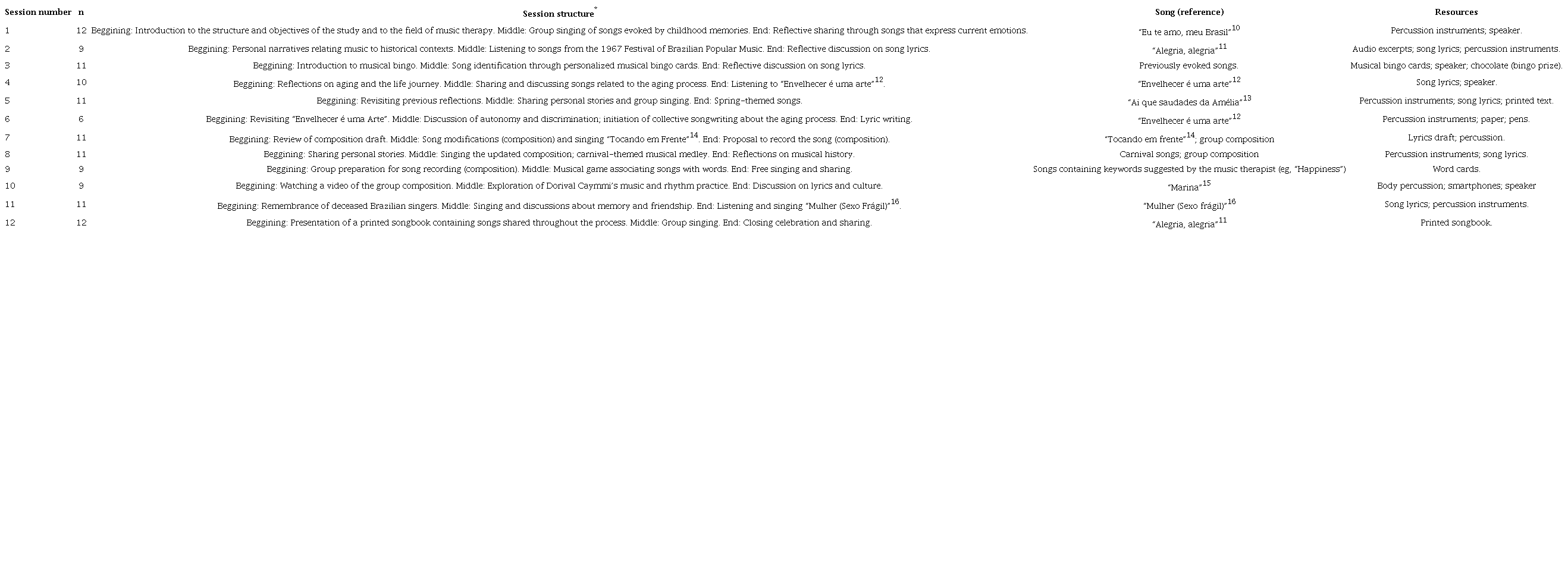
* Structure and key activities of each session.
The analysis focused on participants’ verbal expressions related to the songs evoked during the process, the memories shared, and the discussions promoted by the experience. The transcribed verbal content from the sessions was analyzed using a thematic analysis approach grounded in phenomenological inquiry, as outlined by Creswell.17 The first author carried out the analysis.
The analytical process followed an inductive and iterative logic aimed at identifying significant statements, grouping them into units of meaning, and clustering these units into emergent themes that reflected the lived experiences of the participants. The analysis followed steps adapted from the methodological procedures outlined in the studies by music therapists Zanini18 and Jang19:
-
a. Data organization and immersion: All transcriptions were read multiple times to gain a comprehensive understanding of the material. Reflexive field notes were also consulted to contextualize participant expressions.
-
b. Initial coding: Complete narrative segments of text that captured relevant experiences, meanings, and reflections were coded using NVivo software. Coding was performed inductively, allowing categories and subcategories to emerge directly from the data rather than being imposed a priori.
-
c. Development of themes: The codes were reviewed and grouped into broader themes and subthemes that encapsulated shared patterns across participants. Attention was given to how the meanings were constructed through musical interactions and reflective dialogue during the sessions.
-
d. Interpretation of meanings: Themes were interpreted in relation to the study’s guiding perspective and contextualized within existing literature in music therapy and gerontology.
All transcripts were anonymized, with personal identifiers removed and pseudonyms assigned. GPT-4, an artificial intelligence tool, was used to synthesize transcriptions and validate theme consistency. The transcriptions were processed through GPT-4, which synthesized the key themes. Results aligned with the researchers’ findings. Member checking was conducted to ensure credibility.
RESULTS
The researcher identified four main themes, each with corresponding subthemes. Each theme is illustrated with participant quotations (P) and examples of songs shared during the process.
Emergent theme 1: The aging process and old age
This theme focuses on discussions about the aging process. Participants shared perspectives on topics such as the acceptance of time, wisdom, personal growth, and age discrimination.
Subtheme 1: Socio-family relationships in the aging process
The experience prompted reflections on family dynamics, emphasizing the negative impact of excessive care on the independence of older adults. Songs such as “Couro de boi”20 and “A lista”21 evoked memories, emotional responses, and reflections on how relationships change over time. The lyrics “Ten children don’t care for one father”20 and the question “Who did you see most often ten years ago?”21 were particularly impactful in stimulating participants’ insights about family roles, friendship, and shifting priorities in later life.
I had a friend whose family wouldn’t let him do anything, and he started losing everything. (P1)
My family tells me not to leave the house so much, out of concern. (P2)
A father takes care of 10 children, but one child finds it difficult to take care of one father. (P3)
Pick 10 or 20 friends you had years ago, and you’ll see that today, you barely have any left. (P4)
Now I prefer smaller groups, I don’t want big parties (...) quality over quantity. (P5)
Subtheme 2: Age-related roles and stereotypes
Music therapy provided a space for participants to reflect on how society perceives individuals at different stages of life. Discussions highlighted challenges such as a lack of inclusion and societal expectations, as well as changes in cultural norms over time. Songs like “Panela velha”22, particularly the line “Old pots make the best food”22, resonated with participants and facilitated reflections on age-related roles, activity levels, and the evolving experience of aging.
The transition from when you’re young and go clubbing, and when you turn 50, you’re neither young nor quite in the elderly group. (P6)
I’m 93 years old, and I’m still active as always, but I’ve never stopped. (P1)
By 40, people used to give up, sit down, watch TV. (P7)
Subtheme 3: Resilience in the aging process
This subtheme highlighted participants’ discussions on overcoming challenges and adapting to the aging process with acceptance and perspective. The song “Tocando em Frente,”14 especially the lyrics “I only know for certain that I know very little,”14 served as a prompt for discussing inner strength, changes, and the importance of following the natural course of life.
Some things, like today’s rain, we can’t avoid, but other things we can, like how we face life. (P8)
We don’t lose cognition, it just slows down. (P7)
Time itself teaches us, our minds, our bodies. If you follow and accept it, it’s better. (P9)
Subtheme 4: A space to explore age discrimination
The repertoire provided a platform for participants to reflect on experiences of ageism and the importance of respect and recognition. Songs like “Envelhecer é uma Arte,”12 particularly the lyrics “When someone calls you old, don’t mind it,”12 catalyzed discussions on how aging is addressed in social contexts. The group emphasized the need to go beyond stereotypes and highlighted the value of intergenerational exchange and mutual understanding.
It’s not about needing to be patient with older adults, but about knowing how to resolve problems because everyone is different. (P5)
We want to be seen and respected. (P10)
Sometimes young people from the university would come to our Lian Gong practice and were amazed. (P2)
Emerging theme 2: Representations of gender and romantic relationships
This theme addresses the representations of gender and romantic relationships as perceived by the participants.
Subtheme 1: Gender stereotypes and sexism in song lyrics
Participants discussed the gender stereotypes and sexism portrayed in some songs, reflecting on how cultural norms and representations of femininity and masculinity are embedded in popular music. Songs like “Marina”15 and “Mulher (Sexo frágil)”16 served as triggers for these discussions. Lyrics such as “Don’t paint that face that I like, and that belongs only to me”15 and “They say that women are the weaker sex, but what an absurd lie”16 prompted critical reflections on the valorization of women and societal double standards related to age and gender.
This song is very sexist, but it’s beautiful. (P9)
The singer was ahead of his time. (P2)
Women were also sexist and raised men that way. A more sensitive man was called ‘sissy’. (P5)
In the lyrics, it says that a woman over 30 is considered old. (P8)
Subtheme 2: Romantic and marital relationships
The songs sparked discussions about romantic and marital relationships, highlighting how lyrics reflect gender roles, sexism, and violence. Songs like “Ai que saudades da Amélia”13 and “Se eu te agarro com outro te mato”23, with lines such as “Amélia had no vanity. Amélia was the real woman,”13 served as starting points for participants to reflect on the evolution of societal values, especially in relation to gender expectations and partnership. These conversations also brought up personal memories and the significance of companionship in later life.
If the singer wrote this song saying these things nowadays, he would be arrested. (P10)
My mother divorced from my father and was considered a prostitute. (P5)
It’s better to be accompanied; otherwise, there’s no one to talk to. (P2)
Emerging theme 3: Sociopolitical transformations and historical events
This theme discusses the relationship between music and the construction of cultural identity and the expression of social and political experiences.
Subtheme 1: Music and historical memory
Participants emphasized how musical repertoire is tied to sociopolitical contexts. Tracks such as “Eu te amo, meu Brasil”10 and “Alegria, alegria”,11 with lyrics such as “Through photos and names, without books or rifles, without hunger, without phones,”11 evoked memories of censorship, propaganda, and resistance. The discussions reinforced music’s role both as a tool of control and a form of protest.
It was mandatory to sing it all the time, as well as the Brazilian national anthem. (P2)
The dictatorship period. It was a very sad time. (P11)
Singers Alvarenga and Ranchinho were always criticizing Getúlio Vargas and were imprisoned. (P11)
Subtheme 2: Contemporary sociopolitical reflections
Participants discussed the contemporary relevance of the songs to the current sociopolitical reality. The discussions centered on themes of social inequality sparked by songs such as “Coração civil”24. Lyrics such as “I want justice to reign in my country. I want freedom”24 resonated with the group, who reflected on how these songs remain applicable. The dialogue highlighted both structural inequalities and individual perspectives on effort and opportunity, underscoring music’s role in reflecting and provoking thoughts about social realities.
This song is very relevant today. (P12)
Today, we are facing much suffering, and we can’t smile. (P11)
Some people can work for what they have because they had the opportunity and education. (P9)
Emerging theme 4: Social and linguistic changes
The songs promoted discussions about transformations in communication and culture over the years, addressing how customs are shaped by historical and social contexts.
Subtheme 1: Changes in language and communication
Participants reflected on changes in language and communication, highlighting songs from the 1960s as a source of popular expressions that have shaped collective identity over time. They discussed the cyclical nature of these expressions and how some have resurfaced in contemporary speech. The group also addressed shifts in cultural norms related to language use and social sensitivities.
There was ‘bacana’ [cool], and ‘legal’ [nice]. ‘Bacana’ has come back. (P7)
Adoniran mentioned that they called him grandpa (...) today we can’t call anyone anything. (P4)
Subtheme 2: Behavioral changes over time
Participants discussed behavioral changes over the years and how they perceived these changes. Using songs as a starting point, they identified the persistence of some old practices alongside shifts in values and social behaviors. Reflections included observations about enduring traditions as well as changes in everyday social etiquette, illustrating evolving patterns in interpersonal interactions (Figure 1).
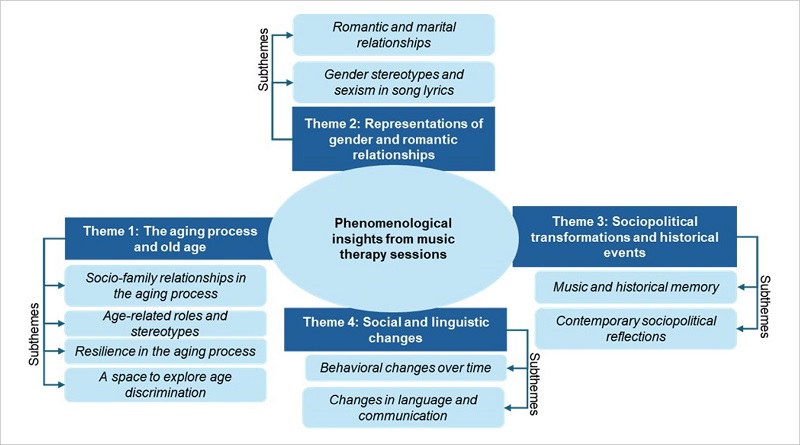
Figure 1
Emergent phenomenological themes and subthemes from music therapy sessions, 2025.
In the countryside, people’s sense of time is different. (P11)
I started talking to the worker, and he responded with ‘Good morning.’ I realized I no longer greeted people. (P7)
DISCUSSION
Our findings show that the strategies employed promoted reflections on themes such as aging, interpersonal relationships, and stereotypes. Narratives from Theme 1, such as “I had a friend whose family wouldn’t let him do anything, and he started losing everything” (P1), highlight the influence of family relationships on the independence of older adults. Behavioral dependence can increase in overprotective environments, which may contribute to functional decline.25 In music therapy, songs that address overprotectiveness may promote the sharing of personal experiences and increase awareness.
Songs such as “Tocando em Frente” prompted the sharing of perspectives on themes such as resilience, as reflected in accounts like: “If you follow and accept it, it’s better” (P9), from Theme 1. These accounts align with the life-span development paradigm, which views human development as a continuous process involving both losses and gains.3
The analysis also revealed that participants reflected on how representations of aging have changed over time, as illustrated in Theme 1 by statements such as “By 40, people used to give up, sit down, watch TV” (P7). This can be understood through the lens of subjective aging, which emphasizes the role of individual perceptions, shaped by social context, in influencing behavior.26 These narratives suggest that age categories are socially constructed, underscoring the need for ongoing discussions on aging.
Our findings also suggest that song discussions may serve as a means of promoting reflections on ageism. This is exemplified by narratives from Theme 1 such as “It’s not about needing to be patient with older adults, but about knowing how to resolve problems” (P5). Discussing ageism may help combat the internalization of negative stereotypes, which often leads older adults to adopt more limited social roles.27 P2 reported an experience illustrating the potential benefits of intergenerational interactions: “Sometimes young people from the university would come to our Lian Gong practice and were amazed,” which supports the Pan American Health Organization’s recommendations emphasizing the importance of promoting intergenerational initiatives to combat ageism.28
From the perspective of aging as ongoing development, narratives such as “Now I prefer smaller groups, I don’t want big parties (...) quality over quantity” (P5) align with Carstensen’s socioemotional selectivity theory.29 According to the theory, as individuals age, they tend to prioritize emotionally meaningful experiences and relationships over broader social engagements. This shift is driven by the awareness of limited time, which leads older adults to focus on emotionally satisfying connections.29
Other songs evoked themes of gender, history, and sociocultural changes, triggering autobiographical memories and sparking reflections, as illustrated by comments such as: “My mother divorced from my father and was considered a prostitute” (P5). Additionally, the statement “If the singer wrote this song saying these things nowadays, he would be arrested” (P10) reflects an awareness of past gender-based norms and suggests a generational shift in values. The songs prompted participants to revisit personal experiences while relating them to broader societal shifts in gender roles, and social expectations.
This study has some limitations. The inclusion criteria focused on a specific group of active older adults, which limits the generalizability of the findings. This criterion excluded individuals with varying degrees of functional limitations who could potentially benefit from more assisted settings. Additionally, the study was conducted within a specific geographical context, which may affect the transferability of the findings to other settings.
The duration of the intervention and the small sample size also represent limiting factors. A larger sample and a longitudinal follow-up would provide a more comprehensive understanding of long-term impacts. The reliance on self-report of participants’ ability to perform daily activities may also introduce potential bias. The dual role of the music therapist as both facilitator and primary data analyst may also introduce interpretative bias, despite the use of reflexive notes and member checking.
CONCLUSIONS
This study explored the shared experiences of 12 Brazilian older adults participating in music therapy sessions using song-based methods to retrieve autobiographical memories, promote social interaction, and encourage personal expression. The findings reveal that music therapy facilitated discussions and critical reflection on topics relevant to participants.
By using familiar songs as entry points for discussion, therapists can facilitate critical engagement with social themes such as ageism and intergenerational relationships. This approach highlights music therapy as a space for social reflection and dialogue, particularly in community settings. Future research could explore how these methods may impact empowerment, and psychological resilience among aging populations, as well as investigate the long-term effects and broader applicability of such interventions in diverse cultural contexts, including rural populations.
We conclude with a personal reflection from participant P11, shared at the end of the music therapy process:
Times change, desires change, but the desire to remember the moments that shaped us remains. And my heart beats happily and I know why: because I see illuminated faces sharing emotions, amidst songs, chants, and melodies from a not-so-distant past, echoing in our hearts, lighting up the deep train of our lives. Sing, sing, my people, leave the sadness behind, sing loud, sing proud, for life will get better (P11).
ACKNOWLEDGEMENTS
The present work was carried out with the support of the Coordination for the Improvement of Higher Education Personnel - Brazil (CAPES) - Funding Code 001.
REFERENCES
Instituto Brasileiro de Geografia e Estatística. Projeções da população do Brasil e unidades da Federação por sexo e idade: 2010-2060. Available from: https://www.ibge.gov.br/estatisticas/sociais/populacao/9109-projecao-da-populacao.html?=&t=resultados. Accessed on Jul 30, 2024.
Mortimer JT, Moen P. The changing social construction of age and the life course: Precarious identity and enactment of “early” and “encore” stages of adulthood. In: Shanahan MJ, Mortimer JT, Kirkpatrick Johnson M, editors. Handbook of the life course. Cham: Springer; 2016. p. 111-29. https://doi.org/10.1007/978-3-319-20880-0
Baltes PB, Reese HW, Lipsitt LP. Life-span developmental psychology. Annu Rev Psychol. 1980;31(1):65-110. https://doi.org/10.1146/annurev.ps.31.020180.000433
Fancourt D, Finn S. What is the evidence on the role of the arts in improving health and well-being? A scoping review. Geneva: World Health Organization; 2019. Available from: https://iris.who.int/handle/10665/329834. Accessed on Jul 30, 2024.
DeNora T. Health and music in everyday life: a theory of practice. Psyke & Logos. 2007;28(1):271-87.
Bonde LO. Music and health promotion in Danish/Nordic hospitals - who and how? An essay. In: Bonde LO, Johansson K, editors. Music in paediatric hospitals - Nordic perspectives. Oslo: Norwegian Academy of Music; 2020. p. 149-69.
McDermott O. Aging, adaptation, connection and music. Nord J Music Ther. 2020;29(1):1-3. https://doi.org/10.1080/08098131.2020.1694791
Engelbrecht R, Bhar S, Ciorciari J. Planting the SEED: a model to describe the functions of music in reminiscence therapy. Complement Ther Clin Pract. 2021;44:101441. https://doi.org/10.1016/j.ctcp.2021.101441
Bruscia KE. Defining music therapy. 3rd. ed. Gilsum: Barcelona Publishers; 2014.
Os Incríveis. Eu te amo, meu Brasil [Sound recording]. Rio de Janeiro: RCA Records; 1970.
Veloso C. Alegria, alegria. In: Veloso, C. Caetano Veloso [Sound recording]. São Paulo: Philips Records; 1967.
Barbosa A. Envelhecer é uma arte [Sound recording]. São Paulo: EMI-Odeon Brasil; 1976.
Lago M, Alves A. Ai que saudades da Amélia [Sound recording]. Rio de Janeiro: EMI-Odeon Brasil; 1942.
Bethânia M. Tocando em frente. In: Bethânia M. 25 anos [Sound recording]. São Paulo: Universal Music Group; 1990.
Caymmi D. Marina [Sound recording]. Rio de Janeiro: RCA Victor; 1947.
Carlos E. Mulher (sexo frágil). In: Carlos E. Mulher (Sexo frágil) [Sound recording]. São Paulo: RCA Victor; 1981.
Creswell JW. Qualitative inquiry & research design: Choosing among five approaches. 3rd. ed. Los Angeles: SAGE Publications; 2013.
Zanini CRO. Coro terapêutico: um olhar do musicoterapeuta para o idoso no novo milênio [dissertação]. Goiânia: Universidade Federal de Goiás; 2002. https://doi.org/10.13140/RG.2.1.1501.0802
Jang S. Intergenerational choir: a qualitative exploration of lived experiences of older adults and student music therapists. J Music Ther. 2020;57(4):406-31. https://doi.org/10.1093/jmt/thaa012
Palmeira B. Couro de boi. [Sound recording]. São Paulo: RCA Victor; 1954.
Montenegro O. A lista. In: Montenegro O. A lista [Sound recording]. São Paulo: Jam Music; 2001.
Reis S. Panela velha. In: Reis S. Panela velha [Sound recording]. São Paulo: RCA Records; 1983.
Magal S. Se eu te agarro com outro te mato. In: Magal S. Sidney Magal [Sound recording]. Rio de Janeiro: Polydor Records; 1977.
Nascimento M. Coração civil. In: Nascimento, M. Caçador de mim [Sound recording]. São Paulo: Universal Music Ltda; 1981.
Baltes MM. Dependency in old age: gains and losses. Curr Dir Psychol Sci. 1995;4(1):14-9.
Diehl M, Wahl HW, Brothers A, Miche M. Subjective aging and awareness of aging: toward a new understanding of the aging self. Annu Rev Gerontol Geriatr. 2015;35(1):1-28. https://doi.org/10.1891/0198-8794.35.1
Hausknecht S, Low LF, O’Loughlin K, McNab J, Clemson L. Older adults’ self-perceptions of aging and being older: a scoping review. Gerontologist. 2020;60(7):e524-34. https://doi.org/10.1093/geront/gnz153
World Health Organization. Global report on ageism. Available from: https://apps.who.int/iris/handle/10665/340208. Accessed on Jul 30, 2024.
Carstensen LL. Social and emotional patterns in adulthood: support for socioemotional selectivity theory. Psychol Aging. 1992;7(3):331-8. https://doi.org/10.1037/0882-7974.7.3.331
Notes
Author notes
Correspondence data Claudia Regina de Oliveira Zanini - Avenida Esperança s/n - Campus Samambaia - CEP: 74690-900 - Goiânia (GO), Brazil. E-mail: mtclaudiazanini@gmail.com
Conflict of interest declaration