Artículo
Eye Care Interventions in Critical/Surgical Patients in the Prone Position: Scoping Review
Intervenciones para el cuidado ocular en pacientes críticos/quirúrgicos en decúbito prono: revisión de alcance
Intervenções para a saúde ocular em pacientes críticos ou cirúrgicos em decúbito ventral: revisão de escopo
 Ana Clara Dantas anaclaradaantas@yahoo.com.br
Amanda Barbosa da Silva amandab641@hotmail.com
Bárbara Ebilizarda Coutinho Borges barbara_ebilizarda@hotmail.com
Jéssica Naiara de Medeiros Araújo jessicanaiara_rn@hotmail.com
Allyne Fortes Vitor allynefortes@gmail.com
Ana Clara Dantas anaclaradaantas@yahoo.com.br
Amanda Barbosa da Silva amandab641@hotmail.com
Bárbara Ebilizarda Coutinho Borges barbara_ebilizarda@hotmail.com
Jéssica Naiara de Medeiros Araújo jessicanaiara_rn@hotmail.com
Allyne Fortes Vitor allynefortes@gmail.com
Eye Care Interventions in Critical/Surgical Patients in the Prone Position: Scoping Review
Aquichan, vol. 22, no. 3, e2233, 2022
Universidad de La Sabana
Received: 06 February 2022
Revised document received: 17 July 2022
Accepted: 18 July 2022
Abstract
Objectives: This study aimed to map evidence of eye care interventions in managing critical or surgical patients submitted to prone positions.
Materials and method: This scoping review was prepared according to the Joanna Briggs Institute's methodology, following the PRISMA-ScR criteria. A search was conducted from July to August 2020 in the SCOPUS, Web of Science, Science Direct, PubMed Central, CINAHL, and COCHRANE databases. The following research question was delimited: "What are the strategies and interventions used for eye care in the management of critical patients or surgical patients submitted to the prone position?" The sample consisted of 24 studies after applying the inclusion and exclusion criteria.
Results: Eye care interventions in managing critical/surgical patients submitted to the prone position were eye examination, use of lubricants/specific ophthalmic solution, reverse Trendelenburg positioning, and protection with adhesive tape.
Conclusions: This review allowed the understanding of eye care for critical/surgical patients in a prone position. Among the care presented, a large part is related to nursing since it is closer to patient care. The findings emphasize the need to implement patient safety policies with eye care as a priority.
Keywords (Source DeCS): Critical care+ general surgery+ nursing care+ ocular health+ prone position.
Resumen
Objetivos: el presente estudio tuvo como objetivo mapear la evidencia de las intervenciones de cuidado ocular en el manejo de pacientes críticos o quirúrgicos sometidos a decúbito prono.
Materiales y método: esta revisión de alcance se elaboró de acuerdo con la metodología del Instituto Joanna Briggs y bajo los criterios de PRISMA-ScR. Se realizó una búsqueda entre julio y agosto de 2020 en las bases de datos SCOPUS, Web of Science, Science Direct, PubMed Central, CINAHL y COCHRANE. Además, se delimitó la siguiente pregunta de investigación: "¿Cuáles son las estrategias e intervenciones utilizadas para el cuidado ocular en el manejo del paciente crítico o quirúrgico sometido al decúbito prono?". Después de aplicar los criterios de inclusión y exclusión, la muestra quedó constituida por 24 estudios.
Resultados: las intervenciones oftalmológicas en el manejo de pacientes críticos/quirúrgicos sometidos a decúbito prono fueron examen oftalmológico, uso de lubricantes/solución oftálmica específica, posicionamiento de Trendelenburg inverso y protección con cinta adhesiva.
Conclusiones: esta revisión permitió la comprensión del cuidado ocular de pacientes críticos/quirúrgicos en decúbito prono. Entre los cuidados presentados, gran parte está relacionada con la enfermería, puesto que es más cercana al cuidado del paciente. Los hallazgos enfatizan la necesidad de implementar políticas de seguridad del paciente con el cuidado ocular como prioridad.
Palabras clave (Fuente DeCS): Cuidados críticos, cirugía general, atención de enfermería, salud ocular, posición prona.
Resumo
Objetivos: o objetivo do presente estudo é mapear a evidência das intervenções de cuidado ocular na gestão de pacientes críticos ou cirúrgicos submetidos a decúbito ventral.
Materiais e método: esta revisão de escopo é elaborada de acordo com a metodologia do Instituto Joanna Briggs e sob os critérios do PRISMA-ScR. Foi realizada uma busca entre julho e agosto de 2020 nas bases de dados Scopus, Web of Science, Science Direct, PubMed Central, CINAHL e COCHRANE. Além disso, foi delimitada a seguinte pergunta de pesquisa: quais as estratégias e intervenções utilizadas para a saúde ocular na gestão do paciente crítico ou cirúrgico submetido ao decúbito ventral? Após aplicar os critérios de inclusão e exclusão, a amostra se constituiu de 24 estudos.
Resultados: as intervenções oftalmológicas na gestão de pacientes críticos ou cirúrgicos submetidos a decúbito ventral foram exame oftalmológico, uso de lubrificante/ solução oftálmica específica, posicionamento de Trendelenburg reverso e proteção com fita adesiva.
Conclusões: esta revisão permite compreender a saúde ocular de pacientes críticos ou cirúrgicos em decúbito ventral. Entre os cuidados apresentados, grande parte está relacionada com a enfermagem, visto que é mais próxima do cuidado do paciente. Os achados enfatizam a necessidade de implementar políticas de segurança do paciente com relação ao cuidado dos olhos como prioridade.
Palavras-chave (Fonte DeCS): Cuidados críticos, cirurgia geral, cuidados de enfermagem, saúde ocular, decúbito ventral.
Introduction
The prone position is a postural adjuvant therapy first presented in the literature in 1974. It is defined as a maneuver of rotation from a supine to a prone position, effective in managing specific patients1. Used in surgical procedures from ancient times to the present day, prone positioning allows better visualization and access to the particular location of the therapy, as in head, neck, and spine surgeries2. In addition to surgical procedures, it has been observed in recent years that the prone position in patients with Acute Respiratory Distress Syndrome (ARDS) can improve oxygenation and reduce mortality3-4.
Despite the benefits, the prone position is not without risks. It presents the possibility of complications, such as facial edema and pressure lesions in the face region, the thoracic region, and lower and upper limbs. Among these complications, eye injuries are evident, including conjunctival edema and direct pressure on the orbit or eyeball5.
Studies point out that the incidence of pressure injuries due to the prone position is more frequent when compared to patients in the supine position. One study confirmed that the risk of developing pressure injury in the prone position is 57.1 %, while the risk in the supine position is 42.5 °%. In addition, it demonstrated that lesions on the face and chest were the most prevalent6.
The prone position enhances contact between the patient's face and the pillow or cushion. Corneal abrasions from tissue shear may occur if the eyelid is not entirely closed. In this way, the authors report the importance of eye protection so that the complete closure of the eyelid is possible, minimizing the risks of eye complications until the potential loss of vision7.
Among complications, a large part is related to the management by the nursing team, given that nursing is closer to patient care. Therefore, it is up to the nurse professionals to develop care plans to minimize the incidence of complications. It is known that care for critical and surgical patients is complex due to the required procedures. Therefore, some care is overlooked by the teams, such as eye care. However, vision preservation must be prioritized, considering the eyes are critical sensory organs8-9.
Some interventions are used for eye care in critically ill/surgical patients in the prone position, such as hydrocolloid patches, ointments, and lubricating eye drops. However, no studies were found in the literature that addressed the degree of recommendation of interventions for eye protection. Despite the scale of the problem, eye care protocols are generally not encouraged, and documentation of this care is often deficient10.
In this context, the study is justified by the need to obtain scientific knowledge about possible eye care/interventions to be implemented in the care of patients in a prone position. There is a clear need for specific care protocols to manage complications and reduce patient risks. New studies on this topic add even more quality to health care since protocols for eye care are scarce10.
This study aimed to map evidence of interventions applied to eye care in managing critical or surgical patients submitted to the prone position.
Material and methods
Design
It is a scoping review, prepared according to the methodological assumptions of the Joanna Briggs Institute of 2020, following criteria defined by the checklist Preferred Reporting Items for Systematic Reviews and Meta-Analyses extension for Scoping Reviews (PRISMA-ScR)11-12. The study in question was registered on the Open Science Framework study platform and generated a sequential identifier from Uniform Resource Locator13.
Through the guidance of a research protocol, the five methodological steps were followed: (1) identifying the research question; (2) identifying relevant studies; (3) selecting studies; (4) mapping and extracting the results; and (5) making a narrative synthesis of the results11.
Identifying the research question
As a way of defining the guiding question of the review, the PCC mnemonic strategy was used, where P: population (critical or surgical patients); C: concept (strategies and interventions for eye care), and C: context (critical or surgical patients who need the prone position during care). Based on this strategy, the following research question was delimited: What strategies and interventions are used for eye care in managing critical or surgical patients submitted to the prone position?
Identifying relevant studies
To identify relevant studies for the presented theme, a search was carried out from July to August 2020 on the following databases: SCOPUS, Web of Science, Science Direct, PubMed Central, Cumulative Index to Nursing and Allied Health Literature (CINAHL), and COCHRANE. Access for the search was supported by the Federal University of Rio Grande do Norte, via the Federated Academic Community, through the Coordination for the Improvement of University Education Personnel.
As a search strategy in the databases, the descriptors ordered in Medical Subject Headings (MeSH) were defined: "Eye," "Eye Health," "Nursing Care," "Critical Care," "Ocular Care," "Intensive Care Units," and "Prone Position." To identify other relevant studies, a search was performed on Google® scholar using the keywords identified in the studies in the first phase of the search. Crossings used the Boolean operator AND, as shown in Table 1.

Source: Own elaboration.
A reverse search was performed using references identified in the selected articles to identify additional studies. This way, it is possible to capture articles relevant to the study that were not viewed in the databases. The reverse search allows for a broader sample, making it possible to understand more comprehensively the study process of a given research subject matter11.
The inclusion criteria used were studies that addressed evidence about eye care interventions in patients in a prone position, full-text articles in the databases, original articles, and review articles e articles available in English, Portuguese, and Spanish. Regarding the year of publication, the studies were selected between 1999 and 2020. Editorials, letters to the editor, abstracts, and articles that did not address the relevant topic within the scope of the review objective were excluded from the sample.
Identifying relevant studies
The search process was carried out in pairs on different computers at the same time. At the end of each part of the search, the results were analyzed by dynamically reading the titles and abstracts, and subsequently, they were read in full by two reviewers independently. Studies that did not meet the eligibility criteria were excluded, duplicates were counted only once, and divergences between reviewers were decided by consensus.
The search stage in databases and Google® scholar resulted in a total of 8,371 identified articles. After applying the inclusion and exclusion criteria, 23 were selected. In a similar search in references, one article was included. Thus, 24 studies made up the final sample, according to the flowchart shown in Figure 1.
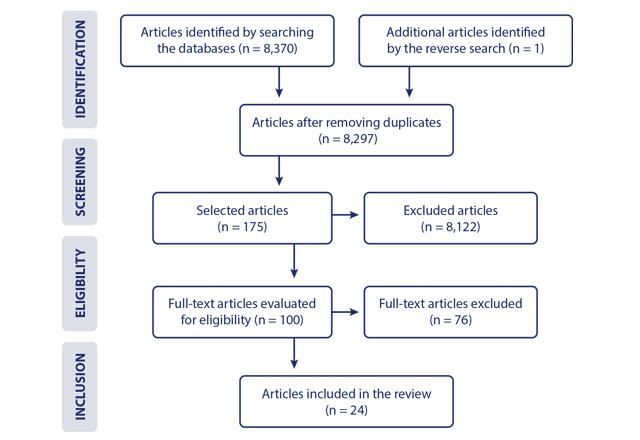
Figure 1
Flowchart of the literature search and article selection according to the PRISMA-ScR guidelines. Natal-RN, Brazil, 2020.
Source: Own elaboration.
Mapping the data
Data mapping and extraction were performed using an instrument prepared with the following items: title of the study, authors, year of publication, country, type of study, evidence level and degree of recommendation, source data, objective of the study, central interventions, and conclusions on eye care in the prone position.
Regarding the evidence level and the degree of recommendation, we decided to follow the Oxford Center for Evidence-Based Medicine guidelines. Thus, the classification of the evidence level followed the pattern that the lower the number, the higher the level. In addition, the degree of recommendation considers "A" as the highest recommendation and "D" as the lowest recommendation14.
Summarizing and reporting results
The results were presented descriptively in tables with the characterization and synthesis of the studies.
Results
As for the characterization of the studies selected and analyzed in the review, the data were presented according to year, data source, and place of publication (Table 2).
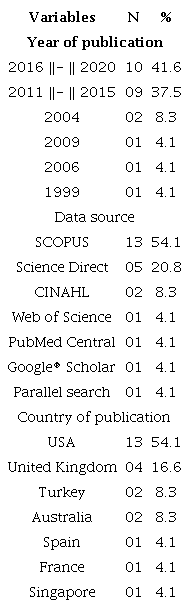
Source: Own elaboration.
Studies that addressed the surgical patient were more frequent with 66.7 % (n = 16), followed by studies with critical patients 25.0 % (n = 6). Only 8.3 °% (n = 2) addressed the two populations in the same study.
After a complete analysis of the 24 studies selected for the scoping review, we could identify the title, authors, year, country of publication, type of study, evidence level, degree of recommendation, and interventions on eye care in critical or surgical patients in the prone position of the selected studies, as shown in Table 3.

*Evidence level: 1A, 1B, 1C (degree of recommendation A); 2A, 2B, 2C, 3A, 3B (degree of recommendation B); 4 (degree of recommendation C); and 5 (degree of recommendation D)13 Source: Own elaboration.
Table 4 features the primary eye care interventions according to the population (critical and surgical patients).
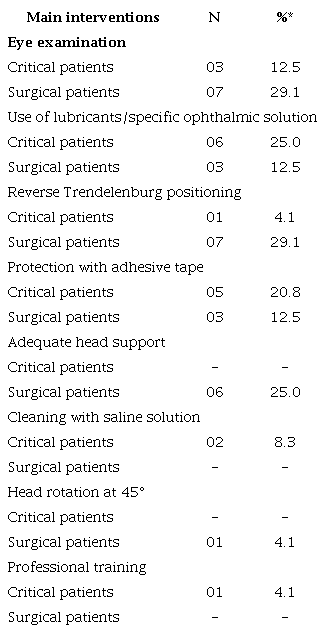
*The variable assumes multiple responses. Source: Own elaboration.
Regarding the central interventions for eye care in patients in the prone position, eye examination, the use of lubricants/specific ophthalmic solution, the reverse Trendelenburg positioning, and the protection with adhesive tape stand out.
Discussion
Noteworthy are the scientific productions published in the last year, demonstrating the relevance of the theme today. Next, the evidence identified will be addressed in two categories: eye care in critically ill patients and eye care in surgical patients. The study was limited by the low number of more specific recommendations, especially concerning ophthalmic care in critically ill patients. As corroborated by the study, there is a need for further studies in intensive care units to assess eye injury, including the follow-up of patients38.
Eye care in critically ill patients in the prone position
Related to critical patients, it is known that the intervention of the prone position is an essential therapy for hypoxemic respiratory failure and ARDS, including for patients with COVID-19 in the current context27.
Concerning patients undergoing treatment for COVID-19, they are more susceptible to eye complications due to prone positioning and the increased demand by the intensive care team39-41. Critically ill patients can be in the prone position for at least 16 hours a day to improve oxygenation. One study observed patients in the prone position for long periods who had bilateral funduscopic findings of optic disc edema and retinal hemorrhages, in addition to a substantial increase in intraocular pressure42.
However, prone position intervention in critically ill patients with breathing difficulties has often been discussed only in recent years. As a result, few published studies are related to critically ill patients. The study points out that despite our routine ophthalmic protocols, invasive mechanical ventilation applications predispose to corneal surface damage in patients in the intensive care unit43-44. Thus, knowledge of complementary protocols for eye care in critically ill patients is necessary.
Regarding eye care in patients with COVID-19, the authors did not present any intervention other than those recommended in uncontaminated patients. Because it is a recently discovered virus, further studies are needed to define care with lower infection risks25,27,30. Among the interventions, lubricants and eye protection with adhesive tape were the most frequent in the sample for critically ill patients, followed by eye examination and cleaning with saline.
In general, in patients receiving an anesthetic pharmacological agent or with incomplete eyelid closure, the authors recommend that, before performing the prone positioning maneuver, the eyes should be cleaned with saline, preferably inside out in a single direction, applied lubricant drops, and protected with adhesive tapes19,27. After performing the maneuver, it is recommended that the eyes be examined, relubricated, and closed with tape every four hours8.
Regarding the eye examination, it is recommended that it be done daily. If there is a concern related to the damage, a deeper examination of the eyes can be performed with the application of drops of fluorescein and viewing the cornea through blue light, often found in ophthalmoscopes. Patients who are constantly exposed should be referred to ophthalmologists27,34.
The study identified patients in the prone position who required treatment for eye diseases through detailed examinations, first with a handheld biomicroscope and direct ophthalmoscope for each patient. Then, the eyes were dilated with 1 % tropicamide, and retinal and optic nerve examinations were performed with an ophthalmoscope45.
As for positioning during the prone position, patients should be kept in a neutral position or with the head higher than the heart level (reverse Trendelenburg)8. Studies with critically ill patients did not address the degree of elevation for the reverse Trendelenburg.
Concerning the devices used, a recent study showed that the prone position becomes more comfortable when using Continuous Positive Airway Pressure (CPAP), as this approach develops fewer complications, such as eye irritation30.
It is also observed that the teams' training on the possible complications of the prone position is indispensable to managing patients adequately and preventing risks35,46. The training of care professionals in handling patients in the prone position is less frequent; however, it is an intervention that must be considered.
A clinical trial performed on patients with reduced or absent blink reflex after losing consciousness or using sedatives determined that implementing the eye care protocol could significantly reduce complications and eye problems47. Based on these data, developing protocols for eye care is essential.
Eye care in surgical patients in the prone position
Studies involving surgical patients in the prone position appear more frequently in the sample. Due to the long surgery period, it is necessary to intervene so that new complications do not occur, prioritizing patient safety. In patients undergoing spinal surgery, for example, the prone position has a tenfold increased risk of eye injury compared to the supine and lateral positions48.
Reverse Trendelenburg positioning, eye examination, and adequate head support were the most addressed interventions among the studies. The reverse Trendelenburg is used as a strat egy to reduce intraocular pressure and, consequently, perioperative visual loss21,24. The authors recommend that the head elevation should be 10°16,33.
As for eye examination, a preoperative ophthalmological examination is recommended to form an opinion about the 'patient's vision. As intraoperative interventions, some authors have addressed using an extensible mirror for frequent eye checking32,34. One study showed eye position monitoring every 20 minutes with an attached mirror as a strategy. A computer video streaming system was implemented to monitor the eye position throughout the process, proving to be a practical technological innovation in health15.
Concerning adequate head support, an effective strategy to reduce the risk of direct pressure on the eye involves using a three-pin Mayfield head support, which fixes and holds the head during surgical procedures8,24. Another device used to reduce direct pressure is the ProneViewTM protective helmet system with facial contour, which allows for prone positioning and reduces the incidence of facial damage. Compared to the Prone PositionerTM without facial contour, this system proved more effective25,27-28,49.
The use of tapes for eye protection and lubricants was less frequent in the sample. Regarding the protection with adhesive tape, a study concluded that the use of silicone tapes with the removal of the type 3M for eyelids used in long surgeries significantly reduced skin lesions when compared with acrylate tapes, thus presenting itself as a strategy that can be considered for eye protection24,27-28,50.
In contrast, a study compared the effectiveness of four protection methods, involving the use of Hypafix® hypoallergenic adhesive tape, Terramycine® antibiotic ointment, artificial tear gel containing Viscotears® polyacrylic acid, and Duratears® ointment eye lubricant. It was concluded that there was no significant difference between the protection methods, showing that all the methods presented are suitable for protecting against corneal injuries17,23,51.
Corroborating the findings of the review, a prospective study performed a trial with a foam-based facial protection method to cover bony prominences during spinal surgical procedures, decreasing the incidence of iatrogenic facial ulcers in surgery by reducing friction and shear force52.
Some studies have addressed using a specific ophthalmic solution to lower intraocular pressure in surgical patients. In one of these studies, the authors recommended using 2 % brimonidine, which should be used preoperatively, for about one hour before anesthesia and every eight hours for 24 hours, helping reduce intraocular pressure in spine surgeries25,53-54. Only one study pointed to head rotation at 45° turned to the right as a technique for lowering intraocular pressure in patients placed in a prone position18.
Conclusion
Among the findings of the selected studies, care was suggested using lubricants to prevent dry eyes and specific ophthalmic solutions to reduce intraocular pressure. It is also essential to associate the prone position with the reverse Trendelenburg to minimize the risk of pressure in the face region and the proper headrest. The studies also propose recommendations on eye protection with adhesive tapes, frequent eye examination, cleaning with saline solution, and head rotation at 45° as essential precautions for preventing risks associated with eye health.
More collaborative clinical studies on eye care are suggested in isolation, as a shortage of scientific evidence that addressed more specific recommendations was identified, especially in critically ill patients.
References
Dalmedico MM, Salas D, Oliveira AM, Baran FDP, Meardi JT, Santos MC. Efficacy of prone position in acute respiratory distress syndrome: overview of systematic reviews. Rev Esc Enferm USP. 2017;51:e03251. DOI: 10.1590/s1980-220x2016048803251
Araújo MS, Santos MMP, Silva CJA, Menezes RMP, Feijão AR, Medeiros SM. Prone positioning as an emerging tool in the care provided to patients infected with COVID-19: a scoping review. Rev Lat Am Enferm. 2021;29:e3397. DOI: 10.1590/1518-8345.4732.3397
Borges DL, Rapello GVG, Deponti GN, Andrade FMD. Posição prona no tratamento da insuficiência respiratória aguda na COVID-19. ASSOBRAFIR Ciênc. 2020;11(1):111. DOI: 10.47066/2177-9333.AC20.covid19.011
Reece-Anthony R, Lao G, Carter C, Notter J. COVID-19 disease: Acute respiratory distress syndrome and prone position. Clin Integr Care. 2020;3:100024. DOI: 10.1016/j.intcar.2020.100024
Welter DI, Batista DCR, Moretti MMS, Piekala DM, Oliveira VM. Clinical profile and complications in pronated patients: a cohort from a university hospital. Clin Biomed Res. 2019;39(4):301-306.
Hadaya J, Benharash P. Prone Positioning for Acute Respiratory Distress Syndrome (ARDS). JAMA. 2020;324(13):1361. DOI: 10.1001/jama.2020.14901
Marimon MF, Huguet EG, Biosca AR. El decúbito prono como estrategia terapéutica para la mejora del síndrome de distrés respiratorio agudo. Metas Enferm. 2018;20(1):57-63. DOI: 10.35667/MetasEnf.2019.20.1003081019
Small J, Robertson E, Runcie C. Care of the eye during anaesthesia and intensive care. Anaesthesia and Intensive Care Medicine. 2019;20:731-734. DOI: 10.1016/j.mpaic.2019.10.008
Oliveira VM, Piekala DM, Deponti GN, Batista D, Minossi SD, Chisté M, et al. Safe prone checklist: construction and implementation of a tool for performing the prone maneuver. Rev Bras Ter Intensiva. 2017;29(2):131-141. DOI: 10.5935/0103-507X.20170023
Hearne BJ, Hearne EG, Montgomery H, Lightman SL. Eye care in the intensive care unit. J Intensive Care Soc. 2018;19(4):345-350. DOI: 10.1177/1751143718764529
Peters M, Marnie C, Tricco AC, Pollock D, Munn Z, Alexander L, et al. Updated methodological guidance for the conduct of scoping reviews. JBI Evid Synth. 2020;18(10):2119-2126. DOI: 10.11124/JBIES-20-00167
Tricco AC, Lillie E, Zarin W, O'Brien KK, Colquhoun H, Levac D, et al. PRISMA extension for scoping reviews (PRISMA-ScR): checklist and explanation. Ann Inter Med. 2018;169:467-473. DOI: 10.7326/M18-0850
Dantas AC, Costa ML, Araújo JNM. Interventions for eye care in critical/surgical patients in a prone position: A Scoping Review; 2020. Available from: https://osf.io/2h6kc
Centre for Evidence-Based Medicine. Levels of evidence (March 2009); 2019. Available from: https://www.cebm.net/2009/06/oxfor-centre-evidence-based-medicinelevels-evidence-march-2009/
Kwee MM, Ho YH, Rozen WM. The prone position during surgery and its complications: a systematic review and evidence-based guidelines. Int Surg. 2015;100:292-303. DOI: 10.9738/INTSURG-D-13-00256.1
Wilcklin SA. Systematic review and meta-analysis of prone position on intraocular pressure in adults undergoing surgery. Int J Spine Surg. 2020;14:195-208. DOI: 10.14444/7029
Kocatürk Ö, Kocatürk T, Kaan N, Dayanir V. The comparison of four different methods of perioperative eye protection under general anesthesia in prone position. J Clin Anal Med. 2012;3:163-165. DOI: 10.4328/JCAM.607
Deniz MN, Erakgün A, Sertöz N, Yilmaz SG, Ates H, Erhan E. The effect of head rotation on intraocular pressure in prone position: a randomized trial. Braz J Anesthesiol. 2013:63(2):209-212. DOI: 10.1016/S0034-7094(13)70217-4
Curley MAQ, Arnold JH, Thompson JE, Fackler JC, Grant MJ, Fineman LD, et al. Clinical trial design - effect of prone positioning on clinical outcomes in infants and children with acute respiratory distress syndrome. J Crit Care. 2006;21(1):23-32. DOI: 10.1016/j.jcrc.2005.12.004
Ozcan MS, Praetel C, Bhatti MT, Gravenstein N, Mahla ME, Seubert C. The effect of body inclination during prone positioning on intraocular pressure in awake volunteers: a comparison of two operating tables. Anesth Analg. 2005;99(4):1152-1158. DOI: 10.1213/01.ANE.0000130851.37039.50
Zeng LA, Lie SA, Chong SY. Comparison of Medical Adhesive Tapes in Patients at Risk of Facial Skin Trauma under Anesthesia. Anesthesiol Res Pract. 2016. DOI: 10.1155/2016/4878246
Carey TW, Shaw KA, Weber ML, Devine JG. Effect of the degree of reverse Trendelenburg position on intraocular pressure during prone spine surgery: a randomized controlled trial. Spine J. 2014;14(9):2118-2126. DOI: 10.1016/j.spinee.2013.12.025
Farag E, Sessler DI, Kovaci B, Wang L, Mascha EJ, Bell G, et al. Effects of crystalloid versus colloid and the a-2 agonist brimonidine versus placebo on intraocular pressure during prone spine surgery: A factorial randomized trial. Anesthesiology. 2012;116:807-815. DOI: 10.1097/ALN.0b013e3182475c10
Atwater BI, Wahrenbrock E, Benumof JL, Mazzei WJ. Pressure on the face while in the prone position: ProneView versus Prone Positioner. J Clin Anesth. 2004;16(2):111-6. DOI: 10.1016/j.jclinane.2003.06.001
Kadam AB, Jaipuria AS, Rathod AK. Modified prone position using lateral brace attachments for cervico-dorsal spine surgeries. Eur Spine J. 2013;22:1474-1479. DOI: 10.1007/s00586-012-2653-9
Keita H, Devys JM, Ripart J, Frost M, Cochereau I, Boutin F, et al. Eye protection in anaesthesia and intensive care. Anaesth Crit Care Pain Med. 2017;36(6):411-418. DOI: 10.1016/j.accpm.2017.08.001
Makic MBF. Prone position of patients with COVID-19 and acute respiratory distress syndrome. J Perianesth Nurs. 2020;35:437-438. DOI: 10.1016/j.jopan.2020.05.008
Gibson V, Rutherford I. Artificial ventilation in the prone position. Aust Crit Care. 1999;12(1):18-22. DOI: 10.1016/S1036-7314(99)70508-4
Longhini F, Bruni A, Garofalo E, Navalesi P, Grasselli G, Cosentini R. Helmet continuous positive airway pressure and prone positioning: A proposal for an early management of COVID-19 patients. Pulmonology. 2020;26:186-191. DOI: 10.1016/j.pulmoe.2020.04.014
Sansome SG, Lin PF. Eye care in the intensive care unit during the COVID-19 pandemic. Br J Hosp Med. 2020;81(6):1-10. DOI: 10.12968/hmed.2020.0228
Kam RYR, Hayes M, Joshi N. Ocular care and complications in the critically ill. Anaesth Crit Care Pain Med. 2011;1:257-262. DOI: 10.9789/2175-5361.2017.v9i4.907-916
Urine AA, Baig MN, Puente EG, Viloria A, Mendel E, Bergese SD. Current intraoperative devices to reduce visual loss after spine surgery. Neurosurg Focus. 2012;33:E14. DOI: 10.3171/2009.8.FOCUS09151
Kamel I, Barnette R. Positioning patients for spine surgery: Avoiding uncommon position-related complications. World J Orthop. 2014;5:425-443. DOI: 10.5312/wjo.v5.i4.425
Epstein NE. How to avoid perioperative visual loss following prone spinal surgery. Surg Neurol Int. 2016;7:S328-330. DOI: 10.4103/2152-7806.182543
Roth S. Perioperative visual loss: What do we know, what can we do? Brit J Anaesth. 2009;103(SUPPL.1):31-40. DOI: 10.1093/bja/aep295
Lin S, Bailey L, Nguyen T, Mintz C, Rosenblatt K. Extendable mirrors to improve anesthesia provider comfort for eye and positioning checks in prone patients: A pilot study. J Patient Saf Risk Manag. 2020;25:117-122. DOI: 10.1177/2516043520914199
Fandino W. Strategies to prevent ischemic optic neuropathy following major spine surgery: A narrative review. J Clin Anesth. 2017;43:50-58. DOI: 10.1016/j.jclinane.2017.09.009
Patterson TJ, Currie P, Williams M, Shevlin C. Ocular Injury Associated with Prone Positioning in Adult Critical Care: A Systematic Review and Meta-Analysis. Am J Ophthalmol. 2021;227:66-73. DOI: 10.1016/j.ajo.2021.02.019
Sanghi P, Malik M, Hossain IT, Manzouri B. Ocular Complications in the Prone Position in the Critical Care Setting: The COVID-19 Pandemic. J Intensive Care Med. 2021;36(3)361-372. DOI: 10.1177/0885066620959031
Kousha O, Kousha Z, Paddle J. Exposure keratopathy: Incidence, risk factors and impact of protocolised care on exposure keratopathy in critically ill adults. J Crit Care. 2018;44:413-418. DOI: 10.1016/j.jcrc.2017.11.031
Moore Z, Patton D, Avsar P, McEvoy NL, Curley G, Budri A, et al. Prevention of pressure ulcers among individuals cared for in the prone position: lessons for the COVID-19 emergency. J Wound Care. 2020;29(6):312-320. DOI: 10.12968/jowc.2020.29.6.312
Sun L, Hymowitz M, Pomeranz HD. Eye Protection for Patients With COVID-19 Undergoing Prolonged Prone-Position Ventilation. JAMA Ophthalmol. 2021;139(1):109-112. DOI: 10.1001/jamaophthalmol.2020.4988
Ceylan I, Korkmaz HA, Ulutas HG. Eye Care in Intensive Care in COVID-19 Era: A Prospective Observational Study from Turkey. Eur Rev Med Pharmacol Sci. 2022;26(6):2165-2170. DOI: 10.26355/eurrev_202203_28364
Santos VB, Aprile DCBA, Lopes CT, Lopes JL, Gamba MA, Costa KAL, et al. COVID-19 patients in prone position: validation of instructional materials for pressure injury prevention. Rev Bras Enferm. 2021;74(Suppl 1):e20201185. DOI: 10.1590/0034-7167-2020-1185
Gok ZE, Gok A, Delen LA, Kasapoglu US, Gurbuz E, Mutlu K. Evaluation of eye care and ocular findings in critically ill COVID-19 patients. Int J Clin Pract. 2021;75:e14909. DOI: 10.1111/ijcp.14909
Soare C, Nowak VA, Osborne S. Eye care in the intensive care unit during the COVID-19 pandemic and beyond. Anaesthesia. 2020;75:1118-1119. DOI: 10.1111/anae.15154
Lahiji AP, Gohari M, Mirzaei S. The effect of implementation of evidence-based eye care protocol for patients in the intensive care units on superficial eye disorders. BMC Oftalmol. 2021;21:275. DOI: 10.1186/s12886-021-02034-x
Leuzinger-Dias M, Lima-Fontes M, Oliveira-Ferreira C, Camisa E, Sousa C, Rocha-Sousa A, et al. Prone Positioning Covid-19 Patients: A Double-Edged Sword - A Case Report of a Devastating Ocular Complication. Ophthalmol Ther. 2021;10(3):691-697. DOI: 10.1007/s40123-021-00359-w
Chandra KN, Kundan M. Post operative visual loss after cervical laminectomy in prone position. Braz J Anesthesiol. 2017;67(4):435-438. DOI: 10.1016/j.bjane.2016.11.003
Peko L, Barakat-Johnson M, Gefen A. Protecting prone positioned patients from facial pressure ulcers using prophylactic dressings: a timely biomechanical analysis in the context of the covid 19 pandemic. Int Wound J. 2020;17(6):1595-1606. DOI: 10.1111/iwj.13435
Bloria P, Bloria S, Chauhan R, Luthra A. Medical adhesive-related skin injuries caused by taping of the eye using acrylic-based adhesive tapes in prone surgery: a case report. Ind J Anaesth. 2020;64(4):345. DOI: 10.4103/ija.IJA_905_19
Haleem S, Mihai R, Rothenfluh DA, Reynolds J. Preventing iatrogenic facial pressure ulcers during spinal surgery: Prospective trial using a novel method and review of literature. Int Wound J. 2020;17:1391-1395. DOI: 10.1111/iwj.13402
Czorlich P, Kràtzig T, Kluge N, Skevas C, Knospe V, Spitzer MS, et al. Intraocular pressure during neurosurgical procedures in context of head position and loss of cerebrospinal fluid. J Neurosurg. 2019;131(1):271-280. DOI: 10.3171/2018.3.JNS173098
Shearer SC, Parsa KM, Newark A, Peesay T, Walsh AR, Fernandez S, et al. Facial Pressure Injuries from Prone Positioning in the COVID-19 Era. Laryngoscope. 2021;131(7):2139-2142. DOI: 10.1002/lary.29374
Notes