Abstract
Introduction: Nurse-led programs have a determinant role in the engagement of individuals in the self-management of type 2 diabetes mellitus (T2DM), as they contribute to improving quality of life. Self-management assisted by social support is vital, especially as it describes the importance of nurses in promoting health for people with T2DM, as this intervention can help reduce the consequences and progression of the disease.
Objective: To map programs focused on nurse-led social support for people with T2DM.
Materials and Methods: This is a scoping review in line with the methodological guidelines of the Joanna Briggs Institute. The search descriptors used were “autocuidado” (self-care), “intervenção liderada por enfermeiro” (nurse-led intervention), and “diabetes mellitus tipo 2” (type 2 diabetes mellitus), with searches in the Web of Science, Medline, CINAHL, Capes Theses and Dissertations Catalog, Scopus, JBI Evidence Synthesis, PsycINFO, and the Portuguese Open Access Scientific Repositories databases conducted between February and March 2022. The eligibility criteria were studies published within the last 10 years, in English, Spanish, and Portuguese, covering the individual’s experience in programs focused on self-management through nurse-led social support.
Results: A total of 12 studies were included, all of which were published in the United States, England, and Iran, focusing on social support for self-management in people with T2DM, and centered on care facilities for people with chronic diseases. It was found that most nurse-led programs have been implemented in developed countries and that their main characteristic is their emphasis on social cognitive theory. The population was characterized by being mostly women, aged over 22, with a low level of education.
Conclusions: The study met the proposed objective by demonstrating that, despite the low implementation cost with high social and economic returns, the development of these programs is still scarce. The need for further studies focusing on emotional levels, such as depression and anxiety, is highlighted.
Keywords (Source: DeCS) Social Support, Nursing Care, Social Programs, Self-Management, diabetes mellitus type 2.
Resumen
Introducción: los programas dirigidos por enfermeras desempeñan un papel fundamental a la hora de implicar a las personas en el autocontrol de la diabetes mellitus tipo 2 (DM2), ya que repercuten en la mejora de la calidad de vida. El autocontrol respaldado por el apoyo social es crucial, especialmente porque describe la importancia de los profesionales de enfermeria en la promocion de la salud de las personas con diabetes mellitus tipo 2 (DM2), dado que esta intervencion puede ayudar a reducir las consecuencias y el empeoramiento de la enfermedad.
Objetivo: mapear los programas centrados en el apoyo social para personas con DM2 dirigidos por enfermeros.
Materiales y método: una revision de alcance que siguio las directrices metodologicas del Instituto Joanna Briggs. Los descriptores de busqueda utilizados fueron “autocuidado”, “intervencion dirigida por enfermeros”, “diabetes mellitus tipo 2”, con busqueda en la Web of Science, Medline, CINAHL, Catalogo de Tesis y Disertaciones de la Capes [Coordinacion de Perfeccionamiento de Personal de Nivel Superior], Scopus, JBI Evidence Synthesis, PsycINFO y Repositorios Cientificos de Acceso Abierto de Portugal, entre febrero y marzo de 2022. Los criterios de elegibilidad fueron estudios publicados en los ultimos 10 anos, en ingles, espanol y portugues, que cubrieran la experiencia individual de programas dirigidos por profesionales de enfermeria centrados en la autogestion a traves del apoyo social.
Resultados: se incluyeron 12 estudios, publicados en Estados Unidos, Inglaterra e Iran, centrados en el apoyo social para la autogestion de personas con DM2 y en entornos de atencion a personas con enfermedades cronicas. Se observo que la mayoria de los programas dirigidos por enfermeros se aplican en paises desarrollados y tienen como caracteristica principal el enfasis en la teoria cognitiva social. El publico se caracterizo por ser mayoritariamente femenino, mayor de 22 anos y con bajo nivel de estudios.
Conclusiones: el estudio respondio al objetivo propuesto demostrando que, a pesar del bajo costo de implementacion con alto retorno social y economico, el desarrollo de estos programas aun es considerado escaso. Se reitera la necesidad de nuevos estudios que enfaticen niveles emocionales como la depresion y la ansiedad.
Palabras clave (Fuente: DeCS): Apoyo social, atencion de enfermeria, programas sociales, automanejo, diabetes mellitus tipo 2.
Resumo
Introdução: os programas liderados por enfermeiros desempenham um papel fundamental no engajamento do individuo na autogestao do diabetes mellitus tipo 2 (DM2), pois impactam na melhoria da qualidade de vida. A autogestao apoiada pelo suporte social torna-se crucial, sobretudo por descrever a importancia do enfermeiro na promocao da saude da pessoa com DM2, tendo em vista que essa intervencao pode contribuir para reduzir as consequencias e os agravamentos da doenca. Objetivo: mapear os programas com foco no suporte social para pessoas com DM2 liderados por enfermeiros.
Materiais e método: revisado de escopo que seguiu as diretrizes metodologicas do Joanna Briggs Institute. Utilizou-se como descritores de busca “autocuidado”, “intervencao liderada por enfermeiro”, “diabetes mellitus tipo 2”, com busca nos bancos de dados Web of Science, Medline, CINAHL, Catalogo de Teses e Dissertacoes da Capes, Scopus, JBI Evidence Synthesis, PsycINFO e Repositorios Cientificos de Acesso Aberto de Portugal, entre fevereiro e marco de 2022. Os criterios de elegibilidade foram estudos publicados nos ultimos 10 anos, em ingles, espanhol e portugues, abrangendo a experiencia do individuo em programas com foco na autogestao por meio do suporte social liderados por enfermeiros.
Resultados: 12 estudos incluidos, publicados nos Estados Unidos, na Inglaterra e no Ira, com foco no suporte social de apoio a autogestao de pessoas com DM2 e com concentracao em locais de atendimento as pessoas com doencas cronicas. Observou-se que a maioria dos programas liderados por enfermeiros e implementada em paises desenvolvidos e apresenta como caracteristica principal enfase na teoria social cognitiva. O publico se caracterizou por ser maioria mulheres, faixa etaria de adultos maiores de 22 anos, com baixa escolaridade.
Conclusões: o estudo respondeu ao objetivo proposto ao demonstrar que, apesar do baixo custo para a implementacao com alta devolutiva social e economica, ainda e considerado escasso o desenvolvimento desses programas. Reitera-se a necessidade de estudos posteriores com enfase nos niveis emocionais, como depressao e ansiedade.
Palavras-chave (Fonte: DeCS) Apoio social, cuidados de enfermagem, programas sociais, autogestao, diabetes mellitus tipo 2.
Carátula del artículo
Nurse-Led Programs Focusing on Social Support for People with Type 2 Diabetes Mellitus: A Scoping Review *
Programas centrados en el apoyo social para personas con diabetes mellitus tipo 2 dirigidos por enfermeros: revisión de alcance **
Programas com foco no suporte social para pessoas com diabetes mellitus tipo 2 liderados por enfermeiros: scoping review
 Isabela Mendonça Rodrigues dos Santos isabela.mrs@discente.ufma
Universidade Federal do Maranhão, Brazil
Isaura Letícia Palmeira Tavares Rolim leticia.isaura@ufma.br
Universidade Federal do Maranhão, Brazil
Aurean D’Eça aurean.junior@ufma.br
Universidade Federal do Maranhão, Brazil
Maria Almira Bulcão Loureiro almira.maria@discente.ufma.br
Universidade Federal do Maranhão, Brazil
Diogo Matheus Barros da Silva silva.diogo@discente.ufma.br
Universidade Federal do Maranhão, Brazil
Geysa Santos Góis Lopes geysagois@hotmail.com
Brazil, Brazil
Aquichan, vol. 24, no. 1, e2412, 2024
Universidad de La Sabana
Received: 20 June 2023
Accepted: 03 November 2023
Introduction
Type 2 diabetes mellitus (T2DM) represents a public health problem due to its high prevalence, mortality, and morbidity rates, with a resulting increase in costs for the healthcare system. All these negative health outcomes, both at the individual and collective levels, prompt the development of innovative strategies to promote effective self-management (1).
Thus, certain decisions in therapeutic management have an impact on the quality of life of people with T2DM since many of the complications progress to disability. Furthermore, the treatment of complications leads to higher costs, both for the individual and the healthcare system (2). For this reason, the guidelines of scientific organizations dedicated to the study of T2DM recommend that people should participate in education programs for diabetes mellitus self-care (EPDMS). These programs train individuals so that they become knowledgeable enough to make decisions and, simultaneously, induce self-management (3). EPDMS thus benefit and improve this population’s health conditions (4).
Self-management is defined as the individual’s ability, alongside their families, community, and healthcare professionals, to manage the symptoms, treatment, and psychosocial, cultural, and spiritual changes resulting from chronic conditions. For this purpose, the processes related to self-management include goal setting and self-monitoring, reflective thinking, decision-making, planning and engaging in specific health behaviors, self-assessment, and management of physical, emotional, and cognitive responses regarding health behavior changes (5).
One of the ways to support self-management is by adopting the perspective of social support. Social support is a care network provided by people who are close to an individual or professionals, regardless of where they receive treatment. This form of support provides knowledge and affection, which enables learning, security, and improved self-esteem. These feelings contribute to the continuity of activities regularly, leading to the individual refraining from quitting treatment or withdrawing from society (6).
Those who receive and, especially, perceive the social support provided by their support network can face these adversities with more commitment since they know who to resort to and from whom to receive the necessary help. This helps them to self-manage a pathology’s treatment, emphasizing that this is a delicate period, with individual adaptations and resignations (7). From this perspective, interventions based on social support are capable of modifying health conditions, because they reduce the individual’s mental and physical stress, as well as reducing behaviors that are harmful to their health (8).
According to the literature, nursing stands out as the profession best suited to provide self-management support, since its importance lies in the fact that it strengthens the bond for treatment, with knowledge and planning of routines to manage a chronic condition (9). In this sense, specific programs led by nurses that offer social support to teach self-management skills stand out (9). Thus, it is necessary to learn more about nurse-led programs that aim to promote self-management through social support in the field of T2DM, since there is currently a lack of information available on their characteristics. Furthermore, understanding these programs’ current state of the art would be useful for informing future research.
Additionally, nursing interventions focused on social support to help the self-management of patients with T2DM contribute to the health-disease process in a way that enables them to manage their health condition. Consequently, it is necessary to carry out this scoping review to synthesize the current scientific evidence on the subject.
The main objective of this review is to map the nature and extent of published scientific production and grey literature related to nurse-led programs aimed at supporting self-management of care of people with T2DM through social support. It has the following specific objectives: To list the programs focusing on social support for people with T2DM led by nurses; to describe the contents of these programs; and to identify the results related to them.
Materials and Methods
This is a scoping review, whose purpose is to map, explore, and describe the literature in the research field and the conceptual limits of the theme addressed. It was done by observing the methodological guidelines of the Joanna Briggs Institute (JBI). Thus, the following steps were followed, according to the Preferred Reporting Items for Systematic Review and Meta-Analyses extension for Scoping Reviews (Prisma-ScR) version 2020: defining and aligning the objectives and questions; developing and aligning the inclusion criteria with the objective and guiding question; describing the planned approach for searching for evidence, selecting and extracting data, and presenting the evidence; searching for the evidence; selecting the evidence; extracting the evidence; evaluating the evidence; presenting the results; summarizing the evidence about the review’s purpose, establishing conclusions, and noting any implications arising from the findings (10).
Registration Protocol
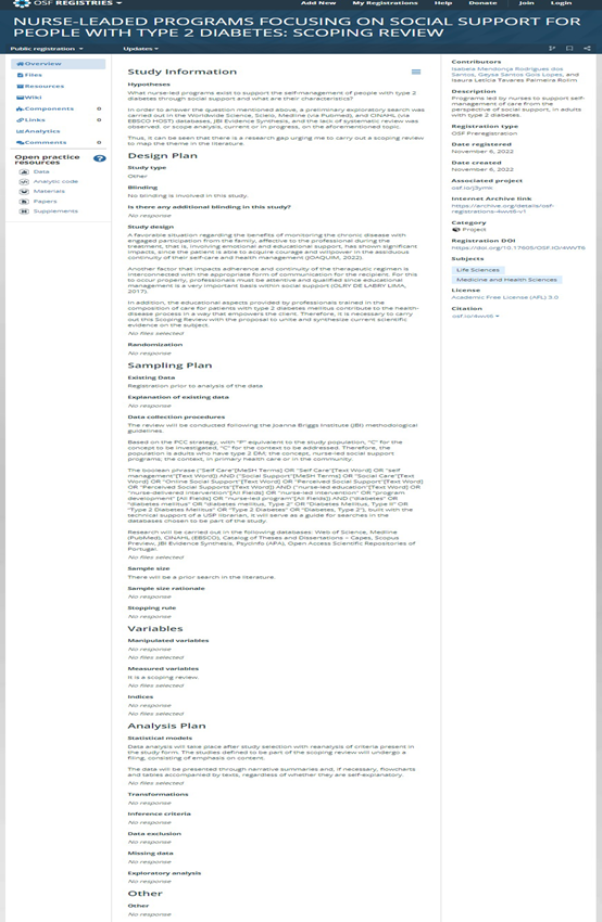
The protocol for the preparation of this review is registered on the Open Science Framework (OSF) platform and can be accessed via the following link: https://osf.io/4wvt6.
Identification of the Guiding Question
The guiding question formulated was the following: What nurse-led programs exist to support self-management in people with T2DM through social support, and what are their characteristics?
Furthermore, the PCC (population, concept, and context) mnemonic strategy was used to integrate the studies in this review. Therefore, the population consists of adults with T2DM; the concept of nurseled social support programs; and the context is primary healthcare or the community.
Eligibility Criteria
The eligibility criteria adopted were: studies published with the proposed theme in English, Spanish, and Portuguese; complete articles, theses, and dissertations available online; any study, regardless of methodological design (qualitative, quantitative, or mixed), that explores the participant’s experience in programs aimed at supporting the self-management of DM through social support and led by nurses; studies with participants aged 18 or over, diagnosed with T2DM, conducted in the primary health care setting, and with program interventions led by nurses.
Search Strategy
The search for studies was performed in the following databases: Web of Science, Medline (PubMed), Cinahl (EBSCO), Capes Catalog of Theses and Dissertations, Scopus, JBI Evidence Synthesis, PsycINFO (APA), and Open Access Scientific Repositories in Portugal between February 23 and March 17, 2022. Afterward, the reference lists of the included studies were manually searched to identify any relevant studies. The search strategies used for each database are shown in Table 1 and were devised with the assistance of two librarians with expertise in the health field and systematized reviews.
Table 1
Search Strategies Used in the Explored Databases. Brazil, 2022
 Source: Search data (2022).
Study Selection
After searching the databases, all the studies were exported to a reference manager (EndNote). Duplicate articles were removed both manually and using an automation tool. It should be noted that the descriptors were adapted for each database, by using synonyms to find the greatest number of studies.
Next, the titles and abstracts were screened based on the inclusion criteria with the help of the Rayyan Systematic Reviews web/mobile app, so that two authors could independently and blindly screen the title/abstract and full text. In the event of any doubts, a third author would read the manuscript and decide whether or not to include it. Publications that met the eligibility criteria were retrieved in full.
Data Mapping
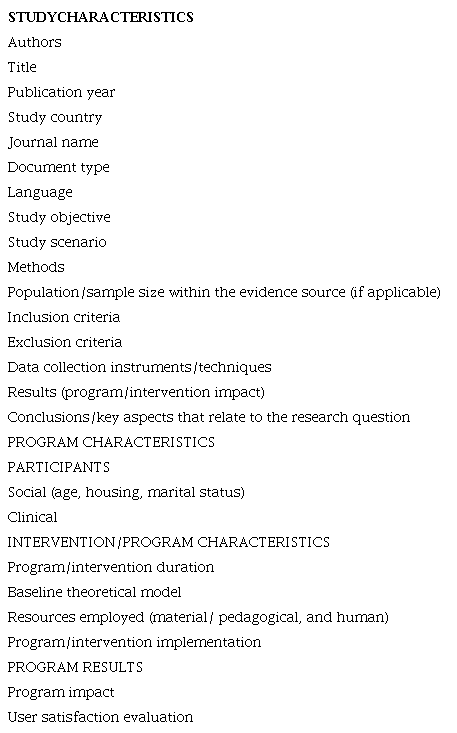
A form was designed by the author to extract the data. A pretest was then carried out to assess the need for adjustments. The data extracted included author, title, publication year, study country, journal name, document type, language, study objective, study setting, methods, population/sample size, inclusion criteria, exclusion criteria, collection instrument/technique, program results/impacts, conclusions, participants’ social characteristics, participants’ clinical characteristics, program/intervention duration, core theoretical model, resources used, program implementation, and user satisfaction assessment.
Compiling, Summarizing, and Reporting the Results
A descriptive analysis of the information related to nurse-led programs and their characteristics was carried out. The evidence was synthesized based on the research questions. A table was prepared with data allocated to the studies included in the review and another table with existing programs. Additionally, a figure was prepared with the basic theoretical model of the interventions. The search steps are represented in the flow diagram of the Preferred Reporting Items for Systematic Reviews and Meta-analyses (Prisma-ScR), which is an extension of the scoping review.
Results
Literature Search
Initially, 1,743 publications were identified, as shown in Figure 1. After removing 10 duplicate studies, the titles and abstracts were then screened, resulting in a sample containing 12 documents for full reading. Subsequently, seven publications were excluded for failing to meet the eligibility criteria, which left five publications eligible for analysis. During the review of the references in the included studies, it was found that it was necessary to incorporate seven additional documents. As a result, this review consisted of 12 studies after the inclusion of the relevant documents.
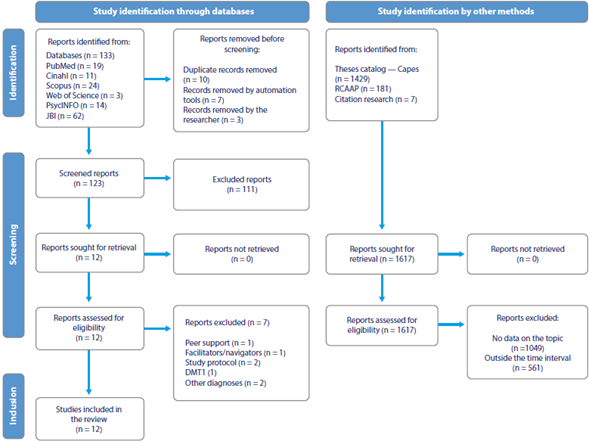 Figure 1
Study identification and inclusion process. Prisma-ScR flowchart
Source: Own elaboration.
Figure 1
Study identification and inclusion process. Prisma-ScR flowchart
Source: Own elaboration.
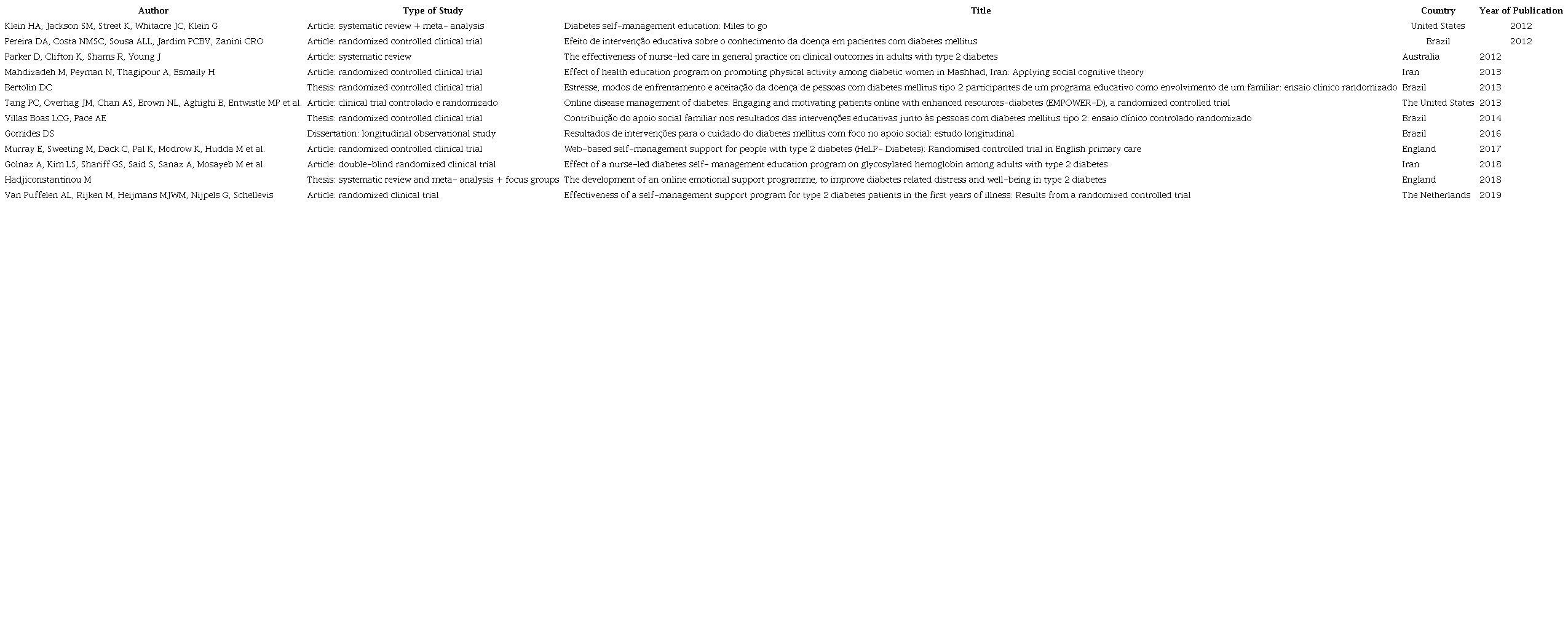
Most of the selected studies were frequently carried out more than five years ago (n = 8) in developed countries such as the United States, England, and Iran (n = 6), as shown in Table 2, which presents the main characteristics of the studies included in this review.
Table 2
Studies included in the scoping review by author, type of study, title, country, and year of publication. Brazil, 2022
 Source: Research data (2022).
Regarding the study designs, there was a prevalence of randomized clinical trials (n = 8). The others were systematic reviews plus meta-analysis (n = 2), a systematic review (n = 1), and a longitudinal observational study (n = 1). As for document type, eight were articles, three were theses, and one was a dissertation.
Study Characteristics
Nurse-led programs were implemented in the following locations: general care clinics (n = 6), specialized care services for people with chronic illnesses (n = 3), and university hospitals (n = 3), as shown in Table 3. It is noted that the programs are designed to improve glycemic control and, simultaneously, achieve significant results in terms of lipid profile, blood pressure, regular physical activity, adequate nutrition, emotional stability, social interaction and, consequently, self-management.
Table 3
Nurse-led programs focusing on social support for people with type 2 diabetes by author, intervention site, results achieved, and population assisted.
 Source: Research data (2022). Key: ND - not defined.
The participants’ characteristics indicate a mean age of 54.2} 11.8 years (between 22 and 69 years), with a prevalence of women (n = 7), with a low level of education, having studied for a total of nine years (n = 8).
The studies found on emotional support covered programs consisting of individual, face-to-face counseling, followed by a collective approach and dynamics with family/friends. To consolidate learning, phone calls were made (Table 4). Therefore, the programs converged on an educational basis -with instructions in face-to-face appointments and via phone calls- with a strong influence of affective aspects, since the person with diabetes would need to be the protagonist of their decisions, but there was also family interaction. On average, the interventions lasted 12 months, with a maximum of 36 months and a minimum of 1 month.
Table 4
Programs by Author, Type of Intervention, and Duration
 Source: Research data (2022).
Regarding the basic theoretical model used by the programs, most followed the social cognitive theory (n = 3), conversation maps (n = 2), the common sense self-regulation theory (n = 2), the self-efficacy theory (n = 1), and motivational interviewing (n = 1). It is worth noting that the studies that were not mentioned correspond to the fact that they did not present their respective basic models and/or clarified the theoretical framework.
Analysis and Discussion
Evidence Summary
The present study found studies conducted in England, the United States, Iran, Australia, and the Netherlands on programs focused on social support for the self-management of people with T2DM, which were led by nurses and centered on care facilities for people with chronic diseases (9, 11-15).
It is worth noting that in these countries, care for people with diabetes is performed in a unique way and with a holistic approach (16). In developing countries such as Brazil, this approach is still in its infancy, despite efforts to improve care for this population, which has increased significantly over the years (17). Factors such as adequate spending of financial resources on healthcare services, continued training processes and engagement of professionals, as well as technological support and priority on conflict management may be associated with the differences mentioned between these regions (18-20).
In addition, strategies for patients’ attendance and commitment to the treatment of chronic diseases are related to family engagement and effective professional intervention, which highlights the importance of social support in achieving these goals. Such support is an essential tool for promoting improvements in health and interpersonal relationships, which leads to improved cognitive performance, and negative emotional reactions management -e.g., anxiety, and offers behavioral analysis (21, 22). The literature highlights the key role played by nursing professionals in primary care in health education activities and self-management through evidence-based practices (23).
In the present study, the findings regarding the theoretical framework that integrates social support into the main strategic interventions were the social cognitive theory (an active pedagogical strategy that determines that individuals influence and are influenced by observational learning [13, 24-26]); conversation maps (a tool subdivided into four stages, delivered to patients via images and metaphors reproduced on a card table with specific topics [27]); the self-efficacy theory (which determines that commitment, depending on personal will and ability, is decisive in preventing or managing the disease [28]); motivational interviewing (evidence-based counseling, in which healthcare professionals help people adopt targeted treatment recommendations [29]); and the common sense self-regulation theory (which provides strategies aimed at finding out how people feel and think about the disease [30]).
These theories can lead to several benefits for patients, such as a reduction in sedentary lifestyles, which has an impact on BMI control and abdominal circumference in women, a better understandingand acceptance of the disease, as well as stress reduction and increased consumption of fruit and vegetables (13, 24, 25). Thus, knowledge of these theoretical models can enable them to be implemented through low-cost programs and favor care processes with a reduction of risks and problems (31, 32).
A study published in the Revista de Medicina da Universidade de São Paulo showed that the perception of social support and family functionality were positive and there was a significant relationship between glycemic levels and information on the adequate management of T2DM in elderly males, which highlights the importance of family support in the therapeutic management of the disease. Nurse-led programs focused on promoting social support and family integration can promote better engagement between patients and their families and, consequently, contribute to improved self-care, healthy eating habits, and physical activity (33- 35). In addition, it is worth highlighting the inclusion of people with T2DM in support groups and educational activities, as this allows for joint interaction, and sharing experiences and feelings (36).
Regarding the multidisciplinary approach, nutritional interventions focused on fruit and vegetable intake and physical exercise programs were noted (15, 25, 37). In the field of nursing, the use of online tools was the main form of intervention and satisfactory results were achieved in terms of glycated hemoglobin values, fasting glycemia, BP levels, and anthropometric data (9, 14, 24, 31, 37-39, 44). It is worth pointing out that, in the field of primary care, nutritional monitoring associated with an adequate diet has led to the best short-term results with a balanced diet specific to each individual (40).
Regarding physical training programs for people with T2DM, these provided greater benefits by improving insulin sensitivity and glycated hemoglobin, which resulted in lower postprandial hyperglycemic peaks. The recommendation to practice physical exercise between 150 and 300 minutes (light to moderate) or 75 to 150 minutes (intense) has an impact on muscle strength and greater endurance capacity in these individuals, which can improve functional capacity and body maintenance (41). In addition, the professional support provided to recently diagnosed patients has benefits, such as reducing stress levels, especially in those who have been diagnosed within less than five years, and who are more resistant to accepting the disease (13, 15, 31, 44).
However, it is worth noting that, although self-management is effective in changing the cognition of people with T2DM, contributing to behavioral change and emotional perception, the maintenance of these behaviors still seems to be insufficient in the long term; therefore, an approach with individuals who have been diagnosed for longer is also essential, as it ensures continuity of care, reduces the possibility of chronic complications such as neuropathy, retinopathy, renal and neurological damage (25, 42).
The present review found that online programs and phone-based approaches under the guidance and leadership of a nurse were more likely to lead to adherence by participants. This can be justified by the fact that technological resources make communication easier, although access to these devices must be considered (9, 12- 15, 24, 25, 31, 39, 43, 44).
Thus, due to the complexity of the treatment, effective adherence by patients becomes a challenge not only for them but also for the healthcare team and family members. Consequently, comprehensive support and reframing of these individuals’ lifestyle habits must have an impact to promote the practice of effective self-care, as well as conscious decision-making with empowerment through cognitive restructuring (25, 44-47).
As such, the social importance of nurse-led programs for individuals with T2DM is materialized as an important alternative in the follow-up of these individuals in terms of risk reduction, adequate self-care management, and satisfactory family support, which contributes to personal satisfaction and lower demand for healthcare services (9, 48-50).
Limitations and Strengths
Although the methodological evaluation of studies is not a stage covered by the scoping review methodology, this can influence the results. The study was limited to the English, Portuguese, and Spanish languages, which may represent a selection bias. Thus, programs from other languages/cultures are not represented in this study. In addition, the studies did not clarify the follow-up and monitoring of the participants included in them, which hinders identifying and characterizing them in the medium and long term.
The strengths of the review include the rigorous and transparent approach adopted to select relevant studies, conducted in line with the Prisma-ScR guidelines. The strengths also lie in the collaboration of a multidisciplinary team of reviewers and the collaboration of librarians with expertise in systematic and scoping reviews to devise the search string.
Conclusions
Based on the results presented, it was found that nurse-led social support programs for self-management are patient- and family- centered and also use playful and educational auditory or visual strategies and can be based on collective and face-to-face sessions and phone calls. The main results of these programs were improved glycemic control, hemodynamics, and lipid profile. In addition, there has been an improvement in emotional and behavioral parameters, especially in the perception of stress and self-management.
Although there is a tendency for an increase in the number of these programs, there are still gaps that warrant attention; there is a need for future studies focused on emotional levels, such as depression and anxiety, as there was no unanimity on these findings. These psycho-emotional aspects can negatively influence the physiological and metabolic parameters of patients with T2DM. Furthermore, there is a need to conduct studies with individuals who have been diagnosed for longer, as there was a prevalence of individuals who had been diagnosed less than five years ago.
Nurse-led programs focusing on social support seem to be an intervention that can lead to more effective self-management, meeting people’s real needs and, consequently, achieving positive health outcomes in the T2DM setting. The relevance of this type of study in following up with participants in the medium and long term is emphasized to highlight the benefits of the proposed interventions.
Appendices
Appendix A. Data Extraction Form
 Annex A
OSF Platform Registration Protocol
Annex A
OSF Platform Registration Protocol