ABSTRACT: The use of a forest seedling bank has been recommended as an alternative to increase species richness in forest nurseries, as well as to produce seedlings of species that are diffi cult to propagate, especially those that belong to the late secondary and climax successional groups, which are not as commercially available. However, little is known about the impact of this method on forest dynamics. Thus, the present study aimed to examine the resilience and dynamics of a seedling bank in a remnant of a subtropical seasonal forest belonging to the Atlantic Forest Biome when subjected to different intensities of seedling removal. The experiment was conducted in a random block design in a factorial scheme (5 × 4), with treatments composed of fi ve intensities of removal of individuals from the seedling bank and the four seasons. The treatments were distributed into 18 blocks and the experimental units were composed of 1 m × 2.5 m plots. The resilience of the seedling community was assessed by examining effects of the fi ve removal intensities. The dynamics between the evaluation periods within each treatment were verifi ed by comparing the number of species and seedlings present before the treatments with those in the other evaluation periods. After one year, we found that tree-shrub vegetation had a partial capacity for restoration after withdrawal of individuals from the seedling bank. Our results show that the impact on the regeneration community can absorb the effects of up to 25% seedling removal. The technique of seedling transplantation may be recommended for species that have abundant regeneration, such as Actinostemon concolor, Eugenia rostrifolia, Trichilia claussenii and Nectandra megapotamica.
Keywords: Forest dynamicsForest dynamics,Restoration of altered áreasRestoration of altered áreas,Seedlings bankSeedlings bank.
Articles
IMPACT OF SEEDLING REMOVAL ON NATURAL REGENERATION IN THE SOUTHERN ATLANTIC FOREST REMNANT
UFLA - Universidade Federal de Lavras
Received: 05 February 2018
Accepted: 23 May 2018
In the present scenario of a high deforestation rate in tropical forests (Hansen et al., 2013), it is critical to develop strategies to conserve or at least minimize the loss of biodiversity (Rodrigues et al., 2011), as well as to protect soil structure (Rodrigues et al., 2011; Rocha Junior et al., 2013).
Forest restoration approaches vary depending on the level of degradation, residual vegetation, and the desired results (Chazdon, 2008). Environmental analysis is required to define the most appropriate reforestation technique (Chazdon, 2008). In highly degraded environments with impoverished soils and with no potential for natural resilience, the planting of highly diverse forest species (Rodrigues et al., 2009) can speed up the restoration process, providing benefits such as soil and water conservation, carbon sequestration, and other ecosystem services (Rodrigues et al., 2009; Gazell et al., 2012; Ferez et al., 2015).
However, there is a low supply of native forest species available for commercialization in nurseries, as can be seen in the low species diversity of restoration plantations (Viani and Rodrigues, 2008). In addition, two-thirds of these species belong to the early stages of secondary succession (Barbosa et al., 2003) and may reduce the ecological viability of forests in the process of restoration, as is the case for areas in fragmented landscapes (Rodrigues et al., 2011).
Under these circumstances, some studies have shown that transplantation of naturally regenerated seedlings could be a strategy for the production of seedlings in nurseries (Calegari et al., 2011; Viani et al., 2012; Turchetto et al., 2016). The main advantage of this technique is the production of seedlings adapted to their bioclimatic regions, mainly of pioneering species that are not available in nurseries.
The formation of a seedling bank is a strategy that can be used for species of plants that germinate under the canopy (Whitmore, 1989). The process of recruitment and establishment in tropical forests depends on a number of factors, including moisture, nutrients, predation of herbivorous seeds and seedlings, and the occurrence of pathogens (Molofsky and Fisher, 1993; Brearley et al., 2003). Therefore, of the total number of germinated seeds that constitute the seedling bank, approximately 10% survive beyond the juvenile phase. Thus, utilization of these seedlings which would normally be eliminated can be greatly beneficial to restoration practices (Carrington, 2014).
However, according to Viani and Rodrigues (2008), any anthropic action, modification, or management practice in natural areas, in this case specifically related to the seedling community, requires previous investigation in order to avoid irreparable damage to the diversity, productivity, and connectivity of the population, the community, and the ecosystem as a whole. This information can be obtained by analyzing the restoration capacity of an individual/species/community after exposure to adverse conditions (Higa et al., 2000); these conditions may be related to environmental restrictions or the intensity of anthropic interference, which define the potential for resilience of the community.
In this context, the present study aimed to characterize the resilience and dynamics of the seedling bank of a forest remnant in the extreme south of the Atlantic Forest biome when subjected to seedling transplantation. We sought to answer the following questions: a) Does seedling transplantation impair the dynamics of the community? b) Is there a limit of acceptable removal? and c) Does the impact vary among species?
The study was carried out in a remnant of the Subtropical Seasonal Forest of approximately 20 ha (29°27′14.71″ S and 53°18′17.86″ W), in the extreme south of the Atlantic Forest biome, in the central region of the state of Rio Grande do Sul, Brazil. The soil is classified as Neossol Regolithic (EMBRAPA, 2013) and the climate is subtropical, with an average annual precipitation of 1560 mm (Alvares et al., 2013), characterized by well-defined seasons.
The experiment was conducted as a randomized block design, with five removal intensities from the seedling bank (0%, 25%, 50%, 75%, and 100% removal). The measures were taken in each of the four seasons. The treatments were distributed into 18 blocks (5 m × 5 m) and the experimental units were composed of 1 m × 2.5 m plots.
Plots were distributed so as to avoid interference with natural regeneration during measurements and were therefore arranged with intervals rather than continuously, allowing the evaluator to measure without damaging the vegetation (Turchetto, 2015).
Five evaluations were carried out, the first being the control (a single evaluation), before application of the treatments. Following removal of the seedlings, four additional evaluations were carried out at 3 (February 2014), 6 (May 2014), 9 (August 2014) and 12 months (November 2014), one for each season-summer, autumn, winter, and spring, respectively.
Data were collected regarding the number of species and seedlings in each plot. Individuals of the tree-shrub category with a height between 5 and 55 cm were considered seedlings and identified according to the APG III classification system (THE ANGIOSPERM PHYLOGENY, 2009). For individuals not identified at the time of sampling, individuals of the same species located outside of the plot were collected.
To evaluate the impact caused by the removal of the seedlings on natural regeneration, a general linear model (GLM) was used to analyze the variance associated with the removal intensities and the evaluation times.
The number of species and seedlings in the control evaluation were compared to those in the other evaluation periods (3, 6, 9 and 12 months) to verify the regeneration dynamics of the seedling community, using the Dunnett test (5% significance level).
Removal of regenerating seedlings at intensities over 50% reduced the number of species and seedlings in each plot (p<0.05). The control plots (without removal) presented the best results (Figure 1).
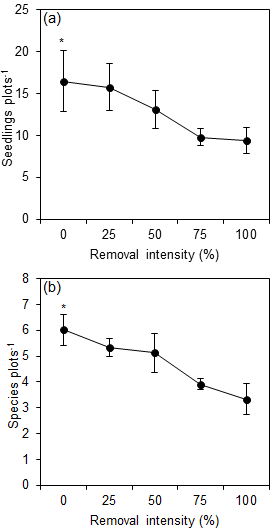
FIGURE 1
Effect of different removal intensities on number of individuals (a) and number of species (b) present in the seedling bank in a remnant of a Subtropical Seasonal Forest in the extreme South of the Atlantic Forest Biome. *Signifi cant 5% probability by GLM test Vertical bars indicate the confi dence interval.
Recruitment of individuals and species varied over time, with greater recruitment between 6 months (May 2014) and 9 months (August 2014), corresponding to autumn and winter, respectively. The last evaluation, in spring (November/2014), presented the lowest number of both species (Figure 2a) and individuals (Figure 2b).
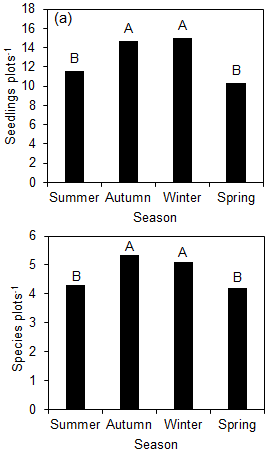
FIGURE 2
Seasonal variation in number of individuals (a) and number of species (b) present in the seedling bank in a remnant of a subtropical seasonal forest in the extreme South of the Atlantic Forest Biome. Means followed by uppercase letters were compared by the GLM test.
The number of individuals (Figure 3) and species (Figure 4) did not differ significantly from that in the control for the 25% removal condition, but significant differences were observed for all other treatments.
For 75% and 100% removal, there was over 50% reduction in the number of species and individuals at 12 months compared to the control.
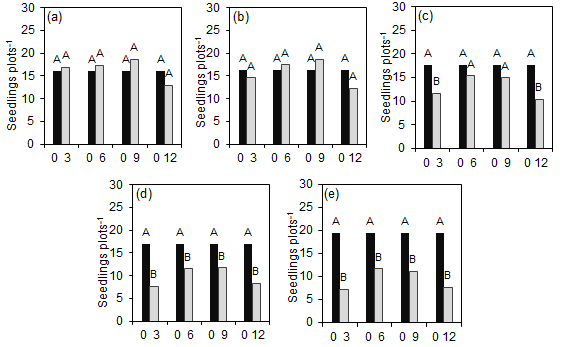
FIGURE 3
Comparison of the mean number of seedlings per plot between time 0 (control) and the other evaluation periods (3, 6, 9 and 12 months), for each treatment. Witness (a); 25% removal (b); 50% removal (c); 75% removal (d); and 100% removal (e). Means followed by uppercase letters indicate comparison to the control (Dunnett test 5% probability).
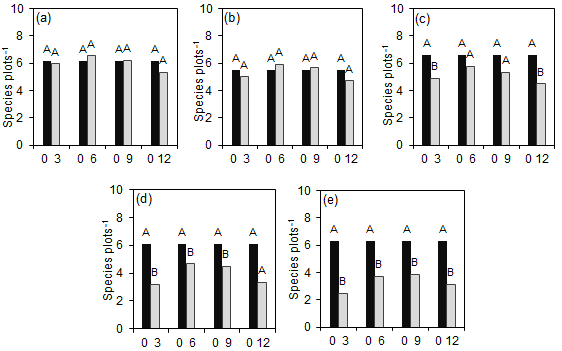
FIGURE 4
Comparison of the mean number of species per plot between time 0 (control) and the other periods (3, 6, 9 and 12 months), for each treatment. Witness (a); 25% removal (b); 50% removal (c); 75% removal (d); and 100% removal (e). Means followed by uppercase letters indicate comparison to control (Dunnett test at 5% probability).
For the most abundant species in the seedling bank (Actinostemon concolor (Spreng.) Müll.Arg, Eugenia rostrifolia D.Legrand, Nectandra megapotamica (Spreng.) Mez and Trichilia claussenii C. DC.), we compared the number of individuals in each evaluation and removal intensity and found that the species adopted different recruiting strategies to cope with the removal of regenerating individuals (Figure 5).
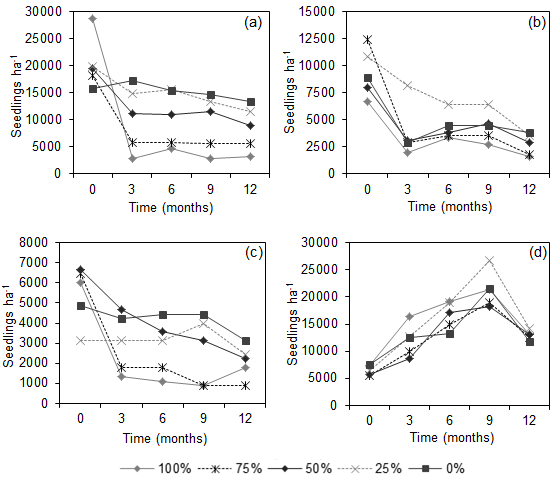
FIGURE 5
Seasonal dynamics of individuals at different removal intensities (100%; 75%; 50%; 25% and 0%) for Actinostemon concolor (a), Eugenia rostrifolia (b), Nectandra megapotamica (c) and Trichilia claussenii (d).
A. concolor was the only species that presented an increase in the number of individuals recruited at 12 months after seedling removal, for all treatments evaluated. However, there was a considerable reduction of individuals between the 9th and 12th months (August to November) (Figure 5a).
E. rostrifolia presented a considerable reduction in the number of individuals in the 3rd month (February 2014) for treatments with 50%, 75%, and 100% removal, and for the control. Additionally, for species N. megapotamica and T. claussenii, there was a significant reduction in seedlings at removal intensities higher than 75% (Figure 5).
Our results show that the regeneration community can tolerate the removal of up to 25% of regenerating seedlings, while removal intensities over 50% interfere with the resilience of the seedling bank, as the vegetal community was not able to reestablish the species and seedlings initially present. Viani and Rodrigues (2008), investigating the impact on a seedling bank caused by different removal intensities in a semideciduous seasonal forest in the state of São Paulo, found that at 18 months, seedlings and species numbers in plots with 50% removal of individuals did not differ significantly from those in the control (0% removal).
This shows the resilience potential of the environment when the remnant vegetation is not considerably affected. Thus, the results indicate that naturally regenerated seedlings can be used to enrich restoration projects in degraded areas without compromising the regenerative potential of forests.
On the other hand, the removal of more than 50% of the seedlings led to a reduction in the number of individuals and species sampled, indicating a limit on the possible removal of regenerating individuals. In this case, a larger number of species ceased to constitute the seedlings bank, probably due to the need to maintain a “stock” with some species with more difficult dispersion and/or regeneration. This scenario demonstrates that the impact of the removal of individuals contained in the seedling bank may be significant for some species, especially those with low regeneration density
Comparisons over the different periods of evaluation demonstrated the influence of the season on recruitment of tree-shrub seedlings. There was a greater density of individuals at 6 and 9 months (autumn and winter), with considerable reductions in the density of individuals from the 12th month (spring). Other studies of seedling banks in seasonal forests have also found variation over time both in the richness and abundance of regenerating species (Mclaren and Mcdonald, 2003; Ceccon et al., 2004; Venturoli et al., 2011).
The phenology of species in seasonal forests, mechanisms of dormancy (Andeis et al., 2005), germination of many individuals in the seed bank at the end of spring and summer (Viani and Rodrigues, 2008), and seasonality due to supra-annual reproductive characteristics of many tropical tree species, all influence the seedling bank composition over the year.
In this study, increased seedling recruitment at 6 (autumn) and 9 months (winter) may be related to the reproductive characteristics of A. concolor (laranjeira-do-mato). This species presented the greatest density and was the only species with a greater number of individuals at 3 months (February 2014) than at the initial evaluation, for plots with 100% transplantation of regenerating individuals.
The initial evaluation was carried out in the flowering/fruiting period for A. concolor, which is between September and November (Andreis et al., 2005). In the subsequent evaluations, an increase in the number of emergent individuals is expected due to seed dispersion, since it is an understory species (Scipioni et al., 2013), indicating a seedling bank regeneration strategy.
The decreased number of seedlings at 12 months (November 2014) may be related to the increased temperature at this time of year, since seedlings with a height lower than 55 cm are sensitive to temperature variation. (Huxman et al., 2004), evaluating the efficiency of water utilization in different ecosystems, found that temperature and precipitation interfered in seedling survival and growth. According to Metz et al. (2008), seedlings are more susceptible to seasonal water deficit because they do not have deep enough roots to obtain water from deeper in the soil. The effects of the water deficit on the dry period are greater because of the increased temperatures and intensities of solar radiation, which may lead to plant desiccation and death (Lieberman and Mingguang, 1992; Vieira and Scariot, 2006).
When we analyzed the most abundant species in the seedling bank (A. concolor, E. rostrifolia, N. megapotamica, and T. claussenii), different regeneration strategies following seedling bank removal were observed. The variations between treatments and between seasons within each treatment may be related to reproductive and silvicultural characteristics of the species.
According to Janzen (1970), the survival, establishment, and development of seedlings are influenced by several morphological, physiological, and abiotic factors, as well as by biological interactions. The way each species responds to these factors is determined by seedling adaptations, that is, the way each species interacts with the environment and with other organisms (Melo et al., 2004).
E. rostrifolia and A. concolor presented intraspecific thinning. According to Freckleton and Watkinson (2002), survival rates in most plants decrease as density increases. Moreover, higher temperatures and lack of rain can also contribute to seedling mortality in these species. Because most of the individuals presented a height below 10 cm, they did not possess photosynthetic capacity efficient enough for establishment.
T. claussenii and N. megapotamica presented a significant reduction in the number of individuals at removal intensities over 75%. T. claussenii presents a low germination rate (Backes and Irgang, 2002), while N. megapotamica is characterized by abundant regeneration under shade (Backes and Irgang, 2002; Carvalho, 2006). Davide et al. (2003) note that species of the genus Nectandra present seeds with short longevity (recalcitrant). Thus, the existence of a seedling bank for these species may constitute a survival strategy, as these remain in the understory until recruitment by higher classes.
According to Viani and Rodrigues (2008), the use of seedling banks of natural areas for seedling production aimed at forest restoration should focus on species with high regeneration density and evident intraspecific thinning, which was the case for E. rostrifolia and A. concolor in all treatments evaluated.
T. claussenii and N. megapotamica did not present intraspecific thinning. However, for the treatments up to 50% removal, the number of individuals was similar to that found for the control (0% removal) at 12 months. Of the species studies here, these show good potential for use in forest nurseries, considering that their seedlings are difficult to obtain and produce since they are adapted to regional edaphoclimatic conditions.
The remnant studied presented partial capacity for self-regeneration following low-intensity seedling bank removal.
Removal of up to 25% of the seedling bank over a short period of time does not interfere with the dynamics of the most abundant populations in the forest understory and may be a useful strategy to produce seedlings of species presenting difficult propagation.
Seedling removal of up to 25% does not impair the persistence of the communities of the species A. concolor, E. rostrifolia, T. claussenii, and N. megapotamica, which present abundant natural regeneration and/or intraspecific thinning. However, more studies with a longer period of evaluation are necessary to more fully understand the interference of seedling removal on vegetal community resilience.
This research was supported by the Foundation for Research Support of the Rio Grande do Sul State (FAPERGS) and the Environmental Fund of the Caixa Econômica Federal (AC FSA CAIXA, Nº. 015,007 / 2012).
+ turchetto.felipe@gmail.com
FIGURE 1
Effect of different removal intensities on number of individuals (a) and number of species (b) present in the seedling bank in a remnant of a Subtropical Seasonal Forest in the extreme South of the Atlantic Forest Biome. *Signifi cant 5% probability by GLM test Vertical bars indicate the confi dence interval.
FIGURE 2
Seasonal variation in number of individuals (a) and number of species (b) present in the seedling bank in a remnant of a subtropical seasonal forest in the extreme South of the Atlantic Forest Biome. Means followed by uppercase letters were compared by the GLM test.
FIGURE 3
Comparison of the mean number of seedlings per plot between time 0 (control) and the other evaluation periods (3, 6, 9 and 12 months), for each treatment. Witness (a); 25% removal (b); 50% removal (c); 75% removal (d); and 100% removal (e). Means followed by uppercase letters indicate comparison to the control (Dunnett test 5% probability).
FIGURE 4
Comparison of the mean number of species per plot between time 0 (control) and the other periods (3, 6, 9 and 12 months), for each treatment. Witness (a); 25% removal (b); 50% removal (c); 75% removal (d); and 100% removal (e). Means followed by uppercase letters indicate comparison to control (Dunnett test at 5% probability).
FIGURE 5
Seasonal dynamics of individuals at different removal intensities (100%; 75%; 50%; 25% and 0%) for Actinostemon concolor (a), Eugenia rostrifolia (b), Nectandra megapotamica (c) and Trichilia claussenii (d).
