Relationship Between Internationalization and Eco-Innovation Strategies: a Brazilian chemical industry study
A Relação entre Internacionalização e Estratégias de Ecoinovação: um Estudo na Indústria Química Brasileira
Relationship Between Internationalization and Eco-Innovation Strategies: a Brazilian chemical industry study
Desenvolvimento em Questão, vol. 17, no. 46, 2019
Universidade Regional do Noroeste do Estado do Rio Grande do Sul
Received: 01 October 2016
Accepted: 23 April 2018
Abstract: This study investigates the association of contextual factors with the adoption of eco-innovation strategies, between internationalized and non-internationalized companies. As part of the research, there is an analyses of the average values for the adoption of contextual factors and eco-innovation strategies between these group of companies. The quantitative research method was used by performing a cross-sectional survey in 124 Brazilian chemicals manufacturing companies. The results from the analysis of the surveys show within the non-internationalized companies there is a better association between the contextual factors of top management support, technological competence, environmental standards and proactive eco-innovation strategies. Results also reveal that internationalized companies do not differ from the other companies regarding to the adoption of environmental regulatory factors, reputation effects, top management support, reactive strategies and proactive strategies. In conclusion, this study indicates that the Brazilian surveyed companies are concerned about eco-innovation, regardless of their status and scope within their market.
Keywords: Eco-innovation, Contextual factors, Internationalization, Chemical industry.
Resumo: Este estudo tem por objetivo investigar a associação de fatores contextuais com a adoção de estratégias de ecoinovação, comparando-se grupos de empresas internacionalizadas e não internacionalizadas. Além disso, também objetiva-se analisar as médias da adoção desses fatores contextuais e das estratégias de ecoinovação nesses dois grupos de empresas. A metodologia da pesquisa segue a abordagem quantitativa, realizando-se um levantamento de corte transversal (survey) em 124 empresas do setor de fabricação de produtos químicos do Brasil. Os principais resultados da análise mostraram melhor associação entre os fatores contextuais de apoio da alta administração, de competência tecnológica e de formalização ambiental e as estratégias de ecoinovação proativas, nas empresas não internacionalizadas. Os resultados revelaram também que as empresas internacionalizadas não diferem em relação àquelas não internacionalizadas quanto à adoção dos fatores de regulamentação ambiental, de efeitos de reputação, de apoio da alta administração, de estratégias reativas e de estratégias proativas. Esse resultado pode sinalizar que as empresas pesquisadas, de um modo geral, têm se preocupado com a ecoinovação, independentemente da abrangência de seu mercado de atuação.
Palavras-chave: Ecoinovação, Fatores contextuais, Internacionalização, Indústria química.
The finiteness of natural resources and environmental degradation are on the discussions’ agenda of organizations and society, as well as in academic debates and research. This finitude is now seen as a threat to the growth of modern economies, making industrial organizations also return their concerns in the search for less polluting alternatives. The concern of companies reflects the economic environment in which they operate, in a current attempt to improve their image with more demanding consumers and competitive market (LUSTOSA, 2011).
That is the context where the term eco-innovation (or environmental innovation) appears in organizations. Arundel and Kemp (2009) define eco-innovations as innovations with emphasis on sustainable development, covering actions to reduce environmental risks, pollution and other negative impacts of production activities.
On the other hand, organizations that decide to internationalize their businesses face several challenges. Among the most evident, Vasconcellos (2008) mentions the challenge of dealing with different cultures, facing several competitive profiles, as well as to follow norms and standards of the target country. These difficulties can be extended to environmental problems. Depending on the organization’s culture, it may be more or less susceptible to sustainability issues, reflecting on proactive and reactive strategies. As for competitiveness, many countries may require certain product profile that drives companies to environmentally friendly actions. From a standardization perspective, there might be a challenge to achieve compliance with environmental regulations, because they may vary from country to country.
In this sense, it is believed that when companies are taken to the international process and therefore standards of many countries containing regulatory issues as environmental actions, there seems to be a positive relationship between internationalization and eco-innovation. This is due to the fact that these internationalized companies have being urged to conform to international sustainability standards, which encourage the adoption of eco-innovation strategies.
To understand the dynamics of challenges the companies faces related to environmental sustainability in an internationalized market, an investigation into the chemical sector of the Brazilian industry was still missing. Therefore, this study aims to investigate the association of contextual factors with the adoption of eco-innovation strategies, comparing internationalized and non-internationalized companies. The research will analyze the average values of adoption of these contextual factors and eco-innovation strategies in these different companies. This particular article is a sub-set of results from a larger study, conducted in different industries to analyze various aspects of the relationship between contextual factors and eco-innovation strategies.
In this paper, chemical industry sector was chosen as one of the most demanding manufacturing processes with the potential to harm the environment, requiring high spending on energy and water, emitting toxic gases and producing toxic waste (BARCELLOS; OLIVEIRA; CARVALHO, 2007; FERRAZ; MOTTA, 2002; WORLD…, 1997). Moreover, being eco-innovation a recent issue (KEMP, 2009; MAÇANEIRO; CUNHA; BALBINOT, 2013; SCHIEDERIG; TIETZE; HERSTATT, 2012), there is a need to examine the theoretical issues raised by the literature through an analysis of empirical data to verify their organizational adherence.
According to the Chemical Industry Brazilian Association (ASSOCIAÇÃO…, 2015), chemical companies and their class associations have sought to encourage responsible production, consumer awareness and dissemination of even higher standards of production and technology. In this sense, it is highlighted a Brazilian study on the history of the chemical industry towards sustainability, conducted in 2012. That study presents global trends in this sector and indicates that the chemical industry will meet the target set in Rio+10, which provides that by 2020 chemicals must be produced and used in ways that make it possible to minimize its adverse effects on health and the environment (BRASIL, 2012). Thus, study of eco-innovation in the chemical industry becomes relevant in order to consider the activities of Brazilian companies in this sector, both nationally and internationally.
ECO-INNOVATION: Key Concepts and Their Relation to Internationalization
Authors as Arundel and Kemp (2009) indicate that organizations have been increasingly concerned to participate in discussions around themes of sustainability and eco-innovation. This concept can be defined by a classification of five characteristics: environmental technologies, organizational innovations for the environment, innovation in products and services that offer environmental benefits, green innovations systems and general purpose technologies (KEMP; FOXON, 2007). For Kemp and Foxon (2007), the eco-innovation is not limited to new or improved technologies, since it can be represented by each product or service environmentally improved and by each organizational change in the environment.
Arundel and Kemp (2009) mention that there are benefits to organizations that practice eco-innovation, but it only exists with changes in values, beliefs and norms. Furthermore, the concern to reduce environmental impacts require changes in management, organization, laws and governance systems. In this context, companies adopt strategies for eco-innovation, which are described in the literature as proactive or reactive. It is understood by proactive strategy “[...] a set of environmental objectives, plans and procedures of a company that go beyond basic compliance with the laws.” (ATES et al., 2012, p. 1.081). These are the proactive strategies to environmental issues, which may be voluntarily motivated by new opportunities. In turn, in companies with reactive strategies, primary concern is to fulfill the law, introducing minimum mandatory changes. The reason is the care about immediate measures, without actually instill these sustainability ideas into the company culture. These businesses do not develop skills and processes for this purpose.
González-Benito and González-Benito (2006) provide a model in which group the determining factors for environmental proactivity in three categories: a) organizational characteristics; b) pressure from stakeholders; and c) external factors. As for features, it is mentioned the size of the organization, internationalization, value chain positioning, administrative attitudes and motivations and strategic attitude. As for pressure from stakeholders, authors indicate that this tension is exerted in particular by primary stakeholders (customers, suppliers, regulators), but also by the secondary (media, NGOs). On the issue of external factors, influence is the sector where organization belongs, risk that it offers, as well as its geographical location.
In this same rationale, Carrillo-Hermosilla, González and Könnölä (2009) cite several factors that affect the development and adoption of eco-innovations. These can be internal, external and inherent to technology. Examples of internal factors are the company’s conditions, size, value chain position, years of the operation, export-oriented position, among others. Main external factors could be associated to public policies, general state of the economy, suppliers, end users, research centers, among others. As for technology, some of the factors cited are the complexity of eco-innovation, high initial costs, technological opportunities, criteria for evaluating new technology, compatibility with the existing system.
The context where adoption of eco-innovation strategies can be a competitive gain for the internationalization of companies, there should be an entry into demanding foreign markets, in environmental terms. Internationalization is understood by Hitt, Ireland and Hoskisson (2008) as a strategy that promotes sale of products or services in the non-domestic sphere. It arises from the potential of markets to offer competitive advantages by generating new opportunities for action.
The selection of abroad entry mode is also one of the crucial factors for achieving internationalization and this choice has consequences on company’s performance. Broadly, the choice is subject to industry conditions, country’s political situation and available resources. Cyrino, Oliveira and Barcellos (2010) consider that internationalization is reached when it gets full or partial sales from international operations through exports, licensing, strategic alliances, acquisitions of companies in other countries or construction of subsidiaries abroad (greenfield venture). Box 1 presents the main ways of entering the global market and its main characteristics.
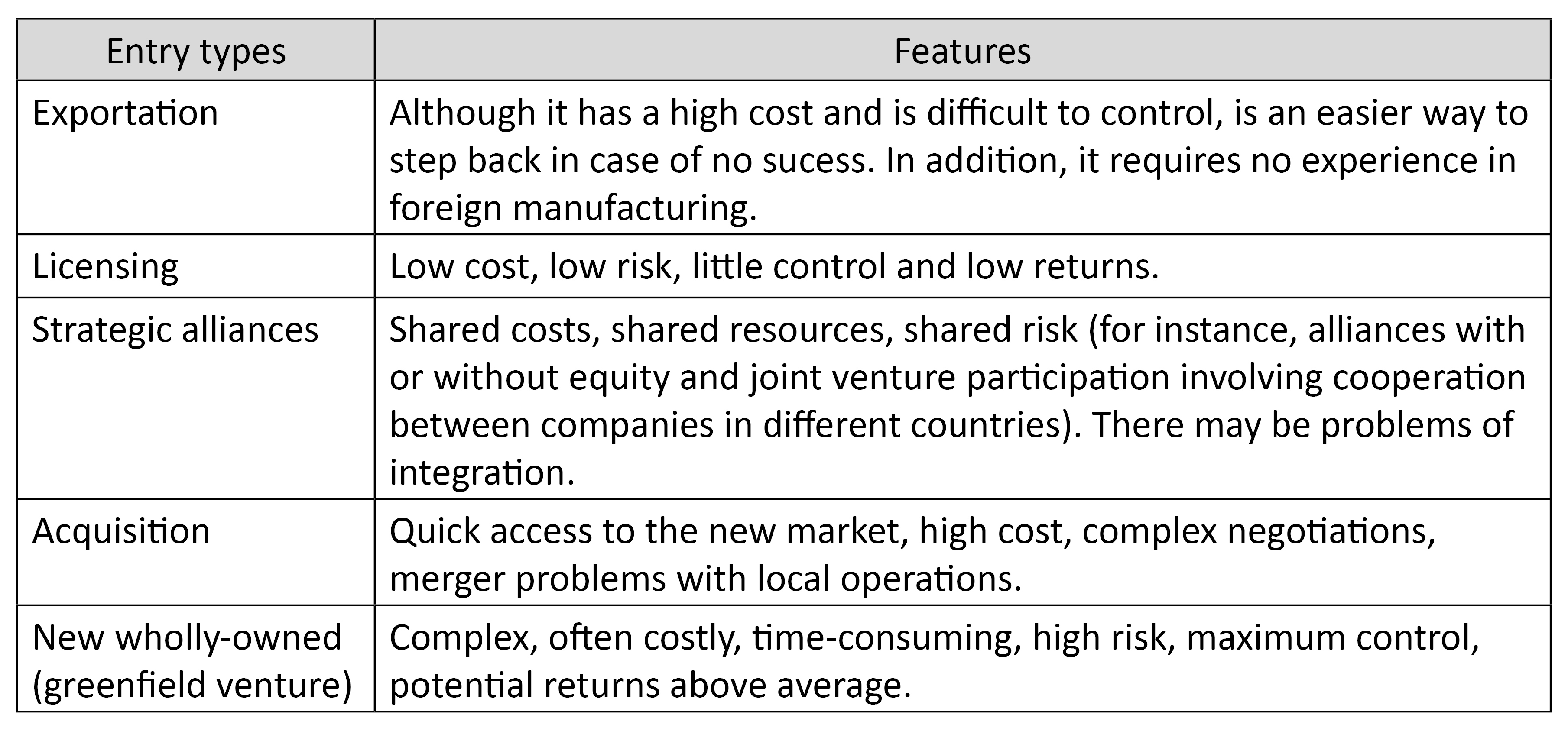
Brazilian industrial companies, as well as in many countries, usually start their international business through exports. Hitt, Ireland and Hoskisson (2008) justify this choice by the fact that, with exportation, it is not necessary to invest in physical space in the target country. However, the company needs to spend funds for transportation, advertising, taxes on goods and product distribution. In general, there are contractual arrangements with the target country company and is the company that performs advertising and distribution, with exporter losing control and still costs becoming high. The consequence is the possibility to make a little competitive product. As for small businesses, they generally also opt for export: for them, exchange rate is the main obstacle.
Exportation can take place directly or indirectly. Direct way requires the exporters aware of the whole process, such as market research, documentation, international agreements, banking, packaging, logistics, and exports. In indirect export, specialized contractors in their own country of origin are responsible for the proceedings. It is obvious that this outsourcing, also known as trading, have additional costs, but it is recommended for beginners, especially micro and small enterprises (BRASIL, 2011).
Licensing is characterized by giving to foreign company the right to manufacture and sell the product through the payment of royalties on each unit produced abroad. For this reason, licensing has also been chosen by smaller companies, because it is the least expensive form of entry, as is borne by the foreign company facilities, marketing, product distribution etc. Since they take few risks, return is also low, as well as control over the operations and the product (HITT; IRELAND; HOSKISSON 2008). A major drawback of licensing is the imminent danger that the licensee, after termination of the contract, imitates the technology acquired to manufacture the product licensor (BRASIL, 2011).
According to Hitt, Ireland and Hoskisson (2008), strategic alliances are, generally, formed by the company of the target country that best understands standardization, legal requirements, and the country’s culture which may have an innovative product or expand their business in non-domestic spheres. When successful, alliances are welcomed because the companies share costs, resources and risks. Yet, according to these authors, there are studies that state that alliances are chosen in situations of greater uncertainty, which makes necessary to reinforce cooperation between the companies.
Although costly, acquisitions are one of the best ways to quickly enter the host country’s business, which already has the knowledge and the necessary structure. A difficulty, together with the high costs, regulatory requirements of the target country and have access to real information makes a higher struggle for the companies. Besides, having a wholly owned subsidiary in the host country is also one of the best ways to have full control over the operations, however, it is very expensive, time consuming, and very complex. The return potential is high and is more likely to happen when companies have their own technology (HITT; IRELAND; HOSKISSON, 2008).
Rocha, Silva and Carneiro (2007) point out that there are several reasons for the internationalization consistently figure in the strategy of companies, which briefly are: 1) companies that had already conquered the national market and wanted to expand its business; 2) companies that have installed distribution points and storage abroad to facilitate their logistics; 3) companies that need to follow their client that has become global; 4) access to strategic resources, such as lower prices, know-how, distribution channels; 5) brand value; 6) access to protected markets; 7) entrepreneurial desire to create new markets; and 8) perceived opportunity in emerging strategy.
For the context of this study, it is important to highlight the relationship between internationalization activities and eco-innovation. To illustrate this relationship, the research from Hrdlicka and Kruglianskas (2010), held in different economic sectors shows data from 2005 to 2007. The authors investigated whether the successful internationalization through exports, from these companies headquartered in Brazil, may have been influenced by good environmental practices. Results obtained by that research showed that good management practices did not significantly affect the export performance, in isolation. However, when these practices were associated with other business functions, this joint influence have greater explanatory power.
Moreover, these authors believe that for an organization to be competitive and sustainable, their managers need to be able to identify new opportunities, create business with social and environmental guidance, that take into account the “legal environment, socio-cultural, economic, natural and technological” (HRDLICKA; KRUGLIANSKAS, 2010, p. 263); also developing this demand on employees, as well as creation of new functions that meet these requirements.
Donaire (2007) also points out that the environmental variable influences the organizational strategy under several factors, one being the fulfillment of international requirements. This is more intense in the multinational companies, for the need to transpose directly related policies with headquarters in countries of origin, which force them to develop environmental strategies. In this sense, Schaltegger (2006 apud HRDLICKA; KRUGLIANSKAS, 2010) also highlights the main motivations of the managers of internationalized companies having sustainable behavior in organizations:
a) compliance with legal requirements; b) realization that to be sustainable increases competitiveness; c) reduction of exposure to business risks; d) perception of personal risks and risks to managers’ reputation; e) cost reduction; f) maintaining the legitimacy of the enterprise and “social license to operate”; g) the shareholder value. (SCHALTEGGER, 2006 apud HRDLICKA; KRUGLIANSKAS, 2010, p. 261).
Some statistics are also significant in the relation internationalization-sustainability. Turolla, Lima and Meirelles (2010) report that foreign direct investment and gross fixed capital formation in Brazil exceeded 30% in early 2000. The authors argue that this investment has a direct consequence for sustainability and can be positive or negative. That is, this investment may mean defining “the technical characteristics of the country’s generation matrix, influencing, for example, the type of production equipment, their energy efficiency and their characteristics in terms of residues” (TUROLLA; LIMA; MEIRELLES, 2010, p. 20). They can also, through their multinational companies, impose highest standards of sustainability. However, it is still possible that, due to fierce competition, is sought by where less stringent environmental standards occur, for example, industries that pollute more, migrating to countries with less demand in this respect. Turolla, Lima and Meirelles (2010) do not develop this item, but leave a research agenda waiting that advancement of internationalization bring benefits, but it is still not possible to verify whether this is actually happening.
In addition to these aspects, customers, suppliers and international competitors pressure multinational companies because they “[...] are more likely to use international standards and other voluntary agreements as a reference for its own environmental strategy” (BUYSSE; VERBEKE, 2003, p. 462). Therefore, these companies with foreign insertion prove to be more concerned with environmental issues, by pressures from foreign shareholders, adoption of environmental standards of the headquarter, as well as demanding foreign consumers (LUSTOSA, 2003). Another factor is that, in international markets, competing companies need to implement the policies of that country, which forces them to develop eco-innovation strategies (CARRILLO-HERMOSILLA; GONZÁLEZ; KÖNNÖLÄ 2009; DONAIRE, 2007).
Thus, it behooves companies to monitor the pressure from external environment that impel to develop eco-innovation strategies and to internationalize. These pressures are interpreted by the organizations in different ways and the decisions taken by them is to differentiate those who take a proactive or reactive behavior in relation to eco-innovation strategies. Taking into account the above discussed literature, it was raised two hypotheses, deployed in a null hypothesis and an alternative to each of them, as follows:
H0A: Internal and external contextual factors are associated more positively to the adoption of proactive eco-innovation strategies to internationalized companies.
H1A: Internal and external contextual factors are associated more negatively to the adoption of proactive eco-innovation strategies to internationalized companies.
H0B: Internationalized companies differ in their indexes of contextual factors and adoption of eco-innovation strategies, compared with not internationalized companies.
H1B: Internationalized companies do not differ in their indexes of contextual factors and adoption of eco-innovation strategies, compared with not internationalized companies.
This paper goes on with the methodological procedures by performing data analysis, comprising sample analysis and constructs constitution, characterization of sample and characterization of companies’ internationalization, presenting, then, analysis of the study’s hypotheses.
METHODOLOGICAL PROCEDURES
Research methodology lies on a quantitative approach, based on a cross-sectional survey in 124 companies of the chemical manufacturing sector in Brazil. Data collected refer to contextual factors of companies in this sector, identification of eco-innovation strategies and information about the performance in the international market. The instrument used was an adaptation from Maçaneiro (2012) study, with adaptations and scale modifications. Based on these changes, new validation by the method of experts was conducted, by three Ph.D professors in the area of innovation and technology. It was also performed a pretest, with two industrial managers responsible for environmental management area, resulting in some improvements.
Data were collected from April to June, 2014, through computerized questionnaire sent by Qualtrics® system. The contact was made via email initially and later by phone. Respondents invited to participate in the study, preferably those responsible for the area/sector/division of environmental management or similar, between management positions, directors or business owners. Sample of the survey was defined as non-probabilistic (non-random), by adhesion (COOPER; SCHINDLER, 2011).
Of the companies in the chemical manufacturing sector in Brazil, the questionnaire was sent to 1,144 companies throughout the country. On this population, 144 companies accessed the system page to answer the questionnaire, however, only 127 of them actually completed all the blocks of the instrument, including the identification data of these respondents. Other 17 companies initiated the filling, but not concluded it, so they are excluded from the analysis. As for missing values within the questions were not detected, since the Qualtrics® platform avoid the possibility of responders forget marking one of the response options.
Before running the analysis, validation and cleansing of data was performed by analysis of each variable through the Boxplot chart, and three outliers were detected between the responses, so they were excluded. Therefore, final amount of sample was 124 companies. For normality of data that sample, it can be used the parameters of Cooper and Schindler (2011, p. 485), who mention that “when sample size approaches to 120, sample standard deviation becomes a very good estimate of population standard deviation (σ); beyond 120, the t and Z distributions are literally identical”.
Data analysis was based on inferential statistics by Pearson correlation coefficient and determination coefficient (R2), for testing of hypotheses. In addition, a t-test for independent samples was conducted to evaluate the statistical significance of differences between group average values. Tests were also carried out for each specific type of analysis such as: graphic analysis; analysis of missing values; analysis of scales reliability by Cronbach’s Alpha; the Exploratory Factor Analysis (EFA) to prove or not the composition construct of eco-innovation strategies; Kaiser-Meyer-Olkin (KMO) test and Bartlett’s sphericity test, to verify the suitability of measurement of factor analysis; and descriptive analysis of the sample. Analyses were performed using statistical package SPSS® (Statistical Package for Social Sciences).
DATA ANALYSIS
Description of the Companies’ Internationalization
Companies were asked about their participation in the international market, and 57% (71 companies) stated that they have no initiative to deal with foreign markets. The other part (53 companies) participate in the international market as follows: a) product(s) license for foreign companies to produce in other countries (1 company); b) export by third party companies (trading) (13 companies); c) export on their own, without any representation in other countries (15 companies); d) export for own account with one or more trade offices in other countries (21 companies); e) with one or more production units in other countries (8 companies). Interesting to point out that the internationalization of companies were mentioned by 47 of the 53 companies that mention some kind of international operation. Therefore, this is the amount to the following description on the internationalization of companies.
The average period of activity of these companies in foreign markets is around 12 years, and the sample has businesses with up to 45 years of internationalization. But the highest percentage (28%) has companies that have from 1 to 5 years, followed by 6 to 10 years (26%). It was also asked about the percentage of transactions abroad and on their total sales. Most (53%) of the 47 companies acts with up to 5% of their revenues in international transactions. But there are also significant values (32%) of performance with 6 to 15% of sales in the international market.
Companies were also asked about the main barrier they face in promoting exports. The most frequently cited (45%) is the bureaucratic barrier, with regard in particular to customs documentation, in which there are excessive requested documents and slow in their analysis. The Brazilian National Industry Confederation report (CONFEDERAÇÃO…, 2014) corroborates this result, to indicate that the bureaucracy is the second major obstacle pointed out by Brazilian surveyed exporters, second only to the exchange rate. In this sense, this research on the chemical industry only reinforces the need to simplify and streamline this process, finding a balance between customs control and the agility to this type of transaction.
Also the tariff barrier, which represents all kind of charges imposed on the imported product, is mentioned in a significant value (25%). The technical barrier has also been mentioned (15%), which is related to the specificity of the product. The cultural barrier was mentioned, but in much smaller value (4%). In turn, the phytosanitary barrier, which relates to derivatives of victuals, was not mentioned by the companies, probably by the industry feature. As for other types of barriers (11%), companies mentioned aspects as lack of competitive price with other countries; competition from Chinese industry; difficulty for finding the ideal partner for marketing; exchange barrier; and some also mentioned that there are no barriers to their companies.
Analysis of the Constructs’ Constitution
The analyzes were performed from the constructs presented in the study from Maçaneiro (2012), with minor changes. Six constructs composed the contextual factors, with independent variables, being named as: 1) environmental regulations; 2) use of environmental and innovation incentives; 3) reputation effects; 4) support of top management; 5) technological competence; 6) environmental standards. In addition to these, a construct was made with dependent variables, called eco-innovation strategies. In all of them, it was used Likert scale of 5 points, except on construct using environmental and innovation incentives, that used the scale “no time” to “four or more times”. Constructs variables of the contextual factors are listed in Box 2.
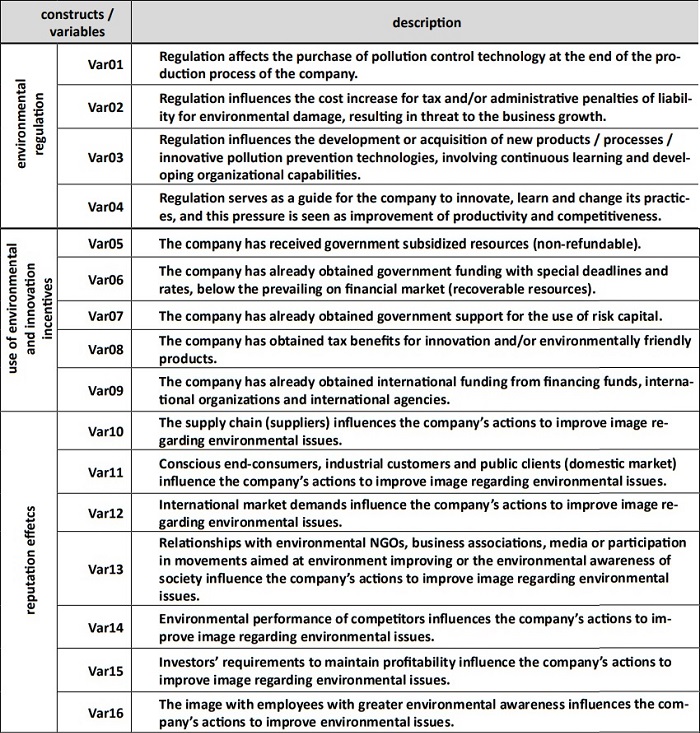
Source: Adapted from MAÇANEIRO (2012).
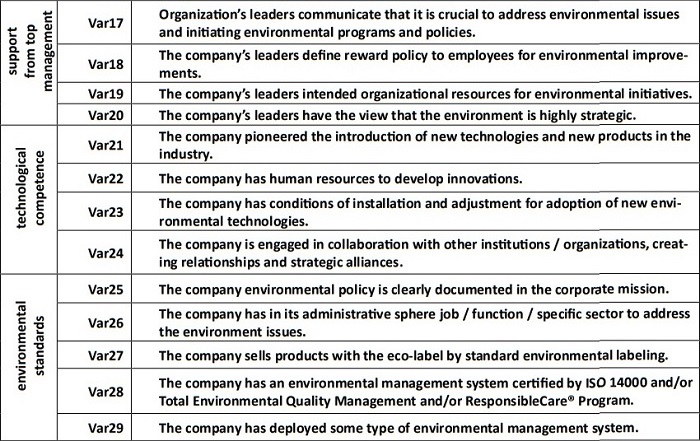
Source: Adapted from MAÇANEIRO (2012).
It was performed a reliability verification of these constructs scales by internal consistency indicator Cronbach’s Alpha, which shows the degree of consistency between the responses (HAIR Jr. et al., 2005). Results confirm that the constructs of reputation effects, support from top management, technological competence and environmental standards has a good level of association intensity (between 0.752 and 0.797), according to the parameters presented by Hair Jr. et al. (2005). The construct environmental regulations has a low correlation (0.504), however, according to Hair Jr. et al. (2005), this association may also be considered. Therefore, these constructs are suitable to the size of the scales, suggesting its reliability.
However, the construct use of environmental and innovation incentives has a substantially low coefficient (0.325), indicating an unreliable scale (FIELD, 2009). As Cronbach’s Alpha measures the average correlation of all attributes of the scale, which has 5 variables, and few companies (23%) indicated the use of some of the sources of financing, the correlation was low. Therefore, this score can be justified by the low use of these types of resources, which made the highest frequency of responses staying too much in degree 1 of the scale (no time). This reveals that, in most cases, analyzed companies were not covered with any government incentive or international organizations for environmental and/or innovative actions. With this result, the construct use of environmental incentives and innovation has been excluded from next analyzes.
In the case of construct eco-innovation strategies, in the study from Maçaneiro (2012), it was divided into the dimensions of proactive and reactive strategies. To prove whether or not this composition in this study, it was used the multivariate statistical technique Exploratory Factor Analysis (EFA). Although this analysis has also been made in the study of Maçaneiro (2012), here the factor analysis was also preceded, since this survey was conducted in another sector of economic activity.
Results of suitability measuring of factor analysis by Kaiser-Meyer-Olkin (KMO) test reach 0.759, which is considered a good value, indicating that the use of EFA is suitable. In addition, the Bartlett’s sphericity test is highly significant (p=0.000), which also shows the appropriateness of factors analysis (FIELD, 2009). Thus, in principle, the factor analysis was performed with two factors, which was not adequate, but the test indicated an adaptation of the construct for loading on three factors. In this case, the construct was divided in the dimensions of reactive strategies, environmental action and proactive strategies, as shown in Box 3.
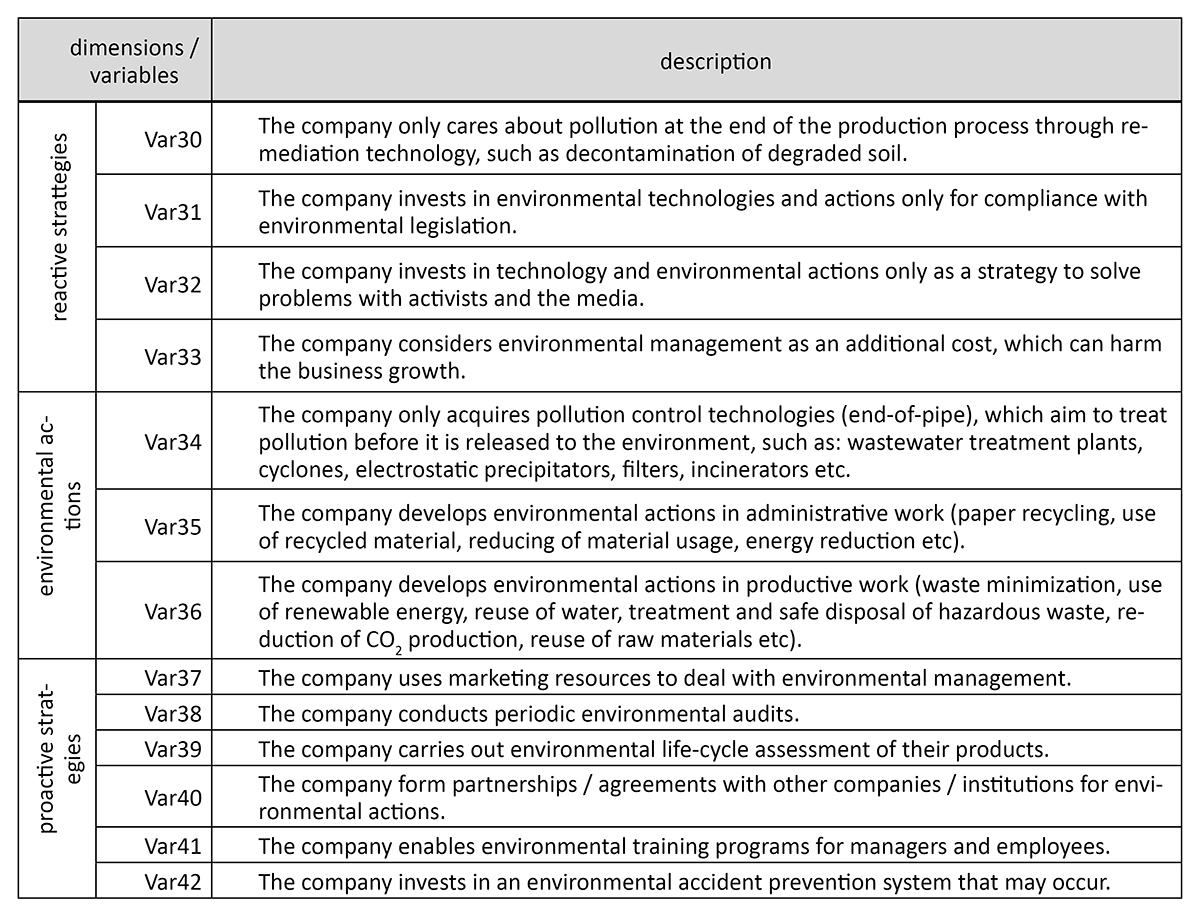
Box 3
Dimensions and variables of eco-innovation strategies construct
Source: Adapted from MAÇANEIRO (2012) and from field research data (2014).
For this construct, it was also carried out the scales’ reliability verification for the internal consistency indicator Cronbach’s Alpha. Results showed that the construct size of reactive and proactive strategies reaches values of Cronbach’s Alpha above 0.7 (0.772 and 0.776, respectively), which is considered a good level of scales reliability, in the parameters of Hair Jr. et al. (2005). The construct’s size of environmental actions had a moderate loading (0.613), but it is also acceptable to analysis. Hence, these constructs’ dimensions proved to be reliable in terms of scales.
Analysis of Hypothesis of Study
Initially, to verify hypotheses H0A and H1A, the correlation analysis was performed between contextual factors and the adoption of eco-innovation strategies, with the intervention of the internationalization factor. In this analysis, the objective was to determine whether the relationship between the internal and external contextual factors in adoption of eco-innovation strategies differed negatively or positively to internationalized companies. That is, with this analysis, it was possible to verify if the factor variation is related to the variation of the other factor.
This analysis was based on inferential statistics, through the testing of hypotheses, which allows to define if the null hypothesis (H0A) will be rejected or not, based on data collected in the study. It was performed by evaluation of Pearson correlation coefficient, which provides numerical overview of the direction and intensity of the relationship between two variables, where high coefficients indicate high covariation and strong relationship (FIELD, 2009). Thus, the correlation shows if there is relationship, meaning it (positive or negative) and the strength of the relationship between variables. Parameters for the coefficient size (effect size) of the correlation are presented by Field (2009), as follows: r=0 for no effect; r=± 0.10 when effect is small; r=± 0.30 when effect is average; r=±0.50 when effect is big; and r=1 when effect is perfect.
It was also calculated the practical significance levels, through the determination coefficients. The determination coefficient (R2) “[...] is a measure of the amount of change in a variable which is explained by the other” (FIELD, 2009, p. 143). The result of this calculation, converted into percentage, provides parameters to explain this variation.
For the analysis of hypotheses, companies were grouped, characterizing them in: group 1 – comprises the 71 companies that mentioned do not operate in the international market (not internationalized companies); and group 2 – consisting of 53 internationalized companies. With these groups defined and based on the assumptions of the hypotheses, tests were run for correlation of the constructs and their variables, resulting in the scores presented in Tables 1 and 2.
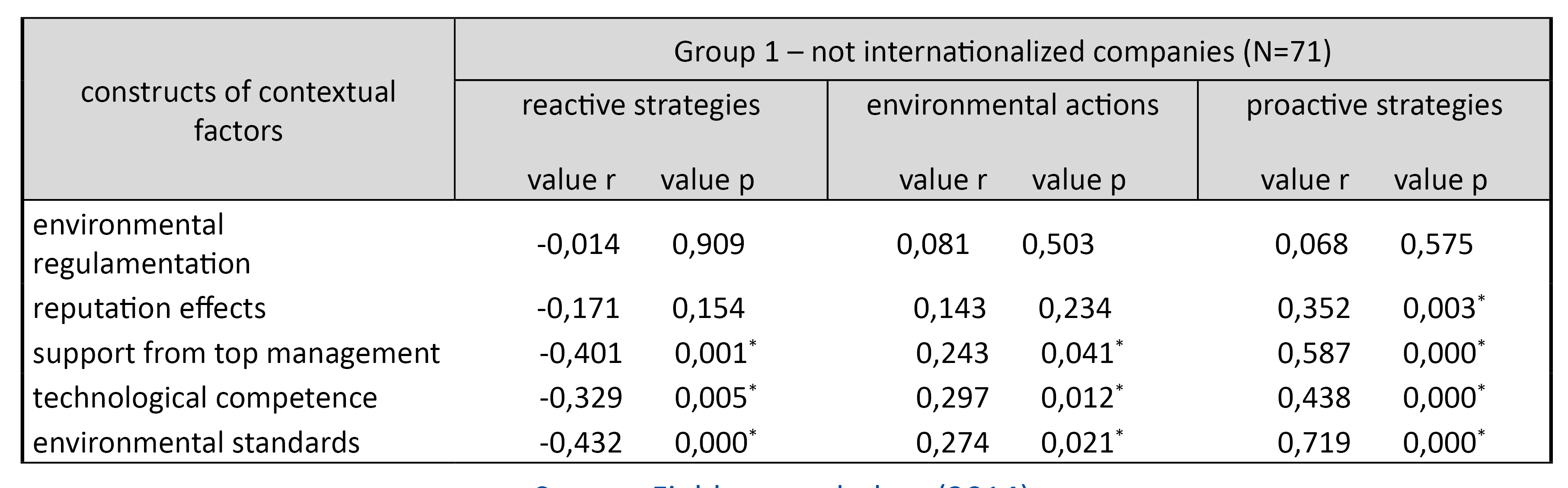
Table 1
Correlation between contextual factors and eco-innovation strategies, under incidence of Internationalization moderating variable – Group 1 (not internationalized companies)
Source: Field research data (2014). * value p<0,05.
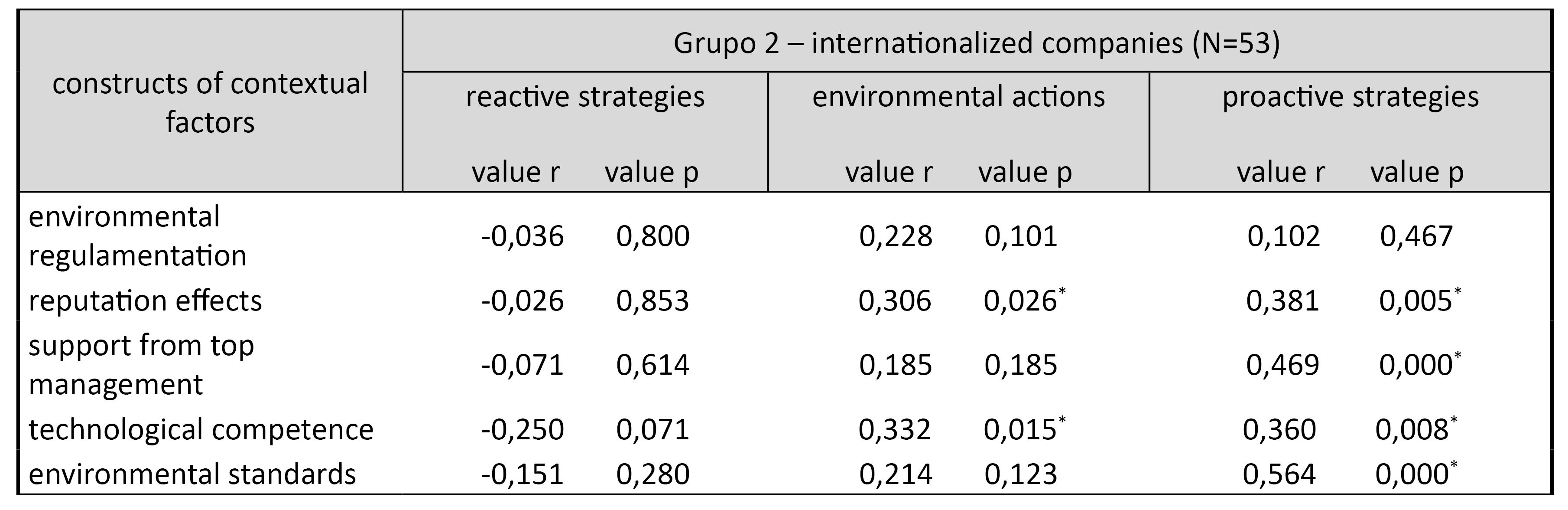
Table 2
Correlation between contextual factors and eco-innovation strategies, under incidence of Internationalization moderating variable – Group 2 (internationalized companies)
Source: Field research data (2014). * value p<0,05.
For the data in Table 1, it is verified that some correlations are not significant at the significance level α=0.05 (value p<0.05), such as environmental regulation with reactive strategies, environmental actions and proactive strategies; and the reputation effects with reactive strategies and proactive strategies. In turn, in the data in Table 2, to internationalized companies, no significant correlations between environmental regulation with reactive strategies, environmental actions and proactive strategies; the same for reputation of the effects with reactive strategies, support from top management with reactive strategies and environmental actions, technological competence with reactive strategies, and environmental standards with reactive strategies and environmental actions. In such cases, it means that the variation of a construct is not related to the other.
Analyzing the significant correlations (value p <0.05) together in both groups (Tables 1 and 2), it can be verified that, between the reputational effects and proactive strategies, joint variation has some improvement in the group of internationalized companies (r=0.381, p=0.005) compared to the not internationalized companies (r=0.352, p=0.003), but the two correlations are considered as average effect according to parameters of Field (2009) and positive. Through determination coefficient, it can be evidenced that the first correlation explains about 15% of the variation of reputation effects on the strategies and the second, approximately 12%.
The opposite occurred with the correlation of support from top management with proactive strategies, that was higher in not internationalized companies (r=0.587, p=0.000), being considered positive and of big effect, in contrast to internationalized companies (r=0.469, p=0.000), positive and of average effect. These correlations explain around 34% and 22%, respectively.
Also in the correlation between technological competence with proactive strategies, not internationalized companies have a higher correlation (r=0.438, p=0.000) than the internationalized companies (r=0.360, p=0.008), the two considered positive and of average effect. With respect to the determination coefficient, the first one explains around 19% and the second one, approximately 13%. It is observed that, in this construct, internationalized companies have slightly higher correlation with environmental actions (r=0.332, p=0.015) than not internationalized companies (r=0.297, p=0.012).
Lastly, the correlation between environmental standards and proactive strategy has substantial increase in the group of not internationalized companies (r=0.719, p=0.000) compared to internationalized companies (r=0.564, p=0.000), where two are of big effect. The determination coefficient of the first was approximately 52% and 32% in the second.
Thus, in general on the significant correlations, the variation in not internationalized companies is related to higher levels with proactive strategies than companies operating internationally. Moreover, it is interesting to note that not internationalized companies have been associated with reactive strategies negatively in three constructs (support from top management, technological competence and environmental standards), which did not occur in internationalized companies (no statistical significance). It is also noticeable that, in these same three constructs, results of not internationalized companies are substantially lower for environmental actions and substantially positive for proactive strategies.
Consequently, by the sample correlation tests, it can be considered that the above results reject the null hypothesis H0A and confirm the alternative hypothesis H1A, which stated that the internal and external contextual factors are associated more negatively to the adoption of proactive eco-innovation strategies for internationalized companies. It is noteworthy that this result only provides the direction and intensity of the relationship between contextual factors and the adoption of eco-innovation strategies, without any implication of cause and effect between the variables (FIELD, 2009).
For the purposes of this study, it was also carried out the t-test for independent samples, which is a statistical technique used to evaluate differences between two population averages (HAIR JR. et al., 2005). This test allows to verify H0B and H1B hypotheses, assessing whether there is a difference between internationalized and not internationalized companies, with regard to the averages of the contextual factors and the adoption of eco-innovation strategies. That is, to evaluate the statistical significance of the difference between the averages of the two groups (not internationalized and internationalized companies) for contextual factors and the adoption of eco-innovation strategies. Values can be examined in Table 3.
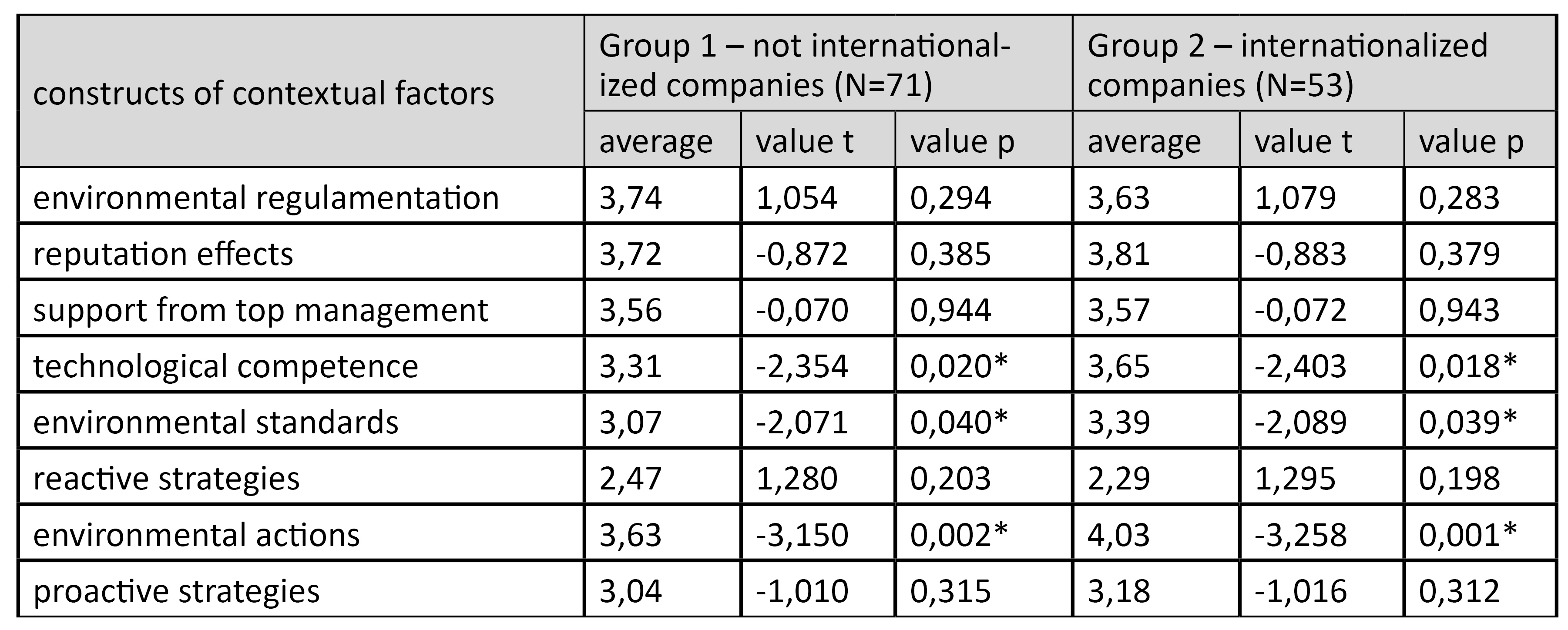
Table 3
Difference test between the average values for contextual factors of Group 1 (not internationalized companies) and Group 2 (internationalized companies)
Source: Field research data (2014). * Value p<0,05.
By t-test, there is no statistically significant difference between the two groups in the averages of constructs environmental regulatory, reputation effects, support from top management, reactive strategies and proactive strategies. In these constructs, tests of the averages are not significant at a significance level α=0.05 (p<0.05). With this result, it can be considered to reject the null hypothesis H0B, in contrast to the literature in some ways. This result can refute the claims of the studies of Donaire (2007) and Turolla, Lima and Meirelles (2010) about compliance with environmental regulations in other countries. These authors claim that multinational companies tend to develop environmental strategies in compliance of international requirements, so for the need to implement the policies of those countries. Therefore, they tend to have higher standards of sustainability. These results also do not support the claims of Buysse and Verbeke (2003), Carrillo-Hermosilla, González and Könnölä (2009), Donaire (2007) and Lustosa (2003), when they mention about customer service, suppliers, competitors, headquarter and international policies (reputation effects). They declare that internationalized companies are more likely to use higher environmental standards, for these pressures from demanding stakeholders.
In turn, in constructs technological competence, environmental standards and environmental actions, there is statistically significant difference between the averages, in which companies from group 2 (internationalized companies) have better average than group 1 (not internationalized companies). For results of the last constructs, the null hypothesis H0B was not rejected, confirming that internationalized companies differ in their average indexes of these contextual factors and the adoption of environmental actions, compared to national companies.
To drill down further and contribute to the above analysis, size data of the companies in each group can also be used. It was found that the groups consist of: a) group 1 – 28% micro companies; 49% small companies, 23% medium-sized companies; and b) group 2 – 8% micro companies, 41% small companies, 51% medium-sized companies (it is noteworthy that there are no large companies in this sample). That is, group 1 has the highest number of micro and small companies (up to 99 employees), while group 2 has its highest percentage in medium-sized companies (100 to 499 employees), which should make these companies more active in environmental terms, as shown by the literature. For these data, it was performed the chi-square test (p>0.05) of these two distributions (groups 1 and 2), for verifying statistical significance of the difference. The p value was 0.000, indicating that there is a statistically significant difference between the two, with the highest concentration of internationalized companies in mid-sized segment and non-internationalized mainly in micro organizations.
Concerning the size of the companies, authors like Carrillo-Hermosilla, González and Könnölä (2009) affirm that there is a connection between the size of the company and its environmental innovation behavior. Buysse and Verbeke (2003) also state that the size of the company can be reflected in the perceived importance of the pressure factors for adoption of environmental issues, such as smaller companies that give less importance to international customers, suppliers and competitors, than large companies. Passos (2003) points out that the size is a factor that can influence companies to adopt environmental management more effectively, “[...] as it increases the size of the company, the greater the degree of complexity of its operations and hence the need for an organized and structured management” (PASSOS, 2003, p. 104). Therefore, in this study, results partially corroborate this literature, since the correlations showed better results in not internationalized companies that are smaller, to the detriment of companies with international operations and differences tests between averages indicated major differences in just three (technological competence, environmental standards and environmental actions) of the eight constructs of the study.
CONCLUDING REMARKS
This study aimed to investigate the association of contextual factors with the adoption of eco-innovation strategies, comparing groups of internationalized and non-internationalized companies, in addition to analyze the average values of adopting these contextual factors and strategies in these two groups of companies.
Some of internationalization characterization data showed that, of the 124 companies in the sample, 57% said they did not have international transactions, with the other part working in the international market through products licensing, trading, export with or without commercial representation and production units abroad. Most frequently cited countries by companies, which had business transactions were: Argentina, Paraguay, Uruguay, Chile, Bolivia and the United States. Most internationalized companies (53%) operates up to 5% of its revenue in international transactions, but there were also significant values (32%) of performance with 6 to 15% of sales in the international market. The most cited barrier by 45% of companies was bureaucracy, with regard, in particular, to customs documentation, in which there are excessive amount of documents requested and slow in its analysis. But also the tariff barrier was mentioned by 25% of companies, representing all kinds of charges imposed on the imported product.
Analysis results of the first hypothesis (H0A and H1A) showed a better association between contextual factors and proactive eco-innovation strategies in non-internationalized companies. This association with the proactive strategies was better in the constructs of support from top management, technological competence and environmental formalization. Another important outcome was the negative association of non-internationalized companies with reactive strategies in those three constructs, which did not occur in internationalized companies (no statistical significance). It was also noticeable, in those three constructs, the fact that the results of the non-internationalized companies get substantially lower values for environmental actions and substantially positive for proactive strategies. These results reject the null hypothesis H0A and confirm the H1A alternative, establishing the direction and intensity of the relationship between contextual factors and the adoption of proactive eco-innovation strategies for better levels to non-internationalized companies.
In the analysis of the second hypothesis (H0B and H1B), there was no statistically significant difference in average values of non-internationalized and internationalized companies, in the constructs environmental regulation, reputation effects, support from top management, reactive strategies and proactive strategies. This shows that internationalized companies do not differ from those non-internationalized, as the adoption of contextual factors and proactive eco-innovation strategies. This result rejects the null hypothesis H0B, in contrast to the literature in some aspects, such as meeting the strictest environmental regulations in other countries, international policies, customers, suppliers and competitors in the international market. Moreover, this result may signal that companies in general have been concerned about the eco-innovation independently of the scope of its market. In this case, concern for environmental management may be present in the strategic decisions of all chemical companies investigated, but not to a greater extent in the internationalized ones.
On the other hand, in the constructs of technological competence, environmentalformalization and environmental actions, it was identified a statistically significant differencebetween the average values. In these constructs, internationalized companieshad better average values than non-internationalized ones, since the null hypothesisH0B was not rejected, confirming that the internationalized companies differ in theirindexes of average values of these contextual factors and adoption of environmental actions.This may suggest that the internationalized companies have better technologicalconditions for the formalization of environmental issues in their structure, resulting inincreased adoption of environmentally sound actions.
Data also did not corroborate with the literature in terms of size, which mentions that larger companies tend to have a more effective environmental management than smaller ones. That is because 77% of non-internationalized companies in the sample are micro and small, over 51% of medium-sized companies in the internationalized group. However, it is noteworthy that the comparison between internationalized and non-internationalized companies perhaps could have different results if the sample includes large companies.
From the results obtained in this study, it is expected to have contributed to the research on environmental management, given the importance attached to this issue on the world scene. It is important to note that this study contributes to the knowledge advancement in the area of eco-innovation strategies, by bringing empirical evidence of an industrial sector that is considered of high potential for pollution and intensive natural resource user.
As topics for future research, it is considered that the contextual factors that lead companies to adopt eco-innovation strategies could be investigated in further studies with bigger emphasis and in other activity sectors. Or, yet, other factors related to the company’s functions could lead to results that would point a more significant relationship of association between adoption of environmental actions, eco-innovation strategies and internationalization.
References
ASSOCIAÇÃO BRASILEIRA DA INDÚSTRIA QUÍMICA (Abiquim). 2015. Available in: <http://canais.abiquim.org.br/sassmaq/>. May 2016.
ARUNDEL, A.; KEMP, R. Measuring eco-innovation. UNU-MERIT Working Paper Series. 2009. Available in: <https://www.oecd.org/env/consumption-innovation/43960846.pdf>.
ATES, M. A. et al. Proactive environmental strategy in a supply chain context: the mediating role of investments. International Journal of Production Research, 50(4), p. 1.079-1.095, fev. 2012. DOI: 10.1080/00207543.2011.555426.
BARCELLOS, F. C.; OLIVEIRA, J. C. D.; CARVALHO, P. G. M. D. Investimento ambiental em indústrias sujas e intensivas em recursos naturais e energia. ENCONTRO DA SOCIEDADE BRASILEIRA DE ECONOMIA ECOLÓGICA. Fortaleza, 2007.
BRASIL. Ministério das Relações Exteriores. Divisão de Programas de Promoção Comercial. Exportação passo a passo. Brasília: MRE, 2011.
______. Confederação Nacional da Indústria (CNI). Associação Brasileira da Indústria Química. A trajetória da indústria química rumo à sustentabilidade. Brasília: CNI, 2012. Available in: <http://arquivos.portaldaindustria.com.br/app/conteudo_18/2013/09/23/4970/20131002174409281773i.pdf>..
BUYSSE, K.; VERBEKE, A. Proactive environmental strategies: a stakeholder management perspective. Strategic Management Journal, 24(5), p. 453-470, May 2003. DOI: 10.1002/smj.299.
CARRILLO-HERMOSILLA, J.; GONZÁLEZ, P. DEL R.; KÖNNÖLÄ, T. Eco-innovation: when sustainability and competitiveness shake hands. London: Palgrave MacMillan, 2009.
CYRINO, A. B.; OLIVEIRA JR., M. M.; BARCELLOS, E. P. Evidências sobre a internacionalização de empresas brasileiras. In: OLIVEIRA JR., M. M. (Org.). Multinacionais brasileiras: internacionalização, inovação e estratégia global. Porto Alegre, RS: Bookman, 2010.
CONFEDERAÇÃO NACIONAL DA INDÚSTRIA (CNI). Entraves às exportações brasileiras. Principais problemas da empresa exportadora. Brasília: CNI, 2014.
COOPER, D. R.; SCHINDLER, P. S. Métodos de pesquisa em administração. 10. ed. Porto Alegre: Bookman, 2011.
DONAIRE, D. A. Gestão ambiental na empresa. 2. ed. São Paulo: Atlas, 2007.
FERRAZ, C.; MOTTA, R. S. Texto para discussão n° 863: regulação, mercado ou pressão social? Os determinantes do investimento ambiental na indústria. São Paulo: Instituto de Pesquisa Econômica Aplicada, Ipea 2002.
FIELD, A. Descobrindo a estatística usando o SPSS. 2. ed. Porto Alegre: Artmed, 2009.
GONZÁLEZ-BENITO, J.; GONZÁLEZ-BENITO, O. A review of determinant factors of environmental proactivity. Business Strategy and the Environment Business Strategy, 15, 87-102, 2006. DOI: 10.1002/bse.450.
HAIR JR., J. F. et al. Fundamentos de métodos de pesquisa em administração. Porto Alegre: Bookman, 2005.
HITT, M. A.; IRELAND, R. D.; HOSKISSON, R. E. Administração estratégica. 2. ed. São Paulo: Thomson Pioneira, 2008.
HRDLICKA, H.; KRUGLIANSKAS, I. Influência das práticas de gestão socioambiental na internacionalização de empresas brasileiras. In: FLEURY, A. (Org.). Gestão empresarial para a internacionalização de empresas brasileiras. São Paulo: Atlas, 2010.
KEMP, R. From end-of-pipe to system innovation. Druid Summer Conference. Copenhague, 17-19 june 2009.
KEMP, R.; FOXON, T. J. Tipology of eco-Inovation. In: MEI project: measuring Eco-Inovation. European Commission, aug. 2007. Available in: .
LUSTOSA, M. C. J. Industrialização, meio ambiente, inovação e competitividade. In: MAY, P. H.; LUSTOSA; VINHA, M. C. J. V. (Org.). Economia do meio ambiente: teoria e prática. Rio de Janeiro: Elsevier, 2003. p. 155-172.
LUSTOSA, V. C. J. Inovação e tecnologia para uma economia verde: questões fundamentais. Política ambiental. Economia verde: desafios e oportunidades, 8, p. 111-122, 2011. Available in: <http://www.ecoeco.org.br/economia-verde/191-revista-politica-ambiental-no-8-economia-verde>.
MAÇANEIRO, M. B. Fatores contextuais e a adoção de estratégias de ecoinovação em empresas industriais brasileiras do setor de celulose, papel e produtos de papel. 2012. Thesis (Doctorate in Administration) – Universidade Federal do Paraná, Curitiba, 2012.
MAÇANEIRO, M. B.; CUNHA, S. K.; BALBINOT, Z. Drivers of the adoption of eco-innovations in the pulp, paper, and paper products industry in Brazil. Latin American Business Review, 14, p. 179-208, 2013. DOI: 10.1080/10978526.2013.833465.
PASSOS, L. A. N. Gestão ambiental e competitividade: um estudo do setor químico brasileiro. 2003. Dissertation (Master in Business Management) – Universidade Estadual de Maringá, Londrina, 2003.
ROCHA, A.; SILVA, J. F.; CARNEIRO, J. Expansão internacional das empresas brasileiras: revisão e síntese. In: FLEURY, A.; FLEURY M. T. (Org.). Internacionalização e os países emergentes. São Paulo: Atlas, 2007. p. 183-197. Cap. 10.
SCHIEDERIG, T.; TIETZE, F.; HERSTATT, C. Green innovation in technology and innovation management: an exploratory literature review. R & D Management, 42(2), p. 180-192, 2012. DOI: 10.1111/j.1467-9310.2011.00672.x.
TUROLLA, F. A.; LIMA, M. F. F.; MEIRELLES, F. S. Internacionalização & sustentabilidade. GV-executivo, 9(1), p. 16-21, 2010.
VASCONCELLOS, E. Internacionalização competitiva: Braskem, CCR, CSN, Dixtal, Embraer, Natura. São Paulo: Atlas, 2008.
WORLD HEALTH ORGANIZATION (WHO). Health an environment in sustainable development: five years after the Earth Summit. Genebra: WHO, 1997.