2026
14
03042025
11072025
 Diana Pinzón dianapinzonq@gmail.com
Universidad Nacional de Loja, Ecuador
Abstract: Writing is essential in the acquisition of the English language, benefiting both the professional and academic spheres. This research aimed to determine the effect of Learning Journals on the development of writing skills in upper secondary school students at a public institution in Loja. A mixed methodological approach was used, integrating quantitative and qualitative techniques within an Exploratory Action Research (EAR) design. The sample consisted of 25 students, and the intervention lasted eight weeks. The quantitative results revealed significant improvements in spelling and organization, with more moderate improvements in content. In addition, qualitative data revealed that students found Learning Journals, especially Dialogue Journals, useful for reflecting on their writing. Overall, the implementation of Learning Journals contributed to the development of students’ writing skills
Keywords: writing skills, learning journals, superior basic education students, English language acquisition, journal writing.
Resumen: La escritura es esencial en la adquisición del inglés, ya que beneficia al ámbito profesional y al académico. Con esta investigación se tuvo como objetivo determinar el efecto de los diarios de aprendizaje en el desarrollo de habilidades de escritura en los estudiantes de educación básica superior de una institución pública en Loja, Ecuador. Se empleó un enfoque metodológico mixto, integrando técnicas cuantitativas y cualitativas enmarcadas en un diseño de investigación acción exploratoria (EAR). La muestra estuvo conformada por veinticinco estudiantes y la intervención duró ocho semanas. Los resultados cuantitativos revelaron mejoras significativas en la ortografía y la organización, más moderadas en contenido. Además, los datos cualitativos revelaron que los estudiantes consideraron los diarios de aprendizaje, especialmente los diarios de diálogo, útiles para reflexionar sobre su escritura. En general, la implementación de los diarios de aprendizaje contribuyó al desarrollo de las habilidades de escritura de los estudiantes.
Palabras clave: habilidades de escritura, aprendizaje de diarios, estudiantes de educación básica superior, adquisición del inglés, escritura de diarios.
Learning journals and writing skills among superior basic education students at a public institution in Loja, Ecuador
Diarios de aprendizaje y habilidades de escritura en estudiantes de educación básica superior de una institución pública en Loja, Ecuador
Diana Pinzón dianapinzonq@gmail.com

Recepción: 03 Abril 2025
Aprobación: 11 Julio 2025
Writing is a vital component of English language acquisition, offering untold benefits for learners in both their professional pursuits and effective communication in a non-native language. As noted by Bora (2023), writing entails high-level skills such as content, structure and organization, as well as low-level skills such us punctuation, vocabulary choice, and grammar. Besides, Demera and Fajardo (2023) underscored the key role that the writer’s mind assumes in developing English as a Foreign Language (EFL) writing skills, as it directly manages and actively supervises the composition of the written language.
As per the Ecuador’s national curriculum (2019), students from superior basic education are expected to choose the appropriate text type for their writing goals while developing editing and revision skills to enhance their understanding of writing. However, an issue about this skill became visible by the researcher during the practicum, where there was an opportunity to observe superior basic education students. During these observations, it was perceived that students found difficulties when composing sentences, with challenges encompassing issues such as spelling, organization, and content. As Graham (2019) specifies, these writing challenges can be attributed to numerous factors, including a lack of resources, or the use of traditional and inadequate educational methodologies.
To address the aforementioned situation, the use of Learning Journals has been proven effective in the development of writing skills. Numerous studies have demonstrated the positive effects of Learning Journals on the development of writing skills among students. For instance, Masdianti et al. (2021) observed substantial improvements in writing skills among ninth-grade students after a journal writing intervention, confirmed by significant posttest score increases. Besides, Shaumiwaty (2020) highlighted the effectiveness of Learning Journals in enhancing eighth graders’ writing abilities, with statistical evidence supporting the intervention’s success. Lastly, Sholah (2019) demonstrated that journal writing significantly improved writing motivation and proficiency among second-year EFL students.
Furthermore, this research study was expected to contribute to the scientific knowledge in the education field, specifically in the area of EFL teaching, by exploring the significance of developing writing skills in high school students with the aid of an innovative resource. Learning journals can be employed as a tool to help students to build their writing skills practicing what they have learned in class. In light of this, it was hoped that throughout the implementation of learning journals to monitor students’ writing progress, the research study intended to collect the insights from students that could be of help in the curriculum development, teaching methodologies, and incorporating activities to develop students’ writing skills.
With all this in mind, the following research questions were designed to address the study:
To what extent does the use of Learning Journals have an effect on the development of writing skills among superior basic education students at a public institution in Loja?
What is the impact of using learning journals for the development of organization, spelling and content writing skills among superior basic education students at a public institution in Loja?
What are the perceptions of the use of learning journals in the English language writing skills among superior basic education students at a public institution in Loja?
Writing skills play a significant role in education, serving as a crucial tool for conveying thoughts with a specific purpose. Tri Purwanti and Eliwarti (2021) highlight the nature of writing, involving considerations of content, word choice, audience, and grammar throughout various stages. Despite its significance, writing is often not the favored language skill among students, due to the time-consuming nature of crafting quality written pieces, coupled with the solitary aspect of the activity (Majchrzak & Ostrogska, 2022). In light of this, content, organization, and spelling components, were selected to measure students’ writing skills development.
The first component is content, as being the central part of a text or paragraph, and represents the main point, the writer needs to connect ideas across sentences to further develop the topic in a coherent way (Alberto Lázaro, 1996). However, it must be both factual and intellectual, with criteria discerned through distinct purposes in writing (Politton & Hadiyanti, 2019). The following component is spelling, Harmer (2007) remarked that one of the reasons that spelling is difficult for students of English is that the relationship between the sound of a word and the way it is spelt is not always visible. Therefore, teaching students to cultivate strong spelling aptitude is a definitive means of enhancing their writing skills (Hasibuan, 2013). Finally, the organization component, as indicated Alberto Lázaro (1996), with organization the readers can appreciate a structured composition and it could preclude extraneous repetitions, disconnected threads, or inadequate exposition
In the field of English education, effective writing is acknowledged as an art that requires learning, development, and domain (Obadare, 2023). Tri Purwanti and Eliwarti (2021) underscore that the inherent difficulty in writing lies in the requirement for high-level language control compared to other language skills. Consequently, teachers are challenged to employ creative strategies in teaching writing to overcome these obstacles.
Understanding the development of writing skills is an ongoing process, and Graham et al. (2019) assert that the journey from novice to competent writer is significantly influenced by the context in which writing occurs. This includes changes in students’ writing skills, strategies, knowledge, and motivation. Harmer (2004) highlights its diverse purposes of writing in English language teaching, ranging from being a support for grammar teaching to a stand-alone chapter of the curriculum in which effective writing is a primary learning objective.
Majchrzak and Ostrogska (2022) emphasize the adaptability of journal writing as a teaching strategy, allowing teachers to incorporate writing activities anywhere. Additionally, in educational contexts, learning journals serve as tools for reinforcing literacy skills, especially reading and writing, while simultaneously fostering critical thinking (Maneepakhathorn, 2023). In this study the journals that were used for the intervention were Reflective Journals, Dialogue Journals, and Learning Logs.
Reflective Journals are a particularly successful tool for the development of students’ reflection skills, allowing them to rely on their critical thinking and analytical skills in analyzing their study experiences (Maneepakhathorn, 2023). The practice of writing reflective journals during the learning process enables students to improve their writing proficiency and achieve independence in learning, and at the same time allows them to reflect on their learning process (Ramadhanti et al., 2020).
On the other hand, Learning Logs play a crucial role in promoting self-reflection, aiding students in identifying gaps in their knowledge and exploring connections between current learning and past experiences (Wagiyo, 2018). In essence, as per by Ayoub (2020), Learning logs have been shown to make a significant contribution to students’ self-awareness, critical thinking and transformation of knowledge in the learning process.
Regarding Dialogue Journals, Al Kayed et al. (2020), define them as regular written conversations between students-students or students-teachers that offer a dynamic space for communication. This motivates students to express their feelings and interests, fostering accurate use of vocabulary, grammar, spelling, organization and content (Wagiyo, 2018). This tool is versatile for the EFL classroom because it reveals its effectiveness in improving writing proficiency, commands an expanded vocabulary, and adjusting the involvement of learners in a positive manner (Zabala & Carolina, 2020).
O’Loughlin and Griffith (2020) stated that the utilization of metacognitive strategies in classroom enables students track and improve their learning techniques during the entire course. Journaling is one solution, as it develops metacognitive skills essential for the learning process and allows students to articulate their developing competencies.
For Rahmat et al. (2019), metacognitive skills are inherently linked to planning skills, monitoring skills, and assessment skills. Furthermore, Alt and Raichel (2020) reaffirm the connection between metacognition and reflection, noting that journaling sharpens students’ ability to adapt their approach and monitor learning outcomes.
Under this study the researcher employed the mixed method approach. Schouten (2021) highlighted that mixed method research aimed to integrate qualitative and quantitative research, taking advantage of the strengths and mitigating the weaknesses of both techniques.
This investigation followed an action research design where a problem in the researcher’s practice is addressed to develop an effective pedagogical strategy, in this case with regard to developing students’ writing skills (Almeida & Rosero, 2023). Moreover, the model that the researcher focused on in action research design for the respective research was the exploratory action research model (EAR) proposed by Smith and Rebolledo (2018).
Although the study was framed under the EAR approach, it adopted a sequential explanatory mixed-methods design, where quantitative data (pre-test and post-test results) were collected and analyzed first, followed by qualitative data (questionnaire and field notes) to explain and enrich the quantitative findings. The integration of both data types happened during the interpretation stage, using triangulation to establish consistency across the results and to support the conclusions drawn from multiple perspectives. This strategy improved the depth and breadth of the study without constituting a fully structured mixed design.
The present research took place in Loja city, at a public urban educational institution. The participants of the study were selected through convenience sampling, based on accessibility, availability, and the existing academic relationship between the students and the researcher during the pre-professional practicum. According to Rahi (2017, as cited in Golzar & Tajik, 2022), convenience sampling allows researchers to collect data from individuals who are readily accessible.
After receiving institutional authorization, the researcher collaborated with the class teacher to gather relevant information for planning the intervention. Initially, the intervention was applied to an intact class of thirty-eight students; however, only those who returned the signed parental consent form were included in the final sample. As part of the inclusion criteria, students had to be enrolled in 10th grade, possess an A2.1 English proficiency level according to the Ministry of Education (2019), and provide signed consent through their legal tutor. Students who did not meet these criteria or missed essential phases of the intervention were excluded from the data analysis. As a result, data from twenty-five students, eleven boys and fourteen girls, was considered for the final analysis.
This research was conducted in compliance with ethical standards. Institutional approval was obtained from the academic coordination of the Language Department. Students and guardians were informed about the study’s objectives, voluntary participation, confidentiality, and the right to withdraw at any time. To ensure anonymity, numerical codes were used to identify participants, and all data was processed confidentially.
Since the researcher planned to employ a mixed method approach, a combination of quantitative and qualitative techniques was used for data collection. The testing technique that was used to gather quantitative data through a pre-test and post-test administration. Students were asked to write a short story of at least 35 words based on the pictures. The format and scoring rubric were adapted from the Cambridge English A2 writing assessment (Cambridge, 2020). The rubric evaluated three writing components: content, organization, and spelling; each with a maximum of five points, for a total of 15 points.
To ensure instrument validity, a panel of two university EFL professors reviewed the rubric and the questionnaire to confirm alignment with the study objectives and A2-level writing standards. A pilot test was also conducted with a comparable group of students not involved in the main study to verify item clarity and structure. The internal consistency of the questionnaire, which followed a Likert scale model, was verified using Cronbach’s alpha, yielding a reliability coefficient of 0.82, indicating acceptable consistency.
Likewise, for qualitative data, the observation technique was carried out during the intervention. Field notes were used to document students’ reactions and engagement while writing their Learning Journals. Additionally, a questionnaire was administered at the end of the intervention, combining Likert-scale and open-ended questions to capture students’ perceptions about the usefulness of Learning Journals. The combination of instruments enabled a well-rounded perspective on the research problem and supported the interpretation of the quantitative findings.
In quantitative terms, the researcher first applied descriptive analysis to the pre- and post-test scores using Excel. Scores were categorized by the three writing components: content, organization, and spelling. This allowed for a detailed comparison of student performance before and after the intervention. To determine whether the differences in scores were statistically significant, a paired-samples t-test was conducted. This inferential statistical test provided objective evidence regarding the effectiveness of the intervention, adding methodological rigor to the quantitative component.
In parallel, thematic analysis was used to process qualitative data collected through the open-ended questionnaire responses and field notes. Recurring themes and student reflections were grouped according to writing development indicators and students’ attitudes toward the intervention. The integration of qualitative and quantitative results was achieved through triangulation, where findings from different data sources were compared and interpreted jointly. This approach helped validate the quantitative outcomes and offered deeper insight into the learning process and students’ experiences.
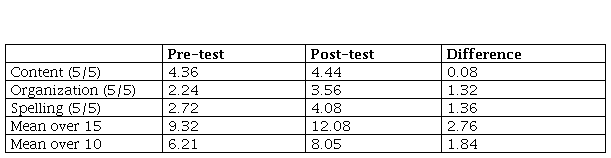
As seen in Table 1, students demonstrated improvement in all three components after the intervention. In the content component, students started with a strong average (4.36/5) and improved slightly to 4.44/5. Organization, initially a weaker area (2.24/5), showed substantial progress, reaching 3.56/5. Similarly, spelling improved from 2.72/5 to 4.08/5, suggesting enhanced accuracy in word formation and grammar.
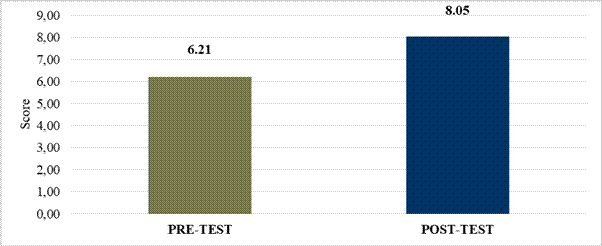
Overall, the mean total score increased from 9.32 to 12.08 out of 15, which equals a difference of 1.84 points over 10. This indicates a moderate and consistent development in students’ writing abilities following the use of Learning Journals.
To assess whether this difference was statistically significant, a paired samples t-test was conducted on simulated student-level data (n = 25). The results showed a statistically significant difference: t (24) = 4.88, p < .001
This result indicates that the observed improvement in writing scores was unlikely to be due to chance, and supports the effectiveness of the intervention. Although the use of means provides an initial insight into the changes observed between the pre-test and post-test, it is recommended to include measures of dispersion, such as standard deviations, and inferential statistical tests to more robustly determine whether the differences are statistically significant. However, due to the lack of access to individual student data, such analyses were limited. Future research should consider collecting and reporting these data to enhance the precision and rigor of the findings.
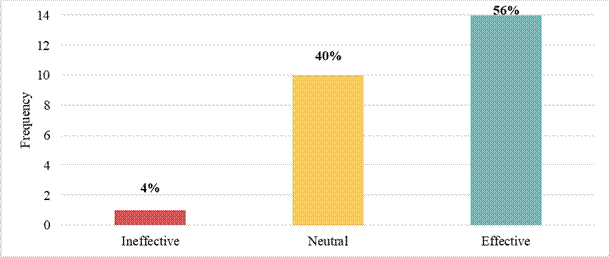
Figure 2 presents students’ perceptions concerning to the development of writing skills using Learning Journals in general. According to the data, 56% of students perceived a positive impact on their writing skills after using Learning Journals. Meanwhile, 40% of students remained neutral about the effectiveness of the journals, indicating they either did not notice significant changes or needed more time to evaluate the impact. Only 4% of students felt that Learning Journals did not help them improve their writing skills.
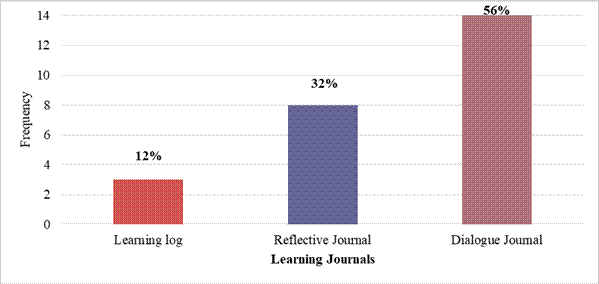
Figure 3 displays students’ preferences for the diverse types of Learning Journals used in the study. Dialogue Journals were the most favored type, chosen by 56% of students, likely due to their interactive nature, which encourages written exchanges. Reflective Journals came second, preferred by 32% of the students, possibly because they promote self-assessment and critical thinking. Learning Logs were the least preferred, selected by only 12%, which may be related to their more structured and less interactive format.
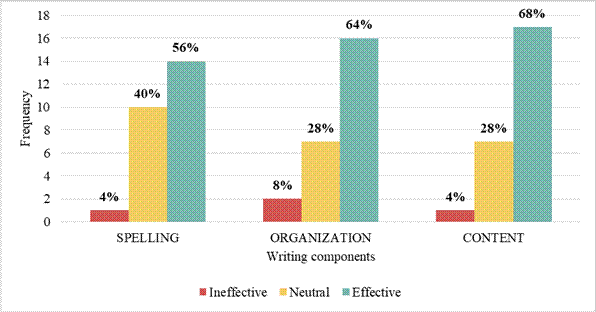
Figure 4 details students’ perceptions of how effective Learning Journals were for specific writing components: content, organization, and spelling. For the content component, a majority of 68% found the journals effective in helping them document information relevantly, while 28% remained neutral and 4% considered them ineffective. Regarding organization, 64% reported improvements due to the journals, with 28% neutral and 8% disagreeing on their effectiveness. Finally, for spelling, 56% of students saw benefits, 40% were neutral, and 4% did not find them helpful for this skill.
The present research set out to examine the impact of Learning Journals on the development of writing skills among superior basic education students. The data collected through both quantitative and qualitative methods provided insights into how students’ writing performance changed over time and how they perceived the use of the three types of journals implemented: Learning Logs, Reflective Journals, and Dialogue Journals.
The quantitative analysis revealed that the greatest improvement was found in the spelling component, with an increase of 1.36 points between pre- and post-test results. This finding is consistent with the purpose of Reflective Journals, which were designed to support students in noticing and correcting spelling issues. In addition, organization saw a notable increase of 1.32 points, largely attributed to the use of Dialogue Journals. These provided students with an opportunity to exchange ideas and structure information in a conversational format. Although the content component showed only a slight increase (0.08), it is worth noting that students initially performed strongly in this area. Therefore, the modest improvement may reflect a ceiling effect, rather than a lack of impact.
On the other hand, the questionnaire and field notes supported the quantitative findings. Most students reported that Reflective Journals helped them become more aware of their spelling mistakes and how to correct them, thus reinforcing the quantitative evidence. Likewise, Dialogue Journals were praised for helping students organize their ideas and communicate more fluently. Students noted feeling more comfortable expressing themselves in writing, especially those who were usually less verbal in class. This aligns with Harmer’s (2004) view that journals create a safe space for expression. Furthermore, students expressed that Learning Logs helped them retrieve prior knowledge and reflect on content learned in class, aiding in content retention and coherence.
These findings align with the literature. Majchrzak and Ostrogska (2022) reported that regular journal writing enhances both writing fluency and accuracy, particularly when the practice is consistent. Similarly, Yurekli and Afacan (2020) emphasized the importance of Dialogue Journals in improving the organization of writing and fostering students’ positive attitudes. Studies by Ramadhanti et al. (2020) and Maneepakhathorn (2023) also found that Reflective Journals contribute to improved spelling and critical thinking skills. In this research, the distinct but complementary contributions of each type of magazine support the above claims and, at the same time, fill a gap, which is that most existing studies focus on a single type of magazine, whereas this study compares all three in a single intervention, allowing for a broader understanding of their combined and individual effects.
Although all three types of Learning Journals supported the development of writing skills, students expressed a clear preference for Dialogue Journals. This could be due to the interactive nature of the activity, which allowed them to engage with peers and develop a sense of audience. Still, Reflective Journals and Learning Logs were also valued for their contributions to specific writing components. The combination of quantitative improvement and positive qualitative feedback confirms that Learning Journals are a versatile and effective strategy for enhancing writing skills in EFL contexts.
The purpose of this study was to analyze the effect of the use of Learning Journals on the writing development of students in higher basic education. This section discusses the conclusions drawn after analyzing the results obtained during the intervention.
To start off, the implementation of Learning Journals was proven to have a positive effect on students’ writing skills practice and development, as students showed a moderate increase in their post-test scores compared to the pre-test. Despite the fact that writing is often challenging for students, it is a useful skill for everyday life. Therefore, Learning Journals offered students a space to reflect and express their knowledge and ideas in written form, as well as develop their critical thinking skills. This could be attributed to the varied impact of Learning Logs, Reflective Journals, and Dialogue Journals implementation.
Regarding the impact of each Learning Journal on the writing components, the results demonstrated that Dialogue Journals did help students in a modest way in the organization component, as it was effective for them to organize information and build structured dialogues according to the questions offered. Being in pairs facilitated their development as it gave students the opportunity to share their ideas, situation from which students showed comfort. Besides, pertaining to Reflective Journals, they have revealed to positively develop the spelling component on students’ writing. With the journal, students were able to reflect on themselves, on what they needed to improve, to develop their critical thinking skills, and to give importance to what they had learned in class. Likewise, Learning Logs slightly helped students to remember and transmit correctly the content they had learned in class, thus being able to identify their knowledge gaps. As the score for the content component was already high, the instrument still contributed to subtly develop it. Overall, even though every journal was destined to help in the development of a specific writing component, each of them supported the development of all the components together. For instance, despite the fact that students felt that the improvement was higher in the “content component”, results revealed the increased improvement in the “spelling component”.
Finally, according to the students’ perceptions, it can be concluded that most of them positively perceived the different journals useful to develop their writing. They described that they helped them in different areas, in accordance to the focus of each instrument. They mentioned that it allowed them to share ideas, perform better at the moment, reflect on what they learn, gain more understanding of themselves, and to remember what they have been learning without pressure. Even so, students showed a greater inclination to Dialogue Journals, as it allowed them to engage in conversations and create their own dialogues.
Al Kayed, M., Alkayid, M., & Alsmadi, M. A. (2020). The impact of dialogue journal writing on the writing skills of Jordanian EFL learners and their attitudes towards writing. Humanities & Social Sciences Reviews, 8(4), 569-576. https://doi.org/10.18510/hssr.2020.8456
Alberto Lázaro, L. (n. d.). Teaching and assessing writing skills.
Almeida, E., & Rosero, A. (2023). Action research: Promoting speaking in EFL college students. Revista Kronos, 4(2), 86-94.
Alt, D., & Raichel, N. (2020). Reflective journaling and metacognitive awareness: Insights from a longitudinal study in higher education. Reflective Practice, 21(2), 145-158. https://doi.org/10.1080/14623943.2020.1716708
Ayoub, N. N. (2020). Learning logs: The effect of incorporating write-to-learn assignments on promoting learning and retention of information in a phonology course. European Scientific Journal, 16(13), 80-96. https://doi.org/10.19044/esj.2020.v16n13p80
Bora, P. (2023). Importance of writing skill to develop students’ communication skill. Journal for Research Scholars and Professionals of English Language Teaching, 7(35). https://doi.org/10.54850/jrspelt.7.35.009
Cambridge Assessment English. (2020). A2 Key Handbook for teachers for exams from 2020. Cambridge. https://www.cambridgeenglish.org/Images/504158-a2-key-handbook-2020.pdf
Demera Macías, A. G., & Fajardo Dack, T. (2023). The impact of reflective journals on the writing skills of EFL sophomore students. Runas. Journal of Education and Culture, 4(7). https://doi.org/10.46652/runas.v4i7.100
Golzar, J., & Tajik, O. (2022). Convenience sampling. International Journal of English Language Studies, 4(4), 18-21. https://doi.org/10.22034/ijels.2022.162981
Graham, S. (2019). Changing how writing is taught. Review of Research in Education, 43(1), 277-303. https://doi.org/10.3102/0091732X18821125
Graham, S., Harris, K. R., MacArthur, C. A., & Hebert, M. (2019). Best practices in writing instruction. Review of Research in Education, 43(1), 277-303. https://doi.org/10.3102/0091732X18821125
Harmer, J. (2007). The practice of English language teaching (4th ed.). Pearson Longman.
Hasibuan, K. (n.d.). Teaching writing as productive skills.
Majchrzak, O., & Ostrogska, P. (2022). Journal writing-students’ voices. Językoznawstwo, 17(2), 253-274. https://doi.org/10.25312/2391-5137.17/2022_18ompo
Maneepakhathorn, R. (2023). An exploratory study of reflective dialogue journal writing of EFL graduate students in the English as a foreign language context. Reflections, 30(1).
Masdianti, A., & Suhartini, R. (2021). The use of journal writing to improve high school students’ writing. International Journal in Applied Linguistics of Parahikma, 3(1).
Obadare, F. T. (2023). The revolutionizing effects of journal writing strategy on students’ writing ability. Journal of Literature, Languages and Linguistics. https://doi.org/10.7176/jlll/96-07
O’Loughlin, V. D., & Griffith, L. M. (2020). Developing student metacognition through reflective writing in an upper-level undergraduate anatomy course. Anatomical Sciences Education, 13(6), 680-693. https://doi.org/10.1002/ase.1945
Politton, M. E., & Hadiyanti, K. M. W. (2019). Enhancing University Students English Writing Skills on Content Area. LLT A Journal on Language and Language Teaching, 22(2), 146-155.
Ramadhanti, D., Ghazali, A. S., Hasanah, M., Harsiati, T., & Yanda, D. P. (2020). The use of reflective journal as a tool for monitoring of metacognition growth in writing. International Journal of Emerging Technologies in Learning, 15(11), 162-187. https://doi.org/10.3991/ijet.v15i11.11939
Rahmat, I., Chanunan, S., & Bahri, A. (2019). Open inquiry with learning journal promoting metacognitive skills and retention of students with low academic achievements. Advances in Social Science, Education and Humanities Research, 434, 347-351. https://doi.org/10.2991/icamr-18.2019.69
Schouten, B. (2021). Mixed-methods. In Oxford Research Encyclopedia of Education. https://doi.org/10.1093/acrefore/9780190264093.013.1233
Shaumiwaty. (2020). Learning journal strategy to enhance students’ writing ability. JourMe (English Journal of Merdeka): Culture, Language, and Teaching of English, 5(2), 131-140. https://doi.org/10.26905/enjourme.v5i2.4238
Sholah, H. M. (2020). Enhancing EFL learners’ writing skill via journal writing. ALSUNA: Journal of Arabic and English Language, 3(2), 59-70. https://doi.org/10.31538/alsuna.v3i2.677
Smith, R., & Rebolledo, P. (2018). A handbook for exploratory action research. British Council.
Tri Purwanti, I., & Eliwarti. (2021). The effect of journal writing technique on students’ writing ability. International Journal of Educational Best Practices, 5(2), 183-196. https://doi.org/10.32851/ijebp.v5n2.p183-196
Wagiyo, S. (2018). The use of journal writing in teaching English writing. https://www.researchgate.net/publication/328597250
Yurekli, A., & Afacan, A. (2020). Journal writing: Effects on students’ writing proficiency and student and teacher attitudes. Register Journal, 13(1), 1-48. https://doi.org/10.18326/rgt.v13i1.1-48
Zabala, M., & Carolina, Y. (2020). Dialogue journals on students’ writing. Journal of Language and Linguistic Studies, 16(4), 1860-1872.
redalyc-journal-id: 7868