ABSTRACT: The aim of this integrative review was to "identify, synthesize and evaluate the scientific evidence available on therapeutic marihuana use in those treated in health care services". The articles analyzed were selected from the following databases LILACS, CINAHL and MEDLINE and using tools such as WOS (Web of Science) and SCOPUS. After a broad search in Spanish, Portuguese and English, a total of ninety article were identified. The final selection consisted of six articles, four of which were primary articles and the other two were case studies. The analysis found that there are gaps in the evidence on the therapeutic effects of cannabis. Some positive effects are suggested, potentially useful in some cases, but probable adverse effects were also reported, it being therefore recommended that use of marihuana and marihuana-based products be weighed up depending on the pathologies present in the individual.
Descriptors: MarihuanaMarihuana,therapeutic usetherapeutic use,health care serviceshealth care services,health care centershealth care centers.
RESUMO: Esta revisão integrativa tem como objetivo "identificar, sintetizar e avaliar a evidência científica disponível sobre o uso terapêutico da maconha em pessoas tratadas em diferentes serviços de saúde". Para a seleção dos artigos trabalhou no LILACS, CINAHL, MEDLINE, e outros como WOS (Web of Science) e de dados Scopus; após uma busca em idiomas, espanhol, português e inglês, foram identificadas noventa artigos. A seleção final seis artigos considerados; a análise mostra que existem lacunas na evidência sobre o efeito terapêutico da cannabis. Eles sugerem alguns efeitos positivos; uso dose recomendada de acordo com patologias presentes em pessoas.
Descritores: Maconha, Uso Terapéutico, Os Serviços de Saúde, Centros de Saúde.
REVIEW ARTICLE
Scientific evidence on therapeutic marihuana use in individuals treated in Health Care Services
Evidências científicas sobre o uso terapêutico da maconha para as pessoas que frequentam os serviços de saúde
Universidade de São Paulo, Escola de Enfermagem de Ribeirão Preto ou USP/EERP
The possibility of cannabis-based medications being used is viewed with mistrust and there are many doubts regarding therapeutic marihuana use. "Marihuana is a generic term used to refer to "Cannabis Sativa", an herbaceous plant with psychoactive properties. There are records of C. Sativa use dating back to 4,000 BC in China, where it was used to treat a range of afflictions"1. "Cannabis Sativa has approximately 489 components, with more than 80 terpene phenolic compounds, known as cannabinoids. The others are components such as terpenes, hydrocarbons, ketones, aldehydes and other small hydrophobes able to cross the hematoencephalic barrier"1.
In 1963 and 1964 the chemical structures of Delta-9-Tetrahydrocannabinol (Δ9-THC), the psychoactive component of Cannabis, and of Cannabidiol (CBD) were discovered, these being the principal components of Cannabis. "The Δ9-THC/CBD rate differs between strains. The proportion of Δ9-THC, and therefeore psychoactive strength, has increased over time from 1-5% in the 1960s to current levels of around 10-15%"1.
In this context, cannabis "is of great interest for medicinal use for its anxiolytic, antiemetic, analgesic and anti-inflammatory properties"2. "Different studies have discovered the therapeutic effects of canniboid treatments: in the 1980s, several authors conducted clinical trials to compare the effectiveness of THC with other antiemetic medications and placebos in treating nausea and vomiting from chemotherapy. These studies show that THC is at least as effective as conventional treatments with dopamine antagonists"2.
"According to research published in the Journal of the American Medical Association (JAMA), there is moderate to high quality evidence of the compatibility of cannabis use for certain diseases, although not for others. After reviewing 80 random trials with around 6,500 individuals, the authors found moderate support for using cannabis to treat chronic pain and muscular spasms and involuntary movements" (3. "In 1995, Beal J. et al designed a 6 week Controlled Clinical Trial to evaluate the effects of dronabinol (synthetic THC in an oral capsule) on increased appetite and weight gain in patients with Acquired Immune Deficiency Syndrome (AIDS)-associated anorexia. The results showed that dronabil is safe and effective in treating this"4. The cannabinoids studied included smoking marihuana, orally-administered cannabis extracts and cannabis-based medications such as Nabilona and Dronabinol.
Thus, in several countries, therapeutic use of marihuana is accepted to counteract the effects of certain pathologies. Given this context, this study was guided by the following question: What scientific evidence is there on the therapeutic use of marihuana in the sick treated in health care services? In order to answer this question, we undertook an integrative review of the literature, aiming to identify, synthesize and evaluate the scientific evidence available on therapeutic marihuana use in the sick treated in different health care services.
This was an integrative review, a "focus that enables different methodologies, for example experimental and non-experimental, to be combined, and which tends to produce a coherent, global view of complex concepts and theories of health problems". ("Whittemore; Knafl, 2005.)5. This review followed the six stages proposed by Ganon (1987)6.
The first stage is selecting the topic of interest. The PICo7 strategy was used when developing the question for the integrative review. P stands for the population or problem - describe the population in question, I stands for the phenomenon of Interest - describe what will be investigated in the study and Co stands for the context in which the phenomenon in question occurs. In this integrative review, PICo is as follows:
P: the sick
I : therapeutic marihuana use
Co: Health care services
Thus, the research question is: What scientific evidence is there on the therapeutic use of marihuana in the sick treated in health care services?
Inclusion criteria for the articles were as follows: primary articles, complete texts, from indexed journals, published in Spanish, English or Portuguese. Excluded articles were those which dealt with other types of drugs or those that referred to drugs in general.
The primary studies were selected from the LILACS (Latin American and Caribbean Health Sciences Literature), CINALH (Cumulative Index to Nursing and Allied Health Literature) and MEDLINE (MEDical Literature Analysis and Retrieval System On Line (MEDLINE) databases and the search was later widened with tools such as WOS (Web of Science) and SCOPUS8.
To review the primary studies that responded to the research question we used a combination of Boolean descriptors using the operators AND and OR, as follows:
-
- Marihuana OR "Marijuana Medicinal" OR "Cannabis sativa"
-
- Therapeutic use
-
- Health care services OR "Health care centers"
-
- To broaden the search we included controlled descriptors (DeCS) as follows:
-
- Marihuana Medicinal (DECS) OR Cannabis sativa (DECS)
-
- Health care centers (DECS) OR Hospitals (DECS)
The various stages of the search were reviewed by a librarian and the research question was the basis on which studies were selected for this integrative review. Table 1 shows a summary of the selection of the primary data in the databases.
Summary of the selection of the primary data in the databases.
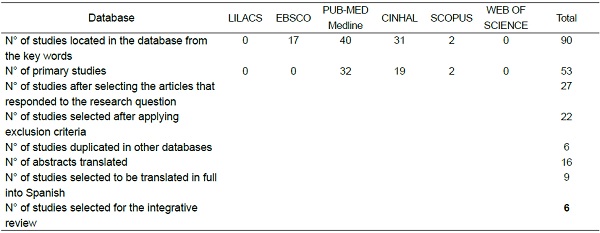
De noventa artículos localizados inicialmente en las diferentes bases de datos, solo seis resultaron seleccionados para esta revisión integrativa, eliminando los que no cumplían los criterios de inclusión.
The instrument validated by "Ursi (2005)"10 was authorized for use to extract information from the selected studies, for the following items: identification, objectives, methodological characteristics, res ults and conclusions.
As well as analyzing the selected articles, they were categorized, according to the criteria proposed by Stetler (1998)11, hierarchized according to the classification of the evidence, depending on the methodological focus.
Comparisons and conclusions were then made of the studies included in the review, based on critical evaluation of the results as well as the implications of the review.
The data are presented below. All of the articles selected originated in medical research, allowing Nursing professionals to increase knowledge on the therapeutic Marihuana use that can lead to a discussion on the involvement of Nursing in therapeutic use of this product.
A search was conducted in the databases available for primary articles containing scientific evidence on therapeutic marihuana use published in Spanish, Portuguese or English. Ninety studies were found in the EBSCO, PUB-MED Mediline, CINHAL, SCOPUS; LILACS and WEB OF SCIENCE yielded no results. Of these ninety studies, fifty-three were primary studies, all in English. After translating and reading the titles, twenty-seven articles were found to be on the topic of the research: "Therapeutic marihuana in individuals treated in Health Care Services"; of these, five studies met the exclusion criteria and six were duplicated in other databases, leaving sixteen studies of which the abstracts were translated into Spanish, after which a further seven articles were eliminated. Nine articles were eventually translated in full, when it became evident that one article was not a primary study and another examined the side effects of marihuana use. A third examined the effects of Haloperidol in cyclical vomiting resulting from marihuana consumption. Eventually, six studies were selected and analyzed for this integrative review.
The figure below shows the stages of selecting the articles for this review.
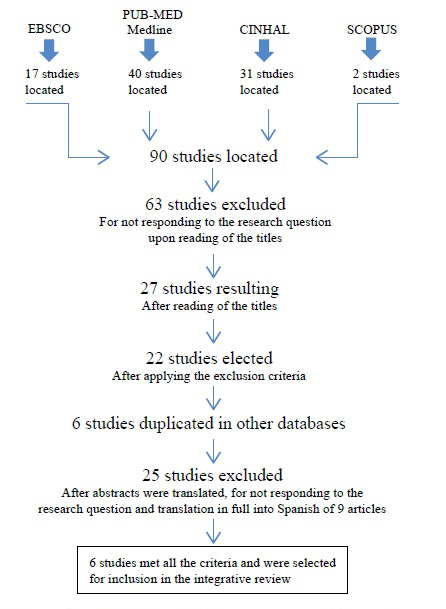
Figure 1
Details of the selection of the primary studies located in the EBSCO, PUBMED, CINAHL and SCOPUS databases and included in the integrative review, Ribeirao Preto, March 2016.
Distribution of the studies included in the integrative review, according to author, title, source, country of origin, year of publication, objectives and level of evidence.
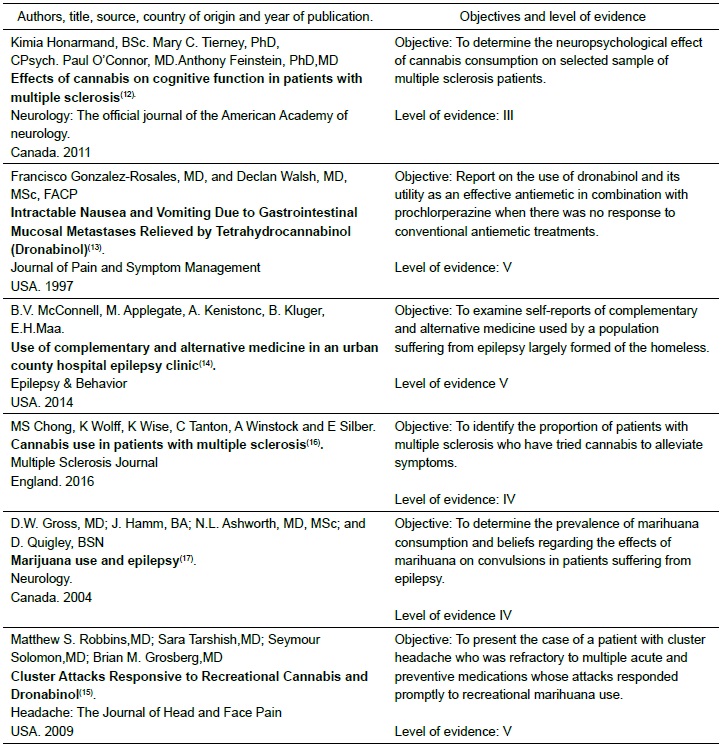
Analysis of the six articles enabled us to extract three common categories: Need for careful dosing and monitoring when using cannabis for therapeutic purposes; Subjective beneficial effects or triggering adverse side effects and Limited evidence as to its efficacy.
The need for careful dosing and monitoring when using cannabis for therapeutic purposes can be seen in the articles by Francisco Gonzalez-Rosales 13 and by M.S. Chong16.
On this topic, it is noteworthy that Dr. Chong, in the Neurological Department of Kings College Hospital, London, directed a study entitled "Cannabis use in patients with multiple sclerosis", the aim of which was to identify the proportion of patients with multiple sclerosis who had used cannabis to control their symptoms. It mentions that cannabinoids appear advantageous in reducing pain in multiple sclerosis and neuropathic pain syndromes, with caution needed in the dosage and monitoring when cannabis is used for therapeutic ends. A small proportion experienced potentially serious adverse effects, including psychiatric symptoms and exhaustion.
The study entitled "Intractable Nausea and Vomiting Due to Gastrointestinal Mucosal Metastases Relieved by Tetrahydrocannabinol (Dronabinol)"13) is a study which shows that low doses of dronabinol may be both safe and effective, when used in combination with other antiemetics, for nausea and vomiting related to cancer. Dronabil can be viewed as a potentially useful agent in cases of cancer-related intractable nausea and vomiting with no mechanical obstruction.
As with pain in multiple sclerosis patients, neuropathic pain, nausea and vomiting are effects of certain pathologies and/or treatments, affecting patients’ wellbeing. The evidence or using marihuana as a method for halting these problems shows limited success, depending on how the dose is administered, the dose itself and monitoring for the specific risks of consuming cannabis. Thus, any benefit there may be must be weighed up against associated side effects.
Subjective beneficial effects or adverse side effects triggered by cannabis use were evinced in the articles by Matthew S.(15, Kimia Honarmand 12), B.V. McConnell14 and M.S. Chong16
Data on cannabis consumption among patients with cluster headache are limited. The case study by Matthew S.15 observes that the patient showed a rapid improvement in the pain just 15 minutes after use, faster than the reported appearance of 30 to 60 minutes. This quick response may represent a placebo effect. However, the multitude of preventative treatments, as well as the failure of other acute treatments, are evidence against this phenomenon. Routine use of cannabis preparations is not recommended, be it for recreational use or pharmacological cannabis preparations for treating cluster headache, given the risk of addiction and other potential adverse effects over the long term.
The study by Kimia Honarmand12 covers marihuana use in multiple sclerosis patients obtaining probably subjective relief from pain and spasticity; without evidence of clinical efficacy that this is the effect of the cannabis, any benefits should be weighed against associated cognitive effects.
The study by B.V. McConnell14) also analyzes "Use of complementary and alternative medicine in an urban county hospital epilepsy clinic". Conducted in the US in 2014, it studies self-reports of complementary and alternative medicine used by a population of 120 subjects, aged over 18 and diagnosed with epilepsy. In the study, 33% of those surveyed reported using marihuana and of those, 54% mentioned a reduction in the frequency of fits. However, as this is an observational study, described efficacy cannot be analyzed as it may be due to placebo effects.
Debate continues as to the clinical efficacy of cannabinoids in treating multiple sclerosis symptoms. According to the study by M.S. Chong16, for those with neurological disease, self-medicating with psychoactive substances may pose risks. This study also analyzes the specific risks of cannabis consumption, in particular the social factors, levels of disability and perceived effects.
As no pharmacological compounds are totally healthy or toxic, cannabis, like any other drug, may pose health risks if not carefully dosed and monitored. Any interactions with other drugs should be identified and the beneficial and adverse effects weighed up.
Limited evidence of efficacy were demonstrated in the articles by Matthew S.15), B.V. McConnell14 and D.W. Gross17
The study by Matthew S.(15 suggests that the rapid improvement in pain experienced by the multiple sclerosis patient on consuming cannabis may represent a placebo effect.
According to D.W. Gross17, the majority of active users report beneficial effects on convulsions. Twenty-four percent of all subjects believed that marihuana was an efficacious treatment for epilepsy. Despite evidence of the limited efficacy, many patients with epilepsy believe that marihuana is an efficacious treatment for epilepsy and actively use it. This random controlled study was conducted to verify the anticonvulsive effects of the cannabidiol, and the results were inconclusive.
In the study by B.V. McConnell14 the subject of marihuana use for epilepsy is controversial, as it did not confirm the data regarding the efficacy of marihuana use, mentioning the limited evidence for epilepsy. It is a popular treatment in this patient population, 54% of whom use marihuana, deeming it of clinical utility. As this was an observational study, efficacy cannot be evaluated, as it may be the result of placebo effects, information bias or other non-specific effects or the effect of direct anticonvulsant.
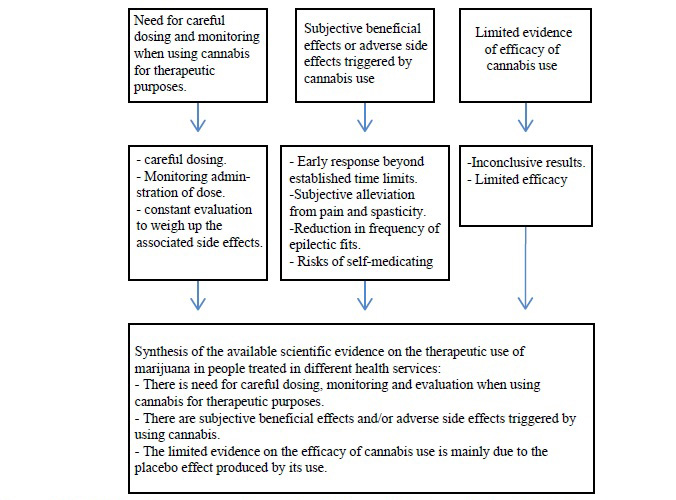
Figure 2
The information discussed synthesized and correlated according to subject categories.
This integrative review seeking scientific evidence on the therapeutic marihuana use by individuals in Health Care Services verified the limited availability of primary scientific articles on the subject, particularly in Spanish. At the same time, it found that there are no nursing publications on the therapeutic marihuana use. The most important findings relate to the existence of limited evidence on the efficacy of cannabis or the products beneficial effects, and this is mainly due to the placebo effect it produces. Adverse side effects that can be triggered by cannabis use mean there is a need for careful monitoring and ongoing evaluation when using cannabis for therapeutic purposes.
Quiero expresar mis agradecimiento a La Escuela de Enfermería de Ribeirão Preto de la Universidad de São Paulo (EERP-USP) y al Centro Colaborador de la OMS para el Desarrollo de la Investigación en Enfermería y la Secretaria Nacional de Políticas sobre Drogas - SENAD por la posibilidad de realizar este estudio e investigación en Alcohol y otras Drogas Psicoactivas. Agradezco a los organizadores por la acogida, el esmero y gentileza de la planificación en cada fase del curso, y por la confianza que depositaron en mi al aceptarme como parte del equipo de investigadores. Hago especial agradecimiento a mi tutora que con paciencia y cariño supo encaminarme y hacerme agradable esta experiencia.
Agradezco a la Escuela de Enfermería de la Universidad de Valparaíso, Chile, por las facilidades que me fueron otorgadas para hacer esta formación. Quiero también desearles gran armonía al equipo y éxito en los cursos venideros, es cansador el trabajo y talvez no veamos los resultados de inmediato, pero vale la vida trabajar por tener un mundo mejor.
Corresponding Author: AUTHOR: Leslie Luza Acosta, Assistant Professor, Department of Adult Nursing, Nursing School, Universidad de Valparaíso Chile; e-mail: leslie.luza@uv.cl ADVISOR: Carla Aparecida Arena Ventura, Associate Professor, Department of Psychiatric Nursing and Humanities, Ribeirão Preto Nursing School, Universidade de São Paulo; e-mail: caaventu@eerp.usp.br
Summary of the selection of the primary data in the databases.
De noventa artículos localizados inicialmente en las diferentes bases de datos, solo seis resultaron seleccionados para esta revisión integrativa, eliminando los que no cumplían los criterios de inclusión.
Figure 1
Details of the selection of the primary studies located in the EBSCO, PUBMED, CINAHL and SCOPUS databases and included in the integrative review, Ribeirao Preto, March 2016.
Distribution of the studies included in the integrative review, according to author, title, source, country of origin, year of publication, objectives and level of evidence.
Figure 2
The information discussed synthesized and correlated according to subject categories.
