Generales
Recepción: 02 Febrero 2021
Aprobación: 05 Abril 2021
Publicación: 30 Junio 2021
Abstract: Underutilized species are often referred to as plants whose potential has not been fulfilled yet. These plants may be meaningful as food, nutrient source, and, besides that, they often show medicinal properties important to the local population. This paper aims to identify the consumers’ socio-economical profile and their preference to allow the development of new marketing strategies and techniques to spur the popularization of these fruits. Four commercial centers were assessed (Mercado Municipal de Marituba Governador Simão Jatene, Feira de Benevides, Complexo Feira Cidade Nova e Ver-o-Peso) by means of descriptive research, structured interview and 100 closed-ended questionnaires by farmers’ markets, amounting to 400 altogether, each of them with 7 multiple-choice questions. Other than Benevides, which has the majority of the interviewees’ age between 19 and 45, it can be noticed that the consumers’ age leans to be greater than 46 years old. The consumers’ wealth goes up to 1 minimum wage (62.25%), and a smaller part receives an income between 1 and 3 minimum wage. Most respondents (38.5%) have graduated from high school or elementary school (20.75%) both incomplete, with a clear majority of men (54.25%) over women (45.75%). For all the evaluated locations, Camu-Camu was the least known fruit, and the same take place to its consumption, according to consumer reports, while Abiu was the best known as well as the most consumed in 3 of 4 of the fairs analyzed. Any marketing strategy comprising these fruits ought to regard a purchaser possessing the following attributes: elder, not wealthy, without a high education standard, and it must pay attention to Abiu and Mangostão.
Keywords: Abiu, Mangostão, Rambutã.
Resumen: Las especies subutilizadas se refieren a plantas que aún no han explorado completamente su potencial. Estas plantas pueden tener importancia nutricional, como fuente de nutrientes, aceites, fibras, así como pueden presentar varias propiedades medicinales utilizadas por la población local. Con esto en mente, el objetivo de este trabajo fue perfilar el perfil socioeconómico así como las preferencias de los consumidores de frutas infrautilizadas en ferias municipales para posibilitar el desarrollo de estrategias de comercialización adecuadas, así como promover la popularización de estas frutas. Esta investigación se desarrolló en cuatro centros comerciales (Mercado Municipal de Marituba Governador Simão Jatene, Feira de Benevides, Complexo Feira Cidade Nova y Ver-o-Peso), siendo una encuesta descriptiva, estructurada, con el llenado de 100 cuestionarios en cada feria totalizando 400 cuestionarios, cada uno con 7 preguntas de opción múltiple. Los resultados de esta investigación muestran que las edades de los consumidores en las ferias evaluadas tienden a ser mayores de 46 años, a excepción de Benevides, que tiene una mayoría en torno a los 19 y 45 años. Los ingresos de la mayoría de los consumidores varían hasta 1 salario mínimo (62,25%), y una parte más pequeña tiene un ingreso de 1 a 3 salarios (29,5%). La mayoría de los encuestados (38,5%) tenían secundaria incompleta o primaria incompleta (20,75%), con una clara mayoría de hombres (54,25%) en comparación con mujeres (45,75%). Para todas las localidades evaluadas, Camu-Camu fue la fruta menos conocida, así como la menos consumida según reportes de los consumidores, mientras que Abiu fue la más conocida así como la más consumida en 3 de 4 de las ferias analizadas. Cualquier estrategia de mercadeo que involucre estas frutas debe considerar al consumidor con las siguientes características: senil, con bajos ingresos mensuales, sin un alto nivel educativo, y se debe prestar mayor atención a las frutas de mangostão y abiu.
Palabras clave: Abiu, Mangostão, Rambutã.
1. INTRODUCTION
The farmers’ markets are commonly located in urban regions and have an outstanding role as a device to produce income for street merchants, who trading their products in multiple locations (Rocha et al., 2013), as well as to producers, who are the underlying source of the production chain, particularly concerning farming products. This market renders important function in feeding several families and breeding formal and informal jobs (Cunha, 2014), and the consumer market is the main factor fostering merchants and producers, jointly with the product price, and feeding tradition and culture.
Pará state belongs to the Brazil North Region, having an estimated population of 8.602.865 people (IBGE, 2019). Its metropolitan region is constituted by 5 towns (Belém, Ananindeua, Marituba, Benevides, and Santa Bárbara) and amounts to 1.794.981 dwellers, the major of them spotted in urban regions. Belém town has 1.279.861, matching for 71.3% of the total population of the 5 metropolia assessed (IBGE, 2019). Marituba possesses 131.521 habitants, Benevides has 62.737, Ananindeua 530.598 (IBGE, 2019). Four out of those 5 cities were chosen (Belém, Ananindeua, Marituba, and Benevides) and each of them was represented by its most active and urbanized farmers’ market.
Padulosi et al. (2002) pointed out that the term “underutilized” usually refers to a species that hasn’t fulfilled its potential yet, and requires additional information to clarify the word meaning. Therefore, it is important to stress that the assessed fruits are underused mainly in some regions of Brazil (especially the north and northeast region), and may have feeding importance, but lack, or have few, economic impacts. These agricultural crops are often used for feeding to obtain fibers, oils, and may be used for medicinal purposes. Despite these species have prospects as a feeding source, to guarantee income, Ambiental advantages as well as to spurs human health, they are underexploited hitherto (Malkanthi, 2017).
Most of these fruits are relatively cheap and have a high nutrient content. They are well known for their medicinal and curative properties, and some local tribes use them to health some diseases. Besides that, their fruits, seeds, and leaves are used in the Indian and Ayurveda traditional medicine as well (Dahanayake, 2015).
The present paper aims to identify the socio-economical profile and the preference of the underutilized fruits’ customers in farmers’ markets from Pará state, thereby allowing the development of new marketing strategies comprising these fruits and techniques to popularize them.
2. MATERIAL AND METHODS
Four commercial centers (Mercado Municipal de Marituba Governador Simão Jatene, Benevides Market-Place, Complexo Feira Cidade Nova and Ver-o-Peso) spotted in Marituba (Latitude: -1.35532, Longitude: -48.3432), Benevides (Latitude: -1.36133, Longitude: -48.2454), Ananindeua (Latitude:-1.35721, Longitude: -48.39934) and Belém (Latitude: -1.45502, Longitude: -48.5024) municipalities from Pará state, respectively, were assessed using 400 questionnaires altogether, each commercial center comprising 100 of them. It was performed a structured interview with multiple-choices and closed-ended questions concerning both socio-economical as well as costumers’ preferences information comprising variables as age, education, wealth, sex, knowledge concerning those fruits and consumption. The interviews occurred during November 2020, mainly in the morning, in the following days: 12, 25, 19, and 26, respectively. The collected data was organized in Excel virtual spreadsheet, and, afterward, submitted to descriptive statistics to infer both the socioeconomic profile of the customers as much as their preference for those fruits.
The first four questions of the questionnaires revolved around the profile of the customers, as shown ahead: 1 - Sex of the consumer (male or female); 2 - Age of the consumer; 3 - The wealth of the consumer (numbers of minimum wages); 4 - Education stage of the consumer. The next three questions concerned the knowledge, consumption as well as usages of the fruits, being possible to choose more than one option, therefore the same customer may be in two or more of these options in the afterward analysis. It was asked the following queries: 5 - Which of the prefixed fruits the consumer knows (Sapotilha, Camu-Camu, Rambutã, Mangostão, Pitaya, and Abiu); 6 - Which of the prefixed fruits the consumer has consumed (Sapotilha, Camu-Camu, Rambutã, Mangostão, Pitaya, and Abiu); 7 - What the main usage made by the customers (processed or in natura).
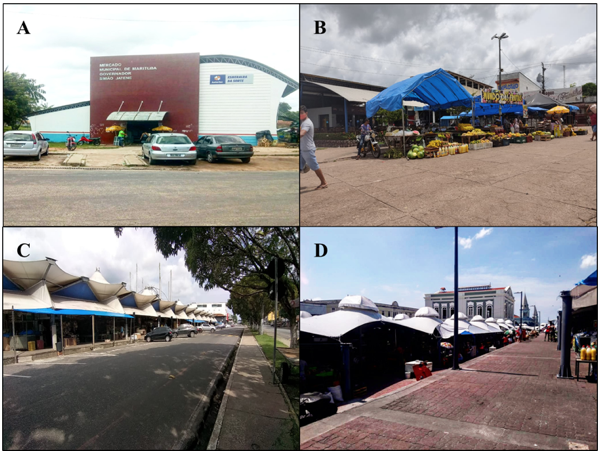
Figure 1
Assessed Locations (A – Mercado Municipal de Marituba Governador Simão Jatena; B – Benevides Market-Place; C – Complexo Feira Cidade Nova; D – Complexo Ver-o-Peso)
Source: Own Source
3. RESULTS AND DISCUSSION
3.1 Socio-economical profile
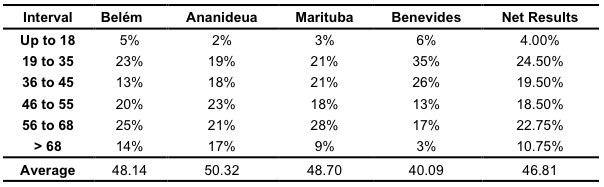
The data equivalent to the age of the interviewees in Belém, Ananindeua, and Marituba entails that the majority of them are older than 46 years, with a percentage of 59% (sum of the interviewees’ age greater than 46 years old), 61%, and 55%, respectively. Benevides, on the other hand, have shown a younger population, standing between 19 and 45 years old (61%). Benevides portrays the same observed in the Berno (2020) study, in which the interviewees were between 26 and 45, being a younger population. Furthermore, the average age from Cidade Nova was the bigger among all of them (50.32), while Benevides was the smaller (40.09).
Interviewees’ Age
Source: Own Source
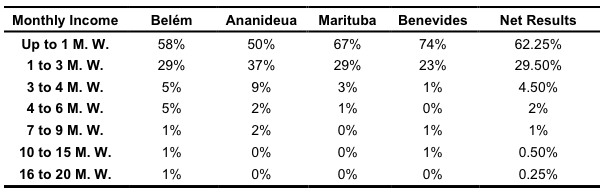
Table 2 shows the income of the majority of the consumers’ population varies up to 1 minimum wage (62.25%), being relatively low, as 29.5% is the income of 1 to 3 salaries. The cited values conform with Alves’ (2014) research findings, carried out at Ver-o-Peso Complex, where the consumers shown up a wealth between 1 and 3 minimum wage. What’s more, Alves (2014) has found that 56% of the costumers prone to purchase at this location owing to the more accessible prices. Therefore, this public profile (low income) can be related to commonly lower fruits’ prices in farmers’ markets.
Consumers’ Income of Farmers’ Markets of Pará State
Source: Own SourceM. W. - Minimum Wage
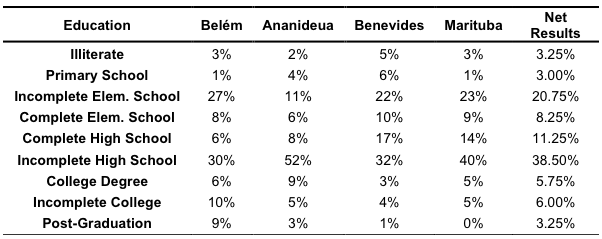
As it can be observed in Table 3, it entails the result of the education stage of interviewees is mainly complete high school, which accounted for 38.50%, while incomplete elementary education is spotted in the second position, with 20.75%. A research in the Bahia state (Oliveira, 2020) showed that 53% and 22% of respondents, respectively, had high school and elementary education, concordantly with the information found in the present research.
Education Stage of the Consumers
Source: Own Source
As for the gender of consumers presents in Chart 01, it had a clear majority of men (54,25%), as compared to women (45,75%) in Belém, Ananindeua e Marituba. Only at the fair from the municipality of Benevides, the percentage is the same in both sexes. In contrast with the studies of Garcia (2020), showed the female sex in greater vigor with 59.67% and the male with 40.33% in the Tome-Açu fair. The fact that more men are present at the fairs is due to the social isolation caused by the pandemic, because many people need to obey quarantine, and 57% of people, according to Bezerra (2020), are in partial isolation, namely, they are those people who go out to buy food, hence, in this case, more men are leaving.
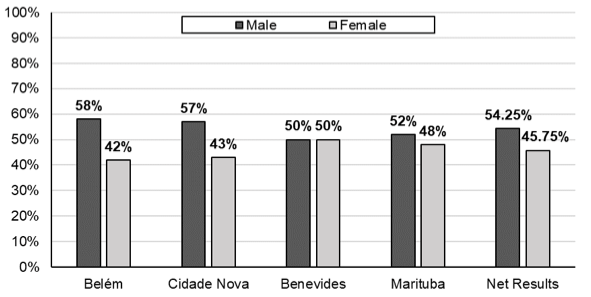
Chart 01
Interviewees’ Sex Proportion by Town
Source: Own Source
3.2 Preference and consumption
As can be seen in table 04, Pearson’s Modified Contingency Coefficient to Information as well as to consumption and the locations is utterly low (0.0129 and 0.0114, respectively), which means that the relationship between these two categorical variables is quite weak. Therefore, it may be concluded that the preferences of the costumers are not strongly related to the evaluated locations, and it stands to reason that the following analysis can be extended to all the regarded farmers’ markets individually as well as the net results drew from the whole data.
Pearson’s Modified Contingency Coefficient between Consumers’ Information and Consumption and the Acessed Locations relationship.

Source: Own SourceC - Pearson’s Contingency CoefficientC* - Pearson’s Modified Contingency Coefficient
As shown in chart 01, among the interviewees only 2.5% have reported bearing no information on the respective fruits, which entails the underuse hitting this species might not be given rises by lack of information comprising that. The less known fruit was Camu-Camu both in the net results (24.75%) as well as in each town individually. On the other hand, Abiu was the most known fruit concerning net results. As regard the individual analysis, Abiu was more common only in 3 out of 4 of towns – Belém, Benevides e Ananindeua –, whereas, in the Marituba town, Rambutã was pointed out as the most known. Oliveira et al. (2020) has found that only 15% of the consumers pointed out have an interest in consuming Pitaya, whereas, in this present research findings, 79,5% out of the consumers claim to know about these fruits.
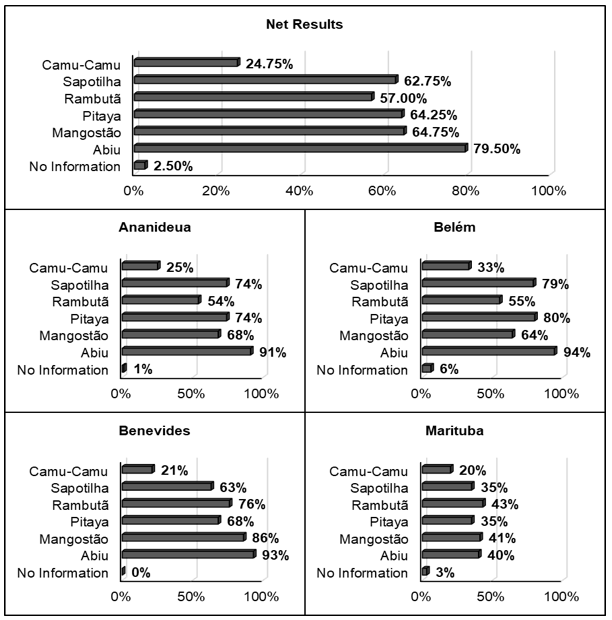
Chart 02
Consumers` knowledge concerning the assessed fruits in percentage
Source: Own Source
Concerning the fruit consumption, it can be noticed that Camu-Camu was the less consumed species (22,5%) while Abiu was pointed out as the most consumed fruit altogether (80,75%) (chart 02). In 3 out of 4 analyzed towns – Benevides, Ananindeua e Belém – the most consumed fruits was Abiu, whereas in Marituba the Rambutã was regarded as the most consumed. To all the assessed locations, Camu-Camu was claimed to be less consumed, probably because it is less known, as described previously. 5,75% of the interviewees pointed out have never consumed these fruits. Watanabe e Oliveira (2014) reported that Pitaya, Mangostão, and Rambutã fruits are most commercialized than Abiu, therefore more consumed. However, as per the present analysis, Abiu was considered more consumed.
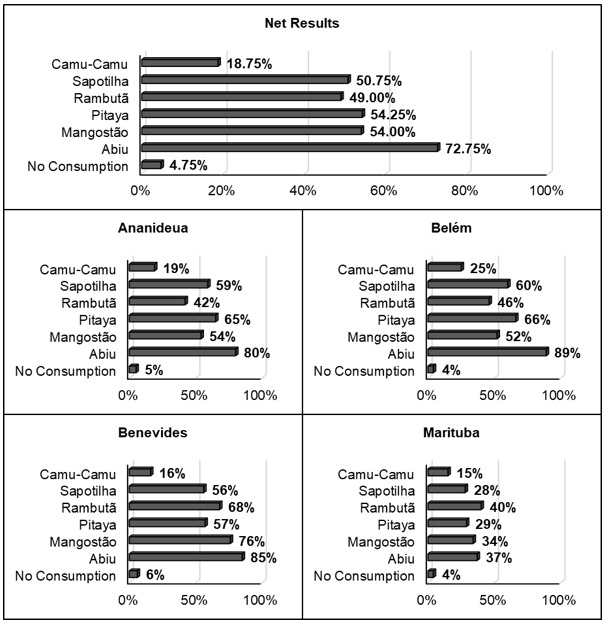
Chart 03
Consumption of the assessed fruits in percentage.
Source: Own Source
With regards to these fruits’ usages, 79.40% of the interviewees claim to consume these fruits mainly in natura, as 13,19% and 7.42% of the interviewees asserted to consume in some processed form or both of them, respectively (chart 03). The same results may be realized to each of the places evaluated, with in natura being the chief way of consumption. In compliance with these results, Sacramento and Andrade (2014) have declared that, in Brazil, the Rambutã fruits are rather consumed raw, and Sacramento et al. (2007) have reported that Mangostão is mainly consumed fresh, namely in natura, as found out in the present analysis.
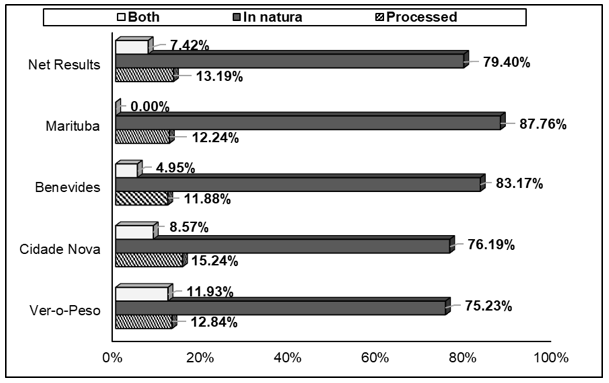
Chart 04
Fruits’ Usages
Source: Own Source
4. CONCLUSIONS
The consumers are mainly older than 46 years and are made up more commonly by men, therefore, the customers of these fruits might be regarded as an elder and male public, Benevides being an exception. What’s more, most of them have an income up to 1 minimum wage, which entails the consumers is not a wealthy population, while the major part of the interviewees have graduated from high school incompletely, which it stands to reason that the consumers don’t possess high educational level. The most known and consumed fruit is Abiu, while Mangostão stands in the second position. Camu-Camu, meanwhile, was less known as well as the less consumed fruits.
Based on this analysis, one may deduce that any marketing strategies or popularization techniques concerning these fruits should focus on populations possessing the followings attributes in future studies: elder, not wealthy, without a high education standard, and it must pay attention to Abiu and Mangostão. Furthermore, some additional studies are also needed to determine the description of the consumers’ socio-economical profile and preferences on other commercial centers, and by means of it trying to draw more global conclusions useful to the marketing of these fruits.
REFERENCES
Alves, R.J.M; Souza, L.P.F And Pontes, A.N. 2014. Socioeconomic profile and consumer satisfaction of produce greengrocer Complex Ver-o-Peso, Pará. ENCICLOPÉDIA BIOSFERA, Centro Científico Conhecer.10:2912-2920.
Berno, N. D And Silva, P. V. 2020. Perfil de consumidor de frutas e hortaliças durante a quarentena (Pandemia COVID-19). Revista Iberoamericana de Tecnología Postcosecha.
Bezerra, A. C. V; Silva, C EM; Soares, F.R. G. And Silva, J. A. M, 2020. Fatores associados ao comportamento da população durante o isolamento social na pandemia de COVID-19. Ciênc. saúde coletiva. 25:2411-2421.
Cunha, J. G. 2014. A feira livre do município de Mari-PB: uma análise histórica, geográfica e socioeconômica. Trabalho de Conclusão de Curso, Universidade Estadual da Paraíba, Guarabira. 23 p. Guarabira, Brasil C972f.
Dahanayake, N. 2015. Some neglected and underutilized fruit-crops in Sri Lanka. International Journal Of Scientific And Research Publications. 2:1-7
Garcia, W. G., Gaia, W.J.A; Sardinha, A.P.A And Rosário, L.F. 2020. Estudo do mercado e perfil do consumidor do fruto da Pitaya Vermelha, no município de Tomé-AÇU/PA. Brazilian Applied Science Review, 4:418-436.
INSTITUTO BRASILEIRO DE GEOGRAFIA E ESTATÍSTICA - IBGE .2019. Estimativas da População. Rio de Janeiro. Disponível em: https://www.ibge.gov.br/estatisticas/sociais/populacao/9103-estimativas-de-populacao.html?edicao=25272&t=resultados. Acesso em: 21 jan. 2021.
Malkanthi, S.H.P. 2017. Importance of Underutilized Crops in Thanamalwila Divisional Secretariat Division in Monaragala District in Sri Lanka. Journal Of Agricultural Sciences. 12:197-206.
Oliveira, I.; Aquino, C. F.; Guerra, A. M. N. de M.; Bezerra Neto, F. das C. B.; Caiana, C. R. A.; Medeiros, A. C. de; Maracajá, P. B. 2020. Perfil socioeconômico dos consumidores e comerciantes de frutas de Barra-BA. Research, Society And Development. 9:1-22.
Padulosi, S.; Hodgkin, T.; Williams, J. T.; Haq, N. 2002. Underutilized Crops: Trends, Challenges and Opportunities in the 21st Century. p. 323-338. In: Engels, J. M. M.; Rao, R. V.; Brown, A. H. D.; Jackson, M. T. Managing Plant Genetic Diversity. Cabi Publishing.
Rocha, F. A. G. et al. 2013. Características socioeconômicas dos comerciantes de plantas medicinais de currais novos/rn. Holos. 4:87-100.
Sacramento, C. K. do; Andrade, R. A. 2014. Cultivo do rambotä. Revista Brasileira de Fruticultura. 36:79-85.
Sacramento, C. K. do; Poelho Púnior, E.; Carvalho, J. E. U. de; Müller, C. H.; Nascimento, W. M. O. do. 2007. Cultivo do mangostão no Brasil. Revista Brasileira de Fruticultura. 29:195-203.
Watanabe, H.S.; Oliveira, S.L. 2014. Comercialização e frutas exóticas. Revista Brasileira de Fruticultura. 36:023-038.
Notas de autor
