Reportes Procesamiento
Defoliación e impactos en la composición fisicoquímica del vino Cabernet Sauvignon
DEFOLIATION AND IMPACTS ON THE PHYSICOCHEMICAL COMPOSITION OF CABERNET SAUVIGNON WINE
Defoliación e impactos en la composición fisicoquímica del vino Cabernet Sauvignon
Revista Iberoamericana de Tecnología Postcosecha, vol. 24, núm. 1, 2023
Asociación Iberoamericana de Tecnología Postcosecha, S.C.
Recepción: 06 Junio 2023
Aprobación: 15 Junio 2023
Publicación: 30 Junio 2023
Resumen: El objetivo de este trabajo fue evaluar el efecto de diferentes intensidades de defoliación en el cultivar Cabernet Sauvignon y su relación con la composición físico-química del mosto y el vino, en la región de Campanha Gaúcha. Las vides fueron deshojadas a 0% (testigo), 25%, 50% y 75% de intensidad. Tras el completo desarrollo del ciclo fenológico, la uva fue vendimiada en plena madurez. Las uvas se almacenaron en cámara frigorífica hasta la vinificación. En el mosto se evaluaron los siguientes parámetros: °Babo; °Brix, pH, acidez total titulable, acidez volátil, polifenoles totales y contenido de potasio. La fermentación alcohólica se realizó a una temperatura controlada de 20°C. Los análisis fisicoquímicos del vino se realizaron después de la fermentación alcohólica: acidez total, acidez volátil, densidad, alcohol, SO. libre, pH, ácido tartárico, extracto seco, índice de polifenoles totales, taninos, antocianos totales, intensidad de color, tono de color, parámetros de color a 420, 520 y 620 (nm), potasio, calcio, magnesio y hierro. El deshoje de la vid, realizado en la fase fenológica del tamaño del guisante de las bayas, no supuso cambios significativos en la composición del mosto y del vino.
Palabras clave: uva, vid, mosto, intensidad de defoliación, vinificación.
Abstract: The objective of this work was to evaluate the effect of different defoliation intensities on the Cabernet Sauvignon cultivar and its relationship with the physicochemical composition of must and wine, in the region of Campanha Gaúcha. The vines were defoliated at 0% (control), 25%, 50% and 75% intensity. After the complete development of the phenological cycle, the grapes were harvested at full maturity. The grapes were stored in a cold chamber until vinification. The following parameters were evaluated in the must: °Babo; °Brix, pH, titratable total acidity, volatile acidity, total polyphenol and potassium content. Alcoholic fermentation was conducted at a 20ºC controlled temperature. The physicochemical analysis of the wine were carried out after alcoholic fermentation: total acidity, volatile acidity, density, alcohol, free SO., pH, tartaric acid, dry extract, total polyphenols index, tannins, total anthocyanins, color intensity, color tone, color parameters at 420, 520 and 620 (nm), potassium, calcium, magnesium and iron. Defoliation of the vine, carried out at the phenological stage of the pea-size of the berries, did not result in significant changes in the composition of the must and wine.
Keywords: grape, vine, must, intensity defoliate, vinification.
INTRODUCTION
One of the most cultivated fruits worldwide is the grape (Vanderweide et al., 2021). The vitiviniculture area in Brazil is concentrated in the southern region of the country, with Rio Grande do Sul as the main producing state, with more than 62% of the national viticultural area (Mello and Machado, 2021).
The Campanha Gaúcha Region, in the south of the Rio Grande do Sul, is the second largest producer of fine wines in Brazil, representing more than 30% of the country's production (Stein et al., 2018a). In this region, viticulture is modern, technological and scientific research is used for successful production, vines are conducted in the espalier system and mechanization is also widely used (Manfio, 2019). Its soil and climate conditions have been favorable for the production of quality wines, with sandy well-drained soils, high solar radiation and low rainfall during maturation, from December to February.
On the Rio Grande do Sul frontier, Cabernet Sauvignon is one of the most cultivated varieties, both for the production of young and mature wines, resulting in quality red wines with excellent aging potential (Stein et al., 2018a). Vineyard management influences the acidity and quality of the wine produced (Zocche et al., 2017).
In the Campanha Gaúcha, Cabernet Sauvignon grapes have high levels of potassium (Zooche et al., 2017). Elevated levels of potassium in the must can reduce the total sugar concentration and consequently damage alcoholic fermentation (Walker e Blackmore, 2012). Excess potassium in wine results in an increase in pH and a reduction in total acidity, which directly influence the quality and microbiological stability of wines (Stein et al., 2018b; Zooche et al., 2017).
Defoliation is a viticultural practice carried out during the growing season to regulate canopy density and exposure to sunlight, with the aim of improving grape quality (Almeida and Ono, 2016). The effect of leaf removal depends on timing, number of leaves removed, vine variety and climate (Almeida and Ono, 2016). The assimilation area strongly affects the quality of the grape, not only the total sugar and acid content, but also other characteristics of the bunch and berry.
The limited and selective removal of leaves that covers the fruiting region along the buds, create a microclimate with greater luminosity in the fruit zone, which can bring several benefits to production and quality (Vanderweide et al., 2021). Changes in plant microclimates can impact primary and secondary metabolites associated with the quality of grape and wine composition. Thus, bunches exposed to sunlight by defoliation are generally characterized by higher contents of sugars, anthocyanins, flavonols and malic acid and lower titratable acidity compared to shaded bunches (Wang et al., 2018).
Thus, defoliation can be an important tool to improve the physicochemical characteristics of grapes, and consequently, of musts and wines (Vanderweide et al., 2021).
Depending on the phenological stage, defoliation can be performed early (at pre-flowering), medium (at fruit set) or late (pre-or post-veraison) (Cataldo et al., 2021). Pre-flowering leaf removal applied early in vine growth and developmental stages restricts the availability of carbohydrates for inflorescence, which accelerates inflorescence abscission and causes a reduction in fruiting (Vanderweide et al., 2021).
The objective of this work was to evaluate the effect of different defoliation intensities on the Cabernet Sauvignon cultivar and its relationship with the physicochemical composition of must and wine, in the region of Campanha Gaúcha.
MATERIAL AND METHODS
The experiment was carried out in a commercial vineyard in the municipality of Bagé, in the Campanha Gaúcha region (31º19'53" S, 54º06'25" W). The plot used for this study consisted of an area of 0.5 ha, of the variety Cabernet Sauvignon clone R5 on SO4 rootstock, in espalier, pruning in double cordon, with spacing of 3.30 m between rows and 1.20 m between plants. The region's climate is classified as humid subtropical, with cold winters and mild summers, and the soil is classified as Vertical Planosol with medium to clayey texture (Santos et al., 2013). The climatic data used in this study were collected from the National Institute of Meteorology (INMET) database.
The design used was randomized blocks with treatments arranged in three replications. Four treatments were carried out, each with six plants, which were defoliated at the intensities of 0% (control), 25%, 50% and 75%, on both sides of the plant, at the berry pea-size phenological stage, using the Lorenz et al. (1995) grape phenology scale as a reference. After the development of the phonological cycle, the grapes were harvested manually, at full maturity, in March 2018, and transported to the cellar in plastic boxes with a capacity of 20 kg. The microvinifications were carried out in three repetitions, the grapes were destemmed, crushed and placed in glass bottles with a capacity of 20 L, coupled a Müller valve. A sample of each repetition was collected for analysis of the must, which was then sulphited with 100 mg.L-1 of Potassium Metabisulfite. After two hours, inoculation with yeast Saccharomyces cerevisiae Blastosel. was performed, at a dosage of 20 g.hL-1, as indicated by the supplier.
The must samples were placed in falcon tubes, filtered and centrifuged for subsequent analysis of °Babo; °Brix, pH, total titratable acidity, volatile acidity, total polyphenol content, according to the methodology of Rizzon (2010), and potassium analyzed by infrared spectroscopy by the Wine Scan equipment (Wine Scan TM SO2, Foss, Denmark®) by software Foss integrator version 1.6.0.
Alcoholic fermentation was conducted at 20ºC controlled temperature. During the maceration period, the skins of the grapes were re-incorporated to the fermenting must twice a day. Removal of the skins was carried out on the seventh day of the fermentation process, and the must was transferred to glass containers with a capacity of 5 L, coupled with a Müller valve. They remained in these containers until the end of the malolactic fermentation, about 30 days, when the content of free SO. of the wines were corrected with Potassium metabisulphite at a dose of 50mg.L-1 and bottled in 750ml bottles.
The physicochemical analysis of the wines were carried out after the end of alcoholic fermentation, namely: total acidity, volatile acidity, density, alcohol, free SO., pH, tartaric acid, dry extract, total polyphenol index (TPI), tannins, total anthocyanins, color intensity, color tone, color parameters at 420, 520 and 620 nm, according to the methodology of Rizzon (2010). Potassium, calcium, magnesium and iron minerals were analyzed in the WineFlow equipment of Gibertini®, which uses enzymatic kits for multiparametric and spectrophotometric analysis.
Statistical analysis of variance and Tukey 5% probability were performed using Statistix 8.0 analytical software.
RESULTS AND DISCUSSION
The analysis carried out on the must showed no significant difference for the variables °Babo, °Brix, total titratable acidity, volatile acidity, total polyphenol index, and potassium between the treatments performed (Table 1).
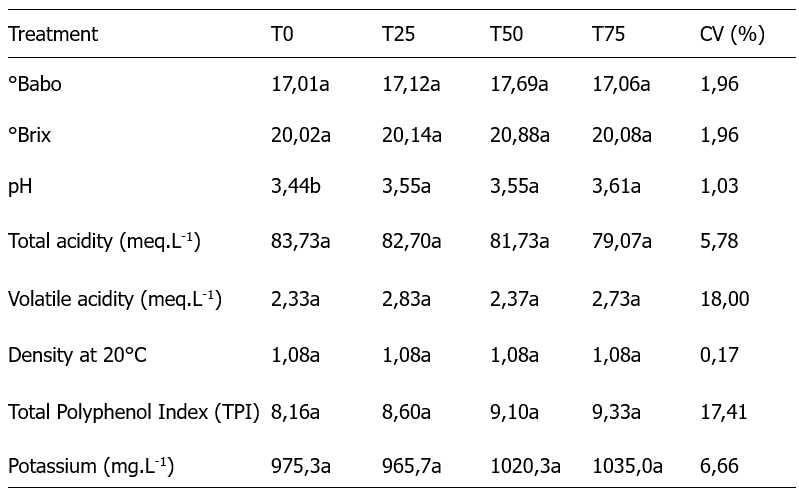
Averages followed by the same letter, lowercase on the line, do not differ statistically with a 5% probability of error using the Tukey test.
The only variable that showed a difference was pH. Defoliation is a practice that helps the maturation of the grape, contributing to an increase in the concentration of sugars and consequent decrease in total acidity. It was expected that the analysis of °Babo, °Brix and total acidity would present a significant difference between treatments, which did not occur.
This result can be explained by the climatic conditions that occurred after the treatments were applied (figure 1), which showed high insolation during the maturation period and low rainfall (Inmet, 2018), reducing the possible effect of defoliation. It is also important to consider that the accumulation of sugars and the reduction of titratable acidity is delayed when the vine leaf area decreases sharply. Studies performed by Bobeica et al. (2015), where nutritional source limitation induced by severe leaf removal in Cabernet Sauvignon and Sangiovese caused a significant reduction in the accumulation of sugars in the berries.
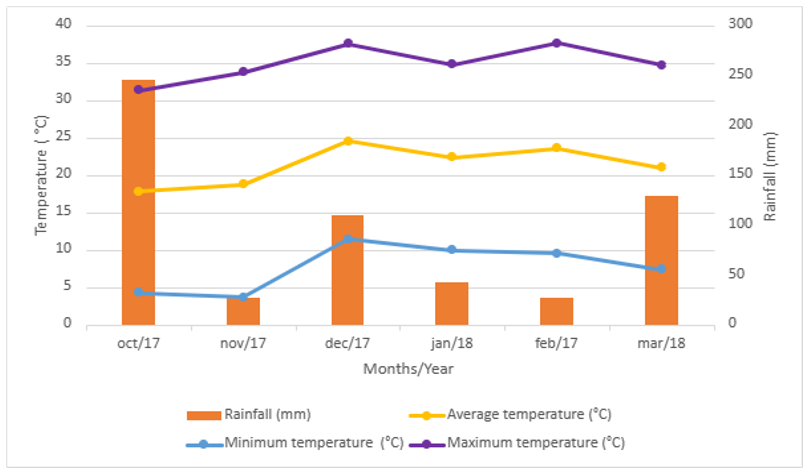
Figure 1
Monthly weather conditions at the experiment site, Bagé, RS, Brazil. The variables considered for this study were average, minimum and maximum temperatures, in °C, and precipitation in millimeters (mm).
Source: INMET – National Institute of Meteorology, 2018.
Grape acidity at harvest is a key factor for obtaining high quality wines, and its content results from the relationship between free organic acids (malic and tartaric) and organic acids neutralized by the K+ ion (Villette et al., 2020). In the context of warmer climates, the accumulation of K+ ions increases during grape ripening, leading to an excessive neutralization of organic acids (Nieves-Cordones et al., 2019). In addition, the high temperature also affects the organic acid content of the berries, inducing the consumption of malic acid as a respiratory substrate (Famiani et al., 2016).These results show a low-acid must, which can lead to unstable wines with poor organoleptic properties (Villette et al., 2020).
Similar results were found by Almeida and Ono (2016) in studies carried out with the Shyrah cultivar remaining at different levels of development in the Brazilian semi-arid region, by Moreno et al. (2016) in early defoliation performed in Tempranillo and Potter et al. (2010), who evaluated the defoliation of Cabernet Sauvignon produced in the Campanha Gaúcha region.
There was a significant difference in the pH of the must, a result similar to that found by Coelho (2016), who evaluated the effect of defoliation on the composition of the Aragonez grape. On the other hand, in studies carried out by Potter et al. (2010), the defoliation of Cabernet Sauvignon decreased the pH values in the must. The practice of early defoliation in Tempranillo, in different vintages, did not show differences for pH values, in a study evaluated by Moreno et al. (2016).
High pH values in musts support the action of oxidative enzymes before alcoholic fermentation, since the concentration of free SO2 is lower when compared to musts with lower pH values. The highest pH values found in the musts from the vines with the highest intensity of defoliation coincide with the increase in potassium concentration in these samples (although they do not present statistical differences), indicating that the defoliation altered the physiology of the plants, stimulating their vegetative vigor.
In table 2 it is possible to verify that the pH values of the wine also showed differences, between T0 and T75, the result was expected, since it is conditioned to the pH concentration of the must. However, this result differs from that found by Song et al. (2018), in which more intense defoliation decreased the pH of the wines produced. The pH influences the color and flavor of the wine, in addition, wines with a high pH are more susceptible to oxidative changes and attack by microorganisms.
The variables total acidity, density, alcohol, free SO2, dry extract, TPI, tannins and color index 520nm and 620nm obtained through physicochemical analysis of wines resulting from vines that received different defoliation treatments, did not show significant difference. The period and intensity of grapevine defoliation can lead to different results in the physicochemical characteristics of musts. Thus, the defoliation performed at a specific time may have influenced the results found in this study. For Potter et al. (2010), the variables of total acidity, density, free SO2 and alcohol also did not show significant differences in the study of defoliation in Cabernet Sauvignon in Campanha Gaúcha.
Regarding total anthocyanins, the values found for treatments 25% and 75% of defoliation were lower compared to treatments 0% and 50%. However, the values found in all treatments are in accordance with the concentrations of these pigments in the variety under study, which are close to or greater than 300 mg.L-1 (González-Neves et al., 2007; Ribéreau-Gayon et al., 2003).
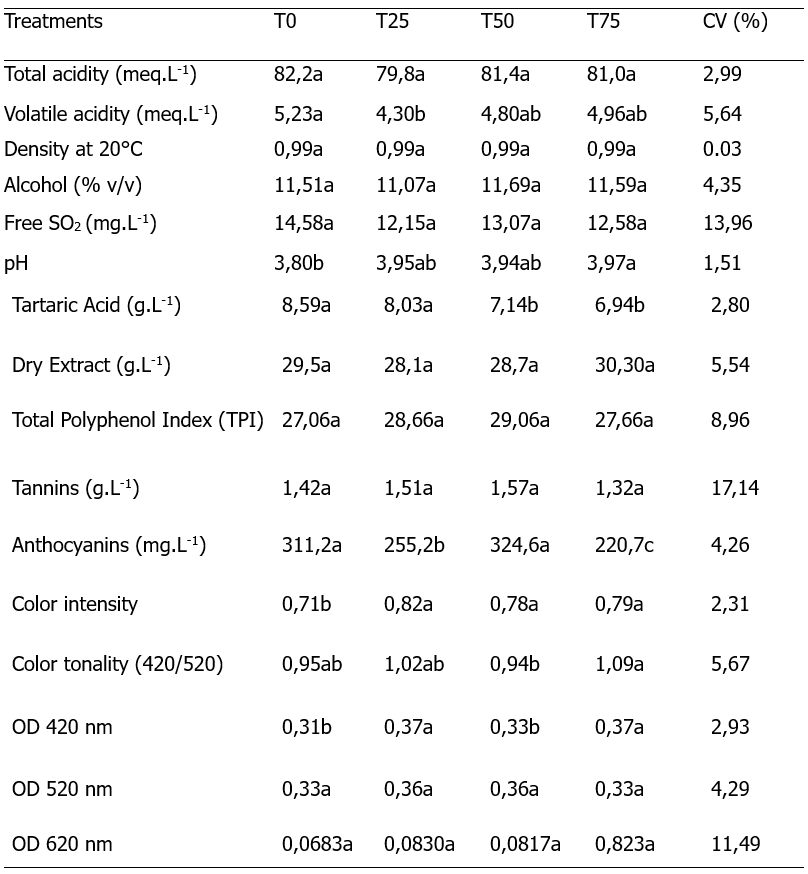
Averages followed by the same letter, lowercase on the line, do not differ statistically with a 5% probability of error using the Tukey test.
However, in this work, the treatment with 75% defoliation presented the lowest value among the evaluated treatments. Baiano et al. (2015) found higher values of anthocyanins (491 mg.L-1) with 75% defoliation on the east side of the vine, and (472 mg.L-1) on the east/west sides in the Vitis vinifera Nero di Troia in the Mediterranean region. In studies carried out by Bobeica et al. (2015), the authors concluded that the grape berry manages the metabolic direction of carbon in such a way that sugar accumulation is maximally maintained at the expense of secondary metabolites (eg. anthocyanins) under source limitation (leaves).
Light and temperature are the most important climatic factors in the biosynthesis of anthocyanins, in addition to cultivation, environmental conditions, cultural practices and water regime. According to Fernández-Cano and Togores (2011), very high temperatures tend to inhibit the synthesis of anthocyanins and may degrade them. According to figure 1, temperatures approached 40°C in February, which may have contributed to the degradation of these pigments, due to the high defoliation rate.
Furthermore, the sharp decrease in anthocyanin concentration under severe defoliation suggests that the influence of light and temperature are dominant in the degradation of these compounds (Cataldo et al., 2021). Niu et al. (2017) concluded that the enzymatic degradation of anthocyanins was more severe after 9 days at 35°C, and for Rosas et al. (2017) high temperature conditions, approximately 45°C, reduced the total anthocyanin content in Malbec and Bonarda grape berries.
The wine making process (must extraction, maceration and fermentation) can also change the concentration of anthocyanins, and contribute or not to a better stability of these pigments (Baiano et al., 2015). Potassium also influences anthocyanin levels, as it raises the pH and increases their instability, decreasing their concentration in wines and resulting in color deficiency. The concentration variation depends on the cultivar and the winemaking method used (Riberéau-Gayon et al., 2003).
Wine color indexes are determined by measuring the absorbance at different wavelengths. The color intensity is the result of the sum of the color measurements (absorbance at 420, 520 and 620 nm) (Riberéau-Gayon et al., 2003). In this work, a greater intensity of color was verified in wines made from grapes from plants subjected to defoliation, which may be associated with greater luminosity. The combination of visible and UV radiation has the ability to positively regulate some genes responsible for the synthesis of anthocyanins, the pigments responsible for the color of grapes (Martínez-Lüscher et al., 2020).
As for the color tone, treatments 50% and 75% were different from each other, but they were similar to treatments 0% and 25%. The tonality of the wines was close to 1.0 in treatments 25% and 75%, and greater than 1.0 in the other treatments. This index shows a greater presence of red and yellow colors in wines, with a tendency to express colors in brick tones, generally observed in older wines. (Riberéau-Gayon et al., 2003).
The potassium values found in the wines of this study (table 3) were very high. Red wines generally have a concentration of 1g.L-1 (Riberéau-Gayon et al., 2003). The availability of this mineral comes from the skin of the grape, where its concentration is higher, and is transferred in the maceration phase during alcoholic fermentation. Although factors such as soil, variety, rootstock, age and vineyard fertilization affect potassium accumulation (Fernández-Cano and Togores, 2011), its final content depends on the ionic balance that occurs in the wine. The presence of potassium cations in wine leads to an increase in pH (Fernández-Cano and Togores, 2011).
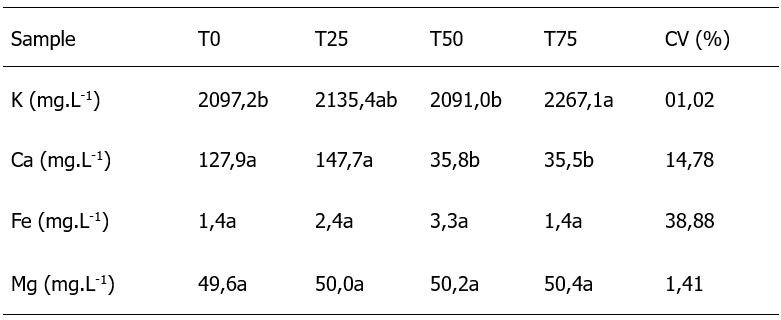
Averages followed by the same letter, lowercase on the line, do not differ statistically with a 5% probability of error using the Tukey test.
Potassium is involved in the transport of sugars to the berries, it is not metabolized and accumulates until the end of ripening. Vines subjected to low minimum air temperatures and high rainfall, increase the accumulation of potassium in the berries. The lower minimum air temperatures and the high volume of rainfall favors the accumulation and concentration of Potassium in the grape berries. (Stein et al., 2018b). In the harvest under study, there were no high rainfall rates, but the minimum air temperatures were low (close to 10°C) for the summer period, and the time of grape maturation, (Figure 1), which may have influenced the concentration of potassium in the grapes.
The treatment with 75% defoliation significantly increased potassium levels in relation to T0% and T50%. In studies by Pötter et al. (2010) potassium values showed no significant difference between treatments with 0% and 25% defoliation. A similar result was found by Moreno et al. (2016).
CONCLUSIONS
Defoliation of the vine, carried out at the phenological stage of the pea-size berry did not result in significant changes in the composition of the must and wine.
Climatic conditions contribute to the composition of the grape, and consequently, of the must and wine. Therefore, the climate may have actively influenced the defoliation treatments and, consequently, the results obtained.
In vintages where weather conditions present adequate luminosity and humidity, defoliation can be an unnecessary practice.
REFERENCES
Almeida, MB e EO Ono. 2016. Efeitos de diferentes níveis de desfolha sobre a fisiologia, a produção e a qualidade das uvas e dos vinhos da variedade Syrah em condições tropicais semiáridas brasileiras. Revista Semiárido De Visu, v. 4, n°. 3, p.160-175.
Baiano, A., A. Gianni, M.A. Previtali, M.A Del Nobile, V. Novello e L, Palma. 2015. Effects of defoliation on quality atributes of Nero di Troia (Vitis vinífera L.) grape and wine. Food Research International, v.75, p. 260-269.
Bobeica N, Poni S, Hilbert G, Renaud C, Gomès E, Delrot S & Dai Z (2015) Differential responses of sugar, organic acids and anthocyanins to source-sink modulation in Cabernet Sauvignon and Sangiovese grapevines. Frontiers in Plant Science. v.6, p.382.
Cataldo E, Salvi L, Paoli F, Fucile M & Mattii GB (2021) Effects of Defoliation at Fruit Set on Vine Physiology and Berry Composition in Cabernet Sauvignon Grapevines. Plants, v.10, p.1183.
Coelho SSP (2016) Efeito da desfolha precoce no microclima térmico dos cachos e na síntese de antocianas na casta Aragonez. Dissertação (Mestrado) - Instituto Superior de Agronomia, Universidade de Lisboa, Portugal, 68p.
Fernández-Cano LH & Togores JH (2011) Tratado de viticultura I. Mundi-Prensa, v.1, Madrid, 1031p.
Famiani F, Farinelli D, Frioni T, Palliotti A, Battistelli A, Moscatello S & Walker RP (2016) Malate as substrate for catabolism and gluconeogenesis during ripening in the pericarp of different grape cultivars. Biologia Plantarum, v. 60, n°1, p. 155–162.
González-Neves G, Franco J, Barreiro L, Gil G, Moutounet M & Carbonneau A (2007) varietal differentiation of tannat, cabernet sauvignon and merlot grapes and wines according to their anthocyanic composition. European Food Research and Technology, v. 225, p. 111-117.
INMET- Instituto Nacional de Meteorologia: Banco de Dados Meteorológicos (2018). Disponível em: <https://portal.inmet.gov.br/>. Acesso em 29 agosto 2022.
Lorenz DH, Eichhorn KW, Bleiholder H, Klose R, Meier U & Weber E (1995) Phenological growth stages of the grapevine (Vitis vinifera L. ssp. Vinifera)- Codes and descriptions according to the extended BBCH scale. Australian Journal of Grape and Wine Research, v.1, p.100-110.
Manfio VA (2019) Vitivinicultura no espaço geográfico do Rio Grande do Sul, Brasil: Uma abordagem sobre a Campanha Gaúcha. Caminhos de Geografia, v. 20, n° 70, p. 433-447.
Martínez-Lüscher J, Chen CCL, Brillante L & Kurtural SK (2020) Mitigating heat wave and exposure damage to “Cabernet Cauvignon” wine grape with partial shading under two irrigation amounts. Frontiers in Plant Science. v.11, 579192.
Mello LMR & Machado CAE (2021) Vitivinicultura brasileira: panorama 2020, Comunicado Técnico 223, Embrapa, Bento Gonçalves.
Miele A & Rizzon LA (2013) Pruning and cluster thinning intensity on the composition of Cabernet Sauvignon grape. Revista Brasileira de Fruticultura, v.35, n°4, p.1081-1092.
Moreno D, Valdés E, Uriarte D, Gamero E, Talaverano I & Vilanova M (2016) Early leaf removal applied in warm climatic conditions: impact on Tempranillo wine volatiles. Food Research International, v.98, p.50-58.
Nieves-Cordones M, Andrianteranagna M, Cuéllar T, Chérel I, Gibrat R, Boeglin M, Moreau B, Paris N, Verdeil JL, Zimmermann SD, & Gaillard I (2019) Characterization of the grapevine Shaker K+ channel VvK3.1 supports its function in massive potassium fluxes necessary for berry potassium loading and pulvinus-actuated leaf movements. New Phytologist. v.222, n°, p.286–300, 2019.
Niu J, Zhang G, Zhang W, Goltsev V, Sun S, Wang J, Li P & Ma F (2017) Anthocyanin concentration depends on the counterbalance between its synthesis and degradation in plum fruit at high temperature. Scientific Reports, v. 7, 7684.
Pötter GH, Daudt CE, Brackamnn A, Leite TT & Penna NG (2010). Desfolha parcial em videiras e seus efeitos em uvas e vinhos Cabernet Sauvignon da região da Campanha do Rio Grande do Sul, Brasil. Ciência Rural, v.40, p.2011-2016.
Ribéreau-Gayon P, Glories Y, Maujean A & Dubourdieu D (2003) Tratado de Enologia: Quimica del vino, estabilización y tratamentos. Buenos Aires: Hemisfério Sur, 537p.
Rizzon LA (2010) Metodologia para análise de vinho. Embrapa Informação Tecnológica. Brasília – DF, 120p.
Rizzon LA & Miele A (2017) Efeito do porta-enxerto na composição mineral do vinho Cabernet Sauvignon. Revista Brasileira de Viticultura e Enologia, n.9, p.66-73.
Rosas I, Ponce MT, Malovini E, Deis L, Cavagnaro B & Cavagnaro P (2017) Loss of anthocyanins and modification of the anthocyanin profiles in grape berries of Malbec and Bonarda grown under high temperature conditions. Plant Science, v. 258, p.137-145.
Santos HG, Jacomine PKT, Anjos LHC, Oliveira VA, Lumbreras JF, Coelho MR, Almeida JA, Cunha TJF & Oliveira JB (2013) Sistema brasileiro de classificação de solos. 3.ed. rev. e ampl. Brasília: Embrapa, 353p.
Song C, Wang C Xie S & Zhang Z (2018) Effects of leaf removal and cluster thinning on berry quality of Vitis vinifera cultivars in the region of Weibei Dryland in China. Journal of Integrative Agriculture, v. 17, n°7, p. 1620–1630.
Stein T, Carvalho IR, Zocche RGS, Jacobs SA, Szareski VJ, Zocche F, Aloy KG, Santos LV, Martins HCGB, Rosa TC & Souza VQ (2018) climatic variables and their effects on phenolic maturation and potassium uptake in cabernet sauvignon wines. Journal of Agricultural Science; v.10, n°8, p.388-396.
Stein T, Carvalho IR, Szareski VJ, Zocche RGS, Zocche F, Aloy KG, Santos LV, Martins H CGB, Lautenchleger F & Souza VQ (2018) Quality of Cabernet Sauvignon Wines Determined by the Variability of Climatic Attributes. Journal of Agricultural Science; v.10, n°8, p.380-387.
Villette J, Cuéllar T, Verdeil JL, Delrot S & Gaillard I (2020) Grapevine potassium nutrition and fruit quality in the context of climate change. Frontiers in Plant Science. v.11, 123.
Vanderweide J, Gottschalk C, Schultze SR, Nasrollahiazar E, Poni S & Sabbatini P (2021) Impacts of pre-bloom leaf removal on wine grape production and quality parameters: a systematic review and meta-analysis. Frontiers in Plant Science, v.11, 621585.
Walker RR & Blackmore DH (2012) Potassium concentration and pH inter-relationships in grape juice and wine of Chardonnay and Shiraz from a range of rootstocks in different environments. Australian Journal of Grape and Wine Research, v.18, p.183-193.
Wang Y, He L, Pan Q, Duan C & Wang J (2018) Effects of basal defoliation on wine aromas: a meta-analysis. Molecules, v.23, n°4, p.779.
Zocche RGS, Jacobs SA, Sampaio NV, Souza VQ, Carvalho IR, Nardino M, Rizzon LA & Rombaldi CV (2017) Wines produced with 'Cabernet Sauvignon' grapes from the region of Bagé in the state of Rio Grande do Sul, Brazil. Pesquisa Agropecuária Brasileira, v. 52, n°5, p. 311-318.
Notas de autor