ABSTRACT: The purpose of this paper is to consolidate the measurement of a lovemark and unify a set of elements that form a lovemark in university institutions by considering the differences between students and graduates. Based on a review of factors that build a lovemark, brand loyalty relationships were explored. In addition, an empirical study was carried out and applied to a sample of 257 participants at the National University of Colombia (unal), one of the most important universities in this country. The results validated the positive effects of brand love, brand experience, and brand involvement on brand loyalty, the determining factor of a university lovemark. This article is one of the first works integrating all the constructs proposed by prior research studies, which, until now, have approached lovemark and brand loyalty separately.
KEYWORDS: LovemarkLovemark,loyaltyloyalty,higher educationhigher education,brandbrand.
RESUMEN: Este artículo busca consolidar la medición de una lovemark y unificar el conjunto de elementos que conforman una marca de este tipo en instituciones universitarias a partir del análisis de las diferencias existentes entre estudiantes y egresados. Con base en una revisión de los factores que construyen una lovemark, se exploraron relaciones de lealtad de marca. Además, se llevó a cabo un estudio empírico sobre una muestra de 257 participantes miembros de la Universidad Nacional de Colombia (UNAL), una de las instituciones de educación superior más importantes del país. Los resultados validaron los efectos positivos de las variables amor por la marca, experiencia de marca y participación de la marca sobre la lealtad hacia ella, un factor determinante de lovemark para una universidad. Este artículo es uno de los primeros en integrar todos los constructos propuestos por investigaciones anteriores, que, hasta ahora, se han relacionado por separado en la teoría de lovemark y lealtad de marca.
PALABRAS CLAVE: Lovemark, lealtad, educación superior, marca.
RESUMO: O objetivo deste trabalho é consolidar a medição de uma lovemark e unificar um conjunto de elementos que forma uma lovemark em instituições universitárias ao considerar as diferenças entre estudantes e graduados. Com base em uma revisão de fatores que constroem uma lovemark, as relações de fidelidade à marca foram exploradas. Adicionalmente, um estudo empírico foi conduzido e aplicado a uma amostra de 257 participantes da Universidade Nacional da Colômbia (UNAL), uma das universidades mais importantes do país. Os resultados validaram os efeitos positivos do amor pela marca e da experiência de marca, e o envolvimento com a marca na fidelidade à marca, o fator determinante para uma lovemark universitária. Este artigo é um dos primeiros trabalhos a integrar todas as proposições de artigos de pesquisa anteriores que, até o momento, haviam abordado love-mark e fidelidade de marca separadamente.
PALAVRAS-CHAVE: educação superior, fidelidade, lovemark, marca.
RÉSUMÉ: Cet article cherche à consolider la mesure d'un lovemark et à unifier l'ensemble des éléments qui la composent dans les institutions univer-sitaires, en partant de l'analyse des différences entre étudiants et diplômés. En partant d'un examen des facteurs qui construisent un lovemark, on a exploré les relations de fidélité à une marque. Par la suite, on a mené une étude empirique sur un échantillon de 257 membres participants de l'Univer-sité Nationale de Colombie (unal), l'un des établissements d'enseignement supérieur les plus importants du pays. Les résultats ont validé les effets posi-tifs des variables amour de la marque, l'expérience et la participation de la marque sur la fidélité, un facteur déterminant de lovemark pour une univer-sité. Cet article est l'un des premiers à intégrer toutes les constructions pro-posées par les recherches précédentes, qui, jusqu'à présent, étaient reliées séparément dans la théorie de la loyauté et de la fidélité à une marque.
MOTS-CLÉ: lovemark, fidélité, enseignement supérieur, marque.
Carátula del artículo
Lovemark Effect: Analysis of the Differences between Students and Graduates in a Love Brand Study at a Public University
EFECTO LOVEMARK: ANÁLISIS DE LAS DIFERENCIAS ENTRE ESTUDIANTES Y EGRESADOS EN UN ESTUDIO DE "MARCA DE AMOR" EN UNA UNIVERSIDAD PÚBLICA
EFEITO LOVEMARK: ANÁLISE DAS DIFERENÇAS ENTRE ESTUDANTES E GRADUADOS EM UM ESTUDO DE AMOR PELAS MARCAS REALIZADO EM UMA UNIVERSIDADE PÚBLICA
L'EFFET « LOVEMARK » : UNE ANALYSE DES DIFFÉRENCES ENTRE LES ÉTUDIANTS ET LES DIPLÔMÉS DANS UNE ÉTUDE D'UNE « MARQUE D'AMOUR » DANS UNE UNIVERSITÉ PUBLIQUE
 Iván Alonso Montoya-Restrepo iamontoyar@unal.edu.co
Universidad Nacional de Colombia, Colombia
Javier A. Sánchez-Torres jasanchez@udem.edu.co
Universidad de Medellín, Colombia
Sandra Patricia Rojas-Berrio sprojasb@unal.edu.co
Universidad Nacional de Colombia, Colombia
Alexandra Montoya-Restrepo amontoyar@unal.edu.co
Universidad Nacional de Colombia, Colombia
Innovar, vol. 30, no. 75, pp. 43-56, 2020
Facultad de Ciencias Económicas. Universidad Nacional de Colombia.
Received: 14 November 2018
Accepted: 03 October 2019
Introduction
The positioning of a brand is one of the main distinguishing elements for a company to achieve its marketing objectives. Brand definition corresponds to a "unique identification" that differentiates a brand from its competitors, providing confidence in the product (Delgado-Ballester & Munuera-Alemán, 2001), its quality, price (Blackett & Harrison, 2001; Gallo, 2000; Hernani, 2008), and the purchase process from interest to post-consumption, which is a learning process by consumers, facilitating subsequent purchase decisions and decreasing the time for making such decision (Keller, 2008; Kotler & Keller, 2016). These differentiating aspects of the product allow consumers to relate previous experience with subsequent consumption (Aaker, & Biel, 2013). These comparisons are based on the experience and values that customers obtain themselves. Therefore, some researchers have assigned personality and emotional dimensions to this process (Escobar-Farfán, Mateluna, & Araya, 2016; Haigood, 2001; Liu, Huang, Hallak, & Liang, 2016).
Brand recognition of a university is an important factor for universities that consolidate within their stakeholders (Sulkowski, Seliga, & Wozniak, 2020). In this regard, it is strategically important to have a strong brand positioning in the sector, creating the need to carry out research related to the university brand (Fazli-Salehi, Esfidani, Torres, & Zúñiga, 2019).
The brand, in its evolution, has taken the "emotionality" that has been granted to the study of the intimacy and sentimentality that consumers develop towards brands. In this article, we will describe the concept of "Marca-Amor" (or lovemark) to study its consolidation in one of the most beloved institutions in Colombia, the National University of Colombia (UNAL).
Literature review
The Importance of the Brand within an Organization
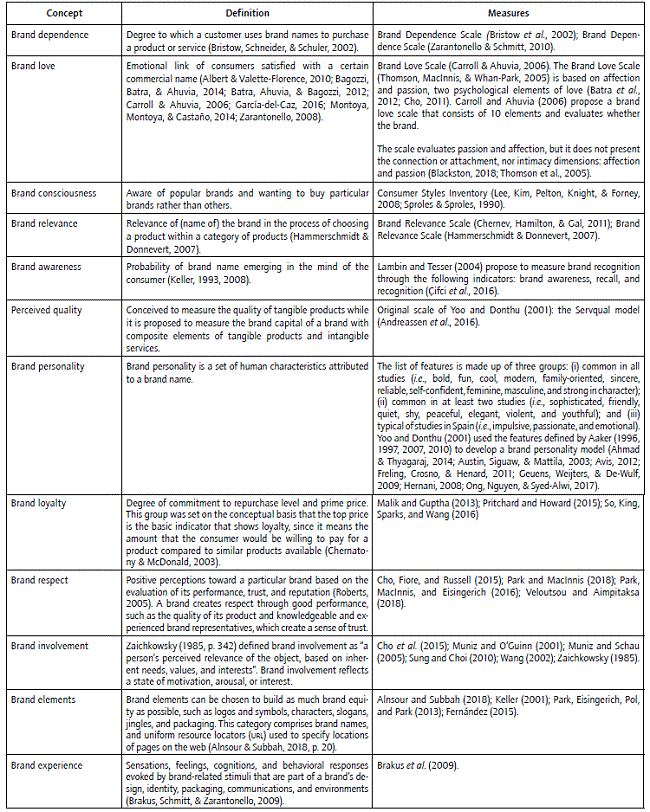
As noted in the introduction, a brand becomes one of the most important and best-valued intangible assets of organizations looking for different alternatives for their measurement and consolidation; some examples can be seen in table 1.
Table 1
Main scales of brand measurement.
 Source: adapted from Ostrovskaya (2014, p. 22).
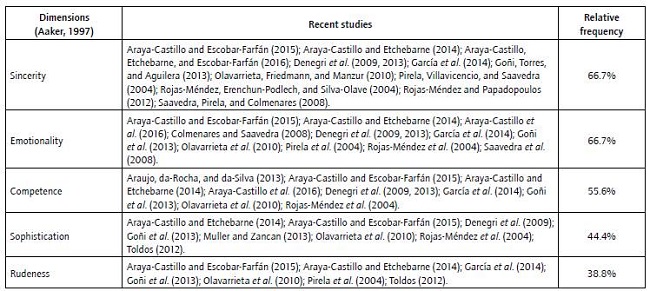
The brand then ceases to be a symbol and becomes an element of relationship with the consumer, who forces organizations to work on values such as notoriety, personality, perceived quality, and loyalty (Alvarado & Lucano, 2015, p. 29). There are many dimensions that can be evaluated in the brand (Escobar-Farfán et al., 2016). Table 2 shows that one of these elements is emotionality, a fundamental pillar of the lovemark (Batra et al, 2012).
In this context of brand positioning, the relationship of brands with consumers becomes so close that we can say that consumers "love" their brands and feel deep affection and longing for them, to the point of missing them when they disappear. This emotional closeness has been studied by neuromarketing, which has discovered activation centers with products, whose marks are close to the feeling of love and generate love substances, such as dopamine (Lindstrom, 2011). According to the information gathered by these studies, it is possible to speak of love brands or passion brands.
Lovemarks
For Roberts (2005, 2006), consumers are primarily emotional beings. This author proposes that brands continue fulfilling their goal to "create deep and complex emotional bonds", such as a lovemark, which is based on "creating a personal relationship, a story of love with people, creative and wrapped in mystery, with a touch of sensuality" (Kelemen, 2012, p. 3). Roberts and his team identify three fundamental attributes of a lovemark (Albert, Merunka, & Valette-Florence, 2008) to develop "their special emotional resonance": mystery, intimacy, and sensuality (Antequera 2016, p. 6).
The consolidation of a lovemark is based on two essential elements: respect and love. Respect focuses on the reliability of the product or service, which is why its characteristics must maintain a standard of the highest quality, as well as trust and reputation; elements that must be maintained at the same level, purchase after purchase. Additionally, love is divided into three components: mystery, sensuality, and intimacy. Mystery allows telling great stories that involve the past, present, and future, as well as dreams, myths, icons, and inspiration. Sensuality resorts to the use of the senses, and intimacy is the sum of empathy, commitment, and passion. In short, a lovemark maintains a relationship with the consumer united by love (Ahuvia, 2005; Carroll & Ahuvia, 2006), a personal and unique feeling (Forero, 2014, p. 6). These three dimensions of brand image contribute positively (Pavel, 2013) to the creation of a lovemark experience (Bagozzi et al, 2017), leading consumers to become avid fans of a certain offer of a company. These attributes are observed in figure 1.
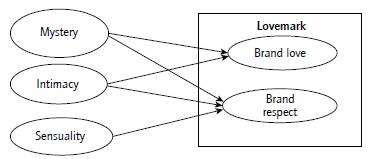 Figure 1
Attributes of a lovemark.
Source: adapted from Roberts (2005).
Figure 1
Attributes of a lovemark.
Source: adapted from Roberts (2005).
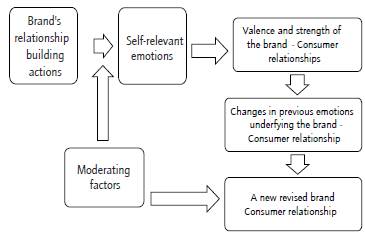
Figure 2 shows the construction of the lovemark, which depends on different moderating factors, especially emotions; which is why the messages sent to the senses become so important in this process. Being able to change the emotions in the relationship with the consumer allows understanding the real positioning of the brands and, through this, create a feeling of love that strengthens brand loyalty.
Case: National University of Colombia (UNAL)
UNAL is one of the most prestigious universities in Colombia, providing a universal and inclusive education model. It is difficult for a consumer in Colombia not to know about UNAL or understand its role in the development of Colombian society. However, the image of this institution has gone through many phases. In July 1986, Dr. Roberto Rosero conducted a study, which, among other things, sought to determine the preference of high school graduates for careers and universities. This study was carried out with 600 senior students of 20 schools from different socioeconomic levels (Rosero, 1986). The research focused on inquiring about career and university preferences with a central question to determine if the admission process was a decisive factor, and whether the student had a scholarship that would assume the costs of their university studies.
Depending on which university the student preferred, especially if it was public or private, the results showed a decline in the preference for UNAL, revealing a higher interest for private universities. In 2000, Napoleon Franco polling firm and UNAL carried out a new research study (Montoya, Montoya, Rosero, & Montañez, 2000) in a sample of 1,203 surveys of high school students of the city of Bogotá, Colombia. The results of this study determined that 51°% of students preferred private universities over UNAL because its students and professors were perceived as guerrilla members or communists (Montoya et al, 2000).
Methodology
An exploratory study aimed at solving the research problem was conducted. For this purpose, we used a non-experimental, cross-sectional design. In order to define the sample we used the statistical equation for populations (table 3). The measurement tool was constructed through a process of translating the items detailed above in the theoretical framework, which were endorsed by expert judges in marketing. A virtual questionnaire was created to facilitate data collection. Likewise, as a dissemination action, a campaign for the study was posted on a Face-book page in order to encourage responses by students and graduates. We obtained 267 valid questionnaires: 100 from graduates and the remaining 167 from students.
Table 3
Sample design.
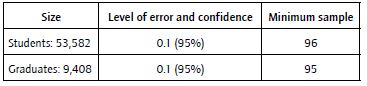
The following assumptions are proposed according to the conceptual contributions approached. For Roberts (2005, 2006), intimacy, mystery, and sensuality are the main elements for both brand respect and brand love (Blackston, 2018). Brand awareness (Çifci et al, 2016; Lambin & Tesser, 2004) affects brand experience (Al-Mandil & Yen, 2017; Brakus et al, 2009) because of brand value. Besides, brand loyalty (Malik & Guptha, 2013; Pritchard & Howard, 2015; So., 2016) depends on brand respect, brand love, brand vale, brand elements (Alnsour & Subbah, 2018; Keller, 2001, 2017; Fernández, 2015), and brand involvement (Cho et al, 2015; Muniz & O'Guinn, 2001; Muniz & Schau, 2005; Sung & Choi, 2010; Wang, 2002; Zaichkowsky, 1985).
Results
Due to the exploratory nature of this study, a latent variable regression analysis was conducted with Smartpls 3.2.7 (Hair, Hult, Ringle, & Sarstedt, 2017). The analysis was performed in two phases: the first phase assessed the measurement model and the second tested the structural model.
Measurement Model
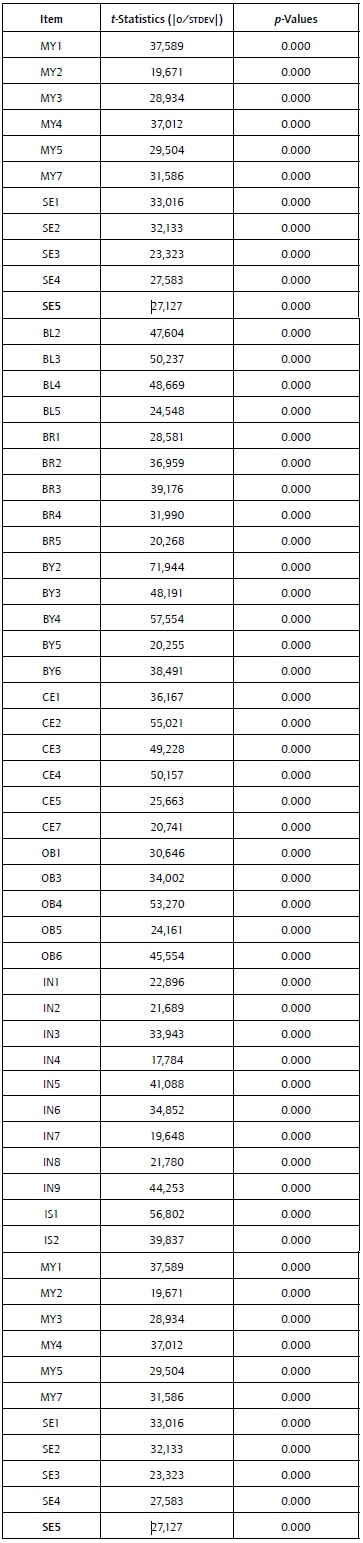
The first step was to test the convergent and discriminant validity of the constructs and the reliability of each item. The results of the convergent validity tests construct were acceptable, and all t-statistics had loads higher than 0.505, as shown in table 5 (Hair et al., 2017). Composite reliability tests and Goldstein's test were applied. All values were higher than the acceptable minimum of 0.70. In addition, Cronbach's alpha test obtained values above 0.70 (Churchill & Iacobucci, 2004). Finally, the convergent validity was tested with average variance extracted (AVE), reporting values above 0.5 (table 6).
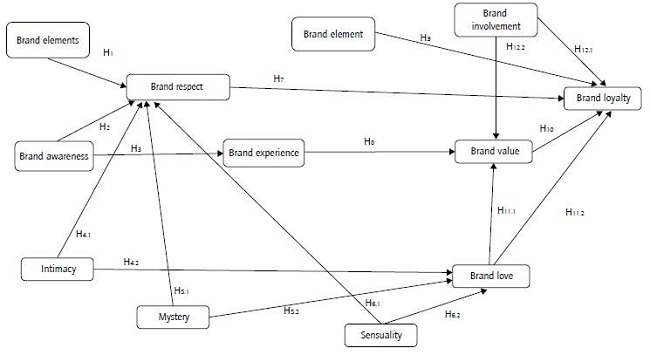 Figure 3
Hypothesis. Source: authors.
Figure 3
Hypothesis. Source: authors.
Table 4
Study hypotheses.
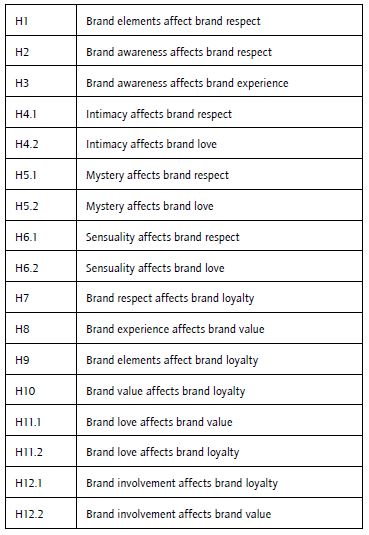
Table 5
Indicator loads.
 Source: authors.
Table 6
Composite reliability tests.
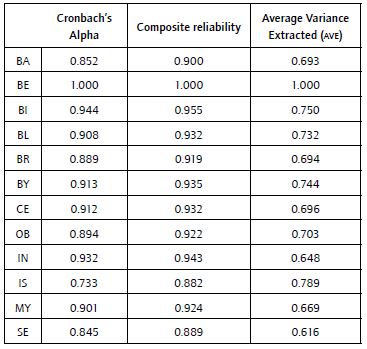 Note: BA: brand awareness; BE: brand experience; BI: brand involvement; BL: brand love.
Discriminant validity was verified by the matrix AVE-squared correlation (Fornell & Larcker, 1981), whose results are shown in table 7, and the Henseler-Ringle test (Henseler, Ringle, & Sarstedt, 2015), presented in table 8). Both tests were validated.
Table 7
Discriminate validity: AYE.
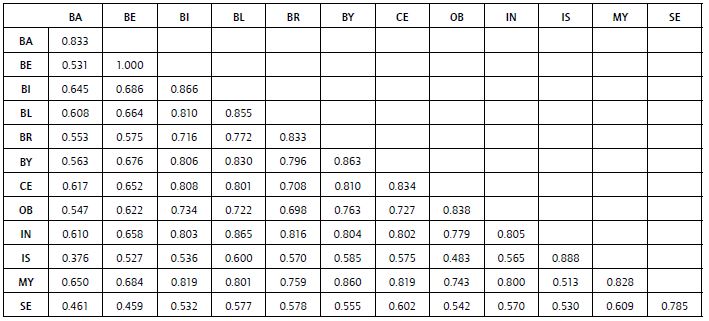 Source: authors.
Table 8
Discriminate validity: Dillon-Goldstein's.
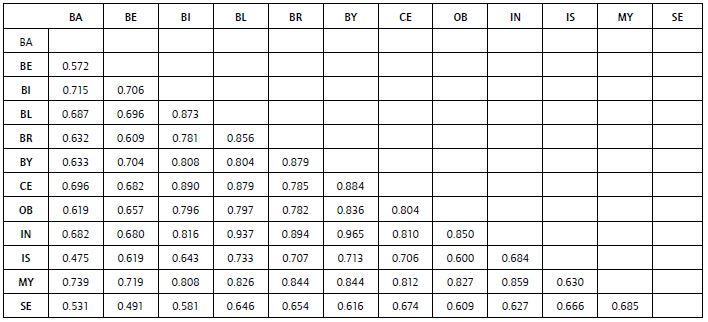 Source: authors.
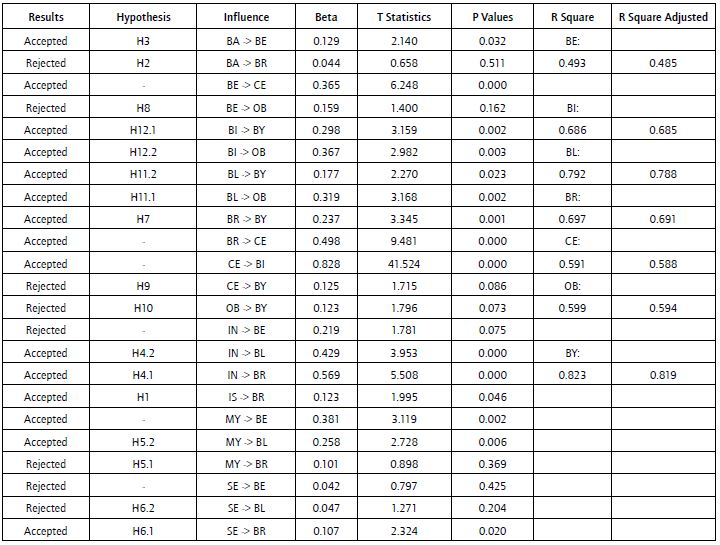
Likewise, this study suggests that brand loyalty reflects customers' conceptions regarding their levels of involvement with the brand (H12.1, β = 0.298*), brand value (H10, β = 0.123), and brand love (H11.2, β = 0.177*), which could better shape the concept of lovemark.
To test the predictive ability of the model, bootstrapping was performed (n = 5.000), with all R2 values above 0.10 (t > 1.96), indicating that the independent variables are adequate and confirming the predictive capability of the proposed model (Falk & Miller, 1992). All the hypotheses were validated, except the following: H1.2, H2.1, H2.3, H5.1, H6.2, H7, H8.1, H10.3, H11.1, and H11.2 (Table 9) (Figure 4).
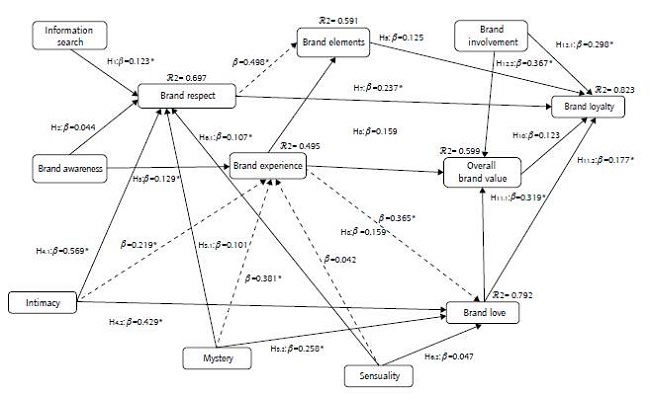 Figure 4
Empirical model.
Source: authors. Note: significant at: * p < 0.05, t-value = 1.960
Figure 4
Empirical model.
Source: authors. Note: significant at: * p < 0.05, t-value = 1.960
The results show, first, that brand loyalty is built in a complex manner within the customer-brand relationship, since it requires actions in the short term. As long-term actions, it is a process in which all the marketing actions related to the levels of symbolic consumption (cognitive, affective and conative) manage to explain brand loyalty (R2 = 0.823). This allows validating its high-predictive capacity from the conceptions of marketing, framed in the paradigm shift towards the multidimensional consumer. Our findings confirm not only that the lovemark concept is composed of love brand and brand respect, but also that the variable of brand experience is the key concept of brand co-creation, integrating a third concept that is also part of the love-mark theory influenced by the three essential actions of branding: mystery, sensuality, and intimacy.
Differences between Active Students and Graduates
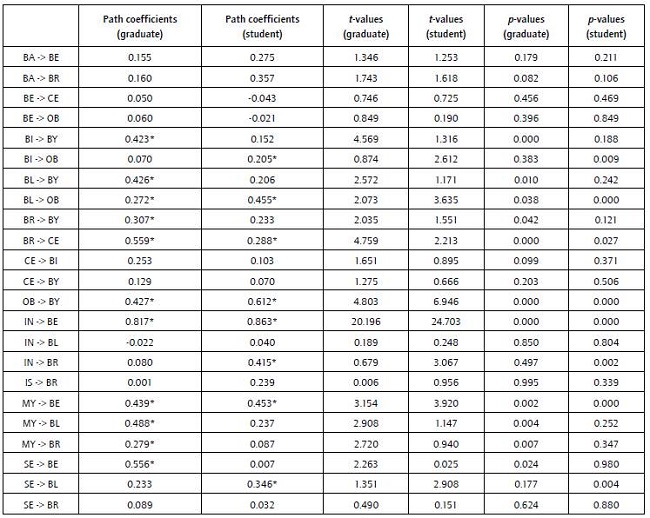
Finally, a multigroup analysis was performed in order to determine the differences between active and graduate students. For this, a bootstrapping analysis was carried out with more than 3,000 subsamples.
Table 9
Results.
 Source: authors.
Table 10
Summary of the multi-group analysis (graduated-student).
 Note: significant at: * p < 0.05, t-value = 1.960 Source: authors.
It was found that the graduates (β = 0.426*), unlike the students (β = 0.206), report a high significance of influence of brand love on the brand loyalty. This could mean that their time at UNAL generated strong bonds that make them to keep their alma mater in their mind in an effective way forever. In fact, the mystery construct is also significant for the group of graduates in its effect on brand love (β = 0.488*) and brand respect (β = 0.279*), which ratifies the assumption that the course of time and the interaction of the brand with the client generate an emotional bond between the two parties that becomes stronger over time.
The sensuality factor has been validated as influential on brand love (β = 0.746*) and brand experience (β = 0.556*) for the group of students, but not for the graduates. This could be explained by the fact that students are in a stage of considerable interaction with the brand. Therefore, they value more the experiences offered by the brand on a day-to-day basis, in addition to being in closer contact with tangible brand actions (i.e., advertising actions, facilities, processes, and services).
Conclusions and Future Research
The results allowed us to consider love as the result of a complex process in which the brand is the reflection of all the actions carried out by the organization in the short and the long term. Moreover, all levels of the brand's relationship with the client, especially this model, propose the new construct of brand experience as another variable within this process. Likewise, this model proposes the construction of the brand of means for love brand, brand involvement, and brand value, demonstrating the complexity that comes with its construction and maintenance in the long term.
In the case of university institutions, this study is a pioneer studyin explaining how the actions of the brand with students and graduates can be positive, especially in short-term relationships for students and long-term actions in the case of graduates. The actions implemented by these institutions in order to strengthen the affection for the brand will make it possible for this effort to continue creating loyalty ties. Well-being strategies with students and strong relations with graduates must become indispensable elements for strengthening the brand in the medium and long term.
The lovemark, as a relationship with the brand of sensuality, intimacy, and mystery, and its relationship with brand positioning, should be built every day with students, since they evaluate the quality and the elements associated with the brand on a daily basis. However, an important group is graduates, who, in many cases, are forgotten by the institutions, even though they are the main promoters of the brand in several social contexts.
The scientific contribution of this study are the new relations explored between the variables proposed in the literature on brand development, thus generating a relational model that seeks to integrate all the elements that consider brand loyalty and brand love as key components.
The main limitation of this study is that it was applied in one single university. Therefore, results cannot be generalized to other institutions. Future research lines are required to apply brand love studies in other institutions with the aim of studying possible differences between universities, as, for example, private and public universities.
References
Aaker, D. A. (1996). Measuring brand equity across products and markets. California Management Review, 38(3), 102-120.
Aaker, D. A. (2007). Strategic market management. Hoboken, NJ: John Wiley & Sons.
Aaker, D. A. (2010). Building strong brands (9th ed.). New York: Pocket Books.
Aaker, D. A., & Biel, A. L. (2013). Brand equity & advertising: Advertising's role in building strong brands. New York: Psycology Press.
Aaker, J. L. (1997). Dimensions of brand personality. Journal of Marketing Research, 34(3), 347-356.
Ahmad, A., & Thyagaraj, K. S. (2014). Applicability of brand personality dimensions across cultures and product categories: A review. Global Journal of Finance and Management, 6(1), 9-18.
Ahuvia, A. C. (2005). Beyond the extended self: Loved objects and consumers' identity narratives. Journal of Consumer Research, 32(1), 171-184. https://doi.org/10.1086/429607
Albert, N., Merunka, D., & Valette-Florence, P. (2008). When consumers love their brands: Exploring the concept and its dimensions. Journal of Business Research, 61(10), 1062-1075. https://doi.org/10.1016/JJBUSRES.2007.09.014
Albert, N. & Valette-Florence, P. (2010). Measuring the love feeling for a brand using interpersonal love items. Journal of Marketing Development and Competitivenes, 5(1), 57-63.
Al-Mandil, K., & Yen, D. (2017). From brand experience to happiness: exploring the impact son brand loyalty and price premium. In 12th Global Brand Conference of the Academy of Marketing's SIG in Brand, Identity and Corporate Reputation, 26-28 April. Linnaeus University, Kalmar, Sweden.
Alnsour, M. S., & Subbah, M. L. (2018). Impact of brand elements on brand equity: An applied study on Jordanian corporations. African Journal of Marketing Management, 10(3), 17-27. https://doi.org/10.5897/AJMM2016.0493
Alvarado , K. S., & Lucano, A. (2015). Valor de marca: un acercamiento conceptual mediante su origen y modelos. Revista Valor Agregado, 2(1), 21-32.
Andreassen, T. W., Kristensson, P., Lervik-Olsen, L., Parasuraman, A., McColl-Kennedy, J. R., Edvardsson, B., & Colurcio, M. (2016). Linking service design to value creation and service research. Journal of Service Management, 27(1), 21-29. https://doi.org/10.1108/JOSM-04-2015-0123
Antequera, M. (2016). No te he visto pero me acuerdo: Cómo se relacionan las personas con deficiencia visual con las marcas. [trabajo de grado] Barcelona: Universitat Autónoma de Barcelona. https://ddd.uab.cat/record/163929
Araujo, F., da-Rocha, A., & da-Silva, J. F. (2013). Brand personality of global quick-service restaurants in emerging and developed markets: A comparative study in Brazil and the u.s. Latin American Business Review, 14(2), 139-161. https://doi.org/10.1080/10978526.2013.808950
Araya-Castillo, L., Etchebarne, S., & Escobar-Farfán, M. (2016). Propuesta de modelo de personalidad de marca: Un estudio exploratorio de los Bomberos de Chile. Revista Latinoamericana de Ciencias Sociales, 12(1), 125-141.
Austin, J. R., Siguaw, J. A., & Mattila, A. S. (2003). A re-examination of the generalizability of the Aaker brand personality measurement framework. Journal of Strategic Marketing, 11 (2), 77-92. https://doi.org/10.1080/0965254032000104469
Bagozzi, R. P., Batra, R., & Ahuvia, A. C. (2014). Brand love: Construct validity, managerial utility, and new conceptual insights. Ann Arbor, MI. https://doi.org/10.1111/zoj.12246
Blackston, M. (2018). Brand love is not enough: a theory of consumer brand relationships in practice. London: Routledge.
Brakus, J. J., Schmitt, B. H., & Zarantonello, L. (2009). Brand experience: What is it? How is it measured? Does it affect loyalty? Journal of Marketing, 73(3), 52-68. https://doi.org/10.1509/jmkg.73.3.052
Bristow, D. N., Schneider, K. C., & Schuler, D. K. (2002). The brand dependence scale: measuring consumers' use of brand name to differentiate among product alternatives. Journal of Product & Brand Management, 11(6), 343-356. https://doi.org/10.1108/10610420210445488
Chernatony, L., & McDonald, M. (2003). Creating powerful brands in consumer, service and industrial markets (3rd edition). Elsevier/ Butterworth- Heinemann. Oxford.
Chernev, A., Hamilton, R., & Gal, D. (2011). Competing for consumer identity: Limits to self-expression and the perils of lifestyle branding. Journal of Marketing, 75(3), 66-82. https://doi.org/10.1509/jmkg.75.3.66
Cho, E. (2011). Development of a brand image scale and the impact of lovemarks on brand equity (graduate thesis). Iowa State University, Iowa, USA.
Cho, E., Fiore, A. M., & Russell, D. W. (2015). Validation of a fashion brand image scale capturing cognitive, sensory, and affective associations: Testing its role in an extended brand equity model. Psychology & Marketing, 32(1), 28-48. https://doi.org/10.1002/mar.20762
Churchill Jr., G. A., & Iacobucci, D. (2004). Marketing Research -methodological foundations (9th ed.). Mason, OH: Thomson
Çifci, S., Ekinci, Y., Whyatt, G., Japutra, A., Molinillo, S., & Siala, H. (2016). A cross validation of consumer-based brand equity models: Driving customer equity in retail brands. Journal of Business Research, 69(9), 3740-3747. https://doi.org/10.1016/JJBUSRES.2015.12.066
Colmenares, O., & Saavedra, J. L. (2008). Dimensiones de personalidad de marca. Caso de estudio: cadenas de farmacias. Revista Venezolana de Gerencia, 13(42), 220-232.
Denegri, M., Cabezas, D., Herrera, V., Páez, A., & Vargas, M. (2009). Personalidad de marca de carreras de psicología de universidades estatales en Chile: Un estudio descriptivo. Revista de Investigación en Psicología, 12(2), 13-23. https://doi.org/10.15381/rinvp.v12i2.3752
Denegri, M., Cabezas, D., Novoa, M., Peralta, J., & Estrada, C. (2013). Personalidad de marca en carreras de psicología de zonas territoriales extremas: Arica y Punta Arenas. Magallania, 41(2), 85-100. https://doi.org/10.4067/S0718-22442013000200003
Escobar- Farfán, M., Mateluna, C., & Araya, L. (2016). Evolución y descripción de los modelos de personalidad de marca en Latinoamérica. Dimensión Empresarial, 14(2), 91-113. https://doi.org/10.15665/rde.v14i2.736
Falk, F. R., & Miller, N. B. (1992). A primer for soft modelling. The University of Akron Press. Akron.
Fazli-Salehi, R., Esfidani, M. R., Torres, I. M., & Zúñiga, M. A. (2019). Antecedents of students' identification with university brands. Asia Pacific Journal of Marketing and Logistics, 31(4), 830-854. https://doi.org/10.1108/APJML-07-2018-0242
Fernández, L. (2015). The importance of brand elements: Effects of critical brand elements on wine purchase behaviour (thesis work). http://hdl.handle.net/11285/63233
Forero, M. F. (2014). Determinación de la aplicabilidad del Brand Equity basado en el consumidor para el contexto colombiano (tesis de maestría). Universidad Nacional de Colombia, Bogotá.
Fornell, C., & Larcker, D. F. (1981). Evaluating structural equation models with unobservable variables and measurement error. Journal of Marketing Research, 18(1), 39-50. https://doi.org/10.2307/3151312
Freling, T. H., Crosno, J. L., & Henard, D. H. (2011). Brand personality appeal: conceptualization and empirical validation. Journal of the Academy of Marketing Science, 39(3), 392-406. https://doi.org/10.1007/s11747-010-0208-3
Gallo, G. (2000). Posicionamiento: el caso latinoamericano. Bogotá: McGraw-Hill.
García, L., Denegri, M., Orellana, O., Yanac, E., Herrera, E., & Campos, M. (2014). Personalidad de marca de carreras pertenecientes a tres áreas académicas de la UNMSM. Revista de Investigación en Psicología, 17(1), 13-29. https://doi.org/10.15381/rinvp.v17i1.8968
Goñi, N., Torres, E., & Aguilera, S. (2013). Dimensiones de la personalidad de la marca en México. Revista de Ciencias Sociales (ROS), 2, 213-225.
Haigood, T. L. (2010). Deconstructing brand personality. In AMA Educators Proceedings, 12, 327-328.
Hair, J. F. J., Hult, G. T. M., Ringle, C., & Sarstedt, M. (2017). A primer on partial least squares structural equation modeling (PLS-SEM). Thousan Oaks, CA, USA: Sage.
Hammerschmidt, M., & Donnevert, T. (2007). Brand efficiency and brand relevance: Introducing and linking both concepts. In AMA Winter Educators' Conference Proceedings, 20. http://dx.doi.org/10.2139/ssrn.962240
Henseler, J., Ringle, C. M., & Sarstedt, M. (2015). A new criterion for assessing discriminant validity in variance-based structural equation modeling. Journal of the Academy of Marketing Science, 43(1), 115-135. https://doi.org/10.1007/s11747-014-0403-8
Hernani, M. (2008). Percepción de la personalidad de una marca global y de valores : un estudio comparativo entre consumidores brasileños y peruanos. Contabilidad y Negocios, 5, 44-54.
Kelemen, Z. (2012). Lovemarks or passion brands may create barriers to private labels in the digital age. Regional and Business Studies, 4(1-2), 1-12.
Keller, K. L. (1993). Conceptualizing, measuring, and managing customer-based brand equity. Journal of Marketing, 57(1), 1-22. https://doi.org/10.2307/1252054
Keller, K. L. (2001). Building customer-based brand equity: A blueprint for creating strong brands.
Keller, K. L. (2008). Strategic brand management: Building, measuring, and managing brand equity. Upper Saddle River, NJ: Prentice Hall.
Keller, K. L. (2017). Managing the growth tradeoff: Challenges and opportunities in luxury branding. In Advances in luxury brand management (pp. 179-198). Cham: Palgrave Macmillan. https://doi.org/10.1007/978-3-319-51127-6_9
Kotler, P., & Keller, K. L. (2016). Marketing management. New York, NY: Pearson.
Lambin, J. J., & Tesser, E. (2004). Marketing estratégico y operativo: market-driven management. Rome: McGraw-Hill Libri Italia.
Lee, M., Kim, Y., Pelton, L., Knight, D., & Forney, J. (2008). Factors affecting Mexican college students' purchase intention toward a US apparel brand. Journal of Fashion Marketing and Management, 12(3), 294-307. https://doi.org/10.1108/13612020810889263
Lindstrom, M. (2011). BRANDWASHED: El lavado de cerebro de las marcas. Bogotá: Norma.
Malik, G., & Guptha, A. (2013). Measuring 'brand love': Understanding the attitude of millennials towards select brands. Ushus, Journal of Business Management, 12(4), 1-30. https://doi.org/10.12725/ujbm.25.1
Montoya, I. A., Montoya, L. A., & Castaño, J. M. (2015). Metodología de evaluación de brand equity bajo la perspectiva de las comunicaciones integradas de marketing y el Lovemark. Punto de Vista, 6(10), 9-34. http://dx.doi.org/10.15765/pdv.v6i10.767
Montoya, I. A., Montoya, L. A., Rosero, R., & Montañez, G. (2000). Estudio de la universidad nacional, modalidad bachilleres, Vicerrectoría general. Bogotá: Universidad Nacional de Colombia.
Muniz, A. M., & Schau, H. J. (2005). Religiosity in the abandoned Apple Newton brand community. Journal of Consumer Research, 31(4), 737-747. https://doi.org/10.1086/426607
Olavarrieta, S., Friedmann, R., & Manzur, E. (2010). Brand personality in Chile: A combined emic-etic approach. Estudios de Administración, 17(1), 25-50.
Ong, K. S., Nguyen, B., & Syed-Alwi, S. F. (2017). Consumer-based virtual brand personality (CBVBP), customer satisfaction and brand loyalty in the online banking industry. International Journal of Bank Marketing, 35(3), 370-390. https://doi.org/10.1108/IJBM-04-2016-0054
Ostrovskaya, L. (2014). Influencia de los valores y antivalores de los consumidores en la tendencia a usar el nombre de marca (thesis work). Universidad Miguel Hernández de Elche, Spain.
Park, C. W., & MacInnis, D. J. (2018). Introduction to the special issue: Brand relationships, emotions, and the self. Journal of the Association for Consumer Research, 3(2), 123-129. https://doi.org/10.1086/696969
Park, C. W., MacInnis, D. J., & Eisingerich, A. B. (2016). Brand admiration: Building a business people love. New York, NY: John Wiley.
Pavel, C. (2013). What is behind the lovemark concept? Supplement of Quality-Access to Success, 14(2), 482-489.
Pirela, J. L., Villavicencio, H. A., & Saavedra, J. L. (2004). Dimensiones de personalidad de marca: Estudio exploratorio en Venezuela. Revista de Ciencias Sociales, 10(3), 430-440.
Pritchard, M. P., & Howard, D. R. (2015). Measuring loyalty in travel services: A multi-dimensional approach. In Sirgy M., Bahn K., Erem T. (eds) Proceedings of the 1993 World Marketing Congress (pp. 120-124). Springer, Cham. https://doi.org/10.1007/978-3-319-17323-8_30
Roberts, K. (2005). Lovemarks: the future beyond brands (2nd ed.). New York, NY, USA: Powerhouse Books.
Roberts, K. (2006). The lovemarks effect: Winning in the consumer revolution. New York, NY: PowerHouse Books.
Rosero, R. (1986). Preferencia de universidades y programas de bachilleres en la ciudad de Bogotá. Bogotá: Universidad de la Sabana.
Savedra, J. L., Pirela, J. L., & Colmenares, O. A. (2008). Determinación de personalidad de marca del venezolano. Revista Debates IESA, 13(2), 48-52.
Saavedra, J. L., Urdaneta, D., Pirela, J. L., & Colmenares, O. (2008). Medición de la personalidad de marca en el mercado automotriz. Visión Gerencia, 7(1), 183-196.
So, K. K. F., King, C., Sparks, B. A., & Wang, Y. (2016). The role of customer engagement in building consumer loyalty to tourism brands. Journal of Travel Research, 55(1), 64-78. https://doi.org/10.1177/0047287514541008
Sulkowski, L., Seliga, R., & Wozniak, A. (2020). Image and brand awareness in universities in consolidation processes. In Kantola, J., Nazir, S. (eds.). Advances in Human Factors, Business Management and Leadership. Cham: Springer. https://doi.org/10.1007/978-3-030-20154-8_57
Sung, Y., & Choi, S. M. (2010). "I won't leave you although you disappoint me": The interplay between satisfaction, investment, and alternatives in determining consumer-brand relationship commitment. Psychology and Marketing, 27(11), 1050-1073. https://doi.org/10.1002/mar.20373
Thomson, M., MacInnis, D. J., & Whan-Park, C. (2005). The ties that bind: Measuring the strength of consumers' emotional attachments to brands. Journal of Consumer Psychology, 15(1), 77-91. https://doi.org/10.1207/s15327663jcp1501_10
Toldos, M. P. (2012). Dimensions of brand personality in Mexico. Global Journal of Business Research, 6(5), 35-47.
Veloutsou, C., & Aimpitaksa, J. B. (2018). The lovemarks effect: An abstract. In Krey N., Rossi P. (eds). Back to the Future: Using Marketing Basics to Provide Customer Value. Academy of Marketing Science Annual Conference (pp. 259-260). Cham: Springer. https://doi.org/10.1007/978-3-319-66023-3_94
Whan, P., & MacInnis, D. J. (2018). Introduction to the special issue: Brand relationships, emotions, and the self. Journal of the Association for Consumer Research, 3(2), 123-129. https://doi.org/10.1086/696969
Zarantonello, L. (2008). A literature review of consumer-based brand scales. Handbook on brand and experience management. Cheltenham: Edward Elgar Publishing Ltd.
Zarantonello, L., & Schmitt, B. H. (2010). Using the brand experience scale to profile consumers and predict consumer behaviour. Journal of Brand Management, 17(7), 532-540. https://doi.org/10.1057/bm.2010.4.
Notes
Notes
CITACIÓN: Montoya-Restrepo, I. A., Sánchez-Torres, J. A., Rojas-Berrio, S. P., & Montoya-Restrepo, A. (2020). Lovemark Effect: Analysis of the Differences Between Students and Graduates in a Love Brand Study at a Public University.
Innovar, 50(75), 43-56.
https://doi.org/10.15446/innovar.v30n75.83256
CLASIFICACIÓN JEL: M31, M32, I29.
Conflict of interest declaration
Disclosures: Authors declare no conflict of interest.
Author notes
*DIRECCIÓN DE CORRESPONDENCIA: Luz Alexandra Montoya. Carrera 80 No 65-223 - Campus Robledo Medellín, M8B-99-07, Colombia.