Theoretical-empirical Article
Cultural Entrepreneurship as Affective Networks: A Multi-sited Ethnography of Food Markets
Empreendedorismo Cultural como Redes Afetivas: Uma Etnografia Multissituada em Mercados Populares
 Eduardo Paes Barreto Davel davel.eduardo@gmail.com
Cultural Entrepreneurship as Affective Networks: A Multi-sited Ethnography of Food Markets
Revista de Administração Contemporânea, vol. 29, no. 1, e240093, 2025
Associação Nacional de Pós-Graduação e Pesquisa em Administração
Received: 22 April 2024
Revised document received: 27 August 2024
Accepted: 09 November 2024
Published: 13 March 2025
ABSTRACT
Objective: to explain how affective networks support cultural entrepreneurship.
Theoretical approach: theories of cultural entrepreneurship and affective networks, pointing out the relevance of networks and affectivity in this context.
Method: a multi-sited ethnography was conducted in popular food markets, using ethnographic interviews, participant observation, documents, and visual and audiovisual records.
Result: explaining cultural innovation, how affective networks support that process, and how the networks’ affectivity inspires the singularities of cultural entrepreneurship.
Conclusions: the results contribute to advancing research on (a) cultural entrepreneurship as affective networks, (b) affectivity in entrepreneurship, and (c) cultural entrepreneurship as affective networks.
Keywords: Cultural entrepreneurship+ affective networks+ food markets+ multi-sited ethnography.
RESUMO
Objetivo: explicar como as redes afetivas sustentam o empreendedorismo cultural.
Marco teórico: teorias de empreendedorismo cultural e redes afetivas, apontando a importância das redes e da afetividade nesse contexto.
Método: foi realizada uma etnografia multissituada em mercados populares, utilizando entrevistas etnográficas, observação participante, documentos e registros visuais e audiovisuais.
Resultado: explicação sobre o processo de inovação cultural, sobre como esse processo é sustentado pelas redes afetivas e sobre como a afetividade das redes inspira as singularidades do empreendedorismo cultural.
Conclusões: os resultados contribuem para o avanço nas pesquisas sobre: (a) o empreendedorismo cultural como redes de empreendedorismo, (b) a afetividade no campo do empreendedorismo, e (c) o empreendedorismo cultural como redes afetivas.
Palavras-chave: Empreendedorismo cultural, redes afetivas, mercados populares, etnografia multissituada.
INTRODUCTION
Entrepreneurship is a multifaceted and diverse field of study (Bürger & Volkmann, 2020). As the entrepreneurial process is influenced by culture and generates cultural change, the cultural perspective of entrepreneurship has shown significant and considerable growth (Lockwood & Soublière, 2022). Cultural entrepreneurship emphasizes the symbolic, aesthetic, and identity values of goods and services (Elias et al., 2018; Khaire, 2019), without neglecting the relevance of economic and consumer aspects in an economy of culture (Wilson & Stokes, 2005). Cultural entrepreneurship consists of innovative individuals or organizations expressing creative ideas, resulting in something new and appreciated in the cultural sphere, exploited in an organizational and economic context (Khaire, 2017; Swedberg, 2006; Wilson & Stokes, 2005).
Unlike the classic conceptions and patterns of entrepreneurship, which focus on a fundamentally economic perspective, cultural entrepreneurship has some singularities. These include the subjective value of entrepreneurial work, the consumption of goods and services, and intensely subjective innovation (Marins & Davel, 2020). When they generate cultural goods and services through complex processes of creating meaning and building value (Khaire, 2019), and innovating through a balance between novelty and familiarity (Islam et al., 2016), cultural entrepreneurs face different challenges to sustain their ventures. These challenges require building relationships and collaborations with external partners through networks (Konrad, 2013). Formed by the ties and contacts of entrepreneurs, these networks are vital for entrepreneurs to include themselves and interact with the environment, providing access to knowledge and resources and helping assess and exploit opportunities (Chen & Tseng, 2021).
Research into creative industries highlights the importance of networks in providing resources, advice, information, knowledge transfer, and support in reputation building (Wu, 2017). In this context, networks foster exchanges between individuals and organizations (Schoales, 2022), the development of projects and businesses (Johnsen, 2011), facilitate innovation (Ceci et al., 2020) and creativity (Giuffre, 2015), and improve the sector’s economic performance (Fahmi, 2019).
Cultural entrepreneurship research focuses on the role of networks in accessing resources (Wilson & Stokes, 2004), identifying entrepreneurial opportunities, stimulating creativity (Chen & Tseng, 2021), contributing to the growth and sustainability of cultural entrepreneurship (Sardana, 2018), success (Konrad , 2013) and the formation of entrepreneurial identity (Werthes et al., 2018). However, despite the relevance of networks for cultural entrepreneurship in the creative economy, one significant dimension remains neglected by research: the affective dimension of networks (Oliveira & Davel, 2022b). Investigating the importance of affect in cultural entrepreneurship networks allows us to understand how it influences the creation and consumption of cultural goods and services (Elias et al., 2018; Marins et al., 2023), and codifies and inspires the entrepreneurs’ discourse (Davel & Cora, 2016; Wetherell, 2013).
This article aims to explain how affective networks support cultural entrepreneurship. To this end, we adopted multi-sited ethnography (Marcus, 1999). and sought to employ an approach that could capture the subtleties and singularities of affect (Gherardi, 2019; Wetherell, 2012), allowing us to establish connections, associations, and relationships between multiple locations (Marcus, 1995). Moreover, this type of ethnography allows us to respond to a need to renew methodological approaches in studies on affect in entrepreneurship (Oliveira & Davel, 2022a). We opted for popular markets among the several types of cultural organizations as our empirical field. While the object of study in different investigations (Andrade, 2017; Oliveira & Silva, 2020; Saraiva et al., 2014; Velame, 2023), markets still represent a promising context little explored in discussions about cultural entrepreneurship and the creative economy. Although they represent tradition, popular markets need to adapt to socioeconomic changes, modernizing, innovating (Coles, 2021) and engaging in cultural entrepreneurship (Khaire, 2017; Marins & Davel, 2023). Popular markets are universes full of symbolic, cultural, and identity production, positioning them as important territorial agents for the creative economy (Khaire, 2017; Marins & Davel, 2020; Toghraee & Monjezi, 2017).
The results of this research make two contributions to the advancement of entrepreneurship research. The first relates to reinforcing the relevance of the network in research on cultural entrepreneurship. The research results highlight how cultural entrepreneurship defines itself as network entrepreneurship by sustaining cultural innovations (Khaire, 2017). Furthermore, we highlight how cultural entrepreneurship gains from being conceived as an affective network. When we adopt the affective perspective of networks (Casciaro et al., 2022) in cultural entrepreneurship, we show how affectivity in networks can inspire cultural innovation (Khaire, 2017) and the creation of values and meanings (Davel & Cora, 2016; Khaire, 2019). Secondly, we highlight new paths for entrepreneurship research based on theories of affectivity, responding to the need for new theoretical directions (Oliveira & Davel, 2022a).
CULTURAL ENTREPRENEURSHIP AND NETWORKS
The consolidation of entrepreneurship as a research field has enabled new studies focusing on entrepreneurship in specific sectors, such as the cultural, creative, and artistic industries (Hausmann & Heinze, 2016). The creative industry/economy supports entrepreneurship, focusing on cultural and social values (Hausmann & Heinze, 2016; Khaire, 2017). The creative industry/economy supports entrepreneurship, focusing on cultural and social values (Banks et al., 2014; Schulte-Holthaus, 2018). It builds on the relationship between creativity, the symbolic, and the economy and can be defined as a set of economic activities dependent on symbolic content (Howkins, 2001).
The link between entrepreneurship and the creative and cultural industries (Loy & Aageson, 2018) helps structure and materialize symbolic goods, which are appreciated for their symbolism and require economic viability (Toghraee & Monjezi, 2017). Cultural entrepreneurship emphasizes the symbolic, aesthetic, and identity values of goods and services (Elias et al., 2018; Khaire, 2019), without neglecting the importance of economic aspects and consumption in an economy of culture (Wilson & Stokes, 2005). The cultural entrepreneur consists of innovative individuals or organizations that express creative ideas, resulting in something new and appreciated in the cultural sphere, being exploited in an organizational and economic context (Khaire, 2017; Swedberg, 2006; Wilson & Stokes, 2005).
Some singularities that help us better understand the distinctions between cultural entrepreneurship and the classic conceptions and patterns of entrepreneurship (Marins & Davel, 2020) are: (a) the subjective value of the entrepreneurial work, since cultural goods or services have a subjective value associated with their meaning (Elias et al., 2018); which is linked to the experiences that are translated into the cultural work and consumers’ perceptions of the goods or services (Toghraee & Monjezi, 2017); (b) a subjective consumption, since the consumption of cultural and artistic goods or services is a subjective experience, influenced by the interpretation of symbolic values grounded in the consumer’s experiences (Davel & Cora, 2016); and (c) the subjective innovation of cultural goods or services, since innovations stemming from entrepreneurship in a creative economy context represent forms of contemporary innovations, emphasizing the human capital of creativity, new interpretations and meanings, and the creative skills that allow people to adapt to an ever-changing social and economic environment (Cunningham & Potts, 2015). A cultural innovation represents a manifestation of new ideas that do not align with existing conventions and criteria of worth (Khaire, 2017).
Cultural innovations can be defined as “an organization’s capability to design, implement, and distribute products that support new aesthetic and symbolic propositions” (Coblence & Sabatier, 2014, p. 10). The renewal of symbolic (Ravasi & Rindova, 2013), aesthetic (Marins & Davel, 2023) and cultural values (Klamer, 2011) is essential to innovation in cultural entrepreneurship (Schulte-Holthaus, 2018). In the cultural and creative industries, innovation primarily impacts the aesthetic and intellectual appeal of goods and services, as opposed to their utilitarian and functional purpose (Stoneman, 2010). Examples of cultural innovations include writing and publishing a new book, developing and launching a new clothing line (Stoneman, 2010) or even managing a museum’s art collections through innovative exhibitions and displays (Coblence & Sabatier, 2014).
The cultural entrepreneur discursively constructs or reconfigures the cultural, symbolic, and aesthetic values of goods and services. These have a greater symbolic value than the utilitarian or material values (Khaire, 2017). Cultural values include practices and discourses that act as symbols, such as stories, images, artifacts, vocabularies, and categories (Lockwood & Soublière, 2022). Symbolic values are determined by “the social and cultural meanings associated with it, which allow consumers to express individual and social identity through the purchase and use of the product” (Ravasi & Rindova, 2013, p. 14), and evoke a sense of belonging and identity (Baldo & Demartini, 2021). Aesthetic values refer to the “properties of beauty, harmony, form, and other aesthetic characteristics of the work” (Throsby, 2000, p. 28). Entrepreneurs use these values to facilitate the search for novelty (Lounsbury et al., 2021) and innovation (Ratten, 2022).
Due to the singularities of cultural entrepreneurship, entrepreneurs operating in this context face different challenges to sustain their ventures, including the need to innovate by seeking a balance between novelty and familiarity (Islam et al., 2016), cand creating cultural and artistic goods through processes of meaning-making and value-building (Khaire, 2019). These challenges mean that cultural entrepreneurs must build relationships with external partners and know how to network (Konrad, 2013; Naudin, 2017). For cultural entrepreneurs, the desire to cooperate with other stakeholders favors the formation of networks, which can be characterized by bonds of friendship, support, and collaboration (Lounsbury & Glynn, 2001), as well as serving as spaces that provide the combination of talents, co-creation, and mutual inspiration (de Klerk, 2015) between stakeholders.
Networks are crucial for the creative, cultural, and artistic industries and are used to access resources, advice, and information, transfer knowledge, and help build reputation (Wu, 2017). They also encourage exchanges between individuals and organizations (Schoales, 2022) and the development of projects and businesses (Daskalaki, 2010; Johnsen, 2011), They also improve the economic performance of industries (Fahmi, 2019), and facilitate innovation (Ceci et al., 2020) and creativity (Giuffre, 2015).
Cultural entrepreneurs argue that networks contribute to accessing the resources needed to maintain their businesses (Wilson & Stokes, 2004), promote the identification of entrepreneurial opportunities, stimulate creativity (Chen & Tseng, 2021), and influence the growth and sustainability of cultural enterprises (Sardana, 2018). They also contribute to success (Konrad, 2013) and to shaping the entrepreneurial identity (Werthes et al., 2018). However, despite the relevance of networks for cultural entrepreneurs, some perspectives on this subject have still been neglected by research, including the affective dimension of networks (Oliveira & Davel, 2022b).
Although some studies are dedicated to affective networks in the organizational sphere (Casciaro, 2014; Casciaro, 2019; Yang & Horak, 2019), research focusing on the affective networks of cultural entrepreneurship is still scarce. There are at least two important reasons to deepen existing knowledge about affective networks in this context. The first is the relevance of affectivity in creating and consuming cultural goods and services (Elias et al., 2018; Khaire, 2019). Creation and consumption are essentially symbolic in cultural entrepreneurship (Davel & Cora, 2016). Creations incorporate cultural and aesthetic meanings, while consumption occurs through interpreting these meanings through the affective and emotional experiences (Marins & Davel, 2023) evoked and produced (Elias et al., 2018). In the context of networks, these experiences (Wetherell, 2012) influence innovation and creativity (Ceci et al., 2020; Lopez-Kidwell et al., 2018) in creating and consuming cultural goods and services. The second reason addresses the importance of affectivity in the discourses (Wetherell, 2013) cultural entrepreneurs use to attract partnerships and validate their businesses (Davel & Cora, 2016). Cultural entrepreneurs create stories that reflect the identity of the business and function as mechanisms for legitimizing cultural projects and ventures (Borghoff, 2018; Lounsbury & Glynn, 2001). In this sense, affective discourse can be exploited by the entrepreneurs in their networks to, for example, access the resources needed to keep their businesses (Wu, 2017).
AFFECTIVE NETWORKS
As with social interactions between people, networks are permeated by affect and emotions (Casciaro, 2014; Lopez-Kidwell et al., 2018). However, while promising (Casciaro, 2019), the relevance of affect and emotions to networks has still been little explored from the perspective of network theories (Lopez-Kidwell et al., 2018; Oliveira & Davel, 2022b). Few studies theorize about affect in networks, proposing theoretical advances on the subject. Research shows that, like cognitive characteristics, affect and emotions are essential for the development and cohesion of social networks (Yang & Horak, 2019). In a network context, exchanges generate emotional responses in the stakeholders, in which affect, when positive, can encourage interactions and strengthen the relationship, and when negative, weakens them (Lawler, 2001). Specifically in the workplace, relationships and social interactions are also influenced by affect (Casciaro, 2019; Lopez-Kidwell et al., 2018). Thus, affective networks can contribute to achieving goals and performance in performing tasks (Casciaro, 2014), and promote motivation, performance, and innovation among social stakeholders (Lopez-Kidwell et al., 2018).
Research discussing affectivity and emotion in network interactions in entrepreneurship is also scarce (Oliveira & Davel, 2022b). Some studies address entrepreneurial passion, a positive emotion, and how it motivates the formation of bonds, exerts social influence, and infects entrepreneurs (Becker et al., 2023). In discovering and exploiting entrepreneurial opportunities, which rely heavily on networks, affective trust, derived from ties and emotional attachment between individuals, is fundamental in exchanging information and resources (Ren et al., 2016). Moreover, female entrepreneurs’ affective or informal networks, made up of family and close friends, are crucial for emotional support (Rosenbaum, 2023).
Despite advancing discussions on the significance of affect in networks and focusing on the relational dimension of affect, we believe these proposals do not solve the theoretical and practical challenge of understanding affect as a multiple and complex event (Wetherell, 2012). since they focus on affect as an indicator of pleasant or unpleasant feelings (Lawler, 2001), a set of moods and emotions (Casciaro, 2014), affect experienced in work relationships (Lopez-Kidwell et al., 2018) or emotions and feelings (Becker et al., 2023; Yang & Horak, 2019).
For this reason, we consulted and analyzed different studies in the field of social sciences to identify perspectives that could offer alternatives for theoretical and practical renewal, improving the understanding of affect. In this sense, the perspective of affective practice stands out for offering precise and practical support for studies on affect since the concept of basic emotions such as sadness, anger, and happiness cannot describe the breadth and plurality of affective scenes and performances (Wetherell, 2012). The perspective of affective practice considers affect as a flexible process under construction, the result of social interactions, highlighting how it emerges in social life, with its changes and flexibility, rather than focusing on causality and well-defined categories of emotions (Wetherell, 2012). This perspective is concerned with the embodied and felt dimensions, as well as the discursive and conscious dimensions of affects, in how these are constructed in the relational processes of affecting and being affected (Wetherell, 2015).
RESEARCH METHODOLOGY
Multi-sited ethnography of cultural innovations in food markets
Our research adopted multi-sited ethnography (Marcus, 1995). Ethnography is a relevant method for affective research (Gherardi, 2019, Gherardi, 2023), and is instrumental in entrepreneurship (Johnstone, 2007). We aimed to employ an approach that could capture the subtleties and singularities of affect (Wetherell, 2012), deepening our understanding of the affective networks of cultural entrepreneurship. The definition of study objects in multi-sited ethnographies can occur, among other possibilities, by following things (Marcus, 1995). Therefore, our ethnographic study object was cultural innovations. These innovations, and consequently popular markets, were selected through interviews and documents.
As relationships and connections are a significant input of a multi-sited ethnography, the sites studied may not be addressed with the same intensity (Marcus, 1995). Therefore, this research followed three stages. The first stage focused on the Salvador market, the second on other Brazilian markets, and the third on an international market. At each stage, the research followed three phases (approximation, selection, and densification) according to the activities and sources of information (Table 1).

Note. Elaborated by the authors.
Food markets as a field of tradition and cultural innovation
We surveyed national and international markets that met a combination of factors related to their relevance and convenience to select the popular markets that made up our empirical field. In Brazil, we chose three markets based on the following criteria: (a) the existence of cultural innovations, (b) identification of the respective cultural entrepreneurs, (c) permission to accompany the entrepreneurs, and (d) mapping of affective networks. On the basis that multi-sited ethnography is “the product of knowledge bases of varying intensities and qualities” (Marcus, 1995, p. 100), at the international level, we surveyed eight international markets and chose one. The London market followed the same selection criteria as the Brazilian markets. Of all the markets, London was viable because it agreed to provide access to ethnographic research. In other words, the selection did not follow a Eurocentric logic but a research process, opening up to several other countries and Brazilian regions. The international market is not seen in the analysis and field research as superior to the others in Brazil. It is just another market that contributes to reflexivity and estrangement, which is necessary in the analysis and interpretation for constructing explanatory theory. As a result of this process, the popular markets that were part of the field research were:
-
The Salvador market, the largest and most important in Bahia, which is responsible for supplying a large part of the local and regional market;
-
The Belo Horizonte market, which was revitalized and became a center for the creative economy;
-
The Recife market, which, although traditional, also has a bohemian side, hosting cultural events with regional gastronomy as its main feature;
-
The London market, which has an almost millenary history and has undergone revitalization and experimentation, and has become a cultural and gastronomic center.
Table 2 provides information on the popular markets surveyed, the entrepreneurial organizations that make up the empirical field of research, and information on the itinerary of market visits. The visits were determined based on information about the markets’ opening hours and people’s circulation in these spaces. To maintain their anonymity, we used fictitious names to identify the entrepreneurs who participated in the research.
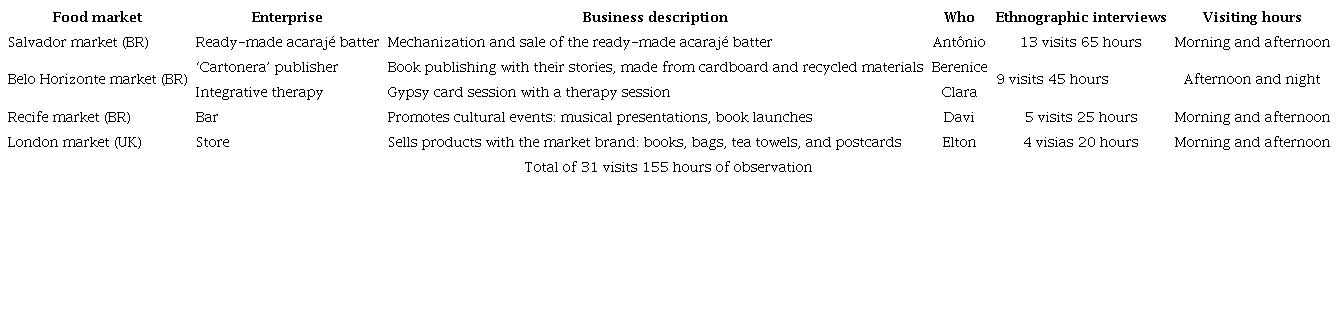
Note. Elaborated by the authors.
Information sources
The methodological techniques used to interact with the empirical material include ethnographic interviews, participant observation, documents, and visual and audiovisual records. Ethnographic interviews (Spradley, 2016) were the primary technique adopted to collect detailed data. This type of interview reveals the meaning that participants attribute to their experiences (Spradley, 2016), considering their social context in an interactive and co-constructive process, in which the interviewer and respondents are active participants in creating knowledge (Heyl, 2001). The process of drafting up the interview roadmap was based on three main axes from studies on networks, affect, and entrepreneurship: (a) the process of creating the business, access to resources, and opportunities; (b) the relationship with the stakeholders in the networks; and (c) evaluation of the business and the market..
Ethnographic interviews were conducted with key informants, entrepreneurs, and players in the entrepreneurial networks studied. The key informants are individuals who visit and know the markets or have conducted academic research on them. The interviews aimed to gather information about the innovations developed in these environments, the history of the markets and the ventures, and the possibility of indicating other informants. We asked the respondents to describe the innovations and identify the entrepreneurs and their businesses, making it possible to choose the markets to be studied. We also conducted ethnographic interviews to collect detailed data on the entrepreneurs and their networks. We interviewed ten key informants, five entrepreneurs, and 34 stakeholders from the entrepreneurial networks.
The principal author conducted participant, face-to-face, and participatory observation (Emerson et al., 2011) in the markets to verify the affective interactions between entrepreneurs and stakeholders in the networks. The observation roadmap included information on the physical environment of the market and the enterprise, focusing on the layout of the stores, the architecture, the goods and services offered, the interactions between people, and the performance of routine activities, especially focusing on people’s gestures, behaviors, attitudes, and expressions. This approach allowed the researcher to understand and describe the impressions, sensations, emotions, and affects experienced during her interactions in the market with entrepreneurs and network stakeholders. The observational act was accompanied by notes and field diaries (Emerson et al., 2011) produced by the principal author. Keeping a field diary was essential for the researcher to record her experiences, ideas, fears, progress, and problems during the fieldwork. The diaries recorded elements inaccessible or not easily articulated through other methods (Alaszewski, 2006), interactions between people and markets, and the researcher’s self-observation.
The documents helped contextualize and complement the information on markets and innovations. Following the methodological rigor required in documentary research (Silva et al., 2020), as a search criterion, we identified documents that described the history of the markets and their characteristics and helped identify and characterize cultural innovations. Moreover, we looked for affective evidence that described the affective relationships between the markets and the people, for example, people’s impressions when visiting the market.
Once selected, the documents were classified into three categories: contextual, descriptive, and affective. This categorization was created to organize the documents according to their subject matter. The descriptive documents were used to identify, map, and characterize the innovative ventures and activities developed in the markets. Contextual documents helped gather information about the history and the markets. Affective documents helped detail the affective dimension of the markets and the relationships between people and the place. To analyze the documents (Silva et al., 2020), we transformed the data on the markets’ history into information, made inferences about the video narratives, and theoretically situated this information. This information supported the theory that emerged inductively during the research process.
The principal author made visual and audiovisual records during the visits and participant observation, which added resources to the field notes. These records included the market space (architecture, stores, location), people (consumers, vendors) and their interactions (between people, between people and space), artifacts (products and services), and entrepreneurial practices (routine buying and selling activities).
The information sources included 51 interviews and informal conversations (38.5 hours), 155 hours of observations of markets and the researcher’s impressions, more than 140 descriptive, contextual, and affective documents (films, documentaries, pages on platforms such as YouTube, interviews, posts on social media such as Facebook and Instagram, texts on informational and organizational websites such as market websites, news, and ratings), 1,236 photos and videos produced by the researchers, and field notes.
Analysis process
The material collected was analyzed using narrative analysis (Czarniawska, 2004). As narratives are based on affect and emotion (Hogan, 2011), this analysis allows us to go beyond a simple description of the reality observed, recognizing and reflecting on affect’s complexity, dynamism, and fluidity (Gherardi, 2019).
Narrative analysis of the material collected began during data collection. We used an inductive process of categorization (Creswell, 2014). We followed the stages of the research and their respective phases. In the approach phase, we focused on preliminary aspects, such as recognizing markets as a field of entrepreneurship and highlighting these places’ identity, symbolic and cultural aspects, and the stories of the market and the entrepreneurs. The selection phase involved identifying and describing the cultural innovations and affective networks of the markets’ cultural entrepreneurs. Finally, in the densification phase, the entrepreneurial networks and their activities were analyzed affectively, contributing to the construction of the categorization to explain the contributions of affect to the cultural entrepreneurs’ networks.
These phases were repeated at each new stage within a logic of reflexivity and theoretical refinement. Theorizing was comparatively performed in this progressive, reflexive, and inductive process. In other words, the categories created in previous stages were compared with the new narratives obtained to revise, change, or consolidate the emerging categories. This enabled us to refine the categories generated by constantly comparing and revising them. Thus, the categories were constantly modified until they were consolidated into the categories presented in the following sections: 'Cultural innovations in popular markets,' 'Affective networks that sustain cultural innovations,' and 'The affectivity of cultural entrepreneurship networks, explained by the provocation and affective elevation of the network.'.
CULTURAL ENTREPRENEURSHIP AS AFFECTIVE NETWORKS IN FOOD MARKETS
In this section, we present the results of the empirical research. First, we describe cultural innovations in popular markets, detailing their characteristics. Next, we explain how affective networks support cultural innovations. Finally, we discuss the affectivity of cultural entrepreneurship networks and how the singularities of this entrepreneurial context can be inspired by the network’s provocation and affective uplift.
Cultural innovations at food markets
Since in cultural entrepreneurship, cultural goods and services carry symbolic, cultural, aesthetic, and identity values, cultural innovation is sustained through the renewal of these values. These innovations represent the manifestation of new ideas that do not align with existing conventions and value criteria and are represented by symbolic, cultural, and aesthetic changes, such as in the look, feel, or smell of a good, or that include an intellectual appeal rather than focusing solely on its functionality.
An important cultural innovation was implemented in typical Bahian food in the Salvador market. The innovation occurred in a traditional element of local gastronomy, the acarajé. Acarajé is a delicacy of African origin brought to Brazil by the enslaved during colonization. Its batter is made with refried beans, onion, and salt and fried in palm oil. Due to the cultural, heritage, and historical importance of acarajé as a symbolic food that reflects an ethnic, regional, and religious identity and is part of Brazilian culture, the National Historical and Artistic Heritage Institute (IPHAN), a Brazilian government agency responsible for the preservation and dissemination of the country’s tangible and intangible heritage, recognized acarajé and the craft of baianas of acarajé (Figure 1), a profession associated with the sale of this food, as an intangible cultural asset of Brazil (Instituto do Patrimônio Histórico e Artístico Nacional [IPHAN], 2007).
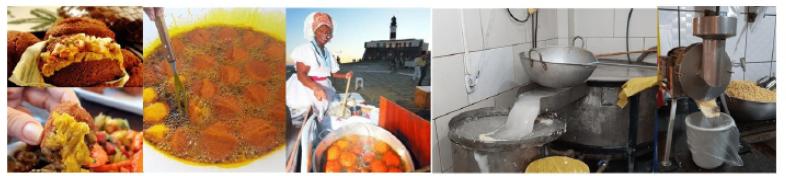
Figure 1
Acarajé and the craft of the baianas de acarajé and the mechanization of the ready-made batter.
Source: Instagram - Abam Nacional: (1) acarajé; (2) frying acarajé; (3) baiana de acarajé (open access); Photo by the authors: (4) machine for washing beans; (5) electric mill for preparing ready-made batter.
Identifying acarajé as a cultural asset allows the process of innovation implemented in its preparation to be conceived as a cultural innovation. When a baiana of acarajé makes acarajé, she links symbolic, cultural, and religious aspects to its preparation (IPHAN, 2007). In Salvador market, the sale of ready-made acarajé batter causes a change in cultural and symbolic values and meanings - cultural because this change brings new interpretations and meanings to preparing this food. Before this change, the batter was prepared individually. The person who prepared the acarajé bought the black-eyed peas, soaked them, washed them, removed the skins, drained the water, and then milled the beans to make the batter (documents and interviews).
The symbolic changes are related to the social and religious aspects of preparing acarajé. With the start of the sale of ready-made acarajé batter, the process of preparing the batter became mechanized. Two entrepreneurs are responsible for creating machines to help mechanize the batter’s preparation. One of the entrepreneurs created a machine to help wash the beans, making it simpler and quicker. In contrast, another entrepreneur came up with an electric mill, which would replace the mechanical mill, making it easier to grind the beans and prepare the batter, which was then sold on the market (interviews and documents) (Figure 1).
In the Belo Horizonte market, an example of cultural innovation can be seen in the creation, publishing, production, and marketing of books. Berenice was a teacher when she started a social project, a non-profit organization (NGO) that offered Portuguese language and reading courses. The project to create a ‘cartonera publishing’ arose from this NGO to encourage and involve children in reading and writing about their community’s history. A ‘cartonera publisher’ is an alternative publishing house that uses reused cardboard and handicrafts to publish and make books independently (Figure 2). The entrepreneur took a training course to learn how to make books. Her idea was to record and transform the history of communities into texts for low-cost books that would democratize access to these works (documents and interviews).
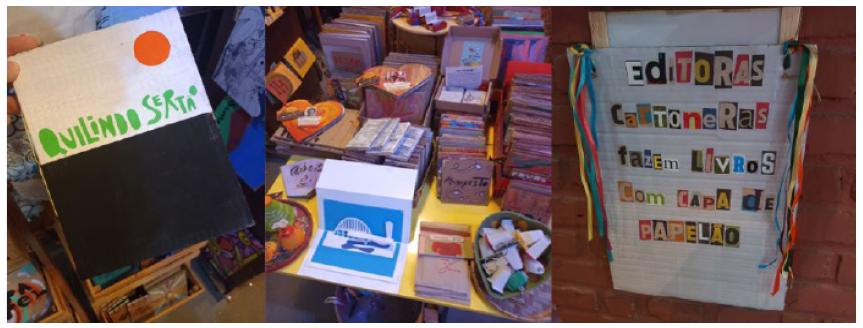
Figure 2
Cartonera publisher and its books.
Source: Photo by the aurtors.
The cartonera publishing house represents a cultural innovation because it modifies the cultural, symbolic, and aesthetic values and meanings used to make and publish books. The aesthetic changes are portrayed in the making of the books since the materials used, such as cardboard and dried leaves, to make up the book covers and the artisanal production method used, since the entrepreneur binds the books by hand, expose substantial aesthetic changes compared to the production of books by conventional publishers. The cultural changes are evidenced by the way the stories are told. One of the aims of the publishing house is to record the memories, legends, and expressions of popular culture of the communities that participate in the projects developed to create and make the books. The projects involve young people who will collect the stories, memories, and knowledge of the communities, which will result in a book being made available as a source of knowledge and research, ensuring the preservation of this knowledge. The books also express symbolic changes since consumers who buy these works identify with the stories told and the publisher’s proposal (documents, field notes, and interviews).
In the Recife market, a change in a bar’s cultural and symbolic values and meanings supports an example of cultural innovation. Davi was already a regular at the market when he decided to open his own business. The idea was for his bar to be a meeting place that praised Pernambuco culture and artistic expressions such as music, dance, theater, and literature. The change in cultural values is directly linked to the enterprise’s purpose, which is no longer to be a bar in the market but a cultural meeting point that holds cultural and artistic events, such as book launches, theater performances, events in partnership with NGOs to raise funds, soirees, poetry readings, and live music. The symbolic changes relate to the bar’s identity and cultural significance, transcending the provision of the service, generating recognition by consumers as a place that promotes Pernambuco culture and its expressions, and facilitating access to cultural products and services, such as books and music (documents, field notes, and interviews).
In the London market, cultural innovation is represented by the renewal of a store’s values that carries the market’s brand. Besides acting as an information point, the market store includes a range of merchandise bearing the market’s brand. This store is a valuable asset and strengthens its image. Values change in the symbolic, cultural, and aesthetic spheres. The renewal of cultural values is seen in the use of the market’s stories and images to build products that translate these symbologies, such as recipe books, which exploit the ingredients offered by the market’s entrepreneurs to create original recipes, blending the history of the ingredients and the market. The aesthetic changes include the intellectual appeal of these works, for example, in one of the cookbooks. The passion for food is transformed into a collection of short stories that explores a culinary journey through the histories of Britain’s favorite drinks and snacks, instigating the reader to learn about and reflect on the history of these ingredients. Furthermore, symbolic values are evoked by consumers’ feelings of belonging and identity when purchasing goods. The products in the market seek to express their identity and values, such as sustainability. For this reason, the store’s eco-bags express the market’s identity and the individual and social identity of consumers and their concern for the environment and conscious consumption (documents, field notes, and interviews).
Based on the examples presented, cultural innovations are based on building, renewing, or modifying the values, meanings, and senses of cultural goods and services. These values can be symbolic, cultural, and aesthetic and help highlight the innovations’ originality and uniqueness in the context of cultural entrepreneurship. Due to the creativity of entrepreneurs, these innovations bring about constant improvements in the designs, processes, and functionalities of cultural goods and services.
Affective networks sustaining cultural innovations
Our results confirm previous research that affirms the relevance of entrepreneurial networks for accessing resources, identifying and exploiting entrepreneurial opportunities, developing new projects, sharing risks, and building the reputation, credibility, and legitimacy of the stakeholders that make up the network (Oliveira & Davel, 2022b). However, since innovation in cultural entrepreneurship and the creative economy is based on constructing new meanings and values, we focused on the entrepreneur’s ability to mobilize the stakeholders in their network affectively. In affective networks, affect influences the formation of bonds between the stakeholders that comprise the network (Casciaro, 2014, Casciaro, 2019). These networks are characterized by bonds and interactions that lead to the sharing of something valuable and useful. They are networks in which affects are experienced and expressed in interactions.
In the Salvador market, affective networks were used by the entrepreneur to explore a new business opportunity - the sale of ready-made acarajé batter. I observed that Antônio uses his networks to exchange resources with other entrepreneurs, including information about products, suppliers, services for moving goods within the market, technology, and knowledge. Antônio is happy and enthusiastic in his interactions with entrepreneurs, always smiling and chatting amicably. In a meeting with an entrepreneur from the same street as the market, Antônio talked about the rising prices of goods, suppliers, and the difficulty in finding banana straw used in cooking recipes, which was in short supply in his store (field notes). These exchanges between the stakeholders, promoted by identifying with the organizational purposes and sharing values, including respect and honesty, result in relationships of trust and closeness between the entrepreneurs, evidenced by mutual help and Antônio’s expressed desire to help other entrepreneurs in the market whenever possible (field notes and interviews). The exchange of information and knowledge enabled the entrepreneur to acquire the machinery that made it possible to produce and then sell the ready-made acarajé batter. Recalling the start of sales of the ready-made batter in the market, Antônio told me that he was enthusiastic and believed that the bean-washing machine and the electric mill would speed up the production of the acarajé batter, facilitating and increasing its sale and, consequently, achieving the growth of his business. When we spoke, he said ready-made batter accounted for more than half of his sales (interviews).
In the Belo Horizonte market, Berenice used her emotional networks to open the physical store of the cartonera publishing house. Before the store, the entrepreneur participated in book and craft fairs and decided to open her business in the market with a friend. Networks were important for Berenice to get advice and emotional support when starting her business. Her husband and daughter were fundamental in providing her with the emotional support she needed during this process. Her friend and business partner helped her devise the project, renovate, open, and run the store. The entrepreneur expressed her gratitude for the support and was optimistic about the growth and maintenance of her business. She always expressed serenity and calm while we talked (field notes and interviews). These emotional bonds give Berenice the energy she needs and encourage her to face difficulties, continue her business, and generate social impact with her publishing house (field notes and interviews).
Davi, in the Recife market, mobilized his emotional networks to communicate the originality and authenticity of his bar. The entrepreneur used his networks as emotional support to cope with the restrictions on holding events in the market due to the pandemic. Davi was tense and stressed, reporting his dissatisfaction with the regulatory body, which vetoed the holding of events in the bar. However, in another market area, events had been approved and occurred during opening hours (field notes and interviews). When talking to friends and customers, the entrepreneur showed his concerns, asking them to complain to the competent body about the approval. These interactions sought the support and assistance of the networks to clear the events, showing commitment and validating the entrepreneur’s passion for the business (field notes and interviews).
We can see that affective networks underpin cultural innovation by playing an essential role in the interactions between stakeholders, in which they share something valuable, such as resources and knowledge. These interactions are permeated by affects and emotions, experienced and expressed as joy, satisfaction, or passion. Finally, the results of these interactions clarify why entrepreneurs interact affectively with the stakeholders in their networks.
The affectivity of cultural entrepreneurship networks
Based on the selection of the singularities of cultural entrepreneurship (Marins & Davel, 2020), we seek to demonstrate how the affectivity of networks is decisive and fundamental in this entrepreneurial context. The first singularity is the subjective or cultural innovation of entrepreneurial work, which represents the renewal of the cultural, symbolic, and aesthetic values and meanings of cultural goods and services. The second singularity concerns the subjective value of entrepreneurial work. This value is linked to the meaning of cultural goods and services and refers to the symbolism, emotions and sensations, feelings, and perceptions of taste aroused by the cultural work. These singularities are inspired through the provocation and affective elevation of the network.
Affective provocation of the network
We can see that affectivity in networks leads to cultural innovation and the subjective value of cultural goods and services. In the case of cultural innovation, networks trigger the creative process affectively when the entrepreneurs and stakeholders in the networks relate to create or modify the values and meanings of cultural goods and services. These exchanges are cognitive, knowledge-based, and affective, in which the stakeholders affect and are affected by their experiences, interpretations, and emotions. For example, when he created the machine to wash the beans used in the preparation of acarajé batter, the entrepreneur aimed to make the baianas’ work easier because he knew that the process of washing the beans took time and resources and was tiring, and to exploit the ready-made batter on the market. Thus, the entrepreneur drew on his experiences and interpretations as a trader in the market to innovate the process of traditionally preparing acarajé batter, meeting the needs of consumers and other entrepreneurs in the market, who turned to networks to access innovation and who consequently helped to introduce and solidify a new trade niche in the market (interviews and documents).
Affectivity in networks is procedural, i.e., it encourages interactions between the cultural entrepreneur, the stakeholders, and the market environment to promote cultural innovation. These interactions favor creativity, allowing cultural entrepreneurs to share their ideas, imagine, and create innovative goods and services. Davi’s enterprise does not fit the traditional idea of a bar but rather that of a cultural meeting place, translating the entrepreneur’s feelings and admiration for Pernambuco’s culture and art into the market. When he was still a regular at the market, the entrepreneur wanted to open his business. As a differentiator, he wanted to invest in promoting events, using his networks to invite friends to poetry slams and book launches (interviews and field notes). Elton also explained that he always prioritizes local suppliers and manufacturers who care about the environment and use sustainable materials and means of production. He said suppliers must think together about the best way to manufacture products. Thus, the market partners with brewers to launch limited-edition drinks under their brand. These drinks are developed and manufactured collaboratively, considering sustainable materials and means of production, such as sustainable packaging (interviews and field notes).
Affective relationships in networks take on a dynamic character to stir the creation of subjective value, connecting cultural entrepreneurs and network stakeholders through conversations. These conversations help entrepreneurs and stakeholders relate to each other while collaboratively stimulating the creation of meanings. For example, when Berenice develops projects to produce books, she selects and talks to the community leader to explain the project and its relevance. These conversations are necessary to promote community awareness and acceptance of establishing a partnership, forming a collective of young people who will be the leading figures in producing the books and collecting the stories of their community. During the development of the project, the entrepreneur holds workshops on producing and editing texts, producing cardboard covers, and talking to the young people about the importance of preserving the stories, memories, knowledge, and activities of their communities, collectively building subjective value through the symbolism, emotions, perceptions, and sensations aroused in the process of producing the book (interview and documents).
Affective elevation of the network
We found that affectivity in networks also increases cultural innovation and the subjective value of cultural goods and services. Subjective value is raised by affectivity in networks by consolidating and enriching it. Affectivity in networks raises values by strengthening the symbolisms, emotions, sensations, and perceptions aroused by cultural goods and services, which occurs and is impacted by the identity, cultural, and social context of the stakeholders in the networks. For example, Antônio cooperates with his competitors to strengthen the experiences, interpretations, and perceptions of preparing acarajé, which is necessary to integrate the ready-made acarajé batter as part of its preparation process, persuading consumers to buy it without jeopardizing the identity of this food and its importance to Bahian cuisine, besides reinforcing the image of the Salvador market as a benchmark for purchasing ingredients from Bahian cuisine and ready-made acarajé batter (interviews, documents, and field notes).
Affectivity in networks elevates subjective values by enriching them. The affective fluidity of interactions in networks enriches the values of cultural goods and services, making them attractive and enchanting. These values are based on the stakeholders’ perceptions, emotions, tastes, reactions, and preferences. For example, Davi uses interactions in networks with customers, friends, family, and other entrepreneurs to enrich the feelings, tastes, and reactions of these stakeholders when they visit his bar and interact with Pernambuco’s culture and art, attracting and enchanting the stakeholders who relate to his business (interview and field notes). In his interactions with customers, Elton charmed them by telling the product’s story to present its differentials and originality, as in the case of the archive posters and postcards with messages and notices about the market that were originally published over 100 years ago. In one of these interactions, a client was amazed after being informed of the origin of the messages and purchased some postcards (field notes and documents).
In the case of cultural innovation, affectivity in networks enhances its process through intensification, i.e., affect in networks helps encourage and stimulate innovation. For Berenice, her networks’ interactions and affective relationships motivate her to continue innovating. For example, partnerships with other cartonera publishers help publicize her work, strengthening the emotional ties between the entrepreneur and her competitors and stimulating aesthetic, symbolic, and emotional recombination for new creations. Also, holding workshops and participating in book fairs to publicize her publisher enliven and instigate new connections and emotional experiences for the entrepreneur with consumers, writers, competitors, and entrepreneurs, encouraging the realization of new projects (interview and documents).
DISCUSSION
The results of this research significantly contribute to two fields of research, cultural entrepreneurship and general entrepreneurship regarding the study of networks. We have made progress by proposing a conceptualization of cultural entrepreneurship as entrepreneurial networks and expanding research into affectivity in entrepreneurship. In this section, we will explore these advances. As affect and networks are important in other areas, we understand that our results may influence other research fields and indirectly help other studies. However, we emphasize that our study is anchored in cultural entrepreneurship.
The first contribution to advancing entrepreneurship research is conceptualizing cultural entrepreneurship as entrepreneurial networks. As suggested by the research and demonstrated by our results, cultural innovation translates to change, novelty, and originality (Khaire, 2017), based on building new meanings and values, emphasizing new interpretations and meanings for cultural goods and services (Ravasi & Rindova, 2013). This innovation is underpinned by the entrepreneur’s ability to mobilize the stakeholders in their network to build, renew, or modify the symbolic (Ravasi & Rindova, 2013), aesthetic (Marins & Davel, 2023) and cultural (Klamer, 2011) values of goods and services. We broaden these understandings by emphasizing that cultural entrepreneurship is defined as entrepreneurship in networks by sustaining these cultural innovations. These networks serve as a space for co-creation and mutual inspiration (de Klerk, 2015), where entrepreneurs access resources (Wu, 2017) and explore opportunities (Chen & Tseng, 2021), influencing business growth and sustainability (Sardana, 2018).
Thus, we present and instigate studies on cultural entrepreneurship as affective networks, that is, how the affectivity of networks inspires the singularities of cultural entrepreneurship. Our study deepens the understanding of the singularities of cultural entrepreneurship through the affective perspective of networks (Casciaro, 2014; Lopez-Kidwell et al., 2018), which, while promising, has still been neglected by research in cultural entrepreneurship (Oliveira & Davel, 2022b). Our results show how affectivity in networks is fundamental to triggering the creative process (Ceci et al., 2020), allowing cultural entrepreneurs to imagine and share their ideas, making the process of cultural innovation (Khaire, 2017; Loots & van Bennekom, 2023) more dynamic, in which stakeholders affect and are affected by their experiences, interpretations, and emotions (Elias et al., 2018). Affect in networks is also a determining factor in aiding collaborative creation and legitimizing the values of cultural goods and services (Davel & Cora, 2016; Khaire, 2019), enhancing the experiences translated by the cultural work (Toghraee & Monjezi, 2017). In this sense, the discourse and affective experiences (Wetherell, 2012) in cultural entrepreneurs’ networks enrich and strengthen values, facilitating and supporting the search for novelty (Lounsbury et al., 2021) and innovation (Ratten, 2022), and sustaining the narratives and stories that shape the identity of cultural businesses (Borghoff, 2018).
Secondly, our results help advance research on affectivity in entrepreneurship, responding to the need for new theoretical and empirical insights (Oliveira & Davel, 2022a), using affective networks as a fertile theoretical path. We know that in entrepreneurial networks, affectivity is analyzed as affective ties (Rosenbaum, 2023), entrepreneurial passion (Becker et al., 2023) and affective trust (Ren et al., 2016). Based on affective networks (Casciaro, 2014; Lawler, 2001; Lopez-Kidwell et al., 2018; Yang & Horak, 2019) and the perspective of affective practice (Wetherell, 2012), uma visão diferenciada da afetividade como motor da ação our study develops a differentiated view of affectivity as a driver of entrepreneurial action and innovation in networks. We clarify how the affective interactions between stakeholders characterize affective networks, the affects experienced and expressed in these interactions, and the results of these interactions. Also, the results reinforce existing knowledge about how the experiences evoked and produced by cultural goods and services are essentially affective and emotional (Elias et al., 2018; Marins & Davel, 2023).
Although some studies in entrepreneurship make use of multi-sited ethnography (Mösching & Steyaert, 2022; Showkat et al., 2024), no study has set out to apply this approach to research into cultural entrepreneurship, and we are unaware of any studies in the field of general entrepreneurship. In applying this approach, it was essential to understand that we would not be making a holistic representation of markets but instead mapping the field as a network of sites connected by different flows. Furthermore, it was essential to understand that the differentiation between the sites was not related to their geographical distance but instead to their cultural differences. Thus, we enjoyed a knowledge base of varying intensity and quality by bringing these sites into the same study context.
As recommendations, we recognize the advantage of conducting the fieldwork of a multi-sited ethnography gradually, reflexively, and progressively, in which each stage of the research benefited from the previous stage. Using a varied set of techniques to interact with the empirical material enriched this inductive process of qualitative research. In particular, participant observation allowed us to study people’s actual actions, complementing the information gathered through other sources, such as interviews.
The results of this research also have practical impacts. Firstly, the results help entrepreneurship researchers and teachers visualize the possibility of exploring less traditional empirical and methodological contexts. Through a multi-sited ethnography (Marcus, 1999), we explored how the affective networks of cultural entrepreneurs sustain innovations in different popular markets. While traditional, these markets need to adapt to socioeconomic changes, balancing the traditional and the innovative (Andrade, 2017; Coles, 2021), representing promising contexts for detailing cultural entrepreneurship and the creative economy. Secondly, the research results can be helpful for cultural entrepreneurs to understand how affective networks can be mobilized to sustain cultural innovation, obtain resources, explore new opportunities, legitimize, and influence the growth and maintenance of the cultural business.
CONCLUSION
This article aimed to understand how affective networks support cultural entrepreneurship in popular markets. The results dissected and illustrated the process of cultural innovation and how affective networks sustain it. They also presented how the affectivity of networks inspires the singularities of cultural entrepreneurship. The results contribute to advancing research into entrepreneurship, specifically cultural entrepreneurship, using affective networks as a fertile and promising theoretical path.
Future research could apply the perspective of affective practice to study cultural innovations in different empirical contexts, broadening the understanding of the singularities of this type of innovation from the perspective of cultural entrepreneurship and the creative economy. In addition, they can delve deeper into the material aspects and origins of cultural entrepreneurship (Alaszewski, 2006). We encourage researchers to continue producing qualitative and detailed information to explore and reveal the singularities of cultural entrepreneurship compared to entrepreneurship that is mistakenly presented as ‘general’ and ‘universal.’
REFERENCES
Alaszewski, A. (2006). Using diaries for social research. SAGE. https://doi.org/10.4135/9780857020215
Andrade, L. (2017). Os mercados e os dilemas da autenticidade. Uma análise do mercado central de Belo Horizonte. Interseções: Revista de Estudos Interdisciplinares, 19(2), 443-462. https://doi.org/10.12957/irei.2017.32020
Banks, M., Gill, R., & Taylor, S. (2014). Theorizing cultural work: Labour, continuity and change in the cultural and creative industries. Routledge. https://doi.org/10.4324/9780203519912
Becker, K., Ebbers, J. J., & Engel, Y. (2023). Network to passion or passion to network? Disentangling entrepreneurial passion selection and contagion effects among peers and teams in a startup accelerator. Journal of Business Venturing, 38(4). https://doi.org/10.1016/j.jbusvent.2023.106299
Borghoff, B. (2018). Entrepreneurial Storytelling as Narrative Practice in Project and Organizational Development. In E. Innerhofer, H. Pechlaner, & E. Borin (Eds.), Entrepreneurship in Culture and Creative Industries (pp. 63-83). Springer. https://doi.org/10.1007/978-3-319-65506-2_5
Bürger, T., & Volkmann, C. (2020). Mapping and thematic analysis of cultural entrepreneurship research. International Journal of Entrepreneurship and Small Business, 40(2), 192-229. https://doi.org/10.1504/IJESB.2020.107752
Casciaro, T. (2014). Affect in Organizational Networks. In D. J. Brass, G. (JOE) Labianca, A. Mehra, D. S. Halgin, & S. P. Borgatti (Eds.), Contemporary Perspectives on Organizational Social Networks (Research in the Sociology of Organizations, Vol. 40) (pp. 219-238). Emerald Group. https://doi.org/10.1108/S0733-558X(2014)0000040011
Casciaro, T. (2019). Networks and affect in the workplaces. In D. J. Brass & S. P. Borgatti (Eds.), Social Networks at Work (pp. 23-48). Routledge. https://doi.org/https://doi.org/10.4324/9780203701942
Casciaro, T., Lobo, M. S., Wilhelm, H., & Wittland, M. (2022). The way we make each other feel: Relational affect and joint task performance. Academy of Management Discoveries, 8(1), 15-35. https://doi.org/10.5465/amd.2018.0095
Ceci, F., Masciarelli, F., & Poledrini, S. (2020). How social capital affects innovation in a cultural network: Exploring the role of bonding and bridging social capital. European Journal of Innovation Management, 23(5), 895-918. https://doi.org/10.1108/EJIM-06-2018-0114
Chen, M. H., & Tseng, M. (2021). Creative entrepreneurs’ artistic creativity and entrepreneurial alertness: The guanxi network perspective. International Journal of Entrepreneurial Behaviour and Research, 27(4), 1082-1102. https://doi.org/10.1108/IJEBR-05-2020-0306
Coblence, E., & Sabatier, V. (2014). Articulating Growth and Cultural Innovation in Art Museums: The Louvre’s Business Model Revision. International Studies of Management and Organization, 44(4), 9-25. https://doi.org/10.2753/IMO0020-8825440401
Coles, B. (2021). Making markets making place: Geography, topo/graphy and the reproduction of an urban marketplace. Palgrave Macmillan. https://doi.org/https://doi.org/10.1007/978-3-030-72865-6
Creswell, J. W. (2014). Investigação qualitativa e projeto de pesquisa: Escolhendo entre cinco abordagens. Penso.
Cunningham, S., & Potts, J. (2015). Creative industries and the wider economy. In C. Jones, M. Lorenzen, & J. Sapsed (Eds.), The Oxford handbook of creative industries (pp. 387-404). Oxford University Press. https://doi.org/10.1093/oxfordhb/9780199603510.013.007
Czarniawska, B. (2004). Narratives in social science research. Sage. https://doi.org/10.4135/9781849209502
Daskalaki, M. (2010). Building ‘Bonds’ and ‘Bridges’: Linking tie evolution and network identity in the creative industries. Organization Studies, 31(12), 1649-1666. https://doi.org/10.1177/0170840610380805
Davel, E. P. B., & Cora, M. A. J. (2016). Empreendedorismo cultural: Cultura como discurso, criação e consumo simbólico. Políticas Culturais em Revista, 9(1), 363-397. https://doi.org/10.9771/pcr.v9i1.10035
de Klerk, S. (2015). The creative industries: an entrepreneurial bricolage perspective. Management Decision, 53(4), 828-842. https://doi.org/https://doi.org/10.1108/MD-03-2014-0169
Baldo, M. del, & Demartini, P. (2021). Cultural heritage through the ‘youth eyes’: towards participatory governance and management of UNESCO Sites. In P. Demartini, L. Marchegiani, M. Marchiori, & G. Schiuma (Eds.), Cultural initiatives for sustainable development: Management, participation and entrepreneurship in the cultural and creative sector (pp. 293-319). Springer. https://doi.org/10.1007/978-3-030-65687-4_14
Elias, S. R. S. T. A., Chiles, T. H., Duncan, C. M., & Vultee, D. M. (2018). The aesthetics of entrepreneurship: How arts entrepreneurs and their customers co-create aesthetic value. Organization Studies, 39(2-3), 345-372. https://doi.org/10.1177/0170840617717548
Emerson, R. M., Fretz, R. I., & Shaw, L. L. (2011). Participant observation and fieldnotes. In P. Atkinson, A. Coffey, S. Delamont, J. Lofland, & L. Lofland (Eds.), Handbook of ethnography (pp. 352-368). Sage. https://doi.org/10.4135/9781848608337.n24
Fahmi, F. Z. (2019). Business networks, social capital and the economic performance of creative and cultural industries: The case of Indonesia. Asia Pacific Viewpoint, 60(3), 370-385. https://doi.org/10.1111/apv.12211
Gherardi, S. (2019). Theorizing affective ethnography for organization studies. Organization, 26(6), 741-760. https://doi.org/10.1177/1350508418805285
Gherardi, S. (2023). The fluid affective space of organizational practices. Qualitative Research in Organizations and Management: An International Journal, 18(5), 1-19. https://doi.org/10.1108/QROM-07-2022-2368
Giuffre, K. (2015). Cultural production in networks. International Encyclopedia of the Social & Behavioral Sciences: Second Edition, 5, 466-470. https://doi.org/10.1016/B978-0-08-097086-8.10445-3
Hausmann, A., & Heinze, A. (2016). Entrepreneurship in the cultural and creative industries: Insights from an emergent field. Artivate: A Journal of Entrepreneurship in the Art, 5(2), 7-22. https://doi.org/10.1353/artv.2016.0005
Heyl, B. S. (2001). Ethnographic interviewing. In P. Atkinson, A. Coffey, S. Delamont, J. Lofland, & L. Lofland (Eds.), Handbook of Ethnography (pp. 369-383). Sage. https://doi.org/10.4135/9781848608337.n25
Hogan, P. C. (2011). Affective Narratology: The Emotional Structure of Stories. University of Nebraska Press. https://doi.org/10.2307/j.ctt1df4gnk
Howkins, J. (2001). The creative economy: How people make money from ideas. Penguin.
Instituto do Patrimônio Histórico e Artístico Nacional. (2007). Ofício das Baianas de Acarajé. Iphan. http://portal.iphan.gov.br/uploads/ckfinder/arquivos/Dossie_oficio_baianas_acaraje.pdf
Islam, G., Endrissat, N., & Noppeney, C. (2016). Beyond ‘the Eye’ of the beholder: Scent innovation through analogical reconfiguration. Organization Studies, 37(6), 769-795. https://doi.org/10.1177/0170840615622064
Johnsen, I. H. G. (2011). Formal project organization and informal social networks: Regional Advantages in the emergent animation industry in Oslo, Norway. European Planning Studies, 19(7), 1165-1181. https://doi.org/10.1080/09654313.2011.573129
Johnstone, B. A. (2007). Ethnographic methods in entrepreneurship research. In H. Neergaard & J. P. Ulhøi (Eds.), Handbook of qualitative research methods in entrepreneurship (pp. 97-121). Edward Elgar. https://doi.org/10.4337/9781847204387.00013
Khaire, M. (2017). Culture and commerce: The value of entrepreneurship in creative industries. Stanford University Press. https://doi.org/10.2307/j.ctvqr1f6z
Khaire, M. (2019). Entrepreneurship by design: The construction of meanings and markets for cultural craft goods. Innovation: Management, Policy and Practice, 21(1), 13-32. https://doi.org/10.1080/14479338.2018.1530566
Klamer, A. (2011). Cultural entrepreneurship. Review of Austrian Economics, 24(2), 141-156. https://doi.org/10.1007/s11138-011-0144-6
Konrad, E. D. (2013). Cultural entrepreneurship: The impact of social networking on success. Creativity and Innovation Management, 22(3), 307-319. https://doi.org/10.1111/caim.12032
Lawler, E. J. (2001). An Affect Theory of social exchange. American Journal of Sociology, 107(2), 321-352. https://doi.org/10.1086/324071
Lockwood, C., & Soublière, J.-F. (2022). Two advances in cultural entrepreneurship research. In C. Lockwood & J.-F. Soublière (Eds.), Advances in cultural entrepreneurship (Research in the Sociology of Organizations, (Vol. 80, pp. 3-14). Emerald. https://doi.org/10.1108/s0733-558x20220000080001
Loots, E., & van Bennekom, S. (2023). Entrepreneurial firm growth in creative industries: Fitting in … and standing out! Creative Industries Journal, 16(3), 383-405. https://doi.org/10.1080/17510694.2022.2025710
Lopez-Kidwell, V., Niven, K., & Labianca, G. (2018). Predicting workplace relational dynamics using an affective model of relationships. Journal of Organizational Behavior, 39(9), 1129-1141. https://doi.org/10.1002/job.2300
Lounsbury, M., & Glynn, M. A. (2001). Cultural entrepreneurship: Stories, legitimacy, and the acquisition of resources. Strategic Management Journal, 22(6-7), 545-564. https://doi.org/10.1002/smj.188
Lounsbury, M., Cornelissen, J., Granqvist, N., & Grodal, S. (2021). Culture, innovation and entrepreneurship. In M. Lounsbury, J. Cornelissen, N. Granqvist, & S. Grodal (Eds.), Culture, Innovation and Entrepreneurship (pp. 1-12). Routledge. https://doi.org/10.4324/9781003121749-1
Loy, A., & Aageson, T. (2018). Creative economy entrepreneurs: From startup to success: How startups in the creative industries are transforming the global economy. Creative Startups.
Marcus, G. E. (1995). Ethnography in/of the World System: The emergence of multi-sited ethnography. Annual Review of Anthropology, 24, 95-117. https://doi.org/10.1146/annurev.an.24.100195.000523
Marcus, G. E. (1999). What is at stake-and is not-in the idea and practice of multi-sited ethnography. Canberra Anthropology, 22(2), 6-14. https://doi.org/10.1080/03149099909508344
Marins, S. R., & Davel, E. P. B. (2020). Empreendedorismo cultural e artístico: Veredas da pesquisa acadêmica. Revista Pensamento Contemporâneo em Administração, 14(4), 115-140. https://doi.org/https://doi.org/10.12712/rpca.v14i4.46268
Marins, S. R., & Davel, E. P. B. (2023). Cultural and arts entrepreneurship: The importance of being aesthetic. In I. Hill, S. R. S. T. A. Elias, S. Dobson, & P. Jones (Eds.), Creative (and Cultural) Industry Entrepreneurship in the 21st Century (Contemporary Issues in Entrepreneurship Research, (Vol. 18A, pp. 31-43). Emerald. https://doi.org/10.1108/S2040-72462023000018A003
Marins, S. R., Davel, E. P. B., & Parsley, S. (2023). Aesthetic Embeddedness: Towards an Aesthetic Understanding of Cultural and Artistic Entrepreneurship. Entrepreneurship and Regional Development, 35(9-10), 695-714. https://doi.org/10.1080/08985626.2023.2225487
Mösching, D., & Steyaert, C. (2022). Sustainable entrepreneuring: Alternative world making through shifting associations of practice. In N. A. Thompson, O. Byrne, A. Jenkins, & B. T. Teague (Eds.), Research Handbook on entrepreneurship as practice (pp. 328-346). Edward Elgar.
Naudin, A. (2017). Cultural Entrepreneurship: The cultural worker’s experience of entrepreneurship. Routledge. https://doi.org/10.4324/9781315444680
Oliveira, T. M. de, & Silva, G. B. de L. (2020). Expressões da cultura alimentar pernambucana no Mercado da Boa Vista em Recife/PE. Equatorial, 7(12), 1-14. https://doi.org/10.21680/2446-5674.2020v7n12ID16284
Oliveira, X. L. C., & Davel, E. P. B. (2022a). Empreendedorismo e afeto: Desafios e perspectivas de pesquisa. Revista Eletrônica de Ciência Administrativa, 21(3), 475-505. https://doi.org/10.21529/recadm.2022018
Oliveira, X. L. C., & Davel, E. P. B. (2022b). Redes do empreendedorismo: Perspectivas e desafios para a produção acadêmica. Desenvolvimento Em Questão, 20(58), 1-21. https://doi.org/http://dx.doi.org/10.21527/2237-6453.2022.58.11747
Ratten, V. (2022). Cultural entrepreneurship in society. In V. Ratten (Ed.), Cultural entrepreneurship: New societal trends (pp. 1-4). Springer Nature Singapore. https://doi.org/10.1007/978-981-19-2771-3_1
Ravasi, D., & Rindova, V. (2013). Criação de valor simbólico. Revista Interdisciplinar de Gestão Social, 2(2), 13-35. https://doi.org/10.9771/23172428rigs.v2i2.9869
Ren, S., Shu, R., Bao, Y., & Chen, X. (2016). Linking network ties to entrepreneurial opportunity discovery and exploitation: The role of affective and cognitive trust. International Entrepreneurship and Management Journal, 12(2), 465-485. https://doi.org/10.1007/s11365-014-0350-3
Rosenbaum, G. O. (2023). The ego-networks of female international entrepreneurs: a mixed-methods study. Entrepreneurship and regional development, 35(1-2), 103-128. https://doi.org/10.1080/08985626.2022.2158491
Saraiva, L. A. S., Carrieri, A. de P., & Soares, A. de S. (2014). Territorialidade e identidade nas organizações: O caso do Mercado Central de Belo Horizonte. RAM. Revista de Administração Mackenzie, 15(2), 97-126. https://doi.org/10.1590/S1678-69712014000200005
Sardana, D. (2018). What facilitates cultural entrepreneurship? - A Study of Indian cultural entrepreneurs. Journal of Creative Behavior, 52(1), 35-51. https://doi.org/10.1002/jocb.131
Schoales, J. (2022). Competing in the creative industries: Two-sided networks and the case of Hollywood. City, Culture and Society, 28, 100439. https://doi.org/10.1016/j.ccs.2021.100439
Schulte-Holthaus, S. (2018). Entrepreneurship in the Creative Industries. In E. Innerhofer, H. Pechlaner, & E. Borin (Eds.), Entrepreneurship in culture and creative industries: Perspectives from companies and regions (pp. 99-154). Springer. https://doi.org/10.1007/978-3-319-65506-2_7
Showkat, S., Bennett, D. L., & Branzei, O. (2024). Entrepreneurs’ well-being in extreme contexts: Evidence from refugee camps. Academy of Management Proceedings, 2024(1). https://doi.org/10.5465/AMPROC.2024.15282abstract
Silva, J. L. da, Emmendoerfer, M. L., & Cunha, N. R. da S. (2020). Análise documental ilustrada em administração pública: Uma proposta operacional (re)aplicável. Teoria e Prática Em Administração, 10(2), 23-41. https://doi.org/10.21714/2238-104x2020v10i2-51394
Spradley, J. P. (2016). The Ethnographic Interview. Waveland Press.
Stoneman, P. (2010). Soft innovation: Economics, product aesthetics, and the creative industries. Oxford University Press. https://doi.org/10.1093/acprof:oso/9780199572489.001.0001
Swedberg, R. (2006). The cultural entrepreneur and the creative industries: Beginning in Vienna. Journal of Cultural Economics, 30(4), 243-261. https://doi.org/10.1007/s10824-006-9016-5
Throsby, D. (2000). Economics and culture. In Economics and culture. Cambridge University Press. https://doi.org/10.1017/cbo9781107590106
Toghraee, M. T., & Monjezi, M. (2017). Introduction to cultural entrepreneurship: Cultural Entrepreneurship in developing countries. International Review of Management and Marketing, 7(4), 67-73. https://ideas.repec.org/a/eco/journ3/2017-04-10.html
Velame, J. V. (2023). Uma coleção de desenhos etnográficos: Os ritmos e movimentos no ambiente de um mercado público paraibano. Cadernos de Campo (São Paulo - 1991), 32(2), e210311. https://doi.org/10.11606/issn.2316-9133.v32i2pe210311
Werthes, D., Mauer, R., & Brettel, M. (2018). Cultural and creative entrepreneurs: Understanding the role of entrepreneurial identity. International Journal of Entrepreneurial Behaviour and Research, 24(1), 290-314. https://doi.org/10.1108/IJEBR-07-2016-0215
Wetherell, M. (2012). Affect and Emotion: A new social science understanding. SAGE. https://doi.org/10.4135/9781446250945
Wetherell, M. (2013). Affect and discourse - What’s the problem? From affect as excess to affective/discursive practice. Subjectivity, 6(4), 349-368. https://doi.org/10.1057/sub.2013.13
Wetherell, M. (2015). Trends in the turn to affect: A social psychological critique. Body and Society, 21(2), 139-166. https://doi.org/10.1177/1357034X14539020
Wilson, N. C., & Stokes, D. (2004). Laments and serenades: Relationship marketing and legitimation strategies for the cultural entrepreneur. Qualitative Market Research: An International Journal, 7(3), 218-227. https://doi.org/10.1108/13522750410540227
Wilson, N. C., & Stokes, D. (2005). Managing creativity and innovation. The challenge for cultural entrepreneurs. Journal of Small Business and Enterprise Development, 12(3), 366-378. https://doi.org/10.1108/14626000510612286
Wu, D. (2017). Rethinking creative industries research: Synthesizing the creative class thesis, clustering, and global production network approaches. Geography Compass, 11(12), 1-11. https://doi.org/10.1111/gec3.12348
Yang, I., & Horak, S. (2019). Emotions, indigenous affective ties, and social network theory-The case of South Korea. Asia Pacific Journal of Management, 36(2), 395-414. https://doi.org/10.1007/s10490-017-9555-7
Notes

Author notes
Magnus Emmendoerfer (Universidade Federal de Viçosa, Brazil) https://orcid.org/0000-0002-4264-8644
One reviewer did not authorize the disclosure of his/her identity.
* Corresponding Author
Conflict of interest declaration