2025
291
02042024
04122024
 Patrick Wendell Barbosa Lessa patrickwbarbosa@gmail.com
Universidade Federal de Santa Catarina, Brazil
Marco Antonio de Moraes Ocke marco.ocke@ufsc.br
Universidade Federal de Santa Catarina, Brazil
ABSTRACT
Objective: this article explores the attributes that shape the brand identity of Florianópolis, under the management of public authorities, businesses, academia, and the advertising sector.
Theoretical approach: the research is based on the concepts of place branding and place brand identity, emphasizing the importance of stakeholder collaboration in strengthening a city’s identity.
Methods: data were collected through web scraping and interviews and analyzed using content analysis.
Results: the study identified five attributes that define the essence of the Florianópolis brand: technological and business innovation, education and social impact, collaborative technological community, networking and events, and notable sustainable development.
Conclusion: the findings highlight the importance of collaboration among different stakeholders to drive local development. This study contributes by identifying and analyzing the elements that define a place’s brand identity, emphasizing the need for synergy in the technological ecosystem. Practical implications include strengthening public policies, fostering innovation and entrepreneurship, and consolidating the city as an emerging technology hub.
Keywords: Place branding, brand identity, technological ecosystem, Florianópolis, innovation.
RESUMO
Objetivo: este artigo explora os atributos que formam a identidade de marca de Florianópolis, sob a gestão de autoridades públicas, empresas, academia e no âmbito da publicidade.
Marco teórico: a pesquisa se fundamenta nos conceitos de marca de lugar e identidade de marca de lugar, destacando a relevância da colaboração entre diferentes stakeholders no fortalecimento da identidade de uma cidade.
Métodos: os dados foram coletados por meio de web scraping e entrevistas, sendo analisados por meio da técnica de análise de conteúdo.
Resultados: a investigação revelou cinco atributos que definem a essência da marca de Florianópolis: inovação tecnológica e empresarial, educação e impacto social, comunidade tecnológica colaborativa, conexões e eventos e desenvolvimento sustentável notável.
Conclusão: os resultados enfatizam a importância da colaboração entre diferentes atores para impulsionar o desenvolvimento local. A contribuição deste estudo está na identificação e análise dos elementos que definem a identidade da marca de um lugar, ressaltando a necessidade de sinergia no ecossistema tecnológico. Implicações práticas incluem o fortalecimento de políticas públicas, fomento à inovação e ao empreendedorismo e a consolidação da cidade como um centro de tecnologia emergente.
Palavras-chave: Gestão da marca de lugar, identidade de marca, ecossistema tecnológico, Florianópolis, inovação.
Theoretical-empirical Article
Attributes that Build Florianópolis Brand Identity in the Technological Context
Atributos que Constroem a Identidade da Marca Florianópolis no Contexto Tecnológico
Patrick Wendell Barbosa Lessa patrickwbarbosa@gmail.com
Marco Antonio de Moraes Ocke marco.ocke@ufsc.br
Received: 02 April 2024
Revised document received: 08 October 2024
Accepted: 04 December 2024
Published: 14 March 2025
In the quest to raise the status of a locality through various initiatives, there is a growing global effort to attract both resources and people (Ocke & Platt, 2022). This reflects the intensification of competition between locations, driven by the limitation of resources and the diversification of human demands (Cristófol et al., 2021; Deniz, 2023; Hultman et al., 2016). Consequently, cities, regions, and nations are competing to capture attention and investment in order to strengthen their economic bases (Joshi, 2018; Nazzal et al., 2023).
This dynamic has fostered interest and development around place branding, which has become a multidisciplinary strategy covering various areas with the aim of promoting local development (Ocke & Platt, 2022). Since the early 1980s, the theory and practice behind place branding have gained prominence, evolving not only to meet organizational and resident objectives but also to project an attractive image to a wide range of stakeholders (Souza & Borges, 2019; Ruzzier & Petek, 2012; Suna & Alvarez, 2021). This process encompasses traditional concepts, adapting them to the new paradigm of place marketing, which, despite its complexity and challenges, aims to create a cohesive identity that resonates both internally and externally, thus attracting investment and promoting local human development (Mariutti & Florek, 2022).
It is worth noting that the active participation of internal stakeholders in the development of a place’s brand goes beyond mere marketing initiatives. Through tangible investments in infrastructure, such as technology, education, and mobility, these players not only show their commitment to improving the quality of life of citizens but also demonstrate the innovative and technological capacity of a region (Almeida & Cardoso, 2022; Mitropoulou & Spilanis, 2020; Ragheb et al., 2022; Senyao & Ha, 2020). This engagement creates a solid foundation for the desired brand identity, facilitating the transition to a more comprehensive and innovative perception of a city (Bisani & Choi, 2016; Zavattaro, 2016). It is through these actions that a place’s brand gains authenticity and credibility (Hoskins et al., 2021), key elements for building a strong identity that sticks in the minds of all stakeholders.
Research such as Stevens et al. (2021) and Goi (2017) highlights the relevance of key groups in innovation - public administration, companies, and educational institutions - as fundamental in building a place branding identity, because their collaboration brings transparency, increases legitimacy, and motivates different stakeholders to actively participate as brand co-producers, especially when they see clear value, ultimately strengthening the brand’s impact. In addition, entities focused on publicity also emerge as crucial references in the consolidation of this brand identity (Mariutti & Giraldi, 2019). The joint action of these four segments has a measurable influence on the development and definition of a brand identity.
Although the development of place branding has been growing notably in the literature (Hanna et al., 2021; Lessa & Ocke, 2023), its scientific development in Brazil remains scarce (Mariutti & Florek, 2022). This reveals the need to develop new research in this area, since place branding, in the long term, can result in different benefits for a place (Ocke & Platt, 2022), such as increasing the quality of life of internal stakeholders (Barros & Barros, 2023), strengthening social cohesion and democratization (Stoica et al., 2022), among others. In short, place branding helps develop a place by making it more attractive in relation to its surroundings.
In order to apply place branding, it is necessary to carry out an internal analysis of the place, visualizing how its brand identity is developed; that is, it is necessary to analyze its attributes and, subsequently, how these create associations in the minds of external stakeholders (Kavaratzis & Hatch, 2013; Piva & Prats, 2021). However, little has been studied about the internal perspectives of relevant stakeholders (Piva & Prats, 2021). Therefore, it is important to assess the internal development of the brand identity, highlighting its significance in the context of its evolution.
Thus, in addition to the small number of studies focused on place branding in Brazil (Mariutti & Florek, 2022) and the lack of attention to the internal communication of stakeholders relevant to the development of a brand identity (Piva & Prats, 2021), this study aims to explore the attributes that form the identity of the Florianópolis brand, observed in the infrastructure and superstructure related to technology and innovation, under the management of public authorities, companies, educational institutions, and in the sphere of publicity.
With this aim, achieved through a survey of thousands of documents, this article presents the five attributes that make up the essence of the Florianópolis brand in the technological scenario, identified through content analysis and reflections in the different groups approached (academia, public administration, companies, and publicity). The attributes are: technological and business innovation, teaching and social impact, collaborative technological community, connections and events, and notable sustainable development. The manuscript shows how these attributes emerge from the information and testimonies collected, as well as from the partnerships and events that exist in the city. The study also points out the municipality’s structural limitations and the interconnection between sustainability and quality of life.
Building a place’s brand identity is a multifaceted process that encompasses its inherent uniqueness, operating as the distinctive core that differentiates one place from another. According to Kapferer (2008), the identity of a place brand is built upon unique elements that establish its distinctiveness within a broader context, much like how an individual’s unique characteristics shape their personal identity. This notion is reinforced in Hudson et al. (2017), Saraniemi and Komppula (2019), Skinner (2018) and Wäckerlin et al. (2020), which emphasize the importance of distinct characteristics that make up the identity of a place, making it recognizable and distinct from its competitors (Ocke, 2017; Ocke & Platt, 2022).
In the context of place branding, the identity of a place is considered a set of characteristic traits that reflect its essence (Anholt, 2005; Björner & Aronsson, 2022; Kavaratzis & Hatch, 2013; Michael, 2023). This essence can be influenced by various factors, including natural elements (Graziano & Albanese, 2020), historical heritage (Colavitti & Usai, 2015; Rothschild et al., 2012) and cultural peculiarities (Finkel & Platt, 2020; Scherf, 2021). Therefore, managing a place brand involves an integrated effort to align external perception with internal reality, ensuring that the promoted narrative resonates with both residents and potential visitors or investors (Ocke & Platt, 2022).
The importance of strategic management of a place’s brand identity is highlighted by its ability to attract specific audiences and encourage investment (Ocke, 2017; Ocke & Platt, 2022). Such management not only seeks to present the most attractive attributes of a place but also aims to align these characteristics with the values and interests of the stakeholders (Björner & Aronsson, 2022; Cunha et al., 2022; Pongsakornrungsilp et al., 2021). This emphasizes the importance of an authentic and strategic representation of a place’s identity, which goes beyond merely promoting its aesthetic qualities or natural resources.
Theoretical models developed by Ruzzier and Chernatony (2012), Kavaratzis and Hatch (2013) and Campelo et al. (2014) provide insights into how a place’s brand identity can be effectively managed and promoted. These models emphasize the importance of involving internal and external stakeholders in the brand identity co-creation process, as well as the relevance of strategic values in developing a cohesive and attractive identity.
Case studies conducted by researchers such as Hudson et al. (2017), Lemmetyinen et al. (2021), Piva and Prats (2021) and Suna and Alvarez (2021) reinforce the need for a strategic approach to creating and promoting place brand identity. These studies highlight how the unique characteristics of a place can be leveraged to create a brand identity that is attractive and competitive in the global marketplace. Finally, the relationship between a place’s brand identity and its image is important for the success of place branding, as explored by authors such as Brydges and Hracs (2018), Kamlot and Jesus (2022), and Zhao et al. (2022). Effective integration of these two aspects is key to developing a holistic understanding of a place’s brand and its position in the market.
In short, managing a place’s brand identity is a complex process that requires an in-depth understanding of a place’s intrinsic values and how these values can be conveyed authentically and strategically to attract visitors and investment. The identity of Florianópolis, for example, stands out for being an exceptional fusion of natural beauty, high quality of life, and a diversity of outdoor activities (Dalcin, 2021; Engelmann, 2020; Locks & Tonini, 2006). In addition, its reputation as a technological and innovative hub contributes to its distinction in a highly competitive market scenario (Cavanus & Massabki, 2020; Estúdio NSC, 2021).
The concept of an innovation ecosystem is increasingly prominent in academic discussions, emphasizing the interconnectedness of various stakeholders who collectively drive technological progress. Innovation ecosystems are typically defined by the interactions among a diverse group of participants - such as businesses, government entities, educational institutions, and investors - working toward fostering an environment conducive to innovation (Etzkowitz & Zhou, 2017; Yaghmaie & Vanhaverbeke, 2020). These ecosystems encompass distinct frameworks, including open innovation, collaborative value creation, and actor orchestration, which collectively contribute to their complex nature.
Autio and Thomas (2022) have identified three major types of innovation ecosystems, each focusing on different forms of value production and relationships among the actors involved. Additionally, recent research has identified five primary streams within innovation ecosystem studies: technological advancement, platform development, regional growth, conceptual frameworks, and entrepreneurship (Gu et al., 2021). This multidimensional approach underscores the significance of understanding relationships within these ecosystems, as noted by Torres and Souza (2016), highlighting the role of universities, investors, and startups in contributing to the overall dynamism of innovation networks.
The development of Florianópolis as a technology hub can be effectively contextualized within the concept of an innovation ecosystem. Like the models described by Yaghmaie and Vanhaverbeke (2020) and Autio and Thomas (2022), Florianópolis has leveraged a diverse set of stakeholders - including government bodies, higher education institutions, and entrepreneurial ventures - to build a collaborative environment that fosters technological innovation. The active role played by UFSC and other educational entities aligns with the framework of ecosystem development, providing foundational expertise and supporting startups, which resonates with Torres and Souza (2016) emphasis on the importance of academic institutions.
Furthermore, the coordinated efforts of public administration, companies, and publicity have enabled the orchestration of value, creating a regional innovation ecosystem that mirrors the patterns of regional development noted by Gu et al. (2021). Thus, the emergence of Florianópolis as the ‘Silicon Island’ can be understood as a manifestation of an innovation ecosystem, where collective actions and strategic alignment among different actors have fostered an environment ripe for technological growth and economic advancement.
In terms of methodological nature, this is an exploratory mixed-methods study aiming to explore the identity of the Florianópolis brand through the analysis of public and accessible documents. Adopting an interpretivist perspective (Saunders et al., 2009), the research sought to understand the reality of the local technological context through the analysis of secondary data, both qualitative and quantitative, to identify characteristics and processes that form the brand’s identity.
It is important to clarify that the term ‘technological context’ is used to encapsulate the broader environment where technological advancements and innovations - such as 5G, AI, and computing technologies - play a crucial role in shaping and influencing the identity and development of Florianópolis. The strategy includes a documentary analysis to obtain detailed insights, utilizing a cross-sectional approach to collect data at a specific point in time.
Florianópolis, the capital of Santa Catarina, in southern Brazil, famously known as the Ilha da Magia (Island Magic), is divided into a large island and a smaller continental enclave, and is a city rich in cultural heritage and modern economic development (Cascaes, 2015; Negreiros & Castro, 2012; Tischer & Tarouco, 2022). Despite generational changes, this magical positioning endures, used strategically by the state and tourism companies to attract both visitors and businesses. Critics such Silva (2013), Castells and Santos (2014) and Pontes (2016) argue that this branding was imposed to transition Florianópolis from a traditional city to a modernized, globally recognized hub. However, the blend of natural beauty and technological innovation has reinforced the city’s unique appeal, contributing to its evolution into the Ilha do Silício, a reference to Silicon Valley (Oliveira et al., 2002).
To understand the development of Florianópolis as a technology hub, the ‘Silicon Island,’ it is essential to recognize the role of government initiatives and higher education institutions. Known as the Ilha da Magia for its culture and natural landscapes, the city began its transformation in the 1960s with investments in UFSC to develop expertise in computing (Lins, 2011). Governments and entrepreneurs collaborated to attract foreign investment, renaming the city ‘Silicon Island’ in reference to Silicon Valley (Athanasia, 2022). This rebranding was reinforced by national and international media, which highlighted the growing local technology clusters (BBC News Mundo, 2012; King, 2009; Lóssio, 2008; Mari, 2023; Ribeiro, 2019; StartupSC, 2009). Government investments in technology infrastructure accelerated this growth (Estúdio NSC, 2021).
The technological identity of Florianópolis is composed of government support, educational excellence, entrepreneurial spirit, and effective public relations (Castellano, 1996; Vieira, 1995). The government invested in education and infrastructure; institutions such as UFSC provided expertise; pioneering companies incubated at CELTA (Centro Empresarial para Laboração de Tecnologias Avançadas - Business Center for the Development of Advanced Technologies) spurred innovation; and public relations efforts unified these elements under the ‘Silicon Island’ brand (Castellano, 1996). Besides that, reindustrialization from the 1970s onwards marked a significant shift (Vieira, 1995), with the emergence of high-tech industries reflecting a broader economic transformation. Collective efforts reshaped the economic landscape and redefined the city’s identity nationally and internationally (Castellano, 1996).
The technology sector of Florianópolis has grown remarkably, surpassing tourism in economic importance (Gessner et al., 2019; Lins, 2011). Technology now accounts for 14% of the city’s GDP (Aranha, 2020), and the rise of startups has solidified its position in the national technology scene (Brito, 2018). Public relations were essential in promoting the city’s new identity and attracting investment, effectively communicating the joint efforts of governments, educational institutions, and private companies.
Although it was already a prominent tourist destination, developing the technological brand of Florianópolis required different strategies. Industry leaders emphasize joint development with tourism, improving infrastructure without competition between sectors (Lóssio, 2008), taking advantage of both natural appeal and growing technological capabilities. This strategic approach distinguishes Florianópolis from other Brazilian cities that, despite having unique attributes, have not developed a technological brand identity as agile as Florianópolis, as highlighted in the aforementioned news reports (BBC News Mundo, 2012; King, 2009; Lóssio, 2008; Mari, 2023; Ribeiro, 2019; StartupSC, 2009). The convergence of strong educational institutions, supportive government policies, and natural attractions in Florianópolis has created a unique environment conducive to technological innovation and brand development. This synergy of factors highlights why Florianópolis has emerged as the ‘Silicon Island,’ setting itself apart from other regions and serving as a classic example of high-tech brand development.
To explore the brand’s evolution within the technological ecosystem known as Ilha do Silício (Silicon Island), documentary research was conducted, following Saunders et al. (2009), to uncover how technological innovation shaped the brand’s identity. The selection of documents focused on entities linked to innovation: public administration, academia, and companies, aligned with the triple helix model of innovation by Etzkowitz and Zhou (2017) - and publicity, considered essential for strengthening the brand according to Mariutti and Giraldi (2021). Document analysis, supported by the Descending Hierarchical Classification (DHC) - a technique that segments texts and generates distinct classes based on the relationships between the segmented sections - using the Iramuteq software and content analysis (Bardin, 2016; Krippendorff, 2004), revealed key dimensions of the brand identity of Florianópolis in the technology sector.
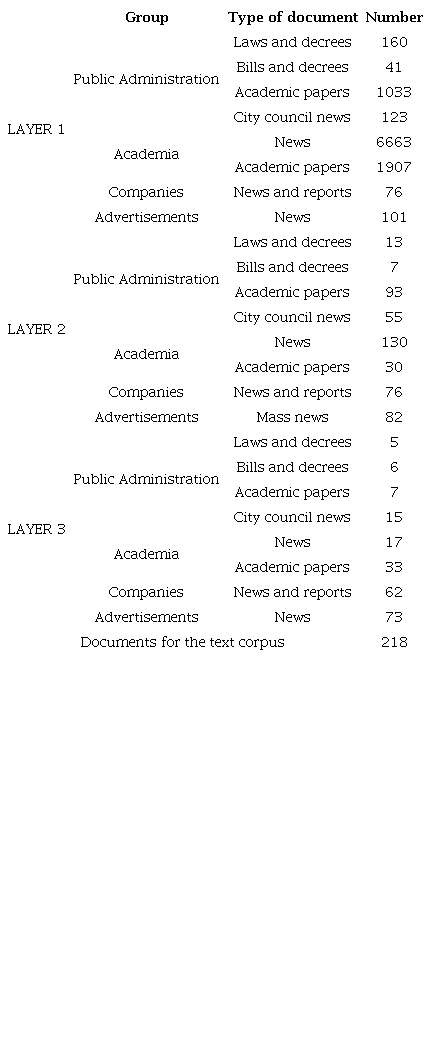
A process of data pre-analysis and systematization (Bardin, 2016) was designed to investigate the attributes of the Florianópolis brand identity. Documents were selected without restrictions on type, covering varied sources such as official publications, academic publications, news, and reports, using the web scraping technique with Python 3.11.6, which initially resulted in 10,808 documents. Web scraping refers to the automated process of extracting and structuring data from websites using specialized software tools, with the goal of enabling subsequent analysis of the gathered information (Krotov & Tennyson, 2021). In this context, the research began by using Google as the search engine with web scraping to gather various documents, including the Municipal Official Gazette, laws, decrees, proposed legislation, academic works (articles, monographs, dissertations, and theses), news, and reports. Then, during the pre-analysis, we organized and coded the data, allowing for an in-depth analysis of the relationships between the groups of documents and the technological development of the city.
The research steps, guided by Bardin (2016) and Krippendorff (2004), led to insights, culminating in an understanding of the Florianópolis brand identity within the technological context. By coding and categorizing the data, as per their methodologies, patterns and themes were identified, allowing for a deeper analysis of the relationships between document groups and the city’s technological development. This approach yielded conclusions aligned with the research goals, emphasizing the importance of these steps for a comprehensive understanding. The data segmentation followed a layered filtering process, refining the documents to those most relevant to the technological characteristics of Florianópolis and its key stakeholders: public administration, academia, companies, and publicity.
In the analysis, each document collected was evaluated through a dynamic reading process in a spreadsheet. Given the large volume of documents, many were found to be unrelated to the article’s objectives (e.g., some public administration documents merely mentioned Florianópolis in the context of awards for public servants). This explains the significant reduction between Layer 1 and Layer 2.
For the transition from Layer 2 to Layer 3, a more detailed reading was conducted, guided by the question: “Does this document positively or negatively impact the city’s identity?” If the answer was yes, the document was retained; otherwise, it was removed.
Finally, the systematization of the collected and filtered data provided a corpus of documents for the subsequent analysis, with each interest group represented by selected documents that reflect the nuances and specificities of their contribution to the technological identity of Florianópolis. This methodological process (see Table 1) not only ensured the collection of a robust and representative set of data but also established a solid basis for qualitative analysis and identification of the attributes of the Florianópolis brand.
Following the web scraping and document analysis processes, semi-structured interviews were conducted with four experts, each representing a different stakeholder group: public administration, educational institutions, companies, and publicity. The decision to select experts from these specific groups was based on the unique roles they play in shaping the development of the technological brand of Florianópolis.
The representative from public administration was included due to their involvement in policymaking and strategic investments that have significantly influenced the city’s evolution as a technology hub. An expert from educational institutions was chosen to highlight the critical role of academic research and knowledge production, particularly through the work of UFSC, in fostering innovation. A representative from the companies group provided insights into the entrepreneurial spirit and the contributions of startups and businesses in driving the local tech ecosystem. Lastly, an expert from the publicity sector offered a perspective on how the brand image of Florianópolis is crafted and communicated both nationally and internationally.
These interviewees were strategically selected to cover all significant facets that contribute to the city’s technological identity. By incorporating perspectives from government, education, business, and publicity, the study gathers a comprehensive understanding of how these sectors interact and contribute to the unique positioning of Florianópolis as a Silicon Island. This choice of participants allowed us to explore different viewpoints, thereby providing a more nuanced analysis that complements the data gathered from web scraping and document analysis.
In short, the triangulation of data used in this research, using scraping, document analysis, and expert interviews, was essential to ensure the robustness and validity of the results. By combining different methods, it was possible to obtain different types of data that, together, provide a richer and more informed analysis of the development of the brand identity of Florianópolis. Web scraping allowed for the automated collection of a large volume of documents, providing a broad database. The systematic document analysis identified important patterns and themes, while the expert interviews brought an essential qualitative dimension, providing context and depth that enriched the interpretation of the results. This triangulation not only strengthens the arguments presented but also offers multiple perspectives that validate the conclusions of the study, aligning with the defense of the methods used.
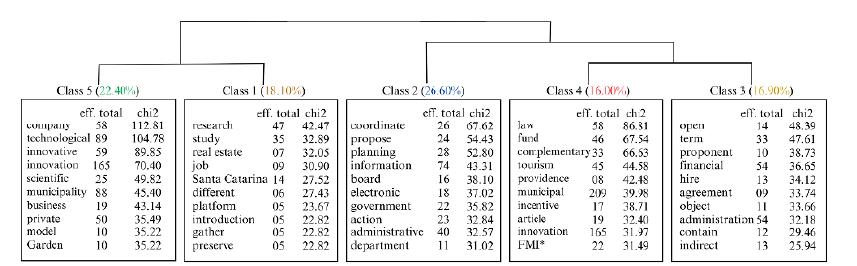
The Descending Hierarchical Classification analysis revealed five distinct classes within public administration (Figure 1), highlighting its multifaceted role in promoting technology in Florianópolis. Based on the in-depth analysis of documents that represent the group, it is important to highlight that Class 2 represents the majority and focuses on municipal management and the promotion of technological progress, while Classes 3 and 4 complement it with a focus on legislation and transparency. Class 5 highlights the role of regulation and incentives for private innovation, and Class 1 examines the impact of public policies on technological development and society. This outlines a coordinated effort toward sustainable technological advancement, showing an interdependence among classes that reflects the complex network of influences and interactions promoting innovation in Florianópolis.
In the academia group, which is composed of higher education, research, and extension institutions, we examined the actions of the Federal University of Santa Catarina (UFSC) and other academic institutions. These actions were aimed at boosting technological progress in Florianópolis. Authors such as Tartaruga et al. (2019) highlight the role of higher education institutions in disseminating technological knowledge. In addition to teaching, academia expands its research and extension activities to promote community development, including through digital platforms.
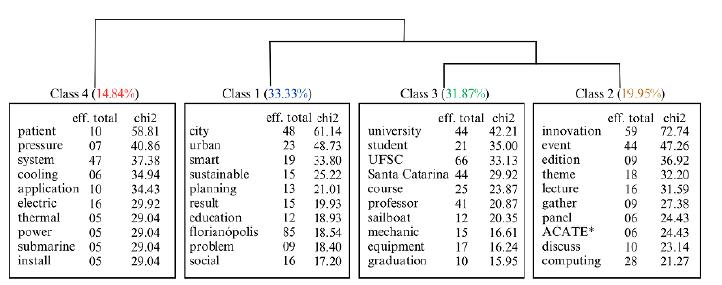
DHC analysis revealed the existence of four distinct classes within the academia group (see Figure 2). The first class emphasizes the relevance of the urban environment for technological advancement, highlighting the interaction between academia and the urban context as a catalyst for innovation and progress (Class 1). In contrast, the second class points out academia’s commitment to promoting innovation through events and lectures, highlighting its vital role in disseminating knowledge and innovative practices (Class 2). In addition, the analysis revealed a class dedicated to academia’s efforts to contribute to regional development through academic projects, highlighting its importance in the local economic and social scenario (Class 3). Finally, the fourth class highlights the tangible results of these projects, especially in the area of mechanical engineering, illustrating the practical applicability of academic research in industry and the community (Class 4). These classes provide a comprehensive view of the role of academia in the technological ecosystem of Florianópolis and in driving regional development, serving as a foundation for subsequent categories of analysis.
The third group focuses on companies that play a role in driving the economy of Florianópolis and contributing to its technological development. Leading firms in Santa Catarina, such as Intelbras and Resultados Digitais, exemplify this thriving environment for innovation. This technological progress is not confined to a single hub but extends across the state, with Intelbras originating in São José and Resultados Digitais in Florianópolis. These companies strengthen the region’s position as a leader in technology and innovation. Beyond fueling economic growth, they also foster an environment conducive to talent development and attracting investment.
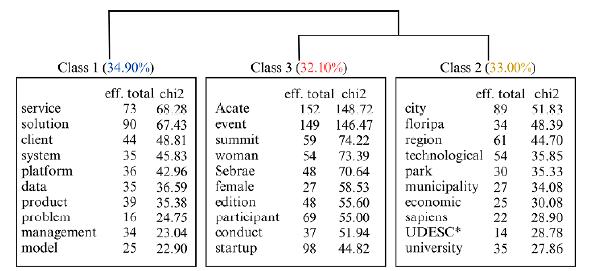
The analysis revealed three distinct classes of companies (Figure 3), highlighting their role as problem-solvers and innovators (Class 1), the importance of local infrastructures for technological progress (Class 2), and the strategic value of interaction and collaboration in events and associations (Class 3). Correspondence factor analysis revealed distinct differences between these classes, highlighting the relationship between physical spaces, events, and technological development. These classes were fundamental in defining the categories that represent the companies group, which will be detailed in the next topic.
The last group, called publicity, plays a vital role in publicizing technological advances in Florianópolis. Through various means of communication, such as newspapers, magazines, and videos, the aim is to promote the city’s identity as a technological hub on the rise. This publicity not only influences people’s perception of the city but also contributes to building a brand identity in line with the goals of Florianópolis as a center of innovation.
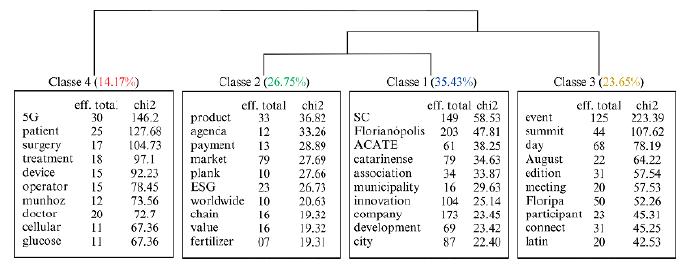
The analysis identified four different classes (Figure 4). The first class emphasizes the role of companies and associations in the technological development of the city. The second class emphasizes the economic and sustainable potential of alternative technological products. The third class highlights the importance of local events in promoting discussions and connections related to innovation. Finally, the fourth class shows how cutting-edge technologies have been applied in different sectors of the city. These classes reveal the complexity of technological development in Florianópolis and the variety of approaches needed to sustain its continuous innovation.
Content analysis of the four groups - public administration, academia, companies, and publicity - reveals an intricate network of contributions that shape the technological ecosystem of Florianópolis. Each group plays a unique and complementary role in stimulating innovation and boosting regional development. While public administration leads planning and regulatory initiatives, establishing the necessary framework for technological growth, academia emerges as a source of knowledge and research, driving technological advances and enriching the region’s human capital. Companies, in turn, are emerging as the main economic drivers, driving innovation, creating jobs, and strengthening the position of Florianópolis as a rising technological center. Finally, publicity plays the role of publicizing the city’s achievements, positioning it as an attractive destination for investment and talent. Together, these four groups form a collaborative and interdependent tapestry, feeding technological and economic progress in Florianópolis. Table 2 summarizes the analysis carried out on the four groups, highlighting their respective relevance, the data sources compiled, the classes identified through the DHC analysis, as well as the emerging categories resulting from this analysis.

The classes resulting from the DHC show the main insights from the process of collecting, processing, and analyzing the data obtained from various groups in the technological ecosystem of Florianópolis. The application of methodologies such as web scraping and the collection of specific documents stands out. This segment covers aspects such as the relevance and foundations of the study, the compilation of documents, the classes resulting from the DHC, the analysis of these classes and their interconnections, culminating in the definition of the Florianópolis brand identity attributes in the technological context.
The analysis identified public administration as a catalyst for technological progress through the application of management principles (Cardoso et al., 2023). Documents such as laws, decrees, and news about technological innovations in Florianópolis were essential. Categories such as operational efficiency and fostering and promoting technological innovation should be taken into account, as many documents have addressed this issue. In addition, the group highlights the incentive to set up technology-based companies and the implementation of urban monitoring systems, the promotion of innovative businesses, and the fostering of strategic investments.
The sources examined in this group deal with the implementation of programs aimed at fostering innovation, such as the creation of collaboration spaces, startup incubators, and initiatives aimed at stimulating technological entrepreneurship. These actions are aimed both at strengthening the technology-based companies already established in the municipality and at attracting new related businesses to the region (Sala et al., 2022). On the other hand, the comments from the public administration interviewee suggest that Florianópolis needs to more effectively communicate its potential, which highlights the need for more efficient brand management to attract more resources to the municipality:
We have just obtained a place in Sapiens Parque where the innovation laboratory for making vegetable meat is being set up. It’s owned by JBS. It’s the biggest in the world. ... So, that kind of thing brings a very large investment, more than 100 million Brazilian reais [actually, it was R$287 million; for more details, see Dresch (2023)] There is construction and everything, but it brings wonderful, brilliant minds. That develops and this branches out to the base in others who will work in their chain, so we have to start trying to do a solid job. We don’t have an agency in the city that does this, that attracts business. Another major deficiency in Florianópolis, in my opinion, is one that can also get in the way because it’s like I said, we don’t have a huge amount of capital. Imagine JBS coming here, we set up the laboratory center with more than 100 million reais of investment, it’s already building there, so there’s no company that would have the capacity to do this in Floripa [Florianópolis] ... Brazil is known for São Paulo, and that’s it. Perhaps Rio de Janeiro, and the rest doesn’t exist, right? We also have to show ourselves.
Therefore, although the government documents seek to emphasize the municipality as a technological potential capable of obtaining large technological companies, there is still a need for positions that encourage national and international private initiatives to invest in the region (Gerasimenko et al., 2021; Janiszewska & Insch, 2012; Pike et al., 2016; Rodríguez-Molina et al., 2019).
Academia was considered a pillar for the development of human capital and technological advancement, with data coming from higher education institutions. An illustrative example of this focus is available in a press release from UFSC, which informs us that the city will be hosting the Congress of the Brazilian Computer Society, with the theme “Exploring the Frontiers of Technological Innovation: Challenges and Opportunities for the Future” (Notícias UFSC, 2021). These events aim to promote the exploration and discussion of various approaches that researchers, teachers, and students can adopt to boost technological development in the region. These initiatives not only have a positive impact on the local community but also contribute to the integration of the technology-enabled system and its growing influence on connectivity.
Therefore, the academia group significantly contributes to the technological development of Florianópolis, as evidenced by the interviewee, such as the involvement of universities in research and innovation initiatives. Its inter-institutional collaborations, its commitment to finding innovative solutions, and the ability to translate research into tangible results not only strengthen the academic community but also reverberate positively throughout the city (Bisani et al., 2022; Mariutti & Florek, 2022), as the academia interviewee pointed out:
We have joint projects with companies. So, our research groups, laboratories, have developed various projects with companies, and there’s also the possibility of consultancies. So when a company has a problem that’s a bit more specific, it basically needs someone to give an opinion or a contribution, not necessarily to contribute to the final product in the whole development cycle, but it’s a more specific contribution. This type of consultancy is often requested. There are working groups, for example, at ACATE itself, you have groups that involve both people from industry and researchers in various different areas of knowledge ... So, there are various different nuclei where you bring together these specialists for the industry and try to establish agreements, joint projects, right? Often this work originates from workshops, or even longer-term projects in which interested companies work together with researchers, sometimes the development of standards that will be used by the companies themselves, sometimes developing a real product.
The DHC of the companies corpus generated only three categories, but they have a deep connection. The first shows technology companies in Florianópolis with different business models, serving different audiences through relationships such as B2C, B2B, B2B2C, etc. In addition, many products and services have digital integration, such as PlayBPO, which does business process outsourcing through a platform. This boosts local technological development and promotes the city’s image as a global innovator.
In the second, technology companies see Florianópolis as an attractive center for resources and talent, not only because of the companies but also because of the quality of life. The lack of local labor drives the hiring of professionals from other regions, but efforts are being made to promote the city as an excellent place to live and do business.
Furthermore, collaboration is evident in the technological ecosystem of Florianópolis. Initiatives such as the Living Lab aim to improve the quality of life in the city. Companies not only compete but also collaborate, by sharing resources and knowledge, as the interviewee in the companies group points out:
... I have this feeling that here we have a collaborative environment, that people really exchange information, that they really make themselves available. And then, speaking from experience, I’ve been in groups, it’s obvious that when we’re talking about a group that’s at a specific event, the people are there to help each other, there’s no rivalry. But I have this feeling that, here in Floripa, things flow in a more natural way, that, like, we go beyond a conversation that’s only for a common purpose, people are willing to show the business ... If necessary, they’ll invite you for a visit. I open the doors of my company when people ask me because I talk about my business and thus end up spreading the word to everyone, so yes, I have this feeling that here we manage to exchange information in a healthy and effective way ... to the point of talking about the business and people opening up and helping.
The third category focuses on events that promote the connection of ideas and gender equality. Highlighting the word ‘woman’ underscores the importance of gender equality in a sector historically dominated by men. Companies seek not only profit, but also a positive social impact, as the interviewee pointed out:
... the [company he works for] recently opened its doors to two events that involve ... the population. So, low-income girls joined [the company he works for] with the support of ACATE and various other tech companies. The [company he works for] signed up for this with the aim of teaching programming to these girls and for them to have ... an education there, first to change, because it changes the course of life, and for having more tech professionals introduced into the market. So, one of the interesting things about [the company he works for] is: Floripa, in the beginning ... had little workforce, so instead of bringing people here, we started training people from the island.
In short, companies in Florianópolis not only pursue their own interests, but also strengthen the local ecosystem (Therkelsen & Halkier, 2008; Zheng et al., 2023). Companies are actively investing in events and programs aimed at educating and training the local workforce, which contributes to long-term technological growth. These initiatives demonstrate a collaborative effort to improve local skills and enhance opportunities.
Publicizing the activities of ACATE and other technology companies has an intrinsic relationship with publicity. Events and conferences held in the city aim to bring together companies with innovative ideas, promoting local and national technological development. These events are fundamental for creating connections between companies and attracting investment to the region. The interconnection capacity of Florianópolis is a unique attraction, which makes it stand out as a technological hub on the rise. This can attract various sectors interested in contributing to local development (Lessa & Ocke, 2023; Melović et al., 2020; Scarborough & Crabbe, 2021).
The emphasis on the city’s capacity for interconnection can become an attraction for various sectors interested in investing and contributing to local development, corroborating the view of the interviewee from the publicity area:
It’s a city [Florianópolis] that has a positive brand. Technological city, beautiful city, you name it. All this counts for a lot as a city brand, right? But a brand that I would say is B2B, you know? It’s a corporate brand, mainly for doing business and so on. When there’s an event, the Startup Summit, all of Brazil, from the startup corporation, the corporate startup and innovation market, usually comes here. I don’t know, 4,000 people just from this outside market, so it’s quite a lot of people, in addition to the 5,000 who come from Santa Catarina itself, so it’s an epicenter for business and getting to know the city.
In addition, themes such as sustainable development and alternative means of production are also emerging in the context of publicity. This shows that the construction of the technological identity of Florianópolis is not limited to technological growth but is also concerned with environmental responsibility and sustainable development. These aspects reinforce the idea of Florianópolis as a unique place that seeks to meet the different needs of stakeholders through a variety of strategies.
Considering the evaluations of the different groups and the specific categorization in each of them, this section aims to emphasize the elements that make up the essence of the Florianópolis brand in the technology scene. Thus, we outline the five attributes (Figure 5) identified through content analysis and the reflection carried out in each group of this research.
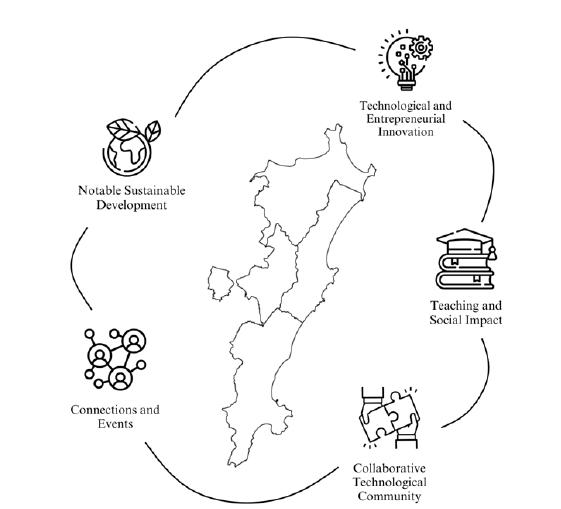
The ‘attribute of technological and entrepreneurial innovation’ emerges from the various pieces of information and testimonies obtained from the collected records and throughout the interviews. The term ‘technology’ and the generation of something genuinely new were themes that the interviewees frequently addressed. In addition, the analyzed records also show the pressing need to develop new solutions through the application of technology. It is important to note that this aspect is especially evident in the business context compared to other spheres, such as government or academia. In short, technological progress in the region is closely linked to the ability to devise innovative solutions so that companies can provide new services more efficiently, thus emphasizing its importance in this context, as the interviewee working in public administration indicated:
The law released 5G internet, the companies are installing it, the providers. A cost invested by private initiative ... and now we’re building a solution called Living Lab, which is to attract companies and small businesses that want to test 5G solutions for their businesses. So that’s going on, and there are actions that, as I said, are isolated actions, but they are actions that have yielded some results. I think we need to start coordinating together in order to boost these actions even more. But there is one thing that we work on in 5G and that we defend. It’s the question of making the city a 5G technology hub for services. For products and services, not for people to use, “Oh, just because I have 5G internet it’s faster to download a movie, it’s faster...” It’s not for that. We need to create, support companies that bring, that create solutions based on this. So that’s an interesting point (emphasis added).
The partnerships that exist in Florianópolis between various organizations demand substantial investment in education, thus training future professionals who work and will work in the technology sector. This educational investment is an integral part of the ‘teaching and social impact’ attribute, highlighting the city as an active promoter of local workforce training. In addition, the municipality establishes a collaborative network among various institutions, thus contributing to the social development of the city, as the interviewee working in public administration also stated:
ACATE’s latest tech report, which mapped vacancies, says that we’ll need to hire 794 people in the full-stack area this year alone. I mean, that’s a lot of people and no training. So we have to seek out these qualifications. And in order to serve these companies and keep them growing, we need to invest heavily in this area. Floripa Mais Tec was a successful program in this area because we did the first edition and we put together a joint effort between the city hall and ACATE, Senai, and Sebrae. It’s a union of institutions ... And then we created a program focused on the short term and the long term ... So this is a point, I think it’s one of the indices that made Floripa reach first place in competitiveness.
As the interviewee stated earlier, the importance of cooperation in Florianópolis is clear. Several organizations, each with their own goals, come together to overcome everyday difficulties and exchange experiences that have helped solve particular issues. Thus, the ‘collaborative technological community’ attribute emerges, since this constant and integrated cooperation not only strengthens the links between the participating organizations but also stimulates innovation and technological progress in the area, as the interviewee in the companies group points out:
One example is at ACATE, I’ve taken part in several events at ACATE, mainly in this area of cybersecurity. I’ve had great references here, whether it’s lectures, supplier events. I’ve taken part in various events, as well as inviting suppliers to an event and presenting a product, and thus we end up exchanging, networking and then I meet people who are here, at Intelbras, who are there, at Mercado Livre, etc. And we end up sharing experiences. So we end up benchmarking, you know? So, combining networking with benchmarking, I think those are the words that come to mind when I think of Floripa.
With the formation of a cooperative group, which values reciprocity based on its development, i.e., “if someone has achieved something [in Florianópolis], they are already giving something back, they are doing it here” (interviewee working in public administration), there has also been an increase in events to establish connections and see how it is possible to support companies working in the city’s technological area. Florianópolis is a hub where relevant connections between people, companies, and institutions are created, as well as being a favorable place for important events on the technology scene. This ability to promote ‘connections and events’ stands out as an attribute of the Florianópolis brand identity, as emphasized by the interviewee from the publicity group:
... the last Startup Summit had 10,000 people, and because the Startup Summit is a Sebrae event, Sebrae has established that Florianópolis, Santa Catarina are national Sebrae startup hubs. In other words, it became a kind of laboratory, a base. So, the knowledge, the main reference, the main market, when it comes to startups, for Sebrae, is Santa Catarina.
Although Florianópolis is able to promote many events, it is necessary to note the structural limitations of the municipality. Several of the interviewees emphasized the physical structure as a weakness of Florianópolis that can cause obstacles to the progress of these events, as the following statement by the interviewee from publicity shows: “So much so that the biggest fear of the group is that the event will continue to grow, and just like the RD Summit, leave Florianópolis.” This analysis highlights a fundamental impasse for the city.
Florianópolis, with its ‘notable sustainable development’ attribute, stands out as a beacon of ecologically correct practices and technological innovation. In this context, the city adopts a cautious approach to economic growth, vetoing industries that could damage its natural heritage. The interviewee from public administration echoes this commitment, highlighting the interconnection between sustainability and quality of life:
We ... have a city that can’t have a kind of industry, that’s right. We have a preserved city, also regarding the environment, and we have a strong focus on technology and innovation ... On the other hand, when we talk about sustainability, we’re also talking about people’s quality of life. So an area of work, an area of innovation. Technology attracts a lot. It’s welcome. It’s an area that adds a lot. And these actions have been worked on, they’ve been thought about ...
The interviewee describes the city as preserved, a place where the environment is not only protected but also celebrated. The combination of technology and innovation is proving to be a key driver in this process. Technology, by being a basis for development, not only attracts talent and creative ideas but also becomes a support that maintains the quality of life of residents. In this scenario, the city welcomes not only greenery and sustainability but also the constant improvement of its inhabitants’ lives. This integrated approach, where sustainable development and quality of life are intertwined, not only defines the identity of Florianópolis but also sets its course for a bright and fair future.
The results of this study demonstrate that the evolution of Florianópolis as a technological hub is rooted in a defined innovation ecosystem, characterized by distinct attributes that collectively shape its brand identity. The attributes identified in this research can be explicitly categorized - technological and entrepreneurial innovation, teaching and social impact, collaborative technological community, connections and events, and notable sustainable development - creating a comprehensive model to understand the core factors contributing to the city’s technological brand. This categorization is consistent with the literature on place brand identity (Hudson et al., 2017; Kapferer, 2008; Saraniemi & Komppula, 2019; Skinner, 2018; Wäckerlin et al., 2020), which emphasizes the importance of unique characteristics that define and differentiate a place.
The evolution of Florianópolis into a technological hub is also informed by the dynamics of its innovation ecosystem, aligning with the broader understanding of how such ecosystems foster technological advancement and competitiveness. According to Torres and Souza (2016) and Yaghmaie and Vanhaverbeke (2020), successful innovation ecosystems are defined by strong relationships among diverse actors, including universities, government entities, and businesses. In Florianópolis, the partnerships between educational institutions like UFSC, public administration, and local companies exemplify this interplay, which is crucial for fostering innovation and developing the local brand identity. Furthermore, Autio and Thomas (2022) and Gu et al. (2021) highlight how innovation ecosystems drive regional development through a structured interplay of technology, entrepreneurship, and community engagement. The attributes identified in Florianópolis - such as collaborative technological community and teaching and social impact - directly reflect these theoretical components, demonstrating the effective orchestration of stakeholders within its innovation ecosystem.
By organizing these elements into a cohesive brand identity framework, the research bridges the gap between theoretical concepts and empirical findings. This structure clarifies how each attribute contributes to the overall positioning of Florianópolis in the national and international technological landscape. The integration of strong educational support, collaborative networks, entrepreneurial innovation, and sustainable practices aligns with the strategic values proposed by place branding scholars (Anholt, 2005; Björner & Aronsson, 2022; Kavaratzis & Hatch, 2013) and underscores the unique competitive advantage of Florianópolis. This alignment strengthens the policy implications of the study, reinforcing why Florianópolis has emerged as the Silicon Island and positioning it as a leading example of how an innovation ecosystem and effective brand identity development can drive regional growth.
This study focused on the construction of the Florianópolis brand identity in the technological context, exploring the interaction among the various players in the city’s technological ecosystem. Using distinctive data collection and analysis methodologies, such as web scraping, document analysis, and interviews with experts, this research investigated the distinctive attributes and specific dynamics that shape the local technological environment.
The development of Florianópolis as a technological hub can be largely attributed to the efforts of its community leaders, who, since the 1990s (Lins, 2011), have strategically invested in technological education, leveraging the city’s already well-educated population and high quality of life. This dynamic underscores the importance of the community’s intrinsic characteristics in shaping a successful place brand. However, it is crucial to recognize that such a strategy might not yield the same results in other communities with different socio-economic contexts. Therefore, while the study highlights the effective branding of Florianópolis, it also emphasizes that place branding strategies must be tailored to the unique attributes of each community to be successful.
Within a broader context, this study stands out in the specialized literature on the development of place branding, especially in the technological field. Despite international recognition in this area, there is a gap in Brazil in terms of scientific progress related to place branding (Mariutti & Florek, 2022). This shows the importance of further research, considering that effective management of a place brand can lead to long-term benefits (Ocke & Platt, 2022), such as improving the quality of life of internal stakeholders, strengthening social cohesion, and other aspects
The results of this study revealed the complexity of managing the Florianópolis brand in the technological context, identifying distinct classes in administration, academia, companies, and publicity. These findings highlight the vital interaction between different actors to drive local technological advancement, emphasizing the importance of a holistic and multidimensional approach to understanding the essence of the city’s technological ecosystem.
By discussing the theoretical and practical implications, this study highlights the need to approach place branding as a continuous process of analysis and development, considering both the internal perspective and the external projection for stakeholders. It is essential to carry out an in-depth analysis of the brand’s attributes and their impact on external perceptions, seeking to assess whether different stakeholders, such as residents or tourists, perceive the positioning of these attributes in the city.
Despite the identified limitations, such as the selection and definition of the data collection method and the depth of the analysis in some groups, we suggest that future research be more comprehensive to follow the evolution of the technological scenario in Florianópolis and make comparisons with other technology hubs, as well as develop new methods to assess whether the results of this research converge with different methodological applications.
We recommend the practical application of the insights from this study to improve public policies, promote collaboration between companies and academic institutions, and stimulate innovation and local entrepreneurship. Ultimately, this study not only deepens the understanding of the Florianópolis brand identity in the technological context but also highlights the importance of cooperation among different actors to drive innovation and technological development in the city, thus consolidating its position as a technology hub on the rise. The continuation of this research and the implementation of its findings have the potential to further strengthen the presence of Brazilian cities on the global technological scene.

Lessa, Patrick Wendell Barbosa; Ocke, Marco Antonio de Moraes, 2025, "Attributes that Build Florianópolis Brand Identity in the Technological Context published by RAC-Revista de Administração Contemporânea", Harvard Dataverse, V1. https://doi.org/10.7910/DVN/ILJ3VW
RAC encourages data sharing but, in compliance with ethical principles, it does not demand the disclosure of any means of identifying research subjects, preserving the privacy of research subjects. The practice of open data is to enable the reproducibility of results, and to ensure the unrestricted transparency of the results of the published research, without requiring the identity of research subjects.
* Corresponding Author