INTRODUCTION
The Tricentennial Public Company (EPT) is a federal public organization whose main products include the production of banknotes and coins. The technological evolution of payment methods has been simplifying financial transactions for companies and individuals, raising doubts about the continuity of traditional means such as banknotes and coins (Correia, 2023). In 2023, the circulation of physical cash decreased for the second time in history due to the increasing adoption of the instant payment system (pix). Transactions via pix amounted to R$ 29 billion in the first half of 2024, representing a 61% increase compared to the same period the previous year (Federação Brasileira de Bancos, 2024). This scenario requires EPT to keep up with the transformations and redefinitions of currency.
With the evolution of payment methods, EPT has begun to question its social role as a public company. In its ‘Management Report’, company managers state that it is necessary to invest in innovation for EPT to maintain its relevance to Brazilian society. For innovation to occur, it is essential to establish a culture that fosters the creation of new solutions, as culture plays a critical role in innovation by shaping patterns of dealing with novelty, individual initiatives, collective actions, understandings, and behaviors (Gonçalves et al., 2023).
Organizational culture has a decisive influence on an organization’s ability to innovate (Silva et al., 2018). Considered the basic personality of an organization, culture defines how people act and work within that organizational context, indicating the appropriate and accepted behaviors among its members. Thus, culture can be seen as a decisive factor for innovation (Emmendoerfer, 2019; Santos et al., 2019).
The lack of an innovation culture at EPT results in negative impacts, such as difficulties in adapting to technological changes, internal resistance to new initiatives, and delays in implementing innovative solutions. These challenges can compromise the organization’s agility and competitiveness in the current landscape, where the evolution of digital payment methods imposes an urgent need for modernization.
The objective of this research is to develop an intervention proposal for implementing an innovation culture in a public company, based on identifying the challenges and benefits of the expected change as perceived by the organization’s leaders. A mixed-methods research approach was adopted, starting with a quantitative phase followed by a qualitative phase. First, the Organizational Culture Assessment Instrument (OCAI) was used to understand four dimensions of organizational culture: clan, adhocracy, market, and hierarchy, comparing the current culture with the one desired by the leaders. Subsequently, in-depth interviews with leaders were conducted to understand the importance of an innovation culture relative to other dimensions of organizational culture.
This study offers a five-step action plan for implementing a new culture, aimed at managers seeking to foster innovation within their public organizations. It is hoped that, after reading this article, other public managers will feel inspired to initiate cultural changes within their own environments.
CONCEPTUAL ASPECTS - INNOVATION CULTURE IN THE PUBLIC SECTOR
Organizational culture can be understood as the values, beliefs, and habits that help individuals understand how the organization operates and guide ways of thinking and experiencing the organization (Khan et al., 2020). Maesschalck and Paesen (2021) argue that culture can be managed, learned, transmitted, and modified, which can lead to specific outcomes such as organizational performance and employee behavior. Thus, leaders can positively influence organizational performance by managing its culture (Eskiler et al., 2016; Tian et al., 2018), including its capacity for innovation (Khan et al., 2020).
An innovative organizational culture involves creating an environment conducive to innovation while simultaneously fostering a behavioral style that encourages the emergence of new ideas and management practices that promote change, take risks, and share this mindset across all levels and departments of the organization (Gomes et al., 2015; Gonçalves et al., 2023). In the context of the public sector, innovations can take the form of the creation and implementation of new processes, products, methods, and techniques for delivering public services that improve performance in terms of efficiency, effectiveness, and results for society (Emmendoerfer, 2019; Teixeira et al., 2019; Torfing et al., 2019).
Innovation initiatives in the public sector generate tensions between the bureaucratic culture, dominant in public sector organizations, and innovative behaviors, as their implementation requires reconciling structural and procedural aspects oriented toward control with flexible practices conducive to collaboration and learning (Emmendoerfer, 2019; Sønderskov & Rønning, 2021). Among the challenges faced by public organizations in innovating is the lack of communication and shared goals with other departments (Amorim, 2022). Thus, cultural changes in public organizations aiming to foster innovation can be a painful process, often encountering strong resistance (Emmendoerfer, 2019).
In this context, leadership plays a crucial role in determining organizational innovation. Leadership can be understood as the management of culture (Schein & Schein, 2022). The leader plays a significant role in organizational culture, as they are the ones who convey the organization’s vision, values, and principles. Therefore, the leader can influence the organization’s culture by inspiring individuals during the process of cultural change to foster innovation.
CONTEXT AND INVESTIGATED REALITY - EPT
EPT was founded on March 8, 1694, with the initial mission of smelting and minting the gold extracted from Brazil during the colonial period. Over its 330-year history, its activities have become deeply intertwined with the country’s trajectory. The organization began its operations in Salvador and, in 1698, relocated to Rio de Janeiro. Today, EPT’s industrial complex is one of the largest in the world and the largest in Latin America, covering a total area of 538,000 m², with 110,000 m² of built-up space. With a workforce of 1,900 employees, EPT operates three main manufacturing departments: Banknotes, Coins and Medals, and Graphic Products and Cards. The banknote and coin factories have an installed capacity to produce approximately 2.6 billion and 4 billion units per year, respectively, fully meeting the national demand for circulating currency (Oliveira, 2020).
The pursuit of innovation at EPT is evident in its management reports. In 2010, the Technological Innovation Department was established to study, design, develop, and innovate products and services. This department has remained part of the company’s structure over the years, though its name has changed several times, always maintaining its mission to foster innovation. In 2013, EPT gained recognition by winning an award for implementing the AQUASAVE system, which reduced water consumption in the printing process by 90%. This innovation placed EPT in 17th position among 85 institutions competing in the 11th Benchmarking Brazil Award, which recognizes the country’s best socio-environmental practices.
EPT has promoted a culture of innovation through various initiatives, such as implementing a structured method to encourage innovation based on the concept of open innovation. In 2019, it launched the Inova EPT Award, encouraging employees to submit innovative ideas, receiving 95 suggestions in its first year. Additionally, EPT established scientific collaboration agreements with institutions such as the Fundação Centro Universitário da Zona Oeste do Rio de Janeiro and the Federal Rural University of Rio de Janeiro.
In May 2020, EPT published a policy to stimulate innovation, establishing guidelines to promote a strong innovation culture, including the creation of an Innovation Committee. In 2021, EPT launched a postgraduate call focused on innovation and leadership, as well as formally establishing the Innovation Committee to implement the Digital Transformation Framework. That same year, it inaugurated its first photovoltaic plant and launched the Tran$forma project, a pioneering solution for the disposal of banknote paper. Also in 2021, EPT introduced its first internally produced digital identity document. These various initiatives and innovation projects demonstrate EPT’s commitment to transforming its organizational culture, incorporating new values and practices that ensure its continuous evolution and prominent market position.
METHODOLOGICAL PROCEDURES
This study employed mixed methods, with a quantitative phase followed by a qualitative phase. In the first phase, the OCAI instrument questionnaire (Cameron & Quinn, 2011) was utilized, in which leaders responded based on their personal interpretations. Subsequently, in the second phase, interviews were conducted to gain deeper insights into the topic, collecting data on organizational functioning, cultural phenomena, and experiences (Bardin, 2010). Therefore, this research focuses on extrapolation, where known methodologies are applied to new problems (Motta, 2017).
Quantitative phase - The OCAI instrument
The OCAI instrument was developed by Cameron and Quinn (2011) to diagnose organizational culture, enabling an understanding of the current culture and the culture that members believe should be developed. It classifies organizational culture based on two dimensions: organizational focus (internal versus external) and adaptability to the environment (stability and control versus flexibility and dynamism). These two dimensions result in four quadrants representing distinct cultural types: clan, adhocracy, market, and hierarchy (Cameron & Quinn, 2011).
The ‘hierarchical culture’ is formal and structured, governed by rules and procedures, with leaders acting as organizers and coordinators. Rules and policies form the basis of cohesion. The ‘market culture’ focuses on competitiveness and results, with demanding, success-oriented leaders who maintain organizational unity. The ‘clan culture’ emphasizes teamwork and a family-like environment, with leaders as mentors and loyalty as a central element of cohesion. The ‘adhocracy culture’ values innovation and experimentation, with visionary, risk-oriented leaders. Commitment to innovation serves as the unifying factor.
The OCAI questionnaires were sent via email to all employees in leadership positions at EPT (see https://doi.org/10.7910/DVN/LKNCTO). These leaders held various roles, including 19 superintendents operating at the departmental level and 73 managers divided into sections subordinate to departments. The instrument, translated into Portuguese, consists of 24 questions divided into six key dimensions: dominant characteristics, organizational leadership, employee management, organizational cohesion, strategic emphasis, and success criteria. Each question within these dimensions offers four alternatives to be ranked by respondents, allocating more points to the option that best resembles their current organization (Cameron & Quinn, 2011). For this study, a Likert scale was used in the quantitative data collection, allowing respondents to express their feelings about products and organizations.
Once the questionnaire responses were collected, the data were analyzed, and charts were generated to clearly illustrate and demonstrate the leaders’ perceptions of the current and desired culture of the EPT organization. Through in-depth interviews, it was possible to understand the importance of innovation and the factors leaders deemed essential to address problems or needs for the organization to achieve the desired culture.
A methodological limitation worth noting is that it was not the objective of the study to apply the OCAI questionnaire at this stage to other hierarchical levels within the organization. Therefore, the selection of managers as respondents and the descriptive treatment of the data were predetermined.
Qualitative phase - Leadership interviews
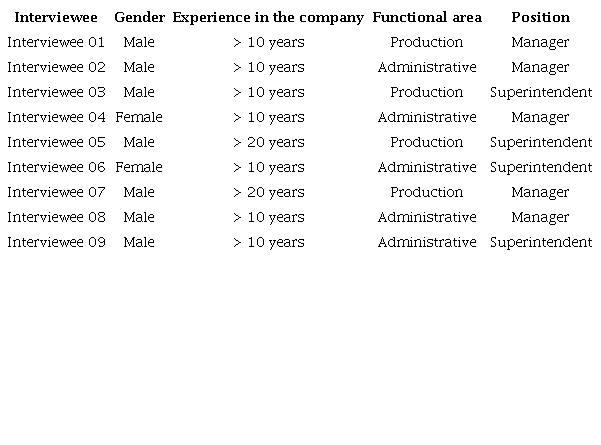
After collecting quantitative data, qualitative data collection was conducted, with nine in-depth interviews carried out with EPT leaders (Table 1). The interviewees included superintendents and managers from administrative and production areas. These leaders were chosen due to their significant influence on topics such as innovation, culture management, and strategy. A semi-structured script was used in the interviews to understand the meaning of key values within EPT’s current organizational culture and the importance of an innovation culture as perceived by these leaders (see https://doi.org/10.7910/DVN/LKNCTO). Each interviewee was provided with a consent form, agreeing to the use of their interview data and ensuring the confidentiality of their identities.
Table 1
Characteristics of interviewees.
The qualitative data were analyzed based on Bardin’s (2010) content analysis method, employed as a diagnostic tool. This approach enabled specific inferences and causal interpretations regarding the interviewees’ behavioral aspects. All interviews were recorded, transcribed, and analyzed in conjunction with the quantitative data. The analysis identified recurring themes in the interviewees’ statements and highlighted relevant findings for the study. Categories were created that aligned with the research objectives.
DIAGNOSIS OF THE PROBLEM-SITUATION
Limitations of the current culture
Through the responses to the OCAI instrument, the current view of the organization’s culture from the perspective of its leaders was obtained. Table 2 presents an overview of the leaders’ perceptions regarding the current and desired organizational culture. In the current culture, the hierarchical culture stands out, consistent with the culture commonly found in public organizations: adherence to rules and routines, overvaluation of hierarchy, paternalism in relationships, attachment to power, stability, formalization, among other traits.
Table 2
Current and desired organizational culture.
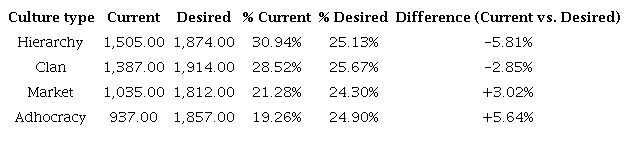
The table highlights the dominant current culture (hierarchy) and the culture with the lowest score (adhocracy). These results reflect the perception that EPT exhibits strong hierarchical traits and minimal focus on innovation. Notably, innovation culture shows the largest gap between current and desired states, with 937 points for the current state compared to 1,857 for the desired state, emphasizing a strong aspiration for an innovation-driven culture.
The interviews corroborate the quantitative findings, indicating that the leaders perceive the current culture as predominantly hierarchical. Public organizations retain the basic characteristics of other organizations but have specific features such as centralized decision-making, routine processes, formalization, and resistance to change: “A conservative, engaged, and deeply rooted culture, primarily in silos, meaning, ‘I do my part, and that’s it.’ I believe there are many [cultures] due to the company being entirely siloed” (Interviewee 2). In contrast to this departmentalized structure, the interviewees generally expressed a desire for more horizontal processes, as highlighted by Interviewee 3: “We should focus on the product rather than the function. So, working in a more matrixed way.”
Within an organization, subunits like functional departments, hierarchical levels, or even teams can reflect their own cultures, forming subcultures. Both administrative and production leaders noted the existence of subcultures within these two functional areas:
“I come from the production area, so there’s always this… let’s say, prejudice between production and administration, and vice versa” (Interviewee 5). These subcultures hinder greater synergy between areas, limiting collaboration on joint projects, including innovation initiatives.
Interviewees also pointed out challenges such as job security, which, according to them, keeps employees in a comfort zone and perpetuates the status quo, acting as a barrier to risk-taking. Another challenge cited was the fear of accountability to oversight bodies regarding research investments that are not mandated to generate financial returns but are aimed at studying and gaining knowledge in specific areas: “This lack of boldness, comfort zone, fear of being accountable for any potential mistakes to oversight bodies - this holds us back” (Interviewee 2).
The desire for a greater innovation culture
The results reveal a strong desire among EPT leaders for an adhocracy culture-focused on innovation. An innovation culture entails risk acceptance, decisive people, entrepreneurial and innovative leadership, teams with freedom and originality to make decisions and take risks. It also involves cohesive groups committed to innovation and development, with an emphasis on cutting-edge technology (Cameron & Quinn, 2011). This desire for innovation was explored and analyzed qualitatively.
The findings indicate that innovation is expected to bring more than just new business or profits; there is an expectation of greater collaboration, motivation, process agility, and external recognition of the organization’s strategic importance: “What I envision is that we would have better talent retention. I think, as a side effect of all this, we would retain quality manpower” (Interviewee 1). For the interviewees, beyond process changes, collaboration, and revenue growth, there is an expectation of expanding the organization’s portfolio of products and services: “The innovation, in my view, should deliver new products and services for the organization.”
For EPT’s leaders, the organization of the future is envisioned as more modern, agile, innovative, and strategic for both the state and society - more collaborative, less bureaucratic, and better able to meet client needs. For some, implementing an innovation culture is not just important but essential and urgent for the organization’s future survival: “I think it [innovation culture] is vital for the company’s survival” (Interviewee 1).
Proposed intervention - Implementation of the ‘innovative culture’ committee
Based on the responses collected from the managers interviewed in the study, it is evident that this group perceives innovation as the expansion of the product portfolio and, consequently, the customer base. In other words, they understand the concept of innovation to be primarily tied to a cycle of products that can be expanded or modified. However, innovation goes beyond products and services or even revenue growth - it needs to become a culture, a belief, or a habit embedded in the organization’s daily practices. Establishing a culture of innovation will naturally lead to the innovation of products and services.
The leaders’ desire for innovation in products and services is legitimate. However, the issue does not lie in reversing this scenario. The real challenge is the hierarchical environment, the structural silos, the lack of communication, and the fear of taking risks. These factors prevent the establishment of an innovation culture within the organization, and as a result, the goal of achieving new products and services remains unattainable. Thus, an action plan is proposed to implement an innovation culture based on five steps, starting with the creation of a committee dedicated to fostering an ‘innovative culture.’ This plan is illustrated in Figure 1.
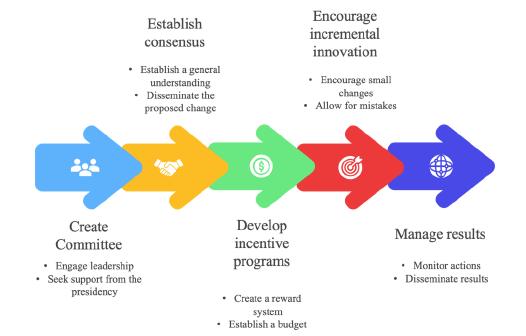 Figure 1
The five steps to cultural change.
Figure 1
The five steps to cultural change.
Before initiating the step-by-step intervention proposal, it is extremely important that the committee define a communication plan to be executed at all stages of the process. To ensure employee participation, it will be essential to offer agendas in both online and in-person modalities, covering all three shift schedules, and to disseminate them via email and the intranet, as well as through posters in workplaces and the cafeteria. The committee members should remain accessible, so an email address should be created for contact, and a physical location should be established. Good communication will be the starting point for implementing a culture of innovation.
Step 1 - Creation of the ‘innovative culture’ committee
Goal: Establish a group composed of leaders from various areas to implement a culture of innovation at EPT. This initiative aims to encourage employees to innovate, foster creativity, and facilitate the generation of new ideas. The committee will be responsible for planning and executing the action plan, engaging employees, and disseminating the culture of innovation, serving as key individuals in promoting this transformation throughout the organization.
Development: The proposal to create a committee is outlined in the ‘Policy for Stimulating Innovation’. Based on the research results, the committee should include leaders from both the manufacturing and administrative areas, totaling between 23 and 25 members, with representation from each department. This ensures that all areas have at least one representative in the committee. The research highlighted the importance of support from the executive board and superintendents for the actions defined by the committee.
It is suggested that the group initially meet weekly, with the frequency of meetings adjusted later as the project progresses and matures. Once the committee is established, it is recommended to conduct a new quantitative survey using the OCAI model, like the one previously applied to managers through a questionnaire. This survey aims to gather the perceptions and general understanding of all employees, including strategic-level staff, about the current organizational culture.
For a successful implementation of an innovative culture, it is crucial to reach and engage as many employees as possible. Understanding the majority’s perspective, identifying potential silos, and uncovering subcultures will be necessary. Given the questionnaire’s length, it is proposed to focus solely on the current cultural perspective at this stage, as the goal is to implement an innovative culture.
Only after collecting the data from the completed questionnaires will it be possible to conduct an in-depth analysis of the cultural perceptions by area (administrative and manufacturing), by age group (as EPT has employees with tenures ranging from 10 to 49 years), and even compare the views of strategic and operational levels. These insights will be critical for future decisions on how to engage employees and implement the culture of innovation while preserving what is valuable to them.
Estimated timeline: 3 months.
Challenges: Resistance to committee participation, low response rates to the questionnaire, and limited engagement from committee members.
To address resistance, open dialogue about the importance of the committee’s work will be essential. Identifying individuals who are less resistant and willing to participate can also help. Regarding the OCAI questionnaire, leadership should emphasize its importance, reinforced through communication channels.
Metrics: To measure committee engagement, it is suggested to initially use attendance lists to identify absences and understand their causes. Additionally, evaluating each member’s contributions to suggestions and decision-making will be beneficial. For the OCAI questionnaire, tracking the number of respondents relative to the total number of employees will help calculate the response rate.
Expected outcomes: Formation of an engaged and aware committee. Completion of the quantitative survey with responses from at least 80% of employees. Committee analysis of the current culture based on survey results.
Step 2 - Establish consensus
Objective: Determine EPT’s current culture through the results of a new quantitative survey conducted with all employees.
Development: The research identified that EPT has strong characteristics of a hierarchical culture and few traits of an innovative culture. However, the survey was limited to the management level of managers and superintendents. It is suggested that committee members reach a consensus on the current culture through a new survey conducted with all employees, including the executive level. Achieving consensus on the current culture will help determine what should or should not be preserved, communicate the new values and processes to the organization, reduce fear and resistance to change, and create a culture that embraces risk-taking for the development of new products, services, and processes.
After this internal consensus is reached within the committee, it is suggested to organize agendas with small groups. Committee members can divide into smaller groups to conduct more sessions. It is recommended that the committee member who is most familiar with the scheduled group act as the facilitator, ensuring that employees feel more comfortable sharing their opinions. These sessions should include discussions about the importance of an innovation culture in the organization and which innovations each employee identifies in the activities they already perform or others. The goal of this meeting is to allow employees to speak openly, or through techniques, about what they understand by innovation and its importance for EPT today. The key takeaway from these sessions should be a clear understanding of what employees perceive innovation to be and what they associate innovation with when thinking about EPT. Additionally, these sessions should provide employees with the opportunity to bring forward their own innovative ideas, engage in discussions, and be heard, fostering a collaborative environment.
In parallel with these sessions, the committee may conduct benchmarking with public companies, startups, and the academic community to explore the best ways to facilitate this cultural change. The proposal is to document the lessons learned from these organizations regarding the process of cultural change aimed at implementing an innovation culture. With this knowledge, the committee can share a proposed change with the entire organization, raising awareness and engaging employees in the need for change. The committee should aim to create new multipliers. These individuals can be identified in the small group sessions currently taking place. The committee members will assess who is interested in the subject and could potentially join the group of multipliers within their areas. The goal is to share information about the change, engage other employees, and bring any questions or concerns from these employees to the committee.
Estimated timeline: 2 months.
Challenges: Employee engagement in attending and participating in committee sessions. Potential difficulties in accessing the companies selected for benchmarking.
Regarding employee participation in the agendas proposed by the committee, it is important for leadership to actively engage and communicate the significance of each employee’s participation. Communication channels should reinforce the importance of everyone’s involvement. Initially, it may be useful to offer incentives for employees who attend the sessions, such as points in the promotion and progression process. The committee should also consider different times and formats for sessions to maximize employee participation.
For the benchmarking research, individuals with contacts or even initial connections via social media can be utilized. It is suggested that the research not be limited to public companies, as engaging with private companies will also provide valuable knowledge and experience exchange.
Metrics: To measure employee engagement in the sessions organized by the committee, it is recommended to create an attendance list to track the number of participants and their areas of operation. It is important to compare this number with the capacity of the venue for the sessions. Additionally, a channel for suggestions and feedback should be provided so that employees can voice their opinions. For the benchmarking research, it is suggested to create a list of companies that have undergone a cultural innovation implementation and then compare it with the number of companies the committee successfully contacted and exchanged experiences with.
Expected results: Awareness of the current culture. Employee perspectives on innovation. Benchmarking research results.
Step 3 - Develop Innovation incentive programs
Objective: Plan and initiate the execution of innovation incentive programs.
Development: Based on the knowledge gained about employees’ perspectives and the benchmarking research, it will be necessary to foster a new environment where employees have a voice, are heard, recognized, valued, and motivated by learning opportunities to seek new knowledge applicable to the company. This step involves preparing and obtaining approval for a budget to create these programs, train employees, and implement new ideas.
The training investment budget should focus on areas related to the implementation of an innovation culture. Training topics might include agile methodologies, communication, technologies associated with EPT’s products and services, and other relevant areas identified. Beyond providing training, it is crucial that trained employees have opportunities to apply their knowledge. Here, the committee will play a vital role in facilitating discussions with management to allocate partial working hours for these employees to develop their ideas based on their newly acquired skills. It is suggested that groups or squads be created to develop new products or services, with trained employees participating in these teams. Conflicts may arise due to the reallocation of employees, so the involvement of the committee and support from the strategic level will be essential to resolve these conflicts and maintain momentum and engagement.
Programs can also be designed to develop ideas in collaboration with partner organizations and universities, combining interests in research, development, innovation, and potential future business opportunities. This model encourages knowledge sharing, with both institutions recognized as creators of the resulting product or service.
Regular meetings with employees should be held to raise awareness and address doubts and concerns. These meetings must occur routinely, with the committee participating in discussions, brainstorming sessions, lectures, and other events, whether in person or virtual. The key is to remain present, maintain transparency, and demonstrate that the change process is underway, sharing progress and updates during these meetings. At this stage, it is critical to establish measurement controls for the development of new ideas and track the ideas that are being suggested and implemented. This process will be further detailed in Step 5.
Estimated timeline: 4 months.
Challenges: Difficulties in securing a budget, employee engagement in the initiatives, and conflicts with managers regarding the allocation of employees.
It is crucial for the committee to work on raising awareness among the leadership team about the importance of innovation-related initiatives to secure the necessary budget. If the total amount cannot be obtained, the committee should replan actions initially aligned with the proposed budget, prioritizing training activities that focus on short-term improvements and deliverables. Additionally, partnerships with companies, universities, and research centers could be explored to facilitate knowledge exchange, employee training, and product development.
Metrics: Compare the amount spent on training and implementing ideas with the allocated budget. Ideally, the entire budget or most of it should be utilized. It is recommended to track the individuals who participate in training programs, assess their contributions and deliverables post-training, and establish a correlation between the acquired knowledge and the outcomes achieved. This approach will help demonstrate the benefits and results generated from the training initiatives.
Expected results: A conducive environment for innovation. Trained and engaged employees collaborating in groups to develop new ideas.
Step 4 - Encourage incremental innovation
Objective: Achieve innovations in products, services, and processes through the groups formed to develop the suggested ideas.
Development: With leaders and employees more engaged and the formation of squads focused on achieving small but significant changes, multiple actions can be carried out simultaneously, involving people from various areas. Implementing and publicizing these small changes will create a sense of momentum and reduce resistance. Mistakes in some projects should be seen as learning opportunities. The committee needs to monitor the changes being implemented, provide support to employees, and hold regular meetings with all involved. It is recommended that squad members participate in meetings scheduled by the committee to present their incremental deliverables to the entire organization, highlighting the value of each contribution and demonstrating the importance and progress of the products being developed. Presenting results will not only recognize the group’s efforts but also inspire others to join, thereby increasing engagement.
Beyond presenting results, it is essential to implement them within the organization so that everyone can see their practical application. This includes results generated by squads as well as process optimizations or improvement suggestions from other areas. The committee members must evaluate these suggestions, understand their impact, and put them into action. Mapping and documenting these improvements are necessary for future evaluations and reporting.
Incremental innovation is significant not only for delivering short-term results but also because it enables quick identification and correction of errors, fostering rapid learning within the group, building experience, and creating a collaborative environment.
Estimated timeline: 4 months.
Challenges: Keeping squad members available and active, managing conflicts regarding their allocation with managers, and potential difficulties in developing and delivering incremental outcomes.
To address the availability of personnel, it is essential to engage in dialogue with functional managers and formalize the temporary assignment of employees to the squads through official directives. This process will provide greater security to employees and the committee. Over time, the necessity of hiring additional personnel to ensure the continuity of the work should be assessed.
Metrics: Record the number of people involved in the squads. Track the number of squads and their respective purposes. Monitor the outcomes delivered by each squad.
Expected results: Establish a cohesive and active group. Deliver incremental innovations. Foster an innovative environment. Ensure transparency and effective communication about cultural changes.
Step 5 - Managing results
Objective: Monitor, measure, and communicate the progress of deliveries and results.
Development: Through metrics, schedules, indicators, and milestones, create a clear view of how much progress has been made and what remains in the process of change for establishing an innovative culture. The committee should develop a schedule that includes activities and key milestones, starting with small changes and gradually evolving to larger ones as the organization becomes engaged, understands the change, and is mature enough to tackle more significant shifts, such as launching new products, modifying structures, among others. This maturity must be assessed both within the company and externally, including clients, partners, and suppliers. Teams or squads can issue reports demonstrating their deliveries and productivity in developing the generated products.
Even after the innovative culture has been implemented, it is important to maintain the committee. Regardless of whether the organization decides to create a specific area, it is still recommended that the committee not be disbanded, even if its size is reduced. In this new stage, the committee will be responsible for ensuring continuous improvement and preventing the loss of the new values and processes, thus avoiding any regression in the work already accomplished. It is crucial to continuously manage the new organizational culture, always aiming to keep the new values alive in the organization’s memory, emphasizing the importance of a collaborative environment, active listening for new ideas, evaluating innovation proposals, and maintaining transparency in communication about programs and project deliveries. Regular meetings with employees should be maintained to clarify specific topics, conduct lectures and debates, always with the support and presence of strategic leadership, which will demonstrate the importance of and reinforce the new culture.
The goal is that, with this plan and the new structure established, EPT will be agile when facing new challenges that negatively impact its business. With employees immersed in a collaborative and agile environment and properly trained, the response to creating solutions will be faster and more assertive, and the emergence of the new will be seen as an opportunity rather than a threat.
Estimated timeframe: Ongoing monitoring process to be embedded in the organization.
Challenges: Maintaining daily motivation, engagement, and commitment among individuals; keeping the new culture at the forefront of people’s minds; and monitoring indicators to demonstrate project progress.
To sustain engagement, it will be necessary to ensure the committee consistently continues its schedules, disseminates reports, and provides feedback to the squads. Support from senior management is also essential for the continuity of the work. Therefore, it is suggested that the committee or responsible area be directly connected to the presidency and, as much as possible, have decision-making authority and the freedom to keep the work alive.
Metrics: The committee should establish indicators, based on the metrics defined in each stage, that are clear to the teams and demonstrate the progress of deliveries and how well the new culture is understood and embraced by employees. It is crucial to consistently set goals related to engagement, delivery, and training to keep individuals actively involved and monitor how the culture is perceived by employees.
Results: Achieve strong teams working on idea development and delivering outcomes, establish the new culture, and maintain indicator monitoring.
 Mirian Gomes de Oliveira Soares mirian.gomes@gmail.com