Editorial
I still vividly remember the astonishment I felt when I first saw Neo awakening from his slumber in a world ruled by superintelligent machines, where the only human function was… to serve as batteries.
Art teaches us a lot. Through extraordinary creations, utopian worlds, and frightening futures, time has passed, and here we are in 2025. We have now surpassed, chronologically, the ‘futures’ imagined in Blade Runner and Back to the Future II, among many others.
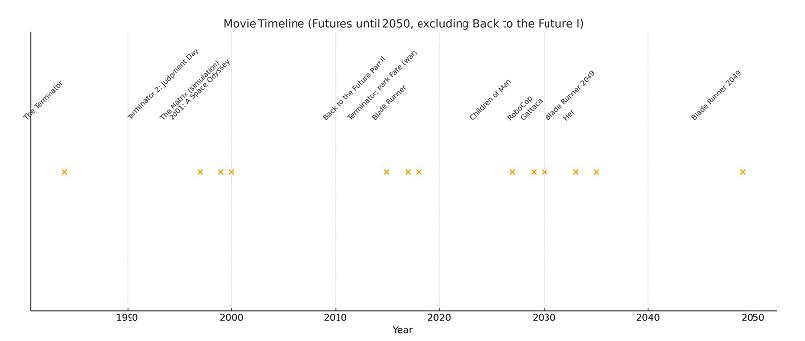
Figure 1
Timeline of films about ‘possible futures’.
Even more fascinating is realizing that technological evolution has already made many utopias - and dystopias - possible. Biotechnology, nanotechnology, artificial intelligence, and robotics now enable us to predict human behavior, interact with robots that look and act like humans, be whoever we want in virtual worlds, outsource information searches and decision-making…
Table 1 summarizes some of this connection between art and the future, presenting some emblematic films that deal with futures that we have already surpassed (or are about to surpass) chronologically.
Plots about “Possible Futures” and What They Imagined.
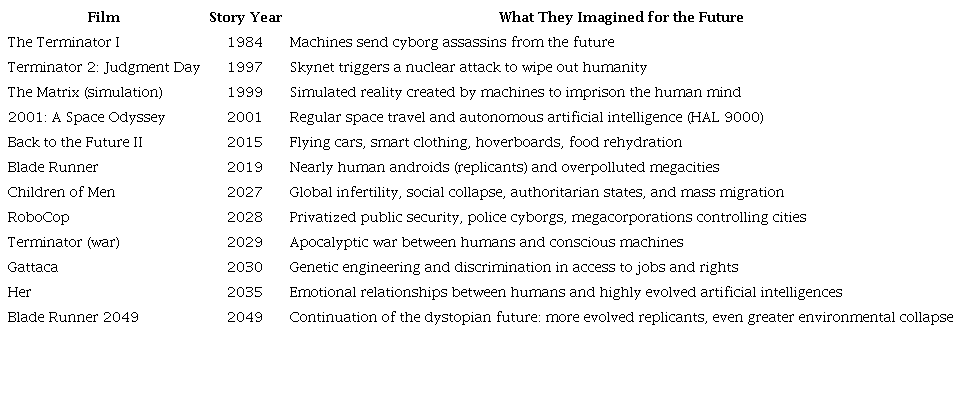
Note. Elaborated by the Authors.
Despite breathtaking technologies and visual effects, what captivates us in these stories are the relationships, dilemmas, and human emotions: the bond between Marty and Doc, Sarah and John Connor, Neo, Trinity, and Morpheus…
I chose to start with the idea of surpassed futures because we live in a time when technology advances at an accelerated pace - sometimes even faster than art itself was able to predict. Yet, amid so many innovations, it is crucial to remember that technology only makes sense if it helps humanity become better. Neither art nor science desires futures in which humans are rendered obsolete, reduced to mere cogs or batteries of a system.
Lindebaum (2025), in his recent editorial for the Academy of Management Learning and Education, asks whether there is still hope for a better future for our planet (and for ourselves), given the magnitude and multitude of challenges we face. I resonate with his view that teaching hope is fundamental. But to build real, non-dystopian futures, the discussion we must engage in today is not merely technological - it is primarily ethical. It concerns what future we want to inhabit and what humanity we want to preserve and strengthen.
This is directly related to objective decisions about what we want to research and how we conduct our research. Recent work helps us understand the impact of researchers’ choices on important conceptual advances in emerging fields of management.
For instance, Lee et al. (2021) showed that scientific production related to sustainability has grown dramatically over the past two decades. Bibliometric studies and databases indicate an exponential rise in the number of articles addressing sustainability, following increasing environmental awareness and global efforts such as the United Nations Sustainable Development Goals.
Van Bommel et al. (2024) explored the evolution of research on diversity and inclusion. It is interesting to note that academic work on both topics highlights the growth in interest and scholarship but also reveals unexplored areas that constitute challenges and opportunities for future research. Indeed, it does not take much reflection to realize that we still have significant ground to cover - both in theorization and in practice - to tackle the immense problems posed by these themes. Ignoring them would be mere denial.
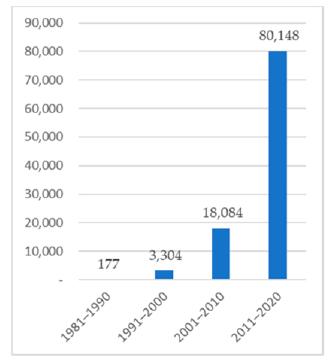
Figure 2
Evolution of publications on sustainability.
Source: Lee, J. H., Wood, J., & Kim, J. (2021). Tracing the trends in sustainability and social media research using topic modeling. Sustainability, 13, 1269. https://doi.org/10.3390/su13031269
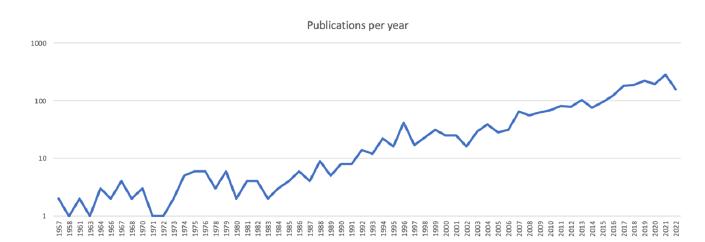
Figura 3
Publications on diversity and inclusion in management and business literature, log(10) scale.
Source: Van Bommel, H. M., Hubers, F. & Maas, K. E. H. (2024). Prominent themes and blind spots in diversity and inclusion literature: A bibliometric analysis. Journal of Business Ethics, 192, 487-499. https://doi.org/10.1007/s10551-023-05522-w
Although there has been positive progress on both fronts, if we lose our ability to decide what we research and teach, the world will undoubtedly become poorer, less diverse - and we will become more like robots ourselves.
Here in Brazil, we continue to view academia as the home of open and frank debate. We believe that science is built by challenging prevailing paradigms with rigor and sound argumentation. That scientific investigation grows stronger through constructive peer criticism. That engaged scholarship holds a commitment to helping solve real-world problems.
The role of RAC in this context is clear. Our mission is to contribute to the discussion of contemporary dilemmas, fostering scientific advancement toward achieving the Sustainable Development Goals. This scope adjustment was initiated by my predecessor, Professor Marcelo Bispo (Bispo, 2024), of which we are very proud. We publish a substantive and relevant journal that applies the principles of engaged research to promote a better world.
At RAC, we believe that a truly innovative, sustainable, diverse, and inclusive future is born from academic freedom. It is born from respect for differences, from serious debate, and from rigorous and engaged research. It is the encounter - and sometimes the clash - between distinct worldviews that expands our capacity to see beyond the borders of what we already know.
As George Bernard Shaw once said: “The reasonable man adapts himself to the world; the unreasonable one persists in trying to adapt the world to himself. Therefore, all progress depends on the unreasonable man.” In other words, progress is not born from conformity, but from the courage to question, to imagine, and to transform.
Art, history, and science have long taught us: totalitarianism and authoritarianism are not solutions to human dilemmas - they are traps. That is why it would be wise to leave behind the tensions of the 20th century, which we hoped were already overcome, and focus our energy on the research debates that truly matter for humanity. There are too many new, too important issues for us to waste time on setbacks that prevent meaningful progress. The list below is far from exhaustive but offers some examples of reflections I would like to see explored in our journal:
-
If the best ideas arise from conflict between different perspectives, how can we make this tension more productive?
-
How can we teach our students to deal with ambiguity and conflict? To collaborate in diverse teams? To ‘coopete’ in a world that increasingly demands it?
-
How do we manage the tensions between short- and long-term results, knowing that if we fail today, the organization may not survive to see the future we aspire to?
-
Similarly, how do we navigate the narrow scopes of decision-making (investors, customers) alongside broader societal responsibilities, recognizing that prioritization and trade-offs are the essence of strategy?
-
How can we balance the tension between merit and inclusion? How can we help individuals become the best versions of themselves, while being conscious of their capabilities and their willingness to contribute?
-
How do we move beyond the myth of the superhero leader, allowing those in authority to exercise their humanity and vulnerability, while still recognizing society’s need for inspiring heroes?
I do not have definitive answers to these questions, but it will be immensely rewarding to see our researchers, teachers, and students delve into them - immersing themselves in hundreds of articles and formulating thousands of research questions until they find the one that makes their eyes shine.
It is within tensions that answers reside. The adaptive challenges we face are complex, often difficult to discern - and certainly difficult to resolve. They have no absolute right answers, no one-size-fits-all solutions, and they will not eliminate human tensions.
So, what is the path forward? Is there hope?
I believe there is. But, just like in The Matrix, the red pill does not offer an easy escape. It offers freedom.
Freedom to debate openly and respectfully. Freedom to build bridges between different perspectives - not so that the loudest voice wins, but so that together, we can see further.
This is the freedom we wish to cultivate.
This is the future we wish to build.
REFERENCES
Bispo, M. S. (2024). O que queremos publicar na Revista de Administração Contemporânea. Revista de Administração Contemporânea, 28(2), e240101. https://doi.org/10.1590/1982-7849rac2024240101
Lee, J. H., Wood, J., & Kim, J. (2021). Tracing the trends in sustainability and social media research using topic modeling. Sustainability, 13, 1269. https://doi.org/10.3390/su13031269
Lindebaum, D. (2025). Hope. Academy of Management Learning & Education. https://doi.org/10.5465/amle.2025.0145
Van Bommel, H. M., Hubers, F. & Maas, K. E. H. (2024). Prominent themes and blind spots in diversity and inclusion literature: A bibliometric analysis. Journal of Business Ethics, 192, 487-499. https://doi.org/10.1007/s10551-023-05522-w
Notes
Emílio José Montero Arruda Filho (UNAMA, Belém, PA, Brazil; UFPA, Belém, PA, Brazil)
Gabrielle Durepos (Mount Saint Vincent University, Halifax, Nova Scotia, Canada)
Rafael Alcadipani da Silveira (EAESP/FGV, São Paulo, SP, Brazil)
Patricia Guarnieri dos Santos (UnB, Brasília, DF, Brazil)
Silvia Gherardi (University of Trento, Trento, Italy)
Editor-in-chief
Paula Chimenti (UFRJ, Rio de Janeiro, RJ, Brazil)
Associate Editors
Ariston Azevedo (UFRGS, Porto Alegre, RS, Brazil)
Carolina Andion (UDESC, Florianópolis, SC, Brazil)
Cristiana Cerqueira Leal (Universidade do Minho, Portugal)
Denize Grzybovski (IFRS, Erechim, RS, Brazil)
Elisa Yoshie Ichikawa (UEM, Maringá, PR, Brazil)
Fernando Luiz Emerenciano Viana (Unifor, Fortaleza, CE, Brazil)
Gaylord George Candler (University of North Florida, Jacksonville, Florida, USA)
Gustavo da Silva Motta (UFF, Niterói, RJ, Brazil)
Keysa Manuela Cunha de Mascena (Unifor, Fortaleza, CE, Brazil)
Leonardo Marques (Audencia Business School, France)
Ludmila de Vasconcelos Machado Guimarães (CEFET-MG, Belo Horizonte, MG, Brazil)
Marlon Dalmoro (UFRGS, Porto Alegre, RS, Brazil)
Natália Rese (UFPR, Curitiba, PR, Brazil)
Orleans Silva Martins (UFPB, João Pessoa, PB, Brazil)
Tatiana Iwai (INSPER, São Paulo, SP, Brazil)
Scientific Editorial Board
André Luiz Maranhão de Souza-Leão (UFPE, Recife, CE, Brazil)
Aureliano Angel Bressan (CEPEAD/UFMG, Belo Horizonte, MG, Brazil)
Bryan Husted (York University, Canada)
Carlos M. Rodriguez (Delaware State University, USA)
Diógenes de Souza Bido (Mackenzie, São Paulo, SP, Brazil)
Erica Piros Kovacs (Kelley School of Business/Indiana University, USA)
Elin Merethe Oftedal (University of Stavanger, Norway)
Fábio Frezatti (FEA/USP, São Paulo, SP, Brazil)
Felipe Monteiro (INSEAD Business School, USA)
Howard J. Rush (University of Brighton, United Kingdom)
James Robert Moon Junior (Georgia Institute of Technology, USA)
John L. Campbell (University of Georgia, USA)
José Afonso Mazzon (USP, São Paulo, SP, Brazil)
Jose Antonio Puppim de Oliveira (United Nations University, Japan)
Julián Cárdenas (Universitat de València, Espain)
Lucas Ayres B. de Campos Barros (USP, São Paulo, SP, Brazil)
Luciano Rossoni (UnB, Brasília, DF, Brazil)
M. Philippe Protin (Université Grenoble Alpes, France)
Paulo Estevão Cruvinel (Embrapa Instrumentação, São Carlos, SP, Brazil)
Rodrigo Bandeira de Mello (Merrimack College, USA)
Rodrigo Verdi (MIT Massachusetts Institute of Technology, Cambridge, USA)
Valter Afonso Vieira (UEM, Maringá, PR, Brazil)
Editing
Typesetting and normalization to APA standards: Eduarda Pereira Anastacio (ANPAD); Simone L. L. Rafael (ANPAD, Maringá, Brazil)
Frequency: Continuous publication.
Circulation: Free open access to the full text.
Indexing, Directories and Rankings
Scopus, Scielo, Redalyc, DOAJ, Latindex, Cengage/GALE, Econpapers, IDEAS, EBSCO, Proquest, SPELL, Cabell's, Ulrichs, CLASE, Index Copernicus International, Sherpa Romeo, Carhus Plus+, Academic Journal Guide (ABS), DIADORIM, REDIB, ERIHPlus, OAJI, EZB, OasisBR, IBZ Online, WorldWideScience, Google Scholar, Citefactor.org, MIAR, Capes/Qualis.
Author notes
* Corresponding Author.
Conflict of interest declaration
