Theoretical-Empirical Article
Do Informal Controls and Cooperation Trigger Resilience in Role Dependence in Startups?
Controles Informais e Cooperação Desencadeiam Resiliência na Dependência de Papel em Startups?
 Ilse Maria Beuren ilse.beuren@gmail.com
Do Informal Controls and Cooperation Trigger Resilience in Role Dependence in Startups?
Revista de Administração Contemporânea, vol. 29, no. 2, e240208, 2025
Associação Nacional de Pós-Graduação e Pesquisa em Administração
Received: 22 July 2024
Revised document received: 16 January 2025
Accepted: 12 February 2025
Published: 28 April 2025
ABSTRACT
Objective: this article examines the influence of informal controls on resilience in role dependency, with the mediating intervention of cooperation and the moderating intervention of relational difficulties.
Theoretical approach: organizational literature, in light of positive psychology, considers resilience to be a developed trait, which leads to the presumption that resilience related to role dependency can be triggered by informal controls, as they reflect values, norms, and expectations that support the development of organizational resilience capabilities.
Method: structural equation modeling using partial least squares was applied to data collected through a survey with managers of Brazilian incubated startups.
Results: the research findings reveal that informal controls do not directly influence resilience in role dependency, only through cooperation. Furthermore, informal controls have a direct influence on cooperation which, in turn, affects resilience in role dependency. However, relational difficulties did not present a moderating effect on the relationship between cooperation and resilience in role dependency.
Conclusions: these results have implications in showing that resilience in role dependency is not directly influenced by informal controls, but rather through the mediation of cooperation. This highlights the importance of cooperation and the need to foster it in order to promote resilience in startups, due to their limited staff. Thus, it deepens the understanding of the potential influence of informal controls and cooperation on resilience in role dependency in disruptive contexts and resource-scarce environments, common among incubated startups.
Keywords: Informal controls+ resilience in role dependency+ cooperation+ relational difficulties+ startups.
RESUMO
Objetivo: este artigo examina a influência dos controles informais sobre a resiliência na dependência de papel, com a interveniência mediadora da cooperação e moderadora das dificuldades relacionais.
Marco teórico: a literatura organizacional, à luz da psicologia positiva, considera que a resiliência é desenvolvida, o que leva à presunção de que a resiliência voltada à dependência de papel possa ser desencadeada pelos controles informais, uma vez que estes refletem valores, normas e expectativas que apoiam a concepção de capacidades de resiliência organizacional.
Método: para a análise dos dados coletados na survey com gestores de startups incubadas brasileiras, aplicou-se modelagem de equações estruturais por mínimos quadrados parciais.
Resultados: os achados da pesquisa revelam que os controles informais não exercem influência direta sobre a resiliência na dependência de papel, apenas por meio da cooperação. Ademais, os controles informais demonstram influência direta na cooperação e, por sua vez, a cooperação na resiliência na dependência de papel. Contudo, as dificuldades relacionais não apresentaram efeito moderador na relação entre a cooperação e a resiliência na dependência de papel.
Conclusões: esses resultados trazem implicações ao revelar que a resiliência na dependência de papel não é influenciada diretamente pelos controles informais, mas pela mediação da cooperação. Isso indica a relevância da cooperação e a atenção necessária para promover resiliência em startups, devido ao seu reduzido quadro de pessoas. Assim, aprofunda-se a compreensão da influência potencial dos controles informais e da cooperação sobre a resiliência na dependência de papel em contextos perturbadores e de escassez de recursos, comum em startups incubadas.
Palavras-chave: Controles informais, resiliência na dependência de papel, cooperação, dificuldades relacionais, startups.
INTRODUCTION
Turbulent and dynamic environments stimulate the creation of new businesses while simultaneously challenging the continuity of existing ventures, especially small enterprises (Fisher et al., 2020; Townsend et al., 2018). This becomes even more evident in startups, since their goal is to offer new products amid uncertainty (Frare & Beuren, 2023; Ries, 2011). Despite their innovative potential, a significant portion of these companies around the world fails to survive over time, mainly due to the absence of management mechanisms and difficulties in managing the business (Bertolami et al., 2018; March-Chorda, 2004; Noelia & Rosalia, 2020). With fewer resources than large companies and facing a series of challenges in their early stages, these businesses rely on their management capacity for development (Bouncken et al., 2015; Frare & Beuren, 2023).
One of the key drivers of management capacity is managerial control, which is structured in two main formalizations: formal controls and informal controls. While both are relevant across various business configurations, the potential of informal controls is still not fully understood. These controls are especially important in startups due to their guiding and flexible nature (Davila & Foster, 2009; Frare & Beuren, 2023; Santos et al., 2023; Taylor et al., 2019). Informal controls reflect the values, norms, and expectations of the organization’s members, contributing to a more harmonious work environment and guiding desired employee behaviors (Goebel & Weißenberger, 2017; Merchant & Otley, 2007).
Disruptive contexts in the face of uncertainty demand resilience, which is considered essential for the survival of startups (Frare & Beuren, 2021). Resilience is a dynamic process involving positive adaptation and the ability to cope with adversity and risks (Luthar et al., 2000). Various forms of resilience - individual, team, organizational, and contextual (Luthans et al., 2010; Shin et al., 2012), - have been brought into organizational settings as they permeate the work environment (Zhou et al., 2023). This study focuses on resilience in role dependency, broadly understood as the ability to overcome and recover from the absence of a team member (Mallak, 1998).
Resilience can be influenced by managerial control (Bracci & Tallaki, 2021; Frare et al., 2023). Research shows that management control systems (MCS) support cognitive, behavioral, and contextual resilience (Beuren et al., 2020). On one hand, systems focused on planning, monitoring, and performance management are relevant for building organizational resilience capabilities (Bracci & Tallaki, 2021). On the other hand, both formal and informal controls foster proactive and reactive organizational resilience (Beuren & Santos, 2019; Frare et al., 2023). Emphasis is placed on the importance of control in managing the absence of team members and preventing crises (Zhou et al., 2023).
These studies associate control with resilience in a broad way, often overlooking the segmented analysis of its dimensions. Most of them focus on different approaches to resilience but remain silent on resilience in role dependency (e.g. Beuren et al., 2020; Bracci & Tallaki, 2021; Frare et al., 2023). Furthermore, fostering resilience in startups appears to be particularly challenging, creating opportunities for further research (Haase & Eberl, 2019; Zhou et al., 2023). The scarcity of research addressing resilience drivers in startups encourages the investigation of this phenomenon and its antecedents (Frare & Beuren, 2021; Haase & Eberl, 2019; Zhou et al., 2023).
Cooperation is identified in the literature as an antecedent of resilience (Lotfi & Larmour, 2022; Wieland & Wallenburg, 2013), especially in startups that have limited staff (Ries, 2011). Cooperation involves the joint effort of individuals, from interaction to effective communication, to achieve set goals (Smith et al., 1995). In role dependency, constructive, flexible, and balanced collaboration may be more effective than strictly adhering to designated roles (Frare & Beuren, 2021). Relationships can become more resilient and adaptable to changes (Lotfi & Larmour, 2022; Wieland & Wallenburg, 2013), suggesting a mediating role of cooperation, an underexplored aspect in the literature (Pazetto & Beuren, 2022).
In this context, relational difficulties may signal the direction or strength of cooperation’s influence on resilience in role dependency. These difficulties can pose obstacles to cooperation, such as lack of trust, resentment, conflicting interests, and competition (Zhang et al., 2023). Conflicts inherent to relational difficulties can hinder cooperation (Dias et al., 2020), limiting interaction in overcoming challenges (Lowe, 1997; Zhang et al., 2023). However, this remains an under-researched area that requires further study.
Given the above, this study examines the influence of informal controls on resilience in role dependency, with the mediating intervention of cooperation and the moderating intervention of relational difficulties. A survey was conducted with managers of Brazilian incubated startups, and data were analyzed using structural equation modeling. This study is justified in this context because startups are especially prone to challenging situations, which require further investigation (Zhou et al., 2023). Resilience in role dependency is particularly relevant for startups, as in early stages it is common for founders and team members to play multiple roles (Frare et al., 2023). One person often performs several functions, and in their absence, others must step in (Mallak, 1998).
This study contributes to both the literature and managerial practice. First, it broadens the understanding of the potential of informal controls in resilience (Beuren & Santos, 2019; Bracci & Tallaki, 2021), specifically in resilience in role dependency (Mallak, 1998). The research findings also address the gap concerning the influence of informal controls on resilience (Beuren et al., 2020) in under-investigated contexts (Haase & Eberl, 2019). Second, although previous research has empirically demonstrated the relevance of cooperation to resilience, such studies have focused primarily on supply chains (Lotfi & Larmour, 2022; Wieland & Wallenburg, 2013). The literature is still scarce in terms of how this relationship unfolds within startups (Frare et al., 2023). Third, the study contributes by highlighting relational difficulties as potential indicators of the strength of cooperation’s influence on resilience in role dependency (Lowe, 1997; Zhang et al., 2023).
From a practical perspective, the study offers insights for startup managers. First, it shows that informal controls do not have a direct effect on resilience in role dependency, but rather an indirect effect through cooperation. Informal controls can be particularly valuable in startups by enabling quick action and adaptation to changes (Frare & Beuren, 2021). Second, the findings emphasize the importance of fostering employee cooperation to build resilience. Cooperation proves to be a critical mechanism for tackling challenges and seizing opportunities in a competitive and highly volatile environment. Third, the results reinforce that while informal controls affect resilience indirectly, cooperation plays a direct role in enhancing resilience, in view of the uncertainties and the disruptive context that are generally present in startups due to the lack of resources to promote innovation.
THEORETICAL FRAMEWORK AND HYPOTHESES
Informal controls and resilience in role dependency
Organizational literature is structured to support and make a robust contribution to organizational studies and practices (Bedani & Veiga, 2015). To this end, organizational literature is often complemented by elements from other fields of knowledge (Bedani & Veiga, 2015; Hillmann, 2021; Zhou et al., 2023). In cases involving interactions between organizational and individual elements, studies from the field of psychology can contribute to this purpose (Demo et al., 2022; Hillmann, 2021). In the present study, the approach to resilience in role dependency was developed through the theoretical lens of organizational literature, combined with aspects of positive psychology theory (Demo et al., 2022; Hillmann, 2021; Seligman & Csikszentmihalyi, 2000).
Grounded in organizational literature, informal controls seek to translate organizational values and norms (Chenhall, 2003; Frare & Beuren, 2023). They are characterized as organic and flexible and are classified into personnel control and cultural control (Goebel & Weißenberger, 2017). Personnel control relates to employees, such as training and hiring, while cultural control concerns the values and beliefs of the organization (Goebel & Weißenberger, 2017; Kleine & Weißenberger, 2014). Both are rooted in collective norms and values that guide individuals toward organizational goals through their ethical awareness (Goebel & Weißenberger, 2017) and resilience capacity.
Resilience, in broad terms, consists of the ability to withstand and recover from adverse situations (Linnenluecke, 2017; Madni & Jackson, 2009). At the individual level, resilience refers to employees’ ability to recover and/or succeed in the face of adversity (Beuren et al., 2020; Luthans et al., 2010; Shin et al., 2012). Role dependency is defined as an element of resilience. Thus, resilience in role dependency is characterized as the ability to fill in for an absent team member and recover (Mallak, 1998).
From an individual perspective, resilience is considered manageable through intervention by means of human resource management practices and policies (Lengnick-Hall et al., 2011; Khan et al., 2019). It is argued that managers can promote resilience through specific actions (Beuren et al., 2020; Lengnick-Hall et al., 2011). Therefore, it is conjectured that, in the face of adverse events, informal controls may be useful in promoting resilience by fostering behaviors and attitudes that ensure harmony between organizational and individual goals (Goebel & Weißenberger, 2017; Kleine & Weißenberger, 2014).
Previous research provides evidence of the association between controls and resilience. Beuren and Santos (2019) examined the effects of enabling and coercive MCS on cognitive, behavioral, and contextual resilience in companies that acquired or were acquired by others. They found associations between enabling controls and all three forms of resilience, while coercive controls were associated only with contextual resilience. Beuren et al. (2020) analyzed the effects of enabling MCS on psychological empowerment and organizational resilience in the context of company acquisition processes. They found that MCS help in facing turbulence and adversity. Bracci e Tallaki (2021) investigated whether MCS focused on planning, monitoring, and performance management are relevant in fostering resilience capabilities in public sector organizations. They concluded that MCS are important to stimulate quick response behaviors and adaptability in adverse situations.
Focusing specifically on formal and informal controls, Frare et al. (2023) investigated the role of these controls in fostering proactive and reactive organizational resilience in financial technology startups. They concluded that fintechs can benefit from using these controls to develop resilience, helping them anticipate and prepare for moments of uncertainty. Based on the above, the following hypothesis is proposed:
H1: Informal controls positively influence resilience in role dependency.
Informal controls and cooperation
Cooperation consists of individuals’ willingness to unite efforts, foster interaction, and connect to achieve mutual goals (Smith et al., 1995). These efforts can be enhanced with the support of MCS, which include actions to guide individuals toward organizational objectives (Mahama, 2006; Santos et al., 2023). Controls can help guide employees’ interests and behaviors in the best interests of the organization (Beu & Buckley, 2004; Taylor et al., 2019). Therefore, companies can use MCS to intensify employee cooperation and steer their efforts toward common goals (Goebel & Weißenberger, 2017; Merchant & Otley, 2007).
Xu et al. (2014) argue that control is a formality embedded in agreements, helping to define the boundaries of cooperation, which, in a broader definition, includes measures that go beyond formal contracts and aim to develop a culture of cooperation. Mahama (2006) investigated the relationship between MCS (performance measurement systems and socialization processes) and dimensions of cooperation in strategic supply relationships and found a positive and significant relationship. Pazetto and Beuren (2024) studied the influence of the timeliness of management information and trust on cooperation in technology parks. They observed that the speed and frequency of management information operate in different but complementary ways to promote trust and cooperation. Despite the differing contexts of these studies, it is assumed that:
H2: Informal controls positively influence cooperation.
Cooperation and resilience in role dependency
Cooperation tends to occur in various contexts, involving interaction among individuals, teams, or even organizations, and it implies collaboration and communication, which can influence the resilience of those involved (Lotfi & Larmour, 2022; Wieland & Wallenburg, 2013). In the context of interorganizational networks, Lofti and Larmour (2022) analyzed how collaboration affects resilience in the supply chain and found that the more these companies collaborate, the more resilient they become. Wieland and Wallenburg (2013) investigated relational competencies (communication, cooperation, and integration) that may influence proactive and reactive resilience in supply chains. They found that cooperation positively influences proactive resilience.
In the intraorganizational context, focusing on a specific locusntraorganizacional e em um lócus específico de empresas, Ries (2011) investigated cooperation in startups. Among the study’s findings, the importance of cooperation was highlighted, particularly due to the lean nature of such organizations. Frare and Beuren (2021) investigated resilience in startups. The results pointed to the importance of resilience in the face of environmental uncertainties. These studies provide empirical evidence on cooperation and resilience in role dependency. These findings, combined and supported by research in network contexts, lead to the following assumption:
H3: Cooperation positively influences resilience in role dependency.
Mediating effect of cooperation between informal controls and resilience in role dependency
Cooperation is considered a relevant mechanism for the development of resilience (Wieland & Wallenburg, 2013), especially when considering that employees’ capabilities are essential for building resilience (Zhou et al., 2023). This leads to the assumption that cooperation within the organization, between individuals, among teams, or even at the organizational level, may affect the relationship between informal controls and resilience in role dependency. However, the literature remains silent on these potential effects of cooperation.
It is hypothesized that cooperation mediates the relationship between informal controls and resilience in role dependency for the following reasons: (a) informal controls can influence behavior patterns, build trust, and establish norms that encourage cooperation (Mahama, 2006; Pazetto & Beuren, 2022); (b) cooperation promotes the sharing of resources, mutual support, learning, and collaboration, which increase individuals’ ability to deal with adversity (Lotfi & Larmour, 2022; Wieland & Wallenburg, 2013). From this, it is assumed that:
H4: Cooperation has a mediating effect on the relationship between informal controls and resilience in role dependency.
Moderating effect of relational difficulties between cooperation and resilience
Relational mechanisms consist of social factors like learning and coordination, whose role is to stimulate communication and mutual commitment (Luiz et al., 2024; Shahzad et al., 2020). Therefore, relational difficulties in the workplace can affect how people cooperate with one another, impacting the quality and effectiveness of interactions and, consequently, hindering resilience. These difficulties may stem from conflict, lack of communication and commitment, and low trust, among other factors (Dias et al., 2020). Conflict or ineffective communication can impair a team’s ability to work together and overcome challenges (Zhang et al., 2023).
In relationships where these difficulties persist, cooperation may be compromised (Lowe, 1997; Zhang et al., 2023). In the interorganizational context, Pazetto and Beuren (2022) found that the design of the MCS influences cooperation and that the company’s identification with its technology park plays a moderating role. Luiz et al. (2024)investigated the effects of enabling MCS and relational capabilities in managing conflicts within innovation ecosystems and found both direct and indirect effects through learning and coordination capabilities.
In the intraorganizational context, Lowe (1997)examined the role of interpersonal relationships in cooperation and discovered that high-quality leader/member interaction is positively associated with cooperation. Zhang et al. (2023) examined the impact of intergroup conflict on trust and the intention to cooperate and found that conflict can reduce the intention to cooperate. Therefore, it is presumed that relational difficulties affect individuals’ ability to cooperate, which, in turn, may hinder their ability to cope with adversity and overcome challenges. In this sense, it is hypothesized that:
H5: Relational difficulties have a moderating effect on the relationship between cooperation and role-dependent resilience.
Figure 1 highlights the theoretical model and research hypotheses.
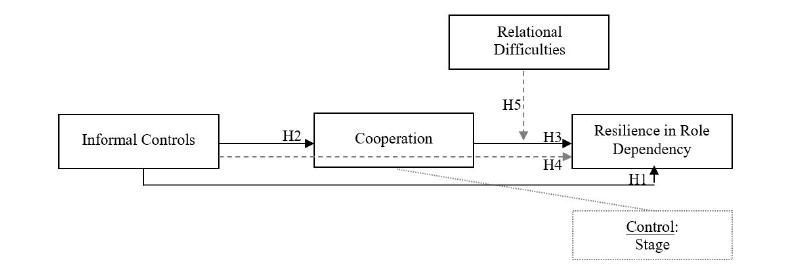
Figure 1
Theoretical model of the research.
Source: Elaborated by the Authors. The dashed arrows refer to the mediation (H4) and moderation (H5) hypotheses.
In the model, positive effects of informal controls on resilience in role dependency (H1) and cooperation (H2) are expected, as well as the effect of cooperation on resilience in role dependency (H3). It is further hypothesized that cooperation mediates the relationship between informal controls and resilience in role dependency (H4), and that relational difficulties moderate the relationship between cooperation and resilience in role dependency (H5). The incubation stage was controlled in accordance with previous research (e.g., Frare et al., 2023), based on the assumption that different organizational configurations at different startup stages require distinct support from the business ecosystem.
METHODOLOGICAL PROCEDURES
Population and sample
The population for this research consists of Brazilian incubated startups. These are companies inserted into an innovation ecosystem and at an early stage of their life cycle, typically facing various risks and uncertainties (Ries, 2011). These companies are created with the mission of developing new products, with a high degree of technology and in contexts of uncertainty (Frare & Beuren, 2021). The choice of these companies is due to their dynamic nature and the challenging situations they face, making resilience essential to their survival (Frare & Beuren, 2021). These elements are inherent to the scope of the present study and justify this locus of investigation.
A survey was conducted with managers of incubated startups in incubators affiliated with the Brazilian Association of Entities Promoting Innovative Enterprises (Associação de Entidades Promotoras de Empreendimentos Inovadores - Anprotec). Mapping these incubators was carried out using their websites, resulting in 1,347 incubated startups from 12 Brazilian states. The identification of startup managers was done through the social network LinkedIn, which resulted in 953 professionals. They received an invitation to participate in the study, and the 565 who accepted it received a link to the questionnaire on the QuestionPro platform between November 2022 and May 2023. A total of 113 valid responses were obtained, compatible with the minimum sample size of 77 responses for the structural model analysis, as determined by the G*Power software, with a confidence level of 0.80 and a margin of error of 0.05.
The demographic analysis of the respondents shows that 70% are male, 27% have a higher education degree, and 30% have a lato sensu postgraduate degree, such as a specialization or an MBA. Regarding their positions, 23% are C-level executives (CEO, CFO, COO, CTO), 24% are directors, 11% are managers, 3% are coordinators, and 39% hold other positions. Concerning the startups’ profile, 68% have fewer than 50 employees and operate in different economic sectors. Regarding their stage of incubation, the data show that 63 startups (56%) are in the pre-incubation or incubation stage, while 50 startups (44%) are graduates.
Constructs and research instruments
The theoretical model of the research includes four constructs: informal controls, cooperation, relational difficulties, and resilience in role dependency. The constructs were measured using research instruments from previous studies, with the items presented on a five-point Likert scale (https://doi.org/10.7910/DVN/X2WIUT).
The construct of informal controls was measured using the research instrument by Goebel and Weißenberger (2017), with five items on personnel control and six on cultural control. However, it was operationalized as a single construct, run as a second-order variable. Respondents were asked to indicate the extent to which the situations described in the items apply to the use of informal controls by the company’s top management, on a scale from ‘does not apply’ (1) to ‘totally applies’ (5).
Cooperation was measured using five items from the research instrument by Seepana et al. (2020), adapted from Cannon and Perreault (1999). Respondents were asked to indicate their degree of agreement with the cooperation in their company, on a scale from ‘totally disagree’ (1) to ‘totally agree’ (5).
The construct of relational difficulties was measured with three items from the research instrument by Dias et al. (2020). Respondents were asked to indicate the frequency with which the described situations occur in their company, on a scale from ‘never’ (1) to ‘always’ (5).
Resilience in role dependency was measured with three items from the research instrument by Mallak (1998). Respondents were asked to indicate the extent to which the items correspond to their resilient capacity, on a scale from ‘extremely low correspondence’ (1) to ‘extremely high correspondence’ (5).
The incubation stage of the startups was controlled for both cooperation and resilience, assigning 0 to graduated startups (those that have completed the incubation process) and 1 to pre-incubated and incubated startups (in the early stages of incubation or residing in an incubator). The incubation stage was assessed through the questionnaire. Related research (e.g., Bedford, 2015) controlled for size and age as representations of the incubation stage. The incubation stages were chosen because startups typically have fewer resources and more flexible informal structures in the early stages, as well as limited staff (Frare et al., 2023) resulting in greater role dependency.
Common method bias and non-response bias
Despite the caution in data collection, the nature of the research is vulnerable to biases. The study used data from a single source, collected at a single point in time. Measures were taken to minimize common method bias (CMB), including the use of different research instruments; care in translating and writing the items; and informing respondents in the introductory letter to the survey that there are no right or wrong answers (Podsakoff et al., 2012). Additionally, Harman’s single-factor test was conducted using SPSS software, where, for the four factors formed, 32.70% of the variation in the variables was explained by a single factor, which is below the 50% threshold (Podsakoff et al., 2012). Given the low sensitivity of Harman’s single factor test, the common method bias was further evaluated through exploratory factor analysis, comparing a one-factor model with a four-factor model (Sun et al., 2023). The results are presented in Table 1.
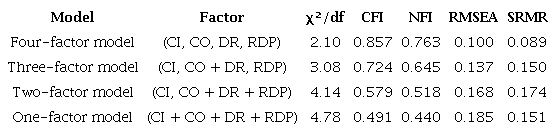
Note. IC = Informal controls; CO = Cooperation; RD = Relational difficulties; RRD = Resilience in role dependency. Source: Elaborated by the Authors.
The four-factor model presents the best fit among all the models, with a χ²/df ratio of 2.10, a CFI of 0.857, an NFI of 0.763, and an RMSEA of 0.100, which is reasonable. The three-factor, two-factor, and one-factor models performed significantly worse, especially in these indices, indicating that the four-factor solution is the most appropriate for the data. Therefore, the absence of serious common method bias can be inferred from the fact that the one-factor model shows a significantly worse fit than the four-factor model, suggesting that the data are better represented by multiple distinct factors rather than a single common factor (Sun et al., 2023).
In addition to the common method bias analysis, potential distortions from non-response bias were also analyzed by comparing the means between the first 10% and the last 10% of respondents (Gomez-Conde et al., 2021). The application of the t-test revealed no significant differences (p < 0.05) in the means of the responses to the questionnaire items between early and late respondents. Therefore, the presence of these biases in the data analysis is unlikely.
The letter attached to the questionnaire also ensured the anonymity of the respondents and their companies. Therefore, the research was exempted from registration and evaluation in the Research Ethics Committee (Comitê de Ética em Pesquisa - CEP) and National Commission for Research Ethics (Comissão Nacional de Ética em Pesquisa - CONEP) system, according to item XIV, article 2, of Resolution CNS No. 510/2016, which allows for such exemption in research that invites participants, with no requirement for identification, to express the meaning they attribute to topics, actions of people, and organizations.
Data analysis procedures
For data analysis, descriptive analysis techniques and exploratory factor analysis were initially used. Subsequently, to test the proposed hypotheses, structural equation modeling (SEM) was employed, estimated via partial least squares (PLS) using the SmartPLS 4 software. In PLS-SEM, the procedures recommended by Guenther et al. (2023) and Hair et al. (2022), were followed to assess the model’s adequacy and measure the significance of the relationships between latent variables (Hair et al., 2022).
In the mediation analysis, situations of presence or absence are presented (Hair et al., 2022). Absence occurs when the direct effect is significant and the indirect effect is not, as well as when both direct and indirect effects are not significant. Presence occurs when both direct and indirect effects are significant and act in the same direction (complementary) or opposite directions (competitive), or when only the indirect effect is significant (indirect). The mediating effect was analyzed through the total indirect effects of SmartPLS (Hair et al., 2022).
RESULTS ANALYSIS
Measurement model and descriptive statistic
In the measurement model, the validity and reliability criteria of the proposed model were initially analyzed (Hair et al., 2022). It was necessary to remove two items from the model - one from the cultural control construct (CC2) and another from the cooperation construct (CO1) - due to their factor loadings being below the established minimum (≥0.708) (Guenther et al., 2023; Hair et al., 2022). Table 2 presents the validity and reliability results of the model.
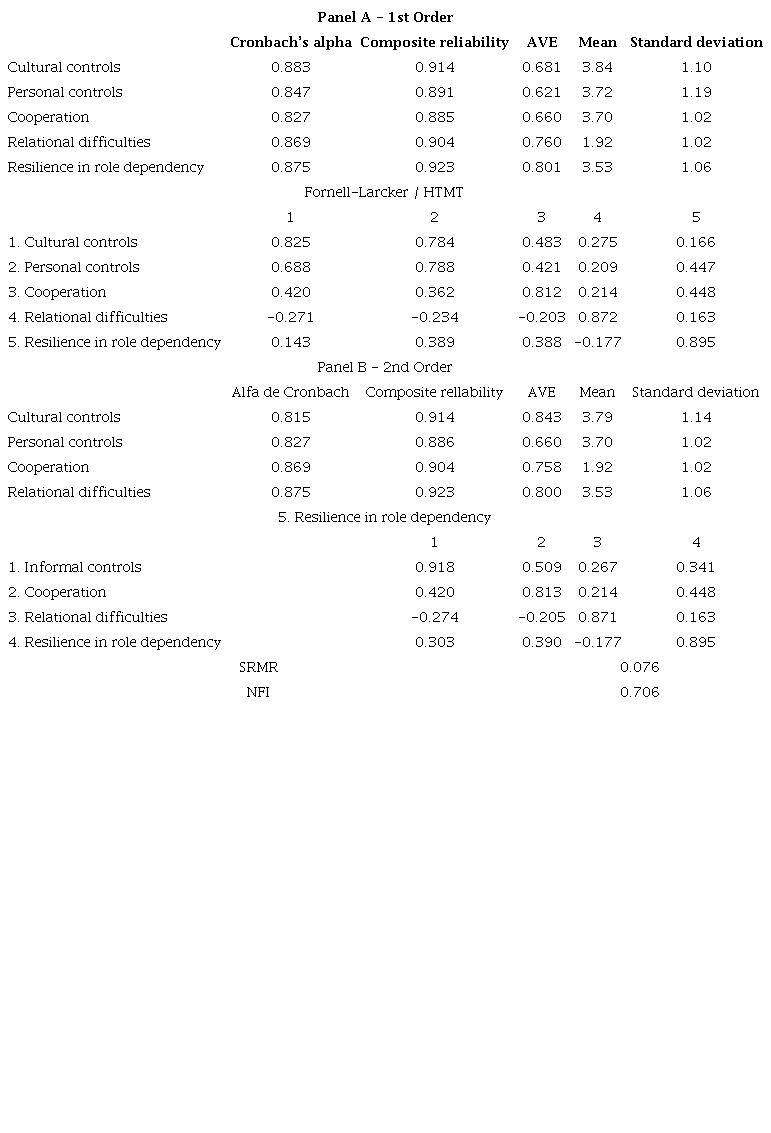
Note. N = 113. Source: Elaborated by the authors.
In the measurement model analysis, it is necessary to consider the results of the first-order model (validity and reliability), as second-order variables depend on first-order latent variables to be properly estimated (Panel A) (Hair et al., 2022). The second-order analysis was operationalized with two-step procedures (Hair et al., 2022), considering the factor scores of each dimension (cultural controls and personal controls) as components of informal controls (Panel B).
The results indicate reliability, with composite reliability and internal consistency (Cronbach’s alpha) values higher than the recommended minimum (>0.70) (Hair et al., 2022). They also indicate that the variables are adequate regarding convergent validity, as the AVE values are greater than 0.50 (Hair et al., 2022). Using the Fornell-Larcker criterion (bold and lower values) and HTMT (higher values), discriminant validity is confirmed, as the correlation values between the same variables are higher than those between different variables (Fornell-Larcker), and HTMT values are within the 0.90 threshold (Hair et al., 2022).
The analysis of the variance inflation factors (VIF) indicates the absence of multicollinearity among the latent variables, as the values range from 1.00 to 3.26, all below 5 (Hair et al., 2022). Using the standardized root mean square residual (SRMR < 0.08) and the normed fit index (NFI), the model fit is evident (Guenther et al., 2023). The results of the measurement model are adequate, allowing the testing of hypotheses.
Structural model and hypothesis testing
For hypothesis testing (Table 3), bootstrapping analysis was conducted with 10,000 resamples, a bias-corrected and accelerated interval, and a two-tailed test at the 5% significance level (Guenther et al., 2023; Hair et al., 2022).
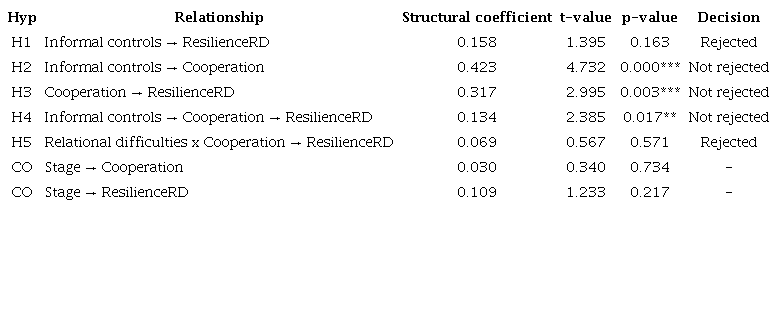
Note. ** p < 0,05; *** p < 0,01.Where: CO = Control; ResilienceRD = Resilience in role dependency. Structural model evaluation (R2): Resilience in role dependency = 0.197; Cooperation = 0.177. Predictive relevance (Q²): Resilience in role dependency = 0.057; Cooperation = 0.136. Source: Research data.
The model presents a coefficient of determination (R²) of 19.7% for resilience in role dependency and 17.7% for cooperation. The predictive relevance (Q²) shows results above zero, which attests to the accuracy of the model (Hair et al., 2022).
The structural coefficients show that there is no direct relationship between informal controls and resilience in role dependency (p>0.05), leading to the rejection of H1. However, informal controls have direct effects on cooperation, and cooperation has a direct effect on resilience in role dependency, both with a positive and significant relationship (p < 0.01), which supports not rejecting hypotheses H2 and H3.
The mediating effect of cooperation in the relationship between informal controls and resilience is statistically significant (p < 0.05), which allows for not rejecting H4. This indicates an indirect mediation, meaning there is only an effect of informal controls on resilience with the inclusion of the cooperation variable. However, the moderating effect of relational difficulties in the relationship between cooperation and resilience in role dependency did not show significance (p > 0.05), leading to the rejection of H5.
Finally, the analysis of control variables does not support a relationship between the incubation stage of the company and cooperation, nor between the incubation stage of the company and resilience in role dependency (p > 0.05), suggesting that the incubation stage does not interfere with cooperation or resilience in role dependency.
Discussion of results
H1, which predicted a positive direct influence of informal controls on resilience in role dependency, did not show statistical significance, leading to its rejection. This finding contrasts with previous literature (e.g., Beuren & Santos, 2019; Beuren et al., 2020; Bracci & Tallaki, 2021; Frare et al., 2023), which found a direct influence of informal controls on resilience. One possible explanation for this is the segregated analysis of the dimensions of resilience, contrasting with the joint analysis carried out in those studies. Moreover, other variables may intervene in the relationship between informal controls and resilience in role dependency, a gap that should be considered in future research.
H2, which predicted a positive influence of informal controls on cooperation, was statistically supported and not rejected. This result aligns with previous studies (e.g., Langfield-Smith, 1997; Mahama, 2006; Pazetto & Beuren, 2022; Xu et al., 2014), which highlighted the relevance of controls for cooperation in different contexts and perspectives. Informal controls can create an environment of trust and a sense of belonging (Mahama, 2006; Pazetto & Beuren, 2024), which facilitates cooperation (Lotfi & Larmour, 2022; Wieland & Wallenburg, 2013). This is particularly relevant in incubators, accessed by startups to support their businesses, which foster support networks, frequent interaction, and knowledge exchange (Lotfi & Larmour, 2022). In this context, informal controls provide a balance between freedom and responsibility (Frare & Beuren, 2021).
H3, which predicted a positive and significant influence of cooperation on resilience in role dependency, was confirmed, supporting not rejecting it. This finding aligns with Lofti and Larmour (2022) and with Wieland and Wallenburg (2013), who found a positive relationship between relational aspects and resilience in supply chain contexts. Cooperation creates an environment of support and exchange, reduces conflicts (Zhang et al., 2023), and fosters resilience development (Lowe, 1997), which is particularly important in situations where individuals need to deal with challenges and adversity (Lotfi & Larmour, 2022). Intra-organizational cooperation enables members to feel more supported in facing challenges and adapting to changes (Shahzad et al., 2020). Startups that cooperate create a supportive environment and are better able to adapt, transfer responsibilities, and innovate in how they perform dependent roles (Frare & Beuren, 2021; Ries, 2011).
H4, which predicted a mediating effect of cooperation in the relationship between informal controls and resilience in role dependency, was supported, showing indirect mediation. This reinforces the idea that the relationship between informal controls and resilience in role dependency involves other variables to become significant - in this case, cooperation (Lotfi & Larmour, 2022; Pazetto & Beuren, 2022). Informal controls operate indirectly, influencing behaviors and attitudes (Pazetto & Beuren, 2022; Xu et al., 2014), and impacting resilience. Controls can encourage employees to cooperate, and through this, they can support resilience development, promoting sharing, collaboration, and mutual support (Zhou et al., 2023). Cooperation acts as a catalyst that enhances informal controls, facilitating mutual support (Frare & Beuren, 2021; Wieland & Wallenburg, 2013).
H5, which conjectured a moderating effect of relational difficulties on the relationship between cooperation and resilience in role dependency, was not confirmed, leading to its rejection. Relational difficulties can affect how people cooperate (Dias et al., 2020) and relate (Lowe, 1997; Zhang et al., 2023), but they do not necessarily moderate the relationship between cooperation and resilience in role dependency. Common goals and rapid adaptation can help overcome challenges in startups (Santos et al., 2023; Taylor et al., 2019). Relational difficulties may vary in their relationship with other variables and in other contexts (Luiz et al., 2024), such as the moderation confirmed by Pazetto and Beuren (2022) on cooperation in technology parks.
The incubation stage of the company as a control variable in cooperation and resilience in role dependency was not significant. One possible explanation is that cooperation and resilience may occur regardless of the incubation stage the startup is in (Bedford, 2015; Frare et al., 2023). Although the size of a startup may indirectly influence cooperation (Bedford, 2015) and resilience through factors such as organizational structure (Frare et al., 2023), it is presumed that these characteristics are more influenced by the management and focus of the startup. Therefore, regardless of its incubation stage, a startup can enhance the resilience of individuals and the organization and promote cooperation to increase its competitiveness.
FINAL CONSIDERATIONS
Conclusions
The results of the research revealed that informal controls do not have a direct effect on resilience in role dependency, only on cooperation, and in turn, cooperation has an effect on resilience in role dependency. A mediating effect of cooperation was observed in the relationship between informal controls and resilience in role dependency. However, no moderating effect of relational difficulties was found in the relationship between cooperation and resilience in role dependency. It is concluded that resilience in role dependency can be triggered by informal controls, provided that the intervention of cooperation occurs. Therefore, startups need to stimulate cooperation to neutralize or reduce the impact of informal controls by fostering resilience in the face of adversity. These findings may have implications for the literature and provide insights for startups, especially by offering a deeper understanding of the potential of informal controls and cooperation to trigger resilience in role dependency in turbulent and disruptive contexts.
Practical and theoretical implications
The study highlights four main implications for the managerial literature. First, although different types of controls were compared with different types of resilience, the study contributes to the gap regarding the impact of various forms of resilience in startups (e.g., Beuren et al., 2020; Bracci & Tallaki, 2021; Frare et al., 2023). It adds to the literature by revealing that, for the relationship between informal controls and resilience in role dependency to be significant in the context of incubated startups, the intervention of cooperation is necessary (Lotfi & Larmour, 2022). Second, the findings suggest that, despite the importance of resilience in the startup context (Noelia & Rosalia, 2020), other variables may play a role in the relationship between informal controls and resilience in role dependency. Third, it contributes to the current literature by empirically showing that controls can direct employees toward cooperation - a relationship that had been underexplored (Pazetto & Beuren, 2024). Fourth, it supports research aimed at analyzing the antecedents of resilience in startups, an area in need of further studies (Frare & Beuren, 2021; Haase & Eberl, 2019; Zhou et al., 2023).
The results also have implications for the managerial practice of startups. The dynamic context, constraints, and challenges that typically involve these companies require their managers to develop adequate levels of resilience in role dependency, which can be achieved with the support of informal controls and the intervention of cooperation. Team leaders can create an environment conducive to cooperation by establishing informal controls with the intention of modeling desired behaviors and, at the same time, building a resilient and adaptable organization. In small companies, such as startups, the manager usually knows the team’s capabilities to overcome obstacles and share knowledge, which is essential for building individual, team, and organizational resilience. The findings provide evidence that can guide managers in leveraging behaviors in favor of the organization. Incubators can consider the findings of this research to develop policies and actions that facilitate cooperation among incubated startups in order to accelerate the incubation stage and support new businesses.
Limitations
The results of the research should be considered in light of its limitations. First, methodological choices are highlighted, which prevent generalizations. This study conducted a cross-sectional survey for data collection. Future research could consider longitudinal data or methods different from those employed here. The study used data from a single source, collected at one point in time, which could introduce biases. Although common variance and method bias do not present concerns, other data collection methods could be adopted, such as interviews, to further investigate the phenomenon under study. The study focuses on resilience in role dependency, so other approaches to resilience could be explored. Given the context of startups, future studies may analyze whether this applies to other business settings in order to determine if these results are affected by the locus of the research. Other methods and data analysis techniques could be used in future research to compare the findings of this study, and the technique used could also be combined (e.g., with fuzzy logic).
Acknowledgements
The authors thank the ad hoc reviewers of the manuscript and the editor for their constructive comments and guidance and appreciate the useful comments received from participants of the 14th UFSC Congress of Controllership and Finance (14º Congresso UFSC de Controladoria e Finanças) and the XLVIII ANPAD Meeting (XLVIII Encontro da ANPAD - EnANPAD 2024).
REFERENCES
Bedani, M., & Veiga, H. M. D. S. (2015). Práticas organizacionais: uma contribuição teórica. Gerais: Revista Interinstitucional de Psicologia, 8(2), 428-442. https://pepsic.bvsalud.org/scielo.php?script=sci_arttext&pid=S1983-82202015000300011
Bedford, D. S. (2015). Management control systems across different modes of innovation: implications for firm performance. Management Accounting Research, 28, 12-30. https://doi.org/10.1016/j.mar.2015.04.003
Bertolami, M., Artes, R., Gonçalves, P. J., Hashimoto, M., & Lazzarini, S. G. (2018). Survival of nascent firms: effects of human and social capital, management practices, and gender. Revista de Administração Contemporânea, 22(3), 311-335. https://doi.org/10.1590/1982-7849rac2018160121
Beu, D. S., & Buckley, M. R. (2004). Using accountability to create a more ethical climate. Human Resource Management Review, 14(1), 67-83. https://doi.org/10.1016/j.hrmr.2004.02.004
Beuren, I. M., & Santos, V. (2019). Enabling and coercive management control systems and organizational resilience. Revista Contabilidade & Finanças, 30(81), 307-323. https://doi.org/10.1590/1808-057x201908210
Beuren, I. M., Santos, V., & Bernd, D. C. (2020). Effects of the management control system on empowerment and organizational resilienceEfeitos do sistema de controle gerencial no empowerment e na resiliência organizacional. BBR. Brazilian Business Review, 17(2), 211-232. https://doi.org/10.15728/bbr.2020.17.2.5
Bouncken, R. B., Pesch, R., & Kraus, S. (2015). SME innovativeness in buyer-seller alliances: effects of entry timing strategies and inter-organizational learning. Review of Managerial Science, 9, 361-384. https://doi.org/10.1007/s11846-014-0160-6
Bracci, E., & Tallaki, M. (2021). Resilience capacities and management control systems in public sector organisations. Journal of Accounting and Organizational Change, 17(3), 332-351. https://doi.org/10.1108/JAOC-10-2019-0111
Cannon, J. P., & Perreault, W. D. Jr. (1999). Buyer-seller relationships in business markets. Journal of Marketing Research, 36(4), 439-460. http://dx.doi.org/10.2307/3151999
Chenhall, R. H. (2003). Management control systems design within its organizational context: findings from contingency-based research and directions for the future. Accounting, Organizations and Society, 28(2-3), 127-168. https://doi.org/10.1016/S0361-3682(01)00027-7
Davila, A., & Foster, G. (2009). The adoption and evolution of management control systems in entrepreneurial companies: evidence and a promising future. In Chenhall, R. H. (Ed). Handbooks of management accounting research (3 ed. pp. 1323-1336). Elsevier.
Demo, G., Neiva, E. R., Coura, K. V., Gomide, S., Jr., & Costa, A. C. R. (2022). Do organizational virtues enhance work well-being? the mediator role of HRM practices. Revista de Administração Contemporânea, 26(6), e200144. https://doi.org/10.1590/1982-7849rac2022200144.en
Dias, J. S., Rocha, L. P., Carvalho, D. P. D., Tomaschewski-Barlem, J. G., Barlem, E. L. D., & Gutierres, E. D. (2020). Saúde, comportamento e gestão: Impactos nas relações interpessoais. Texto & Contexto-Enfermagem, 29, e20190057. https://doi.org/10.1590/1980-265X-TCE-2019-0057
Fisher, G., Stevenson, R., Neubert, E., Burnell, D., & Kuratko, D. F. (2020). Entrepreneurial hustle: navigating uncertainty and enrolling venture stakeholders through urgent and unorthodox action. Journal of Management Studies, 57(5), 1002-1036. https://doi.org/10.1111/joms.12584
Frare, A. B., & Beuren, I. M. (2021). Job autonomy, unscripted agility and ambidextrous innovation: Analysis of Brazilian startups in times of the Covid-19 pandemic. Revista de Gestão, 28(3), 263-278. https://doi.org/10.1108/REGE-01-2021-0005
Frare, A. B., & Beuren, I. M. (2023). The role of informal controls in a green innovative setting: Evidence from Brazilian AgTechs. Journal of Management Control, 34(4), 489-522. https://doi.org/10.1007/s00187-024-00367-4
Frare, A. B., Leite, F. K., Cruz, A. P. C. D., & D’Avila, L. C. (2023). Management control mechanisms, environmental unpredictability and organizational resilience. Revista Contabilidade & Finanças, 34(91), e1677. https://doi.org/10.1590/1808-057x20221677.en
Goebel, S., & Weißenberger, B. E. (2017). The relationship between informal controls, ethical work climates, and organizational performance. Journal of Business Ethics, 141(3), 505-528. https://doi.org/10.1007/s10551-015-2700-7
Gomez-Conde, J., Lopez-Valeiras, E., Malagueño, R., & Gonzalez-Castro, R. (2021). Management control systems and innovation strategies in business-incubated start-ups. Accounting and Business Research, 53(2), 210-236. https://doi.org/10.1080/00014788.2021.1986365
Guenther, P., Guenther, M., Ringle, C. M., Zaefarian, G., & Cartwright, S. (2023). Improving PLS-SEM use for business marketing research. Industrial Marketing Management, 111, 127-142. https://doi.org/10.1016/j.indmarman.2023.03.010
Haase, A., & Eberl, P. (2019). The challenges of routinizing for building resilient startups. Journal of Small Business Management, 57, 579-597. https://doi.org/10.1111/jsbm.12511
Hair, J. F., Hult, G. T. M., Ringle, C. M., & Sarstedt, M. (2022). A primer on partial least squares structural equation modeling (PLS-SEM) (3 ed.). Sage.
Hillmann, J. (2021). Disciplines of organizational resilience: contributions, critiques, and future research avenues. Review of Managerial Science, 15(4), 879-936. https://doi.org/10.1007/s11846-020-00384-2
Khan, Z., Rao-Nicholson, R., Akhtar, P., Tarba, S. Y., Ahammad, M.F., & Vorley, T. (2019). The role of HR practices in developing employee resilience: A case study from the Pakistani telecommunications sector. International Journal of Human Resource Management, 30(8), 1342-1369. https://doi.org/10.1080/09585192.2017.1316759
Kleine, C., & Weißenberger, B. E. (2014). Leadership impact on organizational commitment: The mediating role of management control systems choice. Journal of Management Control, 24(3), 241-266. https://doi.org/10.1007/s00187-013-0181-3
Langfield-Smith, K. (1997). Management control systems and strategy: A critical review. Accounting, Organizations and Society, 22(2), 207-232. https://doi.org/10.1016/S0361-3682(95)00040-2
Lengnick-Hall, C. A., Beck, T. E., & Lengnick-Hall, M. L. (2011). Developing a capacity for organizational resilience through strategic human resource management. Human Resource Management Review, 21(3), 243-255. https://doi.org/10.1016/j.hrmr.2010.07.001
Lengnick-Hall, C. A., & Beck, T. E. (2009). Resilience capacity and strategic agility: Prerequisites for thriving in a dynamic environment. UTSA, College of Business.
Linnenluecke, M. K. (2017). Resilience in business and management research: A review of influential publications and a research agenda. International Journal of Management Reviews, 19(1), 4-30. https://doi.org/10.1111/ijmr.12076
Lotfi, M. & Larmour, A. (2022). Supply chain resilience in the face of uncertainty: how horizontal and vertical collaboration can help?. Continuity & Resilience Review, 4(1), 37-53. https://doi.org/10.1108/CRR-04-2021-0016
Lowe, K. B. (1997). Team diversity and leadership: Tests of model of process and direct effects. Florida International University.
Luiz, T. T., Frare, A. B., & Beuren, I. M. (2024). Does enabling control systems and relational capabilities foster conflict management in innovation ecosystems?. Journal of Business & Industrial Marketing, 39(4), 808-821. https://doi.org/10.1108/JBIM-05-2022-0213
Luthans, F., Avey, J. B., Avolio, B. J., & Peterson, S. J. (2010). The development and resulting performance impact of positive psychological capital. Human Resource Development Quarterly, 21(1), 41-67. https://doi.org/10.1002/hrdq.20034
Luthar, S. S., Cicchetti, D., & Becker, B. (2000). The construct of resilience: a critical evaluation and guidelines for future work. Child Development, 71(3), 543-562. https://doi.org/10.1111/1467-8624.00164
Madni, A. M., & Jackson, S. (2009). Towards a conceptual framework for resilience engineering. IEEE Systems Journal, 3(2), 181-191. https://doi.org/10.1109/JSYST.2009.2017397
Mahama, H. (2006). Management control systems, cooperation and performance in strategic supply relationships: A survey in the mines. Management Accounting Research, 17(3), 315-339. https://doi.org/10.1016/j.mar.2006.03.002
Mallak, L. A. (1998). Measuring resilience in health care provider organizations. Health Manpower Management, 24(4), 148-152. https://doi.org/10.1108/09552069810215755
March-Chorda, I. (2004). Success factors and barriers facing the innovative start-ups and their influence upon performance over time. International Journal of Entrepreneurship and Innovation Management, 4(2-3), 228-247. https://doi.org/10.1504/IJEIM.2004.004758
Merchant, K. A., & Otley, D. T. (2007). A review of the literature on control and accountability. In C. S. Chapman, A. G. Hopwood, & M. D. Shields (Eds). Handbook of Management Accounting Research (pp. 785-802). Elsevier.
Noelia, F. L., & Rosalia, D. C. (2020). A dynamic analysis of the role of entrepreneurial ecosystems in reducing innovation obstacles for startups. Journal of Business Venturing Insights, 14, e00192. https://doi.org/10.1016/j.jbvi.2020.e00192
Pazetto, C. F., & Beuren, I. M. (2022). Control systems and interorganizational identification in technology parks cooperation. Revista Contabilidade & Finanças, 33(88), 13-28. https://doi.org/10.1590/1808-057x202113020
Pazetto, C. F. & Beuren, I. B. (2024). Does the information timeliness and trust promote interorganizational cooperation? The Journal of High Technology Management Research, 33(1), 10049. https://doi.org/10.1016/j.hitech.2024.100493
Podsakoff, P. M, MacKenzie, S. B., & Podsakoff, N. P. (2012). Sources of method bias in social science research and recommendations on how to control it. Annual Review of Psychology, 63(1), 539-569. https://doi.org/10.1146/annurev-psych-120710-100452
Ries, E. (2011). The lean startup: How today’s entrepreneurs use continuous innovation to create radically successful businesses. Crown Currency.
Santos, V., Beuren, I. M., Bernd, D. C., & Fey, N. (2023). Use of management controls and product innovation in startups: Intervention of knowledge sharing and technological turbulence. Journal of Knowledge Management, 27(2), 264-284. https://doi.org/10.1108/JKM-08-2021-0629
Seepana, C., Paulraj, A., & Huq, F. A. (2020). The architecture of coopetition: Strategic intent, ambidextrous managers, and knowledge sharing. Industrial Marketing Management, 91, 100-113. https://doi.org/10.1016/j.indmarman.2020.08.012
Seligman, M., & Csikszentmihalyi, M. (2000). Positive psychology: An introduction. The American Psychologist, 55, 5-14. https://doi.org/10.1037/0003-066X.55.1.5
Shahzad, K., Ali, T., Kohtamäki, M., & Takala, J. (2020). Enabling roles of relationship governance mechanisms in the choice of inter-firm conflict resolution strategies. Journal of Business & Industrial Marketing, 35(6), 957-969. https://doi.org/10.1108/JBIM-06-2019-0309
Shin, J., Taylor, M. S., & Seo, M. G. (2012). Resources for change: the relationships of organizational inducements and psychological resilience to employees attitudes and behaviors toward organizational change. Academy of Management Journal, 55(3), 727-748. https://doi.org/10.5465/amj.2010.0325
Smith, K. G., Carroll, S. J., & Ashford, S. J. (1995). Intra-and interorganizational cooperation: Toward a research agenda. Academy of Management Journal, 38(1), 7-23. https://www.jstor.org/stable/256726
Sun, J., Xie, X., Zhou, M., & Yan, L. (2023). How to drive green innovation of manufacturing SMEs under open innovation networks-the role of innovation platforms’ relational governance. Management Decision. Vol. ahead-of-print. https://doi.org/10.1108/MD-10-2022-1452
Taylor, D., King, R., & Smith, D. (2019). Management controls, heterarchy and innovation: a case study of a start-up company. Accounting, Auditing & Accountability Journal, 32(6), 1636-1661. https://doi.org/10.1108/AAAJ-11-2017-3208
Townsend, D. M., Hunt, R. A., McMullen, J. S., & Sarasvathy, S. D. (2018). Uncertainty, knowledge problems, and entrepreneurial action. Academy of Management Annals, 12(2), 659-687. https://doi.org/10.5465/annals.2016.0109
Wieland, A. & Wallenburg, C. M. (2013). The influence of relational competencies on supply chain resilience: A relational view. International Journal of Physical Distribution & Logistics Management, 43(4), 300-320. https://doi.org/10.1108/IJPDLM-08-2012-0243
Xu, G., Zhou, Y., Xu, L., & Li, S. (2014). Effects of control in open innovation: an empirical study of university-industry cooperation in China. International Journal of Technology, Policy and Management, 14(4), 346-363. https://doi.org/10.1504/IJTPM.2014.065010
Zhang, X., Wu, J., Zhang, N., & Xu, B. (2023). Conflicts, trust toward the acquirer from emerging economies and post-acquisition cooperation intention. International Journal of Emerging Markets, 18(9), 2839-2868. https://doi.org/10.1108/IJOEM-01-2021-0036
Zhou, Q., Edafioghor, T. E., Wu, C. H., & Doherty, B. (2023). Building organisational resilience capability in small and medium‐sized enterprises: The role of high‐performance work systems. Human Resource Management Journal, 33(4), 806-827. https://doi.org/10.1111/1748-8583.12479
Notes

Meurer, Silvana Mannes; Beuren, Ilse Maria, 2025, "Do Informal Controls and Cooperation Trigger Resilience in Role Dependence in Startups? published by RAC-Revista de Administração Contemporânea", Harvard Dataverse, V1. https://doi.org/10.7910/DVN/X2WIUT
RAC encourages data sharing but, in compliance with ethical principles, it does not demand the disclosure of any means of identifying research subjects, preserving the privacy of research subjects. The practice of open data is to enable the reproducibility of results, and to ensure the unrestricted transparency of the results of the published research, without requiring the identity of research subjects.
Author notes
Jorge Brantes Ferreira (Pontifícia Universidade Católica do Rio de Janeiro, Brazil) https://orcid.org/0000-0002-9579-4477
One reviewer did not authorize the disclosure of his/her identity.
* Corresponding Author
Conflict of interest declaration