2025
292
04062024
30032025
 Marcos André Soares Farias m.andrefarias@gmail.com
Universidade Federal do Rio Grande, Brazil
Márcio André Leal Bauer mlealbauer@gmail.com
Universidade Federal do Rio Grande, Brazil
ABSTRACT
Objective: in this study, we seek to understand, from a substantive perspective of analysis, the process of inclusion/exclusion of deaf individuals in organizations.
Theoretical approach: we introduce the discussion based on the inclusion-exclusion process and the need to listen to what included subjects have to say. As the results (essences) are presented, some important concepts are discussed: deaf culture, identity and ‘deafhood’; social organization; and communicational action. Taking the interactionist perspective as a basis, which highlights communication and intersubjectively shared language, the confrontation between the symbolic universes of the deaf and the hearing is brought into discussion as ultimate challenges to inclusion.
Method: we adopted phenomenology as a methodological horizon to analyze the deaf workers’ lived experience in an industrial unit of a multinational company.
Results: the study resulted in three essences: (a) work in its ontological dimension, as an opportunity to express the equality of the deaf in relation to the hearing; (b) the need for cultural exchange based on the communicational action between deaf and hearing individuals; and (c) the need for acceptance and belonging to the social organization.
Conclusion: we conclude by presenting the inclusion-exclusion process, in which the sharing of meanings, based on sign language, leads to integration into the social organization. Such integration allows for the recognition of work and full participation in organizational processes. The mediating element is communication, which can be a bridge or a barrier to inclusion and is mobilized through affective relationships between deaf and hearing people. From a substantive point of view, being included means, for the deaf person, having a recognized job, in which they can perform not only a task but also engage in a cultural exchange with hearing people, in order to participate in the daily social organization.
Keywords: Deaf people, substantive inclusion, diversity, organization.
RESUMO
Objetivo: compreender o processo de inclusão/exclusão do sujeito surdo nas organizações a partir de uma perspectiva substantiva de análise.
Marco teórico: introduzimos a discussão a partir do processo inclusão-exclusão nos estudos sobre diversidade. Apresentamos as especificidades da inclusão de surdos e discutimos conceitos importantes nesse processo. Tomando-se como base a perspectiva interacionista, que põe em relevo a comunicação e a linguagem intersubjetivamente partilhada, traz-se à discussão o confronto entre os universos simbólicos do surdo e do ouvinte como desafios últimos à inclusão.
Método: adotamos a fenomenologia para analisar a experiência vivida por um grupo de trabalhadores surdos em uma planta industrial de uma multinacional.
Resultados: o estudo resultou em três essências: (a) o trabalho em sua dimensão ontológica, como oportunidade de expressar a igualdade do surdo em relação ao ouvinte; (b) a necessidade de intercâmbio cultural a partir da ação comunicacional surdo-ouvinte; e (c) a necessidade de aceitação e pertencimento à organização social.
Conclusão: concluímos apresentando o processo de inclusão-exclusão, em que a partilha de significados, a partir da língua de sinais, leva à integração na organização social. Tal integração permite o reconhecimento do trabalho e a participação plena nos processos organizacionais. O elemento mediador é a comunicação, que pode ser ponte ou barreira à inclusão, sendo mobilizada a partir de relações afetivas entre surdo e ouvinte. Analisando de um ponto de vista substantivo, ser incluído é, para o surdo, ter um trabalho reconhecido, no qual possa realizar não apenas uma tarefa, mas também o intercâmbio cultural com o ouvinte, de modo a participar da organização social cotidiana.
Palavras-chave: Startups pessoas surdas, inclusão substantiva, diversidade, organização.
Theoretical-Empirical Article
Challenges to Substantive Inclusion in Organizations: A Phenomenological Study with Deaf People
Desafios à Inclusão Substantiva nas Organizações: Um Estudo Fenomenológico com Surdos
Marcos André Soares Farias m.andrefarias@gmail.com
Márcio André Leal Bauer mlealbauer@gmail.com
Received: 04 June 2024
Revised document received: 23 January 2025
Accepted: 30 March 2025
Published: 12 May 2025
James Charlton’s book from the late 1990s invoked an old motto of the Disabilities Rights Movement: Nothing about us without us. The author pointed out that attempts to theorize about the routines of people with disabilities were flawed and incomplete because they did not take into account realities in peripheral countries (Charlton, 1998).
More than 20 years later, Charlton’s criticism remains up to date, given the limitations and gaps observed in studies on diversity. The inclusion of people with disabilities in organizations remains a current academic issue (Fraga et al., 2022) and a relevant practical management challenge in contemporary times (Bispo, 2021). Studies that take into consideration the identity specificities of different categories (Nkomo et al., 2019) and that treat groups as subjects in the world to overcome a reified vision are still needed (Teixeira et al., 2021).
There is a call for more ‘inclusive’ organizational and managerial studies, mainly in the diversity field, aimed at assessing the inclusion of people with disabilities in order to find ways to overcome the ‘medical model’ perspective. This model sees disability as a negative element , (Dobusch, 2021, p. 381), to highlight limitations to the detriment of capabilities (Araújo & Silva, 2020; Beltrão & Brunstein, 2012; Reis et al., 2017; Rezende et al., 2016; Souza et al., 2017).
Accordingly, the aim of the present study was to understand deaf individuals’ inclusion/exclusion process in organizations from the perspective of a substantive analysis. In order to do so, it was necessary to assume deaf individuals as parenthetical subjects (Azevedo & Albernaz, 2006; Guerreiro Ramos, 1972) rather than (operational or reactive) objects of a system that includes them. These individuals seek to give meaning to their inclusion experience in a world of intersubjectively shared meanings (Correia, 2005; Schutz, 2012). More than pointing out the supposed prevalence of instrumental rationality in hiring deaf individuals through the Quota Law, the aim of using Guerreiro Ramos's (1989, 2022), approach in the study is to reach a truly substantive analytical level in which deafness is conceived as a social and identity construction (Cromack, 2004; Mauldin & Fannon, 2016). We analyze the experience lived by a group of deaf workers in an industrial facility of a multinational company from the chemical sector by following a line of studies that adopt phenomenology as a methodological design to investigate the universe of deaf individuals (see Meek, 2020; Stokar & Orwat, 2018; Wells et al., 2009). Just as in other studies, it was observed that communication is one of the main barriers to deaf individuals’ inclusion.
Just as in other studies, it was observed that communication is one of the main barriers to deaf individuals’ inclusion (Loxe et al., 2019; Reis et al., 2017; Viana & Irigaray, 2016; Wheeller-Scruggs, 2002), and it is explained by the lack of proficiency in sign language by hearing-oriented coworkers and managers. However, the experience herein analyzed allowed us to take steps ahead in the analysis and go beyond the focus on exclusion, as well as to point out processes and practices to achieve equality and inclusion (Bendl et al., 2024). From the perspective of a substantive analysis (Guerreiro Ramos, 1989, 2022), and according to deaf individuals’ opinions, being included in an organization means having their work acknowledged, as well as their ability to perform more than a single task, and the possibility of accomplishing cultural exchanges with hearing individuals in order to participate in social organization routines.
The next section addresses studies on diversity and inclusion that have assessed the deaf individual category in the world of organizations. It means discussing the deaf/hearing communication issue as a barrier to this population’s full inclusion in organizations. The following section provides details about the conducted phenomenological research. The last part of the present article is divided into three sections: the first one introduces the context of deaf individuals’ insertion in the assessed organization; the second section presents the evidence brought by deaf individuals; and the third one discusses the essence factors and their associations. The final considerations highlight that the case analyzed herein points toward important substantive dimensions of inclusion.
While discussions about ‘diversity’ regard belonging to groups other than the ‘dominant’ ones in society (Mor Barak, 2015). diversity management concerns these groups’ inclusion in the organization through their effective participation in decision-making processes and sense of belonging (Fraga et al., 2022). Therefore, these two concepts are related to each other, and this correlation has opened room for increasing interest in them. However, previous studies have provided more knowledge about exclusion experiences than about the mechanisms, processes, or practices aimed at promoting equality and inclusion (Bendl et al., 2024; Nkomo et al., 2019).
Nevertheless, some categories are often excluded from diversity studies - the so-called ‘other ‘Other” (Dobusch, 2014, 2021, p. 389, emphasis added) - and diversity groups belong to multiple categories (Dennissen et al., 2020). This scenario makes it necessary to take into consideration and respect the specificities of each category. It is so because situations that include some individuals may represent exclusion for others (Dobusch, 2014, 2021). Similarly, management practices and diversity policies can be contradictory and often have unpredictable consequences (Leslie, 2019).
This process is observed in several studies focused on the Brazilian Quota Law for People with Disabilities (Lunardi, 2012; Quadros, 2003; Ribeiro et al., 2009). Although quotas are necessary, they are not always enough to ensure individuals’ inclusion (Bahia & Schommer, 2010; Hoffmann et al., 2014), Special attention is required to the process taking place after the individual joins the organization (Souza et al., 2017). Some organizations argue that they provide this population with non-discriminatory treatment and, therefore, make these individuals responsible for their own inclusion by disregarding differences and the need for structural adaptation in order to create an effectively inclusive environment (Loxe et al., 2019; Souza et al., 2019). It is not uncommon to observe individuals assigned to low-complexity activities, at levels lower than those based on their formal schooling; therefore, their potential ends up unknown and underestimated (Miranda & Carvalho, 2016; Souza et al., 2019; Tanaka & Manzini, 2005) - These scenarios are also quite often experienced by deaf workers (Irigaray & Vergara, 2011; Ladd, 2003; Loxe et al., 2019).
They point out frustration due to lack of career-progression expectations - the so-called ‘glass ceiling’ (Irigaray & Vergara, 2011; Reis et al., 2017; Viana & Irigaray, 2016) -, and the feeling of being ‘imprisoned’ in simple tasks that pose few challenges and segregate this population from hearing colleagues. These individuals are afraid of leaving their jobs, although they feel underestimated in them, due to fear of not getting another one (Jammaers & Zanoni, 2021; Loxe et al., 2019; Viana & Irigaray, 2016; Wells et al., 2009).
Despite the historical struggles of the Deaf Movement for the so-called deaf citizenship, which seeks to overcome disability (whose target is the discourse based on ‘hearing-centered’1 ‘representations’ and on ‘normalization’ attempts) in favor of ‘difference’ (the recognition of the deaf culture and identity) (De Clerck, 2010; Kauchakje, 2003; Klein, 2013; Ladd, 2003; Perlin & Miranda, 2003; Sá, 2002; Skliar, 2013; Witkoski, 2015; Wrigley, 1996), in the labor market, deaf individuals are still seen through the lens of ‘ableism’ (Jammaers & Zanoni, 2021). These individuals end up facing “contempt for being disabled and devalued for being ‘different’” when interacting with hearing people in the work environment (Reis et al., 2017, p. 191), It happens in such a way that listeners’ gaze and the ‘disabled’ label are embodied by deaf individuals (Witkoski, 2015), Thus, this process reinforces stigmatization (Araújo & Silva, 2020; Goffman, 1988; Stokar & Orwat, 2018; Viana & Irigaray, 2016).
Communication barriers (Loxe et al., 2019; Reis et al., 2017; Viana & Irigaray, 2016; Wheeller-Scruggs, 2002) seem to limit deaf individuals’ full inclusion in the organization. This is reinforced by the passive attitude of hearing coworkers, who expect the company to adopt measures aimed at making instrumental communication easier (visual signaling, captioned video conferences). On the other hand, they exempt themselves from the responsibility for any initiative, such as learning to communicate with deaf coworkers through signs (Foster & McLeod, 2003; Punch et al., 2007). Consequently, deaf individuals end up ‘forgotten’; they are not invited to participate in activities like work meetings without interpreters (Wells et al., 2009).
This barrier, and the fact that Portuguese is a foreign language to deaf individuals, make social isolation common for this population. These individuals end up feeling like ‘outsiders’ and alone, whether in functional situations, in informal moments at work (Loxe et al., 2019; Viana & Irigaray, 2016) or even in the family environment (Meek, 2020).
The feeling of being a kind of ‘foreigner in one’s own country’ (Viana & Irigaray, 2016, p. 224) tseems to be the best way to describe deaf individuals’ exclusion experience. When foreigners arrive in unknown places, even if they are already inserted in them, they are not part of such a community’s sign system; therefore, they end up socially isolated. It happens because a group’s symbolic universe, once created and established, influences its entire social fabric (Correia, 2005; Schutz, 2012). The idea of addressing the deaf individuals’ exclusion issue from this perspective can open room for inclusion possibilities.
The essential elements for substantive inclusion were disclosed by trying to understand the symbolic universe of deaf individuals. Empirical research has shown that many aspects brought up by deaf people are closely related to the so-called “blind spots of organizational analysis” addressed by Guerreiro Ramos (1989, 2022), Accordingly, work, in its ontological and integral dimension, opposes the merely functional vision; it emphasizes the relevance of symbolic interaction rather than pure instrumental communication; and views organizations as something that goes beyond their formal/functional (economic, legal or contractual) meaning.
Guerreiro Ramos, by using Herbert Blumer as a reference, brings up an essential point of understanding by questioning the space where individuals will be included - in other words, the organization. This is not something external that determines and encourages actions, but the framework where social action takes place. Both organizations and changes within them are the very product of individuals’ activities, rather than forces acting without taking them into account (Guerreiro Ramos, 1989, 2022; Blumer, 2005).
Therefore, inclusion is a substantive element that represents not only ‘inclusive practices’ in the formal organizational system but, foremost, individuals’ feeling of belonging to the organization, whether through formal or informal processes (Bendl et al., 2024; Mor Barak, 2017). Studies have highlighted the need for this feeling of belonging to social groups in order for individuals to achieve the sense of uniqueness and recognition experienced through inclusion (Dobusch, 2014; Jansen et al., 2014; Shore et al., 2018; Tyler, 2019).
This is not just about belonging to an informal work group, but about being accepted and part of the social organization in its broader sense. It represents a largely unconscious process, according to which the individual engaged in vital cooperation triggers the attitude of others while simultaneously adopting the attitude of other individuals involved in the same activity (Cooley, 1924; Mead, 1962).
Therefore, it is not enough to simply be engaged in actions aimed at achieving certain goals in order to feel included in the organization. It is necessary to be ‘co-oriented’ to others by complying with their ways of dealing with the ‘objective world’ while adjusting themselves to the ‘social world’ (Taylor & Robichaud, 2004, p. 7). Agents cooperatively try to adjust their action plans within a shared lifeworld based on common interpretations of different situations through linguistically mediated actions. They need to understand the validity of their communication actions within this process or take into account the assessed disagreements. This scenario opens room for criticizing validity claims that, in turn, shed light on an “intrinsic orientation towards intersubjective recognition” (Habermas, 2002, p. 111).
However, such an orientation presupposes the relationships among people who identify themselves as ‘us’ (Schutz, 2012; Weick, 1995), and it poses a challenge - namely, its possibility, given the different worlds in which deaf and hearing individuals find themselves within the organizational space.
According to Schutz (2012), just as men recognize the material existence of their fellow men as a presupposition, they also see the possibility of intercommunication and social organization. Thus, the ‘other’ is not simply recognized by its original presence, but by its ‘co-presence’. Therefore, people know each other through the communication environment as ‘counter-subjects’, rather than as objects.
Presumably, this happens because all previous events are, somehow, subjected to reconsideration and revision when communication takes place. According to Fraga (2009), citing Dewey, communication gives meaning to events. Therefore, human beings use words to establish living relationships with their fellow men. Thus, language is not a means (instrument) but a manifestation - a revelation of the psychic bond that unites us to the world and to our fellow men (Merleau-Ponty, 1999).
Accordingly, dialogue is essential to the feeling of co-presence between the self and the other (Fraga, 2009), and it goes beyond punctual understanding - it is the very recognition of the existence of the other as a similar entity (Merleau-Ponty, 1999; Schutz, 2012). Following this logic, the non-recognition of the other would imply the non-recognition of oneself.
In short, if language shapes the world and rationality itself (Mead, 1962; Silva, 2007), then reading the world through ready-made and pre-tested categories (based on ‘typifying schemes,’ in Schutz’s words) means this same language can hide more than it reveals, segregate rather than unite, and create distorted categories of perception about the other. This process raises issues for communication between deaf and hearing individuals, as it prevents symbolic interaction between them. This occurs because the rationalized world of life, in line with Habermas’s proposal, is immersed in hearing-oriented rationality (Witkoski, 2015) - that prevails in organizations and disregards sign language and the entire deaf culture (Loxe et al., 2019).
With regard to the present study, this scenario places a barrier between deaf and hearing individuals due to preconceptions about the deaf (considered disabled) and hearing-oriented universes (seen as ‘normal’). However, bridges to overcome this barrier can be glimpsed through the phenomenological analysis shown below.
Phenomenology, more than being a protocol, is an attitude toward the ‘object.’ It is the critical and interpretative reflection about conscious experiences oriented to the essential features of this consciousness (Dartigues, 1992; Goulding, 2005; Merleau-Ponty, 1999).The elucidation of phenomena and the clarification of their essence take place through the understanding of introduced experiences that must be purely described as they manifest themselves, without inference regarding their genesis or speculations about their cause (Berticelli, 2000; Gil, 2008). Therefore, although the main goal is to describe the adopted research procedures, this proposition opposes the idea that strict protocols guarantee rigor; instead, it emphasizes coherence in creating a reasoning path for theorization (Harley & Cornelissen, 2022).
The main source of material used in this study lies in what is given by the individuals based on what is in their consciousness (Gil, 2008), in other words, their ‘intentionality.’ It means that individuals’ consciousness moves toward this phenomenon through different modes, namely: perception of the real object, memories, created images, predicative or value judgment, among others (Husserl, 2001). Thus, objects are not investigated, but their representation in consciousness. Therefore, inclusion, as a phenomenon, needs to be uncovered by taking into consideration individuals’ intentionality.
The study was mostly guided by Alfred Schutz’s phenomenological sociology (Gill, 2014). EHowever, the method proposed by Sanders (1982), whose essential components are (a) determining what and who will be investigated, (b) data collection, and (c) data phenomenological analysis, was chosen for research operationalization purposes.
With respect to the ‘first component’ (a), the idea was to analyze deaf workers’ experience at the industrial facility of a multinational chemical company in Rio Grande do Sul (Brazil). Selection criteria included at least two years of work experience in the organization, which was considered sufficient time to acquire adaptation experience and to achieve good coexistence with both hearing-oriented coworkers and the company. However, these workers had to represent different areas in the company, whether managerial or operational. Three workers were chosen among the approximately twenty deaf individuals employed in different sectors of the company: two men (S1 and S3) and one woman (S2), with a mean age of 32 years. S1 and S2 had worked in the taxation/financial department for approximately six years. S3 was the one who had worked the longest at the company (seven years). Unlike the others, he had worked in more than one department and was currently working in the operational area.
The small number of interviewees, which was desirable to deeply capture the lived experiences and the structure of this phenomenon, was based on recommendations by Sanders (1982) and on previous studies about the universe of the deaf population (Loxe et al., 2019; Wells et al., 2009), These references prioritize richness in gathering reports to the extent that extracting the very essence of the phenomenon is clearly perceived.
As for the ‘second component’ (b), script-based interviews were conducted. There were a few open-ended questions designed to elicit memories or opinions about experiences lived by deaf individuals. These questions sought to describe these individuals’ work life experiences: from their entry into the labor market and the organization to their adaptation process and the difficulties they faced. In addition, the questions addressed interactions with hearing-oriented coworkers and managers, both inside and outside the work environment, as well as the deaf individuals’ perceptions of the communicative inclusiveness in the organization - or the lack thereof - given the ‘strangeness’ between spoken and signed languages, as well as comprehension tools. Memories of their first impressions and perceptions about interaction were compared to their current experiences and perceptions of inclusion as workers.
All interviews were conducted in Libras (Brazilian Sign Language), and the researcher’s proficiency in it was rated from basic to intermediate. This procedure allowed achieving authentic communication during in-depth interviews (Frechette et al., 2020), It was intended to ensure interviewees were understood and to avoid likely biases caused by incorrect signaling. Deaf workers did not have time limits in order to freely report their experiences after a topic was proposed. They were not interrupted, even when they strayed from the topic they had been prompted to, until they finished signing. Sometimes, they nodded positively after the report was over. Other times, they gave a thumbs-up or simply fixed their gaze on the interviewer and stopped signing. The aim of this time freedom was to capture interviewees’ experiences, concerns, and questions based on how they were lived.
This entire process was carried out in a specific room that was provided by the organization - only the researcher and the interviewee could be in the room during the interview. Immediate supervisors were asked not to set a time limit for the workers to return to work. The researcher was introduced to each interviewee by the facility’s Human Resources manager. A brief conversation followed, in which the research content and interview procedures were explained. This was followed by an invitation to the deaf worker to participate in the interview. Once the invitation was accepted, the interviewee received a Free and Informed Consent Form to sign, ensuring the confidentiality of the interview. Data such as name and image were preserved, and the video recording was used solely for transcription purposes.
Communicating in Libras with the interviewer was essential for building trust and encouraging participation in the research. This interaction was not mediated by a third party. Presumably, this procedure ensured an important intersubjective bond (Schutz, 1995) between interviewer and interviewee. From the outset, it was clear that the deaf individuals felt valued when they realized the research focused on their symbolic universe in the workplace. Interviewee S3, who intended to pursue a Business degree, showed particular interest in participating and gave an especially detailed and rich interview.
The interviews were recorded on a tablet, in video format, at the device's maximum resolution (1920x1080; 16:9) in order to clearly identifying the signs. The tablet was positioned on a table, approximately 70 cm from the interviewee, in such framing to allow capturing participants’ facial expressions and hand movements. Participants sat right in front of the researcher. The transcriptions were made by mirroring the tablet on a 49-inch television, for better viewing. The reports lasted 23.5 minutes, on average.
The interview sentences and transcripts were prepared with the assistance of a Brazilian sign language translator and interpreter certified through the PROLIBRAS proficiency program. The interviews were translated into Portuguese with careful attention to preserving the original signaled expressions, although some sentence constructions appeared confusing due to syntactic differences between Portuguese and Libras. The support of a proficient translator helped ensure accurate understanding of the answers and minimized the risk of misinterpretations.
Finally, the ‘phenomenological report analysis’ (c) involved initially identifying core topics that emerged from the descriptions (common elements or meaning units) and compiling them into sets of essences that characterize the structure of the phenomenon as an effort to intuitively grasp what is being examined (Gill, 2014; Holanda, 2006; Moreira, 2002). This principle distinguishes phenomenological analysis from thematic content analysis, for example. The process of uncovering the essences of the phenomenon can be understood as a cycle in which material is collected, analyzed, and essence is captured based on the researcher’s intuition and understanding of the phenomena. This process may be restarted - or not - to assess whether new essences emerge. The researcher must remain immersed in the phenomenon and the life-world of the individuals under study. However, the researcher must also emerge from this immersion to intuitively understand the phenomenon in their broader life-world (Coltro, 2000; Moreira, 2002).
Therefore, the effort to present something that was uncovered through analysis and intuition will be described in the phenomenological analysis, although it is shown as a sequential rite in the movements of ‘immersion’ and ‘emergence’ from the phenomenon. It is important to note that the concept of intuition here differs from that of common sense2. According to Husserl (2006), it is the ability to directly apprehend the essence - that is, the possibility of grasping a meaning through an individual’s imaginative capacity, which goes beyond sensory experience. This is so because ideas or ideal objects are at stake. Thus, intuition was defined as an essential part of the investigative process, which enables the application of phenomenology and the capture of the addressed essences through the researcher’s movement of immersion in and emergence from the phenomenon.
Accordingly, the long analysis period - from the collection of reports in 2017 to the final version of this manuscript - demanded the bracketing of contextual and contingent elements to enable a close association between the essences of the phenomenon. Elements emerging from significant eidetic reduction (essences) do not have an expiration date or fixed duration that would render the continued discussion of the findings unfeasible. This is the stage when the researcher orients their consciousness toward the phenomenon (intentionality) in order to intuitively discern what presents itself as essential. This process aimed to deepen reviews of studies on the inclusion of deaf individuals in workplaces. It also enabled a distancing from the natural attitudes of hearing-oriented individuals when confronted with the unfamiliar deaf universe. This was done to reflect on the coherence of the observed essences in light of conclusions from other studies. These comparisons are discussed in the next section, and they transform the deaf individuals’ reports from mere elements of a particular reality into indicators for understanding the inclusion/exclusion process briefly presented in the final considerations section. It is worth noting that the phenomenological method advocates for the absence of assumptions, but not the absence of theory (Husserl, 2006) or research - which, in turn, allows for the emergence of different perspectives on the assessed phenomenon.
This is the case of the research by Silva (2016)3, previously conducted in the same company as the current study, under the supervision of one of the present authors. It helped contextualize the inclusion experiences of the group of deaf individuals analyzed, as will be seen follow.
At the time of the current research, most deaf individuals had joined the company through an internship program after attending a course offered by SENAC (National Commercial Apprenticeship Service) in partnership with the company. These individuals reported not having gone through a traditional selection process based on interviews and résumé evaluation. Such a process would have allowed them to learn more about the department/function they would be working in and who their managers would be. They also did not undergo any integration process promoted by the company.
Slowly, they were sent to different departments, as long as their deafness did not pose any risk to them. “After a while, a month and a few days, they chose the position I would occupy. However, there was no activity for me to perform in this position. Over time, I began to ask for activities” (report by a deaf interviewee, see Silva, 2016, p. 49).
The company chose some people to act as ‘facilitators’ or as a kind of ‘godfather/godmother’ who had attended a basic Libras course. This hearing-oriented person would accompany the deaf individuals’ learning process until they had learned the work they would be assigned to. However, the deaf professionals would often need to teach basic Libras to their coworkers in order to communicate with them. “I taught the signs, and people were interested in learning. I explained the visual aspect and they gave me tips and strategies” (report by a deaf interviewee; see Silva, 2016, p. 49).
Nevertheless, sometimes deaf individuals could not make themselves understood. It was common for hearing-oriented people to feel quite insecure and nervous, and this was noticed by deaf individuals. Therefore, actions such as typing words on the computer screen and mimicking were widely used by hearing-oriented people, including those who had taken Libras classes. A few classes did not provide enough vocabulary or experience to ensure satisfactory communication, as is the case with any other language.
However, the manager of an administrative department became interested in learning Libras. She invested in purchasing equipment to make communication easier and ended up becoming a reference for deaf individuals in the department. In addition, another manager provided an internal Libras course to organization employees who were interested in it. Later on, at the request of deaf individuals, the company acquired real-time translation software, which is widely used in meetings.
Deaf individuals started observing different behaviors in their hearing coworkers, especially regarding opportunities to grow within the company. For example: “There are no opportunities for training; it is difficult to get promoted. Sometimes this demotivates deaf individuals. I see a difference between deaf individuals and hearing people” (report by a deaf interviewee; see Silva, 2016, p. 50).
The issue of salary also came up at times: “The salary is lower than that of assistants without disabilities. I don’t think it’s fair.” “I ask my coworkers who aren’t deaf, and their salary is higher.” On the other hand, there was consensus among deaf workers that they would have a hard time getting a job in companies that do not have a legal quota requirement because “no one gives jobs to deaf people,” as one of them reported. Another individual added: “In fact, the organization sees the disabled person as someone who needs to fill a quota” (reports by deaf interviewees; see Silva, 2016, p. 54).
It is necessary to deeply analyze the phenomenon before one can hastily conclude that only instrumental reasons govern relationships when deaf individuals are included in organizations. To do so, it is necessary to move on to the entanglements of intersubjective relationships, based on the phenomenological analysis applied to the three interviewed deaf individuals.
The process at the initial stage was described before capturing the essences (phenomenological reduction) as they present themselves to deaf individuals’ consciousness in order to seek recurrent ‘core topics’ in the signs of their discourses based on the so-called initial categories, namely: (a) first contact - deaf individuals’ memories and reports about their insertion in the organization; (b) exchange - memories and reports of deaf/hearing-oriented interactions; (c) communication - reports of strangeness, difficulties, and strategies for understanding; (d) change - comparative perception between the past (starting in the company) and the present time; (e) inclusion - perception about work and inclusion promotion. These elements are addressed below by showing deaf individuals’ most recurrent signs (words) within each of the five topics, as shown in Figure 1.
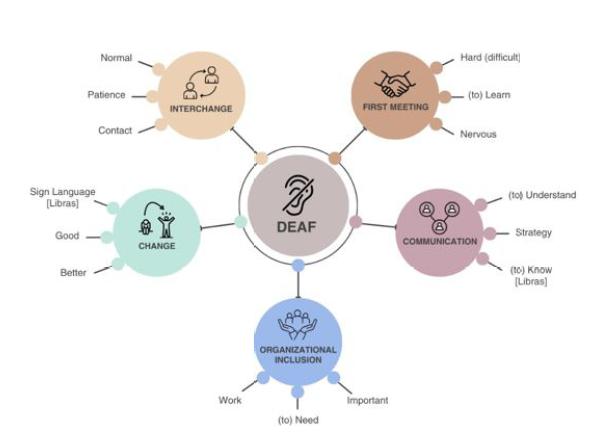
The first contact between a deaf individual and a hearing person was the first topic used to explain the idea/association process. Words and signs used by both populations pointed toward ideas linked to discomfort and disorientation, as expected. Deaf individuals often used a sign that represents the word ‘difficult’.
In the first contact, deaf individuals often refer to the strangeness that Goffman (1988) talks about regarding times of interaction between the so-called ‘normal’ individuals and the stigmatized ones. There is a shock in being inserted into a work environment for the first time, in addition to concerns about how these individuals would learn the tasks to be done - it is common to observe signs meaning ‘learn’ and ‘nervous.’ There are no reports of positive perceptions. One of the interviewed deaf workers reported:
As a deaf person, when I got my first job at 18, I had problems. That’s normal, but I worked normally. Hearing people would yell at me and I wouldn’t hear, so my boss would come to me, touch me on the shoulder and then I would understand. They were worried: ‘What now? He’s deaf!’ (S1).
There are positive references in the deaf/hearing exchange, such as the presence of interpreters at special events and lectures, which opens space for contact with hearing-oriented individuals, rather than isolation in events specific to hearing or deaf individuals. After the company provided a Libras course to hearing-oriented workers, some began to sign with the deaf ones. The sign for ‘patience’ (in the sense of resignation) was often used by the deaf individuals.
Here, every day, there are hearing people, saying ‘good morning’ to us in Libras, and there are others who turn their faces away and don’t even care. That’s fine with me. I let it go. I care about those I know and who have contact with me (S1).
Some [hearing people] want to make friends. They invite me to get together, others don’t. It depends. I insist. I always invite them, but sometimes I end up waiting. But be patient. As time goes by, they will call me. We will share and make friends. That is important. ... For men, there is soccer. It is easier. They always get together. Women are a little different: some want to make friends. It depends (S2).
The first quote shows that this deaf individual feels uncomfortable with those who ‘turn their backs’ on him, although he remembers that what really matters are those he knows and “has contact with”; he says: ‘I’ll leave it this way.’ According to the second excerpt, it is important to ‘share’ and ‘make friends.’ The deaf worker mentions that there will be opportunities for collective coexistence beyond the work environment.
Finally, one of the deaf individuals who had already made some friends mentioned being invited by the boss to participate in barbecues to help him:
I used to stay quiet here at the company. Then, one day, my boss asked me: ‘Do you know how to barbecue?’ I said yes, that I could help, so he called me. Then, another boss, [name of supervisor], invited me to help at a barbecue party for family and friends. Another person from here invited me to a motorcycle camp. It was really good (S1).
On the other hand, the feeling of exclusion derived from not participating in social or leisure activities outside the company is expressed by the sign for ‘having little contact’:
I have little contact. I don’t play soccer, we don’t make any plans, I have little contact. It’s very difficult. Some parties, a few, more or less. I have little contact, I stay quieter (S3).
This ‘contact’ means setting bonds with, which often leads to the feeling of inclusion. Thus, the following excerpt stands out because it deals with the same objective phenomenon: laughter.
Deaf and hearing friends laugh at each other. It’s normal, the same on both sides. But there are bad listeners. [If] I [am] talking to another deaf person in Libras, listeners look at me and think it’s funny. We’re not stupid. It’s not funny (S1).
This excerpt makes it clear that laughter, whenever it is shared within a community based on friendship bonds, is interpreted as normal. However, laughing at a deaf individual’s communicative action, especially when it comes from a group of hearing strangers (foreigners), is a serious offense. This is because sign language is not a mere instrument, but a mark of deaf persons’ identity. Therefore, it constitutes an exclusionary situation that deeply affects these individuals’ dignity, to the point of considering hearing people who act this way as bad people, with whom one should not relate.
If, on the one hand, communication is not something merely instrumental, but actually carries cultural and identity elements of the deaf community, on the other hand, it is necessary to take action to break communication barriers in work situations. This process starts with something deaf individuals often pointed out, namely: using strategic sign language.
“The deaf group thought of a strategy, and we talked about how each person could have a strategy because they didn’t have communication. We had the idea of calling the person, showing the sign on the computer; and calmly they would do it using dactylology [writing a word by signing letter by letter] and learn, or they would have the idea of a sign [of some situation that happened], and they would agree with the hearing person. So now it’s better. But before it was very complicated, difficult, it wasn’t easy” (S2).
Hearing people wrote and tapped on the computer screen at first; later on, the company purchased real-time translation software to be used in meetings. Finally, regarding the comparative perception of changes observed between past and current times, deaf individuals are unanimous about improvements in communication. Although it is not yet ideal, it has shown visible progress.
Communication has improved a little. Before, they didn’t understand well. Hearing people saw deaf people signing in sign language in places, they were curious and thought of a strategy for how to make contact, but they didn’t know. That was before. Today, communication has improved a little because some have learned sign language (S3).
Therefore, it is not an exaggeration to consider that, from deaf individuals’ perspective, a hearing person who is willing to learn and practice Libras in their daily workplaces is someone willing to enter their culture. In other words, they are acknowledged as ontological beings. This profile is shown in the following excerpts:
I have a friend with whom I have a very good relationship, we help each other like this: I teach him the signs, and he teaches me too. ... Before, hearing people would ask me the signs for things. What were the signs for water, places, restaurants... and they gradually learned through contact with me (S1).
I also think, regarding the equality of deaf and hearing people in the workplace, that we learn in Libras and we need to teach it at work, because when we type, the papers, the emails are different. Communication is different. Deaf [people] have their own language that is different from that of hearing people. The hearing person learns by copying us, teaching us the work, having contact with us to learn how to communicate (S2).
The analysis of this same item continues in another excerpt that discloses the same meaning: listeners’ interest or lack of interest in entering the symbolic universe of deaf individuals by learning sign language.
I said: ‘Hey [surprised facial expression], you guys have already done the sign language course here at work, you learned the signs to use here at work. There’s material with pictures, everything. What are you waiting for to use it?’ We talked. [Then] they told me that it’s very confusing to reconcile work with learning the language, and that it was very difficult. It would be good to do a sign language course outside of work, somewhere else at night, it would be easier (S2).
However, it is not a formal training where one takes a course and receives a certificate to add to one’s resume. Deaf individuals are aware of the opportunities hearing people have to learn Libras, and this creates expectations in these individuals to communicate with them. Another excerpt shows the connection between lack of interest in learning sign language and ‘despising deaf individuals,’ which is the opposite sense of ‘friendship’ and ‘unity’.
When they realize this difference, they start helping. They understand that it is not my responsibility to teach or explain everything. I teach a little, but the hearing person needs to take a basic course in sign language to understand better. Then we share it. And it depends: some people learn sign language very quickly, others don’t. They need to communicate in writing, but they don’t need to worry. They are capable. You just need to be respectful and warn the deaf person, you can’t look down on the deaf person. You need to have friendship and unity to work here, everyone knows ... A while ago, my best friend here left. Then it was a little difficult and confusing because no one knew sign language. I was upset, sad, but ok (S2).
Communication creates friendship bonds and opens room for communication and mutual help. But these aspects are often disregarded by the formal organization that sticks to the rationality of tasks.
Finally, the inclusion phenomenon topic is associated by interviewees with the importance of working. At first, it means achieving material independence, mainly in comparison to deaf individuals who live on the Continuous Benefit Payment, also known as BPC.
By working, you will have quick support in the future. Today you can already take advantage of a psychologist and have private care (S2).
My parents never wanted to get the benefit. They said that deaf people didn’t have any problem, that they were normal, strong, and had a perfect body. But there are other lazy deaf people who only want the benefit. So, I ask them: do you have money for your house, to buy food, to give to your child? I tell them that it’s important. I say: with the benefit, you will always receive the same amount, always the same amount. I don’t (S1).
A second dimension of the inclusion phenomenon lies in showing one’s capabilities and progress in their careers.
... the deaf person needs to be informed that there are courses he can take, that he can finish high school or college [to] have a foundation and work, or go to college while working, graduate in psychology, journalism ... The salary is important, but the person working is just as important (S2)
Accordingly, there is a close connection between progress and the sense of equality observed in deaf individuals’ discourses, and the work issue. It seems that working was the meaning of equality within society. This idea becomes clearer by observing the following excerpts:
It is important for the deaf [person] to work in the same way as the hearing person works, because the deaf person is equal to the hearing person, they are truly equal! ... The hearing person is not superior to the deaf, nor is the deaf person superior to the hearing person, they need to understand [that there is] equality. There cannot be conflict problems, both sides need to be friends (S1).
I don’t think it’s difficult, I have the ability and desire to learn and in the future study business. I think: ‘deaf people and hearing people are equal, it’s easy!’ ... What I think and believe is that deaf people are capable of working, they are on an equal footing with hearing people, and deaf people need to know that (S2).
I think it is possible to have equality between deaf and hearing people in the workplace. Deaf people have the ability, it is easy to learn if they are taught. It is easy, it is simple and it evolves. Deaf people feel, perceive things and are able to learn more and more. They have a good capacity to work (S3).
These statements reinforce the lack of difference in ‘skills’ between deaf and hearing people. They demonstrate both the ability to feel and perceive individuals’ potential, as well as the effort made by deaf individuals to learn. On the other hand, frustrated expectations can lead to feelings of exclusion, such as those observed in the previous section. Table 1 discloses perceptions about feelings of inclusion and exclusion based on reports transcribed and analyzed from different topics.
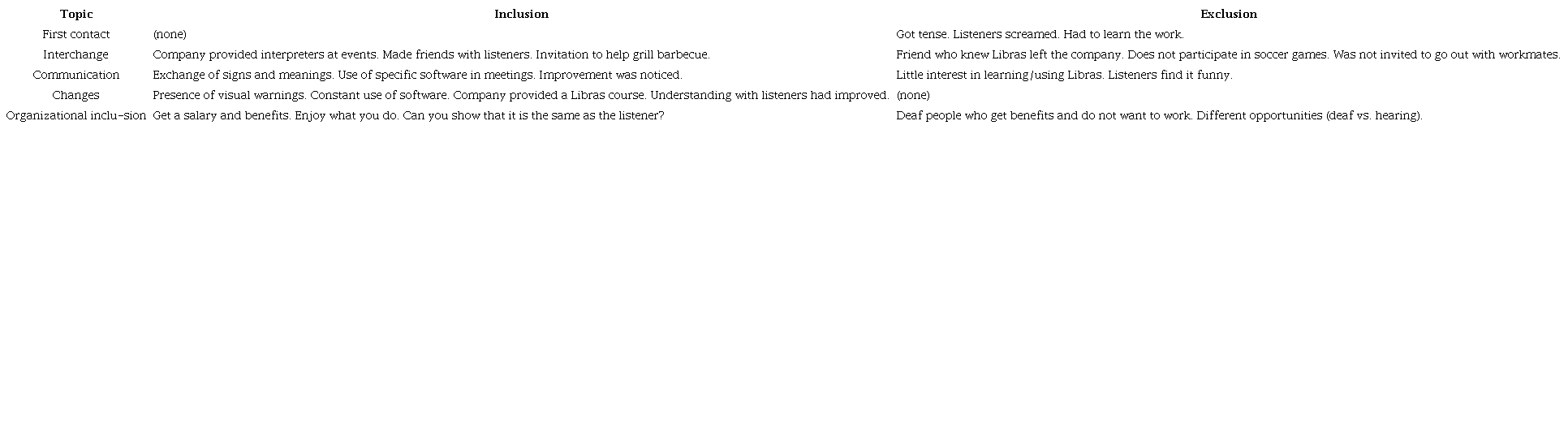
In short, the table shows that deaf individuals experience a dual inclusion-exclusion relationship in the organization they work at. At times, strategies and actions make deaf individuals feel like they belong, but at other times, reports point to exclusionary situations. Three essences were extracted from the phenomenological reduction to interpret the inclusion/exclusion phenomenon, as introduced below.
The first and most apparent essence is related to the previous discussion on the role of work in deaf individuals’ perception of the meaning of inclusion.
Initially, it is important to bring up deaf individuals’ criticism toward those who receive BPC and do not work. There is frustration at being perceived as a ‘quota’ member, rather than as a fully skilled person. The sense of being inserted in the labor ‘market’ as access to formal employment, although important, represents a limited understanding of this phenomenon by deaf individuals. This scenario sheds light on the work/occupation dimension as an important element from the substantive inclusion perspective (Guerreiro Ramos, 1989, 2022).
Working under conditions of recognition and equality with hearing-oriented individuals in the organization shows that deafness can be seen as a difference, rather than a disability, in this population’s daily work routines (De Clerck, 2010; Kauchakje, 2003; Klein, 2013; Ladd, 2003; Perlin & Miranda, 2003; Sá, 2002; Skliar, 2013; Witkoski, 2015; Wrigley, 1996). However, more than the flag of a movement, this understanding is an icon, in the sense used by Bourdieu (1996), according to whom it is a social construction that opposes stigma, as it directly reflects on self-esteem and sociability (Araújo, 2005). Therefore, deaf individuals expect to break away from the ableism and isolation they have historically experienced in the world of hearing people. They believe they deserve recognition in the same way hearing individuals do. However, deaf individuals contrast with this ideal worker model (Jammaers & Zanoni, 2021), which is not always achieved even by hearing people, given the lower salaries and simpler tasks often assigned to them - tasks that fall below their capabilities (Irigaray & Vergara, 2011; Reis et al., 2017; Viana & Irigaray, 2016). They mostly explain this scenario through the lack of knowledge by hearing-oriented individuals (Reis et al., 2017; Stokar & Orwat, 2018) and through communication barriers that prevent them from reaching leadership positions or more complex functions (Loxe et al., 2019; Viana & Irigaray, 2016). Despite such inequalities, they remain in the organization because they understand that it would be difficult to find a job in another company. Far beyond the ‘glass ceiling,’ the deaf experience, in a sense, emerges as a prison (Viana & Irigaray, 2016).
However, the present study reports a ‘change’ perceived by deaf individuals over time. The fact that older deaf individuals were interviewed may point to an inclusion process that has improved in the company. But how can one explain the critical comments made by deaf individuals, according to which the organization is only interested in meeting quota requirements and legal obligations, without any concern for the person to be included or their work?
It is necessary to analyze differences in meanings given to at least three phenomena linked to deaf individuals’ interpretations in order to understand this apparent contradiction: (a) the quota policy, often practiced by ‘formal organizations’ to hire a ‘person with disabilities (PwD)’ - this is a critical perception similar to that of other deaf individuals in the studies by Loxe et al. (2019) and Viana and Irigaray (2016); (b) the work experience itself in their lives; and (c) the work carried out with their peers in the social dimension.
Accordingly, contentment, pride, and a feeling of being the protagonists of their own story (which the interviewed deaf individuals wanted to show) do not represent a contradiction, but rather highlight the relevant dimensions of the ‘inclusion’ experience lived by them. It is mediated by social relationships at work. Thanks to these relationships, cultural exchange between deaf and hearing individuals takes place.
According to deaf individuals, hearing people must be interested in learning Libras. Therefore, sign language is the element promoting this population’s social acceptance in the organization (not only in terms of formal aspects). This is because they already see themselves as individuals with potential; they are not different from hearing workers and perform their tasks just as well. But they still need to take one more step to go from being excellent performers to being fully social subjects within the organization. They need to be counter-subjects (Schutz, 2012), those whom hearing individuals recognize as another.
The need for exchange as a form of communicative action was clear. However, communication and mutual understanding in the deaf-hearing relationship, which are necessary for social organizational inclusion, do not happen automatically, given the hearing-based features of rationality within the organization (Witkoski, 2015). Efforts are needed to overcome the language barrier, considering the passivity of both management and workers (Foster & McLeod, 2003; Punch et al., 2007) According to the present study, this effort was led by the deaf community and by those who ‘care about them,’ rather than by company-wide measures.
The interviews highlighted that deaf individuals believe that exchange and interaction in the organization should be normal. Therefore, other excerpts disclose a certain frustration with small acts and events that, although subtle, are not insignificant for analysis - such as turning away to avoid greetings or not inviting people to events and meetings. Given the characteristics of deaf communication, there is a heightened ability to capture and interpret coworkers’ body language (Wells et al., 2009) and this is perceived as disrespect and exclusion by deaf people when it comes to communication.
Based on the aforementioned situations, and by taking into account that many communication initiatives did not come from company policies, but from deaf individuals themselves, coworkers, or immediate supervisors, it is noteworthy that this population reserves criticism toward their colleagues when it comes to lack of interest, rather than for the purely formal/functional rationality model observed in organizations when it comes to insertion based on quotas. From this perspective, it cannot be said that deaf individuals’ perception is naïve, because, as previously seen, they are aware of the situation, although they accepted unemployment as the greater evil.
Deaf individuals seem to understand that the inclusive effort to overcome communication barriers depends on strategies they must pursue for their own inclusion. Their reference point becomes the hearing individuals with whom they are friends and have closer ‘contact,’ since they cannot rely on the formal organization. They develop camaraderie with these coworkers (Wells et al., 2009) who nurture bonds with them. This process enables the development of strategies to learn how to communicate and to exchange cultural differences. Therefore, bonds and meanings are set (Maciel & Camargo, 2015), and inclusion takes place in the ‘substantive’ context, immersed in affective and supportive relationships between colleagues (Pellin et al., 2021).
The aforementioned process connects to the next essence, according to which, from the deaf individuals’ perspective, the concept of inclusion does not only mean working alongside hearing people, but also sharing the work environment and performing the same activities (collaboration) to achieve shared goals. In their view, it also involves belonging to the group and being co-oriented by others to fulfill both the objective and social dimensions of work (Habermas, 2003; Taylor & Robichaud, 2004).
Thus, the assistance of Libras interpreters is important for good communication in the organization (Loxe et al., 2019), but their mere presence in moments of functional communication (transmitting instructions, translating meetings) does not seem sufficient for the full inclusion of deaf individuals. They expect their culture and identity to be known and respected. Therefore, establishing social relationships is essential. Consideration from others and high-quality relationships with coworkers and managers foster both a sense of belonging and team spirit, in addition to making deaf individuals feel important (Reis et al., 2017). Small efforts made by hearing individuals in daily communication (conversations, jokes, news), and, most of all, their participation in informal events give deaf people the feeling of inclusion in the community (Wells et al., 2009) - This is the topic of the last essence.
Being included in the social organization implies entering the most intimate circle of coworkers with whom one shares life through significant experiences, both inside and outside the company’s borders. By analyzing the narratives of deaf people about changes perceived in the organization, we observe organizational actions mediated by significant individuals (supervisors who seek for Libras courses, deaf individuals who seek software to communicate) who are sensitive to deaf individuals’ problems (Viana & Irigaray, 2016) and who care about them.
As addressed by Guerreiro Ramos (1989, 2022), adapting his quote from Blumer (2005), deaf individuals’ substantive inclusion does not happen through external ‘forces’ that set and encourage changes aimed at inclusive actions, but rather results from the actions of people who symbolically interact within the social organization framework. This organization involves daily work aspects, as well as social activities outside formal organizations’ ‘borders.’ Wells et al. (2009) reinforced these findings by including the role of families, neighbors, and community in developing deaf individuals’ sense of belonging to the hearing world.
On the other hand, the lack of participation in social activities, or even the mocking gaze of listeners when deaf individuals communicate using sign language, reinforces their isolation (Loxe et al., 2019; Viana & Irigaray, 2016).
At this point, both foreigners and natives need to make communication efforts until they can exchange symbols (Schutz, 2012) and deaf individuals are accepted by the community into which they are inserted. The idea of acceptance does not imply losing one’s essence as self-identity; actually, foreigners do not lose their origin or references, they just become participants in the shared-meaning cosmos, i.e., in the social organization, in its broadest sense.
Inclusion is not an objective concept, but a relational phenomenon dependent on intersubjectively shared meanings. Therefore, inclusion processes, such as those driven by quota laws, may lead to the insertion of individuals into organizations, but that does not necessarily mean full inclusion. Accordingly, this study analyzed how the inclusion/exclusion process of deaf individuals unfolds within the organization. Several studies have pointed out the isolation and exclusion of this population due to communication barriers. However, the aim of this study was to better understand the possibilities of achieving inclusive processes and practices (Bendl et al., 2024).
Guerreiro Ramos, in his attempt to put conventional organizational theory in parentheses, presented more than a deontological organizational model; he offered an alternative proposal to analyze inclusion policies in organizations (Azevedo & Albernaz, 2004). It is no coincidence that the experiences of deaf individuals in the present case highlighted relevant dimensions of substantive inclusion that, to a great extent, address the ‘blind spots’ identified by the author in organizational analysis (Guerreiro Ramos, 1989, 2022).
If these elements expressed epistemological limitations to the full understanding of the organizational phenomenon in Guerreiro’s work, in the present context, they may point to barriers that still need to be overcome in order to achieve more inclusive organizational practices, as suggested by the current study.
The first dimension introduces ‘work,’ in its ontological nature, as an opportunity to express deaf individuals’ equality with their hearing peers. However, merely inserting deaf individuals into work environments in formal organizations can reinforce exclusion if their skills are not acknowledged. They must be integrated into work tasks and decision-making processes.
The second dimension refers to the role of symbolic interaction, understood as a cultural exchange between deaf and hearing individuals. This process presents a major communication challenge, since the task is not just a backdrop, but the linguistic framework in which inclusion actually occurs. Studies have highlighted communication barriers between deaf and hearing individuals as the main obstacle to inclusion. Hiring translators and implementing government policies to teach Libras is essential, but not enough to overcome the social barriers that prevent deaf individuals from being fully included in the organization’s routines.
Thus, if the lack of communication - due to the absence of a common language - excludes deaf individuals from the social organization, this exclusion becomes a barrier to potential intercommunication. At this point, the third and final dimension of Guerreiro Ramos’s work points to inclusion in organizations in its substantive and processual meaning.
In summary, it can be said that sharing meanings through sign language leads to integration into the social organization. Social integration allows work recognition and full participation in organizational processes. Communication is the mediating element that can be a bridge or a barrier to inclusion in social organization. It interferes with the very condition of deaf individuals’ work, serving as a barrier and becomes a source of stigma and isolation by stopping the potential development of this population. This bridge leads to truly substantive inclusion and exceeds a rational issue, as it brings to light affective relationships, such as the sense of belonging and friendship deriving from interactions. This process is represented in Figure 2.
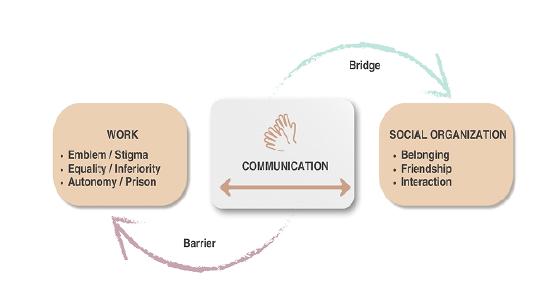
Barriers or bridges are not solely a matter of language, but of communicative actions that include attitudes and expectations, driven by hearing individuals’ interest in entering the world of the deaf. Bridges can be built through small gestures by hearing people (greetings, paying attention, interacting) and by managers who acknowledge the capabilities of this population and recognize it as significant within the organizational space.
It is possible to say that the encounter between deaf and hearing people in formal organizations can lead to meaningful mediation (in the dialectical sense) and create space for ‘parenthetical individuals’ who, by suspending functional imperatives, are concerned with establishing affective bonds with deaf individuals. This process breaks with instrumental models based solely on rational agreements (communicative reason). Equality in communication conditions, by itself, is not enough to achieve inclusion in situations marked by different symbolic realities, as in the deaf-hearing relationship. Communicative action is established to the extent that bonds, relationships, and affections are constructed within meaningful interactions. A key contribution to updating analyses that transcend rationalism lies in this element, especially when one considers ‘substantivity’ as affection. After all, it is this bond that fills relationships with meaning and makes inclusive social organization possible.
One limitation of the present study is that it did not consider the dimension of deaf individuals’ primary sociability and the relevance of relationships with parents, relatives, and reference figures in inclusion processes. Accordingly, future research on substantive inclusion can take two important directions. The first concerns the social organization as an intersubjective process between deaf and hearing individuals. The second, based on an approach different from the phenomenological one, involves observing networks of significant relationships between organizations that, in turn, contribute to the inclusion process - such as family, schools, associations, support entities, social movements, councils, public agencies, and private companies. This is, in fact, a gap identified in research from other fields, such as education (Espote et al., 2013), and one that may represent a fruitful direction for studies on inclusion in organizations.
Finally, by extrapolating the scope of the current research, studies can also assess how affirmative action policies account for the substantive inclusion of other organizational diversity populations.

Farias, Marcos Andre Soares; Bauer, Márcio André Leal, 2025, "Replication Data for: Challenges to Substantive Inclusion in Organizations: A Phenomenological Study with Deaf People published by RAC-Revista de Administração Contemporânea", Harvard Dataverse, V1. https://doi.org/10.7910/DVN/APN1JZ
RAC encourages data sharing but, in compliance with ethical principles, it does not demand the disclosure of any means of identifying research subjects, preserving the privacy of research subjects. The practice of open data is to enable the reproducibility of results, and to nsure the unrestricted transparency of the results of the published research, without requiring the identity of research subjects.
One reviewer did not authorize the disclosure of his/her identity.
* Corresponding Author