Methodological Article
Received: 16 June 2024
Revised document received: 02 January 2025
Accepted: 28 March 2025
Published: 20 May 2025
DOI: https://doi.org/10.1590/1982-7849rac2025240148.en
Funding
Funding source: Brazilian National Council for Scientific and Technological Development
Contract number: 304290/2021-1
Funding
Funding source: Brazilian School of Public and Business Administration at Getulio Vargas Foundation
Contract number: PROPESQUISA 00505100300360
Funding statement: This research was funded by Brazilian National Council for Scientific and Technological Development (CNPq), grant number 304290/2021-1 and Brazilian School of Public and Business Administration at Getulio Vargas Foundation, grant number PROPESQUISA 00505100300360.
ABSTRACT
Objective: this study explores the application of social representation theory (SRT) in defining theoretical constructs within information systems (IS) research. It aims to develop a comprehensive methodological workflow to guide researchers in effectively utilizing SRT to understand emerging constructs in the IS domain.
Proposal: the paper underscores the critical need for clarity in construct definition and introduces the principles of SRT, advocating for its application to enhance the precision and depth of construct definition in IS research. Using a narrative literature review, the study identified 26 papers that employed SRT to define constructs in the IS field and, based on them, proposed an SRT-based methodological workflow to define constructs in the IS area.
Conclusion: the results highlight the importance of a careful application of SRT through the methodological workflow developed, which integrates the word evocation technique, Vergès’s quadrant, as well as lexical, content, and implicative analyses to make sense of emerging constructs in the IS domain. While many IS studies have traditionally relied on isolated case studies, conceptual models, or quantitative methodologies to address new constructs, this article demonstrates the potential of SRT to do so - especially when combined with other methodological approaches, as presented in the proposed methodological workflow. Thus, this comprehensive approach can significantly improve the process of defining and interpreting emerging constructs in IS research. Consequently, IS scholars can use this article as a guide to achieve this goal.
Keywords: Social representation theory, constructs definition, Vergès’s quadrants, implicative analysis, information systems.
RESUMO
Objetivo: este estudo explora a aplicação da teoria das representações sociais (TRS) na definição de construtos teóricos na pesquisa em sistemas de informação (SI). Seu objetivo é propor um fluxo de trabalho abrangente para guiar os pesquisadores na utilização eficaz da TRS para dar sentido a construtos emergentes no domínio de SI.
Proposta: o artigo destaca a necessidade crítica de clareza na definição de construtos e introduz os princípios da TRS, defendendo sua aplicação para aprimorar a precisão e a profundidade na definição de construtos na pesquisa em SI. Utilizando uma revisão narrativa da literatura, o estudo identificou 26 artigos que empregaram TRS para definir construtos no campo de SI, analisando o modo como o fizeram, de modo a que se pudesse gerar um framework abrangente de uso da TRS para definir construtos na área de SI. As descobertas deste artigo apontam para a importância de uma aplicação cuidadosa da TRS, por meio de um fluxo de trabalho robusto que integra as técnicas de evocação de palavras, o quadrante de Vergès, assim como as análises léxica, de conteúdo e implicativa, visando ao uso eficaz da TRS na compreensão de construtos emergentes no domínio de SI.
Conclusões: embora muitos estudos em SI tradicionalmente se baseiem em estudos de caso isolados, modelos conceituais ou metodologias quantitativas para definir construtos, este artigo demonstra o potencial da TRS para tal, especialmente quando combinada com outras abordagens metodológicas, conforme delineado no fluxo de trabalho proposto. Esta abordagem abrangente pode melhorar significativamente a definição e a interpretação de construtos na pesquisa em SI. Consequentemente, acadêmicos em SI podem se valer dos resultados deste artigo para alcançar tal objetivo.
Palavras-chave: Teoria das representações sociais, definição de construtos, quadrantes de Vergès, análise implicativa, sistemas de informação.
INTRODUCTION
One of the major causes of rejection of papers submitted to scientific outlets is the lack of clarity of the constructs under investigation in them (Suddaby, 2010). Sumpter et al. (2019) define a construct as a concept intentionally and consciously invented or adopted for a specific scientific purpose - that is, a conceptual abstraction of a phenomenon that cannot be observed. Indeed, constructs cannot be reduced to specific observations, being instead abstract definitions of categories of observations. These categories must be robust enough for observers to recognize the construct in question.
Suddaby (2010) argues that the clarity of a construct encompasses four elements: the definition of the concept via language; the circumstantial conditions in which the construct is applicable or not; the semantic relationships of the construct with other constructs; and the logical consistency of the construct in relation to the theoretical argumentation wherein it is inserted. In fact, the clarity of a construct facilitates the communication among researchers and between researchers and the general public. Constructs are, thus, the bedrock of any theory (Eisenhardt, 1989; Suddaby, 2010; Sumpter et al., 2019). In fact, if different studies approach the same construct in different ways, how is it possible to compare their respective results and conclusions? Furthermore, how is it possible to effectively develop indicators to measure latent constructs (El-Den et al., 2020) that are perceived differently by scholars? All of this constitutes an obstacle to the advancement of scientific theory.
On the other hand, assuming that academic research must not only be theoretically rigorous but also relevant to practice, are academics actually sure that practitioners understand a specific construct as theory defines it (Kieser & Nicolai, 2005)? As can be seen, this problem can lead to a cognitive dissonance between theory and practice (Greenway et al., 2019) - namely, professionals do not understand a construct as scholars approach it in their respective research. This puzzle can cause research to be disregarded in practice, making academic studies, at the very least, useless for real life (Law et al., 2024). It can be seen, therefore, that consensus building on constructs is fundamental for scholars to develop their investigations, as well as for professionals to trust them, thus applying the ensuing results in their real-life scenarios (Slife et al., 2016).
In fact, construct definition has been a critical research subject for a long time, since the appearance of the first works in this realm (Kelly, 1955, 1963). Since then, several authors have researched this topic, pointing out how confusing it can be to define, in a monosemous way, theoretical constructs (Middendorp, 1991; Slife et al., 2016). However, this is a critical and imperative issue (Cornelissen & Durand, 2014; Hibberd, 2019) and is still a source of misunderstanding and confusion.
According to Rossiter (2017, p. 490): “… there is, however, a necessary prior step, which is to agree on single definitions of our major constructs, given that the content of the measure depends critically on the content of the construct definition.” This is the case in the management area, where several authors have requested more research on construct definition before assigning indicators to measure them (Pesämaa et al., 2021; Thomas, 2010; Wright et al., 2012).
In turn, digital technologies have become increasingly relevant for business processes and value creation in companies. However, these technologies have brought new constructs that need to be properly defined so that academics and practitioners perceive them in the same way. For example, cloud computing, blockchain, internet of things (IoT), smart city, IT governance, fintech, and digital transformation, to name just a few, are new constructs associated with recent technological innovations. Thus, it is not difficult to realize that the information systems (IS) area has continually faced the challenge of consistently defining new constructs associated with emerging digital technologies (Joia & Marchisotti, 2020; Joia & Proença, 2022; Joia & Leonardo, 2023; Michelotto & Joia, 2023; Teodoro et al., 2014; Vieira & Joia, 2024).
In fact, one of the main challenges of scientific research lies in clearly defining the theoretical constructs under investigation (Suddaby, 2010). Thus, in the context of emerging digital technologies, the area of information systems (IS) faces the continuous task of defining new constructs.
There are several general alternatives for defining constructs, such as hermeneutics (Gadamer, 2018), focus group (Lloyd, 2011), phenomenography (Marton, 1981), actor-network theory (Doolin & Lowe, 2002), and Semiotics (Berger, 2014), to name just a few - each of them with their strengths and weaknesses. There are also other approaches coming from social psychology, such as sensemaking theory (Weick, 2012), direct perception theory (Gibson, 1977), constructive perception theory (Gregory, 2013), social cognition theory (Lewis & Carpendale, 2014), and social representation theory (Moscovici, 2001a, 2001b). In fact, it cannot be said that there is a best theoretical approach for defining constructs (Lüftenegger & Chen, 2017). However, social representation theory has recently been increasingly used for this purpose, having consolidated itself as an important option in this realm, as it considers the social construction of shared meanings, is effective for studying collective perceptions and cultural changes, and is context-sensitive.1 All these characteristics are related to the emergence and implementation of new ICT - and related concepts - in organizations, since ICT is context-dependent (Davison & Martinsons, 2016), often leads to cultural changes (Leidner & Kayworth, 2006), and its success depends on a common perception shared by professionals (Ramos & Mota, 2014).
Based on the abovementioned explanations, this article focuses on social representation theory (SRT), aiming to identify, discuss, and structure how it can be used to make sense of theoretical constructs in the IS area. Furthermore, in line with Jang et al. (2021), one of the reasons for choosing to investigate the adoption of SRT in studies in the IS area is its potential to be complemented by other methodological approaches, in order to follow the social reality involved with new technologies in the IS area.
That said, the research question of this article is: How can SRT be applied to unveil and define the meaning of theoretical constructs in the IS field? To answer this question, a narrative review of the literature was carried out to investigate and compare how articles have used SRT in the IS area. This review aimed to identify which comprehensive methodologies have involved SRT, providing a richer and more reliable analysis of the use of social representations in the IS field. However, it is important to highlight that this study only focuses on articles that have used SRT as the main theoretical lens and that provided detailed explanations of the methodologies used - alone or in combination with SRT.
As already mentioned, this paper aims to explore how SRT can contribute to a more comprehensive understanding of theoretical constructs in the IS field. Specifically, it investigates how SRT can identify and define the meaning of emerging constructs, bridging the gap between academic and business perspectives in the IS area. Thus, the focus of this article on the application of SRT to improve the definition of theoretical constructs has academic and practical relevance for the IS area. In fact, by providing examples of how SRT can be operationalized in a real IS scenario, this work intends to allow the understanding of the potential of this theory to define new constructs in a univocal way within this knowledge field. Therefore, the topic addressed in this article is relevant, especially given the increasing emergence of new constructs and the importance of understanding them in an interdisciplinary field such as IS (Tarafdar et al., 2022).
This work intends to answer the aforementioned research question via a structural approach - namely, by depicting the structure of the social representation of the construct under analysis (Abric, 1998; Martins-Silva et al., 2016), which is explained below. Thus, based on Gal and Berente (2008), this article focuses on individual cognition, considering words as a means to identify social representations and proposing a methodological approach based on questionnaires, statistics, and content analysis.
As addressed by Silva et al. (2011), the IS area has demanded the creation of new social representations, since users have been asked to communicate and relate in ways very different from when interactions occurred without digital technologies. In fact, although the problem of ‘definition of constructs’ is not unique to the IS area (Udo-Akang, 2012), technological innovations have overloaded and challenged the IS field through the need to unequivocally define new constructs for academia and practice.
That said, this work is structured as follows. After this introduction, a section on the tenets of SRT is presented. In the sequence, the methodological approach used in this paper is explained. Then, SRT is addressed as a tool for the definition of constructs in IS research. After that, a comprehensive SRT-based methodological workflow to define IS constructs is proposed, based on the papers collected. Finally, the contributions of this work to both theory and practice are discussed, and the limitations of using an SRT-based approach for defining constructs in the IS knowledge area are set forth.
THEORETICAL BACKGROUND
Constructs definition in the IS area
Construct definition is not a new topic in academia, as can be concluded from the pioneering works of Kelly (1955, 1963) on the subject. Indeed, over time, several authors have addressed this issue from sundry perspectives, such as Stenner et al. (1983), Middendorp (1991), Udo-Akang (2012), Gilliam and Voss (2013), Rossiter (2017), Hibberd (2019), and Uher (2023), to name just a few.
In the IS area, construct definition has been a research topic for a long time (e.g., Klenke, 1992; Segars & Grover, 1998). As discussed by Silva et al. (2011), the IS area has required the creation of new constructs, most of them related to the fact that users have been asked to communicate and relate in ways very different from when interactions took place without digital technologies. In fact, although the problem of construct definition is not unique to the IS area (Udo-Akang, 2012), technological innovations have overloaded and challenged the IS field through the need to unequivocally define new constructs for academia and practice.
Although theoretical constructs are not theory per se (Weick, 1995), theories depend on theoretical constructs (Dyer & Wilkins, 1991; Eisenhardt, 1989; Weick, 1989). However, this work puts forth that constructs in the IS domain are not always univocally defined, opening an understanding gap between academics - who define the constructs - and practitioners, who are pushed to deal with them in their organizations. Indeed, in this study, several articles are presented that have found cognitive dissonances between academia and practice regarding what a construct actually is (see Michelotto & Joia, 2023), in relation to the smart city construct, and Joia and Torres (2022), in relation to the IT governance construct, to name just a few). Thus, it seems necessary to have a comprehensive methodological framework that can align scientific literature and practice in relation to theoretical construct definition in the IS area.
One of the challenging issues in the IS area is theorization (Hassan et al., 2019; Leidner & Gregory, 2024). As supported by Truex et al. (2006), the importance of theory in the IS field has been extensively studied and debated by IS researchers, but little is known about the theorizing2 process itself (Weick, 1989), especially when it comes to the spontaneous and creative behaviors that occur throughout the discovery phase (Holmström, 2016).
While that is an issue of enormous relevance, this work does not intend to address the theorizing process in the IS domain. Instead, the focus of this research, as previously stated, lies in investigating how SRT can be used to define IS constructs in a monosemic way - that is, without leading to cognitive dissonances between theory (captured by the search in scientific literature) and practice (captured by SRT via the word evocation technique associated with the central nucleus theory, as it will be presented below).
According to Wagner et al. (1999), SRT is a methodological theory3 - like actor-network theory (Czarniawska, 2006) - aspiring to provide either a new paradigm from which to view a broad phenomenon or to bring attention to and explain a new phenomenon (Leidner & Gregory, 2024). Although the application of SRT in the IS area is not entirely new, this manuscript aims to offer an innovative perspective by analyzing and comparing articles that used SRT to define constructs, identifying those that are methodologically comprehensive and justifying this choice. In doing so, this work aims to develop a methodological framework on how to use SRT to understand the concepts behind constructs in the IS area, defining them according to the perception of those somehow involved with them. In this way, it intends to fill a potential gap between how theory and practice perceive the same construct in the IS area. The methodological framework herein presented can, therefore, guide other researchers in the effective application of SRT in the IS area.
By proposing a structured and comprehensive SRT-based methodological workflow for defining theoretical constructs within the IS context - as there is no consensus on how to use SRT for this purpose4 - this study aims to improve the clarity and consistency of theoretical constructs in IS research.
Nonetheless, we do not claim that SRT is the only way to define theoretical constructs. In fact, in this article, we suggest SRT as an approach that can be used in conjunction with other theoretical-methodological perspectives. However, the great advantage of using SRT to define constructs (in IS or another area) is the possibility of comparing the social representation of constructs from the perspective of practitioners vis-à-vis the scientific literature on them. In line with this, this article presents several works that did that and found sundry cognitive dissonances between theory and practice related to IS constructs, such as (to name just a few): Marchisotti et al. (2019, 2021), Joia and Melon (2020), and Michelotto and Joia (2023). These facts reveal that IS scholars need to better define the constructs used in their research, since constructs are the bedrock of any theory (Eisenhardt, 1989; Suddaby, 2010; Summers, 2019). In fact, the focus of this article is not on the development of theories, but on the definition of the constructs that are embedded in them, which must have a clear and monosemic definition - both for theory and for practice.
In sum, construct definition is not just a challenge for the IS area. In the area of management as a whole, Summers (2019) argues that the inadequate definition of constructs is the main cause of rejection of articles submitted to top-tier marketing journals; MacKenzie (2003) suggests that the poor conceptualization and definition of constructs torments many manuscripts submitted for review in journals in the management area; Joia and Ferreira (2005) investigated the overlap between the constructs of business model and strategy; Harmancioglu et al. (2009) argue that multiple definitions of constructs produce ambiguity in causal relationships, incongruent empirical results, and difficulty in interpreting results. Furthermore, from a more specific perspective, Gelencsér et al. (2024) investigated the different definitions for the employee retention construct; Gobov et al. (2020) verified the confusion regarding the IT business value construct; Hillmann and Guenther (2021) ascertained the different definitions attributed to the organizational resilience construct; and Alvesson and Blom (2022) analyzed the hegemonic ambiguity of some omnipresent constructs in organizational studies, such as leadership, strategy, and institution.
Finally, Gilliam and Voss (2013) proposed a procedure to better define the constructs of marketing - an interdisciplinary area such as IS - as intended in this research. Therefore, it can be seen that the adequate definition of constructs in management in general, and IS in particular, has been a lasting challenge.
Theoretical foundation of SRT
Serge Moscovici created SRT in 1961 through the book La Psychanalyse, son Image, et son Public (Moscovici, 1961), where the concept of social representation was introduced and applied to how psychoanalysis was perceived and understood by the public. Thus, the role of social communication and the construction of shared meanings in shaping the public’s comprehension of psychoanalysis were explored. In 2001, Moscovici published another important book called Social Representations: Explorations in Social Psychology (Moscovici, 2001a), which delves into the formation, function, and dynamics of social representations, emphasizing their role in the social construction of reality. That work also discusses the influence of the social context, communication, and historical factors on the development and evolution of social representations. Both works, Moscovici (1961) and Moscovici (2001a, 2001b), have had a significant impact on the field of social psychology, providing a solid foundation for understanding the socio-cognitive processes involved in creating and disseminating shared meanings within groups and societies.
SRT is associated with the process of building social knowledge through interpersonal communication shared within social groups, including emotions, symbols, values, practices, images, etc. In other words, SRT describes how an object, concept, or idea is internalized by a social group, both through the analysis of the group’s behavior and the verbal expressions evoked by its members. As such, SRT investigates and shapes the thought structure of a society. While created in the psychoanalysis area, over time SRT started being used in other fields, such as social sciences, nursing, education, and information and communication technology, to name just a few (Marzal et al., 2021; Weerasinghe et al., 2018; Winskell, 2021).
Besides, over time, social representations started to be applied to non-human artifacts. Jodelet (2001) supports this possibility, as a social representation corresponds to an act of thinking by which a subject relates to an object. This ‘object’ may be either a person, a thing, a material, a social or psychological event, a natural phenomenon, an idea, or a theory. SRT, therefore, is useful for trying to understand collective practices that are shared through a unified understanding of their real meanings. Thus, it allows the consolidated inference of collective perceptions associated with what is represented - which can be a person, object, or event (Lima & Campos, 2015; Pozzebon et al., 2016).
Brenner and Hartl (2021) and Rodrigues and Pietrocola (2020) argue that social representations interpret reality, determining the behavior and practices of groups of individuals through the analysis of the shared understanding of reality that shapes group perspectives. In this way, SRT can help social groups to deal with the demands of social life. Therefore, by knowing a social representation, it is possible to bring out the common sense of a social group - that is, the meaning and significance of what is represented within that group - namely, the consensual ideas - that help understand how the group learns (Reis et al., 2021). When groups come across new and unfamiliar events or phenomena in their everyday lives, they are faced with challenges that require symbolic and collective responses from the group members. During these instances - when there is a perceived gap between what individuals already know and what they struggle to comprehend - a sense of meaning is lacking. This is the point where the unfamiliar becomes apparent, and the process of representational work begins to restore a sense of familiarity (Moscovici, 2001a; 2001b).
Moreover, according to Moscovici (1961), SRT provides a socio-cognitive framework that can be employed to examine how common-sense knowledge is socially constructed. It presents a range of practical conceptual tools that enable the exploration of the social environment in which shared meanings originate, as well as the analysis of the temporal aspects of socio-cognitive processes. As such, social representations are a comprehensive system comprising values, ideas, and practices that serve a dual purpose. First, they establish an order that allows individuals to navigate their material and social surroundings effectively. Second, they facilitate communication within a community by providing a code for social exchange and a framework for categorizing and understanding various aspects of the world, as well as individual and collective histories. In fact, social representations play a crucial role in helping individuals make sense of their environment, engage in interactions, and communicate with other members of society (Moscovici, 2001a, 2001b).
Methodological context of SRT
Martins-Silva et al. (2016) state that although there is a single general theory of social representation, there are three distinct approaches related to its implementation. The first approach is structural, which aims to identify the structure of the social representation, especially its central nucleus (explained below in Section 2.4), having as its main exponent Jean-Claude Abric (Abric, 1998). The second approach is sociological, which intends to comprehend how social representation arises and circulates within a group, having as its main supporter Willem Doise (Doise, 1993). Lastly, the third approach is ‘culturalist’ or processual, which focuses on the historical and cultural issues associated with the social representation, having as its main promoter Denise Jodelet (Jodelet, 2002). There are also other perspectives that intend to understand the dialogue and interdependence between the knowledge built individually by each member of the group and that built and shared by all members of the group.
Moscovici (2001a, 2001b) discusses the significance of social discourse in public, where individuals engage in open discussions, exchange perspectives, and form opinions. In contemporary organizational settings, these forums may take the form of online chat rooms, informal conversations among employees, emails, meetings, or formal documents. Consequently, research utilizing SRT not only investigates individual and group cognition but also employs a range of research methods. These methods aim to capture the interpersonal processes through which organizational members collectively make sense of new phenomena they encounter, such as new technologies. By utilizing techniques such as group interviews, analysis of mass media content, questionnaires, observations of group interactions, focus groups, and others, researchers can assess and compare the social processes involved in creating meaning and their resulting outcomes.
Finally, Gal and Berente (2008) affirm that social representation is not a simple phenomenon - as it emerges from social interactions between group members - being identifiable via sundry research methods, as mentioned in Table 1 below.
Analysis of behaviors and investigation techniques.

Note. Elaborated by the authors.
It is important to mention that the social representation of something or someone can constantly change, as it is built through continuous social interactions between individuals in a social group, which both influence and are dynamically influenced by the representation (Weerasinghe et al., 2018). Martins-Silva et al. (2016) corroborate this understanding, stating that there can be profound variations in a social representation, as it can be structurally reconfigured and transformed as social spaces and different social groups can change over time. Gal and Berente (2008) argue that comprehending social representations requires acknowledging that their meanings arise within the context of broader group endeavors that extend across both past and future dimensions. Additionally, social representations are not static but rather dynamic entities that adapt to reflect shifts in the group’s environment, as well as changes in communication and interaction patterns. Therefore, research designs that incorporate a temporal dimension are crucial for observing the emergence and evolution of social representations in social settings.
Furthermore, according to Gal and Berente (2008), Jung et al. (2009), and Winskell (2021), there are two fundamental pillars that support SRT, which are associated with the creation and transformation of a social representation. One pillar addresses the underlying concepts associated with social representation, encompassing anchoring and objectification. The other pillar, which will be detailed in the next section, supports the structure of social representation, covering its central nucleus and peripheral system. Thus, the former pillar depicts how the social representation is created internally, while the latter expresses how the social representation is structured and externally presented.
Regarding the first pillar, the concepts of anchoring and objectification are fundamental to define social representations, as they explain how something socially unknown becomes familiar by being associated with stories prevalent in a social group (Cunha et al., 2014; Gal & Berente, 2008; Winskell, 2021). Objectification aims to materialize the abstract phenomenon one intends to study, making it possible to understand. As mentioned by Gal and Berente (2008), when a person encounters something new, (s)he often lacks a framework or representation to make sense of it. To develop a basic understanding of the unfamiliar phenomenon, (s)he first needs to name it and assign certain characteristics to it, enabling effective communication and reference.
As such, this process privileges certain information over other elements, removing it from its original context and associating it with the group’s context in order to transform the abstract into something concrete and real, by means of images, symbols, or metaphors. For example, comparing God to a father enables individuals to associate that image with corresponding feelings (Martins-Silva et al., 2016; Winskell, 2021). Moreover, in the immediate aftermath of the terrorist attacks on the World Trade Center in the United States, people described the events by comparing them to previous major terrorist attacks. It was only later that a distinct representation - referred to as “9/11” - emerged, allowing these specific attacks to be differentiated from other acts of terrorism. This process of developing a new representation is known as objectification (Gal & Berente, 2008).
Anchoring, in turn, seeks to give meaning to an object within the context of a group; once this meaning materializes via objectification, the object becomes familiar to the group. As such, anchoring integrates new knowledge with existing knowledge. Once a new phenomenon has been anchored and interpreted using familiar terms and representations, continued communication among group members facilitates the development of an objectified representation. This representation often takes the form of a metaphor, symbol, or image (Gal & Berente, 2008). Anchoring also makes it possible to comprehend how the group’s sense of the object is construed and, when combined with objectification, enables a member of the group to reproduce how the object is interpreted by another member (Martins-Silva et al., 2016; Winskell, 2021). Thus, “anchoring is to comprehend an object in function of another, being the unknown anchored in the known” (Cunha et al., 2014, p. 304).
According to Jang et al. (2021), there are three reasons to adopt SRT in studies in the IS area: (1) SRT provides a theoretical framework aimed at understanding the collective knowledge about how a social group understands a social object in the IS area; (2) SRT can investigate how an unknown social object becomes familiar, concrete, and anchored in a social group, which is especially important in the IS area as it addresses new technologies; and (3) SRT can be used in exploratory research, operationalized through different methodological approaches, to track the social reality involved with a new social object in the IS area.
After having presented the theoretical and methodological general aspects of SRT, it is time to address how it can be operationalized to define constructs in general, as presented below.
Central nucleus theory
Although SRT has shown great potential in the definition of constructs since its inception, a question soon arose, namely: How could it be operationalized? In fact, one of the first problems detected when trying to apply SRT to define constructs was its unstructured and discretionary operationalization (Potter & Billig, 1992). To address this issue, as set forth in the former section, Abric (1987, 2001) introduced the concept of the central core of social representations - which states that social representations can be evaluated by the free association of concepts, words, and ideas on a topic. In this sense, “the resulting frequency of associated words and the hierarchical interdependence between them indicate the social representation’s structure” (Wagner, 2020, p. 12-13). Based on these ideas, Pierre Vergès proposed a structured way of representing a social representation in all its dimensions, namely the Vergès quadrant (Vergès, 1992), through which the central nucleus of a social representation can be located, as explained below.
For Vergara and Ferreira (2006), the most important part of a social representation is its central nucleus, which needs to be unambiguously identified. To this end, the central nucleus theory (CNT) was proposed by Jean-Claude Abric as a complement to SRT (Abric, 1998, 2005a; Vergara & Ferreira, 2006). Indeed, CNT is one of Abric’s main contributions to the field of social representation (Abric, 1998; Vergès, 1992). As mentioned above, CNT is related to the structural approach of SRT (Sammut et al., 2015), which aims to identify the structure of the social representation, especially its central nucleus (Abric, 2008; Jodelet, 2008; Moliner & Abric, 2015).
According to Winskell (2021), the central nucleus is the outcome of the objectification process. Through it, one identifies the clearest and most cohesive values and perceptions shared by the group under analysis regarding object whose social representation one wants to obtain. Moreover, according to the CNT, social representations have a central core or nucleus that represents the stable and shared aspects of the representation. This core is characterized by its higher level of organization, stability, and resistance to change. It reflects the deep-rooted cultural and social values that underlie the social representation (Abric, 1998, 2005a, 2005b).
Besides, the central nucleus of a social representation comprises values of which, in general, the subject is not aware, or values that are not explicitly revealed but that orient the subject’s actions and behavior. That way, the central nucleus represents the immutable essence of a social representation, being stable and resistant to changes as it unveils the consensual issues related to a social representation (Menin, 2007). Therefore, within a certain historical and cultural context, the central nucleus is paramount for the meaning an object assumes to a group (Vergara & Ferreira, 2006).
Yet, Mazzotti (1997) argues that a social representation is not fully unanimous, as divergences and negotiations on it might turn up to maintain stable the central nucleus. One can infer, thus, that besides the consensual central nucleus, there must be a more flexible subsystem around it. Indeed, the peripheral system accommodates the current contextual divergences of the group, thereby housing the distinct perceptions of the group’s members and allowing the social representation to adapt to the daily routine without affecting the central nucleus (Mazzotti, 1997; Vergara & Ferreira, 2006). In this way, the peripheral system is less stable than the central nucleus, playing the role of an individual moderator so as not to put the meaning of the central nucleus at risk (Menin, 2007).
While being located around the central nucleus, the peripheral system, unlike the central nucleus, is flexible and accommodates contradictions, different momentary and immediate perceptions, and context changes that arise in a group of different individuals. Thus, the peripheral system allows individuals to adapt to the social representation defined by the central nucleus without impacting it. In this way, the peripheral system modulates the individuals of a group, not putting at risk the central nucleus and its meaning, which gives rise to the social representation already established by that same group (Marchisotti et al., 2019, 2021). Thus, according to Winskell (2021), the dynamic interaction between the central nucleus and the peripheral system guarantees the stability of social representation. This core-periphery perspective on SRT has been employed in research that uses SRT, providing a systematic and social explanation of each represented element.
Moreover, the central nucleus and the categories located in it have four main characteristics, which are important in the structural approach of SRT as they define the central nucleus (Wolter, 2018): (1) associative power - the elements that are part of the central nucleus have a strong association with each other, which makes this core cohesive and without oppositions or contradictions; (2) consensus - the elements that are part of the core express the position of the majority and not the minority; (3) stability - the central nucleus is stable from two perspectives: synchronous and diachronic; synchronous stability refers to the activation of some elements of the central nucleus by individuals, regardless of context, and diachronic stability refers to the persistence of the elements of the central nucleus in remaining as such over time; (4) conditionality - the central nucleus has a symbolic link with the represented object, which arises from the birth of its social representation. That is, the core elements are distinguished not only quantitatively but also qualitatively, based on the story of their creation.
In the next section, it is explained how to apply the CNT, through its structural approach, to operationalize the SRT and identify social representations, as well as the central nucleus and the peripheral system (a.k.a. silent zone) within them (Abric, 1998, 2005a, 2005b). It is also presented how the CNT associated with SRT can be used in conjunction with other qualitative and quantitative approaches, aiming for a better application of SRT to define constructs in the IS area.
RESEARCH METHOD
This paper employed a narrative literature review (Sukhera, 2022) to help researchers review and synthesize topics studied by various groups, thereby contributing to the understanding of a specific topic. The narrative literature review allows for a more flexible and comprehensive approach, where the authors can include a wide range of studies and perspectives without the need to follow a rigid protocol. This is particularly useful when one wants to explore a topic in a more holistic and interpretative way, being therefore suitable for this article - which can benefit from a deeper and more reflective analysis of the topics covered. Indeed, according to Greenhalgh et al. (2018, p. 1), “conventional systematic reviews address narrowly focused questions; their key contribution is summarizing data whereas narrative reviews provide interpretation and critique; their key contribution is deepening understanding.” Besides, for Mishra and Mishra (2023, p. 127),
the main objective behind the narrative literature review is to examine and recapitulate an existing body of literature. To achieve this, a thorough background of the literature is presented in interest to educate, identify gaps, or spot inconsistencies in the research area. Thus, the narrative review can not only assist in refining, focusing, and identifying research questions but also in proposing conceptual and theoretical frameworks.
Thus, in this research, we preferred to adopt a more adaptive and open approach in conducting the investigation, as we needed to detect, interpret, and criticize the collected articles in order to deepen the understanding of the state of the art on the use of SRT to define IS constructs, as well as propose a methodological framework to do this. Due to that, we did not follow a fully structured way of searching for articles, opting for not to use, for example, the PRISMA5 approach for a systematic literature review.
The search for academic references related to the topic of this research was carried out from January to March 2024 in a national database (SciELO) and two international databases (Scopus and Web of Science)6. A search for scientific references was also carried out in the AIS’s journals basket, which covers the most important journals in the IS area (Clarke et al., 2020).
The inclusion criteria associated with the search for articles comprised articles in English, published in indexed journals, submitted to double-blind review, and addressing the IS subject. Books and chapters were not considered in the search. The objective was to identify articles that effectively addressed the research topic - i.e., works focused on using SRT to define constructs in the IS area - ensuring that they had high academic relevance, editorial quality, and addressed diverse contexts. This strategy aimed to ensure that the selected works provided substantial knowledge about the application of SRT in the IS realm. Furthermore, we looked for articles that had employed different methodological approaches associated with SRT (e.g., core-periphery analysis, word evocation technique, implicative analysis), thus ensuring the robustness and versatility of the selected works. Furthermore, the search carried out in the aforementioned databases looked for the following expressions: ‘social representation’ (X1), ‘construct definition’ (X2), as well as the respective Boolean combination (X1 AND X2), which led to 65 articles being found. The abovementioned constructs were, then, combined, via Boolean logic, with the constructs information systems (X3) and information technology (X4), namely: (X1 AND X3 OR X4) and (X2 AND X3 OR X4). The search for the above expressions and due combinations was carried out in the title, abstract, and keywords of the articles searched.
By so doing, 26 articles were found, which contributed to the discussion of the study topic and enabled the creation of Table 2. Besides, the article search process was monitored by two external academics, in order to mitigate any possible bias on the part of researchers in the selection of studies.
Articles using SRT to define constructs in the IS area.

Note. Elaborated by the authors.
A focused research scope was sought, so that it was possible to carry out an in-depth analysis of the selected studies, aiming for a detailed understanding of how SRT has been applied in IS research. In other words, all articles collected were thoroughly read, with special emphasis on how they applied SRT to conduct the respective research. Therefore, considering the different methodological approaches the collected articles have applied to define IS constructs via SRT (see Table 2) - namely, Vergès’s quadrant, content analysis, lexical analysis, implicative analysis, etc. - we grouped and classified such approaches into semantic categories through categorical analysis (Arden et al. 2018). The methodological step-by-step used in each article to define IS constructs was also analyzed. Once this was done, it was possible to consolidate this information and propose a methodological workflow for using SRT in defining IS constructs. In other words, based on the way in which the collected articles applied SRT to define IS constructs, a comprehensive methodological flow for defining IS constructs via SRT was developed and detailed - which was not found in any of the articles researched. The proposed workflow - presented in Figure 1 and then detailed - can help IS researchers better define new constructs associated with emerging technologies.
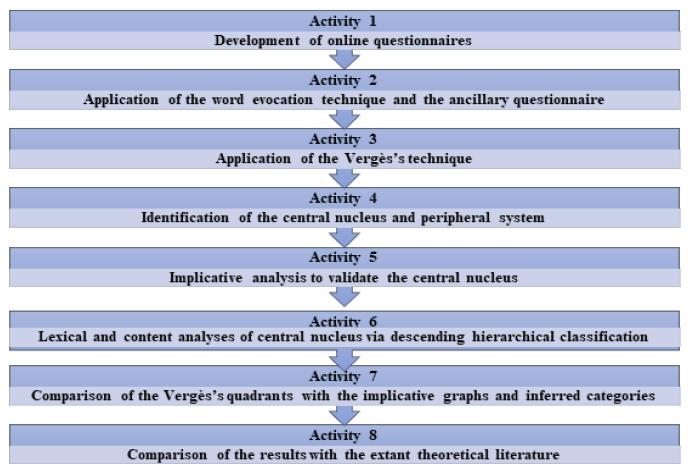
Figure 1
SRT-based research methodological workflow.
Source: Elaborated by the authors.
SRT AND CONSTRUCTS DEFINITION IN IS RESEARCH
The use of SRT for construct definition in IS research has been a recurrent phenomenon. Some IS articles that apply this methodological approach are set forth below vis-à-vis the construct investigated (Table 2), where papers with (*) are using the central nucleus theory (CNT) via a core-periphery analysis.
The literature review conducted identified 26 papers that have applied SRT to define various constructs within the IS field, which allows the development of Table 2. More than half of the articles (14) utilized central nucleus theory (CNT) to identify the static social representation of a construct, with a few other papers using alternative approaches such as frequency of occurrence, analysis of similarity, Reinert method, social group analysis, social network analysis, critical discourse analysis, thematic analysis, and coding based on anchoring/objectivation. The former papers demonstrate concrete examples of how CNT can be logically and cohesively integrated within the social representation theory (SRT) framework. Indeed, CNT serves as a natural extension of SRT, providing a detailed structure to understand the internal organization of social representations. In fact, CNT is not a separate theory but rather an analytical tool within SRT, enabling a deeper and more detailed analysis of social representations, enriching the results and providing robust insights. It offers a way to better structure and understand data collected under the SRT lens. Therefore, the use of the CNT aims to contribute to the objectivity and accuracy of research conclusions by providing a clear methodology to identify central and peripheral elements of social representations. This integration enhances the overall rigor and depth of the analysis conducted, making the findings more reliable and comprehensive.
To offer a more comprehensive review, the distinctive contributions of each of the papers collected will be discussed below.
Vaast (2007) examined the social representation of information systems security within the healthcare industry, revealing that perceptions of danger are highly subjective and vary significantly among stakeholders. Pawlowski et al. (2007) explored the social representation of burnout in the IT area, creating a social representations map reflecting IT professionals’ views of burnout. Jung et al. (2009)examined the sensemaking about electronic health records (EHRs), presenting a methodology for socio-cognitive research based on the theory of social representation. Michelotto and Joia (2023) investigated the social representation of smart cities in Brazil, noticing a technocentric view among citizens, with gaps in understanding important dimensions like people, participation, and culture. Joia and Vieira (2021) researched the social representation of blockchain, concluding that Brazilian professionals did not realize the potential for financial inclusion through blockchain and did not notice the need and relevance of specific legal governance for blockchain - an issue also overlooked by academia.
Additionally, Kaganer and Vaast (2010) focused on the social representation of social media. The authors explored how social media and other end-user-driven technologies have transformed organizational innovation, often outpacing decision-makers’ understanding. Chen et al. (2022) examined, via SRT, the evolving social perceptions of COVID-19 on the Chinese social media platform Weibo, concluding that the related discussions shifted from a clinical perspective to include personal, economic, and political aspects. Lu et al. (2016) also explored the rise of social media in Chinese government, particularly microblogging, via SRT, showing that while social media use is growing rapidly, interaction levels remain low. Gal et al. (2018) provided a historical perspective on IS by developing a tool and methodology for studying the evolution of social representations on Wikipedia. The study uses SRT to analyze how IS has been represented over time, offering insights into the changing perceptions and collective understanding of the field within the Wikipedia community.
Dulipovici and Robey (2013) explored the social representation of knowledge management systems (KMS). The authors adopted an interpretative case study that revealed how the social representations of KMS, according to four user groups, led to misalignment with organizational strategy. Vreuls and Joia (2012) investigated the social representation of CIO competencies. Their study highlights the shared meanings related to perceptions of CIO core competencies among IT professionals and CIOs themselves. Vaast et al. (2006) investigated the concept of ‘knowledge’ in knowledge management from a social representation perspective. By applying SRT, the study examines how different stakeholders perceive and understand knowledge management, highlighting the diverse and sometimes conflicting representations that influence knowledge management practices in organizations.
Teodoro et al. (2014) explored the social representation of IT governance, providing insights on how IT practices are collectively understood within organizations and applying SRT to elucidate the shared meanings associated with IT decision-making processes. In turn, Cunha et al. (2014)investigated the social representation of ICT-enabled public participation decision-making, indicating that political strategies are not effectively utilizing the internet’s capabilities for interaction and collaboration, leading to reduced citizen participation.
Moreover, Sarrica et al. (2020) delved into the social representation of e-bikes, suggesting that despite efforts to promote cycling and its health benefits, adoption in cities is still low. Using SRT, it was possible to conclude that e-bikes are gaining attention but haven’t yet transformed the overall narrative of cycling, which focuses on infrastructure, mobility, and safety. Bailey and Ngwenyama (2010) investigated the social representation of telecenters in a developing country, highlighting intergenerational interaction as crucial and examining the social relations through social network analysis and theories of social identity and representation. A framework is proposed for how these interactions at telecenters affect community development. Jang et al. (2021) investigated the perspective of managers on chatbot adoption in South Korea’s financial industry, examining the initiation and future potential of financial chatbots, as well as providing insights into their current status and implications for the financial sector.
Furthermore, Ju and Gluck (2011) applied SRT to explore information users’ perception of relevance and their criteria for judging relevant information, offering quantitative insights to improve metadata-based search algorithms from a user perspective. Naidoo et al. (2015)applied SRT to examine how computing researchers in South Africa have adapted to the novel design science research (DSR) paradigm. The study found distinctive views on DSR influenced by conventional research practices, offering recommendations for integrating new research practices into the computing field. Joia and Proença (2022)investigated how traditional financial sector professionals in Brazil perceived fintech and compared this with the academic literature. Thus, via SRT, the study found a misalignment between professionals’ views and the scientific literature on fintech.
Additionally, Joia and Leonardo (2023) and Vieira and Joia (2024) explored the social representation of digital transformation. By integrating SRT with qualitative interviews, they revealed how organizational leaders collectively perceive the impact of digitalization on business processes, strategies, and the workplace. IT professionals often have a technocentric view of digital transformation, focusing mainly on technological aspects, which may hinder the full achievement of digital transformation endeavors. Pawlowski and Jung (2015) explored the social representation of cybersecurity among university students. Via SRT, the study revealed students’ perceptions of cybersecurity threats, creating a map of social representations that highlighted students’ collective understanding.
Besides, Maina and Singh (2022) and Weerasinghe et al. (2022) explored the social representation of big data. Big data is increasingly central to digital health advancements, yet its application faces challenges of trust due to privacy, security, and governance concerns. In Kenya, stakeholders’ diverse perceptions of big data highlighted the need for tailored engagement strategies to rebuild confidence in big data initiatives. Similarly, in New Zealand, although the potential of big data for clinical care remains untapped, there is a planned adoption of big data for healthcare management, with specific concerns about data quality. Therefore, a theoretical framework is proposed using SRT to explore the social dynamics that influence the alignment between business and IT in healthcare, emphasizing the importance of understanding users’ experiences and the perceived usefulness of big data for them.
Through that comprehensive analysis, it can be noticed the diverse contexts in which SRT has been applied - from software development to healthcare and beyond. The aforementioned studies collectively contribute to the understanding of how social representations shape perceptions, decisions, and actions in the constantly evolving IS landscape. Although each article contributes in a unique way to the advancement of the use of SRT in the IS area, it is worth highlighting the work of Joia and Marchisotti (2020) due to its multifaceted approach to defining the concept of cloud computing. That study not only uses the four-quadrant framework of Vergès (Abric, 1998, 2005a) but also integrates lexical and content analyses (Freitas & Janissek, 2000), along with implicative statistics (Flament, 1986; Gras & Almouloud, 2002), to provide a nuanced understanding of the construct under investigation. In fact, the use of sundry analytical techniques ensures that the study captures the various dimensions of a social representation, providing a richer and more detailed analysis compared to studies that rely just on a single methodological approach.
The works surveyed demonstrate the comprehensiveness and depth of using SRT through several aspects, namely: (1) robustness and reliability: by integrating different methodological approaches, they can cross-validate their findings, enhancing the reliability and robustness of their results (Jang et al., 2021). This fact reduces the risk of bias and increases the credibility of their conclusions. Both qualitative and quantitative data collection methods are used, ensuring a comprehensive dataset that covers various aspects of the social representations being studied; (2) applicability and flexibility: the approach adopted by the papers is versatile and can be adapted to various contexts within the IS field. This flexibility makes it a valuable tool for researchers studying different constructs and phenomena. It is designed to be applicable to a wide range of constructs, from cloud computing to digital transformation, proving its broad applicability and relevance in the IS domain; (3) theoretical and practical contributions: the integration of multiple analytical techniques not only increases methodological rigor but also contributes to the theoretical advancement of SRT in IS research. Thus, it provides a more comprehensive framework for understanding social representations (Jang et al., 2021). Besides, the detailed and nuanced analysis offered by these works provides practical insights that can inform the design and implementation of IS solutions, making it valuable for both academics and practitioners (Howarth, 2006); (4) comparative strengths: while some studies, such as those by Vaast (2007) and Pawlowski et al. (2007), often focused on a single aspect or method, others (Joia & Marchisotti, 2020; Michelotto & Joia, 2023) provided a more holistic view by combining multiple methods. Therefore, that comprehensive approach allows for a deeper understanding of the constructs, capturing the complexity and multifaceted nature of social representations in IS.
However, the SRT-based methodological approaches identified in the articles are also subject to flaws, which can be mitigated through specific strategies. The complexity and comprehensiveness of the techniques used can demand significant time and resources to be effectively implemented. To mitigate this weakness, detailed planning is essential, clearly defining the steps, timelines, and responsibilities, thereby ensuring that each technique is effectively implemented. Furthermore, adequate training of research personnel is crucial to mitigate possible idiosyncrasies. Thus, specific workshops and training sessions can be organized to familiarize staff with the methods, and cross-validation between different techniques can help identify potential interpretation flaws, thus increasing the reliability of the results. Moreover, comparing results accrued from different methods can increase the robustness of the outcomes, and peer review during the research process can provide valuable feedback and identify potential methodological flaws, offering additional insights and suggesting improvements. Additionally, conducting a pilot study before undertaking full-scale research can help identify and resolve potential issues, allowing for adjustments to the methodology before the actual investigation begins. Furthermore, maintaining rigorous documentation of all procedures and methodological decisions can guarantee the transparency and replicability of the work, facilitating the identification of points that may require future adjustments. Finally, the use of specialized software for data analysis, like Iramuteq or Evoc, can increase the accuracy and efficiency of the analyses, automating parts of the process and reducing the risk of human error. Indeed, by implementing these strategies, researchers can mitigate the weaknesses of the methodology and ensure that the results are valid and reliable.
One can thus realize that SRT has been increasingly applied in the IS area for construct definition, and the use of implicative analysis to validate the SRT results appears to be a good solution to guarantee the correct IS construct definition. However, it is important to mention that - as argued by Gal and Berente (2008), Vaast (2007), Vaast and Walsham (2005) - a social representation is not a static entity, but a dynamic one, needing to be constantly re-elaborated to reflect changes in the environment, communication patterns, and group interaction. Consequently, it is essential that the research design incorporates a temporal dimension to capture the emergence and evolution, over time, of the social representation in its context of use. This can be done by repeating the research at different time intervals.
In the next section, it is explained how to use CNT, through its structural approach, to identify social representations and search for the central nucleus and the silent zone within them (Abric, 1998, 2005a, 2005b), together with a brief explanation of other qualitative and quantitative approaches, aiming for a better application of SRT in the IS area.
SRT AS A METHODOLOGICAL APPROACH FOR CONSTRUCTS DEFINITION
Most of the research methods proposed in studies on construct definition via SRT in the IS field lie in the tenets of a quali-quantitative approach, with data collected via the word evocation technique. Then, data treatment is performed through the Vergès’s four-quadrant framework - based on the central-peripheral analysis - and data analysis is conducted through lexical, content, and implicative analyses (Abric, 1998; Flament, 1986; Vergara & Ferreira, 2006; Vergès, 2003).
Vergès’s four-quadrant framework was first proposed by Vergès (1992) to portray, in a structured way, the social representation of money. Subsequently, other works began to better investigate the logic of this framework and how it could be used to obtain the social representation of an object, person, or similar entity (Moliner & Abric, 2015). Lexical and content analyses were later proposed to complement Vergès’s four-quadrant framework in the search for social representation. Instead of dealing with the frequency and order of expressions evoked by the interviewees, they address the content of the evocation itself, using text mining techniques for this purpose (Chartier & Meunier, 2011). Finally, implicative analysis - based on statistical implicative analysis (Gras et al., 2008; Gras et al., 2023) - also began to be used in conjunction with the aforementioned approaches, as a way of validating the structure of the social representation under analysis (Acioly-Régnier & Régnier, 2008, Elia & Gagatsis, 2008).
Based on that and what has already been presented previously, a methodological workflow for empirical research based on SRT can be proposed in Figure 1, which is detailed the following table.
Initially, as suggested by Marchisotti (2014) and Joia and Marchisotti (2020), a questionnaire must be developed to be applied to the respondents. This questionnaire must have three distinct sections, namely: a word evocation test; open questions to help understand the evoked words; and closed and semi-open questions regarding the respondents’ profile. The questionnaire is then applied to the respondents, who must present a certain level of familiarity with the construct being investigated to mitigate the possibility of the construct being misrepresented due to the respondents’ lack of experience with it.
The word evocation technique is based on asking the respondents to mention, orally or in writing, a certain number of words that spring to mind upon the presentation of an induced expression (Vergara, 2005; Vergara & Ferreira, 2006). Usually, the participants are asked to evoke the first five words or expressions that come to their minds when presented with the construct under analysis (Joia & Marchisotti, 2020; Marchisotti, 2014; Vreuls & Joia, 2012).
After using the words evocation technique, an open question is included, asking the respondent to justify the reason for choosing the first word/expression evoked by them. In practice, this word/expression should be considered the most important one evoked. From the answer to this question, and through content analysis, it is possible to understand the meaning of the words/expressions that support the identification of the social representation of the object under investigation (Marchisotti et al., 2019, 2021).
The treatment of the evoked words/expressions is done via Vergès’s four quadrants, developed by Pierre Vergès. These quadrants provide essential information for social representation analysis and allow the evoked words/expressions to be discriminated and clustered into categories of analysis (Abric, 1998; Vergès, 1992, 2003). According to Marzal et al. (2021), lexical analysis can be used to validate the categorization related to Vergès’s four quadrants, as words with the same semantic meaning are included in the same category.
In fact, Vergès’s four-quadrant technique, which is more specific and investigative, complements rather than replaces Moscovici’s seminal theory (Moscovici, 1961), which is broader and functions as an overarching framework. It is a statistical process that calculates the percentage of frequency of occurrence of the categories, accompanied by their order of importance, and is used to determine the central nucleus - where the categories with the highest ranking in importance and frequency are located - and the peripheral system of the social representation (Joia & Torres, 2022; Marzal et al., 2021).
The steps below are necessary to create Vergès’s quadrants (Abric, 2005a): categorization of the words/expressions; calculation of the frequency of the categories; and calculation of the average order of evocation (AOE) and average frequency of evocation (AFE). From the words/expressions mentioned by the subjects, semantic categories are created to gather similar words/expressions, thereby avoiding treating semantically similar words/expressions as distinct. The categories considered less significant - namely, those evoked only once - are discarded (Vergara, 2005). The ensemble de programmes permettant l’analyse des évocations (EVOC), developed by Pierre Vergès, can be used to categorize the evoked words/expressions and position them into the analysis categories.
Each category is then ranked based on the number of times each word belonging to that category is evoked in the first, second, third, fourth, or fifth position. The calculation of the AOE of each category is performed as presented below:
where f1 means the number of times this category is evoked in the first instance, f2 the number of times this category is evoked in the second instance and so on. The total sum of f, as presented in the denominator, describes the total number of times that category is evoked: (f1+ f2+ f3+ f4 + f5).
The AFE is calculated by dividing the total frequency with which categories are evoked by the number of categories, and the mean figure for the AOE is calculated by dividing the total sum of all AOEs by the number of categories. By comparing the individual values of each category with the aforementioned reference values, it is possible to locate each category horizontally and vertically in a specific quadrant.
Thus, from the joint analysis of the two averages of each category, the elements belonging to the central nucleus of the social representation are revealed. The categories are then grouped into the quadrants (Abric, 1998; 2005a). It can be seen, therefore, that the most frequently and promptly evoked words (in relation to the averages) will be part of the central nucleus, which defines the social representation of the object under study. For a complete understanding of how the construction of a social representation occurs using the Vergès’s four-quadrant technique, each of the quadrants is presented in Figure 2 (Joia & Marchisotti, 2020; Lukosevicius et al., 2017; Marchisotti et al., 2019; 2021; Marchisotti, 2014):
-
(a) Upper left: categories with frequencies of evocation greater than or equal to, and AOE lower than, their respective averages (central kernel);
-
(b) Upper right: categories with frequencies of evocation greater than or equal to, and AOE greater than or equal to, their respective averages;
-
(c) Lower left: categories with frequencies of evocation lower than, and AOE lower than, their respective averages;
-
(d) Lower right: categories with frequencies of evocation lower than, and AOE greater than or equal to, their respective averages (peripheral system).
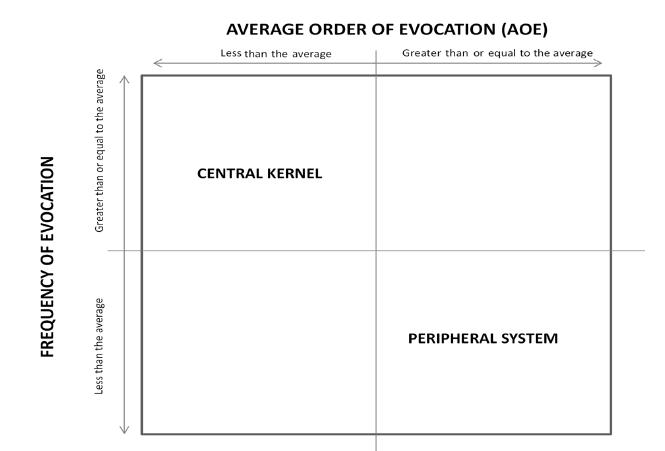
Figure 2
Vergès’s four quadrants framework.
Source: Elaborated by the authors.
The (b) and (c) quadrants do not allow any direct interpretation, as they refer to cognitions that only have close relationship with the central kernel (Tura, 1997). Thus, according to Abric (2005a) and as summarized in Table 3, Vergès’s four-quadrant framework crosses the frequency of evocation - of a quantitative nature - with the order of evocation - of a qualitative nature.
Descriptive summary of the Vergès’s four quadrants framework.

Note. Adapted from Cosso, E., Franco, M. L. P. B., & Fernandes, J. D. S. G. (2018). Representações sociais sobre relação professor-aluno no ensino superior. Revista Brasileira de Ensino Superior, 4(3), 5-23. https://doi.org/10.18256/2447-3944.2018.v4i3.2389
Next, an implicative analysis is performed to identify the relationships among the words/expressions that are part of the social representation of the construct under analysis. For Pereira (1997) and Gras and Almouloud (2002), implicative analysis allows for a confirmatory examination of the proposed social representation, helping to define the structural model of its components. In other words, the implicative analysis aims to understand the associations among the words/expressions that form the social representation of the construct, unveiling those that are most strongly connected to other words/expressions in Vergès’s quadrants. Therefore, the implicative analysis, like any multivariate statistical technique, enables researchers to visualize and organize models, as well as explain phenomena associated with the data obtained (Gras & Almouloud, 2002, Vieira & Joia, 2024).
According to Pereira (1997), implicative analysis helps mitigate a key weakness of the investigative technique used in the study, since the word evocation technique does not always clearly differentiate what belongs to the universe of the representation from what is merely part of common language. Thus, implicative analysis of the words/expressions may also suggest changes to the central nucleus identified by EVOC. To verify this possibility, an implicative graph based on a Poisson statistical distribution (Gras & Almouloud, 2002) can be developed using correspondence and hierarchical cluster software - such as CHIC. As an illustrative example, in Figure 3, the categories associated with the social representation of cloud computing submitted to implicative analysis, which described the associations among them (Joia & Marchisotti, 2020). This analysis identified the category ‘security’ as vital for the stability of the social representation of cloud computing, as it connects the two circles of the social representation in question (Joia & Marchisotti, 2020).
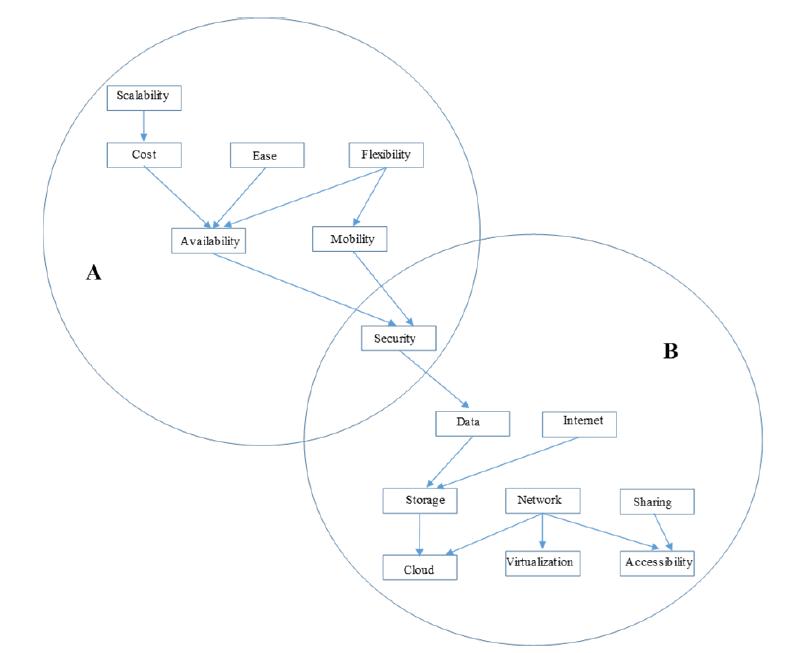
Figure 3
Implicative graph of cloud computing’s social representation.
Source: Elaborated by the authors.
Moreover, data analysis is also carried out through lexical and content analyses. Lexical analysis supports content analysis, which aims to identify what is said about the construct from the answers to the auxiliary questionnaires, seeking indicators that provide insights into the conditions under which the answers were produced or received (Vergara, 2005).
According to Freitas and Janissek (2000), lexical and content analyses, when used in a serial, recurrent, and complementary manner, can be applied to categorize research data. Lexical analysis enables a transition from text analysis to lexicon analysis (the set of all words found in the depositions). It can be performed using the descending hierarchical classification (DHC) method (Marchisotti et al., 2019, 2021), operationalized by software such as Iramuteq, and visualized through a dendrogram - a graphical representation of the categories correlated according to their similarities (Bueno & Couto, 2017). For example, Michelotto and Joia (2023), who investigated the social representation of smart city, applied lexical analysis using a dendrogram based on DHC, as shown in Figure 4.
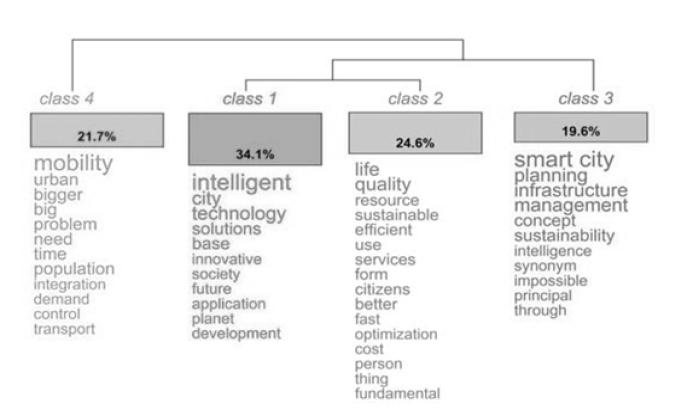
Figure 4
Using dendrogram for lexical analysis associated with SRT.
Source: Michelotto, F., & Joia, L. A. (2023). Unveiling the smart city concept: Perspectives from an emerging market via the social representation theory. Sustainability, 15(10), 8155. https://doi.org/10.3390/su15108155.
By using a dendrogram, it is possible to understand the hierarchical relationships among the evoked words - that is, the dendrogram clusters the evoked words and suggests categories that can be used to complement the SRT analysis. On the other hand, content analysis enables a detailed reading of each answer, which, once coded, reveals a holistic understanding (Freitas & Janissek, 2000).
Moreover, the implicative analysis carried out can be used to confirm (or not) the developed Vergès’s quadrant, functioning as a type of confirmatory analysis of the developed process. Thus, it is possible to move borderline categories from one quadrant to another in the Vergès’s quadrant, depending on their position in the implicative analysis (see, for example, Michelotto & Joia, 2023).
Finally, some articles compare the social representation of the investigated construct with the scientific literature on it. See, for instance, Joia and Marchisotti (2020) on cloud computing, Michelotto and Joia (2023) on smart city, Joia and Leonardo (2023) on home office, and Vieira and Joia (2024) on cryptocurrencies, to name just a few. The objective is to detect possible cognitive dissonances between how people make sense of the construct and what the theory says about it. As such, companies can identify and face possible cognitive dissonances found, in order to align theory and practice related to the construct under analysis.
CONCLUSIONS
Research contributions for theory and practice
The objective of this article is, as said at the beginning, to present the potentialities of using SRT for clearly defining constructs in the IS area via the proposition of a methodological workflow of SRT-based empirical research. As this knowledge area deals directly with advancements in information and communication technology, new constructs turn up evenly, leading academics to investigate them most of the time without knowing exactly their actual meanings (Vieira & Joia, 2024).
Based on that, the contributions of this work to both theory and practice are put forth below. Regarding the theoretical contributions accrued from this research, one might cite the application of SRT in replication studies that might confirm (or not) findings accrued from works that used other methodological approaches - namely case study, conceptual models, or quantitative methodologies - the most commonly used methodological approaches in IS research worldwide (Orlikowski & Baroudi, 1991; Recker et al., 2021; Warfield, 2010). As an example, one can cite the study of Correa and Joia (2014) that, by means of theoretical replication, compares and critically discusses the CIO core competencies obtained via multivariate statistical analysis (Vreuls & Joia, 2012) vis-à-vis those obtained via SRT application. In this way, both academia and industry can become aware of the need to mitigate the cognitive dissonance between theory and practice in relation to a specific theoretical construct. Thus, on the academic side, new work can be developed to investigate the antecedents of this problem. And, on the industry side, companies can carry out capacity-building initiatives so that their professionals make sense of a specific construct in alignment with theory.
Besides, some articles stand out for their comprehensive integration of multiple analytical techniques, including Vergès’s four-quadrant framework, lexical and content analyses, and implicative statistics (Joia & Marchisotti, 2020; Joia & Proença, 2022; Michelotto & Joia, 2023; to name just a few). The consolidation of this multifaceted approach via an SRT-based methodological workflow allows for a more refined and robust understanding of social representations of IS constructs, when compared to other studies that typically rely on a more limited set of traditional methods. Thus, as a further theoretical contribution, this work proposes that, by combining different analytical techniques linked to SRT, scientific research can produce a more reliable and in-depth analysis of theoretical constructs - which is particularly valuable for defining and giving meaning to new constructs in the IS domain.
Moreover, although SRT is not a panacea for all the challenges of IS research, this article highlights that its application offers valuable information about how different social groups perceive and interact with ICT. Thus, by recognizing the benefits of using SRT in IS research, but also its limitations, SRT might be used in future studies linked to other theoretical references, such as the technology acceptance model (Davis, 1989) and its various variants (TAM2, e-TAM, UTAUT, etc.), actor-network theory (Latour, 2005), and structuration theory (Giddens, 1984), to name just a few, which could provide valuable complementary insights, as well as lead to a more complete theoretical framework. All of these theoretical approaches are based on constructs associated with individual cognition, which can be transformed into constructs related to social cognition via SRT (Proulx et al., 2016). Indeed, one can cite works that have put together SRT and TAMxx (Di Marco et al., 2019; Mutlu & Efeoglu, 2013; Weerasinghe et al., 2018), SRT and ANT (Barndon, 2004; Hald & Spring, 2023; Krieger & Belliger, 2014; Maurizio & Petroccia, 2023; Veltri & Suerdem, 2013), and SRT and structuration theory (Ivinson & Duveen, 2005; Lahlou, 2015; Rezaei et al., 2014).
Furthermore, employing mixed methods approaches - including qualitative techniques (such as interviews and ethnography) along with quantitative methods - can provide a more holistic understanding of IS phenomena. Thus, IS studies that apply SRT can make use of these ancillary theories and methodologies to enrich the analysis developed and address in detail the multifaceted nature of IS research.
Moreover, this article intends to make an important contribution to practice by enabling, via SRT, the identification of possible cognitive dissonances between what an IS construct means for IT professionals and managers vis-à-vis what the scientific literature says about it. Indeed, several studies mentioned in this investigation have identified cognitive dissonance between theory and practice in relation to some IS constructs (see Correa & Joia, 2014; Joia & Proença, 2022; Vreuls & Joia, 2012, to name just a few), which can lead to failure in implementing emerging technologies in organizations. Therefore, by using the results accrued from the application of the proposed methodological workflow, organizations can help their professionals make sense of a new IS construct in tandem with its theoretical definition.
Research limitations and future steps
Despite the potential of the methodological approach proposed in this study, some limitations must be presented so that they can be addressed in future research, as shown below.
One can first mention the difficulty of obtaining a truly random sample for SRT-based studies. In fact, most of the samples used in existing works that apply SRT are not probabilistic, but rather obtained by accessibility (Vergara, 2013). Therefore, as a practical suggestion, future SRT-based research could use probabilistic samples that fully represent the respective populations, in order to obtain the social representation of the construct under investigation.
Second, one can cite the difficulty of extracting meaningful categories for the social representation accrued from the words/expressions evoked (Marchisotti, 2014; Joia & Marchisotti, 2020). In fact, even with the use of software, researchers’ interpretations (with their possible biases) are still essential for creating clusters related to the evoked words in order to obtain the social representation in question. Thus, as a practical suggestion for dealing with this, future SRT-based research might use outsiders who, together with researchers, could mitigate the potential interpretation bias associated with grouping the expressions evoked by interviewees.
Finally, another limitation pertains to the predetermined minimum frequency of evocation used in the study, as well as the thresholds selected for the average order of evocation (AOE) and average frequency of evocation (AFE). As there is no consensus on how to calculate these values, it is possible that choosing another way to define them could lead to different results from those obtained. Thus, as a practical suggestion to mitigate this limitation in future SRT-based works, the AOE and AFE obtained from different approaches could be compared, making it clear why one criterion was chosen over another.
As a final observation, it is important to clarify that the methodological framework presented in this work is just one among many that can be associated with the operationalization of SRT (see, for example, Doise, 1993). As stated by Philogène and Deaux (2001, p. 4):
the strength of social representation theory has been its ability to explain sociocultural phenomena by being eminently practical in a Lewinian sense. For this reason, the conceptual complexity of the theory has been matched by methodological strategies that often combine a variety of empirical techniques. This rich connection between theory and empirical applications, both quantitative and qualitative, has made social representation theory particularly effective in studying modern society.
In sum, and despite these limitations, this work intends to have shown the potential of SRT - especially when combined with other methodological approaches - for the definition and interpretation of constructs in the IS area, aiming to make it a viable alternative to the dominant methodological approaches in this knowledge field.
REFERENCES
Abric, J. C. (1987). Coopération, compétition et représentations sociales. Delval.
Abric, J. C. (1998). A abordagem estrutural das representações sociais. In: Moreira, O. D. (Orgs.). Estudos Interdisciplinares de Representação Social (p. 27-38). AB.
Abric, J. C. (2001). A structural approach to social representations. In K. Deaux & G. Philogène (Eds.), Representations of the social: Bridging theoretical traditions. Blackwell.
Abric, J. (2005a). La recherche du noyau central et de la zone muette des représentations sociales. Dans: éd., Méthodes d’étude des représentations sociales (pp. 59-80). Érès. https://doi.org/10.3917/eres.abric.2003.01.0059
Abric, J. (2005b). A zona muda das representações sociais. In D. C. Oliveira & P. H. F. Campos. Representações sociais: Uma teoria sem fronteiras. Museu da República. https://doi.org/10.1590/S0102-37722006000100006
Abric, J. (2008). A structural approach to the social representations the theory of the central nucleus. In 9th International Conference on Social Representations: Alternative productions of knowledge and social representations, Bali, Indonesia.
Acioly-Régnier, N. M., & Régnier, J. C. (2008). Identifying didactic and sociocultural obstacles to conceptualization through Statistical Implicative Analysis. In Statistical implicative Analysis: Theory and applications (pp. 347-379). Springer.
Alvesson, M., & Blom, M. (2022). The hegemonic ambiguity of big concepts in organization studies. Human Relations, 75(1), 58-86. https://doi.org/10.1177/0018726720986847
Arden, S. V., Pentimonti, J. M., Cooray, R., & Jackson, S. (2018). A categorical content analysis of highly cited literature related to trends and issues in special education. Journal of Learning Disabilities, 51(6), 589-599. https://doi.org/10.1177/0022219417720931
Bailey, A., & Ngwenyama, O. (2010). Bridging the generation gap in ICT use: Interrogating identity, technology, and interactions in community telecenters. Information Technology for Development, 16(1), 62-82. https://doi.org/10.1080/02681100903566156.
Barndon, R. (2004). A discussion of magic and medicines in East African iron working: actors and artefacts in technology. Norwegian Archaeological Review, 37(1), 21-40. https://doi.org/10.1080/00293650410001180
Berger, A. A. (2014). Semiotics and society. Society, 51, 22-26. https://doi.org/10.1007/s12115-013-9731-4
Brenner, B., & Hartl, B. (2021). The perceived relationship between digitalization and ecological, economic, and social sustainability. Journal of Cleaner Production, 315, 128128. https://doi.org/10.1016/j.jclepro.2021.128128
Bueno, E.D.L., & Couto, G.S. (2017). Representações sociais e tecnológicas: O que dizem as teses e dissertações 2013-2017. In Proceedings of the 4º Seminário Internacional de Representações Sociais, Subjetividade e Educação, Curitiba, PR, Brazil.
Chartier, J. F., & Meunier, J. G. (2011). Text mining methods for social representation analysis in large corpora. Papers on Social Representations, 20(2), 37-1. www.europhd.net/sites/europhd/files/images/onda_2/07/27th_lab/scientific_materials/sarrica/chartier_meunier_2011.pdf
Chen, A., Zhang, J., Liao, W., Luo, C., Shen, C., & Feng, B. (2022). Multiplicity and dynamics of social representations of the COVID-19 pandemic on Chinese social media from 2019 to 2020. Information Processing & Management, 59(4), 102990. https://doi.org/10.1016/j.ipm.2022.102990
Clarke, R., Davison, R. M., & Jia, W. (2020). Researcher perspective in the IS discipline: an empirical study of articles in the basket of 8 journals. Information Technology & People, 33(6), 1515-1541. https://doi.org/10.1108/ITP-04-2019-0189
Cornelissen, J. P., & Durand, R. (2014). Moving forward: Developing theoretical contributions in management studies. Journal of Management Studies, 51(6), 995-1022. https://doi.org/10.1111/joms.12078
Correa, J., & Joia, L. (2014, August). CIO Competencies: A social representation analysis. AMCIS 2014 - Proceedings of the Twentieth Americas Conference on Information Systems, Savannah, EUA. https://doi.org/10.13140/RG.2.1.5140.0482
Cosso, E., Franco, M. L. P. B., & Fernandes, J. D. S. G. (2018). Representações sociais sobre relação professor-aluno no ensino superior. Revista Brasileira de Ensino Superior, 4(3), 5-23. https://doi.org/10.18256/2447-3944.2018.v4i3.2389
Cunha, M. A. V. C., Coelho, T. R., & Pozzebon, M. (2014). Internet e participação: o caso do orçamento participativo digital de Belo Horizonte. RAE-Revista de Administração de Empresas, 54(3). http://dx.doi.org/10.1590/S0034-759020140201
Czarniawska, B. (2006). Book review: Bruno Latour: Reassembling the social: An introduction to actor-network theory. Organization Studies, 27(10), 1553-1557. http://dx.doi.org/10.1177/0170840606071164
Davis, F. D. (1989). “Perceived usefulness, perceived ease of use, and user acceptance of information technology.” MIS Quarterly, 13(3), 319-340. https://doi.org/10.2307/249008
Davison, R. M., & Martinsons, M. G. (2016). Context is king! Considering particularism in research design and reporting. Journal of Information Technology, 31(3), 241-249. https://doi.org/10.1057/jit.2015.19
Di Marco, L., El Kechaï, H., Martin, D. K., & Gillois, P. (2019). Blended learning for french health students: Does acceptance of a learning management system influence students’ self-efficacy? In MEDINFO 2019: Health and Wellbeing e-Networks for All (pp. 1169-1173). IOS Press.
Doise, W. (1993). Debating social representations. In G. M. Breakwell & D. V. Canter (Eds.), Empirical approaches to social representations (pp. 157-170). Clarendon Press. https://doi.org/10.1093/oso/9780198521815.003.0007
Doolin, B., & Lowe, A. (2002). To reveal is to critique: Actor-network theory and critical information systems research. Journal of Information Technology, 17, 69-78. https://doi.org/10.1080/02683960210145986
Dyer, W. G., Jr., & Wilkins, A. L. (1991). Better stories, not better constructs, to generate better theory: A rejoinder to Eisenhardt. Academy of Management Review, 16(3), 613-619. https://doi.org/10.2307/258920
Dulipovici, A., & Robey, D. (2013). Strategic alignment and misalignment of knowledge management systems: A social representation perspective. Journal of Management Information Systems, 29(4), 103-126. https://doi.org/10.2753/MIS0742-1222290404
Eisenhardt K. M. (1989). Building theories from case study research. Academy of Management Review, 14(4), 532-550. https://doi.org/10.5465/amr.1989.4308385
El-Den, S., Schneider, C., Mirzaei, A., & Carter, S. (2020). How to measure a latent construct: Psychometric principles for the development and validation of measurement instruments. International Journal of Pharmacy Practice, 28(4), 326-336. https://doi.org/10.1111/ijpp.12600
Elia, I., & Gagatsis, A. (2008). A comparison between the hierarchical clustering of variables, implicative statistical analysis and confirmatory factor analysis. In R. Gras, E. Suzuki, F. Guillet, & F. Spagnolo (Eds.), Statistical implicative analysis. studies in computational intelligence (vol. 127). Springer.
Ferreira, T. C. R., Chacon, M. C. M., & Capellini, V. L. M. F. (2021). Analysis of publications relating giftedness, creativity and bilingualism in the scielo, scopus and web of science databases. Revista Brasileira de Educação Especial, 27, e0030. http://hdl.handle.net/11449/233364
Flament, C. (1986). Analyse de Similitude: Une technique pour les recherches sur les representations sociales. In W. Doise (Ed.), L’Etude des Representations Sociales (pp. 139-156). Delachaux & Niestle.
Freitas, H., & Janissek, R. (2000). Análise léxica e análise de conteúdo: Técnicas complementares, sequências e recorrentes para análise de dados qualitativos. Sphinx-Sagra.
Gadamer, H. G. (2018). From word to concept. The task of Hermeneutics as Philosophy. Philosophy, 1, 11-11. https://jochenteuffel.com/wp-content/uploads/2018/11/gadamer-from-word-to-concept-the-task-of-hermeneutics-as-philosophy.pdf
Gal, U., & Berente, N. (2008). A social representations perspective on information systems implementation: Rethinking the concept of “frames”. Information Technology and People, 21(2), 133-154. https://doi.org/10.1108/09593840810881051
Gal, U., Riemer, K., & Chasin, F. (2018). A historical perspective on information systems: a tool and methodology for studying the evolution of social representations on wikipedia. Communications of the Association for Information Systems, 43(1), 37. https://doi.org/10.17705/1CAIS.04337
Gelencsér, M., Kőmüves, Z. S., Hollósy-Vadász, G., & Szabó-Szentgróti, G. (2024). Modelling employee retention in small and medium-sized enterprises and large enterprises in a dynamically changing business environment. International Journal of Organizational Analysis. https://www.emerald.com/insight/content/doi/10.1108/ijoa-09-2023-3961/full/html
Gibson, E. J. (1977). How perception really develops: A view from outside the network. In D. Laberge, & J. Samuels, (Eds.), Basic processes in reading: Perception and comprehension (pp. 155-173). Routledge.
Giddens, A. (1984). The Constitution of Society: Outline of the Theory of Structuration. University of California Press.
Gilliam, D. A., & Voss, K. (2013). A proposed procedure for construct definition in marketing. European Journal of Marketing, 47(1/2), 5-26. https://doi.org/10.1108/03090561311285439
Gobov, D., Maliarcuk, C., Kunanets, N., & Oliinyk, Y. (2020, September). Approaches for the Concept” Business Analysis” Definition in IT Projects and Frameworks. In Índice de Confiança da Construção (pp. 321-332). FGV.
Gras, R., & Almouloud, S. A. (2002). A implicação estatística usada como ferramenta em um exemplo de análise de dados multidimensionais. Educação Matemática Pesquisa, 4(2), 75-88. http://math.unipa.it/~grim/asi/asi_03_saddo_gras.pdf
Gras, R., Suzuki, E., Guillet, F., & Spagnolo, F. (2008). Statistical implicative analysis. Springer.
Gras, R., Bodin, A., Couturier, R., & Gregori, P. (2023). The theory of statistical implicative analysis: Or the implausibility of falsehood... when the exception confirms the rule. CRC Press.
Greenhalgh, T., Thorne, S., & Malterud, K. (2018). Time to challenge the spurious hierarchy of systematic over narrative reviews? European Journal of Clinical Investigation, 48(6). https://doi.org/10.1111/eci.12931
Greenway, K., Butt, G., & Walthall, H. (2019). What is a theory-practice gap? An exploration of the concept. Nurse Education in Practice, 34, 1-6. https://doi.org/10.1016/j.nepr.2018.10.005
Gregory, D. (2013). Showing, sensing, and seeming: Distinctively sensory representations and their contents. OUP Oxford.
Guimelli, C. (1993). Concerning the structure of social representations. Papers on Social Representations, 2(2), 85-92. https://psr.iscte-iul.pt/index.php/PSR/article/view/146
Hald, K. S., & Spring, M. (2023). Actor-network theory: A novel approach to supply chain management theory development. Journal of Supply Chain Management, 59(2), 87-105. https://doi.org/10.1111/jscm.12296
Harmancioglu, N., Droge, C., & Calantone, R. J. (2009), “Theoretical lenses and domain definitions in innovation research”, European Journal of Marketing, 43(1-2), 229-263. https://doi.org/10.1108/03090560910923319
Hassan, N. R., Mathiassen, L., & Lowry, P. B. (2019). The process of information systems theorizing as a discursive practice. Journal of Information Technology, 34(3), 198-220. https://doi.org/10.1177/0268396219832004
Hibberd, F. J. (2019). What is scientific definition? The Journal of Mind and Behavior, 40(1), 29-52. https://www.researchgate.net/publication/333815253_What_is_Scientific_Definition_The_Journal_of_Mind_and_Behavior_2019_401_29-52
Hillmann, J., & Guenther, E. (2021). Organizational resilience: A valuable construct for management research? International Journal of Management Reviews, 23(1), 7-44. https://doi.org/10.1111/ijmr.12239
Hirschheim, R. (2007). Introduction to the special issue on” quo vadis TAM-issues and reflections on technology acceptance research”. Journal of the Association for Information Systems, 8(4), 9. https://aisel.aisnet.org/jais/vol8/iss4/18/
Holmström, J. (2016). Theorizing in IS research: What comes first and what comes after? Scandinavian Journal of Information Systems, 17(1), 167-174. https://aisel.aisnet.org/cgi/viewcontent.cgi?article=1048&context=sjis
Howarth, C. (2006). A social representation is not a quiet thing: Exploring the critical potential of social representations theory. British Journal of Social Psychology, 45(1), 65-86. https://doi.org/10.1348/014466605X43777
Holmström, J. (2005) “Theorizing in IS research: What came before and what comes next?,” Scandinavian Journal of Information Systems, 17(1) Article 2. https://aisel.aisnet.org/sjis/vol17/iss1/2
Ivinson, G., & Duveen, G. (2005). Classroom structuration and the development of social representations of the curriculum. British Journal of Sociology of Education, 26(5), 627-642. https://doi.org/10.1080/01425690500293603
Jang, M., Jung Y., & Kim S. (2021). Investigating managers’ understanding of chatbots in the Korean financial industry. Computers in Human Behavior, 120, 106747. https://doi.org/10.1016/j.chb.2021.106747
Jodelet, D. (2001). Representações sociais: Um domínio em expansão. In D. Jodelet (Org.). As representações sociais (pp. 17-44). EduERJ.
Jodelet, D. (2002). Les représentations sociales dans le champ de la culture. Social Science Information, 41(1), 111-133. https://doi.org/10.1177/0539018402041001008
Jodelet, D. (2008). Social representations: The beautiful invention. Journal for the Theory of Social Behaviour, 38(4), 411-430. https://doi.org/10.1111/j.1468-5914.2008.00383.x
Joia, L. A., & Ferreira, S. (2005). Modelo de negócios: Constructo real ou metáfora de estratégia? Cadernos Ebape. BR, 3, 1-18. https://doi.org/10.1590/S1679-39512005000400002
Joia, L. A., & Leonardo, L. F. (2023). The COVID-19 Pandemic and the Digital Transformation of Workplace: The Social Representation of Home-Office. Sustainability, 15(20), 14987. https://doi.org/10.3390/su152014987
Joia, L. A., & Marchisotti, G. (2020). It is so! (If you think so!) - IT professionals’ social representation of cloud computing. Internet Research, 30(3), 889-923. https://doi.org/10.1108/INTR-10-2018-0463
Joia, L. A., & Melon, M. (2020), “The social representation of success in IT projects”, International Journal of Managing Projects in Business, 13(7), 1578-1599. https://doi.org/10.1108/IJMPB-01-2019-0005
Joia, L. A., & Proença, R. (2022). The social representation of fintech from the perspective of traditional financial sector professionals: evidence from Brazil. Financial Innovation, 8(1), 93. https://doi.org/10.1186/s40854-022-00409-7.
Joia, L. A., & Torres, V. C. S. (2022). The social representation of IT governance: The standpoint of IT professionals. BAR-Brazilian Administration Review, 19(2), e210044. https://doi.org/10.1590/1807-7692bar2022210044
Joia, L. A., & Vieira, J. A. P. (2021). Going beyond cryptocurrencies: The social representation of blockchain. Sustainability, 13(24), 14054. http://dx.doi.org/10.3390/su132414054
Ju, B., & Gluck, M. (2011). Calibrating information users’ views on relevance: A social representations approach. Journal of information Science, 37(4), 429-438. https://doi.org/10.1177/0165551511412030
Jung Y., Pawlowski S. D., & Wiley-Patton, S. (2009). Conducting social cognition research in IS: A methodology for eliciting and analyzing social representations. Communications of the Association for Information Systems, 24(1), 35. https://doi.org/10.17705/1CAIS.02435
Kaganer, E. A., & Vaast, E. (2010). Responding to the (almost) unknown: Social representations and corporate policies of social media. In ICIS 2010 Proceedings (p. 163). https://doi.org/10.17705/1CAIS.04337
Kelly, G. (1955). The psychology of personal constructs (Vol. 1 and 2). Routledge.
Kelly, G. (1963). A theory of personality: The psychology of personal constructs (No. 152). WW Norton & Company.
Kieser, A., & Nicolai, A. T. (2005). Success factor research: Overcoming the trade-off between rigor and relevance? Journal of Management Inquiry, 14(3), 275-279. (Original work published 2005). https://doi.org/10.1177/1056492605279098
Kirsch, G., & Sullivan, P. A. (Eds.). (1992). Methods and methodology in composition research. SIU Press.
Klenke, K. (1992). Construct measurement in management information systems: A review and critique of user satisfaction and user involvement instruments. INFOR: Information Systems and Operational Research, 30(4), 325-348. https://doi.org/10.1080/03155986.1992.11732206
Krieger, D. J., & Belliger, A. (2014). Interpreting networks: Hermeneutics, actor-network theory & new media. transcript Verlag.
Lahlou, S. (2015). Social representations and social construction: The evolutionary perspective of installation theory. The Cambridge Handbook of Social Representations, 193, 210-223.
Latour, B. (2005). Reassembling the Social: An Introduction to Actor-Network-Theory. Oxford University Press. https://doi.org/10.1093/oso/9780199256044.001.0001
Law, R., Lei, S. S. I., Zhang, K., & Lau, A. (2024). Bridging the theory-practice gap: A critical reflection on information and communication technology research. International Journal of Contemporary Hospitality Management, 36(6), 1980-1990. https://doi.org/10.1108/IJCHM-02-2023-0131
Leidner, D. E., & Kayworth, T. (2006). A review of culture in information systems research: Toward a theory of information technology culture conflict. MIS Quarterly, 30(2), 357-399. https://dl.acm.org/doi/abs/10.5555/2017307.2017316
Leidner, D. E., & Gregory, R. W. (2024). About theory and theorizing. Journal of the Association for Information Systems, 25(3), 501-521. https://doi.org/10.17705/1jais.00886
Lewis, C., & Carpendale, J. (2014). Social cognition. In P. K. Smith & C. H. Hart (Eds.), The Wiley Blackwell handbook of childhood social development (2nd ed., pp. 531-548). Wiley Blackwell.
Lima, R. D., & Campos, P. H. (2015) Campo e grupo: Aproximação conceitual entre Pierre Bourdieu e a teoria moscoviciana das representações sociais. Educação e Pesquisa, 41(1), 63-77. https://doi.org/10.1590/S1517-97022015011454
Lloyd, S. (2011). Applying the nominal group technique to specify the domain of a construct. Qualitative Market Research: An International Journal, 14(1), 105-121. http://dx.doi.org/10.1108/13522751111099346
Lu, B., Zhang, S., & Fan, W. (2016). Social representations of social media use in government: An analysis of Chinese government microblogging from citizens’ perspective. Social Science Computer Review, 34(4), 416-436. https://doi.org/10.1177/0894439315595222
Lüftenegger, M., & Chen, J. A. (2017). Conceptual issues and assessment of implicit theories. Zeitschrift für Psychologie, 225(2), 99-106. http://dx.doi.org/10.1027/2151-2604/a000286
Lukosevicius, A. P., Soares, C. A. P., & Joia, L. A. (2017). Caracterização da complexidade em projetos de Engenharia. Gestão & Produção, 25(2), 331-342. https://doi.org/10.1590/0104-530X2957-16
MacKenzie, S. B. (2003). The dangers of poor construct conceptualization. Journal of the Academy of Marketing Science, 31(3), 323-326. (Original work published 2003). https://doi.org/10.1177/0092070303031003011
Maina, A. M., & Singh, U. G. (2022). Rebuilding stakeholder confidence in health-relevant big data applications: A social representations perspective. Information, 13(9), 441. https://doi.org/10.3390/info13090441
Marchisotti, G. G. (2014). A representação social do cloud computing na visão dos profissionais de TI brasileiros [Dissertação de Mestrado]. Fundação Getulio Vargas. https://bdtd.ibict.br/vufind/Record/FGV_155ec0e50dd1d31b9e47804684fd2b89
Marchisotti, G. G., Joia, L. A., & Carvalho, R. B. D. (2019). The social representation of Cloud Computing according to Brazilian information technology professionals. Revista de Administração de Empresas, 59(1), 16-28. https://doi.org/10.1590/S0034-759020190103
Marchisotti, G. G., Farias, J. R. Filho, França, S. L. B., Toledo, R. F., Castro, H. G. C. A., Alves, C., & Putnik, G. D. (2021). The Social representation of the governance system through key descriptors: Mute Zone. International Journal for Quality Research. https://doi.org/10.24874/IJQR16.01-18
Martins-Silva, P. D. O., Silva, A. D., Peroni, G. G. H., Medeiros, C. P. D., & Vitória, N. O. D. (2016). Teoria das representações sociais nos estudos organizacionais no Brasil: Análise bibliométrica de 2001 a 2014. Cadernos EBAPE. BR, 14, 891-919. https://doi.org/10.1590/1679-395155900
Marton, F. (1981). Phenomenography-describing conceptions of the world around us. Instructional Acience, 10(2), 177-200. https://doi.org/10.1007/BF00132516
Marzal, J., Budiman, W., Hutabarat, B. F., & Kurniawan, W. (2021). Improving the response time of online letter management application users: An application of social representation Theory of Shame. JOIV: International Journal on Informatics Visualization, 5(1), 39-45. https://dx.doi.org/10.30630/joiv.5.1.442
Maurizio, E., & Petroccia, S. (2023). e-health and e-care: An application of actor network theory in social communication. International Review of Sociology, 33(1), 39-50. https://doi.org/10.1080/03906701.2023.2187828
Mazzotti, T. B. (1997). Representação social de “problema ambiental”: uma contribuição à educação ambiental. Revista Brasileira de Estudos Pedagógicos, 78(188-190), 86-123. https://doi.org/10.24109/2176-6681.rbep.78i188-89-90.1051
Menin, M. D. S. (2007). O aspecto normativo das representações sociais: Comparando concepções. Revista de Educação Pública, 16(30), 121-135. https://doi.org/10.1590/0102-37722016012074199208
Michelotto, F., & Joia, L. A. (2023). Unveiling the smart city concept: Perspectives from an emerging market via the social representation theory. Sustainability, 15(10), 8155. https://doi.org/10.3390/su15108155
Middendorp, C. P. (1991). On the conceptualization of theoretical constructs. Quality and Quantity, 25(3), 235-252. https://doi.org/10.1007/BF00167530
Mishra, V., & Mishra, M. P. (2023). PRISMA for review of management literature-method, merits, and limitations-An academic review. In Advancing methodologies of conducting literature review in management domain, (pp. 125-136). https://doi.org/10.1108/S2754-586520230000002007
Moher, D., Liberati, A., Tetzlaff, J., Altman, D. G., & Prisma Group. (2010). Preferred reporting items for systematic reviews and meta-analyses: The PRISMA statement. International journal of surgery, 8(5), 336-341. https://doi.org/10.1371/journal.pmed.1000097
Moliner, P., & Abric, J. C. (2015). Central core theory. In The Cambridge handbook of social representations (pp. 83-95). Cambridge University Press.
Moscovici, S. (1961). La psychanalyse, son image et son public/Serge Moscovici. Presses Universitaires de France. https://www.persee.fr/doc/rfsoc_0035-2969_1961_num_2_4_5992
Moscovici, S. (2001a). The phenomenon of social representations. In G. Duveen (Ed.). Social representations: Explorations in social psychology. New York University Press.
Moscovici, S. (2001b). Why a theory of social representation? In K. Deaux & G. Philogène (Eds.), Representations of the social: Bridging theoretical traditions (pp. 8-35). Blackwell.
Mutlu, S., & Efeoglu, I. E. (2013). Evaluation of e-mail usage by extended technology acceptance model. International Review of Management and Marketing, 3(3), 112-121. https://dergipark.org.tr/tr/download/article-file/366651
Naidoo, R., Van der Merwe, A., Gerber, A., & Hevner, A. (2015). A social representations analysis of design science research. South African Computer Journal, 56(1), 33-49. http://hdl.handle.net/2263/50052
Orlikowski, W. J., & Baroudi, J. J. (1991). Studying information technology in organizations: Research approaches and assumptions. Information Systems Research, 2(1), 1-28. https://doi.org/10.1287/isre.2.1.1
Pawlowski, S. D., Kaganer, E. A., & Cater, J. J. (2007). Focusing the research agenda on burnout in IT: Social representations of burnout in the profession. European Journal of Information Systems, 16(5), 612-627. https://doi.org/10.1057/palgrave.ejis.3000699
Pawlowski, S. D., & Jung, Y. (2015). Social representations of cybersecurity by university students and implications for instructional design. Journal of Information Systems Education, 26(4), 281-294. https://doi.org/ doi.org/10.17705/1CAIS.04337
Pereira, C. (1997). A análise de dados nas representações sociais. Análise Psicológica, 1(XV), 49-62. https://repositorio.ispa.pt/bitstream/10400.12/5670/1/1997_1_49.pdf
Pesämaa, O., Zwikael, O., Hair, J. Jr, & Huemann, M. (2021). Publishing quantitative papers with rigor and transparency. International Journal of Project Management, 39(3), 217-222. https://www.sciencedirect.com/science/article/pii/S0263786321000156?via%3Dihub
Philogène, G. & Deaux, K. (2001). Representations of the Social. Blackwell.
Potter, J., & Billig, M. (1992). Re-representing representations-Discussion of Räty & Snellman. Papers on Social Representations, 1, 15-20. https://psr.iscte-iul.pt/index.php/PSR/article/view/107
Pozzebon, M., Cunha, M. A., & Coelho, T. R. (2016) Making sense to decreasing citizen e Participation through a social representation lens. Information and Organization, 26(3), 84-99. https://doi.org/10.1016/j.infoandorg.2016.07.002
Proulx, M. J., Todorov, O. S., Taylor Aiken, A., & de Sousa, A. A. (2016). Where am I? Who am I? The relation between spatial cognition, social cognition and individual differences in the built environment. Frontiers in Psychology, 7, 64. https://doi.org/10.3389/fpsyg.2016.00064
Ramos, P., & Mota, C. (2014). Perceptions of success and failure factors in information technology projects: a study from Brazilian companies. Procedia-Social and Behavioral Sciences, 119, 349-357. https://doi.org/10.1016/j.sbspro.2014.03.040
Rezaei, S., Khaleghi, A., & Eivazi, F. (2014). An entrepreneurial Aha! Experience: A cognitive science, sociology and psychology synthetic approach to entrepreneurship. Innovation Management Journal, 3(2), 125-144. https://www.nowavari.ir/article_14721.html?lang=en
Recker, J. C., Lukyanenko, R., Jabbari Sabegh, M., Samuel, B., & Castellanos, A. (2021). From representation to mediation: a new agenda for conceptual modeling research in a digital world. MIS Quarterly: Management Information Systems, 45(1), 269-300. https://doi.org/10.25300/MISQ/2021/16027
Reis, G.V.L., Rocha, J.F.D., Savassi, L.C.M., Sampaio, C.A., & Caldeira, A.P. (2021). Self-directed learning among primary health care doctors: An analysis in light of the theory of social representations. Revista Brasileira de Educação Médica, 45. https://doi.org/10.1590/1981-5271v45.3-20200522
Rodrigues, E., & Pietrocola, M. (2020). Between social and semantic networks: A case study on classroom complexity. Education Sciences, 10(2), 30. https://doi.org/10.3390/educsci10020030
Rossiter, J. R. (2017). Optimal standard measures: Comment on Matthews et al. (2016). American Psychologist, 72(5), 489-490. https://psycnet.apa.org/doi/10.1037/amp0000131
Sammut, G., Andreouli, E., Gaskell, G., & Valsiner, J. (2015). Social representations: A revolutionary paradigm? In, G. Sammut, E. Andreouli, G. Gaskell, & J. Valsiner (Eds.). Cambridge Handbook of Social Representations (pp. 3-11). Cambridge University Press.
Sarrica, M., Rimano, A., Rizzoli, V., & Passafaro, P. (2020). Are e-bikes changing the social representation of cycling? An exploration of articles on cycling in Italian online publications. Sustainability: Science, Practice and Policy, 16(1), 155-168. https://doi.org/10.1080/15487733.2020.1794148.
Segars, A. H., & Grover, V. (1998). Strategic information systems planning success: An investigation of the construct and its measurement. MIS Quarterly, 22(2),139-163. https://doi.org/10.2307/249393
Silva, S. É. D., Camargo, B. V., & Padilha, M. I. (2011). A teoria das representações sociais nas pesquisas da enfermagem brasileira. Revista Brasileira de Enfermagem, 64(5), 947-951. https://doi.org/10.1590/S0034-71672011000500022
Slife, B. D., Wright, C. D., & Yanchar, S. C. (2016). Using operational definitions is research: A best-practices approach. Journal of Mind and Behavior, 37(2), 119-140. https://www.jstor.org/stable/44631540
Stenner, A. J., Smith III, M., & Burdick, D. S. (1983). Toward a theory of construct definition. Journal of Educational Measurement, 20(4), 305-316. https://psycnet.apa.org/doi/10.1111/j.1745-3984.1983.tb00209.x
Suddaby, R. (2010). Editor’s comments: Construct clarity in theories of management and organization. Academy of Management Review, 35(3), 346-357. https://doi.org/10.5465/amr.35.3. zok346
Sukhera, J. (2022). Narrative reviews: Flexible, rigorous, and practical. Journal of Graduate Medical Education, 14(4), 414-417. https://doi.org/10.4300/JGME-D-22-00480.1
Summers, J. O. (2019). Guidelines for conducting research and publishing in marketing: From conceptualization through the review process. In How to get published in the best marketing journals (pp. 17-27). Edward Elgar Publishing.
Sumpter, D. M., Greenberg, D. & Kim, S. (2019). The dark side of construct convergence: Navigating consensus, evolution, and practical relevance in theory building. Academy of Management Perspectives (in press). Academy of Management Perspectives, 35(3). https://doi.org/10.5465/amp.2018.0153
Tarafdar, M., Shan, G., Bennett Thatcher, J., & Gupta, A. (2022). Intellectual diversity in IS research: Discipline-based conceptualization and an illustration from information systems research. Information Systems Research, 33(4), 1490-1510. http://dx.doi.org/10.1287/isre.2022.1176
Teodoro, A. N., Przeybilovicz, E., & Cunha, M. A. (2014). Governança de tecnologia da informação: Uma investigação sobre a representação do conceito. Revista de Administração, 49(2), 237-239. https://doi.org/10.5700/rausp1148
Thomas, M. A. (2010). What do the worldwide governance indicators measure? The European Journal of Development Research, 22, 31-54. https://doi.org/10.1057/ejdr.2009.32
Truex, D., Holmström, J., & Keil, M. (2006). Theorizing in information systems research: A reflexive analysis of the adaptation of theory in information systems research. Journal of the Association for Information Systems, 7(1), 33. https://aisel.aisnet.org/jais/vol7/iss12/33/
Tura, L. F. R. (1997). Os jovens e a prevenção da AIDS no Rio de Janeiro. (Tese de doutorado) - Universidade Federal do Rio de Janeiro. https://buscaintegrada.ufrj.br/Record/aleph-UFR01-000212393/Details#holdings
Udo-Akang, D. (2012). Theoretical constructs, concepts, and applications. American International Journal of Contemporary Research, 2(9), 89-97. http://aijcrnet.com/journals/Vol_2_No_9_September_2012/11.pdf
Uher, J. (2023). What are constructs? Ontological nature, epistemological challenges, theoretical foundations and key sources of misunderstandings and confusions. Psychological Inquiry, 34(4), 280-290. https://doi.org/10.1080/1047840X.2023.2274384
Vaast, E. (2007). Danger is in the eye of the beholders: Social representations of Information Systems security in healthcare. The Journal of Strategic Information Systems, 16(2), 130-152. https://doi.org/10.1016/j.jsis.2007.05.003
Vaast, E., Boland, R. J., Davidson, E., Pawlowski, S. D., & Schultze, U. (2006). Investigating the “knowledge” in knowledge management: A social representations perspective. Communications of the Association for the Information Systems, 17, 314-340. https://doi.org/10.17705/1CAIS.01715
Vaast, E., & Walsham, G. (2005). Representations and actions: The transformation of work practices with IT use. Information and Organization, 15(1), 65-89. https://doi.org/10.1016/j.infoandorg.2004.10.001
Veltri, G. A., & Suerdem, A. K. (2013). Worldviews and discursive construction of GMO-related risk perceptions in Turkey. Public Understanding of Science, 22(2), 137-154. https://doi.org/10.1177/0963662511423334
Vergara, S. C. (2005). Métodos de pesquisa em Administração. Atlas.
Vergara, S. C. (2013). Projetos e relatórios de pesquisas em Administração. Atlas.
Vergara, S. C., & Ferreira, V. C. P. (2006). A representação social de ONGs segundo formadores de opinião do município do Rio de Janeiro. Revista de Administração Pública, 39(5), 1137-a. https://doi.org/10.1590/S0034-759020190103
Vergès, P. (1992). L’évocation de l’argent: Une méthode pour la définition du noyau central d’une représentation. Bulletin de Psychologie, 45(405), 203-209. https://psycnet.apa.org/record/1998-01851-006
Vergès, P. (2003, October). EVOC - Ensemble de programmes permettant l’analyse des évocations Version 15 octobre 2003. Laboratoire Méditerranéen de Sociologie.
Vieira, A. F. L. E., & Joia, L. A. (2024). The social representation of digital transformation: The IT Professionals’ perspective. Heliyon. https://doi.org/10.1016/j.heliyon. 2024.e31591
Vreuls, E. H., & Joia, L. A. (2012). Proposição de um modelo exploratório dos fatores relevantes para o desempenho profissional do CIO brasileiro. Revista de Administração, 47(2), 307-324. https://doi.org/10.1590/S0080-21072012000200011
Wagner, W., Duveen, G., Farr, R., Jovchelovitch, S., Lorenzi‐Cioldi, F., Marková, I., & Rose, D. (1999). Theory and method of social representations. Asian Journal of Social Psychology, 2(1), 95-125. https://doi.org/10.1111/1467-839X.00028
Wagner, W. (2020). Social representation theory: An historical outline. In Oxford Research Encyclopedia of Psychology. https://doi.org/10.1093/acrefore/9780190236557.013.606
Warfield, D. (2010). IS/IT Research: A research methodologies review. Journal of theoretical & Applied Information Technology, 13, 2010. https://www.jatit.org/volumes/Vol13No1/4Vol13No1.pdf
Weerasinghe, K., Scahill, S. L., Pauleen, D. J., & Taskin, N. (2022). Big data analytics for clinical decision-making: Understanding health sector perceptions of policy and practice. Technological Forecasting and Social Change, 174, 121222. https://doi.org/10.1016/j.techfore.2021.121222
Weerasinghe, K., Pauleen, D., Scahil, L. S., & Taskin, N. (2018). Development of a theoretical framework to investigate alignment of big data in healthcare through a social representation lens. Australasian Journal of Information Systems. https://doi.org/10.3127/ajis. v22i0.1617
Weick, K. E. (1989). Theory construction as disciplined imagination. Academy of Management Review, 14(4), 516-531. https://www.jstor.org/stable/258556
Weick, K. E. (1995). What theory is not, theorizing is. Administrative Science Quarterly, 40(3), 385-390. https://doi.org/10.2307/2393789
Weick, K. E. (2012). Organized sensemaking: A commentary on processes of interpretive work. Human Relations, 65(1), 141-153. http://dx.doi.org/10.1177/0018726711424235
Winskell, K. (2021). Social representations theory and young africans’ creative narratives about human immunodeficiency virus/acquired immune deficiency syndrome, 1997-2014. Journal for the Theory of Social Behaviour, 51(1), 164-182. https://doi.org/10.1111/jtsb.12270
Wolter, R. (2018). The structural approach to social representations: Bridges between theory and methods. Psico-USF, 23, 621-631. https://doi.org/10.1590/1413-82712018230403
Wright, R. T., Campbell, D. E., Thatcher, J. B., & Roberts, N. (2012). Operationalizing multidimensional constructs in structural equation modeling: Recommendations for IS research. Communications of the Association for Information Systems, 30(1), 23. https://doi.org/10.17705/1CAIS.03023
Notes


NOTES
Author notes
Claudia Silva Ribeiro Alves (Universidade do Vale do Itajaí, Brazil) https://orcid.org/0000-0001-5257-4389
One reviewer did not authorize the disclosure of his/her identity
* Corresponding Author
Conflict of interest declaration
