ABSTRACT:
This teaching case aims to describe the main amendments to Law No. 11,340 of 2006 (the Maria da Penha Law) and to analyze the challenges faced by the commander of a police unit in responding to reports of institutional violence committed by police officers during interventions in cases involving crimes within intimate relationships. The military police organization faces difficulties in providing more efficient responses to domestic violence incidents - a serious social issue. The primary legislation addressing this matter, Law No. 11,340, has undergone 16 amendments in the past seven years. The challenges of implementing these legislative changes go beyond legal compliance during police responses. They also point to a hypothesis: the difficulty faced by police officers in legitimizing the legal provisions. Pedagogical objectives: I. Discuss the application of procedures outlined in the Military Police Standard Operating Procedures (SOP), analyzing the norms and principles underpinning their creation to enhance understanding of their importance in addressing domestic violence incidents. II. Foster critical reflection on the theories that support practices within the Criminal Justice System, exploring the limits and possibilities of decision-making in cases related to domestic violence. III. Bridge theory and practice by highlighting the relevance of this topic for undergraduate and postgraduate students in Public Administration, Public Policy, Public Management, Public Security, Law, and related fields.
Keywords: Domestic violence, police response, administration of justice.
RESUMO:
O presente caso para ensino tem como objetivo descrever as principais alterações na Lei n.º 11.340, de 2006 (Lei Maria da Penha), e entender o problema de um comandante de uma unidade policial frente às denúncias de casos de violência institucional praticadas por agentes policiais durante o atendimento de eventos envolvendo crimes no âmbito das relações íntimas. A organização policial militar enfrenta dificuldades em operacionalizar um atendimento mais eficiente nos casos de violência doméstica, um problema social grave. A principal legislação que trata do assunto é a Lei n.º 11.340, que sofreu 16 alterações em seu texto nos últimos sete anos. Os desafios da implementação dessas alterações legislativas extrapolam a observação legal no momento do atendimento policial, ou seja, a atuação conforme as normas e condutas previstas, e indicam, como hipótese, a dificuldade de legitimação, por parte dos agentes policiais, das previsões legais. Objetivos pedagógicos: I. Discutir a aplicação dos procedimentos previstos no POP da Polícia Militar, analisando as normas e os princípios que fundamentam sua criação, de forma a ampliar a compreensão sobre sua importância no atendimento de ocorrências de violência doméstica. II. Promover a reflexão crítica sobre as teorias que embasam as práticas do Sistema de Justiça Criminal, abordando os limites e as possibilidades de tomada de decisão em casos relacionados à violência doméstica. III. Facilitar a integração entre teoria e prática, destacando a relevância do tema para estudantes de graduação e pós-graduação nas áreas de Administração Pública, Políticas Públicas, Gestão Pública, Segurança Pública, Direito, entre outras.
Palavras-chave: Violência doméstica, atendimento policial, administração da justiça.
Carátula del artículo
Commander’s Decisions: Challenges in Domestic Violence Response
Decisões do Comandante: Desafios no Atendimento à Violência Doméstica
 Carlos Antonio Ferreira de Oliveira prof.c.oliveira@gmail.com
Universidade Federal de Goiás, Brazil
Marcos de Moraes Sousa marcos.moraes@ifgoiano.edu.br
Instituto Federal Goiano, Brazil
Lucas Henrique Campos Marin lucas_marin@discente.ufg.br
Universidade Federal de Goiás, Brazil
Revista de Administração Contemporânea, vol. 29, no. 2, e240209, 2025
Associação Nacional de Pós-Graduação e Pesquisa em Administração
Received: 22 July 2024
Revised document received: 13 December 2024
Accepted: 13 January 2025
Published: 08 May 2025
INTRODUCTION
Major Gonçalves left his office thoughtfully, knowing that the situation demanded an urgent response. As commander of the battalion (BPM) of the Military Police of the state of Vila Boa, a unit located in the municipality of Felicidade dos Carajás, he had recently received a series of complaints that could compromise the image of his team. The information came from the Internal Affairs Department of the Military Police and originated from the Public Ministry, the Public Defender’s Office, and some victims of domestic violence (DV). The complaints pointed to serious failures in the handling of these occurrences: inappropriate behavior by the police, from negligence with the cases to derogatory comments directed at the victims. In some episodes, the police allegedly omitted actions necessary to ensure the safety of the victims.
In the latest correspondence from internal affairs, Gonçalves received a concrete example of negligence in an incident. Now, pressured by the seriousness of the allegations and the need to protect the image of the corporation, the major knew that he would have to take immediate steps to correct these flaws and restore confidence in the service of his team.
COMPLAINT
According to the report by Ms. Maria Leopoldina da Silva (57 years old) to the Public Ministry, made the day after the event, her ex-husband, Mr. João da Silva (66 years old), returned to their house that night visibly drunk. The situation occurred after the marital separation, and during an argument in the kitchen, Mr. João, concerned about his image as a local businessman and member of the religious community, in addition to being the father of three adult children, expressed great agitation with the divorce process. In a moment of anger, he took a knife and threatened Maria, insinuating that he could hurt her or even take her life to prevent the separation. During the confrontation, she suffered light cuts on her arm, but managed to push him away and lock herself in the bathroom. From there, she used her cell phone to call the Military Police at 190.
With the arrival of the vehicle, Mr. João’s behavior changed drastically. He began to declare his love for Maria and said that the presence of the police would destroy the family, as he would be arrested, and this would damage the business on which they both depended. He backed away from the bathroom door and apparently made a quick call as he walked toward the gate of the house, where the officers were. Upon receiving them, despite being drunk and visibly nervous, he acted as if nothing had happened.
After the police arrived, Maria came out of the bathroom and watched the approach through the living room window but preferred to stay indoors. She only went to the gate when she saw the family lawyer, Dr. Marcos dos Santos, who lived nearby, arrive at the scene. Even though she was injured, Maria did not clearly express her desire to pursue the accusations, for fear of the impact that Mr. João’s arrest would have on the family business and the children’s view of the incident.
The police report (BO 10000XXX) states that police officers Sergeant Silva and Private Araújo, from vehicle 1412, were sent to the residence after Maria reported physical aggression by her ex-husband. When they arrived, they found Mr. João drunk and nervous, denying that the police had been called and saying that “in a fight between a husband and wife, you don’t get involved in the harvest.” He highlighted his position as a successful businessman and mentioned that his lawyer was on his way, which in fact happened soon after. When the lawyer arrived, Maria approached the gate, still maintaining some distance. Although the police officers noticed visible injuries on her arm, they chose not to take the couple to the police station, as Maria showed no interest in registering the occurrence at that moment. They advised her to visit the police station if she wanted to formalize the complaint and take the appropriate measures.
MARIA DA PENHA LAW AND INSTITUTIONAL VIOLENCE
The complaints that reached Major Gonçalves about the actions of BPM officers, who do not follow the standard operating procedure (SOP) of the Military Police and violate Law No. 11,340 of 2006 - the Maria da Penha Law - (https://www.planalto.gov.br/ccivil_03/_ato2004-2006/2006/lei/l11340.htm), have been increasingly frequent. This has hampered the implementation of public policies to protect women, both by federal and state governments. Thus, the actions of police officers when dealing with cases involving domestic violence are, for the most part, permeated by actions that violate the rights of victims.
The Maria da Penha Law No. 11,340 of 2006 (https://www.planalto.gov.br/ccivil_03/_ato2019-2022/2022/Lei/L14321.htm) aims to prevent and combat any type of domestic and family violence against women, regardless of social class, race, ethnicity, sexual orientation, income, culture, educational level, age, or religion. The crimes that can be committed against women include all those provided for in criminal law, such as bodily harm, threat, femicide, defamation, and slander.
In addition, Law No. 14,321 of 2022 (https://www.planalto.gov.br/ccivil_03/_ato2019-2022/2022/Lei/L14321.htm), made changes to the Abuse of Authority Law, Law No. 13,869 of (https://www.planalto.gov.br/ccivil_03/_ato2019-2022/2019/lei/l13869.htm), including Article 15-A. This article defines that public servants should not subject victims or witnesses of crimes to procedures that are unnecessary, repetitive, or invasive, or to situations that cause suffering or may make them feel stigmatized.
Art. 15-A. To subject the victim of a criminal offense or the witness of violent crimes to unnecessary, repetitive, or invasive procedures, which lead him/her to relive, without strict necessity: I - the situation of violence; or II - other situations potentially generating suffering or stigmatization: Penalty - detention, from 3 (three) months to 1 (one) year, and fine. § 1. If the public official allows a third party to intimidate the victim of violent crimes, generating undue revictimization, the penalty increases by 2/3 (two-thirds). § 2. If the public official intimidates the victim of violent crimes, generating undue revictimization, the penalty is doubled.
Resolution No. 254 of 2018 of the National Council of Justice (CNJ) (Conselho Nacional de Justiça -CNJ)(https://atos.cnj.jus.br/atos/detalhar/atos-normativos?documento=2669), defines institutional violence against women in the exercise of public functions as occurring when any action or omission of a public body or agent weakens, in some way, the commitment to protect and guarantee the rights of these women.
CONTEXT OF CASES OF DOMESTIC VIOLENCE IN THE STATE OF VILA BOA IN 2023
In the state of Vila Boa, 45,901 criminal offenses were recorded in family environments in 2023, cas shown in Figure 1.
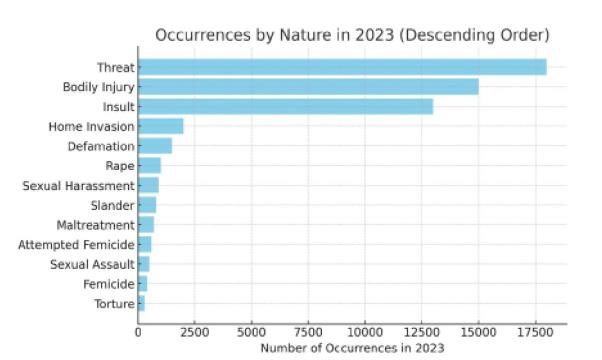 Figure 1
Nature and number of crimes considered domestic violence in the state of Vila Boa in 2023.
Source: Observatory of Public Security (2023).
Figure 1
Nature and number of crimes considered domestic violence in the state of Vila Boa in 2023.
Source: Observatory of Public Security (2023).
The graph reveals a worrying distribution of criminal offenses associated with domestic violence in the state of Vila Boa in 2023, indicating the diversity and severity of crimes that occur in the family environment. Among the 45,901 recorded occurrences, there is a high incidence of physical aggression, threats, and psychological crimes, indicating that domestic violence manifests itself in multiple ways, affecting victims in various aspects of their safety and well-being. This scenario reflects the urgent need for more effective public policies and a safety network that includes both prevention and direct support for victims, considering the complexity of the family dynamics that permeate these crimes.
STANDARD OPERATING PROCEDURE FOR THE OCCURRENCE OF DOMESTIC VIOLENCE
At the Military Police headquarters of the state of Vila Boa, Commander Major Gonçalves met with some auxiliaries to review the procedures for assisting in cases of domestic violence, according to the guidelines of the Maria da Penha Law and the standard operating procedure (SOP).
Major Gonçalves: “Guys, we need to ensure that we are prepared to handle these cases with full rigor and sensitivity, according to the Maria da Penha Law. The law is clear, and the SOP requires that we follow each step to the letter. Should we review it?”
Sergeant Silva: “Of course, Commander. So, starting with the basics: We interview the people involved separately, correct?”
Major Gonçalves: “Exactly. And the approach must be calm and objective. What the law asks of us is that we do not leave the parties in direct contact, to avoid intimidation or interference. That way, each person can present their version of events more confidently.”
Private Araújo: “And after we have heard from both sides? How do we proceed to assess the type of violence?”
Major Gonçalves: “That’s a great question, Araújo. We need to assess whether there has been a crime and, especially, whether there is a flagrant crime. The victim must be referred to the Assistance to Women (DEAM) or, if there is no DEAM nearby, to the police station in the region.”
Sergeant Lima: “At this point, whether or not the victim wants to move forward does not change our procedure, right?”
Major Gonçalves: “Correct. All these crimes committed in the family context involve unconditional public action. That is, even if the victim does not want to proceed, our obligation is to follow with the measures, that is, to arrest the perpetrator in cases of flagrante delicto.”
Private Braga: “And Commander, what if the situation is more complex, with children on the scene or other relatives?”
Major Gonçalves: “If there are other family members or children, we need to act even more carefully. The ideal is to try to protect the minors and third parties from any unnecessary exposure. In such cases, the support of the Guardianship Council may be requested. The safety of everyone on site is our priority.”
Sergeant Lima: “Understood. So, in summary: a careful approach, separate interviews, evaluation of the type of violence, and, if caught in the act, immediate referral to the police station.”
Major Gonçalves: “That’s right, Lima. In addition, remember: if you have any questions, consult the POP. We are here to protect and ensure that the law is obeyed.”
Emergency assistance by the Military Police
Continuing the conversation between the commander and his team, considering that the Military Police’s activity is essentially preventive and ostensible, the commander highlights that, although repression is also part of the work, it usually occurs as an emergency response to crimes in progress, especially in cases of domestic violence. He reinforces some important points for adequate care in these situations.
Major Gonçalves: “Gentlemen, as you know, with the new changes in the law, we have to be agile and precise in cases of domestic violence. Now, any hesitation on our part can put the victim at greater risk.”
Sergeant Lima: “Commander, when we talk about violence, we’re not just talking about physical aggression, right?”
Major Gonçalves: “Exactly, Mendes. The law does not limit violence to only physical aspects. We must also be attentive to psychological violence and crimes against honor, such as defamation and slander, that sometimes precede something more serious. In other words, we need to act as soon as there is any sign of danger.”
Private Carla: “So, Commander, does that mean we don’t have a choice to intervene or not? Even if the victim hesitates to ask for help?”
Major Gonçalves: “That’s right, Carla. The law is clear: We do not choose to intervene; we are obliged to intervene. Our mission is to guarantee the safety of the victim, and the Constitution supports us in this front line to protect these women.”
Corporal Mendes: “And after the initial care, we continue with the transfer to the Civil Police, correct?”
Major Gonçalves: “Correct. We ensure security and provide first aid. In cases of flagrante delicto, we take the person directly to the police station. After that, the Civil Police will take charge of the arrest and investigation.”
Private Carla: “And the process goes ahead, to the Judiciary, right? I always wonder how everything is connected.”
Major Gonçalves: “Exactly. Our work is just the first stage, Carla. We are part of a larger system - the Criminal Justice System. The Civil Police proceeds with the investigation, and then, the Judiciary takes over the trial. It is a chain of protection and justice that begins with us. We are here to ensure the first step is taken with responsibility and firmness.”
Corporal Mendes: “Commander, our role is more than just responding to incidents. We are part of something bigger.”
Major Gonçalves: “Perfect, Mendes. We are the guarantors of the rights of these women. We need to act with the awareness that our every step can be decisive for their safety and dignity. Our action is part of the network to combat domestic violence. Remember: we are the answer they seek in a moment of despair.”
Major Gonçalves’s management challenge
The greatest challenge for Major Gonçalves, commander of the XX BPM, is to guide and train military police officers working in ostensive policing on the importance of guaranteeing women’s rights and acting in accordance with the law. In addition to following legal norms, it is essential that police officers develop skills to address cultural issues, such as structural machismo and patriarchy, which often lead even the victims to not recognize their condition of vulnerability.
Major Gonçalves’s decision is complex, as the issue of domestic violence involves several areas and public policies, such as criminal justice, public health, and citizenship. Within the military structure, it is crucial to invest at the tactical level so that it can sensitize the operational level (police officers who are on the front line) to comply with the legislation and apply best practices when dealing with cases of domestic violence.
The commander’s dilemma
Military organizations are structured based on the principles of hierarchy and discipline, which guide all activities. This structure, reinforced by specific codes and regulations, provides Major Gonçalves with a clear view of the tactical and operational possibilities to improve the performance of the police under his command.
However, he faces several dilemmas:
- 1.
Investigate inappropriate conduct - “Would instituting investigation procedures, such as the Military Police Inquiry or the Administrative Disciplinary Process, help correct errors? Would this be the ideal way to deal with conduct that violates the Military Penal Code or disciplinary rules during care?
- 2.
Continuing education - “Could the development of didactic materials and continuous training make a difference? With that, I might be able to help police officers interpret each situation with more precision and empathy, especially in cases of domestic violence. However, would this sensitize the team to serve more effectively and humanely?”
- 3.
Increase the number of female officers - “What if I talk to the command to increase the number of female police officers in the battalion? This could be a way to ensure that there is always a female officer in the police units, which would bring a more sensitive approach to domestic violence occurrences. However, would this also help create a more welcoming environment for victims?”
Major Gonçalves also asks: “What other management strategies could we implement based on previous case studies? Are there police forces in Brazil that have adopted effective methodologies in dealing with domestic violence that could be adapted to our reality?”
DATA SOURCE
This case is fictional but inspired by real situations, integrating police procedures and guidelines. All characters, events, and dialogue are creations of the authors, and any resemblance to real people or events is purely coincidental. The story was written as a short story to educate about the challenges in police approaches in cases of domestic violence, but it should not be seen as an accurate representation of real events. The information was obtained from documentary and bibliographic research, also using current legislation and data provided by the State Secretariat for Public Security’s Observatory.
National (Lins, 2017; Santos & Costa, 2020) and international (Prenzler & Maguire, 2023; Robinson & Clancy, 2021) research shows that police assistance in cases of domestic violence (DV) faces problems in the implementation of public policies. Studies in Australia, England, and Canada indicate inefficiencies in the care of victims (McPhee et al., 2022; Segrave et al., 2018).
The complexity of the subject requires an analysis that considers the impact of legislative innovations on police assistance and the implications of the mobilization of female officers (Brown & Silvestri, 2020; Carrington et al., 2022), in addition to issues of racism and institutional prejudice (Caveney et al., 2020).
OBJECTIVES OF THE CASE
-
(1) Critically analyze the challenges and effectiveness of police operations in the implementation of the Maria da Penha Law, considering the impact of structural machismo and the cultural barriers that influence the care of victims of domestic violence.
-
(2) Decision-making skills should be developed in the practical application of operational procedures and legal protocols, including the recognition of institutional violations and how to avoid them to ensure the protection of women’s rights.
-
(3) Empathy and strategic thinking should be stimulated in the formulation of innovative solutions to improve the awareness and training of police officers, promote humanized care, and comply with the law in cases of domestic violence.
SUGGESTED SUBJECTS FOR USE IN THE CASE
This case is ideal for courses in law, sociology, and public administration, especially for individuals focused on criminal law, public security policy, and criminal justice management. It aims to discuss legal reforms and the challenges faced by public security agents in situations of domestic violence.
CASE ANALYSIS
To respond to the objectives proposed in this teaching case, it is essential that students reflect on the challenges and complexities involved in the implementation of the Maria da Penha Law, addressing the issues at two levels of analysis: individual and institutional. First, one should consider how police operations can be improved to address cultural and structural barriers, such as machismo, which often hinder effective care for victims of domestic violence. Next, it is important to explore the skills required for public security professionals to make assertive decisions, in line with legal protocols, while avoiding institutional violations and ensuring the protection of women’s rights. The analysis should also promote discussions about the role of empathy and empowerment in promoting a more humanized and strategic approach to care, with a view to improving the ability to cope with domestic violence.
ELEMENTS ADDRESSED IN THE CASE
-
- Current legislation on domestic violence;
-
- The role of public security in the fight against domestic violence;
-
- The role of agents of the Criminal Justice System.
DISCUSSION QUESTIONS
State action
The implementation of legal reforms, such as those promoted by the Maria da Penha Law, reflects the state’s role in strengthening the protection of women and addressing domestic violence with more effective legislative and institutional responses. Table 1 illustrates the main actions of the state over the years, including the creation of new criminal offenses, such as the crime of violation of privacy, the strict monitoring of urgent protective measures (UPMs), and the increase in sentences in cases of femicide. These changes represent a continuous effort to improve the performance of criminal justice agencies, making the system more responsive and aligned with social demands. The following questions aim to promote discussions about the effectiveness of these reforms and the operational challenges that the justice system faces when applying them, encouraging a critical and reflective analysis of the interdependence of subsystems and the role of each institution in addressing domestic violence.
Table 1
State action.
 Note. Elaborated by the Authors.
Question 1 - How can recent changes in the Maria da Penha Law be used to reduce or solve problems related to domestic violence? What state actions have contributed to fighting this violence? Share practical examples.
Discussion: The study of the subject is connected to the areas of criminal law, public policy, and sociology, allowing a critical analysis of how legislative reforms impact the dynamics between security and justice agencies. Students should be encouraged to discuss the application of these changes in the Brazilian reality, considering, for example, the creation of new criminal offenses, the monitoring of urgent protective measures (UPMs), and the intensification of sentences for the crime of femicide.
Theoretical basis: To understand how the recent changes in the Maria da Penha Law can be used to minimize or solve problems related to domestic violence, one can turn to the punitive response theory (Foucault, 2014), which discusses how the state, through laws and punitive systems, aims to control behaviors and protect certain social groups. Legislative reforms, such as the creation of new criminal offenses, the inspection of urgent protective measures (UPMs), and the increase in penalties for femicide, seek not only to punish aggressors but also to establish effective protection mechanisms for victims. In addition, the concept of public security policies (Lotta, 2019) can be used to analyze how state actions, such as the implementation of UPMs and the creation of new criminal offenses, are part of a greater effort to articulate the different levels of government to reduce domestic violence and promote gender equity.
Question 2 - What are the main challenges that the criminal justice system faces when implementing the reforms provided for in the Maria da Penha Law, considering the subsystems involved, such as the police, the Public Ministry, and the Judiciary? How can the concept of ‘loosely adjusted systems’ and the need for communication between these institutions impact the effectiveness of these reforms?
Discussion: This question seeks to stimulate a critical analysis of the operational complexity of the justice system in the context of the Maria da Penha Law reforms, encouraging students to reflect on how different institutions interact to effect legislative changes.
Based on general systems theory, students can explore how the interdependence and possible imbalances between subsystems impact the process of victim protection and the implementation of urgent protective measures (UPMs), in addition to reflecting on strategies that could lead to more effective cooperation.
Theoretical basis: When discussing the challenges of the criminal justice system in the implementation of the Maria da Penha Law reforms, a relevant approach is general systems theory (Luhmann, 1997), which explores how different subsystems, such as the police, the Public Ministry, and the Judiciary, interact within a broader system. The theory suggests that these subsystems, although independent, need to work in a coordinated manner to ensure the effectiveness of legal reforms. The idea of loosely adjusted systems (Vidal, 2023) highlights how the interactions between these agencies can be disjointed due to a lack of communication and integration, resulting in operational challenges in dealing with domestic violence. This concept also helps to understand the need to improve communication and cooperation between institutions to ensure that reforms, such as the application of UPMs and the fulfillment of stricter sentences, are truly effective in protecting victims.
Occurrence of crime and police action
The role of the police in cases of domestic violence presents several challenges, especially with the changes in recent laws that affect how crimes such as threats, psychological violence, and the illegal possession of weapons are treated. Law no. 14.994 (2024), started to consider the crime of threat as an unconditional public criminal action, i.e., the police now have the obligation to act immediately and take the aggressor to the police station, even without the victim’s request. In addition, other laws, such as Law no. 13.772 (2018), expanded the concept of psychological violence, and Law no. 13.880 (2019), determined that the firearms of aggressors should be seized whenever there is domestic violence. These changes present new challenges to the routines of police officers because, in addition to needing to comply strictly with the law, they also need to respond sensitively to victims. Table 2 illustrates the procedures adopted at the scene of the occurrence, highlighting the police responsibilities and the implications of these legal changes. This text discusses how these new rules affect the actions of police officers and what precautions are necessary to ensure an efficient response that truly helps victims.
Table 2
Occurrence of crime and police action.
 Note. Elaborated by the Authors.
Question 3 - Considering the increase in automatic responsibility of the police when dealing with crimes of threat, psychological violence, and seizure of firearms, how does the nature of unconditional public criminal action and the obligation to seize weapons impact the autonomy and performance of agents in the care of victims of domestic violence?
Discussion: The change in the treatment of crimes of threat to unconditional public prosecution, introduced by Law no. 14.994 (2024), requires the immediate referral of the aggressor to the police station, regardless of the victim’s manifestation, reducing police discretion. In addition Law no. 13.880 (2019), requires the mandatory seizure of firearms in the possession of the aggressor, imposing logistical and security challenges. These requirements limit the flexibility of agents, who need to follow strict legal procedures, even in emotionally complex situations. Students can discuss how the reduction in police discretion influences the protection perceived by victims, their trust in the justice system, and the adaptation of agents to the emotional and practical demands of each case. They can also explore the strategies that police officers can adopt to communicate mandatory procedures, welcome victims, and ensure their safety. In addition, it is possible to analyze the specific challenges of weapon seizures, such as risk management during operations and the psychological impact on the victim when witnessing the withdrawal of weapons, reinforcing state action against violence.
Theoretical basis: The theory of street-level bureaucrats (Lipsky, 2019) can guide analysis, discussing how front-line professionals balance institutional norms with the practical and emotional needs of the public they serve. The obligation to take unconditional public action and the seizure of weapons create a context in which police officers must reconcile compliance with legal norms with effective protection and building trust with victims. The theory can help explore the limits and possibilities of police adaptation to these demands.
Classroom organization for the teaching case
The organization of the class aims to provide an interactive and reflective environment, encouraging students to analyze legislative changes and their impact on police action, especially in the context of domestic violence.
Previous reading of the teaching case
Before class, students must read the teaching case, which addresses the implementation of the Maria da Penha Law and its effects on police action in cases of domestic violence. When reading, it is important that students pay attention to the following points:
-
(1) What is the context of the performance of security agents?
-
(2) What dilemmas arise with the new legal reforms?
-
(3) What is the initial diagnosis of the difficulties faced in complying with legal reforms?
Teachers can propose extra activities or questions to encourage reading, encouraging students to reflect on the impact of reforms in the criminal justice system.
Discussion with the classroom (individual level analysis)
In this stage, the professor discusses the challenges faced individually by security agents and how legal reforms influence their performance. The conversation should address:
-
(1) The main challenges of the Maria da Penha Law in relation to police action.
-
(2) The effectiveness of reforms and the cultural barriers that influence victim care.
-
(3) The implications of the new responsibilities of the police, including the arrest of aggressors without the victim’s expression and the seizure of firearms.
During the discussion, the teacher should encourage interaction among students, promoting critical analysis and comparisons between different approaches. The teacher can write the students’ responses on the board to facilitate later analysis.
After the discussion, the class could be divided into two groups to defend different perspectives, such as the defense of greater police autonomy versus the need for greater rigidity in the new laws.
Group discussion (organizational level analysis)
At this time, students are divided into groups to discuss the case in more depth, covering the following topics at the organizational level:
-
(1) How can the different institutions of the justice system (police, Public Ministry, and Judiciary) collaborate more effectively in the implementation of the Maria da Penha Law reforms?
-
(2) What are the operational challenges that police officers face when dealing with new obligations, such as seizing weapons and complying with urgent protective measures (UPMs)?
-
(3) How can the concept of ‘loosely adjusted systems’ explain the difficulties of integration between these institutions?
Teachers should moderate the discussion, offer theoretical elements, and facilitate the exchange of ideas. The objective is for the groups to identify solutions to improve collaboration between different institutions on the basis of recent legislative reforms.
The purpose of the proposed debate is to analyze how recent legislative reforms can improve collaboration between different institutions. During the discussion, the teacher’s role is fundamental in moderating the interaction between the groups, offering theoretical support and facilitating the exchange of ideas. The dynamics allow participants, when discussing in groups, to identify possible solutions to the challenges presented on the basis of the legislative changes.
The process of coordinating the debate will be conducted in three essential stages. First, the professor will monitor and moderate the group discussions, providing theoretical elements that help participants deepen their analyses. Next, the teacher will request and moderate the responses of each group, promoting an engaging and dynamic debate. Finally, the teacher will analyze the responses on the board, connecting them to the theoretical framework and integrating the concepts discussed during the debate.
Below, Table 4 presents the detailed steps for coordinating the debate.
Table 3
Proposed schedule for teaching the case.
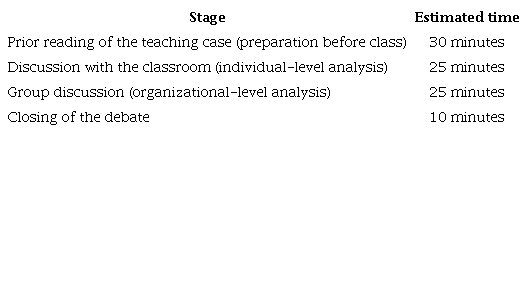
Table 4
Steps for coordination of the debate.

Closing of the debate
In the closing phase, the teacher must consolidate the main points discussed during the previous stages and integrate them into the theoretical framework used throughout the course. The conclusion should address:
-
(1) Innovative solutions to improve the performance of security agents in the fight against domestic violence.
-
(2) The importance of interinstitutional communication and coordination between the subsystems of the criminal justice system.
-
(3) The implications of new legal reforms for the protection of victims and the effectiveness of police assistance.
If class time does not allow for the discussion to conclude, students may be invited to prepare a mind map summarizing the main points discussed and their conclusions, to be handed in as an after-class activity.