Research Article
Understanding the Motivations Throughout the Stages of a Social Enterprise’s Life Cycle
 Larissa Martins Lehmen
Maira Petrini
João Vitor Severo da Silva
Larissa Martins Lehmen
Maira Petrini
João Vitor Severo da Silva
Understanding the Motivations Throughout the Stages of a Social Enterprise’s Life Cycle
BAR - Brazilian Administration Review, vol. 20, no. 3, e220187, 2023
ANPAD - Associação Nacional de Pós-Graduação e Pesquisa em Administração
Received: 19 December 2022
Accepted: 01 August 2023
Published: 18 August 2023
ABSTRACT: Social entrepreneurs have several motivations that lead them to open and continue their companies, which vary according to the stage of the social enterprise’s life cycle. This study seeks to analyze the motivations throughout the stages of a social enterprise’s life cycle. To do this, we carried out a qualitative research with primary data collected through interviews with experts and social entrepreneurs and secondary data collected through documents and websites. The results indicate three types of motivational factors: essential factors, building factors, and solidifying factors. Each type plays different roles during life cycle. All essential factors are present across all stages of the life cycle. The building factors are found mainly in the early stages, while different solidifying factors are distributed throughout the stages of the life cycle. The essential factors are the main difference between social and traditional entrepreneurs. This research brings new insights by linking motivational factors to the life cycle stages of social enterprises. Entrepreneurs can use this information to identify their stage and leverage their motivators for development, while training programs can be tailored to better align with the life cycle stage of social enterprises.
Keywords: Motivation, life cycle stages, social enterprises, social entrepreneurship.
INTRODUCTION
Social entrepreneurship involves the process of innovation using a combination of resources to catalyze social change and meet social needs (Dees, 1998; Mair & Martí, 2006). According to Doherty, Haugh, and Lyon (2014), social enterprises seek the dual mission of having a social purpose and achieving financial sustainability, not fitting perfectly into the conventional categories of private, public, or non-profit organizations. In addition, its goals are rooted in the values of its founders (Zahra et al., 2009), such as the desire for change in society aimed at social well-being (Bacq et al., 2016; Renko, 2013). For Zahra et al. (2009), it is necessary to value the motivations of individuals and groups that assume the risks associated with the design, construction, launch, and maintenance of new organizations and business models. Even so, the motivations are accompanied by substantial challenges throughout the life cycle of social enterprises.
There are several risks during the life cycle of these businesses (Zahra et al., 2009), in different stages of development until the business reaches maturity and establishes itself in the market (Oliveira & Fukayama, 2018). The life cycle of a social enterprise begins with the identification of a social problem (Limeira & Freire, 2018) and the search for solutions in a business idea (Vasconcelos & Lezana, 2012), aiming at a valid business model (Limeira & Freire, 2018; Oliveira & Fukayama, 2018; Sen, 2007). Finally, the entrepreneur seeks scale and resources for company growth in order to find space in the market and ensure social impact (Cremonezzi et al., 2013; Limeira & Freire, 2018).
Thus, despite being the subject of some research, understanding the motivations of social entrepreneurs remains a suggestion for future research by different authors (Germak & Robinson, 2014; Gupta et al., 2020; Stephan & Drencheva, 2017). In addition, there are few studies that relate the motivations of the social entrepreneur to the course of the social enterprise. Stephan and Drencheva (2017) suggest that future research explores changes in entrepreneur motivations and personality throughout the social enterprise life cycle. Germak and Robinson (2014) indicate the need for comparative research on motivation between nascent and mature social entrepreneurs. Furthermore, Saebi et al. (2019) stress the importance of associating the individual and organizational level in research on social enterprises. In this context, there is a research gap regarding how these motivations present themselves over time and how they impact and are impacted by the life cycle of a social enterprise.
We start from the argument that, during the different stages of business development, different motivations stand out and alternate. Understanding how and what motivations are manifested during the life cycle is important in the search for the strengthening and continuity of the social enterprise. In this way, the present work seeks to answer the following research question: ‘How are the social entrepreneur’s motivations presented during the stages of the life cycle of social enterprises?’
The results indicate that there are three types of motivational factors: essential factors, building factors, and solidifying factors. The essential factors run through all stages of the life cycle, the building factors are concentrated in the ideation phase, while the solidifying factors are distributed throughout all stages of the life cycle.
From a theoretical point of view, our research expands knowledge about social entrepreneur’s motivations, bringing a novelty relating motivational factors to the stages of the life cycle of social enterprises. From a practitioner point of view, entrepreneurs can analyze what stage of the cycle they are in and what motivations they can mobilize for the development of social enterprises. Moreover, training and development programs can be developed in a way that is more aligned with the stage of life of social enterprises.
THEORETICAL REFERENCE
Social entrepreneurship and social enterprise
Mair and Martí (2006) define social entrepreneurship as the process of using innovative combinations of resources to catalyze social change and meet social needs. For Austin, Stevenson, and Wei-Skillern (2012), the term describes a value creation process that occurs within or across the non-profit, commercial, or government sectors. Allied to these definitions, it is also important to note that social enterprises seek the dual mission of having a social purpose while remaining financially sustainable (Comini et al., 2012; Doherty et al., 2014). In the quest to solve social problems, such as poverty or the environmental crisis, they identify opportunities and create types of services and products for the community (Petrella & Richez-Battesti, 2014), associating the social role with the company’s strategy (Barki et al., 2020). In this context, the social entrepreneur plays a central role in the social enterprise, conceiving the initial idea, launching and working to sustain the business (Germak & Robinson, 2014), with the company’s goals being deeply linked to its personal values (Nicolás Martínez et al., 2019; Zahra et al., 2009).
In addition, these social enterprises have different terminologies, such as social, inclusive, socio-environmental, social impact, periphery impact, and social enterprises (Barki et al., 2020). These definitions may vary globally, mainly due to the variety of context that these companies find themselves in (Gonçalves et al., 2016; Rosolen et al., 2014). In Brazil, the most used term is social impact business, businesses that aim to generate social impact and financial return from the offer of products or services that reduce the vulnerability of the low-income population (Barki, 2015). For Petrini, Scherer, and Back (2016), social impact businesses can also include individuals and groups in order to solve demands related to societal problems. Pipe Social (2021) emphasizes the commitment to assessing the social and environmental impact that these businesses generate, in order to improve their effectiveness throughout the company’s life cycle. In this research, we will focus on social entrepreneurship and social enterprises from the Brazilian perspective of social impact businesses.
Stages in the life cycle of a social enterprise (SE)
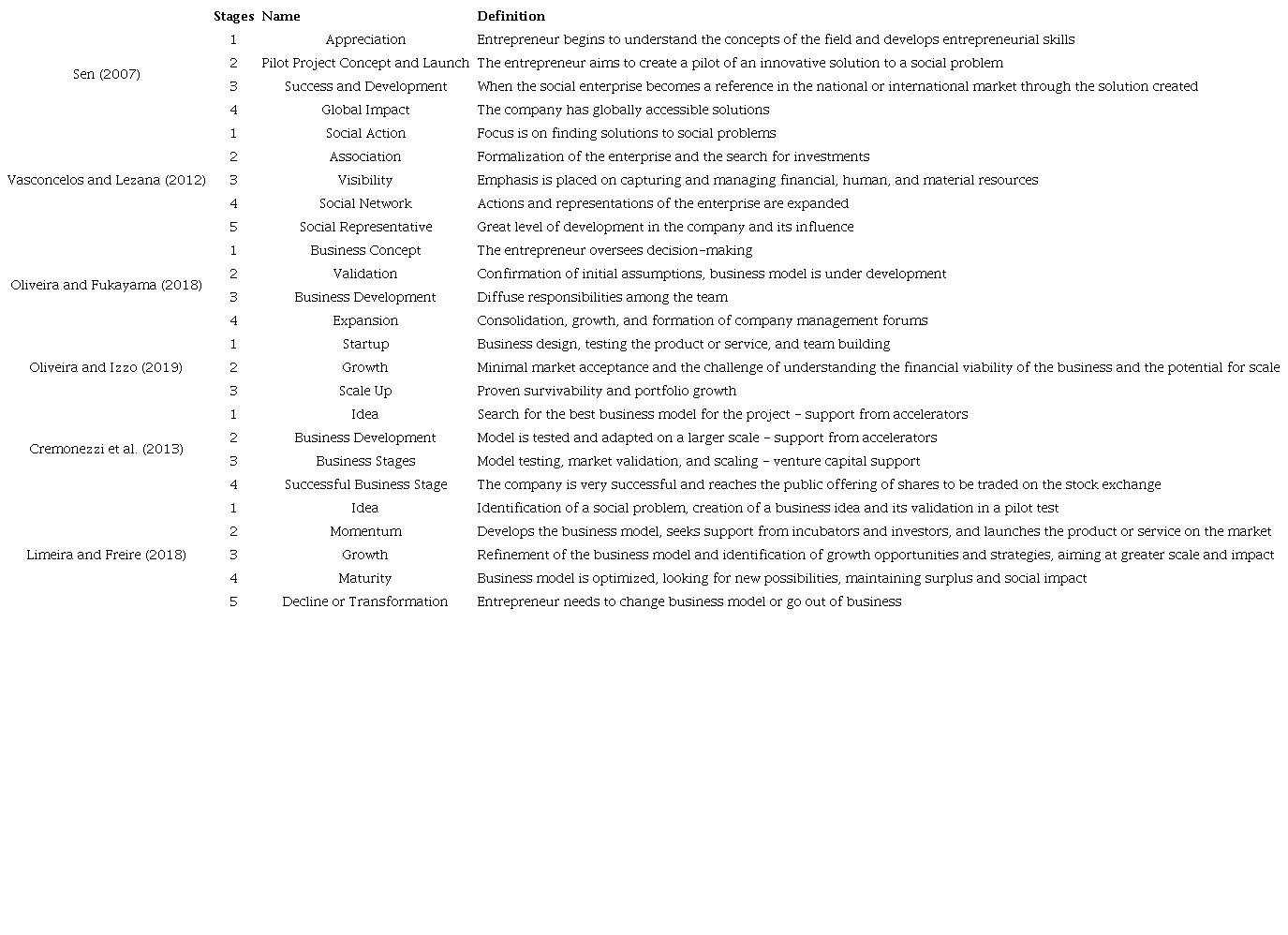
The life cycle of a company refers to the various stages of development until reaching the maturity of a business in the establishment in the market in which it is inserted (Oliveira & Fukayama, 2018). Social enterprises have a life cycle that encompasses the stages of their development with their respective challenges and barriers (Limeira & Freire, 2018). In addition, based on the literature reviewed, a comparative analysis was carried out to identify overlaps and complementarity between authors, as shown in Table 1, with color shading indicating similar characteristics and challenges, allowing for comparison between authors.
Note. Source: The authors.
Based on this analysis, a model of four stages of the life cycle of a SE is proposed, as shown in Figure 1. Of the six stages found in the literature, the four chosen are the ones that have the greatest representation among the authors and from that, it is carried out a reinterpretation and a new model is proposed.
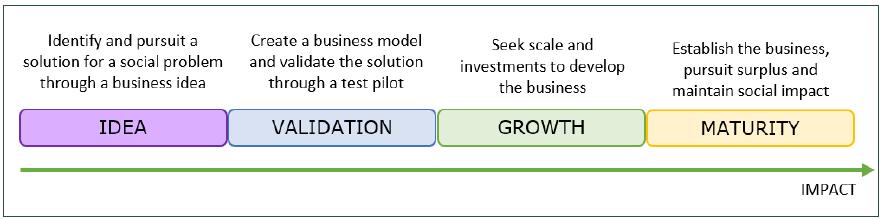
Figure 1
Stages in the life cycle of SE.
Source: The authors.
The life cycle begins in the ideation stage with the objective of identifying and seeking a solution to a social problem through a business idea. Validation follows, in which the social entrepreneur develops a business model and validates the solution through a pilot test. In the growth stage, the purpose is to seek scale and more robust investments to develop the business. Finally, maturity is when the business seeks to consolidate itself in the market with a surplus and great social impact. By advancing through the stages of the life cycle, with their intrinsic and particular challenges, the company increases its social and environmental impact. The more mature the company, the greater the scope of its positive impact.
Social entrepreneur motivation
An individual in control of an organization is usually able to impose his vision on it, and some undertake the creation of social enterprises for reasons that derive mainly from their willingness to see social change (Renko, 2013). While social entrepreneurs share similar work patterns and experience to commercial entrepreneurs, there are significant differences in their social motivations. There is a priority given to the creation of social wealth in relation to the creation of economic wealth (Bacq et al., 2016; Mair & Martí, 2006), motivated by different factors, such as the desire to make changes in society and meet local needs, which can be seen in the company’s mission (Austin et al., 2012).
The motivation of social entrepreneurs can be intrinsic or extrinsic. According to Carsrud and Brännback (2011), extrinsic motivations are linked to wealth, status, and external rewards that arise from entrepreneurship, while intrinsic motivation is linked to success and achievement of goals. Intrinsic motivations are associated with prosocial motivations (Grant, 2008), the desire to mobilize efforts based on concern for others (Batson, 1995). Social entrepreneurs are characterized by a strong relationship with intrinsic motivation through interest and passion for social entrepreneurship, dissatisfaction with previous work, the opportunity to be independent (Carsrud & Brännback, 2011; Stephan & Drencheva, 2017) and with a prosocial motivation, through a passion for helping others and creating a better life for future generations (Miller et al., 2012; Stephan & Drencheva, 2017). Even thought, Zhag, Peterson, and Hujala (2021) show in their case study that the motivation of social enterprise is pure social, including improving people’s mental condition, employability, and promoting public education. Yet, for Ashta (2020), social entrepreneurs are typically driven by a combination of a desire for recognition, empathy, problem-solving skills, and creativity to achieve their goals. Nevertheless, some entrepreneurs may establish social enterprises for profit rather than altruistic reasons.
Yitshaki and Kropp (2016) indicate motivations based on internal choices and desire to be socially active to achieve social goals, categorized into present life events, past life events, awareness from childhood and adulthood, ideology and spiritual imperative, leading individuals to the recognition of opportunities, social engagement, and the formation of social enterprises. Germak and Robinson (2014) also explore the motivation and background of social entrepreneurs, who may have a career history in the public or commercial sector. The authors consider several factors that motivate leaving old careers in favor of opening a social enterprise, such as personal fulfillment, helping society, and a non-monetary focus. Abebe, Kimakwa, and Redd (2020) based on social engagement and the history of the individual, propose a typology of profiles of social entrepreneurs such as season champions, local pragmatists, social activists, and corporate veterans.
For Boluk and Mottiar (2014), social entrepreneurs could join other groups in an effort to ‘make a difference’ but choose to create their own venture. This reflects their need for fulfillment. For the authors, other factors that lead the social entrepreneur to open a company are lifestyle; recognition and entering into a network of contacts; profits and financial viability. Advancing in this perspective, Ruskin, Seymour, and Webster (2016)divide the motivations of social entrepreneurs that encourage social entrepreneurs to focus their resources and efforts on creating value for disadvantaged groups as: own, related to the emotional antecedent of passion and frustration, described as achievements, autonomy, relationship, and influence; and motivations of others, in emotional antecedents of empathy and solidarity, described as altruism, cultivation, social justice, and sense of obligation.
According to Pacut (2020), the factors that influence individuals to start a social enterprise are social and personal benefit, public support, norms and values, feasibility realization, random events, family or social example, and beliefs and ideas. However, the authors consider that these factors vary and cannot be reduced to a single approach. Kruse, Wach, and Wegge (2021)studied the predictors of the intention to found a social enterprise. They discovered that there were two levels that motivated the entrepreneurs, the individual level (personality, cognition, human capital) and social level (subjective norms).
Ghalwash, Tolba, and Ismail (2017) found different patterns of motivation that are determinant in social entrepreneurs: social problems and challenges, inspiration, past personal experiences, and experiences in their network of contacts, where the motivation to undertake is to help and solve societal problems and challenges. Motivation can also be related to the experiences acquired with past activities and projects or from the encouragement, support, and financial incentives of their family, friends, partners, and colleagues. The influence of the network of contacts on the motivation of social entrepreneurs is also studied by Christopoulos and Vogl (2015), highlighting social responsibility, iconoclasm, size of the network of contacts, reliability of the network of contacts, entrepreneurship, success, and relationship with the government. Mottiar (2016) also suggests that the entrepreneur’s motivation can come from the external environment, such as governmental indications. Wanyoike and Maseno (2021) also studied the motivations of social entrepreneurs and founded out that personal experiences linked to past-life events (a combination of closeness to the problem and helping society) and an achievement orientation toward improving livelihoods and creating impact are the main motivators for social entrepreneurship in East Africa.
From the reviewed literature, it was possible to identify and compile the main factors that involve the motivation of social entrepreneurs. In addition, it is clear that these motivating factors for social entrepreneurs have characteristics that move from more essential to more contextual, as shown in Figure 2. Essential factors are those that involve internal and prosocial motivations; contextual factors are linked to the circumstances in which the entrepreneur is involved. Thus, three levels (micro, meso, and macro) of factors that involve the motivation of the social entrepreneur were identified: micro, strongly linked to the essential factors, characteristics, and internal motivations of the entrepreneurs, such as their vision of citizenship and social justice, their beliefs and principles; meso, with motivating factors that are part of the characteristics inherent to the entrepreneurs, but also of the context in which they are inserted, such as their personal trajectory, family influence, proximity to the social problem, self-fulfillment, and career; and macro, linked to the context in which the individuals are inserted, and their motivating factors may be linked to the network of contacts, public or external support, and financial viability. As a result, the motivating factors of social entrepreneurs can vary on a continuum that extends from the purely essential to the purely contextual.
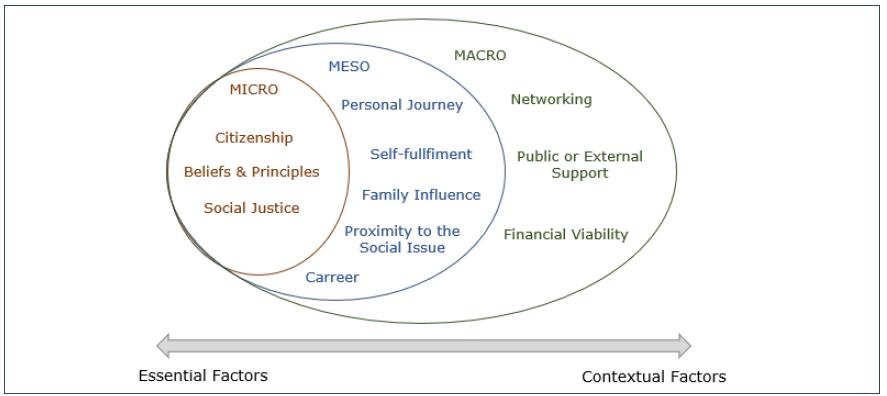
Figure 2
Motivating factors for social entrepreneurs.
Source: The authors.
From the analysis of the literature on the motivations of social entrepreneurs and the phases of the social enterprise life cycle, it is possible to note that the motivations present in the initial phases of the life cycle are more connected to those related to the essential factors. As the life cycle progresses, present motivations move to those more related to contextual factors. This assumption will be investigated in the field using the method presented in the next chapter.
METHODOLOGICAL PROCEDURES
To answer the research question, exploratory research was carried out, whose collected data are of a qualitative nature. Exploratory research is used when the subject is little explored (Sampieri et al., 2013) and its purpose is to make the phenomenon to be studied more explicit and to provide greater familiarity (Gil, 2017). According to Stephan and Drencheva (2017), qualitative studies provide a better understanding of social entrepreneurs’ motivations.
The collection of primary data was carried out through semi-structured interviews, while the collection of secondary data was carried out through documents and websites of the investigated organizations. Semi-structured interviews are guided by a list of points of interest that the interviewer can explore throughout the interview (Gil, 2017). To provide greater credibility to the research, data triangulation should be performed (Gil, 2017). Triangulation provides additional knowledge, contributing to the quality of research by using different perspectives on the topic being studied, compensating for distortions and one-sidedness (Flick, 2012; Jenner et al., 2004). In this research, triangulation occurs from the use of different data sources (primary and secondary) and different profiles of respondents: (a) specialists and (b) social entrepreneurs.
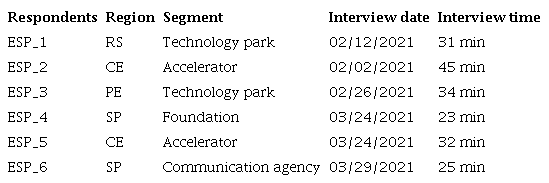
As data collection developed with specialists, they indicated social entrepreneurs through the snowball procedure, a type of non-probabilistic sampling that uses reference chains to obtain data (Vinuto, 2014). The collection was carried out between January and May 2021, and data analysis was carried out interactively, in order to adjust interview questions as information was obtained in the field. Six specialists from different parts of Brazil were interviewed (Table 2). The specialists interviewed are members of organizations, called driving organizations1, which promote social enterprises. The aim was to capture their perceptions about the motivations of social entrepreneurs and understand how their organizations characterize the stages of the life cycle of social enterprises. Additionally, 13 social entrepreneurs were interviewed from different regions of Brazil, from different sectors2 and at different stages of the life cycle (Table 3). The interviews focused on the theme of motivation to start the social enterprise, what influences the entrepreneur to keep it, and the stage of the life cycle he/she is at the time of the interview.
Note. Source: The authors.
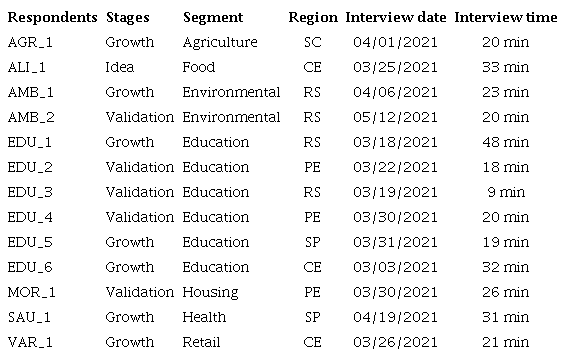
Note. Source: The authors.
The analysis of the collected data was performed using the techniques of the grounded theory method, through the continuous interaction between analysis and data collection (Glasser & Strauss, 1967; Strauss & Corbin, 1994). According to Strauss and Corbin (1994), data analysis is a flexible and creative process in which the researcher moves between coding types, using analytical techniques and procedures freely and in response to the analytical task at hand. According to Bandeira-de-Mello (2003), grounded theory data analysis has its centrality in data coding and is divided into three parts: open, axial, and selective coding. Open coding involves microanalysis, that is, a thorough analysis with the breaking of data to be compared, conceptualized, and grouped into codes. The codes defined a priori are composed of the motivations and life cycle stages of social enterprises identified in the literature review. In addition, other codes were identified later. Codes were grouped into categories. After that, axial coding is performed, which analyzes the relationships between categories and subcategories. Finally, in selective coding, a central category is identified that refines and integrates the others in a social process.
FINDING AND DISCUSSION
Stages in the life cycle of social enterprises
Our results corroborate the life cycle phases already identified in the literature and proposed in Figure 1. ‘Ideation’ is the initial stage, where the entrepreneur identifies a problem in society and seeks solutions to solve this problem. One of the challenges, as indicated by ALI_1, is the appropriation of knowledge about entrepreneurship. “… it takes a lot more at the heart of the problem, to identify the problem, the question of fact to design a more refined business model” (ESPC3). Furthermore, it is structured as a social enterprise. “But here, do they understand what this social business is? What is his benefit? What can they have?” (ESP_2). “And then the big challenge during the ideation process was how I would structure myself as a social impact” (EDU_1).
The next stage is ‘validation’, in which the company carries out the first pilot or minimum viable product (MVP)3 tests to validate the solution. In addition, it seeks to adapt the business model and find the product-market fit4. There are also validations with awards and recognition from the media and the entrepreneurship and social impact ecosystem. “I am accredited by Ashoka in the Young Transformers Network. And then we started to connect with this entire ecosystem of social entrepreneurship, and we also started to see the potential that we could have based on that” (EDU_2). Then the validation is the stage where entrepreneurs validate the solution through a pilot test and through recognition of the impact business ecosystem. Besides, they need to adjust the business model to find their market positioning.
After the product and business model are validated, the social enterprise enters the ‘growth’ stage. “I am in the growth stage. I think I’ve already tested some things; I understood the value, some customers have already understood the value and now I’m looking for investment to develop the business” (EDU_1). This quest to expand the business involves increasing revenue generation, which can lead the entrepreneur to diversify the product portfolio to explore opportunities identified in the journey taken. In line with the need for revenue generation, EDU_5 demonstrated the delicate balance of the business model. “And it’s really a challenge, you know, because we’re neither an ONG to have other sources of funding that would allow us to provide the application for free, and at the same time, we also don’t want to charge too much, so we find ourselves in this middle ground of trying to find what is economically viable for us or not.”
The entrepreneur reaches the final stage of ‘maturity’ when he is already established in the market and seeking to maintain the surplus and the positive impact on society. At this stage, the main challenge is mission diversion. “A minority manages to survive with this initial DNA that constitutes social businesses. Most end up moving toward more conventional businesses, thus leaving the social agenda of social business in the background, almost like an appendix” (ESP_1). Furthermore, the impact generated by companies starts from the growth stage. In the early stages the impact happens but reduced. “This arrow that you put at the bottom, about impact, it is totally true, so I think that maybe even then the growth, the impact of this company, it is simply a hypothesis” (EP_4).
Understading the motivations of social entrepreneurs
All the motivators present in the literature were identified and, additionally, the results point to a new motivational factor, called ‘educational trajectory’. This factor presents itself in two aspects. First, from the experiences of the individual within the educational institutions through which he passed, such as social projects that have or do not have the purpose of promoting entrepreneurship, the main objective being to put the individual, in this case as a student, in contact with the theme of social vulnerability. “I had … the Business Modeling Lab, so I took this question of purpose and something that really captivates me and encourages me to want to do more” (EDU_3). Second, through access to qualified information, such as contact with courses, books, and events, which may or may not be linked to the educational institutions he passed through, but which also sensitize him to social inequalities. “We went to study Yunus and understood that it was possible to work with it, in fact being fully paid, doing what we understood to be our mission” (MOR_1). In addition to accessing qualified information from books and the university, the dynamics of the impact business ecosystem also have the role of raising awareness and qualifying social entrepreneurs. “When we give a lecture here, they say ‘I always wanted to do this, I just didn’t know what it was’” (ESP_2).
This awareness through the educational trajectory awakens the entrepreneur to the issues of social inequality and environmental weaknesses, provoking a search for social justice. Social justice is the motivation to undertake to solve society’s problems and challenges with social equity and a sustainable environment (Germak & Robinson, 2014; Ghalwash et al., 2017). The social justice motivational factor seems to be the essence of social entrepreneurship, being mentioned by specialists and by all interviewed entrepreneurs. “The first step they talk about is social justice, I think it is one of the essential ones” (ESP_2). “The business can arise from a question asked by a teacher in the classroom or an environmentalist who is seeing a problem. In any situation [the entrepreneur] feels a strong sense of purpose for that cause” (ESP_6).
The motivational factor of ‘citizenship’ involves the desire to contribute to national development based on personal values, where the entrepreneur has a proactive engagement with issues of public life (Pacut, 2020; Renko, 2013; Yitshaki & Kropp, 2016). This motivation to see change in society can arise from dissatisfaction with the current state of society. “Motivated in the sense of knowing how much we can impact people’s lives, but very sad to see that reality” (EDU_2).
There is evidence of a relationship between the motivational factors of social justice, citizenship, and eliefs and principles that feedback, since the discomfort with social inequalities mobilizes the exercise of citizenship, being guided by beliefs and principles. The motivational fact of ‘beliefs and principles’ may involve the feeling of giving back a previous advantage (Ruskin et al., 2016; Yitshaki & Kropp, 2016) or the desire to help others (Batson, 1995; Miller et al., 2012). In addition to what was found in the literature review, the social entrepreneurs interviewed also demonstrated a strong motivation that involves their personal purpose. The search for a life and a work that make sense with the beliefs and principles of the individual is linked with their personal purpose, which motivates to undertake socially and can be connected with the individual’s sense of social justice. “… [what influences me to continue every day with this business] is in fact of my personal mission, so I don’t see any other” (MOR_1). The purpose can be linked to the motivation of wanting to repay some previous advantage or of being responsible for helping society. “I see it’s a matter of an exchange. Of those who are in these social businesses and have been through this or have always had this, like, I can give, I have conditions to improve someone’s life” (ESP_2).
Based on beliefs and principles, individuals perceive social entrepreneurship as an opportunity to change the world, as mentioned by AGR_1: “How they can help?” According to expert ESP_5, the younger generations are looking for work with more purpose and that makes sense for the individual’s life. Therefore, beliefs and principles guide the entrepreneur’s career choice. “It’s connected more with this issue of life purpose, in short, which is also something that generations, from the millennial generation onward, this comes increasingly stronger” (ESP_5). Another participant who emphasized this point was VAR_1: “But I think it’s much about idealism, dreams, faith, believing that it is something that is good for the world, in some way.” From this, the ‘career’ motivation factor involves entrepreneurship as a natural career option, in search of a lifestyle with freedom and autonomy (Boluk & Mottiar, 2014; Ruskin et al., 2016). In addition to what was found in the literature, the results of this research indicate the interest of individuals in repositioning their careers for social entrepreneurship in search of a greater alignment between the career and the individual’s worldview, demonstrating the maturity of these individuals in their professional trajectory. “There is already an older age group that is also cool, making a career repositioning and starting to be interested in acting with this purpose” (ESP_1).
Financial compensation is not the main objective of social enterprises, however entrepreneurs are aware that they need to be financially viable to have a social enterprise (Christopoulos & Vogl, 2015; Ruskin et al., 2016. “It’s the basic rule of social business, right? Making money and helping someone” (ESP_2). Differing from what is seen in the literature in which social entrepreneurs are not motivated by financial factors (Boluk & Mottiar, 2014; Germak & Robinson, 2014), this research points out that there is importance in motivating social entrepreneurs to earn remuneration for services or products sold through the social enterprise. “We understood that it was possible to work with this, in fact to be paid in full, doing what we understood to be our mission” (MOR_1). Social enterprises need to be financially viable through the sale of their products and services, unlike non-profit organizations that can generate a positive impact on society and receive financial return through donations or other actions that are not directly linked to the impact. Therefore, how to monetize is one of the main concerns of social entrepreneurship as mentioned by AMB_2 and ESP_3: “How can I monetize this? How can this really be something profitable? Because a social impact company is not an NGO, right, it is a company” (AMB_2). “Nobody wants to be an ONG there, nobody wants to do philanthropy, so we work hard on this aspect of business so that they leave with a real understanding of financial viability because otherwise it will just be an energy expense” (ESP_3).
In the literature review, it was seen that the relationship between the network of contacts and public or external support were different motivational factors. However, when carrying out this research, it is clear that both can be unified. In this research, it was found that support arises from the entrepreneur’s network of contacts, with the government being an unidentified presence. Networking is associated with being recognized within a network of organizations or within the community. This network of contacts can vary in size and trust (Boluk & Mottiar, 2014; Ghalwash et al., 2017). The main actors in the network of contacts consist of the entrepreneur’s team, investors, and partners. From this, public and external support and the network of contacts become a single motivating factor, called the ‘support network’. The support network is made up of different actors who play three roles: financial support, support for business development, and emotional support. Some support network actors may play more than one role. Support for development is provided by the investor and by partners that foster the social entrepreneurship ecosystem. Financial support is provided by the investor and has a great influence on the financial viability of the business. It is at this moment that impact drivers are essential for the development of social entrepreneur motivation. “We’ve seen many entrepreneurs break and get their own resources … and sell to support the company. So, this support, it’s something that we see that is super important” (ESP_5).
Finally, emotional support is provided by partners who have the same belief and principle as the entrepreneur and may be by their team and/or family. The ‘family influence’ motivational factor arises from the molded social awareness of the values and influence of the entrepreneur’s family (Pacut, 2020; Yitshaki & Kropp, 2016). This factor is related to the construction of a social conscience based on family values, the encouragement and support for entrepreneurship by family members, and the family influence in the choice of the area of activity and the problem that the entrepreneur seeks to solve. “When we decided to work with diabetic foot, … I have two uncles who suffer from diabetic foot and they amputated foot and hand because of diabetes, so there was this personal appeal to me” (SAU_1). From this, the family can be seen as the starting point of proximity to the social problem.
The motivational factor of ‘proximity to the social problem’ is one in which the motivation comes from compassion for the supported cause, having the need to care for and promote the development of others. From this, the entrepreneur begins to undertake to solve the problems that he or his community is facing (Abebe et al., 2020; Ruskin et al., 2016). Proximity to the social problem emerges as a motivation that is associated with the entrepreneurs’ compassion for a cause, which arises from the entrepreneur’s beliefs and principles. “So, I’m very happy, but again, I’m passionate about my problem” (EDU_1). Due to their proximity to the social problem, many entrepreneurs feel motivated to see that their social enterprise is positively impacting people’s lives, leading to the motivational factor of self-fulfillment.
For the literature, the motivational factor called ‘self-fulfillment’ is composed of individuals who have a strong desire for personal satisfaction through social entrepreneurship. They have the objective of self-fulfillment with the desire to challenge themselves and attain an achievement through the solutions of social problems (Abebe et al., 2020; Christopoulos & Vogl, 2015; Pacut, 2020). In this research, it was noticed that the motivation of the social entrepreneur of self-fulfillment also permeates the external recognition of media and awards. “There are the certifications he earns along the way. He won an award, he was invested, he made a pitch at an event, he appeared in the media, anyway. This will boost his motivation” (ESP_5). And it can be related to satisfaction with themselves when overcoming challenges and following their beliefs and principles, in addition to seeing the positive impact on society of their social actions. “So, it was very gratifying to see the evolution of these young people so clearly, how they came in and how they left. This is something that only motivates us” (EDU_6).
Another motivational factor is the ‘personal trajectory’ in which the motivation to undertake socially arises from a set of events experienced by the entrepreneur throughout life. These events may result in the objective of helping people who are going through the same problems that the individual faced or may be associated with the need for a lifestyle change due to some event (Ghalwash et al., 2017; Pacut, 2020; Yitshaki & Kropp, 2016). Corroborating the literature, the experts interviewed say that in some cases, not the majority, individuals went through some situation or some experience that led them to undertake socially. These experiences can be professional or personal. “So, I think there is this, like, some experience, some milestone that, in fact, united this person to the purpose” (ESP_4). In addition to what was found in the literature, many of the events experienced by social entrepreneurs influenced and excited them toward motivational factors of social justice, citizenship, and beliefs and principles. It is linked to the educational trajectory, because from these events, individuals seek more information and become aware of the issue of social and environmental impact. “And I’ve always been linked to social projects, …, and I help several projects, [I’m] well connected with that” (EDU_4). Therefore, the motivational factor of personal trajectory is one in which the motivation arises from events that lead the individual to undertake socially and may involve an objective of helping people who go through the same problems that the individual faced or may be associated with the need of lifestyle change due to some event.
The motivational factors, based on the literature, were organized into essential and contextual (Figure 2). Our results point to a new form of categorization of the motivational factors into three categories: essential factors, building factors, and solidifying factors. The relationships between motivational factors are two-way. However, there is a stronger path of influence between each of them, represented by the arrows (Figure 3).
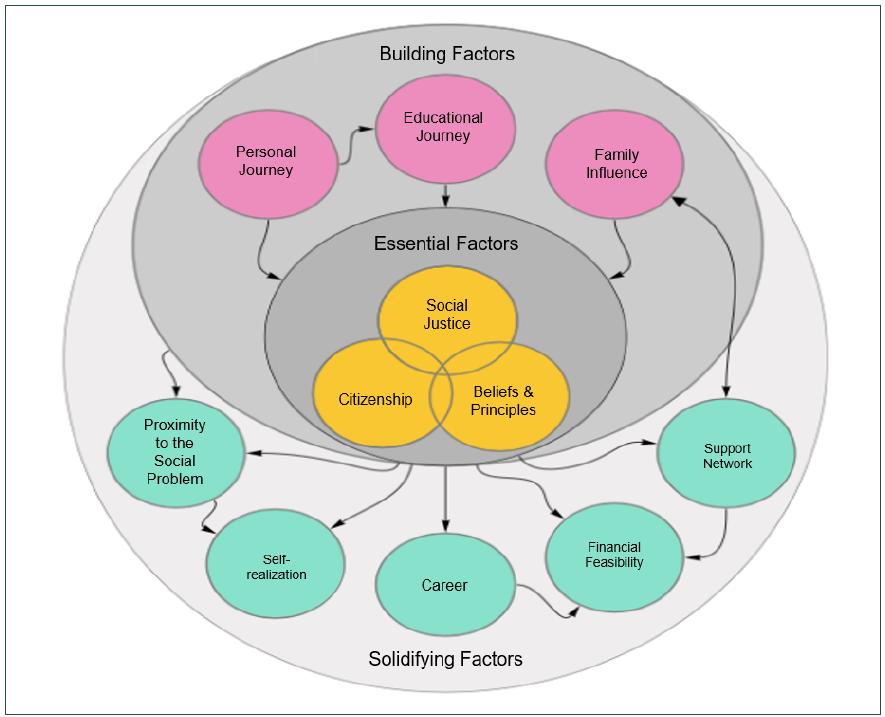
Figure 3
The relationship between social entrepreneurs’ motivational factors.
Source: The authors.
Essential motivational factors are the core of social motivational factors and have a very close feedback relationship. Therefore, ‘social justice’, ‘citizenship’, and ‘beliefs and principles’ are intertwined and interdependent motivations. This interdependence mobilizes the exercise of citizenship to fill social gaps, guided by its beliefs and principles. In addition, they are prosocial motivators that motivate entrepreneurs from the desire to mobilize efforts based on concern and the desire to serve the well-being of others (Batson, 1995; Miller et al., 2012).
The building factors - ‘personal trajectory’, ‘educational trajectory’, and f’amily influence’ - strongly influence the essential factors of entrepreneurs. The ‘personal trajectory’ is connected with the essential factors due to the events lived by the entrepreneurs that led them to develop questions of search for ‘social justice’, ‘citizenship’, and ‘beliefs and principles’. The ‘educational trajectory’ motivates and sensitizes social entrepreneurs to ‘social justice’ guidelines, while the ‘family influence’ motivation shapes values and beliefs from the influence of the entrepreneur’s family. The ‘personal trajectory’ can lead to the educational trajectory, because, from their experiences in social projects, individuals seek more information about social impact.
Finally, the solidifying factor of ‘proximity to the problem’ is also influenced by essential factors due to the relationship of compassion to the supported cause that arises from the entrepreneur’s ‘beliefs and principles’ and influences him to approach a social problem. This ‘proximity to the problem’ leads the entrepreneur to the ‘self-fulfillment’ motivator, given that entrepreneurs feel motivated to see that their social enterprise is positively impacting people’s lives. From the essential factors, entrepreneurs are led to the motivator of ‘self-fulfillment’ due to the pride and pleasure that individuals feel when performing actions that follow their ‘beliefs and principles’. In addition, the ‘family influence’ motivator has a mutual relationship with the ‘support network’ motivator, where the family is seen as a member of this network. Essential factors also influence the ‘support network’ as entrepreneurs connect with other individuals who also have the same values as them. The ‘support network’ can influence the motivational factor of ‘financial viability’ as network actors support the entrepreneur financially. ‘Financial viability’ is related to essential factors considering that social entrepreneurs seek financial results while seeking to positively impact society. ‘Financial viability’ can also be influenced by the ‘career’ motivation factor in which the entrepreneur seeks a ‘career’ that generates monetary returns. Finally, the ‘career’ is influenced by essential factors in the search for a ‘career’ that makes sense with the values of the individual.
The essential factors are the ‘bone structure’ that will support the social enterprise throughout its life cycle, being fundamental for the entrepreneur not to deviate from the social mission. The building factors are essential to develop this ‘bone structure’ that will support the social enterprise and feed some solidifying factors. Finally, the solidifying factors are more focused on the stabilization and consolidation of the social enterprise. All these factors manifest themselves in different ways in each of the stages of the social enterprise life cycle.
Motivations of the social entrepreneur during the stages of the social enterprise life cycle
Social entrepreneurs have several motivational factors that influence them to start and continue with a social enterprise. A motivational factor may be present at all stages of the social enterprise lifecycle, but there may be one or more stages where it stands out. Essential motivational factors are present throughout a company’s life cycle as they occupy a central position in social entrepreneurship. On the other hand, the building factors are present in the ideation stage because they are factors that develop the essential factors and some solidifying factors.
The ideation stage is when the entrepreneur identifies a social or environmental problem and seeks a solution to this problem through a social enterprise. Vasconcelos and Lezana (2012) state that in the first stage, the focus is on seeking solutions for social problems, while the management of the enterprise is done in a rudimentary manner. At this stage, the essential factors are indispensable for the social entrepreneur. These drivers run through the entire life cycle of the social enterprise. “I think there is the ideation movement, which is mass, which is how it is because social entrepreneurs are sure they will change the world, I do. And that’s the biggest motivation” (ESP_5). In addition to the essential factors, entrepreneurs are also motivated in the ideation stage by the factors of ‘personal trajectory’, ‘educational trajectory’, and ‘family influence’, which make up the building factors. In relation to the ‘personal trajectory’, individuals are motivated to the ideation process by perceiving problems in society from events they have experienced. “I started there in the volunteer group, … I went to Rondon, then I came back with this motivation of ‘wow, I’m going to build something’” (EDU_3).
The ‘educational trajectory’ can be important in the ideation stage, given that some entrepreneurs go through the process of discovering a problem and solving it from their school or college. In this case, the student is invited to participate in an event or discipline that makes this ideation process for the creation of social projects. “The ideation started first within the university environment” (EDU_1). The ‘family influence’ stands out in the ideation stage due to the entrepreneurship incentive that many entrepreneurs need to start a new business. “I showed it to my husband, and he said ‘but, love, this is a business, it’s a project, keep going, keep putting into practice’” (ESP_5). For Yitshaki and Kropp (2016), some social entrepreneurs are motivated by values that stem from their family background, as a result of a social consciousness shaped unconsciously during childhood and early adulthood.
The ‘support network’ motivator starts to stand out in the ideation stage. Some entrepreneurs need help to develop their idea and are looking for facilitators of the impact business ecosystem to train and receive support in the development of their business from the ideation stage. “Then we started to receive training, to really prepare for this business vein” (EDU_2). Finally, ‘career’ is also a motivator that stands out in the ideation stage. Some entrepreneurs start socially entrepreneurship and start the ideation process from their desire to change ‘careers’ to a ‘career’ that makes more sense with their ‘beliefs and principles’. “And my last day of work [at the former company as CLT] was my first day at Porto Digital, which was the incubation starting” (EDU_4). According to Germak and Robinson (2014), in the theme of personal fulfillment, individuals have a strong desire to become their own bosses and meet their needs for self-fulfillment, and these are the motivators for starting a social enterprise.
After entrepreneurs find the solution to the problem they seek to solve and structure themselves as a social enterprise, new motivations begin to emerge as they move into the validation stage. Oliveira and Izzo (2019)confirmed that the company goes through the business conception phase as it moves beyond being just an idea and begins to test its product or service. In this stage, the entrepreneurial team needs to understand their passions, motivations, and talents to succeed, in addition to overcoming the challenges of market acceptance and scarce resources. The validation stage is where the entrepreneur validates the solution through pilot tests, validates the market through the impact ecosystem, and adjusts the business model until it is ready for social enterprise growth and expansion. At the time of validation, the most prominent motivators are the ‘support network’, ‘self-fulfillment’, ‘proximity to the problem’, and ‘financial viability’. The ‘support network’ motivates the entrepreneur during the validation stage through the support and legitimation that the entrepreneur receives from impact drivers, being important in helping validate the market in which the company is inserted. Many entrepreneurs participate in acceleration programs that help and motivate them in this validation stage. “And then we started to connect with this entire ecosystem of social entrepreneurship, and we also started to see the potential that we could have based on that” (EDU_2). Boluk and Mottiar (2014)say that a motivating factor is recognition and by entering a network, as when starting a social enterprise, individuals become recognized for their social contribution. Additionally, many social entrepreneurs join a network of organizations that reaffirm, promote, and recognize these contributions.
‘Proximity to the problem’ and ‘self-fulfillment’ are two motivators that are related and that stand out in the validation stage due to the deepening of the link with the public and the problem to be solved. “We realize that entrepreneurs who are always very close, … it is a much more committed entrepreneur, who leaves the computer screen and actually goes to the field” (ESP_5). In addition to being motivated by being close to the problem and the users, entrepreneurs feel motivated and satisfied to see that their company is positively impacting society. “So it was a great validation process, a great case that I am very proud to have carried out” (EDU_1). The ‘financial viability’ motivator starts to stand out in the validation stage as a result of the start of the company’s first revenues. Also, Boluk and Mottiar (2014) affirm that although social entrepreneurs are not motivated by profit, they are aware that they need to be financially viable to continue their activities. It is at this stage that the company starts to worry about the ‘financial viability’ of the business and, often, adjust the business model so that it becomes profitable. “So, I came to adapt my business, to pivot my business, to seek this market pain after I understood that to make money, I needed to have this, you know, I needed to meet this market pain” (AMB_1). After the validation processes are successful, the social enterprise moves on to the growth stage. At this stage, some motivators remain the same, but influence the entrepreneur differently.
The growth stage is when the social enterprise consolidates its management and seeks investments to expand the business. For Limeira and Freire (2018), this stage is in which the business model is refined, opportunities and growth strategies are identified, and investments are sought for greater scale and impact, while the business is prepared to grow in terms of human, technological, and financial resources. At this moment, the ‘support network’ and ‘financial viability’ continue to motivate the entrepreneur. The ‘support network’ in the growth stage motivates the entrepreneur from the support in the development of the management of the social enterprise. The actors in the impact business ecosystem also act as an intermediary between entrepreneurs and investors, which supports the entrepreneur to be ready to receive investments. “Who knows who, anyway, for you to access quality mentorships, … so networks are super important” (ESP_5). One of the main objectives of the growth stage is the search for scale, investments to expand the business. “We raised the first round of capital with ICE in November, which opened many doors for us, because there were many people interested” (SAU_1).
After the growth stage, there’s the maturity stage, which is the final stage of a social enterprise. At this stage, the company establishes itself in the market and seeks to maintain the surplus. For Oliveira and Izzo (2019), the final stage is the scale-up stage, in which the company’s survival capacity is proven, and efforts are made to improve productivity and diversify the product portfolio. It’s necessary for the entrepreneur to be careful not to deviate from the mission and continue with the positive impact. The main motivations are ‘financial viability’ and the essential factors of ‘beliefs and principles’, social justice, and citizenship that already accompany the entrepreneur as central motivators from the ideation stage. “How are we going to focus on impact, make money, but not lose this essence here [of positive impact], I don’t care about that. It’s very challenging” (ESP_5).
From the analysis of the life cycle of the social enterprise, it’s possible to perceive that there are motivators that stand out in each of the stages of the life cycle. The essential factors remain throughout the social entrepreneur’s journey. The building factors seem to be stronger in the ideation stage, while the solidifying factors are distributed in different moments of the social enterprise’s life cycle (Figure 4).
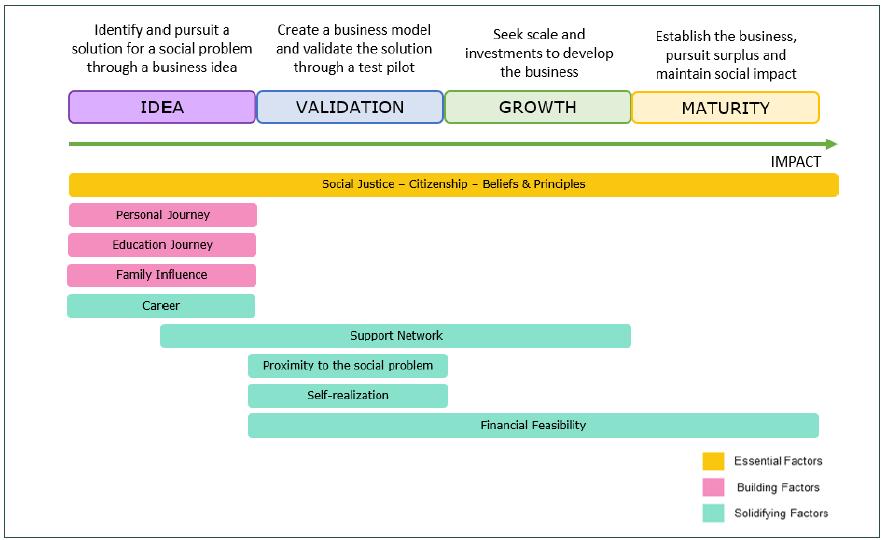
Figure 4
The motivations throughout the social enterprise life cycle.
Source: The authors.
The essential factors of ‘beliefs and principles’, ‘social justice’, and ‘citizenship’ remain present during all stages, considering that they are fundamental so that it does not deviate from its mission. The building factors - ‘personal trajectory’, ‘educational trajectory’, and ‘family influence’ - stand out in the ideation stage not only for inducing the essential factors, but also for influencing entrepreneurs to start the new business. In the validation stage, the ‘support network’ continues as a motivator, but playing a different role than in the ideation stage. The growth stage is guided by the search for investments, management development, and business expansion. Finally, in the maturity stage, the entrepreneur is established in the market and seeks to maintain the surplus. Thus, their motivations remain ‘financial viability’ and essential factors. The essential factors are crucial so that the company does not deviate from its mission and continues to positively impact society and the environment.
FINAL REMARKS
This work aimed to study social enterprises from the motivations of entrepreneurs during the stages of the social enterprise life cycle. Each stage has motivating factors that stand out. The motivational factors were organized into essentials, builders, and solidifiers. The essential factors sustain the social enterprise throughout its life cycle, being fundamental for the entrepreneur not to deviate from the social mission; we identified the prosocial drivers of social justice, citizenship, and beliefs and principles. The building factors are the family influence, personal trajectory, and educational trajectory motivators, which are indispensable to develop the ‘bone structure’ of the essential factors. Finally, the solidifying factors are more focused on the stabilization and consolidation of the social enterprise. The different factors present different presences throughout the stages of the life cycle of a social enterprise, but we emphasize here the constancy of the essential factors during all stages, since they are the main difference between social and traditional entrepreneurs.
In the academic field, the research advances in studies on social entrepreneurship, bringing evidence about the stages of the life cycle of a social enterprise, compiling findings from previous studies and through empirical evidence. In addition, it was possible to expand knowledge about the motivators of social entrepreneurs, bringing findings from the Brazilian context, relating them to the stages of the life cycle of social enterprises. In the management field, this study contributes to the social entrepreneur and the dynamic actors of the impact business ecosystem to have greater clarity when developing their business as they recognize in which stage of the life cycle they are. In this way, the study provides information so that entrepreneurs can analyze which stage of the cycle they are in and what motivations they can mobilize for the development of social enterprises. Impact promoters can use this study as a basis to classify the social enterprises they support and understand where they are and what are the characteristics to be developed in each stage of the life cycle, thus promoting training and development programs for more effective social enterprises.
For future research, it is suggested to investigate entrepreneurs of impact businesses from the periphery to identify what are the motivators of these entrepreneurs and the stages of the life cycle of an impact business from the periphery. In order to advance the understanding and practical application of social enterprise theory, we propose conducting future studies to test the proposed model through application to additional case studies. These studies could explore the applicability of the model to different sectors, as well as to various geographic regions. By conducting multiple case studies, we can identify the nuances in the life cycle of social enterprises and motivation of the entrepreneur that arise from differences in industry and local culture. It may also be necessary to adapt or complement the proposed model based on the findings of these studies. Furthermore, investigating the differences in motivations faced by women, men, and non-binary entrepreneurs in social enterprises could contribute to the advancement of social enterprise theory and practice. This study could be inspired by Tortia et al. (2022), who studied the impact of gender on the motivation and workload of the workforce in social enterprises.
REFERENCES
Abebe, M. A., Kimakwa, S., & Redd, T. (2020). Toward a typology of social entrepreneurs: the interplay between passionate activism and entrepreneurial expertise. Journal of Small Business and Enterprise Development, 27(4), 509-530. https://doi.org/10.1108/JSBED-08-2019-0279
Ashta, A. (2020). Extending the realistic theory to a dynamic life cycle theory of social enterprise. In: A realistic theory of social entrepreneurship. Cham: Palgrave Pivot.
Austin, J., Stevenson, H., & Wei-Skillern, J. (2012). Social and commercial entrepreneurship: same, different, or both? Entrepreneurship Theory and Practice, 30(1), 1-22. https://www.scielo.br/j/rausp/a/HM3r8D3Tfwm7WJZYFkNt5vz/?format=pdf&lang=en
Bacq, S., Hartog, C., & Hoogendoorn, B. (2016). Beyond the moral portrayal of social entrepreneurs: An empirical approach to who they are and what drives them. Journal of Business Ethics, 133(4), 703-718. http://dx.doi.org/10.1007/s10551-014-2446-7
Bandeira-de-Mello, R. (2003). Operacionalizando o método da Grounded Theory nas pesquisas em estratégia: Técnicas e procedimentos de análise com apoio do software Atlas/TI.
Barki, E. (2015). Negócios de impacto: tendência ou modismo? GV Executive, 14(1). https://doi.org/10.12660/gvexec.v14n1.2015.49183
Barki, E., Rodrigues, J., & Comini, G. M. (2020). Negócios de impacto: Um conceito em construção. Revista de Empreendedorismo e Gestão de Pequenas Empresas, 9(4), 477-501. https://doi.org/10.14211/regepe.v9i4.1980
Batson, C. D. (1995). Prosocial motivation: Why do we help others. In A. Tesser (Ed.), Advanced social psychology (pp. 333-381). New York: McGraw-Hill.
Blank, S. (2020). The four steps to the epiphany: successful strategies for products that win. John Wiley & Sons.
Boluk, K. A., & Mottiar, Z. (2014). Motivations of social entrepreneurs: Blurring the social contribution and profits dichotomy. Social Enterprise Journal, 10(1), 53-68. https://doi.org/10.1108/SEJ-01-2013-0001
Carsrud, A., & Brännback, M. (2011). Entrepreneurial motivations: what do we still need to know? Journal of Small Business Management, 49(1), 9-26. http://dx.doi.org/10.1111/j.1540-627X.2010.00312.x
Christopoulos, D., & Vogl, S. (2015). The motivation of social entrepreneurs: The roles, agendas and relations of altruistic economic actors. Journal of Social Entrepreneurship, 6(1), 1-30. https://doi.org/10.1080/19420676.2014.954254
Comini, G., Barki, E., & Aguiar, L. T. de. (2012). A three-pronged approach to social business: a Brazilian multi-case analysis social businesses. Revista de Administração, 47(3), 385-397. https://doi.org/10.5700/rausp1045
Cremonezzi, P. B., Cavalari, D. C., & Gonçalves Dias, S. L. F. (Maio, 2013). Reflexões sobre o papel dos fundos de investimentos de impacto no desenvolvimento de negócios sociais: um estudo de caso. 7º Encontro Nacional de Pesquisadores Em Gestão Social-ENAPEGS, Belém, Pará, Brasil. https://conferencias.ufca.edu.br/enapegs/enapegs-2013
Dees, J. G. (1998). The meaning of social entrepreneurship. Kauffman Center for Entrepreneurial Leadership. https://centers.fuqua.duke.edu/case/wp-content/uploads/sites/7/2015/03/Article_Dees_MeaningofSocialEntrepreneurship_2001.pdf
Doherty, B., Haugh, H., & Lyon, F. (2014). Social enterprises as hybrid organizations: A review and research agenda. International Journal of Management Reviews, 16(4), 417-436. https://doi.org/10.1111/ijmr.12028
Flick, U. (2012). Introdução à metodologia de pesquisa: Um guia para iniciantes. Penso Editora.
Germak, A. J., & Robinson, J. A. (2014). Exploring the motivation of nascent social entrepreneurs. Journal of Social Entrepreneurship, 5(1), 5-21. https://doi.org/10.1080/19420676.2013.820781
Ghalwash, S., Tolba, A., & Ismail, A. (2017). What motivates social entrepreneurs to start social ventures? An exploratory study in the context of a developing economy. Social Enterprise Journal, 13(3). http://dx.doi.org/10.1108/SEJ-05-2016-0014
Gil, A. C. (2017). Como Elaborar Projetos de Pesquisa. Atlas.
Glasser, B. G., & Strauss, A. L. (1967). The development of grounded theory. Alden.
Gonçalves, C. P., Carrara, K., & Schmittel, R. M. (2016). The phenomenon of social enterprises: are we keeping watch on this cultural practice? VOLUNTAS: International Journal of Voluntary and Nonprofit Organizations, 27(4), 1585-1610. http://dx.doi.org/10.1007/s11266-015-9624-9
Grant, A. M. (2008). Does intrinsic motivation fuel the prosocial fire? Motivational synergy in predicting persistence, performance, and productivity. Journal of Applied Psychology, 93(1), 48-58. https://doi.org/10.1037/0021-9010.93.1.48
Gupta, P., Chauhan, S., Paul, J., & Jaiswal, M. P. (2020). Social entrepreneurship research: A review and future research agenda. Journal of Business Research, 113, 209-229. https://doi.org/10.1016/j.jbusres.2020.03.032
Instituto de Cidadania Empresarial. (2022). Instituto Cidadania Empresarial. https://ice.org.br/
Jenner, B., Flick, U., von Kardoff, E., & Steinke, I. (2004). A companion to qualitative research. Sage.
Kruse, P., Wach, D., & Wegge, J. (2021) What motivates social entrepreneurs? A meta-analysis on predictors of the intention to found a social enterprise. Journal of Small Business Management, 59(3), 477-508. https://doi.org/10.1080/00472778.2020.1844493
Limeira, T. M. V., & Freire, P. D. E. L. (2018). Negócios de impacto social: Guia para os empreendedores. Saraiva Educação SA.
Mair, J., & Martí, I. (2006). Social entrepreneurship research: A source of explanation, prediction, and delight. Journal of World Business, 41(1), 36-44. https://doi.org/10.1016/j.jwb.2005.09.002
Miller, T. L., Grimes, M. G., McMullen, J. S., & Vogus, T. J. (2012). Venturing for others with heart and head: How compassion encourages social entrepreneurship. Academy of Management Review, 37(4), 616-640. http://dx.doi.org/10.5465/amr.2010.0456
Mottiar, Z. (2016). Exploring the motivations of tourism social entrepreneurs: The role of a national tourism policy as a motivator for social entrepreneurial activity in Ireland. International Journal of Contemporary Hospitality Management, 28(6), 1137-1154. http://dx.doi.org/10.1108/IJCHM-06-2014-0278
Nicolás Martínez, C., Rubio Bañón, A., & Fernández Laviada, A. (2019). Social Entrepreneur: Same or Different from the rest? VOLUNTAS: International Journal of Voluntary and Nonprofit Organizations, 30(1), 443-459. http://dx.doi.org/10.1007/s11266-018-00053-9
Oliveira, G. R., & Izzo, D. Filho (2019). Buscando recursos financeiros (pp. 187-214). In E. Barki, G. M. Comoni, & H. G. Torres, Negócios de impacto socioambiental no Brasil. FGV.
Oliveira, F. R. de S., & Fukayama, M. (2018). Governança e estrutura jurídica para negócios de impacto (pp. 341-374). In E. Barki, G. M. Comoni, & H. G. Torres, Negócios de impacto socioambiental no Brasil. FGV.
Pacut, A. (2020). Drivers toward social entrepreneurs engagement in Poland: An institutional approach. Administrative Sciences, 10(1), 5. https://doi.org/10.3390/admsci10010005
Petrella, F., & Richez-Battesti, N. (2014). Social entrepreneur, social entrepreneurship and social enterprise: semantics and controversies. Journal of Innovation Economics Management, 14(2), 143-156. http://dx.doi.org/10.3917/jie.014.0143
Petrini, M., Scherer, P., & Back, L. (2016). Modelo de negócios com impacto social. Revista de Administração de Empresas, 56(2), 209-225. https://doi.org/10.1590/S0034-759020160207
Pipe Social. (2021). Mapa de Negócios de Impacto Socioambiental. (3a. ed). https://pipe.social/
Renko, M. (2013). Early challenges of nascent social entrepreneurs. Entrepreneurship Theory and Practice, 37(5), 1045-1069. https://doi.org/10.1111/j.1540-6520.2012.00522.x
Ries, E. (2011). The lean startup: How today’s entrepreneurs use continuous innovation to create radically successful businesses. https://www.academia.edu/6418358/The_Lean_Startup_How_Today_s_Entrepreneurs_Use_Continuous_Innovation_to_Create_Radically_Successful_Businesses
Rosolen, T., Tiscoski, G. P., & Comini, G. M. (2014). Empreendedorismo social e negócios sociais: Um estudo bibliométrico da produção nacional e internacional. Revista Interdisciplinar de Gestão Social, 3(1). https://doi.org/10.9771/23172428rigs.v3i1.8994
Ruskin, J., Seymour, R. G., & Webster, C. M. (2016). Why create value for others? An exploration of social entrepreneurial motives. Journal of Small Business Management, 54(4), 1015-1037. http://dx.doi.org/10.1111/jsbm.12229
Saebi, T., Foss, N. J., & Linder, S. (2019). Social Entrepreneurship Research: Past Achievements and Future Promises. Journal of Management, 45(1), 70-95. https://doi.org/10.1177/0149206318793196
Sampieri, R. H., Collado, C. F., & Lucio, M. Del P. B. (2013). Metodologia de Pesquisa (5a Ed.). Penso.
Sen, P. (2007). Ashoka’s big idea: Transforming the world through social entrepreneurship. Futures, 39(5), 534-553. http://dx.doi.org/10.1016/j.futures.2006.10.013
Stephan, U., & Drencheva, A. (2017). The person in social entrepreneurship: A systematic review of research on the social entrepreneurial personality (pp. 205-229). In The Wiley Handbook of Entrepreneurship. http://dx.doi.org/10.1002/9781118970812.ch10.
Strauss, A. L., & Corbin, J. (1994). Grounded Theory Methodology-An Overview. Handbook of Qualitative Research. NK Denzin and YS Lincoln. Sage Publications.
Vasconcelos, A. M. de, & Lezana, Á. G. R. (2012). Modelo de ciclo de vida de empreendimentos sociais. Revista de Administração Pública, 46, 1037-1058. https://doi.org/10.1590/S0034-76122012000400007
Vinuto, J. (2014). A amostragem em bola de neve na pesquisa qualitativa: Um debate em aberto. Temáticas, 22(44), 203-220. https://doi.org/10.20396/tematicas.v22i44.10977
Tortia, E. C., Gago, M., Degavre, F. & Poledini, S. (2022) Worker involvement and performance in Italian social enterprises: The role of motivations, gender, and workload. Sustainability, 14(2-1022), 1-20. http://dx.doi.org/10.3390/su14021022
Wanyoike, C. N. & Maseno, M. (2021) Exploring the motivation of social entrepreneurs in creating successful social enterprises in East Africa. New England Journal of Entrepreneurship, 24(2), 79-104. http://dx.doi.org/10.1108/NEJE-07-2020-0028
Yitshaki, R., & Kropp, F. (2016). Motivations and opportunity recognition of social entrepreneurs. Journal of Small Business Management, 54(2), 546-565. http://dx.doi.org/10.1111/jsbm.12157
Zhang, S., Paterson, J. S., & Hujala, T. (2021) Sustaining forest ecosystem services through social enterprises: Motivations and challenges from a case study in scotland. Small-scale Forestry 20, 627-647. http://dx.doi.org/10.1007/s11842-021-09484-7
Zahra, S. A., Gedajlovic, E., Neubaum, D. O., & Shulman, J. M. (2009). A typology of social entrepreneurs: Motives, search processes and ethical challenges. Journal of Business Venturing, 24(5), 519-532. http://dx.doi.org/10.1016/j.jbusvent.2008.04.007
Notes
Author notes
Universidade Católica do Rio Grande do Sul
Av. Ipiranga, 6681, Partenon, CEP 90619-900, Porto Alegre, RS, Brazil
larissalehmen@gmail.com
Maira Petrini https://orcid.org/0000-0002-3914-2589
Universidade Católica do Rio Grande do Sul
Av. Ipiranga, 6681, Partenon, CEP 90619-900, Porto Alegre, RS, Brazil
maira.petrini@pucrs.br
João Vitor Severo da Silva https://orcid.org/0000-0002-8514-7532
Universidade Católica do Rio Grande do Sul
Av. Ipiranga, 6681, Partenon, CEP 90619-900, Porto Alegre, RS, Brazil
jvsevero@gmail.com
Corresponding author: Maira Petrini Pontifícia Universidade Católica do Rio Grande do Sul, Av. Ipiranga, 6681 - Partenon, CEP 90619-900, Porto Alegre, RS, Brazil