Research Article
Que País é Esse? A Decolonial Study, Using Semiotics, on the Development Discourse in Havaianas Campaigns
 Carolina de Oliveira Brandão carolbrandaok@gmail.com
Marcus Wilcox Hemais marcus.hemais@iag.puc-rio.br; lpessoa@iag.puc-rio.br
Luís Alexandre Grubits de Paula Pessôa marcus.hemais@iag.puc-rio.br; lpessoa@iag.puc-rio.br
Carolina de Oliveira Brandão carolbrandaok@gmail.com
Marcus Wilcox Hemais marcus.hemais@iag.puc-rio.br; lpessoa@iag.puc-rio.br
Luís Alexandre Grubits de Paula Pessôa marcus.hemais@iag.puc-rio.br; lpessoa@iag.puc-rio.br
Que País é Esse? A Decolonial Study, Using Semiotics, on the Development Discourse in Havaianas Campaigns
BAR - Brazilian Administration Review, vol. 22, no. 1, e240080, 2025
ANPAD - Associação Nacional de Pós-Graduação e Pesquisa em Administração
Received: 29 May 2024
Accepted: 08 January 2025
Published: 04 April 2025
ABSTRACT
Objective: In marketing, studies on the discourse of development and its coloniality, and how this phenomenon affects the discipline, are scarce. Consequently, there are few discussions on how marketing reinforces a narrative that distances countries from a unilateral understanding of development, especially regarding the role of advertisements in contributing to this scenario. From a decolonial perspective on the discourse of development, this study analyzes how advertisements used by a Brazilian company contribute to the construction of an image of development/underdevelopment of the country, focusing on the case of the Havaianas brand.
Methods: to achieve this objective, Greimasian semiotics was used to analyze 54 advertising images from four international campaigns of the company in question, focusing on the third level of the content plane, which is the discursive level, and on the expression plane, using the following classes of analysis: chromatic, eidetic, and topological.
Results: the analysis showed that Havaianas explores elements of stereotypical Brazilianness, which nurture the natural aspects and the notion of Brazil being a ‘tropical paradise,’ ‘corroborating’ its supposed underdevelopment.
Conclusions: in addition, the analysis elucidates how advertisements reinforce coloniality within the marketing area.
Keywords: Development discourse+ decolonialism+ coloniality+ advertisements+ semiotics.
INTRODUCTION
To speak of development is to recognize its importance in various sectors of modern societies (Jimenez et al., 2022), particularly since the end of the Second World War, when ‘development’ began to guide the paths of nations, with the promise that ‘being developed’ would lead to their prosperity and wealth (Escobar, 1999). Because of this, the concept of development has endured globally as a powerful and engaging discourse (Escobar, 2012).
This discourse is conceived through statements about, particularly, technology, economy, societies, and governments and has become institutionalized by practices and theories that determined what it meant to be developed (Escobar, 1992). Understanding development as a discourse is, therefore, recognizing that it reinforces geopolitical movements of power, since what is considered developed is part of a concept originating in the Global North, which uses its references to globally determine what is developed, disregarding elements that are distinct from these - coming from the Global South, especially - as part of this concept (Escobar, 2010). In the end, ‘development’ for the Global South means giving up its socio-political-economic-technological structures for other exogenous ones, in a process of reproducing living conditions that strive to attain those of the Global North (Furtado, 2009; Marini, 2014).
Accepting the Global North’s development discourse as the only reference results in the Global South conforming to the position of a backward state (Mignolo, 2021). Consequently, while societies in this first sphere are considered the most developed, producing the most important global achievements, those in the second sphere contribute little to this, given their supposedly less developed conditions, leaving them to offer natural and cultural attractions to the world, which are considered second-rate for the well-being of all (Mignolo, 2019).
As a result, institutions in the Global South assume that the best aspects of their countries are elements considered ‘less important’ within the development discourse, as they fail to see that their local technologies/economies/societies/policies could distinguish them or their nations in global competition. And, to a large extent, marketing plays an important role in this process, as it follows and seeks to establish a Eurocentric, hegemonic standard over the area (Varman, 2018). Consequently, when marketing is related to development, it is always through references from the Global North that the former seeks to reach the latter (Drucker, 1958; Pastrana et al., 2022).
This Eurocentric standard ends up determining the way marketing communication is produced because it demarcates how advertisements build the image of a country or region, reinforcing what is considered developed or underdeveloped in the world (Aytaç, 2024; Cardoso et al., 2021; Sreekumar & Varman, 2024). After all, advertising is a marketing tool “shaped by the society that produces it” and that “mirrors the prevailing values, concerns, aspirations, and ideals of a society” (Ger, 2024, p. 7).
The Brazilian company Alpargatas, producer of the Havaianas brand, for example, in its campaigns abroad, commonly associates its flip-flops with Brazil’s natural beauty, such as beaches, birds, and flora, and with the national culture, represented by football and black women associated with Carnival and samba, as a sign of appreciation for such characteristics found locally (Merigo, 2016). However, in doing so, it reinforces the developmentalist discourse, as it does not break with the idea that these elements would be second-class aggregates (Escobar, 2012).
How institutions from the Global South - such as Havaianas - communicate ideals about themselves and the context they are from helps consolidate such notions about the development discourse and perpetuate colonialist values (Hemais et al., 2022). Thus, the coloniality contained in such discourse begins to permeate the marketing sphere, particularly when advertisements are used to reinforce the present framework, reaffirming the distinctions between societies (Bonsu, 2009).
In marketing, studies on the discourse of development and its coloniality, and the way they affect the discipline, are scarce. In general, the area engages little with discussions of a geopolitical nature, but even among decolonial studies in marketing, which debate such broader issues (Rodrigues, 2021; Silva & Sauerbronn, 2021), the theme of development is scarcely explored. Consequently, discussions about how marketing reinforces hierarchies of development/underdevelopment between countries, related to the process of superiorization/subalternization of these, are infrequent, especially regarding the role of corporate advertising in contributing to coloniality (Hemais et al., 2022).
Nor do studies that address advertising from a critical perspective raise such concerns. Hemais et al. (2022), for example, adopt a decolonial perspective to discuss how the English language is portrayed in advertisements for English courses in Brazil and used for hierarchical purposes among peoples, pointing out that individuals versed in English are portrayed as more successful in professional and personal spheres than their peers who do not communicate in the Anglo-Saxon language. Bonsu (2009), in turn, shows, through a critical perspective on colonialism and globalization, how American consumers perceive advertisements about Africa and describe the continent from a perspective of inferiority to the ‘other.’ Similarly, Cardoso et al. (2021), who also analyze the perception consumers (but Brazilians) have of advertisements about Africa, argue that their interviewees appeal to stereotypical and colonialist descriptions of the continent and its citizens, as if they were primitive and in need of salvation. In all these cases, the authors’ focus was not on discussing how such advertisements reinforce the development narrative of the Global North that inferiorizes the Global South, so this subject is still little known in marketing.
The present study, therefore, aims to analyze, from a decolonial perspective - particularly one that criticizes the discourse of development (Escobar, 2012) - how advertisements used by a Brazilian company contribute to the construction of an image of development/underdevelopment of the country, focusing on the case of the Havaianas brand. To this end, a semiotic analysis based on Greimasian semiotics was carried out with advertisements from four international communication campaigns developed by the company in question.
The remainder of the article is divided into six more topics. The following topic presents theoretical discussions about the development narrative. In sequence, the relationship between marketi+ng and development and how advertisements portray the Global North and the Global South is addressed. The methodological procedures adopted in the study are discussed next, while the following topic analyzes the data collected through a semiotic analysis. We, then, discuss the research findings from a decolonial perspective, and end the paper with final remarks.
DEVELOPMENT STUDIES AND THE DECOLONIAL PERSPECTIVE
The concept of development has been explored in several areas of knowledge (Patel, 2020; Srinivas, 2022). Within critical studies, one line dedicated to the topic is that of decolonialism. This research tradition unfolds in discussions that relate the colonial process to the emergence of modernity, historically linking the two realities (Mignolo, 2021). Decoloniality is seen as an option, not a condition: it is a conscious choice of an ethical, political, and epistemic nature, which brings the individual to a situation of agency regarding their colonial condition (Tlostanova, 2019). Within decolonial thought, there is a strand that is especially dedicated to studies on development/underdevelopment - mainly represented by the Colombian intellectual Arturo Escobar - whose origins can be traced back to the work carried out by the Economic Commission for Latin America and the Caribbean (ECLAC) and dependency theorists.
According to Escobar (1999), discussions about development emerged after the Second World War, and its establishment was associated with the advent of the Cold War. Before that, the idea of development was of little concern to nations; it did not exist in the institutionalized terms that dominate today. Therefore, the author believes that it is necessary to understand development as a discourse, i.e., a tool of power (Escobar, 2004). What characterizes this discourse is the fact that it is a regime of statements articulated around basic elements that guide all its thinking, such as technology, economy, society, and politics (Escobar, 1992).
Contemplating development as a discourse does not mean that there is no materiality upon which it is constructed (Escobar, 2012). It is possible to recognize that there are significant differences between countries and that realities are marked by wealth/poverty, abundance/scarcity, and high/low levels of education of the population, for example. These factors need to be seen in the light of history and the movements of power that marked societies, colonized peoples, imposed cultural values, and created the notion of the ‘other,’ bringing together a diversity of peoples and civilizations under the same category and diminishing them (Varman & Costa, 2013).
It is at this point that the thinking of dependency theorists becomes important for understanding the narrative on development/underdevelopment. These authors argue that theories equating development/underdevelopment with the phased industrial evolution of a country are incorrect, given that there is a relationship of inequality between central and peripheral countries, which are part of the capitalist world system (Bambirra, 2019; Furtado, 2009; Marini, 2014; Santos, 2020). Thus, peripheral countries would never be able to ‘evolve’ within the industrialization model of capitalism because they are economically and culturally dependent on central countries (Bambirra, 2019; Santos, 2020). Their evolution, therefore, would be associated with the development of the latter, which would always be ahead of them in this social evolutionary process (Furtado, 1974; Marini, 2014). Consequently, these theorists propose that underdevelopment can be overcome through industrialization that originates in the periphery, differing from that of the center, in order to break with the dependence on models imported from central countries (Furtado, 2014; Santos, 2018).
These theorists, therefore, broaden the discussion on development previously highlighted by ECLAC to encompass important epistemological issues, which allow them to criticize the ideologically loaded content of the narratives on modernization and industrialization associated with the development discourse that central countries sought to impose on peripheral countries (Bambirra, 2019; Furtado, 2009; Santos, 2020). In this way, these intellectuals theorize that the concept of development is a myth because, for there to be growth in central countries, there must be exploitation of peripheral countries. Therefore, development occurs only in the former, while underdevelopment remains the reality of the latter (Furtado, 1974; Marini, 2014).
Both Escobar and dependency theorists show that development studies demonstrate a persistent amnesia concerning coloniality (Escobar, 2012; Furtado, 2014; Marini, 2014; Santos, 2020). It is necessary to question how the promise of development made to underdeveloped countries became an unattainable dream and to reflect on the origins of the orders that dictate who is developed/underdeveloped, since this discourse represents conceptualizations institutionalized by countries of the Global North - the same ones that until recently colonized nations of the Global South (Furtado, 2009). Therefore, the development discourse seeks to diminish other forms of existence that did not follow patterns established by the Global North (Jimenez et al., 2022; Ndlovu-Gatsheni, 2012).
This does not mean that alternative forms of development do not exist. For example, the concept of buen vivir stands out, originating from the indigenous worldview on human and natural development (Silva & Sauerbronn, 2021). However, even though there are efforts to break with the dominating logic of this discourse, it continues to reinvent itself (Escobar, 1999).
In this process of subordination, the dominated - the one who must live under the yoke imposed on him - begins to desire to become his dominator. This dominated person is obliged to solve his problems with the help of the more advanced. This is how the logic of development has been acting: through a process of repetition by which colonized countries begin to accept prescriptions about the way of life that will allow them to reach the level of developed countries (Escobar, 2012).
ASYMMETRIC MARKETING, DEVELOPMENT, AND COMMUNICATION ABOUT THE GLOBAL NORTH AND THE GLOBAL SOUTH
Given its strong and historical association with business schools in the Global North, the marketing field has served Eurocentric purposes of establishing a hegemonic standard over the rest of the world (Varman, 2018). Thus, within the field, a hierarchy of knowledge was created so that only knowledge originating from this ‘superior’ context would be considered valid to advance the discipline (Kravets & Varman, 2022). Consequently, when one imagines any form of development - be it business, social, political, or related to other spheres of society - that marketing can foster, it is always through these references from the North that the path to achieving such success is conceived (Chandy et al., 2021; Drucker, 1958).
Marketing in the Global South ended up reproducing the epistemes that the area adopted in the Global North, resulting in its dependence on knowledge originating in the Eurocentric world and its discrediting of local knowledge (Varman & Saha, 2009). Such knowledge coming from the North would then serve the purpose of legitimizing the activities practiced in the South, endorsing them as being ‘marketing’ (Dholakia, 2016). As a result, every form of development associated with this marketing in the South would occur solely and exclusively from references from the North (Pastrana et al., 2022).
It is not surprising that marketing communication follows this Eurocentric pattern and reinforces the asymmetries related to development between the Global North (developed) and the Global South (underdeveloped). Advertisements serve as tools for this purpose because, when they build the image of a country or region, they create deliberate distortions about what is advanced and primitive in the world (Aytaç, 2024; Cardoso et al., 2021; Sreekumar & Varman, 2024).
Cardoso et al. (2021), for example, analyze how advertisements created by Brazilian tourism and exchange agencies portray various African cities. Their analysis shows that such pieces follow colonialist logic because the continent is seen stereotypically, with the region and its citizens considered victims who need to be saved from their backwardness. However, African countries in the north of the continent are considered more developed than those in the south due to the influence that the former suffer from being closer to Europe.
In turn, Sreekumar and Varman (2024) reflect on the damage that colonialism brought to India and how Western values served as powerful symbols of development and wealth in Indian society. Consequently, local advertisements began to reproduce Western values because they were seen as aspirational by Indian consumers. Advertisements in India portray affluent spaces in the Global North, with white women (especially blondes) in the images and products with names in English (British, to give a more traditional air), typical of the West.
This process of announcing the differences between countries/regions associated with the Global North and the Global South through advertisements is also reflected in the way people from such locations are portrayed, with those from the South seen as underdeveloped in relation to their peers from the North, who are fully developed. Aytaç (2024), for example, discusses how campaigns by non-profit organizations portray Africans in a racist manner, making them inferior to the white models in the advertisements. Along these lines, McAllister et al. (2024) also analyze how advertisements by a Canadian company discriminate against the country’s indigenous peoples, depicting them as primitive and oppressed people who, with the help of white men, are managing to overcome their backwardness.
The geopolitics that guide marketing agendas are still little discussed in the field. Much of this is because addressing such a discussion means reflecting on and admitting that the discipline reinforces power asymmetries between the Global North and the Global South (Varman, 2018). As a consequence, marketing tools, such as communication, end up following the same pattern by illustrating the differences between these regions in a hierarchical way. Therefore, even in a country in the Global South, advertisements are created following this central principle of the field, in a way that reproduces the dominant discourse that highlights the inferiority of this location in relation to the Global North (Ger, 2024).
METHODOLOGICAL POSITIONING
To analyze the advertisements that form the data corpus of this research, French discursive semiotics (or Greimasian semiotics) was adopted. Since the object of this study is images composed of verbal and non-verbal texts, this methodology is appropriate because it allows access to the generative path of meaning, making it possible to analyze the meanings of the texts. In addition, it is a methodology already used in decolonial research in marketing, which seeks to expose the coloniality in the area.
For this analysis, the third level of the content plan was used, which is the discursive level. Elements that are found on the surface of the text (i.e., the advertisement) were observed, that is, themes and figures that compose it, without ignoring that these are socio-historically constituted (Barros, 2004). The analysis also focused on the expression plan, using the following classes of analysis: chromatic, which deals with color associations; eidetic, which deals with understanding the relationship between the forms that compose the text; and topological, which deals with the orientation and position of the forms in space (Teixeira, 2008).
The research was conducted using data obtained from the Alpargatas SA company’s advertising campaigns and advertisements, focusing on the Havaianas brand. The process of selecting the company was guided by preliminary criteria: the need to be a Brazilian company that is internationalized and whose brand is associated with Brazil. Although it was created in 1962, it was only in the 2000s that Havaianas saw its international presence increase significantly, going from 8 to more than 130 countries. Today, the brand is present on all five continents, with more than 730 single-brand stores, including franchises and its own (Utino et al., 2023). According to Utino et al. (2023), the company’s success outside Brazil was due to it being a Brazilian company that represented the concept of ‘Brazilianness’ well - that is, a cheerful, fun, simple product, with varied colors, related to the beach and heat. The fact that the product was featured in several editorials in famous international magazines also boosted its expansion, as the flip-flops became the object of desire of consumers around the world, who associated Havaianas with positive attributes, which, as a result, reflected well on Brazil’s image. Few other Brazilian products have managed to have such an impact globally, which makes Havaianas a unique case to be analyzed.
The data was also restricted according to the nature of the advertisements: texts composed of static images. Since the aim is not to provide a historical and longitudinal view, the advertisements selected were from a five-year period, from 2016 to 2020, representing the brand’s first global campaign (from 2016) and the three subsequent ones (since 2020, the company has not carried out new campaigns with broad international reach). The data was collected through online searches to identify the international campaigns carried out by Havaianas. Thus, a total of 54 advertisements were chosen for analysis, coming from four different periods of the brand’s campaigns.
Havaianas’ four international campaigns were launched in all the countries where the company operated at the time they were introduced. Various advertising formats were used in these launches, including materials for digital campaigns, outdoor media, point-of-sale (POS), wraps, store windows, GIFs, and vignettes, among others. In the case of the 2016 “Original do Brasil desde 1962” campaign, for example, a video was produced and broadcast on television and the internet in the countries where Havaianas were sold. On the other hand, in the 2017 “Havaianas. Made of Brazilian summer” campaign, special multicolored packaging was created in the form of boxes, cans, or ice cream tubs, which were also used in activations, press kits for influencers, and direct marketing campaigns.
The process of analyzing the advertisements took place in four stages: dividing the images into campaigns; distributing and analyzing the images on a mood board; searching for intertextualities between the texts; and analyzing decolonial perspectives. After collecting the data, the images were gathered and separated by campaign according to the ones they belonged to.
With all the advertisements categorized, the process of semiotic analysis by campaign grouping began, focusing on: the discursive level of the content plan, providing insight into the themes and figures addressed in the advertisements, and the expression level of each campaign, focusing on the chromatic, eidetic, and topological categories. Through this process, each international campaign was also analyzed individually. This allowed for the identification of the discourses shared between them: their intertextualities and their represented meanings. Finally, a decolonial analysis was carried out within the set of advertisements to highlight the colonialist symbols that reinforced the development discourse (Escobar, 2012).
ANALYSIS OF HAVAIANAS INTERNATIONAL ADVERTISING CAMPAIGNS
This topic semiotically analyzes the four advertising campaigns that the Havaianas brand carried out between 2016 and 2020 in the international market, which make up the corpus of selected data. It is then divided into four subtopics, each dedicated to the analysis of one of the campaigns.
“Original from Brazil since 1962” campaign (2016)
The international Havaianas campaign, entitled “Original do Brasil desde 1962” (Original from Brazil since 1962), was developed by the AlmapBBDO agency, with the Brazilian origin of the brand as its guiding idea. The ambition to showcase the country in all that makes it original is lost amid elements that present Brazil as a happy, spontaneous country, rich in natural beauty, focusing on its tourist attractions in the city of Rio de Janeiro, and even exploring the sexualization of Brazilian women (Figures 1 and 2). It is worth noting that, according to the advertising agency, “the pieces reinforce the Brazilian DNA of Havaianas by inserting it into the landscape and lifestyle of the country at that time, showing that the brand has been part of the history, culture, and lives of its inhabitants for 54 years” (AlmapBBDO, 2016).

Figure 1
Woman lying on a pair of Havaianas with the campaign slogan.
Source: Merigo, C. (2016). With dancing on Sugarloaf Mountain, Havaianas debuts its first global campaign. https://www.b9.com.br/64792/com-danca-no-pao-de-acucar-havaianas-estreia-sua-primeira-campanha-global

Figure 2
Woman hiding her nudity with a pair of Havaianas, with feathers behind her.
Source: Merigo, C. (2016). With dancing on Sugarloaf Mountain, Havaianas debuts its first global campaign. https://www.b9.com.br/64792/com-danca-no-pao-de-acucar-havaianas-estreia-sua-primeira-campanha-global
Content plan (discursive level): in this campaign, the themes and figures play a prominent role in generating meaning in the texts. It is observed that, regardless of the figures changing, the same themes continue to appear in the advertisements: nature, tourism, and Brazilianness. The first theme, Brazilian nature, is embodied by images of the beach, tourist areas with mountains in the background, palm trees, grass, the sea, and rocks. A striking image that expresses the theme of nature is the figure of a macaw in the middle of the forest (Figure 3), sharing a branch with a pair of Havaianas sandals.

Figure 3
A macaw shares a branch with a pair of Havaianas in a setting surrounded by plants, trees, and a mountain in the background.
Source: Merigo, C. (2016). With dancing on Sugarloaf Mountain, Havaianas debuts its first global campaign. https://www.b9.com.br/64792/com-danca-no-pao-de-acucar-havaianas-estreia-sua-primeira-campanha-global
Another theme in the campaign pieces in question is tourism, as well as travel and the feelings related to it: leisure, non-work, joy, adventure, etc. This theme appears through different elements, such as parties and tourist attractions (the Arcos da Lapa and the Pão de Açúcar cable car). The theme of Brazilianness also stands out as the superficial expression of what most represents the country, according to the campaign. This theme is addressed through scenes, characters, and situations that are characteristic of the country. The characters represent Brazilians in different situations and circumstances: in addition to the female characters, who represent a propagated image of the ‘Brazilian woman,’ there are others, such as the figure of a boy balancing a Havaianas sandal on his head, referring to soccer and the dream of young people to become professional players and improve their lives (Figure 4). The theme of Brazilianness is also reinforced by figures in situations such as carnival, samba, capoeira circles, and crowded summer beaches.
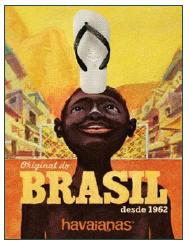
Figure 4
Boy balancing a Havaianas sandal on his head, which replaces a soccer ball.
Source: Merigo, C. (2016). With dancing on Sugarloaf Mountain, Havaianas debuts its first global campaign. https://www.b9.com.br/64792/com-danca-no-pao-de-acucar-havaianas-estreia-sua-primeira-campanha-global
Expression plan: the campaign explores the chromatic category, marked by color and the predominance of warm tones, reinforcing meanings such as the warmth of the country and the welcoming nature of its population. Regarding the eidetic category, rounded and curvilinear shapes are predominantly used, both in the illustrations of space (such as mountains, branches, or buildings) and in human representations. This is especially evident when analyzing the campaign texts that use female figures, portrayed with body shapes that emphasize their curves. The topological category highlights the arrangement of the shapes in the text. The Havaianas flip-flops, which appear in all the images, are generally in central positions and in the foreground. However, they always share a prominent position with some element representing this Brazilian originality (Figure 5).
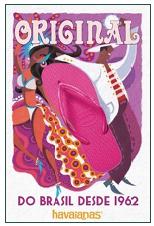
Figure 5
Havaianas generate a perception of figure-ground in the middle of a couple of samba dancers.
Source: Merigo, C. (2016). With dancing on Sugarloaf Mountain, Havaianas debuts its first global campaign. https://www.b9.com.br/64792/com-danca-no-pao-de-acucar-havaianas-estreia-sua-primeira-campanha-global
“Havaianas. Made for the Brazilian summer” campaign (2017)
Following the approach of exploring aspects of Brazilian nature, the 2017 global campaign, ‘Havaianas. Made of Brazilian summer,’ was a campaign that reinforced Brazil’s natural beauty. It used images of the Brazilian summer and reaffirmed that the brand embodies the spirit of this season, which symbolizes the tropical country. According to the AlmapBBDO agency, this campaign was created to bring to the world “the essence of the Brazilian summer, its joy, the rhythm, the energy that seems to have no end, and the unique way the Brazilian people make friends” (Figure 6).

Figure 6
The campaign image features a smiling couple of samba dancers and the words ‘Made of Brazilian Summer,’ which in Portuguese expresses the title of the entire campaign ‘Havaianas. Made of Brazilian Summer’ (Havaianas. Feitas do Verão Brasileiro).
Source: Black Madre. (2017). Havaianas - made of Brazilian summer. https://www.behance.net/gallery/51913607/Havaianas-Made-Of-Brazilian-Summer
Content plan (discursive level): this campaign explores the tropicality of Brazil, that is, everything associated with summer in the country. Along with these aspects, abstract notions are expressed, such as feelings of happiness, energy, and festivity. At the discursive level, this will be expressed through three main themes: joy, summer, and carnival.
The theme of joy is the expression of this feeling, which has a socio-historical and ideological meaning (Barros, 2004), associated with positive factors by the use of words that appear in the illustrations, such as ‘happiness’ and ‘good vibes’ (good energy), which also contribute to the construction of this meaning (Figures 7 and 8). In addition, joy is also represented in the characters through the expression of a smile.
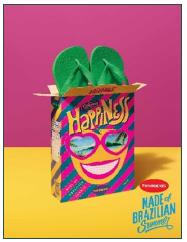
Figure 7
Campaign with sandals inside a box containing an illustration on the front and the word ‘Happiness’ with the face of a smiling person.
Source: AlmapBBDO. (2017). The brand’s new global campaign packs sandals with the best that Brazil has to offer. https://www.almapbbdo.com.br/pt/trabalhos/havaianas-leva-um-pouco-do-brasil-para-o-mundo-em-embalagens-especiais+178
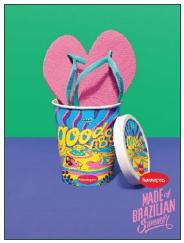
Figure 8
Campaign with sandals inside a can with an illustration saying ‘Good vibes’ (good energy) and a person lying on the beach.
Source: AlmapBBDO. (2017). The brand’s new global campaign packs sandals with the best that Brazil has to offer. https://www.almapbbdo.com.br/pt/trabalhos/havaianas-leva-um-pouco-do-brasil-para-o-mundo-em-embalagens-especiais+178
A second striking theme is summer itself. In addition to being a prominent aspect in the campaign title, which appears frequently in the advertisements analyzed here, the theme is explored through figures that symbolize and clarify the brand’s connection with the senses of this time of year and nature itself. The characters that most represent the summer theme are the surfer (Figure 9) and the woman on the beach (Figure 10).
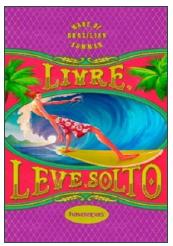
Figure 9
Illustration of a surfer with the words ‘Free, light, loose.’ This image is also found on the packaging presented in the campaign.
Source: Black Madre. (2017). Havaianas - made of Brazilian summer. https://www.behance.net/gallery/51913607/Havaianas-Made-Of-Brazilian-Summer

Figure 10
Illustration of a woman sunbathing on the beach, holding a fan. The advertisement’s slogan reads ‘100% spontaneity’.
Source: Black Madre. (2017). Havaianas - made of Brazilian summer. https://www.behance.net/gallery/51913607/Havaianas-Made-Of-Brazilian-Summer
Finally, the texts also address and take advantage of the theme of carnival to expand on the positive aspects of this time of year. One of the figures used to express this meaning is the streamers and confetti that appear in the background of certain compositions, adding the notion of the party to the thematic aspects discussed above. The term ‘samba no pé’ (good samba dancing), which appears in one of the illustrations associated with a couple of samba dancers, particularly highlights this theme (Figure 11). In this way, the campaign continues to express Brazilianness, creating continuity and intertextuality with the campaigns of previous years and, thus, constructing the notion of Brazil and Brazilians in the ideology of its interlocutors.

Figure 11
‘Samba no pé’ illustration shows not only the joy, but also the carnival theme addressed in the campaign.
Source: Black Madre. (2017). Havaianas - made of Brazilian summer. https://www.behance.net/gallery/51913607/Havaianas-Made-Of-Brazilian-Summer
Expression plan: in the expression plan, the analysis of the categories that make up this stage shows that the brand is clearly aligned in the way it conveys its messages. As seen previously, there is a true ‘explosion of colors.’ This choice demonstrates coherence with the campaign’s objectives since the content portrays joy, summer, and celebration (Figure 12).

Figure 12
Advertisement featuring a pair of Havaianas in the midst of a colorful explosion of confetti and streamers, with one of the sandals coming out of a matchbox bearing the words ‘Contagious energy’.
Source: Havaianas. (2017). Havaianas. Made of Brazilian Summer. https://www.facebook.com/HavaianasUS/photos/10155273334942840
In the eidetic category, the alignment with the posture in previous campaigns is maintained. In general, the elements are portrayed with an emphasis on curvilinear shapes. The sandals, for example, appear to demonstrate curvatures in their arrangement, conveying a sense of flexibility and softness.
Even the typography used to portray the campaign name uses curves in the text ‘Made of the Brazilian summer.’ Furthermore, we can also see the continued use of organic and fluid shapes, whether in representations of nature (such as waves), in representations of humans, in objects, or even more so in compositions formed by sets of sandals.
Finally, the topological category works on the very idea of encompassed/encompassing seen previously. With the use of containers (boxes, cans, pots, etc.), which on the outside have illustrations loaded with the meanings seen in the discursive plane, the sandals are commonly shown as part of the interior of these containers or in a movement of exiting them. This illustrates an idea of essence, of exposing what is at the core. Thus, Havaianas would be representatives of the ‘spirit of the Brazilian summer.’
‘Havaianas Global Campaign 2019’ (2019)
The ‘Havaianas Global Campaign 2019’ has some peculiarities that set it apart from the other campaigns seen so far. First, the main information about the campaign was acquired through Behance,1 directly from the portfolios of two of the art directors who participated in the creation of the advertising pieces. Another aspect is that this is an action that has a specific objective and narrative: the search to take the brand to countries that do not yet know it.
In this sense, this campaign has a particular and delimited target audience in foreign countries that have had no contact with the brand and its history. Because of this, the utilitarian functions of the sandals are the focus of the campaign. However, from the analysis of the texts, it is clear that even the functionalities are aggregated to aspects of Brazilianness.
Content plan (discursive level): the texts of this campaign are composed of different posters that have slogans, illustrations, and images (Figure 13). Among the slogans are phrases such as ‘floating in comfort,’ ‘playful comfort,’ ‘all feet are welcome,’ ‘find your comfort,’ etc. In the illustrations, we see the flip-flops in different positions and with different functions, serving, for example, as a buoy, as support for a person meditating, and on the feet of a person who is making the peace symbol with their fingers.
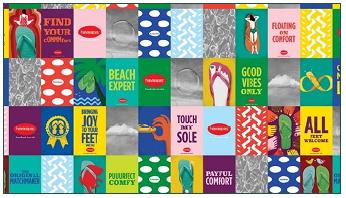
Figure 13
Posters of the “Havaianas Global Campaign 2019.
Source: Belchior, A., Neto. (2019). Havaianas Global Campaign 2019. https://www.behance.net/gallery/84947485/Havaianas-Global-Campaign-2019
The most obvious theme, which is even confirmed by the campaign’s artistic direction, is comfort. As the texts aim to highlight the product’s functional characteristics, comfort is not only an abstract concept but also a necessary association with the sandal. The word itself appears in different pieces. This theme is brought out by characters in situations that represent relaxation, tranquility, and well-being (Figure 14).

Figure 14
Woman meditates on top of a Havaianas sandal, while next to it we read the text ‘Find your comfort’.
Source: Bianchi, G. (2019). Havaianas Global Campaign 2019. https://www.behance.net/gallery/78671545/Havaianas-Global-Campaign-2019
As in previous campaigns, the theme of nature is also addressed through figures such as trees, beaches, sea, and animals. Specifically in this campaign, nature is presented with the sandals integrating part of a natural body, as if they were part of the composition of the figure in question (Figure 15). In this same illustration, on the side, we can read the term ‘beach expert’ written in English.
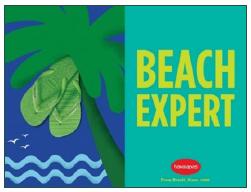
Figure 15
Havaianas sandals become part of the leaves of a tree, in the advertisement that carries the text: ‘Beach expert’.
Source: Bianchi, G. (2019). Havaianas Global Campaign 2019. https://www.behance.net/gallery/78671545/Havaianas-Global-Campaign-2019
Finally, the third theme that stands out is diversity, which introduces the idea that Havaianas can be worn by everyone while also providing comfort. For a global campaign focused primarily on the external public, the use of diversity is a way to engage with other people. At the same time, the brand is also adopting a discourse of Brazilian receptiveness. Therefore, just like Brazil, Havaianas also welcomes everyone (Figure 16).
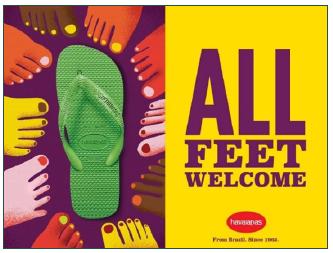
Figure 16
Feet, of different colors, around a pair of Havaianas, accompanied by the words ‘All feet welcome’.
Source: Bianchi, G. (2019). Havaianas Global Campaign 2019. https://www.behance.net/gallery/78671545/Havaianas-Global-Campaign-2019
Expression plan: the reinforcement of forms already adopted by the company in previous campaigns is noticeable. In the chromatic category, for example, the use of vibrant, strong, and saturated colors makes this connection with other advertisements. The eidetic category also aligns with advertisements from previous campaigns, favoring curvilinear and rounded forms. These characteristics appear in humans, in animals, in nature, and in the objects themselves.
Finally, the topological category highlights the sandals in centralized positions, of sizes disproportionate to the size of a sandal. Thus, the sandals represent different objects and scenarios: surfboard, pool, buoy, etc. In this sense, the notion of encompassing appears sometimes when they serve as support for figures of people and animals.
‘Summer is here’ campaign (2020)
The last campaign analyzed is ‘Partiu Verão’ (“Let’s Summer” in English). In this campaign, the Brazilian summer is the main guiding theme, in an invitation made by the brand for interlocutors to ‘enjoy’ the season. According to the AlmapBBDO (2019) agency, people from different countries are invited to ‘feel’ what Havaianas proposes with the experience of living the Brazilian summer lifestyle.
Content plan (discursive level): the elements in this campaign have different characteristics from those seen before. These are illustrations that were printed, forming comic strips with specific colors and styles. In carrying out this global campaign, the agency had the participation of local influencers to carry out particular actions adapted to the reality of each country where the advertising reached (AlmapBBDO, 2019).
The theme of joy, as previously mentioned, is recurrent in this campaign. This is represented by illustrations of people or animals smiling (Figure 17). The smile is even given greater focus in one illustration and is added to the expression ‘ha there is ha,’ a symbolic representation of the feeling of joy. The theme of friendship appears through figures demonstrating unity, a certain partnership. The best representation of this theme can be seen in Figure 18, which shows two characters interacting and joining their ‘hands.’ This image is accompanied by the words ‘partiu amigos’ in the Portuguese version. The opposition between the figure of the human hand and the paw, together in a gesture socially known as partnership/union, also brings a sense of closeness, even in the differences.

Figure 17
Illustrations from the global ‘Partiu Verão’ campaign adapted into different languages, not just English.
Source: Creative Club. (2019). Let's summer. Havaianas in new global campaign. https://www.clubedecriacao.com.br/ultimas/lets-summer/
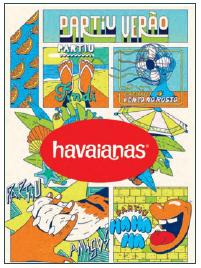
Figure 18
Illustration of the ‘Partiu Verão’ campaign with comics showing the themes of joy, summer, and friendship.
Source: Havaianomaniacos. (2019). Discover the new Havaianas collection 2019-2020. https://www.havaianomaniacos.com.br/2019/05/nova-colecao-havaianas-2019-2020.html
The theme of summer is once again explored by the brand. As seen in previous campaigns, this theme is expressed by different figures. The issue of nature, with images of the sea, with people in this context, is striking. All of this is accompanied by sayings that appear in the comic strips of the illustration (Figure 19), which feature phrases such as ‘let’s surf’ and ‘let’s enjoy the sun.’

Figure 19
Illustration of the ‘Partiu Verão’ campaign with figures that represent summer: beach, swimming pool, parasol, sunglasses, etc.
Source: Creative Club. (2019). Let's summer. Havaianas in new global campaign. https://www.clubedecriacao.com.br/ultimas/lets-summer/l
Expression plane: when the analysis reaches the expression level, it is clear that some factors are already established in the way the brand expresses its advertisements. For example, in the chromatic category, the explosion of colors is already configured as a typical aspect of Havaianas. In the eidetic category, there is the similarity of the shapes found in previous campaigns. There is, mainly, the predominance of rounded and curvilinear elements, as well as the expression of fluidity. This is shown both in the shapes (human and non-human) and in the typography chosen for the different frames. Finally, in the topological category, the Havaianas sandal is highlighted by its size, which has larger proportions compared to the other illustrations in the comics. Furthermore, the use of the comic format in this campaign means that the sandals, as well as all the graphic elements that form the meaning of the Brazilian summer and the themes highlighted above, are in a position of being encompassed by the structure of the borders that divide each frame. These boundaries are not rigid, since the elements included (which are within the comics) go beyond the margins.
Summary of the semiotic analysis of Havaianas international advertising campaigns
The semiotic analysis of Havaianas’ international advertising campaigns is summarized in Table 1 below. In addition to this summary, we also sought to relate the findings to the discussions on decolonialism and development already presented here, in order to indicate how such issues are present in the images analyzed.

DEVELOPMENT DISCOURSE: THE DECOLONIAL PERSPECTIVE ON HAVAIANAS INTERNATIONAL CAMPAIGNS
It is difficult to imagine that Havaianas’ international campaigns were created based on the development discourse. It is much more reasonable to think that the company wanted to associate its flip-flops with certain Brazilian elements because it thought they would help strengthen the symbolism associated with the product and the brand (Utino et al., 2023), without further reflection on the matter. However, from the moment Havaianas chose to make its association with Brazil and present the country based on certain elements to an international audience, these campaigns became part of a broader geopolitical discussion, related to development discourse and, consequently, to the way in which Brazil is compared to underdevelopment (Escobar, 2004; Furtado, 2009).
The asymmetries between the Global North and the Global South are the result of a discourse established by the Eurocentric world about what is developed or underdeveloped, with that which originates from the Global North being associated with the former (Escobar, 2012). Therefore, differences between these two loci are transformed into oppositions, in order to hierarchize the distinctions and thus establish what is superior and inferior. The Global South never sets the agenda for what is development, since, in the capitalist world-system, this peripheral locus only serves as the opposite of the developed - that is, the underdeveloped, the backward, the dependent (Marini, 2014; Santos, 2020).
Havaianas advertisements, therefore, end up invigorating this process, as both what is conveyed in the images released and what is not feeds the discourse of development. For example, the company’s international campaigns strongly emphasize Brazil’s beautiful natural landscape, highlighting beaches, forests, and the ‘typical’ animals of these places, such as macaws and jaguars. Naturally, sun and heat are part of this characterization of the country, as if it were only summer here all year round. To deal with the high temperatures in Brazil, there is nothing better than fresh fruit, including bananas and cashews, cold (alcoholic) drinks, white men surfing, and white women wearing bikinis. Thus, the campaigns refer to Brazil as a perfect place to spend a vacation, especially for people who live in countries with cold seasons, as is traditional in Europe and the United States.
Vacation is the time when individuals are not working, in offices in commercial buildings. However, it is precisely through work that production is carried out, and it is from production that development is achieved (Furtado, 2009). Therefore, if the images of Brazil in the Havaianas campaigns refer to vacation periods, they also indicate the lack of work (and production) in the country, meaning that we are therefore at a level of underdevelopment.
Brazilian culture is still a constant theme in Havaianas’ international campaigns, with elements related to joy, smiles, and parties frequently explored in the advertisements. Thus, the biggest Brazilian festival, Carnival, had to be included in the campaigns, represented by a Black woman and man dancing samba. The figure of the malandro also stands out in the campaigns, illustrating the Brazilian malandro’s ability to adapt to any circumstances, especially adverse ones (DaMatta, 1989). Therefore, the campaigns reinforce the idea that Brazilian culture is associated with leisure, fun, and informality. However, in doing so, they fail to relate to our cultural traits of seriousness, diligence, or dedication - characteristics that are considered necessary for individuals in a society to be seen as developed (Escobar, 2012).
Soccer is another element highlighted in Havaianas’ international campaigns. The choice makes sense because the game is more than just a sport (the favorite) for Brazilians; it is an integral part of who we are (DaMatta, 1989). Brazil is the only country to have won the men’s World Cup five times, has internationally recognized clubs, has invested millions in players and infrastructure, is known for its tradition of great players, with Pelé being the greatest of all time, and the yellow jersey of the Brazilian national team is a symbol strongly associated with the country. Nevertheless, what the advertisement broadcast worldwide by the company illustrates is a young black man, shirtless, on a dirt field located in a poor community. Therefore, the idea of poverty related to national soccer predominates, in contrast to the riches behind this game, its great clubs, and its players.
The advertisements broadcast by Havaianas in its international campaigns end up falling into a duality because, for all the elements used by the company to represent Brazil, the development discourse contrasts them with other, ‘superior’ ones. This discourse has long established the place occupied by Brazil in the hierarchy that puts countries of the Global North at the top so that images associated with developed realities can hardly be related to Brazil. We are in a position of subordination, and even if we advance within the capitalist world-system, we only do so because the central countries have already advanced even further (Bambirra, 2019; Marini, 2014; Santos, 2020).
Therefore, representing Brazil around the world based on other important characteristics, such as the resilience and sense of work of its people, the constitutional duty to provide universal health and education, improvements in global innovation rates, and advances in the creation of clean energy technologies, which are consistent with developed realities, end up not being seen as consistent with the image of our country, according to the development discourse. Thus, it is natural that Havaianas chooses to portray Brazil in the way it did, since it is not possible to do so differently. This explains why countless Brazilian companies have also followed/follow the same path as Havaianas.
Breaking this cycle is, therefore, difficult to envision but necessary if we want to stop being seen (and represented) as a country that has few references that the rest of the world wants to have as a parameter for its development. The first step in this direction is to understand the geopolitics behind the concept of development so that it can then be questioned and this discussion can be advanced using other parameters to define what a developed reality would be.
These points are being made here based on the phenomenon under analysis in this study. However, they should not be restricted to it; instead, they deserve to be taken to a broader sphere in order to think about decolonialism in marketing in depth. Our objective is to encourage the development of more research within the area, especially in Brazil (but not limited to this country), that is, research that adopts this critical perspective so that it is possible to begin to see the presence of coloniality in various phenomena related to marketing.
In order to achieve this goal, a larger critical mass of researchers versed in decolonial discussions in marketing should be fostered. It is not enough to simply have more education on the subject; rather, what is needed is a greater dedication to adopting decolonialism as a political stance in research. Conducting research in marketing from a decolonial perspective means starting from this vision as an axiology. Otherwise, there is a risk of appropriating the values that decolonialism advocates for merely casual purposes, without the commitment to achieving the true sociopolitical changes that this tradition demands of the researcher.
FINAL CONSIDERATIONS
Although Havaianas assumes a role in valuing the Brazilianness of its origin, its advertisements reinforce an image of an underdeveloped country that has evolved little since its colonization. Given the notion that the discourse of development establishes modernity as the maximum value to be achieved in development (Escobar, 2012), and that modernity cannot be thought of without its historical roots in colonization (Quijano, 2007), it can be concluded that the evidence has found a maintenance of the underdeveloped position that this context imposes on Brazil.
However, such critical issues, which deal with the coloniality still present in marketing, particularly related to advertisements, are little debated within the field (Cardoso et al., 2021; Hemais et al., 2022). After all, advertisements are not disconnected from social, market, historical, political, and cultural realities (Ger, 2024). Therefore, it is incoherent to think that such communication devices are ‘only’ commercial marketing tools; in fact, they are much more than that, as they serve as vectors for the dissemination of messages that seek to reinforce the image of the Global North as superior (Sreekumar & Varman, 2024). Therefore, this work has taken a step toward reducing this gap in the literature, serving to bring to light, through a decolonial perspective, geopolitical aspects related to advertisements.
Only by adopting a decolonial theoretical framework was it possible to arrive at the analyses carried out, given that this perspective allows us to reveal a subordinated view of certain phenomena that traditional theorizations in marketing have failed to explore (Queiroz et al., 2021; Rodrigues, 2021). Thus, the analysis of advertisements is no longer based on traditional marketing metrics about the effectiveness of a given message in attracting a consumer’s attention but rather seeks to uncover the role of such a message in reinforcing the structures of domination of the Eurocentric world over the rest of the world (Hemais et al., 2022).
From this perspective, all advertising whose content contains representations of any country can be analyzed from a decolonial lens, in order to reveal how such communication devices can be used to reproduce coloniality in our realities (Aytaç, 2024; Sreekumar & Varman, 2024). This is not a condemnation of advertising or its use per se; quite the opposite. The focus is on pointing out that such tools are subject to the epistemologies behind them and that when the epistemic gaze of those who develop propaganda is covered by a Eurocentric reason (which can occur with people in the Global North or the Global South), this is reflected in the message they wish to communicate.
In order to expand the decolonial perspective and analyze the impacts that this historical reality of colonization has on advertising, we suggest conducting more theoretical and empirical studies that highlight the decolonial debate in the reality and practice of corporate advertising. Thus, a more in-depth analysis of the development discourse in other advertisements would be of great value. To this end, one approach would be a more longitudinal exploration of Havaianas advertisements, assessing the company’s position over its more than fifty years of activity. On the other hand, it would also be interesting to broaden the application of the study, expanding the analyses to other Brazilian companies with international operations. Finally, another path to further study is to conduct discourse and methodological analyses that assess the views of other audiences on Havaianas brand messages and their associations with the development discourse.
REFERENCES
AlmapBBDO. (2016). Havaianas become dance steps in the brand’s first global film. https://www.almapbbdo.com.br/pt/trabalhos/havaianas-viram-passos-de-danca-no-primeiro-filme-global-da-marca+92
AlmapBBDO. (2017). The brand’s new global campaign packs sandals with the best that Brazil has to offer. https://www.almapbbdo.com.br/pt/trabalhos/havaianas-leva-um-pouco-do-brasil-para-o-mundo-em-embalagens-especiais+178
AlmapBBDO. (2019). Global campaign created by AlmapBBDO invites you to experience the unique sensations of the season. https://www.almapbbdo.com.br/pt/trabalhos/havaianas-espalha-diferentes-convites-para-que-o-mundo-viva-o-espirito-do-verao-brasileiro+333
Aytaç, M. (2024). A decolonizing or recolonizing mindset? Semiotic analysis of a Qurban donation appeal to Africa in Turkey. In A. Das, H. Chaudhuri, & O. Sandikci, (Eds.), Postcolonial Marketing Communication: images from the margins (pp.117-136). Springer.
Bambirra, V. (2019). Latin American dependent capitalism. Insular.
Barros, D. (2004). Publicidade e figurativização. Alfa: Revista de Linguística, 48(2), 11-31. https://periodicos.fclar.unesp.br/alfa/article/view/4294
Belchior, A., Neto. (2019). Havaianas Global Campaign 2019. https://www.behance.net/gallery/84947485/Havaianas-Global-Campaign-2019
Bianchi, G. (2019). Havaianas Global Campaign 2019. https://www.behance.net/gallery/78671545/Havaianas-Global-Campaign-2019
Black Madre. (2017). Havaianas - made of Brazilian summer. https://www.behance.net/gallery/51913607/Havaianas-Made-Of-Brazilian-Summer
Bonsu, S. (2009). Colonial images in global times: Consumer interpretations of Africa and Africans in advertising. Consumption Markets and Culture, 12(1), 1-25. https://doi.org/10.1080/10253860802560789
Cardoso, R., Ferreira, M., Baptista, T. & Hemais, M. (2021). Imagens coloniais na contemporaneidade: Um estudo decolonial acerca de propagandas turísticas relacionadas à África. Revista ADM.MADE, 25(2), 1-21. https://dx.doi.org/10.21714/2237-51392021v25n2p001021
Chandy, R., Johar, G., Moorman, G., Roberts, J. (2021). Better marketing for a better world. Journal of Marketing, 85(3), 1-9. https://doi.org/10.1177/00222429211003
Creative Club. (2019). Let’s summer. Havaianas in new global campaign. https://www.clubedecriacao.com.br/ultimas/lets-summer/
DaMatta, R. (1989). O que faz o Brasil, Brasil? Rocco.
Dholakia, N. (2016). Marketing as mystification. Marketing Theory, 16(3), 401-426. https://doi.org/10.1177/1470593115619971
Drucker, P. (1958). Marketing and economic development. Journal of Marketing, 22(3), 252-259. https://doi.org/10.1177/002224295802200302
Escobar, A. (1992). Reflections on “development”: Grassroots approaches and alternative politics in the Third World. Futures, 24(5), 411-436. https://doi.org/10.1016/0016-3287(92)90014-7
Escobar, A. (1999). The invention of development. Current History, 98(631), 382-386. https://doi.org/10.1525/curh.1999.98.631.382
Escobar, A. (2004). Development, violence and the new imperial order. Development, 47, 15-21. https://doi.org/10.1057/palgrave.development.1100014
Escobar, A. (2010). Latin America at a crossroads: Alternative modernizations, post-liberalism, or post-development? Cultural Studies, 24(1), 1-65. https://doi.org/10.1080/09502380903424208
Escobar, A. (2012). Encountering development: The making and unmaking of the Third World. Princeton University Press.
Furtado, C. (1974). The myth of economic development. Peace and Land.
Furtado, C. (2009). Development and underdevelopment (5th ed). Counterpoint.
Furtado, C. (2014). Roots of underdevelopment (3rd ed). Brazilian Civilization.
Ger, G. (2024). Neocoloniality of marketing communication in the global south. In: A. Das, H. Chaudhuri & O. Sandikci (Eds.). Postcolonial marketing communication: Images from the margins (pp.7-16). Springer.
Havaianas. (2017). Havaianas. Made of Brazilian Summer. https://www.facebook.com/HavaianasUS/photos/10155273334942840
Havaianomaniacos. (2019). Discover the new Havaianas collection 2019-2020. https://www.havaianomaniacos.com.br/2019/05/nova-colecao-havaianas-2019-2020.html
Hemais, M., Pessôa, L.A., & Barros, D. (2022). “The “Esperanto” of business... or how to be successful in life: A decolonial reading, using semiotics, of English language courses’ advertisements in Brazil. Marketing Theory, 22 (2), 251-274. https://doi.org/10.1177/14705931221075
Jimenez, A., Delgado, D., Merino, R., & Argumendo, A. (2022). A decolonial approach to innovation? Building paths towards Buen Vivir. The Journal of Development Studies, 58 (9), 1633-1650. https://doi.org/10.1080/00220388.2022.2043281
Kravets, O. & Varman, R. (2022). Introduction to special issue: Hierarchies of knowledge in marketing theory. Marketing Theory, 22(2), 127-133. https://doi.org/10.1177/1470593122108
Marini, R. (2014). Underdevelopment and revolution (5th ed). Insular.
McAllister, M., Forde, S., & Beykont, Y. (2024). bell hooks’ “Eating the Other” as a critical advertising framework. In: A. Das, H. Chaudhuri, & O. Sandikci (Eds.), Postcolonial Marketing Communication: Images from the margins (pp.17-36). Springer.
Merigo, C. (2016). With dancing on Sugarloaf Mountain, Havaianas debuts its first global campaign. https://www.b9.com.br/64792/com-danca-no-pao-de-acucar-havaianas-estreia-sua-primeira-campanha-global
Mignolo, W. (2019). Sustainable development or sustainable economies? Ideas towards living in harmony and plenitude. Socioscapes: International Journal of Societies, Politics and Cultures, 1(1), 48-65. https://doi.org/10.48250/1004
Mignolo, W. (2021). The politics of decolonial investigations. DukeUniversity Press.
Ndlovu-Gatsheni, S. (2012). Coloniality of power in development studies and the impact of global imperial designs on Africa. Australasian Review of African Studies, 33(2), 48-73.
Pastrana, N., Tran, K. & Martam, I. (2022). Marketing to foster development in the Global South. In K., Kubacki, L. Parker, C. Domegan, & L. Brennan. The Routledge Companion to Marketing and Society. Routledge.
Patel, K. (2020). Race and a decolonial turn in development studies. Third World Quarterly, 41(9), 1463-1475. https://doi.org/10.1080/01436597.2020.1784001
Queiroz, M., Hemais, M., & Pessôa, L. A. (2021). A postcolonial study, using semiotics, on covers of classic books published in Brazil and the United States. Cadernos EBAPE.BR, 19(4), 1031-1046. https://doi.org/10.1590/1679- 395120200200
Quijano, A. (2007). Coloniality and modernity/rationality. Cultural Studies, 21(2-3), 168-178. https://doi.org/10.1080/09502380601164353
Rodrigues, L. (2021). Decolonial reflections in marketing: The colonialities of power, knowledge and being. Interdisciplinary Marketing Journal, 11(2), 92-114. https://doi.org/10.4025/rimar.v11i2.5864 1
Silva, K., & Sauerbronn, J. F. (2021). Marketing systems, markets and quality of life: An analysis based on Buen Vivir Andino. Interdisciplinary Journal of Marketing, 11(2), 132-151. https://doi.org/10.4025/rimar.v11i2.58708
Sreekumar, H. & Varman, R. (2024). Postcolonial marketing communication: An Indian perspective. In A. Das, H. Chaudhuri, & O. Sandikci, (Eds.), Postcolonial Marketing Communication: Images from the margins (pp. 53-61). Springer.
Srinivas, N. (2022). Against NGOs: A critical perspective on civil society, management, and development. Cambridge University Press.
Santos, T. (2018). Socialism or fascism: The new character of dependency and the Latin American dilemma. Insular.
Santos, T. (2020). Dependency theory - Balance and perspectives. Insular.
Teixeira, L. (2008). Reading visual texts: Methodological principles. In N. Bastos (Ed.), Portuguese Language: Lusophony - Memory and Cultural Diversity (pp. 299-306). PUC-SP Publishing House.
Tlostanova, M. (2019). The postcolonial condition, the decolonial option and the postsocialist intervention. In M. Albrecht (Ed.), Postcolonialism cross-examined: Multidirectional perspectives on imperial and colonial pasts and the newcolonial present (pp.165-178). Routledge.
Utino, A., Bissoli, E., Pinheiro, R. & Sanches, S. (2023). Havaianas - the internationalization of a Brazilian icon. Lisbon International Press.
Varman, R. (2018). Postcolonialism, subalternity and critical marketing. In M. Tadajewski, M. Higgins, J. Denegri-Knott, & R. Varman (Eds.), The Routledge companion to critical marketing (pp. 49-63). Routledge
Varman, R., & Costa, J. (2013). Underdeveloped other in country-of-origin theory and practices. Consumption Markets and Culture, 16(3), 240-265. https://doi.org/10.1080/10253866.2012.668366
Varman, R., & Saha, B. (2009). Disciplining the discipline: Understanding postcolonial epistemic ideology in marketing. Journal of Marketing Management, 25(7-8), 811-824. https://doi.org/10.1362/026725709X471640.
Notes
BAR - Brazilian Administration Review encourages data sharing but, in compliance with ethical principles, it does not demand the disclosure of any means of identifying research subjects.
Author notes
(Universidade Federal de Goiás, Brazil)
(Pontifícia Universidade Católica do Rio Grande do Sul, Brazil)
(Universidade Federal do Rio Grande do Sul, Brazil)
and one anonimous reviewer.
(ANPAD, Maringá, Brazil)
Corresponding author: Marcus Wilcox Hemais Pontifícia Universidade Católica do Rio de Janeiro, IAG Escola de Negócios Rua Marques de São Vicente, n. 225, Gávea, CEP 22451-900, Rio de Janeiro, RJ, Brazil
Conflict of interest declaration