Research Article
Received: 31 May 2024
Accepted: 07 February 2025
Published: 07 April 2025
DOI: https://doi.org/10.1590/1807-7692bar2025240081
Funding
Funding source: Coordination for the Improvement of Higher Education Personnel
Contract number: 001
Funding statement: Halison Rodrigo de Souza acknowledges that this work was supported by the Coordination for the Improvement of Higher Education Personnel (CAPES, Brazil), Finance Code 001. Ilse Maria Beuren acknowledges that this work was supported by the National Council for Scientific and Technological Development (CNPq, Brazil), and by the Research and Innovation Support Foundation of Santa Catarina State (FAPESC, Brazil).
ABSTRACT
Objective: this article examines the mediating role of formal and informal controls in the relationship between cooperative networks and business model innovation in companies located in technology parks. It draws on the resource-based view literature, assuming that the formal and informal controls of companies in such locations support the capture and use of resources from cooperation networks with other companies in the same location and their park.
Methods: data were collected from 94 managers and analyzed using partial least squares structural equation modeling (PLS-SEM).
Results: the findings indicate that formal controls mediate the relationship between cooperative networks and business model innovation, contrasting with the lack of statistical significance observed in informal controls. When combined, formal and informal controls exhibit a mediating effect.
Conclusions: the research reveals the intervening role of formal controls, indicating a short-term perspective on the resources available in cooperation networks, in contrast to informal controls, which play this role in the long term only when combined with formal controls. These findings contribute to the literature and managerial practice and emphasize the importance of (re)designing managerial controls to enhance the benefits of networks in business model innovation.
Keywords: Formal controls, informal controls, cooperative networks, business model innovation, technology parks.
INTRODUCTION
Business model innovation (BMI) is a strategy aimed at driving revenue growth and profit margins for companies (Amit & Zott, 2012). It involves creating a new business model or modifying an existing one to improve operational efficiency or adapt to market changes (Ferreras-Méndez et al., 2021). The goal of BMI is to reorganize the resources controlled by a company to generate customer value and achieve a sustainable competitive advantage (Amit & Zott, 2012). While BMI depends on resources and information, companies facing resource constraints can benefit from network formation to facilitate access to these assets (Anwar & Ali Shah, 2020).
Cooperative networks provide access to resources, knowledge, and information that facilitate problem-solving (Beuren & Dal Vesco, 2022) and can contribute to fostering innovation and, consequently, achieving a competitive advantage (Wu et al., 2020). Viewing resources as all elements that a company owns or controls and can use to create and sustain a competitive advantage, the resource-based view (RBV) focuses on performance differences among companies with similar resources and investigates network formation for resource access (Barney, 1991). RBV aids in understanding how interorganizational networks serve as essential external resources to mitigate internal resource constraints (Xu et al., 2022). It also enables companies to identify and leverage valuable resources available in the network through their ability to access and utilize them (Lavie, 2006), as well as through sharing and collaboration (Dias et al., 2019).
Companies seeking to overcome resource shortages find physical resources and access to collaborative networks in technology parks (Koçak & Can, 2014). Their primary function is fostering innovation through resource complementarity and action interdependence (Schmidt & Balestrin, 2015). However, not all companies utilize the available resources (Soetanto & Jack, 2013), and research on technology parks has yielded mixed results. Koçak and Can (2014) found that sectoral homogeneity is associated with knowledge sharing and development. Chan and Lau (2005) observed that companies in the same sector may avoid collaboration due to concerns about sharing confidential information.
RBV highlights three inherent challenges in resource-sharing networks: the risk of sensitive information leakage, partner opportunism (Lavie, 2006), and the need to monitor relationship effectiveness (Chenhall et al., 2011). To mitigate these risks, network management is essential, involving the definition of responsibilities, partnership guidelines, and predictability for optimal resource utilization (Mouritsen & Thrane, 2006) to innovate (Pistoni et al., 2022).
Consequently, cooperative networks must implement protective mechanisms such as formal contracts, trust-building, and shared controls (Lavie, 2006). Managerial controls support self-regulation and the orchestration of interorganizational relationships (Mouritsen & Thrane, 2006). Rigid (formal) controls provide goal orientation (Santoro & Chakrabarti, 2002), whereas flexible (informal) controls facilitate communication flow and innovation (Kessler et al., 2017). Both are essential for monitoring cooperative networks and selecting and overseeing partners (Das & Teng, 1998, 2001).
From an RBV perspective, managerial controls function as resources that influence the development of organizational capabilities (Oyadomari et al., 2011). Formal controls trigger behavioral responses to the organizational control environment, while informal controls foster understanding of organizational objectives (Kaveski & Beuren, 2022). These controls act as mechanisms facilitating the identification, integration, coordination, mobilization, and exploitation of valuable resources (Barney, 1991). Effective managerial controls enable companies to optimize resources and drive innovation (Duréndez et al., 2023).
However, research linking formal and informal controls to innovation in networked environments has yielded conflicting results. Chenhall et al. (2011) found that the combination of formal controls and an innovative organic culture (informal controls) does not impact innovation, with informal controls proving more effective. Pistoni et al. (2022) determined that direct personal contacts, status-based rewards, and trust-based coordination collectively do not affect innovation, diverging from findings on the combination of formal and informal controls. Studies have also linked cooperative networks to BMI. Anwar and Ali Shah (2020) associated financial, business, and political networks with BMI in Pakistan. Micheli et al. (2020) highlighted the positive effects of network diversification and interaction with companies of different sizes. Xu et al. (2022) examined the relationship between the size and strength of entrepreneurial networks and BMI in Chinese startups.
The literature addresses managerial control systems (MCS) in interorganizational relationships (Beuren & Dal Vesco, 2022; Stouthuysen et al., 2017), including innovation (Henri & Wouters, 2020) and network innovation (Chenhall et al., 2011; Pistoni et al., 2022). However, it remains silent on their support in utilizing the resources available in the cooperation network for the sake of innovation. While Pistoni et al. (2022) investigated the relationship between partnerships, formal and informal controls, and innovation, they emphasized the need for further research on managerial controls in managing different forms of innovation.
In this study, it is assumed that the cooperative networks of companies located in technology parks, both with other companies in the same location and the park itself, influence BMI, with formal and informal controls serving as mediating factors. Given that social exchanges provide access to knowledge and unexpected opportunities and shape behaviors (Thomas et al., 2017), formal and informal controls - individually or in combination - are expected to monitor relationships and ensure effective resource utilization (Almeida & Machado, 2013).
Based on the above, this study poses the following research question: How do formal controls, informal controls, and the combination of formal and informal controls mediate the relationship between cooperative networks and BMI in companies located in technology parks? Under the theoretical lens of RBV, which assumes that formal and informal controls facilitate the capture and utilization of resources from cooperative networks, this study aims to analyze the mediating role of formal and informal controls in the relationship between cooperative networks and BMI in companies located in technology parks. It is important to note that the managerial controls analyzed pertain to the companies located in technology parks, not the parks or cooperative networks themselves. The perceptions of managers from companies within Brazilian technology parks were assessed through a survey, and the collected data were analyzed using PLS-SEM techniques.
The relevance of this study lies in the fact that companies may be compelled to pursue BMI to secure a competitive advantage, a process that can be time-consuming, costly, and unpredictable (Wu et al., 2020). Therefore, this study is justified by its analysis, from the perspective of managers of companies located in Brazilian technology parks, of how companies extract resources from networks for BMI, mediated by formal and informal controls. Since technology parks are a relatively recent phenomenon in Brazil, their effectiveness must be monitored. This is important for alignment and participation in management between public and private stakeholders in Brazil (Sant’Anna et al., 2019).
This study contributes to the literature by examining the effects of cooperative networks on BMI in companies located in technology parks. Unlike research that directly links managerial controls to innovation (Chenhall et al., 2011; Henri & Wouters, 2020) in network environments, this study considers the mediating role of managerial controls between cooperative networks and BMI. Although cooperation networks provide important resources for BMI (Micheli et al., 2020; Xu et al., 2022), managerial controls serve as resources that facilitate the extraction of additional resources from the networks developed within technology parks. The research findings indicate that formal controls, either individually or in combination with informal controls, act as potential mechanisms for capturing resources in the network for BMI.
This study also offers contributions to managerial practice. The mediation effect of formal controls, both individually and when combined with informal controls, in the relationship between cooperation networks and BMI may provide valuable insights for managers of companies located in technology parks. These findings may encourage managers to refine the design of managerial controls to optimize resource extraction, aiming at achieving a sustainable competitive advantage. In this regard, the study provides evidence that formal controls have a greater capacity to facilitate the transformation of cooperation network resources into innovation benefits. Although informal controls were not found to be effective independently, their combination with formal controls helps foster a long-term perspective on the resources available in cooperation networks. When combined, these controls may offer better guidance to technology park managers regarding the drivers that promote greater integration among companies and cooperation networks.
In addition to the introduction, this article presents a theoretical review, a description of the research methodology, the results and their discussion, and the conclusion, with an emphasis on the study’s implications and limitations.
LITERATURE REVIEW AND HYPOTHESES
Cooperation networks and business model innovation
Networks can facilitate the search for resources, knowledge, and information to foster innovation (Beuren & Dal Vesco, 2022), including the execution of fundamental activities by partners (Thomas et al., 2017). The absence of networks hinders access to critical opportunities and resources (Aldrich & Ruef, 2006). Diverse networks can provide information about markets, business locations, innovation alternatives, sources of capital, and potential investors (Aldrich & Ruef, 2006). The affective strength of networks increases trust and proximity and enables long-lasting relationships, which provide protection against opportunism and uncertainty (Aldrich & Ruef, 2006).
Networks require trust, rapid communication, rules, and self-regulation mechanisms for effective management (Mouritsen & Thrane, 2006). Cooperation can be frustrated by divergent interests among participants ( y suggest a lack of trust in the network and inhibit creativity, whereas more flexible controls foster information symmetry with partners (Chenhall et al., 2011). In uncertain environments, strict formal controls may fail, necessitating adaptable controls (Kherrazi, 2020).
Informal controls encompass norms, values, culture, and the internalization of goals to encourage desired behaviors and results (Das & Teng, 2001). They are flexible, data-rich, and minimally standardized (e.g., involving subordinates in budget planning). They aim to reduce divergences between individual preferences to promote cooperation and commitment among stakeholders (Eisenhardt, 1985). Informal controls include selection processes, training (Eisenhardt, 1985), and the socialization of technical skills, integrity, and values (Beuren & Dal Vesco, 2022).
Formal controls primarily focus on the short term by evaluating the achievement of results and monitoring business partners’ behavior more immediately to correct deviations and track performance (Stouthuysen et al., 2017). Informal controls provide stability and security by positioning the organization and focusing on the long term (Henri & Wouters, 2020). Informal controls help humanize and socialize experiences, strengthen relationships and loyalty, and enhance effectiveness (Stouthuysen et al., 2017). Chenhall et al. (2011) analyzed the effects of social networks and organic innovation culture on innovation and found an indirect and positive effect of social networks on innovation through organic innovation culture.
An appropriate control design (Chenhall, 2003) can contribute to the management of resources available in the network (Xu et al., 2022) and monitor the innovation process (Mouritsen & Thrane, 2006). Kherrazi (2020) investigated the role of a research and development ecosystem in the design of managerial controls and found that a strong ecosystem enhances managerial controls and that effective controls improve performance. However, the study did not confirm whether their combination yields better results.
Stouthuysen et al. (2017) examined the relationship between exploration, exploitation, and ambidextrous alliances and alliance performance, moderated by formal and informal controls. Their findings indicated stronger relationships between formal result controls and exploitation alliances, behavioral controls and exploration alliances, combined with ambidextrous alliances. Informal controls suggest an increase in the effectiveness of behavioral controls in exploration alliances, whereas the benefits of result controls diminished in exploitation alliances.
In the context of collaborative innovation, Guo et al. (2019) found that entry controls promote process innovation, while behavioral and output controls positively impact both process and product innovation. Pistoni et al. (2022) investigated the relationship between mechanisms of coordination and partnership control and innovation performance. They concluded that trust serves as a more effective informal control for innovation than direct contacts. Their study also highlighted that excessive rules can be ineffective and suggested that weak formal controls may prevent the inhibition of initiatives and creativity. Additionally, they emphasized that combining formal and informal controls leads to innovation.
Micheli et al. (2020) found that having a diverse network comprising companies of various sizes, along with changes in network ties, fosters BMI. Anwar and Ali Shah (2020) observed that financial, business, and political networks facilitate resource acquisition, generate new ideas and knowledge, provide access to distinct resources and knowledge, and impact BMI. Xu et al. (2022) investigated the effect of entrepreneurial networks on BMI in Chinese startups and found that the size and strength of networks have a positive impact on BMI.
Based on the above, the following hypothesis is proposed:
H1: Formal controls (H1a), informal controls (H1b), and the combination of formal and informal controls (H1c) positively influence the relationship between cooperation networks and BMI.
Figure 1 presents the theoretical model of the research and highlights the formulated hypotheses.
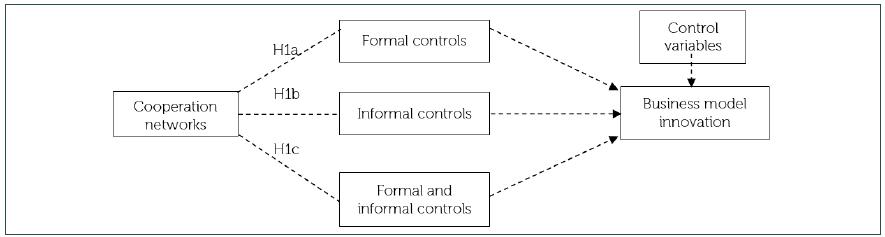
Figure 1
Theoretical model.
Source: Prepared by the authors. Note. The dotted arrows refer to the mediation hypotheses.
The theoretical model predicts a mediating effect of formal controls, informal controls, and the combination of formal and informal controls on the relationship between cooperation networks and BMI. Control variables were also included in the model.
METHOD
Sample and data collection
The research population consists of managers of companies located in Brazilian technology parks listed on the Ministry of Science, Technology, and Innovation (Ministério da Ciência, Tecnologia e Inovações [MSTI]) platform and InovaDatabr. Technology parks integrate educational institutions, research centers, government bodies, and new businesses to foster cooperation (Pazetto & Beuren, 2022). In Brazil, there are 2,657 resident companies (MSTI, 2023) distributed across 103 technology parks, of which 43 are operational and 60 are in the implementation phase (Associação Nacional de Entidades Promotoras de Empreendimentos Inovadores [Anprotec], 2023). The parks in the implementation phase were included as they offer valuable resources, partnerships with incubators, and an environment for knowledge and experience exchanges.
After mapping the 2,657 companies on the MSTI InovaDatabr platform, the company profiles were verified on the social network LinkedIn. This process led to the removal of 171 profiles that were not companies, 43 duplicates, 758 not found, and 3 requiring an email connection, resulting in 1,683 companies. A letter introducing the research, explaining ethical procedures, confidentiality, and participant anonymity was sent to these companies. Those who agreed to participate received the survey link via the QuestionPro platform.
Data collection took place from January to March 2024, yielding 94 valid responses from managers of companies located in technology parks. The sample was determined using G*Power 3.1.9.7 software, following Faul et al.’s (2009) guidelines, with the model having three predictors, a mean effect size of 0.15, a significance level of 0.05 (α = 0.05), and a sample power of 0.8 (β = 0.8), resulting in a minimum sample size of 77 responses, which aligns with the valid responses obtained. The profiles of the respondents and the companies surveyed are consistent with the research objectives.
The respondents are predominantly male (85%), aged between 31 and 50 years (68%). Most held postgraduate degrees, with 33% having specialization, 17% a master’s degree, and 27% a doctorate. The dominant field of study was Engineering (37%), followed by Business Administration (18%), Biological Sciences (17%), and Information Systems (15%). The majority indicated they are partners, co-founders, or directors (86%) and have held their position for less than 6 years (61%). Most companies were relatively young: 27% were 4 years old or less, 26% were 5 to 8 years old, and 24% were 8 to 16 years old. Over half of the companies operate in the technology sector (53%), followed by medicine, health, and chemistry (19%). Most were small companies, with 75% employing fewer than 20 people. The majority have been located in the park for 6 years or less (79%).
Constructs and research instruments
The theoretical model consists of four constructs: cooperation networks, business model innovation, formal controls, and informal controls. The constructs and their corresponding items (see http://doi.org/10.17632/47gv4vwb4h.1) were validated in previous research, and the research instruments were translated from English into Portuguese. The construct ‘cooperation networks’ is composed of two instruments: cooperation networks between the company and other companies in the technology park, and cooperation networks between the companies and the park.
Cooperation networks between the company and other companies in the park were measured using three items adapted from Wu et al. (2020), originally from Collins and Clark (2003). It is a first-order latent variable (e.g., CNP1) that captures information about the volume, frequency, and proximity to other companies in the park. The seven-point scale was modified to five points, ranging from strongly disagree (1) to strongly agree (5), to standardize the scale of the instruments. Adaptations to the items were made in relation to the original context of business incubators.
Cooperation networks between companies and the park were measured with two items adapted from Bocquet et al. (2016), originally from Lynn et al. (1996). It is a first-order latent variable (e.g., NP1) that captures information about exposure to and use of cooperation network services provided by the park over the last three years. The four-point scale was changed to five points, ranging from strongly disagree (1) to strongly agree (5). The items were adapted due to the original context of network management organizations.
Business model innovation was adapted from the reflective-formative model by Spieth and Schneider (2016). It is a second-order variable composed of three first-order elements, capturing changes in the company’s business model over the last three years. The construct is composed of three variables (value proposition, value delivery, value capture) (e.g., VP1, VD1, VC1). A five-point scale was used, ranging from not at all (1) to completely (5). Items were adapted to reduce the length of statements.
Formal controls consist of two first-order unidimensional latent variables, and informal controls consist of one unidimensional latent variable, all adapted from Stouthuysen et al. (2017). Formal controls consist of six items capturing results and behavior controls, grouped into a second-order reflective variable. Informal controls consist of five items related to culture, values, and information sharing (e.g., RC1, BC1, and IC1). The seven-point scale was adjusted to five points, ranging from strongly disagree (1) to strongly agree (5). Items were adapted due to the context.
Control variables were included in the model, specifically: cooperation networks of the technology park with other institutions outside the park, the number of cooperation networks, and the intensity of the cooperation networks.
Cooperation networks between the technology park and other institutions outside the park were measured with two items adapted from Wu et al. (2020), originally from Collins and Clark (2003) It is a first-order latent variable (e.g., PEN1) that captured information about the variety and closeness of relationships with other institutions in the park’s networks. The seven-point scale was changed to five points, ranging from strongly disagree (1) to strongly agree (5). Items were adapted due to the context of business incubators.
The number of cooperation networks was measured with items adapted from Wu et al. (2020). This instrument captured three individual items: the number of networks between companies in the park, with companies outside the park, and with other institutions. The measurement of each item was done through its natural logarithm. The number of networks is relevant because the more networks available, the more resources are accessible, and innovation performance depends on the abundance of external resources (Dongling et al., 2022).
The intensity of cooperation networks assumes that greater intimacy, trust, reciprocity, and emotional engagement lead to a higher transfer of resources between partners (Dongling et al., 2022). This variable was measured with items adapted from Wu et al. (2020) on a five-point Likert scale, ranging from low intensity (1) to high intensity (5).
Data analysis procedures
To test the hypotheses, partial least squares structural equation modeling (PLS-SEM) was used, as it allows the analysis of relationships between dependent and independent variables, with intervening variables, using a causal-predictive approach and seeking to explain the variance in the dependent variables (Hair et al., 2022). Path coefficients and other references are estimated to maximize the explained variance of dependent constructs in various partial regressions (Hair et al., 2022).
In mediation analysis, both the absence of mediation (or no mediation) and the presence of mediation were considered (Hair et al., 2022). In the absence of mediation, only direct non-mediation was evaluated, where the direct effect is significant and the indirect effect is not, as well as non-mediation without effect, where both direct and indirect effects are not significant (Hair et al., 2022). The presence of the mediator effect was evaluated by mediation: complementary (significant direct and indirect effects in the same direction), competitive (significant direct and indirect effects in opposite directions), and indirect (only the indirect effect is significant) (Hair et al., 2022). The combined mediator effect of formal and informal controls was analyzed based on the total indirect effects from SmartPLS, which represents the sum of the indirect effects of each mediator (Hair et al., 2022).
Biases due to common method, non-response, and early and late respondents were also assessed. To mitigate common method bias, the guidelines of Podsakoff et al. (2003) were followed. Respondents were asked to answer the items honestly and were informed that there were no right or wrong answers and that their anonymity was guaranteed. The Harman single-factor test was applied to assess whether one factor explained more than 50% of the variance in the data (Podsakoff et al., 2003). The result from the SPSS software, version 25.0.0.2, showed that the first factor explained 25.82% of the total variance, suggesting the absence of this bias.
The non-response bias arises because only a portion of the invited participants responded to the questionnaire. Assuming that non-respondents resemble late respondents, the first-last method was applied, which involves a t-test for independent samples comparing the early and late respondents. If no significant differences are found at the 5% level, the non-response bias is considered non-representative (Pazetto & Beuren, 2022). Comparing the means of the first 10 and last 10 respondents revealed no significant differences in the constructs (p-value between 0.128 and 1).
RESULTS
Measurement model
The evaluation of the measurement model shows that the convergent validity, after the exclusion of items (BC5 and VD4) with factor loadings below 0.708, resulted in an increase in the average variance extracted (AVE). The reliability and AVE of the constructs were above 0.5. The internal consistency reliability, evaluated by Cronbach’s alpha (α) and composite reliability (CR), was above 0.7. Although the construct ‘value capture’ had α lower than 0.7 (0.612), it was kept in the model as it captures essential elements of the BMI construct, and the other indicators met the assumptions. The discriminant validity of the constructs had HTMT lower than 0.85. The evaluation of the AVE and rho_c of the reflective-reflective (second-order) measurement models were run separately (Hair et al., 2022), all of which were above the recommended thresholds of 0.5 and 0.7, respectively. Table 1 presents the results.
Descriptive statistics and final measurement model.
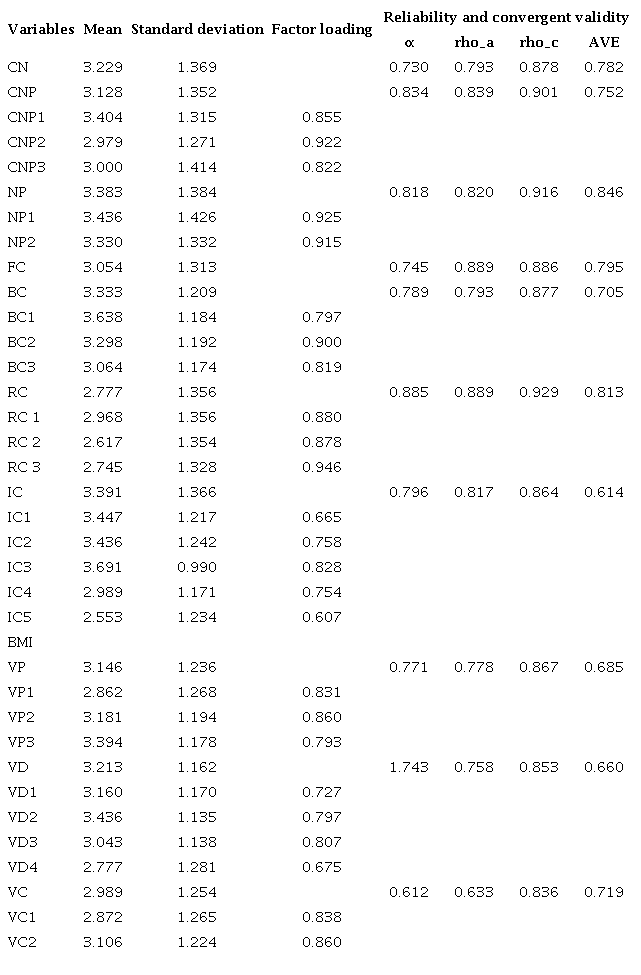
Note. CN = cooperation networks; CNP = cooperation networks with companies located in the park; NP = cooperation networks with the park; FC = formal controls; BC = behavioral controls; RC = result controls; IC = informal controls; BMI = business models innovation; VP= value proposition; VD = value delivery; VC= value capture; AVE = average variance extracted; α = Cronbach’s alpha; rho_c = composite reliability.Source: Prepared by the authors.
The measurement model meets the parameters of discriminant validity for all constructs. The square root of the AVE is greater than the correlations shown below the diagonal, and the HTMT above the diagonal is less than 0.85.
The analysis of redundancy of the reflective-formative higher-order construct resulted in a global evaluation above 0.7 for the three items, with loadings between 0.638 and 0.898, for a 95% confidence interval. The VIF demonstrated a result below 3. The weight of the variables showed that value capture was significant at the 5% level and had the highest weight. The loadings of the constructs showed values higher than 0.5 and significance at the 5% level, which allows keeping all the constructs.
Robustness tests complement the analysis, including tests for linearity, endogeneity, full collinearity test, and additional sensitivity analysis to the size of the companies (Hair et al., 2022; Kock, 2015). The linearity test indicates that the relationships are linear due to non-significance at the 5% level and low f² power. Endogeneity is not an issue for the model, as the results of the Gaussian copula test showed no significance at the 5% level. The full collinearity test confirmed the absence of common variance by showing VIF below the suggested threshold for all variables (VIF < 3.3). Finally, the sensitivity to company size was not significant at the 5% level for all variables.
Structural model
Table 3 presents the results of the structural model, highlighting the hypothesis tests, effects of the control variables, and quality criteria of the model.
Correlations and discriminant validity.
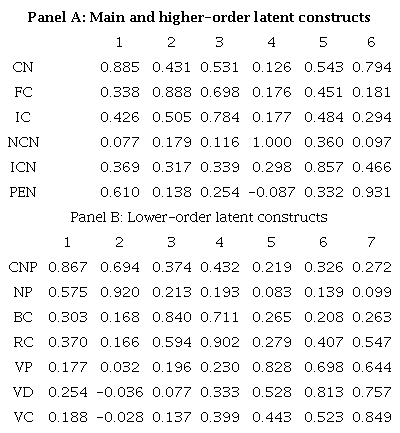
Note. CN = cooperation networks; CNP = cooperation networks with companies residing in the park; NP = cooperation networks with the park; FC = formal controls; BC = behavioral controls; RC = result controls; IC = informal controls; BMI = business model innovation; VP = value proposition; VD = value delivery; VC = value capture; NCN = number of cooperation networks; ICN = intensity of cooperation in the networks; PEN = park external networks; AVE = average variance extracted; HTMT = heterotrait-monotrait. The values in bold indicate the square root of the AVE; the lower diagonal shows the correlations; the upper diagonal shows the HTMT values.Source: Prepared by the authors.
Structural model.
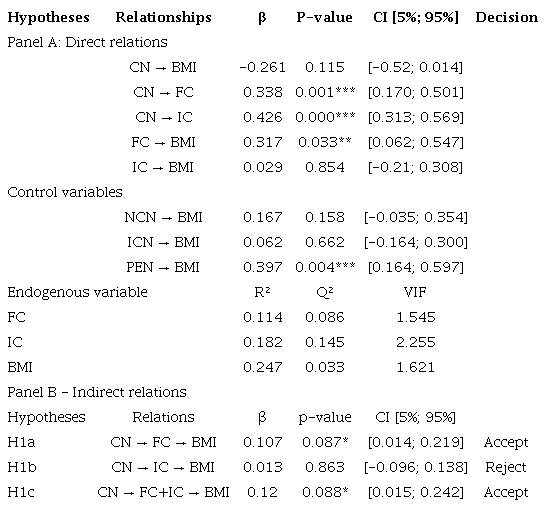
Note 1. CN = cooperation networks; BMI = business model innovation; FC = formal controls; IC = informal controls; NCN = number of cooperation networks; ICN = intensity of cooperation in the networks; PEN = park external networks; CI = confidence interval; R² = coefficient of determination; Q² = Stone-Geisser indicator. * p < 0.10; ** p < 0.05; *** p < 0.01. CI calculated by accelerated bootstrap and bias-corrected, with 5,000 re-samples and a two-tailed test. Source: Prepared by the authors.
Panel A presents the results of the direct relationships, despite the absence of hypotheses. Panel B presents the results for the indirect relationships, where H1a and H1c were supported, contrasting with H1b.
The quality criteria of the model demonstrate an acceptable VIF adjustment for the latent variable (less than 3). R² is below 0.25, indicating that significant relationships have weak adjustments but are aligned with previous research (Stouthuysen et al., 2017). The evaluation of Q² presents positive values, demonstrating the model’s accuracy.
Discussion of the results
The discussion of the results is guided by the research model, based on the hypotheses. Figure 2 presents the hypotheses that were not rejected.
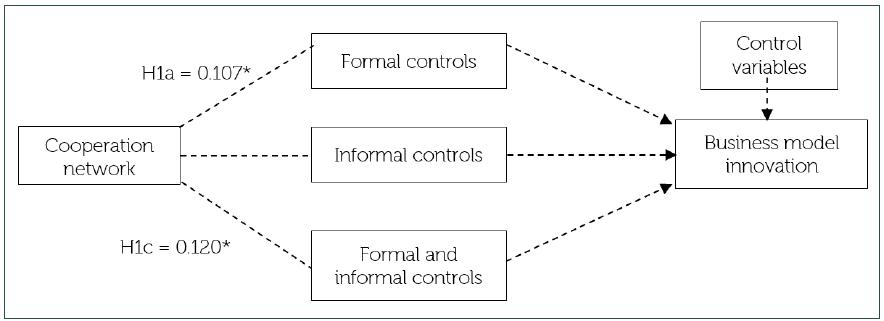
Figure 2
Research model.
Source: Significant relationships at the level of * p < 0.10; ** p < 0.05; *** p < 0.01. The dashed arrows correspond to mediation hypotheses. Source: Prepared by the authors.
Prior theoretical support is required to explore the effect of variables (Memon et al., 2018). The absence of hypotheses for direct relationships stems from the lack of literature to support them. Chenhall et al. (2011) did not find a direct relationship between networks and innovation.Chan and Lau (2005) inferred, in research on startups in a Chinese technology park, that these do not form a cooperative network due to fear of losing information. Faccin et al. (2020) observed in their research the need for the orchestration of the network, even its reconfiguration, for specific collaborative practices.
According to Sant’Anna et al. (2019), despite the increase in the number of parks in Brazil and the willingness to collaborate, there are still controversies between perceptions and collaborative practices. Schmidt and Balestrin (2015) emphasize that these environments affect collaborative innovation but not with infrastructure services. For Clauss (2017), because interactions with external suppliers/partners and customers are the main types of networks that impact BMI, companies seem to interact more with this environment to capture market needs. Furthermore, internal cooperation networks may not provide the necessary resources for BMI. Despite previous studies recognizing the importance of network formation to drive BMI (Anwar & Ali Shah, 2020), other variables may indirectly influence this relationship.
The mediating effect of formal controls in the relationship between cooperation networks and BMI was confirmed, contrasting with informal controls, which were significant only when combined with formal controls. Although prolonged contacts or close relationships may not access resources for BMI, companies use controls in their cooperation networks. Using controls in managing networks influences behaviors, directs efforts, restricts opportunism, minimizes failure risks, and brings trust to partners (Das & Teng, 1998, 2001). Formal controls demonstrated support for managing networks in companies located in technology parks. According to the findings of Pistoni et al. (2022), there is greater strength of formal controls compared to informal controls in managing collaborative networks. This suggests a greater emphasis on short-term maintenance brought by formal controls for sustaining a partnership, as opposed to the long-term view provided by informal controls, which reinforce trust in the network (Chenhall et al., 2011).
Another important finding is the positive relationship between formal controls and BMI. This finding aligns with the results of Ganguly and Das (2020) and Guo et al. (2019). Although formal controls may restrict innovation in achieving goals, they enhance creativity by imposing limits on the use of company resources and allow the identification of opportunities within the company’s domains (Ganguly & Das, 2020). Formal controls assist in the innovation planning process and result evaluation through indicators (Guo et al., 2019).
H1a has support for acceptance. It aligns with Beuren and Dal Vesco (2022), who state that a performance evaluation system applied to a network ensures the fair distribution of information among participants and enables knowledge sharing; with Chenhall et al. (2011), who argue that formal controls stand out in organizations more prone to learning, leading to innovation; with Pistoni et al. (2022), who claim that formal contracts promote relational governance and stability in interorganizational exchanges; and with Stouthuysen et al. (2017), who suggest that the synergistic configuration of results and behavior controls generates dynamic tensions between innovation and goals, which helps balance strategies.
H1b does not present statistical significance, leading to its rejection. This aligns with the research of Pistoni et al. (2022), who found that direct and personal contacts, status-based rewards, and trust-based coordination together do not have an effect on innovation. According to Pistoni et al. (2022), trust-based coordination is an informal mechanism that supports the relationship between collaborative partnerships and innovation. Additionally, personal contacts and rewards are less effective, which encourages future research to evaluate the issue of trust.
H1c has support for acceptance. This result contrasts with Chenhall et al. (2011), who state that the combination of formal controls with an organic innovative culture (informal controls) does not add benefits to innovation. However, it converges with Pistoni et al. (2022), who argue that companies can combine formal control mechanisms with information sharing. This combination promotes information symmetry between the parties and leads to innovation as an alternative to informal controls (Pistoni et al., 2022). This suggests that controls have complementary roles in BMI.
The analysis of the results of the structural model allows some assumptions. First, the non-significance of H1b suggests that social interactions between the research participants may not occur in the search for resources for BMI. Second, the significant relationship of H1a and the non-significant relationship of H1b suggest that formal controls are used more to control the flow of information and govern cooperation networks than informal controls. Third, the non-significance of H1b may indicate a lack of trust among the participants of the cooperation network and, consequently, reluctance to provide information. Fourth, even though H1c is confirmed, the inclusion of informal controls raised statistical significance by only 0.01. This suggests that informal controls are not crucial and that formal controls are the determinants of the model.
The control variables, number of cooperation networks, and intensity of cooperation in the networks, associated with BMI, did not present statistical significance. This suggests that interacting more or less and having more or fewer networks may not result in obtaining resources. This analysis seems to complement the examination of the hypotheses, as it indicates that cooperation for BMI may not occur between the companies located in the park or with the technology park itself.
Companies located in technology parks may not use the resources from cooperation networks for BMI, contrasting with the RBV, perhaps due to the fear of resource exchange among the companies located in parks. The effect of external park networks on BMI was significant. This suggests that companies located in parks make greater use of the resources provided by external park networks than by the resources of internal networks. This result aligns with Bocquet et al. (2016), who found that external resources are more important than internal ones in fostering innovation. It is argued that external park connections provide more resources for companies located in parks.
CONCLUSION
This study analyzed the mediating role of formal and informal controls in the relationship between cooperation networks and the business model innovation (BMI) of companies located in technology parks. Through the lens of the resource-based view (RBV), it was predicted that cooperation networks provide valuable, rare, irreplaceable, and inimitable resources for BMI, enabling the creation of value for customers and an increase in sales and company performance. The results highlight the use of formal controls to monitor behaviors and foster a short-term vision, contrasting with Chenhall et al. (2011) and Guo et al. (2019), but converging with Pistoni et al. (2022). The respondents are concerned with formalized plans, objectives, and goals to ensure that resources are not wasted. The results demonstrate that long-term aggregated information is less useful for BMI. This may stem from the reluctance to share strategic information and the absence of resource slack, which imposes short-term monitoring. It is assumed that companies have a results-oriented perspective with more immediate deviant behaviors, as formal controls integrate short-term information (Henri & Wouters, 2020). The combination of formal and informal controls, being dichotomous, creates a synergistic dynamic tension (Pistoni et al., 2022) that leads to BMI.
The cooperation networks of the technology park do not seem to directly provide resources for BMI, which contrasts with the RBV. However, companies located in the park appear to use the resources provided by the external networks of the parks. Only formal controls showed positive effects on BMI, demonstrating a short-term perspective for controlling resource waste. The combination of formal and informal controls signals the capture of resources from the network to apply in BMI in these companies. It is concluded that formal controls mediate the relationship between cooperation networks and BMI, while informal controls only play this role when combined with formal controls.
The study contributes to the managerial literature by analyzing the implications of cooperation networks and formal and informal controls on BMI in companies residing in technology parks. Despite cooperation networks being sources of external resources for BMI (Micheli et al., 2020; Xu et al., 2022), other elements may be required for their effectiveness in capturing and using these resources in technology parks. Thus, formal and informal controls act as resources (Oyadomari et al., 2011) that help in extracting other resources from the cooperation network. The mediation confirmed for formal controls highlights their importance for information symmetry (Chenhall et al., 2011), task coordination, and contingency management (Kherrazi, 2020).
This work advances understanding by emphasizing the prevalence of formal controls over informal ones in capturing resources from the network for BMI. Informal controls individually did not indicate a mediating effect in this relationship, only when combined with formal controls. This research fills the gap presented by Barros and Ferreira (2019), who call for more research on the synergies and tensions resulting from the use of dichotomous management controls in the innovation process. It responds to the call for research on the role of management controls in different types of innovation (Henri & Wouters, 2020). It expands the understanding of interorganizational networks as sources of external resources (Pulka et al., 2021). It sheds light on the orchestration of resources from cooperation networks in a competitive environment (Mielcarek & Dymitrowski, 2022) and contributes to the alignment of RBV with BMI.
Implications for managerial practice are also observed. The absence of a direct relationship between cooperation networks and BMI may signal that technology parks are unable to motivate companies to exchange resources for BMI. Policymakers and managers of technology parks can benefit from the research results to enhance the impact of parks on company development. The findings can inspire managers to (re)design managerial controls to improve the capture and use of resources available in the cooperation network for BMI. The emphasis on formal controls for specific goals suggests short-term management of resources in the cooperation network. Managers can evaluate how the implementation of these controls optimizes the management of network and resource allocation to achieve results more quickly and minimize waste. Although informal controls alone did not show a mediating effect, when combined with formal controls they can help managers build a long-term vision, generating a sustainable competitive advantage.
The limitations of this study present opportunities for future research. The results encourage the inclusion of other constructs in the model and further investigation in technology parks. For example, cooperation networks and BMI may contain simpler or more complex measurement instruments. Different managerial controls may act as mediators in the relationship between cooperation networks and BMI. It is recommended to investigate the mediating effect with other types of controls, such as coordination based on mutual trust (Pistoni et al., 2022) or organic and mechanistic controls (Chenhall, 2003). Future research could analyze the effect of BMI on the performance of these or other companies to compare results. BMI may directly impact company outcomes due to the restructuring of resources to create and capture value, so future studies could analyze the effectiveness of BMI. Due to the non-random sampling and the non-experimental nature of the method, it is not possible to establish a direct or indirect causal relationship between the observed phenomena. Thus, this research can be replicated in other contexts and the data can be analyzed with other statistical models.
Acknowledgments:
We are grateful to the Reviewers, Associate Editor and Editor-in-Chief for their constructive comments and guidance.
REFERENCES
Aldrich, H., & Ruef, M. (2006). Organizations evolving (2nd ed.). Sage. https://doi.org/10.4135/9781446212509
Almeida, L. F., & Machado, C. A. P., Filho. (2013). Sharing competences in strategic alliances: A case study of the Cosan and Shell biofuel venture. Revista de Administração, 48(2), 359-374. https://doi.org/10.5700/rausp1093
Amit, R., & Zott, C. (2012). Creating value through business model innovation. MIT Sloan Management Review, 53, 41-49. https://sloanreview.mit.edu/article/creating-value-through-business-model-innovation/
Anwar, M., & Ali Shah, S. Z. (2020). Managerial networking and business model innovation: Empirical study of new ventures in an emerging economy. Journal of Small Business and Entrepreneurship, 32(3), 265-286. https://doi.org/10.1080/08276331.2018.1490509
Associação Nacional de Entidades Promotoras de Empreendimentos Inovadores. (2023). Sobre. https://anprotec.org.br/site/sobre/
Barney, J. (1991). Firm resources and sustained competitive advantage. Journal of Management, 17(1), 99-120. https://doi.org/10.1177/014920639101700108
Barros, R. S., & Ferreira, A. M. D. S. da C. (2019). Bridging management control systems and innovation: The evolution of the research and possible research directions. Qualitative Research in Accounting and Management, 16(3), 342-372. https://doi.org/10.1108/QRAM-05-2017-0043
Beuren, I. M., & Dal Vesco, D. G. (2022). Management control systems and performance in strategic supply relationships. International Journal of Productivity and Performance Management, 71(4), 1277-1296. https://doi.org/10.1108/IJPPM-01-2020-0036
Bocquet, R., Brion, S., & Mothe, C. (2016). The role of cluster intermediaries for KIBS’ resources and innovation. Journal of Small Business Management, 54(10), 256-277. https://doi.org/10.1111/jsbm.12298
Chan, K. F., & Lau, T. (2005). Assessing technology incubator programs in the science park: The good, the bad and the ugly. Technovation, 25(10), 1215-1228. https://doi.org/10.1016/j.technovation.2004.03.010
Chenhall, R. H. (2003). Management control systems design within its organizational context: Findings from contingency-based research and directions for the future. Accounting, Organizations and Society, 28(2-3), 127-168. https://doi.org/10.1016/S0361-3682(01)00027-7
Chenhall, R. H., Kallunki, J. P., & Silvola, H. (2011). Exploring the relationships between strategy, innovation, and management control systems: The roles of social networking, organic innovative culture, and formal controls. Journal of Management Accounting Research, 23(1), 99-128. https://doi.org/10.2308/jmar-10069
Clauss, T. (2017). Measuring business model innovation: Conceptualization, scale development, and proof of performance. R and D Management, 47(3), 385-403. https://doi.org/10.1111/radm.12186
Clauss, T., Abebe, M., Tangpong, C., & Hock, M. (2021). Strategic agility, business model innovation, and firm performance: An empirical investigation. IEEE Transactions on Engineering Management, 68(3), 767-784. https://doi.org/10.1109/TEM.2019.2910381
Collins, C. J., & Clark, K. D. (2003). Strategic human resource practices, top management team social networks, and firm performance: The role of human resource practices in creating organizational competitive advantage. Academy of Management Journal, 46(6), 740-751. https://doi.org/10.2307/30040665
Das, T. K., & Teng, B. S. (1998). Between trust and control: Developing confidence in partner cooperation in alliances. Academy of Management Review, 23(3), 491-512. https://doi.org/10.5465/AMR.1998.926623
Das, T. K., & Teng, B.-S. (2001). Trust, control, and risk in strategic alliances. Organization Studies, 22(2), 251-283. https://doi.org/10.1177/0170840601222004
Dias, C. N., Hoffmann, V. E., & Martínez-Fernández, M. T. (2019). Resource complementarities in R&D network for innovation performance: Evidence from the agricultural sector in Brazil and Spain. International Food and Agribusiness Management Review, 22(2), 193-213. https://doi.org/10.22434/IFAMR2018.0023
Dongling, W., Yuming, Z., Xinmin, L., Chen, J., XiaoYi, Z., & Chang, H. (2022). Can inter-organizational knowledge-sharing improve enterprise innovation performance? The mediator effect of innovation capability and the moderator effect of network characteristics. Frontiers in Communication, 7(6), 1-17. https://doi.org/10.3389/fcomm.2022.856301
Duréndez, A., Dieguez-Soto, J., & Madrid-Guijarro, A. (2023). The influence of CEO’s financial literacy on SMEs technological innovation: The mediating effects of MCS and risk-taking. Financial Innovation, 9(15). https://doi.org/10.1186/s40854-022-00414-w
Eisenhardt, K. M. (1985). Control: Organizational and economic approaches. Management Science, 31(2), 134-149. https://doi.org/10.1287/mnsc.31.2.134
Faccin, K., Wegner, D., & Balestrin, A, (2020). How to orchestrate R&D networks? The role of orchestration subprocesses and collaborative practices over time. Creativity and Innovation Management, 29(1), 161-177. https://doi.org/10.1111/caim.12355
Faul, F., Erdfelder, E., Buchner, A., & Lang, A. G. (2009). Statistical power analyses using G*Power 3.1: Tests for correlation and regression analyses. Behavior Research Methods, 41(4), 1149-1160. https://doi.org/10.3758/BRM.41.4.1149
Ferreras-Méndez, J. L., Olmos-Peñuela, J., Salas-Vallina, A., & Alegre, J. (2021). Entrepreneurial orientation and new product development performance in SMEs: The mediating role of business model innovation. Technovation, 108(6). https://doi.org/10.1016/j.technovation.2021.102325
Ganguly, S., & Das, S. (2020). Paradoxes of control and creativity: Evidence from Indian, 17(6), 2050046. https://doi.org/10.1142/S0219877020500467
Guo, B., Paraskevopoulou, E., & Santamaría Sánchez, L. (2019). Disentangling the role of management control systems for product and process innovation in different contexts. European Accounting Review, 28(4), 681-712. https://doi.org/10.1080/09638180.2018.1528168
Hair, J. F. J., Hult, G. T. M., M., R. C., & Sarstedt, M. (2022). A primer on partial least squares structural equation modeling (PLS-SEM) (3rd ed.). SAGE Publications Inc.
Henri, J. F., & Wouters, M. (2020). Interdependence of management control practices for product innovation: The influence of environmental unpredictability. Accounting, Organizations and Society, 86, 101073. https://doi.org/10.1016/j.aos.2019.101073
Kaveski, I. D. S., & Beuren, I. M. (2022). Influência da motivação intrínseca e da cultura organizacional no comprometimento afetivo em empresas familiares: Controles formais e informais como mediadores. Innovar, 32(84), 97-110. https://doi.org/10.15446/innovar. v32n84.99681
Kessler, S. R., Nixon, A. E., & Nord, W. R. (2017). Examining organic and mechanistic structures: Do we know as much as we thought? International Journal of Management Reviews, 19(4), 531-555. https://doi.org/10.1111/ijmr.12109
Kherrazi, S. (2020). Management control of collaborative innovation: Design and structuring mode. European Journal of Innovation Management, 24(3), 848-869. https://doi.org/10.1108/EJIM-05-2019-0110
Kock, N. (2015). Common method bias in PLS-SEM: A full collinearity assessment approach. International Journal of e-Collaboration, 11(4), 1-10. https://doi.org/10.4018/ijec.2015100101
Koçak, Ö., & Can, Ö. (2014). Determinants of inter-firm networks among tenants of science technology parks. Industrial and Corporate Change, 23(2), 467-492. https://doi.org/10.1093/icc/dtt015
Lavie, D. (2006). The competitive advantage of interconnected firms: An extension of the resource-based view. Academy of Management Review, 31(3), 638-658. https://doi.org/10.5465/amr.2006.21318922
Lynn, L. H., Reddy, N. M., & Aram, J. D. (1996). Linking technology and institutions: The innovation community framework. Research Policy, 25(1), 91-106. https://doi.org/10.1016/0048-7333(94)00817-5
Memon, M. A., Cheah, J.-H., Ramayah, T., Ting, H., & Chuah, F. (2018). Mediation analysis: Issues and recommendations. Journal of Applied Structural Equation Modeling, 2(1), 1-9. https://doi.org/10.47263/jasem.2(1)01
Micheli, M. R., Berchicci, L., & Jansen, J. J. P. (2020). Leveraging diverse knowledge sources through proactive behaviour: How companies can use inter-organizational networks for business model innovation. Creativity and Innovation Management, 29(2), 198-208. https://doi.org/10.1111/caim.12359
Mielcarek, P., & Dymitrowski, A. (2022). Business model innovation based on new technologies - is it resources driven and dependent? European Business Review, 34(5), 729-748. https://doi.org/10.1108/EBR-06-2021-0128
Ministério da Ciência, Tecnologia e Inovações. (2024). MCTI InovaDatabr. https://inovadata-br.ufv.br/companies-page
Mouritsen, J., & Thrane, S. (2006). Accounting, network complementarities and the development of inter-organisational relations. Accounting, Organizations and Society, 31(3), 241-275. https://doi.org/10.1016/j.aos.2005.04.002
Oyadomari, J. C. T., Frezatti, F., Mendonça Neto, O. R., Cardoso, R. L., & Bido, D. S. (2011). Uso do sistema de controle gerencial e desempenho: Um estudo em empresas brasileiras sob a perspectiva da resources-based view. Revista Eletrônica de Administração, 17(2), 298-329. https://doi.org/10.1590/S1413-23112011000200001
Pazetto, C. F., & Beuren, I. M. (2022). Control systems and interorganizational identification in technology parks cooperation. Revista Contabilidade & Financas, 33(88), 13-28. https://doi.org/10.1590/1808-057x202113020
Pistoni, A., Arcari, A., & Gigliarano, C. (2022). Managerial control systems and innovation partnership success: An empirical analysis in Italian firms. European Journal of Innovation Management. https://doi.org/10.1108/EJIM-10-2018-0217
Podsakoff, P. M., MacKenzie, S. B., Lee, J. Y., & Podsakoff, N. P. (2003). Common method biases in behavioral research: A critical review of the literature and recommended remedies. Journal of Applied Psychology, 88(5), 879-903. https://doi.org/10.1037/0021-9010.88.5.879
Pulka, B. M., Ramli, A., & Mohamad, A. (2021). Entrepreneurial competencies, entrepreneurial orientation, entrepreneurial network, government business support and SMEs performance. The moderating role of the external environment. Journal of Small Business and Enterprise Development, 28(4), 586-618. https://doi.org/10.1108/JSBED-12-2018-0390
Sant’Anna, L. T., Tonelli, D. F., Martins, T. C. M., & Antonialli, L. M. (2019). O dissenso entre atores públicos e privados envolvidos em Parques Tecnológicos em operação no Brasil. Revista de Ciências da Administração, 21(54), 45-59. https://doi.org/10.5007/2175-8077.2019.e59403
Santoro, M. D., & Chakrabarti, A. K. (2002). Firm size and technology centrality in industry-university interactions. Research Policy, 31(7), 1163-1180. https://doi.org/10.1016/S0048-7333(01)00190-1
Schmidt, S., & Balestrin, A. (2015). Brazilian incubators and science parks’ resources and R&D collaboration. Journal of Technology Management & Innovation, 10(3), 32-43. http://dx.doi.org/10.4067/S0718-27242015000300004
Schmidt, S., Balestrin, A., Machado, R. E., & Bohnenberger, M. C. (2016). Collaborative R&D and project results within Brazilian incubators and science parks. International Journal Entrepreneurship and Small Business, 27(1),1-18. https://doi.org/10.1504/IJESB.2016.073349
Soetanto, D. P., & Jack, S. L. (2013). Business incubators and the networks of technology-based firms. Journal of Technology Transfer, 38(4), 432-453. https://doi.org/10.1007/s10961-011-9237-4
Spieth, P., & Schneider, S. (2016). Business model innovativeness: designing a formative measure for business model innovation. Journal of Business Economics, 86(6), 671-696. https://doi.org/10.1007/s11573-015-0794-0
Stouthuysen, K., Slabbinck, H., & Roodhooft, F. (2017). Formal controls and alliance performance: The effects of alliance motivation and informal controls. Management Accounting Research, 37, 49-63. https://doi.org/10.1016/j.mar.2017.03.002
Thomas, E., Vieira, L. M. & Balestrin, A. (2017). Mind the gap: Lessons from the UK to Brazil about the roles of TTOs throughout collaborative R&D projects. Brazilian Administration Review, 14(4), e170048. https://doi.org/10.1590/1807-7692bar2017170048
Wu, W., Wang, H., & Tsai, F. S. (2020). Incubator networks and new venture performance: The roles of entrepreneurial orientation and environmental dynamism. Journal of Small Business and Enterprise Development, 27(5), 727-747. https://doi.org/10.1108/JSBED-10-2019-0325
Xu, S., He, J., Morrison, A. M., Domenici, M., & Wang, Y. (2022). Entrepreneurial networks, effectuation and business model innovation of startups: The moderating role of environmental dynamism. Creativity and Innovation Management, 31(3), 460-478. https://doi.org/10.1111/caim.12514
Notes
BAR - Brazilian Administration Review encourages data sharing but, in compliance with ethical principles, it does not demand the disclosure of any means of identifying research subjects.
Author notes
(Universidade Federal de Goiás, Brazil)
(Universidade Federal de Santa Catarina, Brazil)
(Universidade de São Paulo, FEA, Brazil)
Paulo Roberto Barbosa Lustosa https://orcid.org/0000-0003-4624-197X
(Universidade de Brasília, Brazil)
(ANPAD, Maringá, Brazil)
Corresponding author: Halison Rodrigo de Souza Universidade Federal de Santa Catarina, Programa de Pós-Graduação em Contabilidade Campus Universitário, Trindade, CEP: 88040-380, Florianópolis, SC, Brazil
Conflict of interest declaration
