RESULTS AND DISCUSSION
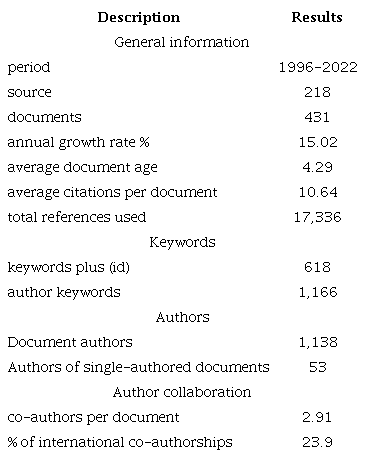
The general bibliometric details based on the search terms used and obtained through the biblioshiny add-on are presented in Table 2. The data collection period spanned from 1996 to 2022, with a total of 431 articles analyzed from 218 sources within this period. The average publication growth rate is 15.02% per year. Additionally, the published documents have an average age of 4.29 years, and the average number of citations per document is 10.64.
Table 2
Key information about the database.
 Note. Developed by the authors.
The analyzed documents feature 618 keywords assigned by the sources, 1,166 keywords assigned by the authors, and 17,336 references used. The analysis includes 1,138 authors, with 53 authors having single-authored documents. Regarding author collaboration, the co-authorship index is 2.91 authors per article, and the international collaboration rate reaches 23.9% of the 431 articles analyzed.
Figure 1 illustrates the annual article production on the subject, with the first publication in 1996 and the peak of publications in 2021 with 117 articles, up until the data extraction, which occurred in the second semester of 2022. The publication by Shimron and Klos (1996) discusses the implementation of entrepreneurial education in the educational curriculum of Israel. According to the authors, this shift in perspective from collectivist values to a competitive perspective embedded in entrepreneurship is due to the country’s strategic vision of creating avenues for the formation of entrepreneurial individuals.
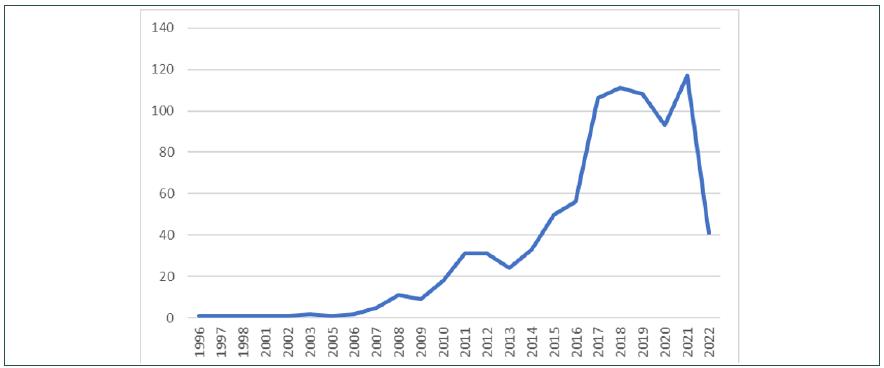 Figure 1
Annual article production.
Source: Developed by the authors
Figure 1
Annual article production.
Source: Developed by the authors
Valencia-Arias et al. (2021), Tiwari et al. (2022), Breznitz and Zhang (2022), and Kayed et al. (2022), for example, explore various attributes, including social entrepreneurial education, empathy, university environment, and culture, which can contribute to the development of entrepreneurial intention.
Furthermore, Donoso-González et al. (2022) seek to understand how entrepreneurial education affects the formation of identity in pre-university students, through pedagogical and environmental factors present in an entrepreneurial education program.
Based on this analysis, there is a shift in focus from a perspective initially centered on the debate of the possible effects of entrepreneurial education to one that investigates the attributes that can foster the formation and development of entrepreneurial intention, as well as the effects of these attributes on the formation of individuals’ identities.
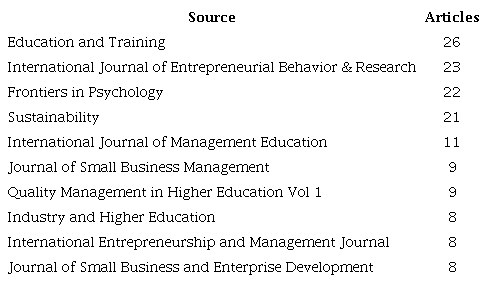
Table 3 presents the top 10 sources with the highest number of publications on the researched topic within the period covered until the present study.
Table 3
Key sources of publications on the researched topic.
 Note. Developed by the authors.
The Journal Education and Training appears with 26 publications. It is a periodical that focuses on young students in universities, supporting investigations that study the transition from academic settings to employment. Among these 26 publications, the study by Nielsen and Gartner (2017) stands out with 27 citations to date. The authors investigate various individual factors that play a role in students’ internal reflection as they attempt to develop an entrepreneurial identity, from a perspective of multiple identities and the influence of external factors, such as the university environment.
Table 4 presents the top 10 most cited references within the analyzed author database.
Table 4
Top 10 most cited references within the database.
 Note. Developed by the authors.
The theory of planned behavior studied by Ajzen (1991), which falls within the theoretical field of social psychology, seeks to predict and explain human behavior based on attitudes, subjective norms, and perceived behavioral control. This work seems to serve as a broad umbrella for many research studies related to the analyzed theoretical field. Among the 431 articles, this work is cited in 116, representing 26.92% of the entire analyzed database, positioning it as a guiding theoretical lens among researchers in the field.
Among the most cited and recent references in this field, the study by Bae et al. (2014) stands out. They conducted a meta-analysis of 73 studies to examine the effect of entrepreneurial education on entrepreneurial intentions. Despite a small effect, the authors were able to establish a significant relationship. Other works add insights into the entrepreneurial behavior of academics, such as the study by Krueger et al. (2000), which compares two models based on intention in terms of their ability to predict entrepreneurial intentions: Ajzen’s (1991) theory of planned behavior (TPB) and the entrepreneurial event model (SEE) by Shapero and Sokol (1982), which is also part of the theoretical field of social psychology. In this study, the authors explore the social dimensions of entrepreneurship, examining the role of social factors in the entrepreneurial process and how they influence the creation and development of new ventures. It is noteworthy that the attribute of entrepreneurial education is widely used as a promoter of entrepreneurial intention, and alongside that, the investigation of factors that shape entrepreneurial capacity is also among the most cited. The literature seems concerned with identifying the variables that can contribute to the promotion of entrepreneurship among individuals.
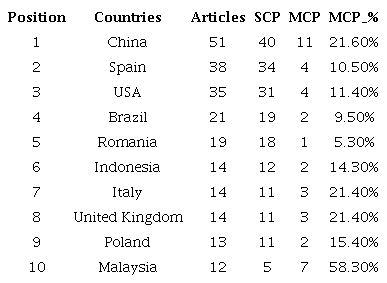
Examining the literature analyzed from a geographic perspective of its origin, Table 5 presents the most productive countries based on the location of their authors, using two indicators: single-country publications (SCP) and publications with international contribution (MCP).
Table 5
Corresponding countries of the authors.
 Note. Developed by the authors.
Table 5 contains the ranking of the top 10 most productive countries. It is notable that the majority of publications come from authors located in China with 51 articles, followed by Spain with 38 and the United States of America with 35 publications. Brazil is in fourth position with 21 publications.
When analyzing the index of international contribution participation (MCP_%) by countries, we observe that Malaysia is the country with the highest level of international contribution in the research process within this field, with international contribution in 58.30% of its research. China follows closely with 21.60%, and Italy and England come next, both with 21.40%. Brazil appears second to last, indicating that it is one of the countries with the lowest levels of international contribution in its research within the investigated theoretical field. Figure 2 illustrates the discussed dynamics.
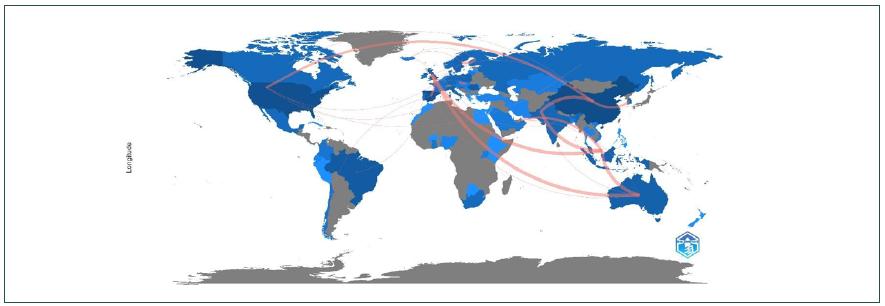 Figure 2
Dynamics of international contribution.
Source: Developed by the authors
Figure 2
Dynamics of international contribution.
Source: Developed by the authors
Figure 2 clearly shows the limited participation of the South American and African continents, with North America represented by the United States of America, Asia represented by Malaysia and China, and Europe represented by England, Italy, and Spain taking the lead.
Figure 3 displays the most cited articles. Among them, some discuss the influence of factors that can contribute to the development of an entrepreneurial characteristic. These discussions are directly related to the theme of entrepreneurial identity, which is the focus of investigation in this study.
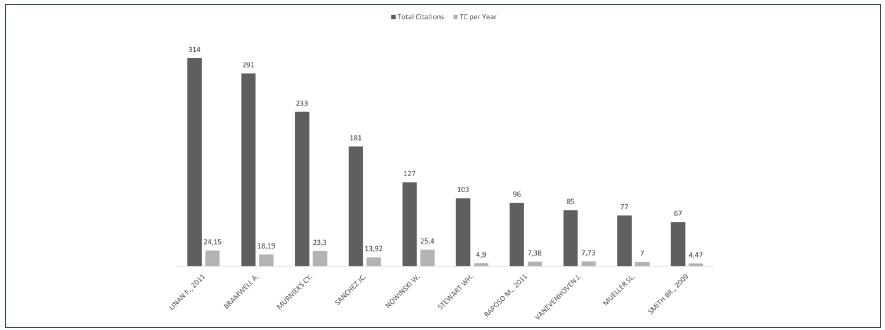 Figure 3
Most cited articles.
Source: Developed by the authors
Figure 3
Most cited articles.
Source: Developed by the authors
As shown in Figure 3, the article by Liñán et al. (2011)stands out with 314 citations to date. The authors investigate which elements of a cognitive approach, considering personality traits, play an influential role in forming the personal decision to start a business.
Murnieks et al. (2014) examine the influence of passion among entrepreneurs. The authors integrate identity theory with literature on passion to investigate the possible pathways through which entrepreneurial identities can influence passion, as well as the relationship between passion and entrepreneurial behavior.
Vanevenhoven and Liguori (2013) conduct their research using a secondary database from an entrepreneurial education project rooted in cognitive theory. The research was based on a longitudinal study in which university students provided data on the impact of entrepreneurial education on two main aspects: (1) the motivational processes underlying the student’s journey to become an entrepreneur and throughout the entrepreneurial process, and (2) the transformation process from student to entrepreneur.
Finally, Mueller and Conway Dato-on (2013) investigate how biological sex, social roles, self-efficacy culture, and entrepreneurial motivation influence the formation of the entrepreneur stereotype that balances stereotypical feminine and masculine characteristics.
These studies provide a starting point for investigating the factors that can impact the development of entrepreneurial identity among scientists. It is important to consider the specific mechanisms through which the development of this identity influences entrepreneurial intention. However, it is important to recognize that this relationship may not be unidirectional. Instead, the development of entrepreneurial identity and entrepreneurial intention can feed back into each other in a dynamic and cyclical process, in which each variable influences and is influenced by the other over time.
The identified literature reveals connections between themes and actors, allowing us to understand their most relevant niches. By clustering the articles according to the themes present in the theoretical field of the database, it was possible to identify the following clusters: impact, innovation, business incubation, identity, secondary education, systems, lessons, emergence, and returns. These clusters were obtained using biblioshiny, which identifies the predominance of themes based on the frequency and co-occurrence of terms within the reviewed articles.
However, only the innovation cluster significantly relates to the identity cluster. This can be explained by the fact that many of the factors that drive innovation are also closely linked to the formation of entrepreneurial identity. Innovation often involves the adoption of new ideas, risk-taking, and the pursuit of opportunities, which are also fundamental characteristics for building an entrepreneurial identity. Thus, articles that explore innovation tend to address aspects of identity, either explicitly or implicitly, by describing how individuals see themselves as innovators and entrepreneurs (Chen et al., 2018; Mascha & Apostolakis, 2020). Therefore, other works related to the theme of identity were captured. Table 6 presents the results.
Table 6
Document adherence to the theme.
 Note. Developed by the authors.
It can be observed that the articles clustered under the theme of identity are recent, and a total of 10 articles related to both the identity cluster and the innovation cluster were identified. Among the articles exclusively belonging to the identity cluster, the most cited one is “Entrepreneurial education for the entrepreneurial university: A stakeholder perspective” by Gianiodis and Meek (2020).
For content analysis, these 10 articles were included, along with the works of Donoso-González et al. (2022), Liñán et al. (2011), Murnieks et al. (2014), Vanevenhoven and Liguori (2013), and Mueller and Conway Dato-on (2013), which were found to be related to the theme during the bibliometric analysis mining.
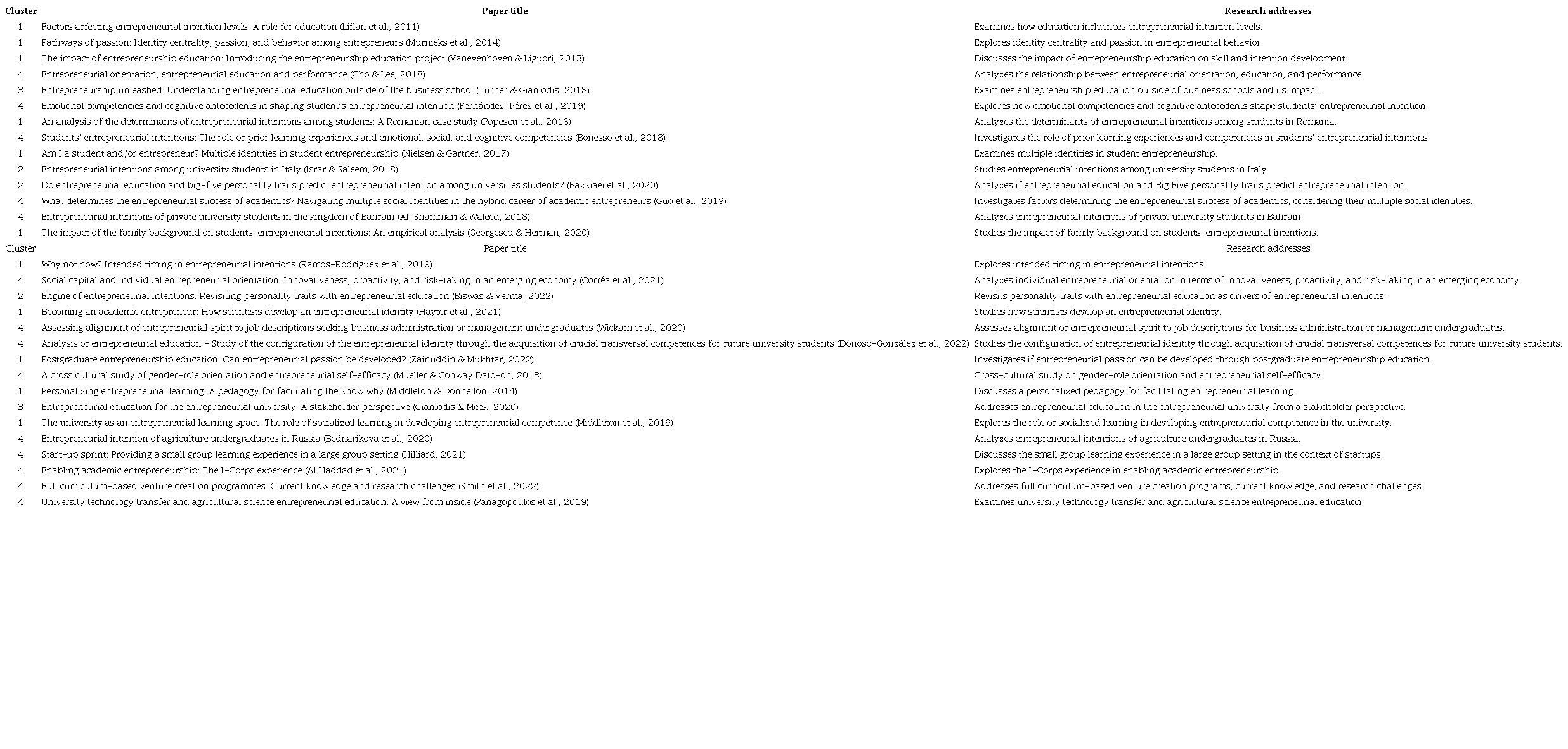
In addition, a review of the abstracts of the other 431 articles was conducted to check if there were any more related to the theme that were not identified during the bibliometric analysis. This resulted in the identification of 15 more articles related to the theme of the identity of the academic entrepreneur. All of these articles are listed in Table 7.
Table 7
Articles included for the construction of the co-citation network.
 Note. Developed by the authors.
With the theme-relevant papers identified, the next step was to analyze the co-citation network of this set of 30 articles. Figure 4 illustrates the co-citation network.
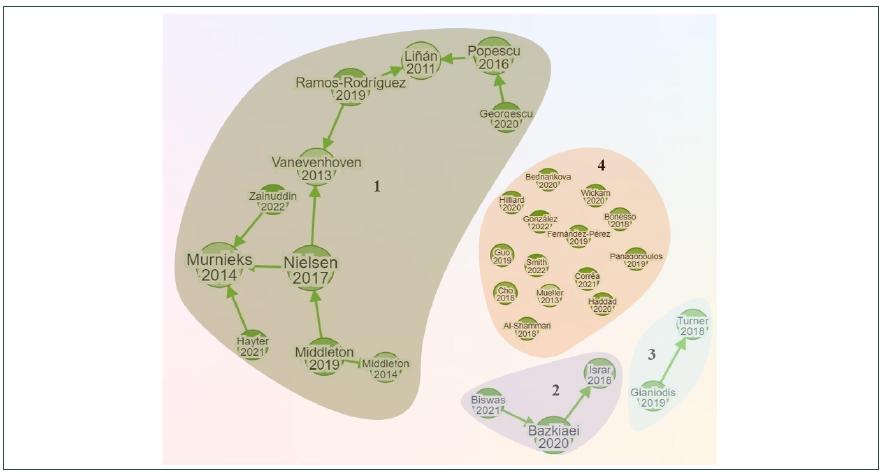 Figure 4
Co-citation network of theme-relevant articles.
Source: Developed by the authors
Figure 4
Co-citation network of theme-relevant articles.
Source: Developed by the authors
As observed in Figure 4, the co-citation network revealed four clusters, of which Clusters 1, 2, and 3 display connections between authors, while Cluster 4 shows no citation relationships among its authors. Among the connected clusters, the largest is Cluster 1, comprising a total of 11 articles, followed by Cluster 2 with 3 articles and Cluster 3 with 2 articles. Cluster 4, characterized by its independence among authors, contains 14 articles.
The studies within Cluster 1, titled Education and the Construction of Entrepreneurial Identities, highlight a convergence regarding the role of education in shaping entrepreneurial identity, supporting the notion that entrepreneurial education is one of the fundamental factors for molding intentions and behaviors related to entrepreneurship (Liñán et al., 2011). Along these lines, the importance attributed by authors to structured educational programs for developing specific entrepreneurial skills and fostering entrepreneurial intentions is evident (Vanevenhoven & Liguori, 2013). These authors argue that education goes beyond the transmission of technical knowledge, playing a significant role in building an entrepreneurial mindset.
Nielsen and Gartner (2017) and Murnieks et al. (2014) expand this perspective by emphasizing the centrality of emotional aspects, such as entrepreneurial passion, and the existence of multiple identities as key factors in the internalization of entrepreneurial identity. Consequently, it becomes clear that the combination of emotional and cognitive dimensions positions education as a multifaceted process encompassing technical, emotional, and social aspects (Ramos-Rodríguez et al., 2019), in addition to influencing the emergence of entrepreneurial intentions in individuals.
Additionally, it is acknowledged that family interactions have the potential to complement the role of education in shaping entrepreneurial identity (Georgescu & Herman, 2020). This suggests that the social environment in which an individual is embedded, particularly the family context, combines with formal entrepreneurial education to foster entrepreneurial perceptions and intentions.
Studies such as those by O’Shea et al. (2008), Krabel and Mueller (2009), and Prodan and Drnovsek (2010)emphasize the role of social networks and access to economic resources in the construction of entrepreneurial identity. These authors highlight that social networks, connections, and financial support can facilitate the transition to entrepreneurship and strengthen entrepreneurial identity.
On the other hand, some authors diverge regarding the effectiveness of formal and informal educational approaches. While Liñán et al. (2011) and Vanevenhoven and Liguori (2013) argue that formal and structured programs, such as university courses, are effective tools for developing entrepreneurial competencies and intentions, Middleton et al. (2019) and Middleton and Donnellon (2014) emphasize the relevance of informal and socialized learning experiences. They stress that the development of entrepreneurial identity occurs beyond the classroom, through network interactions, practical learning, and social dynamics. This perspective is supported by Hayter et al. (2021), who examine hybrid contexts, such as scientists transitioning into entrepreneurship, highlighting the role of non-traditional environments in fostering entrepreneurial skills.
Authors such as Down (2006) and Shepherd and Haynie (2009) also emphasize that the construction of entrepreneurial identity involves a dynamic process between an individual’s self-perception and the social and cultural interactions within their environment. This perspective is further expanded by Downing (2005), who conceptualizes identity as a bridge between micro and macro analyses in the field of entrepreneurship.
The three studies within Cluster 2, categorized as Personality as Drivers of Entrepreneurial Intention, explore personality traits as predictors of entrepreneurial intentions (Bazkiaei et al., 2020; Biswas & Verma, 2022; Israr & Saleem, 2018). Israr and Saleem (2018) argue that individual traits directly influence perceived feasibility and perceived control, which are critical factors in the development of entrepreneurial identity among university students. Bazkiaei et al. (2020) identify a positive correlation between Big Five traits such as extraversion, openness, and conscientiousness and entrepreneurial intentions, shaping favorable attitudes and beliefs toward entrepreneurship.
Meanwhile, in Cluster 3, titled Alternative Contexts and Networks in Entrepreneurial Education, which includes only two articles, the focus is on the need for entrepreneurial education to transcend traditional business school boundaries. The cluster advocates for unconventional educational contexts, such as interdisciplinary courses or training in corporate environments, as offering more diverse and practice-oriented experiences (Turner & Gianiodis, 2018). Gianiodis and Meek (2020) highlight the importance of engaging external stakeholders, including investors, mentors, and institutions, to foster a more applied and market-driven entrepreneurial education.
Finally, Cluster 4, titled Competencies and Identities within Context, composed of independent articles, presents a diverse set of perspectives on the role of emotional, social, and cognitive competencies, as well as cultural and educational contexts, in shaping entrepreneurial identity. A key theme emerging from the analysis is the importance of emotional and cognitive competencies in entrepreneurial intention (Bonesso et al., 2018; Fernández-Pérez et al., 2019), with emphasis on emotional skills, such as emotional regulation, and cognitive competencies, such as critical thinking, in the process of building an entrepreneurial mindset.
Furthermore, studies such as Weick (1995) discuss how individuals develop multiple identities to navigate different social contexts. Expanding on this perspective, Guo et al. (2019) introduce the concept of hybrid identities, suggesting that navigating multiple roles, such as academic and entrepreneur, relies on adaptive emotional and social competencies.
Table 8
Psychological and cognitive aspects.
 Note. Developed by the authors.
To synthesize the cognitive psychological aspects, the following table was organized, composed of clusters and the variables that emerge from them, validated by the authors who substantiate this analysis.
Assuming the perspective of the miner-prospector continuum, the proposed review, on one hand, explored, gathered, and analyzed previous works to shed new light on the field of academic entrepreneurial identity (Gond et al., 2020). On the other hand, the findings from the exploratory mining phase were synthesized and organized, enabling the reconstruction of the field by extending the existing literature, critically re-presenting it, and intervening in theory with the support of interdisciplinarity. In this way, the study advances toward the prospector perspective, proposing new theoretical directions and contributing to a future research agenda.
To this end, the literature analysis reveals that academic entrepreneurial identity is still not a well-defined construct, with a lack of consensus regarding its characteristics, formative processes, and impact on entrepreneurial behavior. Furthermore, the existing literature is predominantly fragmented, focusing on factors such as entrepreneurial intention (Fernández-Pérez et al., 2019; Murnieks et al., 2014) or educational entrepreneurship programs (Donoso-González et al., 2022; Wickam et al., 2020), without deeply exploring the relationship between identity and entrepreneurial practice. Given the lack of a clear definition of academic entrepreneurial identity in the analyzed articles, this study proposes the introduction of new theoretical pathways (Glaser & Strauss, 1967; Nadkarni et al., 2018), applying established theories to a new empirical context (Suddaby et al., 2011). In this sense, studies such as those by Tajfel and Turner (1979) and Fauchart and Gruber (2011) can contribute to the understanding of this social entrepreneurial identity, emphasizing that it emerges from social interactions and shared values within groups, such as social class, family, and research teams (Georgescu & Herman, 2020; Krabel & Mueller, 2009; Middleton et al., 2019; Middleton & Donnellon, 2014; O’Shea et al., 2008; Shepherd & Haynie, 2009). This theoretical framework is rooted in social psychology, much like the work of Fauchart and Gruber (2011), who identified three entrepreneurial social identities: Darwinian, communitarian, and missionary, in a distinct entrepreneurial context. When applied to the context of academic entrepreneurship, this framework raises the possibility of clarifying whether there is a new entrepreneurial social identity specific to this context or whether the characteristics of academic entrepreneurs align with one of the identities already identified.
Furthermore, as this identity has not yet been studied in the academic context, there is an opportunity to explore how academics develop their entrepreneurial identity, particularly in environments where research commercialization and technology transfer are required (Donoso-González et al., 2022; Murnieks et al., 2014), through the lens of the theory proposed by Fauchart and Gruber (2011).
Moreover, the absence of a definition for academic entrepreneurial identity, as well as the scarcity of studies investigating its formation and implications (Li & Li, 2022; Mäkinen & Esko, 2022; Nowak-Mizgalska, 2022), highlights a critical gap. Although the reviewed studies often suggest that academic entrepreneurial behavior can be induced by contextual factors such as funding calls or institutional programs (e.g., I-Corps, Donoso-González et al., 2022), it remains unclear whether these initiatives foster the development of a lasting entrepreneurial identity or merely trigger reactive and temporary behaviors driven by specific opportunities (Hayter et al., 2021). These behaviors may fade once the incentives are removed, diluting the identity into intermittent episodes.
As suggested by Fauchart and Gruber (2011), the formation of an entrepreneurial identity relies on an internalization process that extends beyond external incentives, legitimizing the need for research examining how academics reconcile their multiple identities. Therefore, in addition to other traditional identities, one might be faced with Liquid Academic Entrepreneurial Identity. Inspired by the concept of liquid modernity, developed by Bauman (2000, 2013), this perspective argues that identity, in specific contexts such as funding calls, grants, institutional demands, and social needs, ceases to be a static characteristic and becomes a dynamic task. In these environments, individuals take on the responsibility of constructing their own identities, detaching themselves from fixed roots, rigid behaviors, or pre-established institutional norms. Liquid modernity thus emphasizes the mobility and flexibility of identities, which become increasingly fluid and adaptable to constantly changing circumstances (Beck, 2011; Giddens, 1991).
In this scenario, the identity of the researcher transitioning into the field of entrepreneurship exemplifies this notion of a fluid identity. This transition aligns with the coexistence of multiple identities (Nielsen & Gartner, 2017), the ability to navigate between different roles (Guo et al., 2019), the shift between academic and entrepreneurial functions (Donoso-González et al., 2022), and the experience of liminality (Hayter et al., 2021). These elements suggest a capacity to strategically and adaptively alternate between different identities, reinforcing the concept of a fluid identity (Turner & Gianiodis, 2018).
Despite the characteristic fluidity of identities in liquid modernity, Tajfel and Turner’s (1979) social identity theory remains relevant by emphasizing the importance of the perceived continuity of group identity. This continuity, in both cultural and historical aspects (Sani et al., 2007), becomes particularly significant in dynamic contexts, such as the academic environment. Identification with the group and the fulfillment of needs related to the continuity of central identity (Smeekes & Verkuyten, 2017) are factors that contribute to the psychological and social stability of individuals.
In this sense, the perception of belonging to the academic group provides a solid foundation that enables experimentation and transitions between different identities, such as those of academic and entrepreneur (Zou et al., 2019). This dynamic, characterized by the coexistence of multiple identities, aligns with the notions of reintegration (Ibarra & Barbulescu, 2010) and identity holism (Rogers et al., 2017). Both approaches suggest that aspects of previous and new identities can be reconciled, allowing for meaningful integration of these dimensions (Ebaugh, 1988; Petriglieri, 2011). Thus, even in a context of fluidity and adaptability, continuity and belonging play a crucial role in balancing the stability and transactional nature of identities.
Adding to this, the cognitive framework provided by social identity theory helps interpret social situations and behaviors (Brewer & Miller, 1996; Tajfel & Turner, 1979), such as decisions about markets, customer needs, and resource utilization (Fauchart & Gruber, 2011). Fauchart and Gruber (2011) use three dimensions - basic social motivation, self-assessment, and frame of reference - to explain how they categorize different types of entrepreneurial social identities. By adopting theoretical lenses that address the transactional nature of academic and entrepreneurial identities (Donoso-González et al., 2022; Guo et al., 2019; Hayter et al., 2021; Nielsen & Gartner, 2017; Turner & Gianiodis, 2018) and grounded in the perspective of liquid modernity (Bauman, 2000, 2013; Beck, 2011; Giddens, 1991), a potential advancement in Fauchart and Gruber’s (2011) entrepreneurial social identity theory is projected. This advancement would involve formulating a new theoretical construct that addresses the specificities of the academic context, termed Liquid Academic Entrepreneurial Identity. Table 7 below provides a systematization of the main theoretical relationships, highlighting the dimensions and their respective contributions.
Thus, the construct of Liquid Academic Entrepreneurial Identity is proposed through the integration of the perspective of entrepreneurial social identity theory, as proposed by Fauchart and Gruber (2011), which encompasses the dimensions of motivation, self-assessment, and frame of reference. This is complemented by the perspectives of liquid modernity from Bauman (2000, 2013), Giddens (1991), and Beck (2011), as well as perceptions of group identity continuity (Sani et al., 2007; Smeekes & Verkuyten, 2017; Tajfel & Turner, 1979; Zou et al., 2019). While the theoretical systematization provides a solid foundation, efforts are also directed toward advancing the construction of a metaphorical theorization, employing the analogy of a river’s flow to illustrate the fluidity, transformation, and intersections inherent to this identity.
Table 9
Theoretical systematization of the construct of Liquid Academic Entrepreneurial Identity.
 Note. Developed by the authors.
Regarding the proposed metaphor, the theoretical framework underpinning these analyses suggests that theoretical construction is a form of ‘disciplined imagination,’ where the creation of concepts is not merely a creative exercise but also requires rigor and structured methods. It advocates for the analytical structuring of phenomena through the development of innovative theories (Alvesson & Karreman, 2007, 2011; Morgan, 1997; Weick, 1989).
According to Weick’s (1989) arguments, the metaphorical application of ‘disciplined imagination’ can be seen as a representation of academic identity, which, despite its need for creativity, must be anchored in systematic and rigorous practices. In the context of entrepreneurial identity, this metaphor can be applied to the creative and innovative process within the boundaries of a practical and organized reality, akin to the construction of a new venture that balances innovation with the necessity of operating within norms and structures (Alvesson & Kärreman, 2007).
Considering the metaphorical theoretical framework, a metaphor is proposed that highlights the practical awareness of the construct analyzed in this research. The entrepreneurial identity of academics can be seen as a fluid and temporary state, a role assumed as contextual, social, and opportunistic factors emerge (Bauman, 2000, 2013; Donoso-González et al., 2022; Guo et al., 2019; Hayter et al., 2021; Nielsen & Gartner, 2017; Turner & Gianiodis, 2018), akin to a river that follows the course dictated by its banks. The riverbanks, solid strips of land that delineate the riverbed, represent points of connection between water and land, playing a crucial role in defining the fluvial space. Similarly, the perception of group identity continuity acts as a secure anchoring point for the ‘self.’ This solid foundation facilitates the transactional nature of identities, allowing individuals to navigate more flexibly between different roles and social contexts (Sani et al., 2007; Smeekes & Verkuyten, 2017; Tajfel & Turner, 1979; Zou et al., 2019). They are influenced by factors such as the dynamics of the watercourse, precipitation, and processes of erosion and sedimentation (Christofoletti, 1980), thereby regulating the flow of water and maintaining the fluvial system (Tricart, 1977).
In this representation, these factors take on the role of funding calls, grants, programs, networks, crises, and social and institutional pressures. However, the researcher’s identity functions as the riverbed. According to Christofoletti (1980), the riverbed is divided into two parts: the smaller bed, occupied by water under normal conditions, and the larger bed, which is flooded during periods of high water and adapts to the natural conditions of the watercourse. This fluvial structure responds to factors such as erosion, sedimentation, and variations in water volume over time (Tricart, 1977). Similarly, the academic identity, when adapting to the dynamics of its context, assumes characteristics of fluidity and adaptability. The larger bed, for instance, can be interpreted as the central academic identity (Guo et al., 2019), which responds to external conditions and enables the transition to the Liquid Academic Entrepreneurial Identity (Bauman, 2000, 2013; Donoso-González et al., 2022; Guo et al., 2019; Hayter et al., 2021; Nielsen & Gartner, 2017; Turner & Gianiodis, 2018).
This fluidity, however, is only possible due to the stabilizing function of the riverbanks, which can be associated with the perception of group identity continuity. This perception provides individuals with a sense of belonging and security, anchoring the academic ‘self’ and allowing them to take risks in other roles within dynamic environments (Sani et al., 2007; Smeekes & Verkuyten, 2017; Tajfel & Turner, 1979; Zou et al., 2019). Thus, the interaction between stability and fluidity in the riverbanks and the riverbed reflects the necessary balance for the coexistence of multiple identities in a context of constant transformation.
When favorable factors for entrepreneurship, such as economic incentives, support networks, or favorable sociocultural conditions, are introduced (Al Haddad et al., 2021; Bednarikova et al., 2020; Corrêa et al., 2021; Mueller & Conway Dato-on, 2013), this Liquid Academic Entrepreneurial Identity gains volume, expanding and adapting to the opportunities and challenges of the environment. Just as the larger bed accommodates excess water during floods, the entrepreneurial identity can expand, shaping itself to the demands and dynamism of the context in which it operates, as illustrated in Figure 5 below.
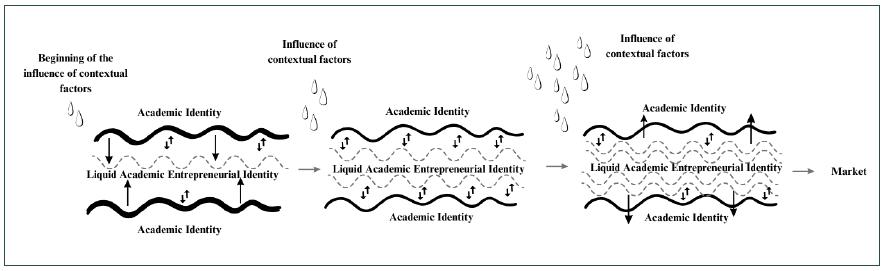 Figure 5
Liquid Academic Entrepreneurial Identity.
Source: Developed by the authors
Figure 5
Liquid Academic Entrepreneurial Identity.
Source: Developed by the authors
Still within the evolutionary context of the Liquid Academic Entrepreneurial Identity (Figure 5), contextual factors expand their influence as contact with the academic entrepreneurial identity evolves into elements shaped by opportunities. Thus, it is highlighted that, in the initial metaphorical levels, represented in the framework as the course of a river, the predominance of the academic identity’s strength is demonstrated. External contextual influences evolve through interaction with the academic identity, driven by the expansion of entrepreneurship-stimulating opportunities. Consequently, the metaphor presented in the framework illustrates the increased fluidity of the river, where academic and entrepreneurial identities transcend the containment barriers of the banks, carrying both external and internal entrepreneurial opportunities into the market environment.
Furthermore, an investigative theoretical contribution is proposed to anchor the behavioral understanding of academic identity and the Liquid Academic Entrepreneurial Identity, built upon opportunities and external influences in environments conducive to the development of innovations.
These researchers, therefore, do not crystallize the entrepreneurial identity as a permanent state but rather incorporate it momentarily, adjusting to external demands. When financial incentives or specific opportunities come to an end, they return to their original state - the academic identity, which remains solid and central to their careers.
This proposition opens a new research direction for future studies, which could investigate the construction of Liquid Academic Entrepreneurial Identity through the lens of the theoretical dimensions of social entrepreneurial identity (Fauchart & Gruber, 2011), the perception of group identity continuity (Sani et al., 2007; Smeekes & Verkuyten, 2017; Tajfel & Turner, 1979; Zou et al., 2019), and the transactional nature of this identity (Bauman, 2000, 2013; Donoso-González et al., 2022; Guo et al., 2019; Hayter et al., 2021; Nielsen & Gartner, 2017; Turner & Gianiodis, 2018). To achieve this, a qualitative and exploratory approach is recommended, such as theory-building based on multiple case studies (Alvesson & Sandberg, 2020; Eisenhardt & Graebner, 2007; Strauss & Corbin, 1998), utilizing theoretical sampling (Eisenhardt, 2021) to compare cases and identify similarities and differences in basic social motivations, self-assessments, and frames of reference (Fauchart & Gruber, 2011). This approach aims to provide empirical evidence for the concept of Liquid Academic Entrepreneurial Identity.
Beyond this future research proposal, and inspired by works such as Ahmed et al. (2022) and Stephan (2018), which structure their future research agendas through thematic axes with clear statements of actionable research questions and the most appropriate methods, the following research agenda has been structured. It describes additional research directions, with the four clusters derived from the co-citation network serving as its structuring axes:
Cluster 1 - Education and construction of entrepreneurial identities
The study of entrepreneurial identity has highlighted its centrality as a driving factor of entrepreneurial behavior, shaped by specific values, beliefs, and behaviors (Murnieks et al., 2014; Nielsen & Gartner, 2017). In the academic context, there is a growing need to define and differentiate academic entrepreneurial identity, considering its unique characteristics compared to traditional entrepreneurial identity. This future research topic proposes investigations into how education can enhance essential components such as entrepreneurial passion, self-efficacy, and cognitive internalization in educational environments. Entrepreneurial passion, described as the core emotion driving entrepreneurial actions, is influenced by internalized values and educational interventions (Zainuddin & Mukhtar, 2022). Self-efficacy, or the belief in one’s ability to achieve entrepreneurial goals, is strengthened through social support and educational practices that foster confidence and competence (Liñán et al., 2011; Middleton et al., 2019). Moreover, the cognitive internalization of entrepreneurial values occurs in learning environments that promote specific behaviors, as evidenced by Middleton et al. (2019) and Vanevenhoven and Liguori (2013).
Thus, research questions that can be outlined include:
-
(1) What are the key components that define academic entrepreneurial identity?
-
(2) How can entrepreneurial passion be stimulated and strengthened through educational practices?
-
(3) What is the impact of social and educational support programs on the development of self-efficacy among academic entrepreneurs?
-
(4) How can learning environments be designed to promote the cognitive internalization of entrepreneurial values and behaviors?
To address these questions, the research can follow a mixed-methods approach. In the first phase, a qualitative study involving interviews and narrative analysis would help identify the core components of academic entrepreneurial identity and the conditions that facilitate its development. In the second phase, longitudinal quantitative studies could analyze the impact of educational programs and social interventions on the development of entrepreneurial passion, self-efficacy, and value internalization. Finally, multiple case studies in educational institutions could provide insights into effective educational practices. As expected contributions, it seeks to differentiate this concept from traditional entrepreneurial identity, expanding opportunities for application and further research.
Cluster 2 - Personality and drivers of entrepreneurial intention
The study of personality and its impacts on entrepreneurial intention highlights specific characteristics, such as the traits within the Big Five theory, which are identified as key determinants of entrepreneurial intentions (Bazkiaei et al., 2020; Biswas & Verma, 2022). Another significant factor is perceived control, which refers to an individual’s belief in their ability to overcome entrepreneurial challenges, directly influencing their confidence to undertake entrepreneurial ventures (Israr & Saleem, 2018). Additionally, perceived feasibility, defined as the cognitive evaluation of the likelihood of success in entrepreneurial behaviors, plays a crucial role in shaping entrepreneurial intentions by aligning personal aspirations with perceived realities (Israr & Saleem, 2018).
This topic proposes research aimed at investigating whether academic entrepreneurial identity is intrinsically formed or triggered by external factors. Longitudinal studies can be employed to explore how specific events, such as participation in funding calls or programs like I-Corps, contribute to the formation of this identity. By examining these processes, important questions arise, such as:
-
(1) How do the personality traits from the Big Five theory influence the formation of academic entrepreneurial identity?
-
(2) What are the impacts of perceived control and perceived feasibility on sustaining entrepreneurial intentions among academics?
-
(3) Can specific external events, such as training programs or financial support, sustainably trigger or strengthen academic entrepreneurial identities?
To address these questions, research can adopt a methodological approach that integrates quantitative and qualitative techniques to provide a comprehensive and detailed understanding of the phenomena under investigation. For the influence of Big Five personality traits on the formation of academic entrepreneurial identity, a cross-sectional quantitative study is appropriate, utilizing standardized instruments such as the NEO-PI-R to measure personality traits (Costa & McCrae, 1992), specifically in relation to entrepreneurial orientation (Bazkiaei et al., 2020). Structural equation modeling (SEM) can be employed to test relationships between variables and identify how specific traits, such as extraversion and conscientiousness, are related to the construction of entrepreneurial identity (Hair et al., 2019).
To explore the impact of perceived control and perceived feasibility on entrepreneurial intentions, controlled experiments can be used to manipulate scenarios with varying levels of perceived control and feasibility, enabling a causal analysis of these variables. Longitudinal studies are also recommended to track how these perceptions evolve over time in educational or training programs, providing insights into temporal dynamics. Structured surveys, such as the perceived behavioral control scale (Ajzen, 1991; Liñán et al., 2011), can be employed to capture broader data on participants’ beliefs at different stages of their entrepreneurial journeys.
Finally, investigating the role of external events, such as training programs or financial support, can benefit from multiple case studies and longitudinal approaches. These strategies enable the assessment of the impact of such events on the formation and strengthening of entrepreneurial identities over time. Qualitative methods, such as interviews and narrative analyses, can complement quantitative studies by deepening the understanding of how participants experience and interpret these events (Creswell & Poth, 2016; Patton, 2014). This combination of methods ensures that both subjective nuances and general patterns are captured, contributing to a more comprehensive and robust understanding of the formation of academic entrepreneurial identity.
The expected outcomes include the identification of mechanisms that align personality traits and perceptions with the strengthening of entrepreneurial intention, as well as providing data for the design of policies and programs aimed at promoting enduring entrepreneurial identities in the academic context. This will enable the development of targeted interventions that facilitate entrepreneurship as an integrated practice within academia.
Cluster 3 - Contextualized learning, cognitive flexibility, and social engagement
Future research can explore the importance of alternative contexts and networks in the development of entrepreneurial competencies. Contextualized learning, cognitive flexibility, and social engagement emerge as key elements in shaping entrepreneurial skills and identities, especially in non-traditional settings (Turner & Gianiodis, 2018). Practical experiences in out-of-routine environments provide unique opportunities to interact with stakeholders, solve complex problems, and build support networks that strengthen both entrepreneurial identity and motivation (Gianiodis & Meek, 2020). Furthermore, engagement in diverse social networks and exposure to innovative contexts foster greater cognitive flexibility, which is essential for adapting to the dynamic challenges of entrepreneurship.
In this scenario, some research questions to be explored can be outlined:
-
(1) How do alternative contexts (such as hackathons or incubators) contribute to the development of specific entrepreneurial competencies?
-
(2) In what ways does interaction with external stakeholders and networks influence the construction of entrepreneurial identity and motivation to undertake entrepreneurial ventures?
-
(3) What is the impact of experiential learning in non-traditional settings on promoting cognitive flexibility and adaptability in future entrepreneurs?
A qualitative approach is well suited to exploring how alternative contexts and networks shape the development of entrepreneurial competencies. Case studies enable the investigation of specific initiatives, such as hackathons and incubators, highlighting how these experiences foster interactions, learning, and networks (Yin, 2018). Additionally, interviews and narrative analyses help to understand how participants experience these contexts and build meaningful networks (Creswell & Poth, 2016).
Cluster 4 - Competencies and identities within context
Emotional competencies and hybrid identities support the development of entrepreneurial behaviors, becoming more evident in contexts where multiple cultural, social, and professional influences interact. Fernández-Pérez et al. (2019) and Bonesso et al. (2018) emphasize that competencies such as emotional regulation, confidence, and empathy enable entrepreneurial behavior, allowing individuals to manage the complexity and uncertainty associated with entrepreneurship. Furthermore, the concept of hybrid identities, as discussed by Guo et al. (2019), highlights the cognitive ability to navigate between distinct social roles, such as those of academic and entrepreneur, reconciling conflicting values and expectations. This navigation process is critical in academic contexts, where traditional norms often contrast with market demands.
Moreover, social and cultural capital emerges as a factor in shaping intentions, behaviors, and social networks (Al Haddad et al., 2021; Bednarikova et al., 2020; Corrêa et al., 2021; Mueller & Conway Dato-on, 2013). Cultural, social, and economic norms influence opportunity perception, network formation, and entrepreneurial motivation. In light of this, the following question is proposed for future studies: How do emotional competencies influence the formation of hybrid identities in academics who become entrepreneurs? The most suitable methodological approach to address this research question would be qualitative, employing in-depth interviews (Patton, 2014) to explore individual experiences and emotional competencies, such as emotional regulation, empathy, and confidence. For analysis, content analysis (Bardin, 2016) could be utilized alongside empirical saturation (Guest et al., 2006) to examine the influence of these factors on the formation of hybrid identities in academics who reconcile the roles of researcher and entrepreneur.
Beyond what has already been proposed, another gap identified in the evaluated studies unfolds: the lack of instruments to measure academic entrepreneurial identity. Studies such as Wickam et al. (2020) and Donoso-González et al. (2022) highlight the entrepreneurial skills acquired through educational programs but do not provide tools to assess how these skills translate into a consolidated identity. The development of specific scales to measure this identity would be crucial for advancing the understanding of this phenomenon.
Finally, the impact of academic entrepreneurial identity on the success of entrepreneurial initiatives remains underexplored. Although studies such as Murnieks et al. (2014) emphasize the importance of passion in entrepreneurial behavior, and others, such as Israr and Saleem (2018), Bazkiaei et al. (2020), and Biswas and Verma (2022), highlight the contribution of personality traits to entrepreneurial intention, there is still a lack of research on how academic entrepreneurial identity influences outcomes such as technology transfer, startup creation, social impact innovations, or contributions to sociotechnical transitions (Geels, 2011).
This agenda seeks not only to advance theoretical knowledge but also to provide pathways for developing practical tools aimed at designing more effective entrepreneurial policies and programs, fostering the engagement of scientists. Furthermore, it can contribute to a broader understanding of the dynamics between identity and entrepreneurial practice in academic contexts.
 José Iran Batista de Melo irandemelo.idm@gmail.com

