Original articles
Received: 03 April 2023
Accepted: 29 January 2024
Published: 30 January 2024
DOI: https://doi.org/10.7705/biomedica.6972
Abstract
Introduction. : Vitamin D is required for bone and mineral metabolism and participates in the regulation of the immune response. It is also linked to several chronic diseases and conditions, usually in populations of European descent. Brazil presents a high prevalence of vitamin D deficiency and insufficiency despite the widespread availability of sunlight in the country. Thus, it is important to investigate the role of vitamin D as a risk factor for disease and to establish causal relationships between vitamin D levels and health-related outcomes in the Brazilian population.
Objective. : To examine genetic variants identified as determinants of serum vitamin D in genome-wide association studies of European populations and check whether the same associations are present in Brazil. If so, these single nucleotide polymorphisms (SNPs) could be developed locally as proxies to use in genetically informed causal inference methods, such as Mendelian randomization.
Materials and methods. : We extracted SNPs associated with vitamin D from the genome-wide association studies catalog. We did a literature search to select papers ascertaining these variants and vitamin D concentrations in Brazil.
Results. : GC was the gene with the strongest association with vitamin D levels, in agreement with existing findings in European populations. However, VDR was the most investigated gene, regardless of its non-existing association with vitamin D in the genomewide association studies.
Conclusions. : More research is needed to validate sound proxies for vitamin D levels in Brazil, for example, prioritizing GC rather than VDR.
Keywords: Vitamin D, genome-wide association study, polymorphisms, single nucleotide, vitamin D-binding protein, vitamin D3 24-hydroxylase, 25-hydroxyvitamin D3 1-alpha-hydroxylase, Brazil.
Resumen
Introducción. : La vitamina D es necesaria para el metabolismo óseo y mineral, y participa en la regulación de la respuesta inmunitaria. También está relacionada con enfermedades crónicas en poblaciones europeas. En Brasil, existe una prevalencia elevada de deficiencia e insuficiencia de vitamina D, a pesar de la amplia disponibilidad de luz solar. Por lo tanto, es importante investigar el papel de la vitamina D como factor de riesgo de diversas enfermedades y establecer relaciones causales entre los niveles de vitamina D y los problemas de salud en la población brasileña.
Objetivo. : Examinar variantes genéticas relacionadas con la vitamina D sérica en estudios de asociación genómica de poblaciones europeas y comprobar si estas mismas están presentes en Brasil. De ser así, estos SNPs podrían utilizarse como proxies en métodos de inferencia causal, tales como la aleatorización mendeliana.
Materiales y métodos. : A partir del catálogo de estudios de asociación de genoma completo se extrajeron SNPs relacionados con los niveles de vitamina D. Luego se hizo una búsqueda bibliográfica para identificar los artículos que evaluaran estos SNPs y la concentración de vitamina D en Brasil.
Resultados. : GC fue el gen más fuertemente asociado con los niveles de vitamina D, en concordancia con los resultados existentes en poblaciones europeas. Sin embargo, el gen VDR fue el más investigado, aunque no esté vinculado con la vitamina D en los estudios de asociación de genoma completo.
Conclusiones. : Se necesita más investigación para validar proxies genéticos de los niveles de vitamina D en Brasil y se recomienda priorizar el gen GC en lugar de VDR.
Palabras clave: Vitamina D, estudios de asociación del genoma completo, polimorfismos de nucleótido simple, proteína de unión a la vitamina D, vitamina D3 24-hidroxilasa, 25-hidroxivitamina D3 1-alfa-hidroxilasa, Brasil.
Vitamin D is a steroid hormone and a fat-soluble vitamin required by the human body for physiological bone and mineral metabolism 1. It plays a role in immune response regulation 2, among other functions. When vitamin D levels are low, its insufficiency or deficiency may contribute to various adverse health outcomes, from skeletal disorders such as rickets and osteomalacia to extraskeletal conditions like cancer, infections, and cardiovascular, autoimmune, and neuropsychiatric diseases 3. However, evidence of a causal effect is still scarce for many of these health problems.
The main source of vitamin D is sunlight. Pre-vitamin D3 is converted from 7-dehydrocholesterol by ultraviolet radiation (UVR) B in the skin and then transported to the liver and other tissues to be metabolized to 25-hydroxy-vitamin D (25OHD) -the major circulating form- by the enzyme CYP2R1. The 25OHD is then further metabolized to 1,25 dihydroxy-vitamin D (1,25(OH)2D), primarily in the kidney, by the enzyme CYP27B1. The 1,25(OH)2D is the active metabolite of vitamin D, responsible for most of its biological actions achieved via binding to a specific nuclear vitamin D receptor (VDR) and eliciting the transcriptional regulation of target genes. The inactivation and catabolism of 25OHD and 1,25(OH)2D are carried out by the enzyme CYP24A1. Circulation in the bloodstream of pre-vitamin D3 and vitamin D metabolites occurs using the vitamin D binding protein (VDBP) and albumin 4.
The US Endocrine Society has defined concentrations of 25OHD above 30 ng/ml as sufficient, between 20 and 30 ng/ml as insufficient, and below 20 ng/ml as deficient vitamin D levels, or their equivalent in nmol/L (1 ng/ml=2,5 nmol/L). Cut-off values may differ between studies depending on whether they follow the recommendations of the US Endocrine Society, the US Institute of Medicine (12 ng/ml and 20 ng/ml as the thresholds for deficiency and sufficiency, respectively), or the UK Scientific Advisory Committee (below 10 ng/ml is considered vitamin D deficiency) 1,5. The proposed minimum thresholds are defined by criteria including the suppression of parathyroid hormone secretion, increased calcium absorption, good musculoskeletal health, and reduced fractures and falls 1.
Identifying causal associations of vitamin D with disease using observational methods can be difficult because of confounding variables and other biases often afflicting these studies. Some reports devise Mendelian randomization as a method to improve causal inference in epidemiology by employing genetic variants strongly associated with an exposure, known in this context as instrumental variables, which are unlikely to suffer the same observational biases 6. Mendelian randomization has become quite popular in the last decade, clarifying cause-and-effect relationships between many risk factors and disease outcomes 7. However, this success has been limited to populations of European descent, where most research is conducted. For Mendelian randomization to be effectively applied in Brazil (and other non-European populations) we need to select genetic variants that are instrumental variables for exposures in the local populations.
For that reason, we investigated single nucleotide polymorphisms (SNPs) strongly associated with serum vitamin D, initially detected in Europeans, to assess whether they could be used as proxies for vitamin D in the Brazilian population to determine causal relationships between vitamin D levels and chronic diseases using Mendelian randomization.
Materials and methods
Single nucleotide polymorphisms associated with 25OHD (from now on, vitamin D) levels in blood were identified using the publicly available genome-wide association studies (GWAS) catalog 8. We generated a list of the top ~30 SNPs most strongly associated with vitamin D (with p-value < 5x10⁻⁸) and their corresponding genes. With this SNP list, we searched for scientific papers reporting the association of these SNPs or genes with vitamin D concentration in the Brazilian population. We consulted the databases of PubMed (9), Literatura Latino-Americana e do Caribe em Ciências da Saúde (LILACS) (10), Scopus 11, Scientific Electronic Library Online (SciELO) (12), and Biblioteca Digital Brasileira de Teses e Dissertações (BDTD) 13. The search was carried out using the reference SNPs cluster ID (rsID) or the name of the gene where the SNPs is located, together with the terms "Brazil" and "vitamin D". In addition, we included SNPs located in the vitamin D receptor (VDR) gene, extensively studied in populations across the world. We selected studies where the association of genotypes with circulating vitamin D was ascertained and written in English, Portuguese, or Spanish.
From the chosen papers, we extracted the following information: SNPs effect on vitamin D levels, the effect allele, allele frequencies, sample size, prevalence of vitamin D deficiency and insufficiency, female percentage, mean age, white ethnicity percentage, study type, Hardy-Weinberg equilibrium test, adjustment for population stratification, and target population.
Results
Twenty-eight SNPs strongly associated with vitamin D in blood, mainly in European populations, were obtained from the GWAS catalog (table 1). Also, we considered 18 extra SNPs in the VDR gene (table 2).
Single nucleotide polymorphisms associated with vitamin D levels found in the GWAS catalog
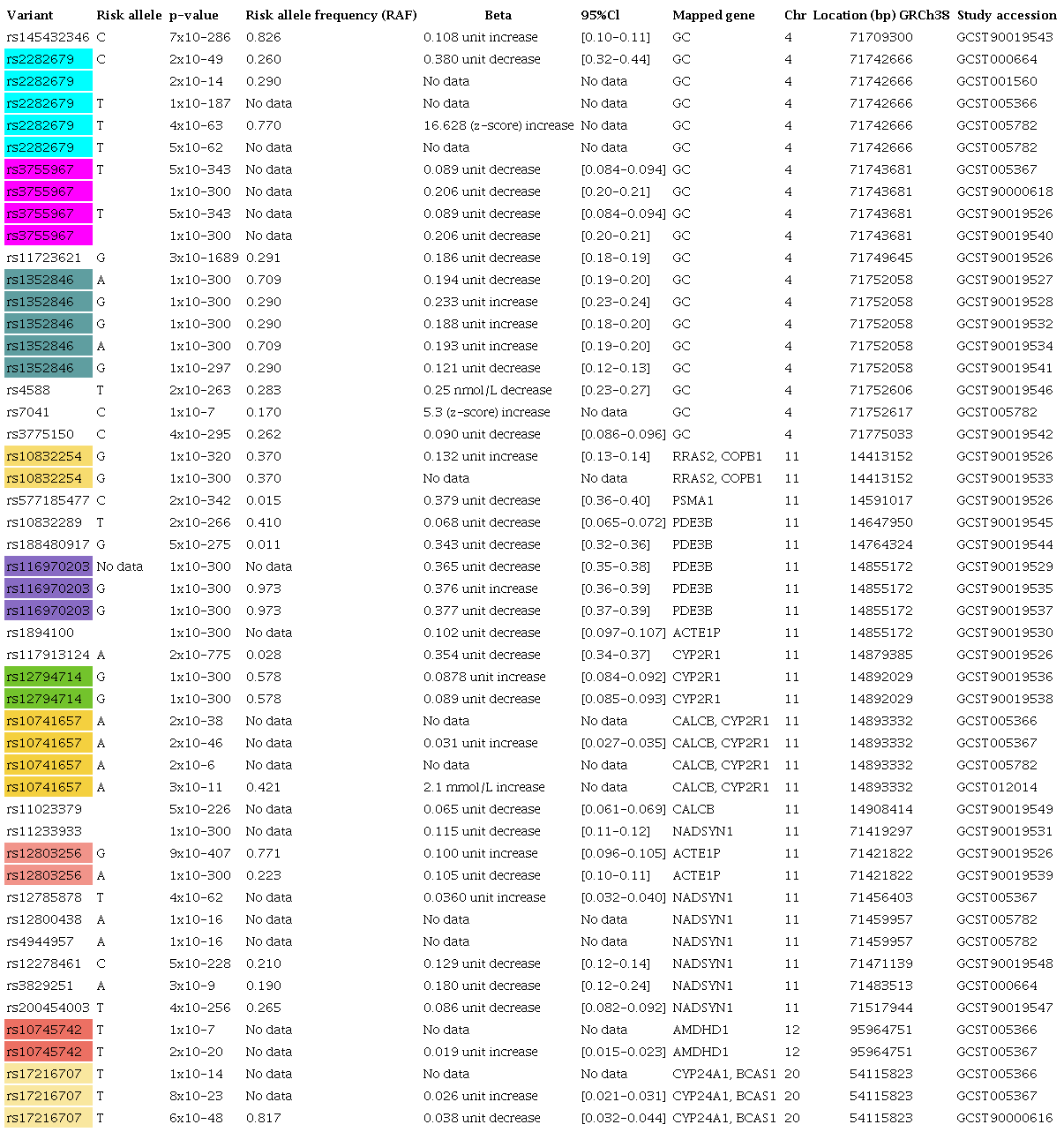
bp: base pairs; Chr: chromosome Same single nucleotide polymorphisms identified in different studies are shown in colour.
VDR single nucleotide polymorphisms examined in relation to vitamin D levels in the Brazilian population
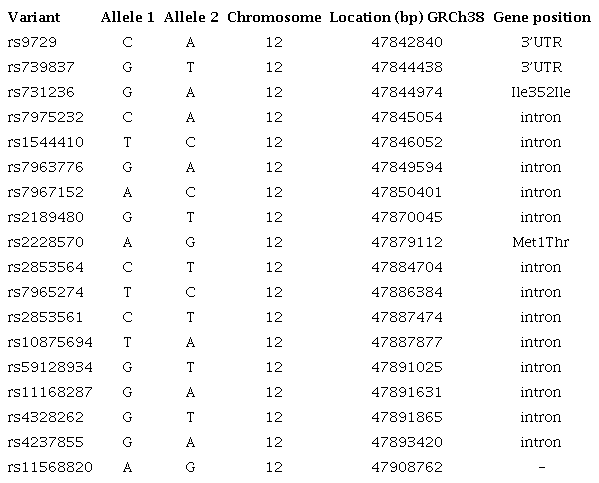
bp: base pairs
GC vitamin D binding protein gene
Vitamin D binding protein gene (GC) is located on chromosome 4q13.3 and encodes for the VDBP. Nine SNPs in this gene were among the 28 variants most robustly associated with serum vitamin D in previous GWAS (i.e. rs11723621, rs1352846, rs145432346, rs222020, rs2282679, rs3755967, rs3775150, rs4588, rs7041). Only rs2282679, rs4588, and rs7041 were analyzed in the Brazilian population (supplementary table 1). We found a total of six published studies in Brazil, three in Porto Alegre, the capital of the state of Rio Grande do Sul, and one each in the states of Rio de Janeiro, Paraná, and São Paulo. The target populations were diverse and involved women of reproductive age, university civil servants, and individuals affected by chronic diseases such as hepatitis C and cirrhosis, but their minor allele frequencies were quite similar (table 3).
Allele frequencies of GC single nucleotide polymorphisms tested in association with vitamin D levels in the Brazilian population

PR: Paraná; RJ: Rio de Janeiro: RS: Rio Grande do Sul; SP: São Paulo
Overall, we uncovered evidence of the GC gene associated with vitamin D concentrations in Brazil, with the rs4588 A allele, the rs7041 T allele, and the rs2282679 C allele underlying lower vitamin D levels.
Vitamin D receptor gene (VDR)
Despite not being one of the genes identified in earlier GWAS as associated with vitamin D levels, the Vitamin D receptor gene (VDR) has been examined in numerous human groups, often in studies conducted before the GWAS era. Our literature search identified 12 publications assessing circulating vitamin D with VDR genotypes in Brazil (supplementary table 2). The SNPs rs1544410 (G/A), rs2228570 (C/T), rs731236 (T/C), and rs7975232 (T/G), formerly detected using the restriction enzymes BsmI, FokI, TaqI, and ApaI, respectively, were ascertained in most analyses, encompassing a variety of populations across the country (table 4). However, unlike what was observed with the GC gene, results were inconsistent in terms of the effect found or the direction of that effect. For instance, while the A allele of SNPs rs1544410 was associated with lower levels of vitamin D in young children from Acre 14, it increases vitamin D in girls 7-18 years old from south Brazil 15. The C allele at SNPs rs731236 was associated with higher serum vitamin D in girls from south Brazil and pregnant women from Bahia but appeared to have the opposite effect in type 1 diabetes patients from Pará state 16.
Allele frequencies of VDR single nucleotide polymorphisms most frequently tested in association with vitamin D levels in the Brazilian population
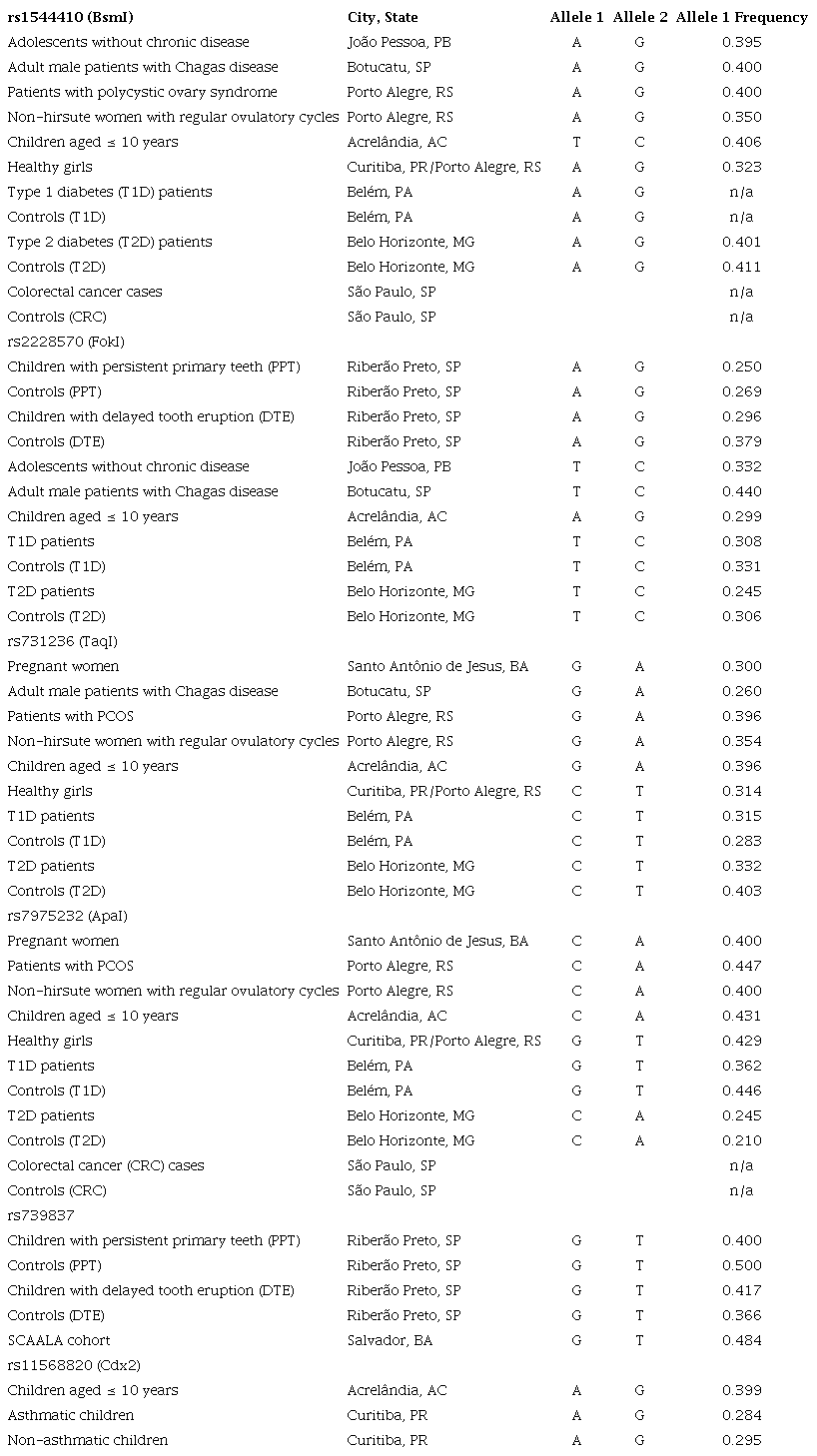
AC: Acre; BA: Bahia; MG: Minas Gerais; PA: Pará; PB: Paraíba; PR: Paraná; RS: Rio Grande do Sul; SP: São Paulo n/a: not applicable
Other genes
We identified 25 SNPs in eight genes other than GC and VDR among the top predictors of vitamin D levels in the GWAS catalog. However, just four of these genes have been explored in Brazil (CYP2R1, CYP24A1, CYP27B1, NADSYN1 ) (supplementary table 3). Several polymorphisms in CYP2R1 and CYP24A1 were associated with serum vitamin D and vitamin D insufficiency in a study of ~800 young people from deprived areas in Salvador, Bahia 17. In contrast, smaller studies investigating the same genes, but different SNPs and populations did not find any effect 18-20.
Discussion
Despite the widespread availability of sunlight across Brazil and UVR levels ensuring vitamin D synthesis in the skin 21, numerous Brazilian studies report a high prevalence of vitamin D deficiency and insufficiency 22. Since 2017, the Sociedade Brasileira de Endocrinologia e Metabologia (SBEM) and the Sociedade Brasileira de Patologia Clínica/ Medicina Laboratorial(SBPC/ML) recommend a 25OHD level equal to or above 20 ng/ml for individuals up to 60 years old, and a range of 30 to 60 ng/ ml for at-risk groups 23. Considering other sources of vitamin D like diet and supplementation, vitamin D intake in Brazil is limited, food fortification is uncommon, and the use of vitamin D supplements (≤ 10%) is infrequent 23. To that extent, the SBEM only recommends supplementation for specific groups at risk of deficiency, for example, pregnant and lactating women, individuals with osteoporosis, elderly people, and patients with conditions that affect vitamin D metabolism 24.
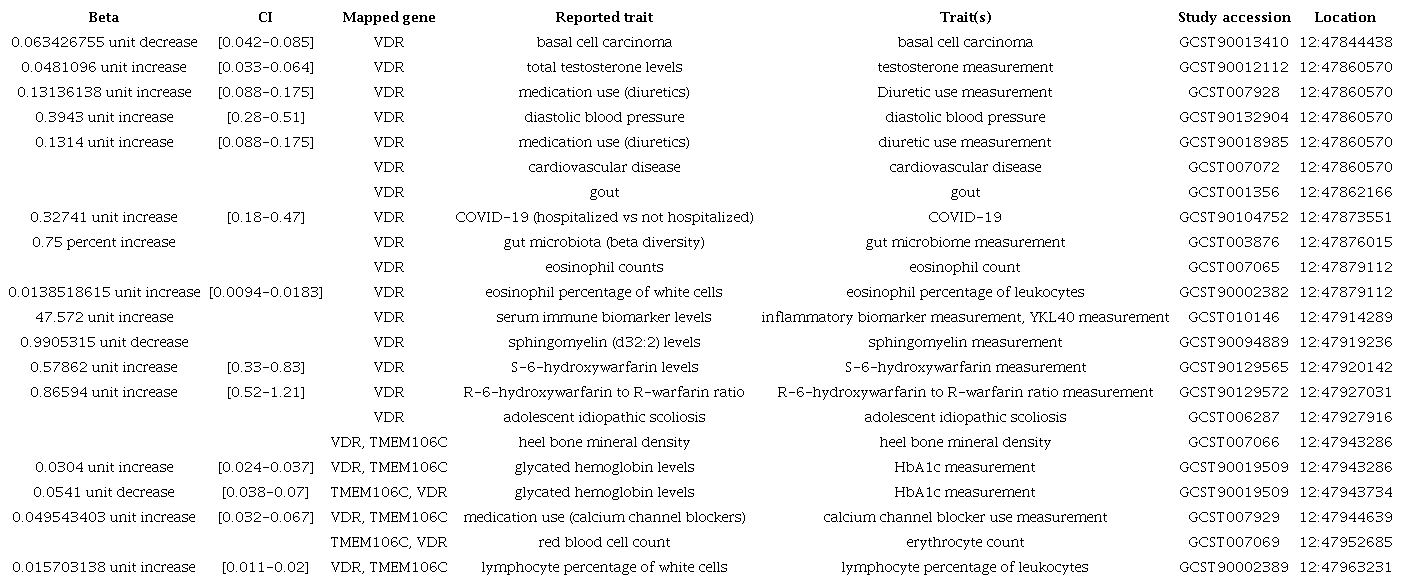
In general, our findings showed limited local research on the genetic determinants of vitamin D levels, with a predilection towards investigating the VDR gene, but with sounder evidence accumulating on the effects of the GC gene. This observation agrees with the GWAS data indicating that GC, the gene that encodes for the binding protein, is among the dominant genetic predictors of vitamin D concentrations in European, Asian, and African-ancestry populations 25-30. Conversely, a look-up of VDR in the GWAS catalog returned associations with different traits but not with vitamin D levels (supplementary table 4).
Brazil needs to conduct more research to confirm the role of GC (and clarify the one of VDR) and to reveal other genetic variants robustly associated with serum vitamin D. The identification of reliable proxies will allow us to establish causal associations with disease and promote the use of appropriate polygenic risk scores for predictive purposes.
Additionally, we would like to suggest a few improvements to future studies, especially to use them as the basis for meta-analyses. For example, it is important to describe all findings (significant and non-significant) and to provide them as supplementary material, if necessary, assess Hardy-Weinberg equilibrium and report test results, and, given Brazil's admixed genetic background, adjust for markers of population stratification or related variables (e.g., race/ethnicity, socioeconomic status) when these are unavailable.
Among the limitations of our study, there is still the chance that we have missed relevant publications not covered by our search parameters, or SNPs associated with vitamin D in the GWAS catalog, outside the top 30, with reports in Brazilian populations, although this is rather unlikely. In addition, given the limited number of studies found and the heterogeneity of the included samples, it was not possible to run a meta-analysis to obtain an indication of the strength and direction of the effect of GC variants on the levels of vitamin D, making unfeasible the implementation of any action in clinical practice linked to our results.
In conclusion, there is a lot of interest in vitamin D as a potential risk factor for several chronic diseases of public health impact. Therefore, it is essential to identify causal relationships between vitamin D levels and disease outcomes. One way of improving causal inference would be to apply Mendelian randomization, which uses genetic variants to proxy or instrument the exposure (e.g., serum vitamin D) to obtain unbiased estimates of these relationships. However, the instruments should be appropriate for the study population, either having been discovered or validated locally. We noticed insufficient research in Brazil (and South America) on vitamin D proxies, with existing studies focusing on the VDR as a genetic risk factor for disease, which may or may not produce changes in circulating vitamin D.
Supplementary archives
Scientific articles on GC polymorphisms and vitamin D levels in the Brazilian population

Scientific articles on VDR gene polymorphisms and vitamin D levels in the Brazilian population

Scientific articles on polymorphisms in genes other than GC and VDR and vitamin D levels in the Brazilian population

. Single nucleotide polymorphisms in the VDR gene associated with complex traits according to the GWAS catalog
References
Holick MF. Optimal vitamin D status for the prevention and treatment of osteoporosis. Drugs Aging. 2007;24:1017-29. https://doi.org/10.2165/00002512-200724120-00005
Charoenngam N, Holick MF. Immunologic effects of vitamin D on human health and disease. Nutrients. 2020;12:2097. https://doi.org/10.3390/nu12072097
Pilz S, Grübler M, Gaksch M, Schwetz V, Trummer C. Vitamin D and mortality. Anticancer Res. 2016;36:1379-88.
Bandera-Merchan B, Morcillo S, Martin-Nuñez G, Tinahones FJ, Macías-González M. The role of vitamin D and VDR in carcinogenesis: Through epidemiology and basic sciences. J Steroid Biochem Mol Biol. 2017;167:203-18. https://doi.org/10.1016/j.jsbmb.2016.11.020
Vieth R, Holick MF. The IOM-Endocrine Society controversy on recommended vitamin D targets. In: Vitamin D: Volume One: Biochemistry, Physiology and Diagnostics. 4th edition. Cambridge, MA: Academic Press; 2018. p. 1091-107. https://doi.org/10.1016/B978-0-12-809965-0.00059-8
Smith GD, Ebrahim S. ‘Mendelian randomization’: can genetic epidemiology contribute to understanding environmental determinants of disease? Int J Epidemiol. 2003;32:1-22. https://doi.org/10.1093/ije/dyg070
Bennett DA, Du H. An overview of methods and exemplars of the use of Mendelian randomisation in nutritional research. Nutrients. 2022;14:3408. https://doi.org/10.3390/nu14163408
Global Core Biodata Resource. GWAS Catalog. Accessed: October 1, 2021. Available at: Available at: https://www.ebi.ac.uk/gwas/
National Library of Medicine. PubMed. Accessed: January 10, 2022. Available at : Available at : https://pubmed.ncbi.nlm.nih.gov/
Pan-American Health Organization. LILACS, scientific health information from Latin America and the Caribbean countries. Accessed: January 10, 2022. Available at: Available at: https://lilacs.bvsalud.org/
Elsevier B. V. Scopus. Accessed: January 10, 2022. Available at: Available at: https://www.scopus.com/
Red SciELO. Scielo, Scientific Electronic Library Online. Accessed: January 10, 2022. Available at: Available at: https://scielo.org/
Instituto Brasileiro de Informação em Ciência e Tecnologia. Biblioteca Digital Brasileira de Teses e Dissertacoes. Accessed: January 10, 2022. Available at: Available at: http://bdtd.ibict.br/vufind/
Cobayashi F, Lourenço BH, Cardoso MA. 25-hydroxyvitamin D3 levels, BsmI polymorphism and insulin resistance in Brazilian Amazonian children. Int J Mol Sci. 2015;16:12531-46. https://doi.org/10.3390/ijms160612531
Santos BR, Mascarenhas LPG, Satler F, Boguszewski MCS, Spritzer PM. Vitamin D deficiency in girls from South Brazil: A cross-sectional study on prevalence and association with vitamin D receptor gene variants. BMC Pediatr. 2012;12:606. https://doi.org/10.1186/1471-2431-12-62
Ferraz RS, Silva CS, Cavalcante GC, de Queiroz NNM, Felício KM, Felício JS, et al. Variants in the VDR gene may influence 25(OH)D levels in type 1 diabetes mellitus in a Brazilian population. Nutrients. 2022;14:1010. https://doi.org/10.3390/nu14051010
Galvão AA, de Araújo Sena F, de Andrade Belitardo EMM, de Santana MBR, Costa GN de O, Cruz ÁA, et al. Genetic polymorphisms in vitamin D pathway influence 25(OH)D levels and are associated with atopy and asthma. Allergy Asthma Clin Immunol. 2020;16:62. https://doi.org/10.1186/s13223-020-00460-y
Bezerra FF, Normando P, Fonseca ACP, Zembrzuski V, Campos-Junior M, Cabello-Acero PH, et al. Genetic, sociodemographic and lifestyle factors associated with serum 25-hydroxyvitamin D. Cad Saúde Publica. 2022;38:e00287820. https://doi.org/10.1590/0102-311X00287820
Brait BJ, da Silva Lima SP, Aguiar FL, Fernandes-Ferreira R, OliveiraBrancati CIF, Ferraz JAML, et al. Genetic polymorphisms related to the vitamin D pathway in patients with cirrhosis with or without hepatocellular carcinoma (HCC). Ecancermedicalscience. 2022;16:1383. https://doi.org/10.3332/ecancer.2022.1383
Vidigal VM, Silva TD, de Oliveira J, Pimenta CAM, Felipe AV, Forones NM. Genetic polymorphisms of vitamin D receptor (VDR), CYP27B1 and CYP24A1 genes and the risk of colorectal cancer. Int J Biol Markers. 2017;32:e224-30. https://doi.org/10.5301/jbm.5000248
de Paula Corrêa M, Pires LCM. Doses of erythemal ultraviolet radiation observed in Brazil. Int J Dermatol. 2013;52:966-73. https://doi.org/10.1111/j.1365-4632.2012.05834.x
Pereira-Santos M, dos Santos JYG, Carvalho GQ, Santos DB, Oliveira AM. Epidemiology of vitamin D insufficiency and deficiency in a population in a sunny country: Geospatial metaanalysis in Brazil. Crit Rev Food Sci Nutr. 2019;59:2102-9. https://doi.org/10.1080/10408398.2018.1437711
Mendes MM, Hart KH, Botelho PB, Lanham-New SA. Vitamin D status in the tropics: Is sunlight exposure the main determinant? Nutr Bull. 2018;43:428-34. https://doi.org/10.1111/nbu.12349
Maeda SS, Borba VZC, Camargo MBR, Silva DMW, Borges JLC, Bandeira F, et al. Recomendações da Sociedade Brasileira de Endocrinologia e Metabologia (SBEM) para o diagnóstico e tratamento da hipovitaminose D. Arq Bras Endocrinol Metabol. 2014;58:411-33. https://doi.org/10.1590/0004-2730000003388
Ahn J, Yu K, Stolzenberg-Solomon R, Simon KC, McCullough ML, Gallicchio L, et al. Genome-wide association study of circulating vitamin D levels. Hum Mol Genet. 2010;19:2739-45. https://doi.org/10.1093/hmg/ddq155
Wang TJ, Zhang F, Richards JB, Kestenbaum B, van Meurs JB, Berry D, et al. Common genetic determinants of vitamin D insufficiency: A genome-wide association study. Lancet. 2010;376:180-8. https://doi.org/10.1016/S0140-6736(10)60588-0
Hong J, Hatchell KE, Bradfield JP, Bjonnes A, Chesi A, Lai CQ, et al. Transethnic evaluation identifies low-frequency loci associated with 25-hydroxyvitamin D concentrations. J Clin Endocrinol Metab. 2018;103:1380-92. https://doi.org/10.1210/jc.2017-01802
Kim YA, Yoon JW, Lee Y, Choi HJ, Yun JW, Bae E, et al. Unveiling genetic variants underlying vitamin D deficiency in multiple Korean cohorts by a genome-wide association study. Endocrinol Metab. 2021;36:1189-200. https://doi.org/10.3803/EnM.2021.1241
Parlato LA, Welch R, Ong IM, Long J, Cai Q, Steinwandel MD, et al. Genome-wide association study (GWAS) of circulating vitamin D outcomes among individuals of African ancestry. Am J Clin Nutr. 2023;117:308-16. https://doi.org/10.1016/j.ajcnut.2022.12.001
Manousaki D, Mitchell R, Dudding T, Haworth S, Harroud A, Forgetta V, et al. Genomewide association study for vitamin D levels reveals 69 independent loci. Am J Hum Genet. 2020;106:327-37. https://doi.org/10.1016/j.ajhg.2020.01.017
Author's contributions:
Author notes
*Corresponding author: Carolina Bonilla, Departamento de Medicina Preventiva, Faculdade de Medicina, Universidade de São Paulo, Avenida Dr. Arnaldo 455, São Paulo, CEP 01246-903, Brasil Phone: +55 (11) 3061 8610 cxbonilla@usp.br
Conflict of interest declaration
