Artículos
Recurrent frothy bloat in goats associated with the consumption of Strombocarpa ferox (Fabaceae) pods
Recurrent frothy bloat in goats associated with the consumption of Strombocarpa ferox (Fabaceae) pods
RIA. Revista de Investigaciones Agropecuarias, vol. 50, núm. 2, pp. 71-74, 2024
Instituto Nacional de Tecnología Agropecuaria
Abstract: Frothy bloat is the over-distention of the rumen and reticulum, resulting from the accumulation of stable foam formed by tiny gas bubbles produced by fermentation. Normally, this functional digestive disorder occurs in ruminants when their diet consists predominantly of legumes in their vegetative state; this produces substances that reduce the surface tension, contributing to the stabilization of bubbles. This paper describes one outbreak of recurrent frothy bloat in goats in northwestern Argentina. The main clinical signs observed in affected goats were moderate to severe distension of the abdomen, agitation, and mouths half-opened, expelling a greenish foam that oozed through the corners of their lips. A gross evaluation of the necropsied animal revealed that the rumen showed a creamy homogeneous ruminal content of greenish color. The microhistological analysis of the ruminal content showed seed coats of Strombocarpa spp. The epidemiological data, clinical signs, gross findings, and microhistological analysis of the ruminal content confirmed the diagnosis of recurrent frothy bloat in goats associated with the consumption of Strombocarpa ferox green pods.
Keywords: Puna, small ruminants, digestive disorder, recurrent frothy bloat, Prosopis ferox.
Resumen: El timpanismo espumoso es la distensión excesiva del rumen y el retículo resultado de la acumulación de formaciones estables de espuma que se generan a partir de pequeñas burbujas de gases de la fermentación. Normalmente, este trastorno digestivo funcional se presenta en rumiantes cuando consumen predominantemente leguminosas en estado vegetativo, ya que la presencia de sustancias que reducen la tensión superficial contribuyen a la estabilización de las burbujas. En este artículo, se describe un brote de timpanismo espumoso recurrente en cabras en el noroeste de Argentina. Los principales signos clínicos observados en las cabras afectadas fueron distensión moderada a severa del abdomen, agitación y boca entreabierta, con expulsión de una espuma verdosa por las comisuras labiales. La necropsia del animal reveló que el rumen mostraba un contenido cremoso homogéneo de color verdoso. El análisis microhistológico de dicho contenido mostró cubiertas de semillas de Strombocarpa spp. Los datos epidemiológicos, los signos clínicos, los hallazgos macroscópicos y el análisis microhistológico del contenido ruminal confirmaron el diagnóstico de timpanismo espumoso recurrente en cabras asociado con el consumo de vainas verdes de Strombocarpa ferox.
Palabras clave: Puna, pequeños rumiantes, trastorno digestivo, timpanismo espumoso recurrente, Prosopis ferox.
INTRODUCTION
Bloat is an over-distention of the rumen and reticulum caused by excessive an accumulation of fermentation gases (Essig et al., 1993). It is one of the most important and frequent gastrointestinal tract disorders in cattle, but less frequent in goats and sheep (Guard and Fecteau, 2010). Normally, ruminants use reticuloruminal contractions to mix contents and for belching the gases produced from digestive fermentation. However, when belching is impeded, or the rate of gas production exceeds the rate of belching, these gases accumulate in the rumen and reticulum causing severe abdominal distention (Franklyn and Craig, 2010; Meyer and Bryant, 2017). There are typically two types of bloats: frothy bloat and free gas bloat (Essig et al., 1993).
Frothy bloat is caused by the accumulation of stable foam formed by small fermentation gas bubbles (Essig et al., 1993). The stability of the froth is due to the components present in the food that act as surface-active agents that stabilize the formation of bubbles, preventing the animal from belching and gas release (Majak et al., 2003). Several food components have been reported as foam stabilizers, although it appears that there may be a combination of events that leads to foam formation. Currently, soluble leaf proteins, saponins, and hemicelluloses are believed to be the main foaming agents, forming a monomolecular layer around rumen gas bubbles (Meyer and Bryant, 2017).
Strombocarpa ferox (Griseb.) C.E. Hughes & G.P. Lewis (Fabaceae) (=Prosopis ferox Griseb), commonly known as “churqui” or “algarrobito”, is a woody legume that grows in southern Bolivia and northwestern Argentina, specifically, in the Puna region of Jujuy and Salta provinces (Burkart, 1976). Like other species of Strombocarpa, S. ferox pods are a valuable livestock food source in arid and semiarid regions. S. ferox is also used as a fuel and building material (Morales et al., 2005). This paper describes one outbreak of recurrent frothy bloat in goats associated with the consumption of S. ferox green pods in northwestern Argentina.
CASE DESCRIPTION
In January 2017, the Specialized Veterinary Diagnostic Service (SVDS) of the National Institute of Agriculture Technology (INTA) in Salta province visited a livestock farm located in the town of Humahuaca (Jujuy province, Argentina) at an altitude of 3435 masl (S 23°12´17.1´´; W 65°42´02.6´´) due to the presence of goats suffering from bloat, progressive weight loss and subsequent death. The flock comprised Creole goats and sheep under an extensive grazing system. The grazing areas, with clear signs of overgrazing, had native grasses and herbs, and abundant Strombocarpa ferox trees that were fruiting (figure 1 A and B). According to the anamnestic data, the owner mentioned that only the goats consumed green pods of S. ferox, while sheep consumed mature pods when they fell from the trees. The goats had been consuming those pods for approximately 90-100 days until they began to show clinical signs.
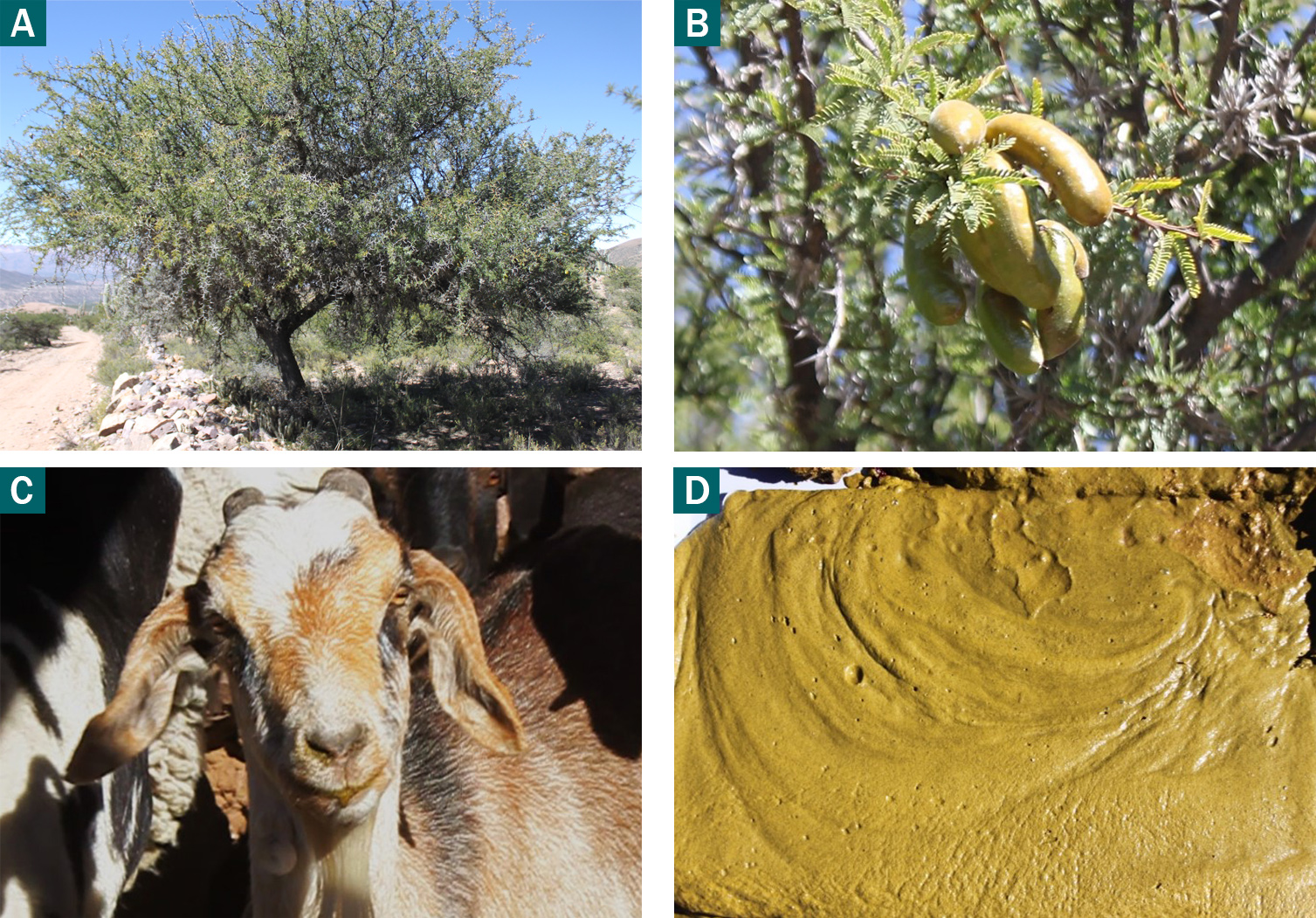
Figure 1.
A. A specimen of a Strombocarpa ferox tree in the grazing area in the study. B. Strombocarpa ferox green pods. C. An affected goat with a greenish foam of the ruminal content in the corners of its lips. D. Creamy homogeneous ruminal content of a greenish color of one of the affected goats.
Only goats were affected, with an incidence of 7% (5/70). In the last week, the affected goats reduced food consumption, locomotion, and interaction with the other animals. Some goats moved their heads constantly. These goats had poor body conditions, classified as 1 on a scale of 1 to 5, and they showed moderate to severe distension of the abdomen and agitation. In addition, they were found with their mouths half-opened, expelling a greenish foam through the corners of their lips (figure 1 C). This clinical sign is known locally as “botar”. The ruminal sounds were less audible in the 2 goats that were clinically evaluated. The clinical signs lasted for 7 to 15 days until the animals died because of progressive weight loss.
One severely affected goat was euthanized for postmortem examination. Tissue samples, including the digestive system and the central nervous system, and the muscles of mastication, were collected and fixed in 10% buffered formalin, embedded in paraffin, sectioned at 3 µm, and stained with hematoxylin and eosin for histopathological examination. A sample of ruminant content from the necropsied animal was collected for a microhistological analysis to determine the presence of plant structures. A specimen of the suspected plants was collected, pressed, dried and submitted to the MCNS Herbarium at the National University of Salta (FCN-UNSA; Facultad de Ciencias Naturales, Universidad Nacional de Salta, Salta, Argentina) for botanic identification.
The gross evaluation of the necropsied animal revealed that the rumen had a creamy homogeneous ruminal content with a greenish color (figure 1 D). It had a mild grassy and fruity odor. Serous atrophy of omental, perirenal, and pericardial fat was observed. Atrophy of masticatory and extrinsic lingual muscles was not observed. The histopathological examination of the tissue samples did not show relevant lesions. The microhistological analysis of the ruminal content showed some seed coats of Strombocarpa spp. The suspected plant was identified as Strombocarpa ferox Griseb. by Dra Olga G. Martinez from the MCNS Herbarium at the National University of Salta (registration #13450).
DISCUSSION AND CONCLUSIONS
Frothy bloat (or legume, dietary, or primary bloat) is caused by the entrapment of fermentation gases produced by readily digestible feeds which form a stable foam. The free-gas bloat (or secondary bloat) is caused by a physical or functional esophagus or cardia obstruction, which leads to the inability to eructate (Essig et al., 1993; Wang et al., 2012). The epidemiological data, clinical signs, gross findings, and microhistological analysis of the ruminal content confirmed the diagnosis of recurrent frothy bloat.
Frothy bloat can occur in ruminants when they graze legume-dominant pastures in the vegetative and early bud stages (Wang et al., 2012; Meyer and Bryant, 2017). The case described here was associated with the consumption of S. ferox green pods. Though, there is no specific nutritional quality data for S. ferox pods, the green pods likely have highly digestible protein that provides readily available nutrients that could result in rapid gas production and proliferation of microbial populations within the rumen (Howarth et al., 1977; Barros, 2010; Meyer and Bryant, 2017). The fast lysis and release of proteins and carbohydrates from plant cells contribute to increasing the viscosity of the ruminal content (Howarth et al., 1977; Gutierrez et al., 1961; Wang et al., 2012), explaining the gross appearance of the ruminal content observed here. However, other factors can also modify the viscosity of the ruminal content, like changes in the pH, surfactant concentration, and small bubbles (Smith et al., 1999; Guard and Fecteau, 2010).
In general, frothy bloat is an acute functional digestive disorder but, in some cases, it can become a chronic, recurring disorder (Majak et al., 2003; Wang et al., 2012). The bloat disappears for a few days and then re occurs. In most cases, chronic bloat occurs sporadically, and it can be resolved spontaneously if the animal stops eating the suspected forage (Guard and Fecteau, 2010; Meyer and Bryant, 2017). Chronic bloat usually occurs due to an abnormality in the belching mechanism, but it is rarely associated with changes in the physical form of the ruminal content (Majak et al., 2003). It is likely that S. ferox has some foam-stabilizing substances that alter ruminal stratification. Moreover, certain legumes such as Medicago sativa L., Trifolium repens L., and grain concentrates have stabilizing substances that promote the formation of a stable ruminal foam (Radostits et al., 2002).
Strombocarpa ferox is a woody legume present in the ravines and high dry valleys of northwestern Argentina and southern Bolivia (Braun Wilke et al., 2000). Locally, this species is highly valued by the habitants as a food resource for livestock (Morales et al., 2005) since a S. ferox medium-sized plant can produce around 32 kg of pods per year (Braun Wilke et al., 2000). To our knowledge, there are no reports of diseases associated with the consumption of S. ferox. In this case, the owner stated that 3 or 4 goats (4-6%) of the flock are affected every year, although that problem varies year after year.
Pods are distributed at the top of S. ferox trees. Forage browsing, a food ingestion behavior of goats, allows them to select and obtain tree pods and leaves that other species, like sheep, cannot reach (Hofmann, 1989; Zapata-Campos and Mellado-Bosque, 2021), which is what could have happened here. This food habit allows goats to consume up to 3 times more pods and fruit from shrubs or trees than sheep (Hofmann, 1989); therefore, goats could become more susceptible to frothy bloat due to the consumption of green pods from the top of the trees, and this can explain why sheep were not affected.
In Argentina, poisoning in goats has been reported due to consumption of Neltuma spp. (formerly Prosopis), locally known as “mascadera,” “tranca,” or “verde” (Micheloud et al., 2018; Martinez et al., 2023). Animals intoxicated in the early stages of this disease show an inability to regurgitate ruminal contents, which accumulate at the labial commissure, sings similar to what is presented here (Micheloud et al., 2018; Micheloud et al., 2019). However, gross evaluation of these animals revealed variable degrees of atrophy of masticatory and extrinsic lingual muscles and high proportions of seeds and pods of Neltuma spp. in the rumen content and the microscopical evaluation revealed vacuolation and degenerative changes in the neurons of the trigeminal nucleus (Micheloud et al., 2018).
In some species of genus Neltuma, which are indicated as causing “mascadera”, piperidine alkaloids called juliprosine and juliprosopine were identified in pods by high performance liquid chromatography-high resolution mass spectrometry (HPLC-HRMS) (Cholich et al., 2024). These toxic components were not evaluated in S. ferox in this study.
Finally, further research on the etiology and pathogenesis of recurrent frothy bloat and other diseases associated with the genus Strombocarpa and Neltuma (=Prosopis) in the ruminant is needed to increase the knowledge about it and establish appropriate prevention guidelines.
REFERENCES
BARROS ASENJO, S. 2010. El género Prosopis valioso recurso forestal de las zonas áridas y semiáridas de América, Asia y África. Ciencia & Investigación Forestal, 16(1), 91-127. https://doi.org/10.52904/0718-4646.2010.340
BRAUN WILKE, R.H.; PICCHETTI, L.P.E.; GUZMÁN, G.F. 2000. Prosopis ferox Griseb.: Estado actual de su conocimiento. Multequina, 9(2): 19-34.
BURKART, A. 1976. A monograph of the genus Prosopis (Leguminosae subfam. Mimosoideae). Journal of the Arnold arboretum, 57 (4), 468-469. https://doi.org/10.5962/p.185864
CHOLICH, L.; PISTÁN, M.; CABRERA BENÍTEZ, A.; TORRES, A.; GARCÍA, E.N.; MARTINEZ, A.; GARDNER, D.; BUSTILLO, S. 2024. Evaluation of the toxicological effects of Neltuma alpataco (Prosopis alpataco) pod alkaloid extract. Toxicon: official journal of the International Society on Toxinology, 241, 107665. https://doi.org/10.1016/j.toxicon.2024.107665
ESSIG, H.W.; HUNTINGTON, G.B.; EMERIK, R.J.; CARLSON, J.R. 1993. Problemas nutritivos relacionados con el tracto gastro-intestinal. In: CHURCH, C.D. (Ed.). El ruminate: Fisiología disgestiva y nutrición. Editorial Acribia, S. A. 539-546 pp.
FRANKLYN, G. CRAIG, M. 2010. Indigestió en Rumiantes. In: SMITH, B.P. (Ed.). Medicina Interna de Grandes Animales (818-842). Elsevier España, S.L.
GUARD, C.L.; FECTEAU, G. 2010. Timpanismo Espumoso. In: Smith, B.P. (Ed.). Medicina Interna de Grandes Animales. Elsevier España, S.L. 855-857 pp.
GUTIERREZ, J.; DAVIS, R.E.; LINDAHL, I.L. 1961. Some chemical and physical properties of a slime from the rumen of cattle. Applied Microbiology ,9(3), 209-12. https://doi.org/10.1128/am.9.3.209-212.1961
HOFMANN, R.R. 1989. Evolutionary steps of ecophysiological adaptation and diversification of ruminants: a comparative view of their digestive system. Oecologia, 78(4), 443-457. https://doi.org/10.1007/BF00378733
HOWARTH, R.E.; MAJAK, W.; WALDERN, D.E.; BRANDT, S.A.; FESSER, A.C.; GOPLEN, B.P.; SPURR, D.T. 1977. Relationships between ruminant bloat and the chemical composition of alfalfa herbage. i. Nitrogen and protein fractions. Canadian Journal Animal Science, 57, 345-357. https://doi.org/10.4141/cjas77-043
MAJAK, W.; MCALLISTER, T.A.; MCCARTNEY, D.; STANFORD, K.; CHENG, K.J. 2003. Frothy bloat. In: KAULBARS, C. (Ed.). Bloat in Cattle. Alberta Agriculture and Rural Development. 4-6 pp.
MARTÍNEZ, A.; CABRERA, R.; CHODILEF, M.; SILVA, C.; ROBLES, C. 2023 “Mascadera”: intoxicación experimental por consumo de Neltuma alpataco en caprinos. xiii Reunión Argentina de Patología Veterinaria, Salta, Argentina.
MEYER, N.F.; BRYANT, T.C. 2017. Diagnosis and Management of Rumen Acidosis and Bloat in Feedlots. In: CALLAN, R.J.; JONES, M.L. (ed.). Digestive Disordes of Forestomach - Veterinary Clinics of North America: Food Animal Practice, 33(3), 481-498. https://doi.org/10.1016/j.cvfa.2017.06.005
MICHELOUD, J.F.; COLQUE CARO, L.A.; CHOLICH, L.A.; MARTÍNEZ, O.G.; GIMENO, E.J. 2019. Suspected poisoning in beef cattle from ingestion of Prosopis nigra pods in north-western Argentina. Toxicon, 157, 80-83. https://doi.org/10.1016/j.toxicon.2018.11.302
MICHELOUD, J.F.; VERA, T.A.; COLQUE CARO, L.A.; GIMENO, E.J. 2018. Clinico-pathological findings in natural cases of “mascadera” in goats. Tropical animal health and production, 50(2), 441-444. https://doi.org/10.1007/s11250-017-1422-5
MORALES, M.S.; VILLALBA, R.; BONINSEGNA, J.A. 2005. Climate, land-use and Prosopis ferox recruitment in the Quebrada de Humahuaca, Jujuy, Argentina. Dendrochronologia 22(3), 169-174. https://doi.org/10.1016/j.dendro.2005.05.004
RADOSTITIS, O.M.; GAY, C.C.; BLOOD, D.C.; HINCHLIFF, K.W. 2002. Timpanismo (Abotagamiento) ruminal. In: MC GRAW HILL. (ed.). Medicina Veterinaria: tratado de las enfermedades del ganado bovino, ovino, porcino, caprino y equino. Interamericana, 9th ed. 348-349 pp.
SMITH, D.F.; BECHT, J.L.; WHITLOCK, R.H. 1999. Anorexia y Distensión Abdominal con o sin dolor en los bovinos. In: ANDERSON, N.V. (Ed.). Gastroenterología Veterinaria. Inter-Médica Editorial. 665-673 pp.
WANG, Y.; MAJAK, W.; MCALLISTER, T.A. 2012. Frothy bloat in ruminants: cause, occurrence, and mitigation strategies. Animal Feed Science and Technology, 172 (1-2), 103-114. https://doi.org/10.1016/j.anifeedsci.2011.12.012https://doi.org/10.1016/j.anifeedsci.2011.12.012
ZAPATA-CAMPOS, C.C.; MELLADO-BOSQUE, M.A. 2021. La cabra: selección y hábitos de consumo de plantas nativas en agostadero árido. Ciencia UAT, 15(2), 169-185. https://doi.org/10.29059/cienciauat.v15i2.1409