Artículos
Evaluation of CBD and THC content in indoor-grown Cannabis sativa cv. MK 2021 flowers for medical use
Evaluation of CBD and THC content in indoor-grown Cannabis sativa cv. MK 2021 flowers for medical use
RIA. Revista de Investigaciones Agropecuarias, vol. 50, núm. 3, pp. 148-154, 2024
Instituto Nacional de Tecnología Agropecuaria

Esta obra está bajo una Licencia Creative Commons Atribución-NoComercial 4.0 Internacional.
Abstract: Cannabis sativa L. has been widely used for medicinal purposes due to the content of specific molecules called cannabinoids. CBD (cannabidiol) is one of the most known cannabinoids for medicinal ends, showing a great potential in therapeutics for childhood epilepsy. In Argentina, cannabis cultivation was prohibited until 2017, when Law No. 27350 was enacted, allowing research using cannabis plants for medicinal use. This gave rise to the need of studying cannabis production and management conditions. To obtain high-quality commercial pharmaceutical products indoor technology is recommended since it allows the control of environmental variables. The aim of this study was to evaluate the CBD and THC content in indoor-grown Cannabis sativa cv. MK 2021 flowers, and their changes according to main and lateral branches. Seeds were sown in phenolic foam cubes and, after 28 days, 46 plants were transplanted to a hydroponic system, composed of 20-liter buckets containing nutrient solution. The crop cycle lasted 105 days. On February 14, the plants were harvested and a total of 10 plants were randomly selected for morphologic measurements and determination of cannabinoids content (%). Plants reached a final height of 119.9 (±10.1) cm. The mean biomass of the flower produced was 52 g/plant, while that of the leaves and roots was 13.3 and 41.6 g/plant respectively. Significant differences were found in the percentage of CBD in the flowers according to the position of the branches: the main branches had higher concentrations than the lateral branches. CBD values varied from 9.5% to 13.65%. In contrast, no differences were found in the percentage of THC according to the position of the branches, with values around 0.7 and 1.6%. This study presents the first results on indoor Cannabis production for medical purposes in south Argentina. This information is very relevant considering that the medicinal cannabis industry may show potential as a new commercial product.
Keywords: cannabinoids, hydroponics, medical plants.
Resumen: Cannabis sativa se ha utilizado ampliamente con fines medicinales debido al contenido de moléculas específicas llamadas cannabinoides. El cannabinoide CBD (cannabidiol) es uno de los más reconocidos para uso medicinal ya que muestra gran potencial terapéutico en la epilepsia infantil. En Argentina, el cultivo de cannabis estuvo prohibido hasta 2017, cuando se aprobó la Ley N.o 27350, lo que permitió la investigación con plantas de cannabis para uso medicinal. Este hecho abre la necesidad de generar información sobre la producción de esta especie y sus condiciones de manejo. Para obtener productos farmacéuticos comerciales de alta calidad, se recomienda el uso de tecnología de cultivo en interiores, ya que permite controlar las variables ambientales. El objetivo de este estudio fue evaluar el contenido de CBD y THC en flores de Cannabis sativa cv. MK 2021 cultivadas en interior, y sus cambios según las ramas principales y laterales. Las semillas se sembraron en cubos de espuma fenólica y tras 28 días, se trasplantaron 46 plantas a un sistema hidropónico compuesto por baldes de 20 litros con solución nutritiva. El ciclo del cultivo tuvo una duración de 105 días. El 14 de febrero, las plantas fueron cosechadas y se seleccionaron al azar 10 plantas para mediciones morfológicas y determinación del contenido de cannabinoides (%). Las plantas alcanzaron una altura final de 119.9 (±10.1) cm. La biomasa media de flores producida fue de 52 g/planta, mientras que la de las hojas y raíces fue de 13.3 y 41.6 g/planta, respectivamente. Se encontraron diferencias significativas en el porcentaje de CBD en las flores, según la posición de las ramas en las plantas: las ramas principales tenían concentraciones más altas que las ramas laterales. Los valores de CBD variaron entre 9.5% y 13.65%. En contraste, no se encontraron diferencias en el porcentaje de THC según la posición de las ramas, con valores entre 0.7 y 1.6%. Este estudio presenta los primeros resultados sobre la producción de cannabis en interiores para fines medicinales en el sur de Argentina. Este tipo de información es muy relevante, considerando que la industria del cannabis medicinal puede mostrar potencial como un nuevo producto comercial.
Palabras clave: cannabinoides, hidroponía, plantas medicinales..
INTRODUCTION
Cannabis sativa is a chemically complex species that contains many molecules from the terpenophenol family, commonly called cannabinoids and phytocannabinoids, which have been widely studied since the discovery of the chemical structure of tetrahydrocannabinol (Δ9-THC), commonly known as THC. This species has been used for medical purposes in China in the last 5000 years (Hanuš and Mechoulam, 2005), although its culture and uses were prohibited for a long time in most countries, mainly owing to the psychoactive nature of THC, generally used as a narcotic substance (Chandra et al., 2017; Wilkinson et al., 2003). Likewise, besides THC, there are about 565 constituents in the plant, of which 120 have already been described as phytocannabinoids, among which are those well-known for their potential in the pharmaceutical industry: cannabidiol (CBD), cannabidivarin (CBDV), tetrahydrocannabivarin (THCV) and cannabigerol (CBG) (ElSohly et al., 2017). Recently, studies on CBD as a medicinal material have shown a great potential in therapeutics for childhood epilepsy syndromes (Chandra et al., 2017), among other reported uses in adults. Moreover, some studies have reported on the best ways to obtain a high-quality medicinal product from this crop (Folina et al., 2019; Jin et al., 2019; Chandra et al., 2017).
In Argentina, this crop had been prohibited until 2017, when law number 27350 regarding the medical and scientific research on the medicinal use of the Cannabis plant and its derivatives was sanctioned. This new legislation provided a framework to start working and carrying out experiments with this species, although scientific studies in the country regarding the management and use of technology in this crop are still very scarce. In addition, it is important to note that most of the cannabis projects initiated in Argentina are either carried out in open fields or greenhouse crops, but no indoor experiences have been reported yet, even though this technology seems to be the most appropriated to obtain high-quality pharmaceutical products (Chandra et al., 2017). In other countries, medical cannabis is usually cultivated indoors to have a better control of the environmental conditions and a higher standardization of the cultivation process (Crispim Massuela et al., 2022). Under indoor conditions, growing temperature, irradiance levels, day lengths and characteristics of growth medium can be manipulated and tightly controlled to obtain the highest quality product. It is known that the content of cannabinoids is affected by both genetic and environmental factors (Gorelick and Bernstein, 2017). While genetics determines the production potential, the environmental conditions can induce variations in quantity, quality, and distribution of the active components in the plant. Therefore, the metabolite profile is a result of the interaction of the environment and physiological processes (Bernstein et al., 2019; Chandra et al., 2017). In addition, some authors have reported that the content of cannabinoids may vary according to the position of the flower in the plant (Nambdar et al., 2018) or pruning (Danziger and Bernstein, 2021).
Southern Patagonia is an area with cold temperatures and strong winds that difficult outdoor cannabis production. Therefore, researchers have been working for almost 10 years on the adaptation of indoor hydroponic cultivation techniques, with the aim of obtaining a technological package that allows producers to grow fresh products all year round (Birgi et al., 2023; Birgi and Gargaglione, 2021). This technological package, in addition to overcoming the climatic constraints of the region, represents an advance in the application of new technologies that have not been explored as much in this austral region and is designed to be applied to a great diversity of crops, including Cannabis. In this sense, the aim of this study was to evaluate the CBD and THC content in indoor-grown Cannabis sativa cv. MK 2021 flowers and their changes according to main and lateral branches. It was carried out in south Patagonia, Argentina, as an alternative to diversify agricultural production with a high-value crop in this climatically unfavorable region.
MATERIAL AND METHODS
This study was carried out at the INTA Santa Cruz Experiment Station (51°37’51’’ S; 69°15’20’’ W), located in the city of Río Gallegos, south Patagonia, Argentina. The mean long-term annual precipitation of this site is 239 mm yr-1 and the mean annual temperature (MAT) is 7.6oC. In summer, strong SW winds are frequent with speeds that can reach up to 90 km h-1.
For indoor production, a shipping container (12 x 2.4 x 2.59 m) was conditioned by applying interior and exterior coating and a layer of insulating material. Light was provided by a total of 60 LED lamps (VIC LED model Ht 5004). The photosynthetically active radiation (PAR) emitted by the lamps was measured with an Apogee Model MQ-301 PAR bar in in three positions inside the container (beginning, middle and end) and at two different heights, 1.07 m and 30 cm away from the lamp. To detect significant differences in light received according to the position of the lamps inside the container, an analysis of variance (p<0.05) was carried out with Infostat 2.0 (Di Rienzo et al., 2020). Air temperature was continuously measured every hour with a Decagon Device Em 5b data logging system. The heating system consisted of four 940 W flat heat panels located at the beginning and end of the container, that were automatically activated when temperature fell below 210C, and when the temperature was above 27 degrees, the extraction systems automatically were initiated, composed by two extractors EOLO (Mod MFR 35/14) with a 0,4 m diameter, 1/8 HP and 1400 rpm.
Plant material and nutrition
On November 2 of 2023, a total of 90 seeds of Cannabis sativa cv. MK 2021 (Fermax, http://agricolafermax.uy/mk2021) were sown in phenolic foam cubes that were arranged in speedling trays containing distilled water. Each seed received a control number and each plant was individually monitored throughout the growth cycle. After 15 days, a total of 47 seeds germinated successfully and nutrient solution at ½ full was added. The pH and electric conductivity (EC) of the solution at this stage were 6 and 1.0 mS cm-1, respectively. Nutrient solution was made according to Llewellyn et al. (2023) for an optimal Cannabis production, and corresponded to the following concentrations in mg L-1: 130, 40, 180, 130, 44, 59, 2.1, 0.6, 0.12, 0.03, 0.39, 0.02 of nitrogen (N), phosphorous (P), potassium (K), calcium (Ca), magnesium (Mg), sulphur (S), iron (Fe), manganese (Mn), zinc (Zn), copper (Cu), boron (B) and molybdenum (Mo), respectively. Nutrient solution pH and EC were monitored daily with a MILWAUKEE (MW 801, ROMANIA) portable meter and values were maintained at 5.8 and 1.8 mS cm-1, respectively.
On November 30, 46 plants with an average height of 12 (±2.8) cm were transplanted to a hydroponic system. The hydroponic system consisted of 20-liter buckets containing nutrient solution, and each bucket had one plant that was randomly located and supported by a plastic basket (figure 1). Extra oxygen for roots was provided continuously by two aquarium air pumps (RS Electrical-16000) (one by side) which injected air bubbles in each bucket individually through microtubes. The photoperiod lasted 16 h at vegetative stage, and after 20 days of growth, it was changed to 12 h to induce flowering.
During the growing period, three pruning were applied, one to the main apex (topping) on December 12, and two to the lower foliage (January 2 and 10, 2024). In this case, all the branches that were below the fifth node and that did not receive enough light were pruned.
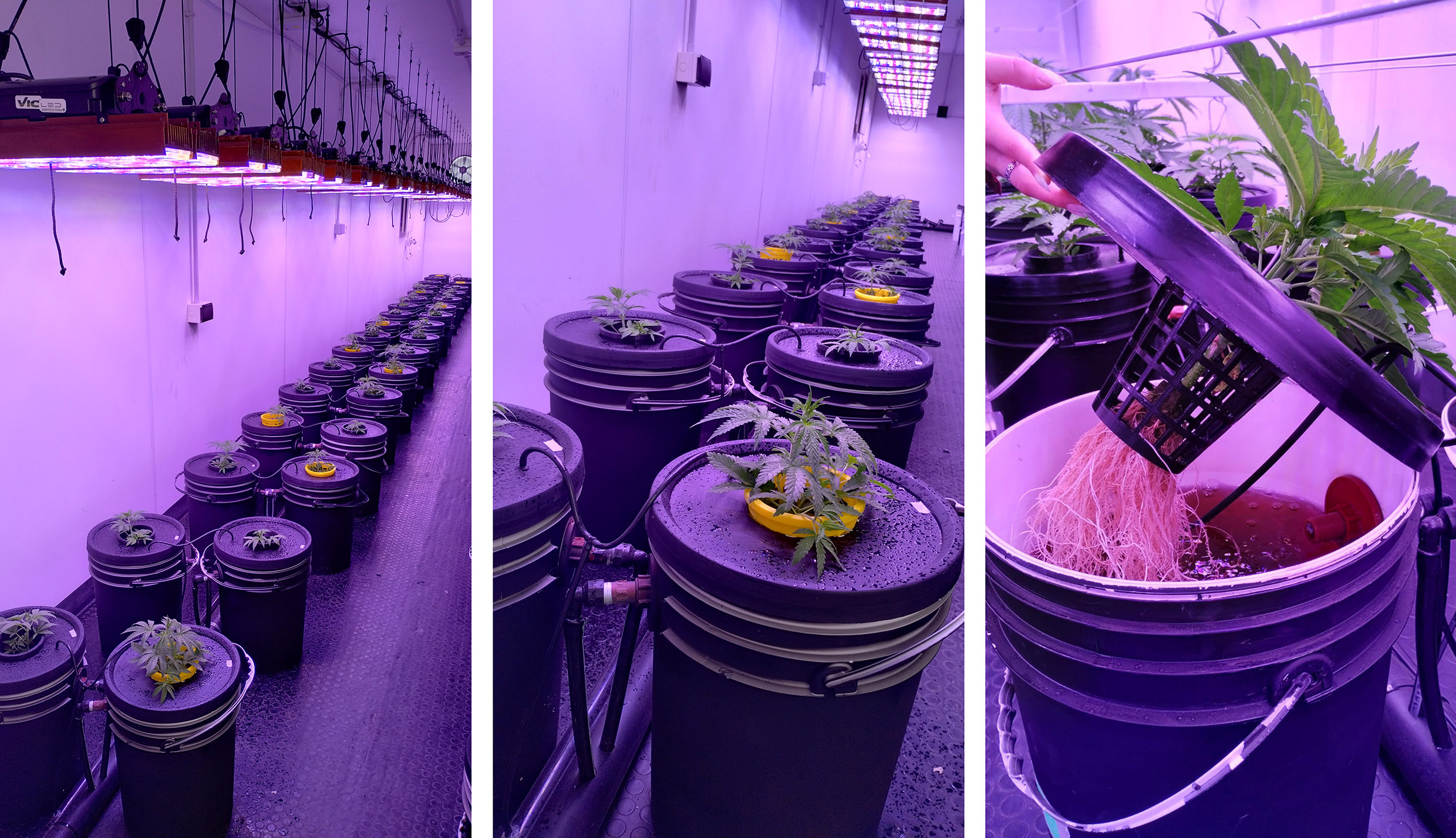
Figure 1
Cannabis sativa var. MK 2021 growing in an indoor hydroponic system inside at maritime container. Each plant was supported by a plastic basket and randomly assigned to 20-liter buckets. Each plant conserved its identification number from germination.
Measurements and harvest
The mean height of the plants was measured daily. After 8 weeks of flowering induction, pistils changed their color from white to amber, indicating that the crop was ready for harvest. On February 14 the plants were harvested, and the roots were weighed fresh and oven-dried to constant weight. A total of 10 plants were randomly selected for morphologic measurements and determination of cannabinoids content (%). Each sampled plant corresponded to plant numbers 11, 23, 25, 41, 53, 66, 70, 73, 81 and 88. All the branches of these plants were counted and classified into main and lateral branches according to their position in the stem. The diameter of the stems (measured just before the first ramification) and main branches were measured with a vernier caliper. After these measurements were taken, the sampled plants and all the others from the container were transferred to the drying area where they were hung from the stem, leaving the inflorescences facing down, for a period of ten days. Once the plants reached a moisture level of 10%, the flowers and leaves were separated from the stem of each plant and weighed fresh, then 10 subsamples were oven-dried to determine the dry weight. Aerial biomass (flowers and leaves) was measured in all plants, while the content of cannabinoids (%) was measured in the 10 plants sampled for morphological measurements. As for these plants, samples consisting of 3 flowers from main branches and 3 from lateral branches were taken to determine instant % of THC and CBD with cannabinoid analyzer Pro GemmaCert NIR (GC 200 7320903). Although this technology is not as accurate as an HPLC analysis, it provides an instantaneous and rapid measurement that allows many samples to be analyzed in a short period of time. In consequence, in this study, a total of 60 samples were analyzed for each cannabinoid (10 plants x 3 flowers x 2 branch type).
To determine the differences in the % of cannabinoids according to plants or branches (main vs. lateral), an analysis of variance (p<0.05) was carried out with Infostat 2.0 (Di Rienzo et al., 2020). The significant differences were separated by a Tukey test with a p value of <0.05.
RESULTS
Environmental conditions
When the plants were placed in the hydroponic system, lamps were located at 1.07 m above them and the mean light received was 470 µmol.m-2s-1. As the plants grew, they got closer to the lamps and, once they had reached their final height, the mean light received was 1060 µmol.m-2s-1. No significant differences were found in the amount of light received according to the locations inside the container (table 1).
The daily mean temperature during the growing period was 21.50C, while the mean temperatures of the light and dark periods were 20.3 and 20.90C, respectively (figure 2). The lowest and highest temperatures values were 15 and 26.60C, respectively (figure 2).
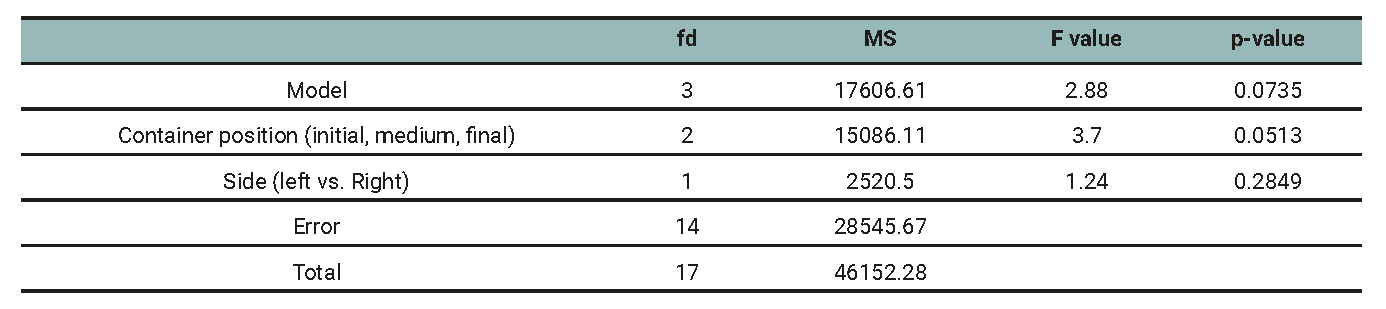
Table 1
Analysis of variance of the amount of PAR light emitted by the lamps according to their position inside the container.
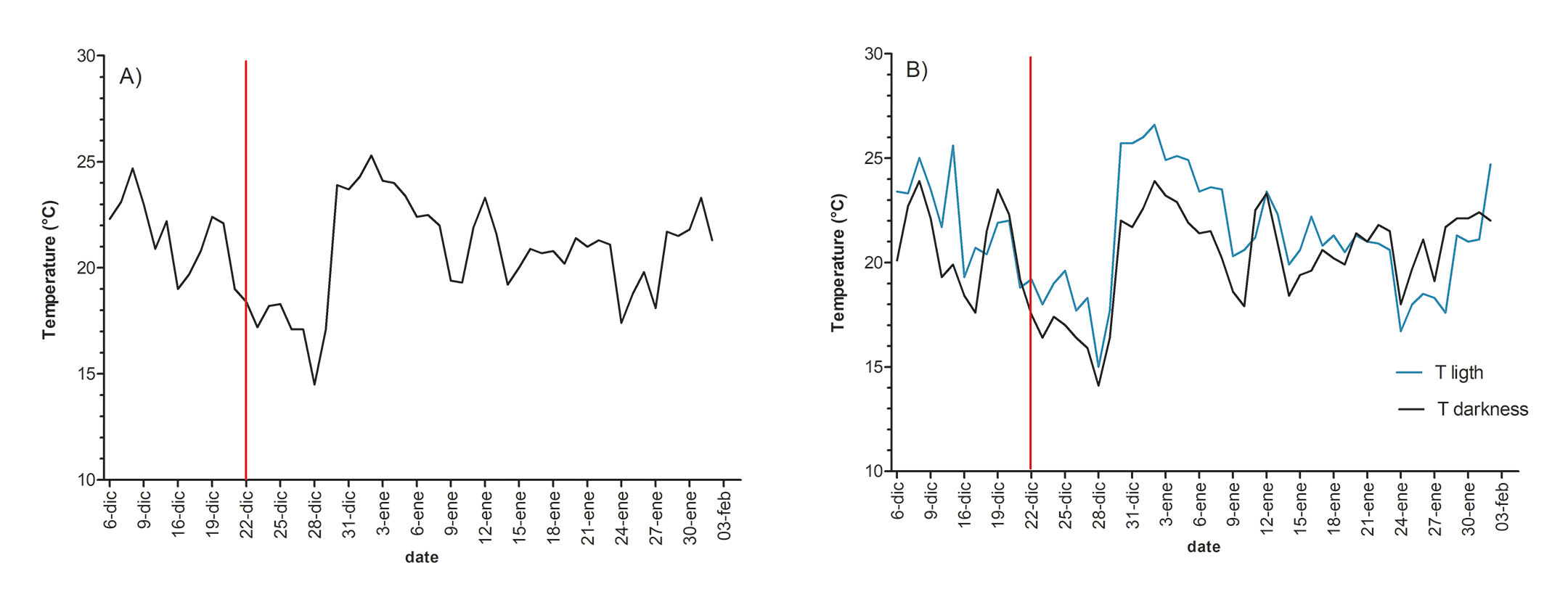
Figure 2
Mean daily temperature values (A), and mean temperature values in hours of light (blue line) and in darkness (black line) (B), among the growing period of indoor Cannabis sativa cv MK 2021. Red line indicates the date when photoperiod changed from 16 to 12.
Growth and biomass results
The length of the crop cycle from sowing to harvest was 105 days. When the plants were transferred to the hydroponic system (November 30th), their mean height was 12.5 (±2.8) cm; then they grew linearly for 38 days, reaching a final height of 119.9 (±10.1) cm on February 8 (figure 3 A). At the end of the cycle, the mean stem diameter of the Cannabis plants was 20.7 (±5) mm and, in general, the plants had 4 main branches, with an average diameter of 9.8 (±2.9) mm. The mean flower biomass was 52 g/plant, while the leaves and roots accounted for 13.3 and 41.6 g/plant, respectively (figure 3 B).
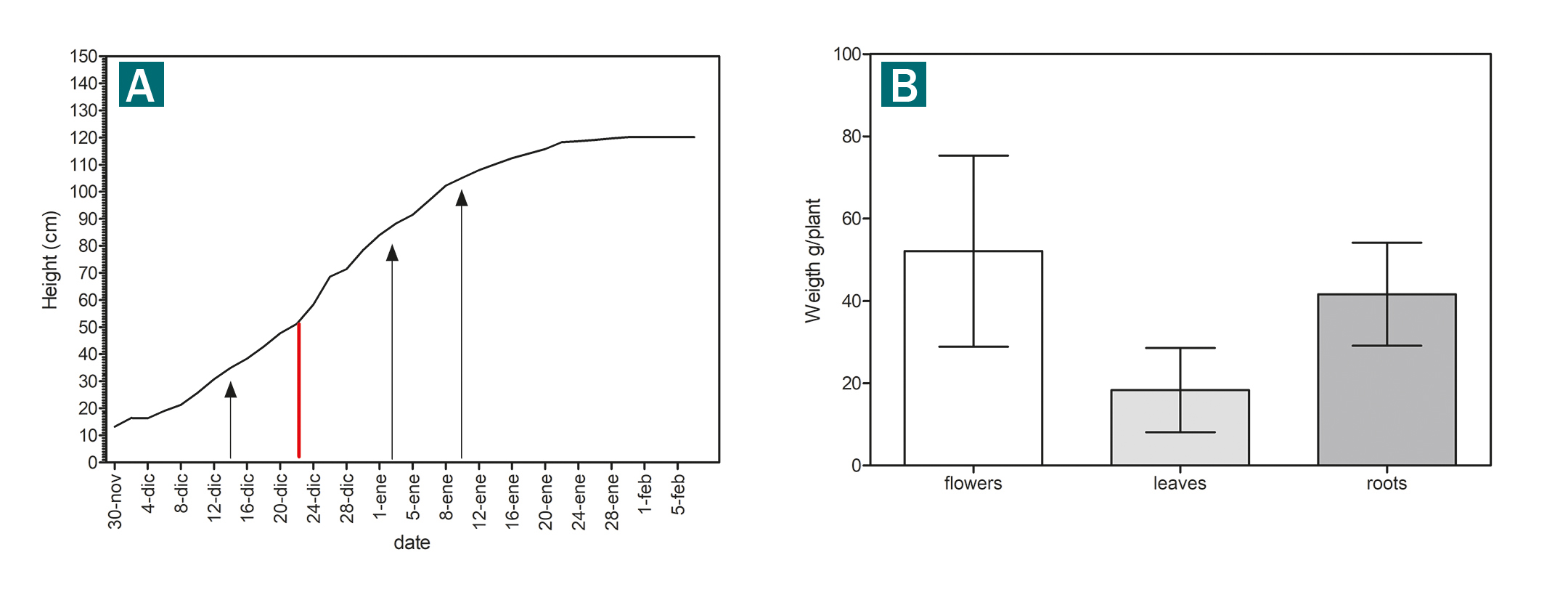
Figure 3
A) Mean height of Cannabis sativa (cv. MK 2021) plants during the growth period in the indoor hydroponic system. Arrows indicate the dates when the pruning of lower leaves was made. The red line indicates the moment when the photoperiod changed from 16 to 12 hours of light. B) The mean biomass values of the flowers, leaves and roots. Vertical bars indicate standard deviation of the mean.
Percentage of cannabinoids in flowers
Significant differences were found in the % of CBD in flowers among individual plants and different type of branches (table 2). The levels of CBD ranged from 9.5% in plant number 73 to a maximum of 13.65% in plant number 11. Additionally, differences were found according to the type of branches (table 2), with mean values of 12.4 and 11.3% for the main and lateral branches, respectively (figure 4). As for the percentage of THC in flowers, differences were found between plants but not between branch types (table 2). The minimum and maximum values of THC were 0.7% and 1.6%, for plant number 41 and 70, respectively.
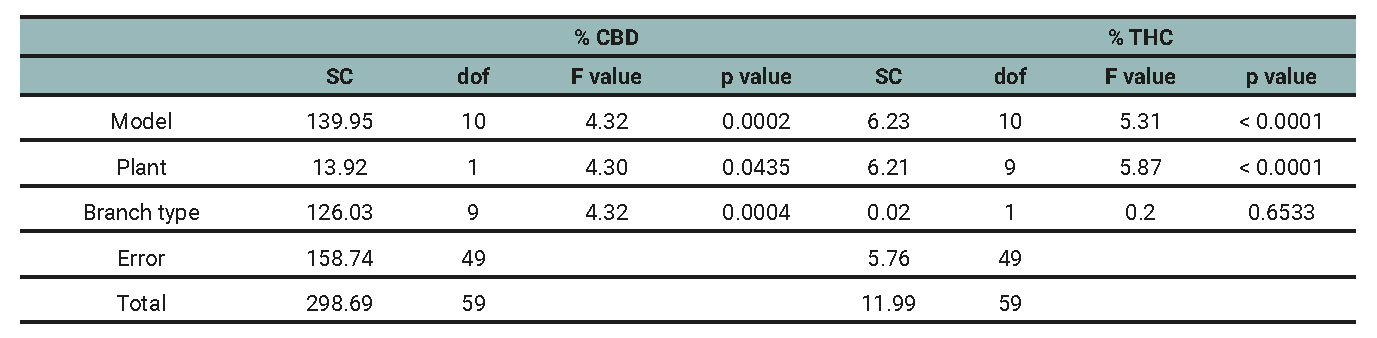
Table 2
Analysis of variance of percentages of CBD and THC cannabinoids in Cannabis sativa cv. MK 2021 flowers, according to individual plant and branch type (main or lateral), grown in an indoor hydroponic system.
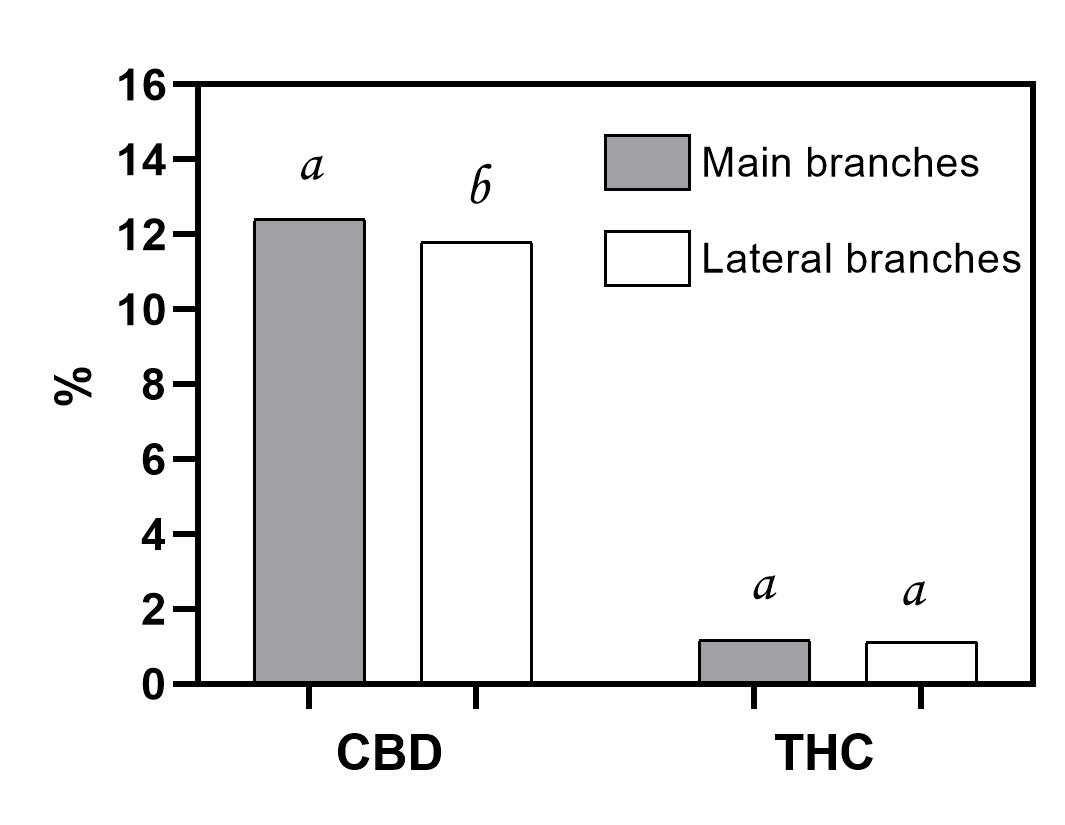
Figure 4
Mean percentages of CBD and THC cannabinoids in flowers of main and lateral branches of Cannabis sativa cv. MK 2021 plants, grown in an indoor hydroponic system.
DISCUSSION
The mean biomass values of flower reported in this study for cv. MK 2021 (52 g/plant) were higher than those reported by Saloner and Bernstein (2021) (40 g/plant) and higher than those reported by Janatová et al. (2018), who, working with Cannabis plants with 19% of THC, observed biomass of flowers that ranging between 15.41 and 24.74 g/plant for different genotypes under indoor conditions. Likewise, Magagnini et al. (2018) observed values that ranged between 22.8 and 26.6 g/plant for THC genotypes (G-170) growing under different light conditions. Vanhove et al. (2011) evaluated different genotypes and observed values around 9 and 28 g/plant of flowers, with a higher production under the highest light intensity (600 W) and a plant density of 16 plants m-2. These authors informed that light interception was the limiting factor in grown indoor cannabis yield, plants at lower densities intercepted more light, having higher photosynthesis and, consequently, higher production (Vanhove et al., 2011). This could also explain our higher results, since the density in our study was lower than previously reported.
The FERMAX company reports mean general values of 0.77% of THC and 18% of CBD for Cannabis sativa cv. MK 2021. In our study, plants presented a mean of 1.15 and 12% for THC and CBD cannabinoids, respectively. These differences may be owing to the variation in the environmental conditions where the plants were measured. On the other hand, we observed differences in CBD between flowers of main and lateral branches, with higher CBD % in those from the main branches. These results agree with those of Reichel et al. (2022), who, by comparing plants growing under different light treatments and with different flower positions in the plant, observed that the acid form of CBD (CBDA) varied according to the position of the flower, especially under LED treatments, with higher concentrations in the main buds and lower in the lateral buds. In this sense, it is known that light intensity and quality, can vary according to the different positions along the shoot due to the architecture of the plant shaped by shading, affect the biosynthesis and the accumulation of secondary metabolites (Bian et al., 2015; Ouzounis et al., 2015). In addition, Dazinger and Bernstein (2021) observed that plant pruning may influence the distribution of cannabinoids, since pruning treatments increased cannabinoid uniformity among plant components, in contrast to control plants. These authors also postulated that there is some variability in this response according to each cultivar. In our study, we did top pruning at early vegetative stage, and we obtained main and lateral branches, which had different CBD concentrations. It is possible that, to obtain a higher homogeneity in cannabinoids among branches, another pruning would be necessary, although this aspect needs to be studied in MK 2021 variety.
This study reports the first results for indoor Cannabis production for medical purposes in Argentina. This kind of information is very relevant as a starting point considering that medicinal cannabis may show potential as a new commercial product, particularly after the approval of Law No. 27350, which regulates on medical and scientific research on Cannabis plants, in Argentine.
REFERENCES
BERNSTEIN, N.; GORELICK, J.; KOCH, S. 2019. Interplay between chemistry and morphology in medical cannabis (Cannabis sativa L.) Industrial Crops and Products, 129, 185-194.
BIAN, Z.H.; YANG, Q.C.; LIU, W.K. 2015. Effects of light quality on the accumulation of phytochemicals in vegetables produced in controlled environments: A review. Journal of the Science of Food and Agriculture, 95 (5), 869-877. https://doi.org/10.1002/jsfa.6789
BIRGI, J.A.; GARGAGLIONE, V. 2021. Producción y calidad de dos variedades de frutilla (Fragaria x ananassa Duch.) en hidroponía en Santa Cruz. Revista ICT-UNPA (1), 95-106. http://doi.org/10.22305/ict-unpa.v13.n1.791
BIRGI, J.A.; GARGAGLIONE, V.; PERI, P.L.; ARAUJO PRADO, C.I.; DÍAZ, B.G., GONZALEZ, L.; GESTO, E.; HALLAR, K.; LAGUÍA, D.; SOFÍA, O.; DÍAZ, M. 2023. Módulo Antártico de Producción Hidropónica: primeros resultados del cultivo en la Antártida Argentina. Informes Científicos Técnicos - UNPA, 15(3), 348-364. https://doi.org/10.22305/ict-unpa.v15.n3.993
CHANDRA, S.; LATA, H.; ELSOHLY, M.A.; WALKER, L.A.; POTTER, D. 2017. Cannabis Cultivation: Methodological Issues for Obtaining Medical-Grade Product. Epilepsy Behavior, 70, 302-312.
CRISPIM MASSUELA, D.; HARTUNG, J.; MUNZ, S.; ERPENBACH, F.; GRAEFF-HÖNNINGER, S. 2022. Impact of harvest time and pruning technique on total CBD concentration and yield of medicinal cannabis. Plants, 11(1), 140.
DANZIGER, N.; BERNSTEIN, N. 2021. Shape Matters: Plant Architecture Affects Chemical Uniformity in Large-Size Medical Cannabis Plants. Plants 10, 1834.
DI RIENZO, J.A.; CASANOVES, F.; BALZARINI, M.G.; GONZALEZ, L.; TABLADA, M.; ROBLEDO, C.W. 2020. InfoStat versión 2020. Centro de Transferencia InfoStat, FCA, Universidad Nacional de Córdoba, Argentina.
GORELICK, J.; BERNSTEIN, N. 2017. Chemical and physical elicitation for enhanced cannabinoid production in cannabis. In: CHANDRA, S.; LATA, H.; ELSOHLY, M.A. (eds.). Cannabis sativa L. – botany and biotechnology. Cham: Springer International Publishing, 439-456.
HANUŠ, L.O.; MECHOULAM, R. 2005. Cannabinoid Chemistry: an Overview. In: MECHOULAM R. (ed.). Cannabinoids as Therapeutics. Birkhäuser Basel. 23-46 pp. http://dx.doi.org/10.1007/3-7643-7358-X_2
JANATOVÁ, A.; FRAŇKOVÁ, A.; TLUSTOŠ, P., HAMOUZ, K.; BOŽIK, M.; KLOUČEK, P. 2018. Yield and cannabinoids contents in different cannabis (Cannabis sativa L.) genotypes for medical use. Industrial crops and products, 112, 363-367.
LLEWELLYN, D.; GOLEM, S.; JONES, A. M. P.; ZHENG, Y. 2023. Foliar symptomology, nutrient content, yield, and secondary metabolite variability of cannabis grown hydroponically with different single-element nutrient deficiencies. Plants, 12(3), 422.
MAGAGNINI, G.; GRASSI, G.; KOTIRANTA, S. 2018. The effect of light spectrum on the morphology and cannabinoid content of Cannabis sativa L. Medical Cannabis and Cannabinoids, 1(1), 19-27.
NAMDAR, D.; MAZUZ, M.; ION, A.; KOLTAI, H. 2018. Variation in the compositions of cannabinoid and terpenoids in Cannabis sativa derived from inflorescence position along the stem and extraction methods. Industrial Crops and Products, 113, 376-382.
OUZOUNIS, T.; ROSENQVIST, E.; OTTOSEN, C.O. 2015. Spectral effects of artificial light on plant physiology and secondary metabolism: a review. HortScience 50, 1128-1135. https://doi.org/10.21273/hortsci.50.8.1128
SALONER, A.; BERNSTEIN, N. 2021. Nitrogen supply affects cannabinoid and terpenoid profile in medical cannabis (Cannabis sativa L.). Industrial Crops and Products, 167, 113516.
REICHEL, P.; MUNZ, S.; HARTUNG, J.; KOTIRANTA, S.; GRAEFF-HÖNNINGER, S. 2022. Impacts of different light spectra on CBD, CBDA and terpene concentrations in relation to the flower positions of different Cannabis sativa L. strains. Plants, 11(20), 2695.
VANHOVE, W.; VAN DAMME, P.; MEERT, N. 2011. Factors determining yield and quality of illicit indoor cannabis (Cannabis spp.) production. Forensic Science International, 212 (1-3), 158-163.
WILKINSON, J.D.; WHALLEY, B.J.; BAKER, D.; PRYCE, G.; CONSTANTI, A.; GIBBONS, S.; WILLIAMSON, E.M. 2003. Medicinal cannabis: is Δ9 -tetrahydrocannabinol necessary for all its effects? Journal of Pharmacy and Pharmacology 55, 1687-1694. http://dx.doi.org/10.1211/0022357022304