Artículos
Travel motivations of the residents of Guimarães
Motivações de viagem dos residentes em Guimarães
Travel motivations of the residents of Guimarães
PASOS. Revista de Turismo y Patrimonio Cultural, vol. 17, no. 4, pp. 643-653, 2019
Universidad de La Laguna

This work is licensed under Creative Commons Attribution-NonCommercial-NoDerivs 4.0 International.
Received: 05 October 2017
Accepted: 25 July 2018
Abstract: Guimarães has made a major effort in promoting tourism, positioning itself as an urban and cultural tourism destination. This strategy is based on the historical heritage of the city, which is a UNESCO world heritage site since 2001, and the promotion of events, such as the European Capital of Culture (ECOC) in 2012. The new image created for Guimarães has defined a new lifestyle for its residents by placing tourism and culture at the forefront of a new development strategy. This study examines the underlying reasons for the travel decisions of the population of the municipality of Guimarães, investigating their push and pull tourist motivations. The study also analyses the role that important socio‑demographic variables play in determining travel motivations of residents from this municipality. The empirical analysis was undertaken based on questionnaires administered in 2012 to residents of Guimarães. Results show that gender, age, and education make a difference with regard to travel motivations.
Keywords: Guimarães, Motivations, Residents, Tourism.
Resumo: Guimarães fez um grande esforço na promoção do turismo, posicionando‑se como um destino turístico urbano e cultural. Esta estratégia baseia‑se no património histórico da cidade, património mundial da UNESCO desde 2001, e na promoção de eventos, como a Capital Europeia da Cultura (CEC) em 2012. A nova imagem criada para Guimarães definiu uma novo estilo de vida para os seus residentes, colocando o turismo e a cultura na vanguarda de uma nova estratégia de desenvolvimento. Este estudo analisa as razões subjacentes às decisões de viagem da população do município de Guimarães, investigando as suas motivações turísticas. O estudo também analisa o papel que as variáveis sociodemográficas exercem na determinação das motivações de viagens dos moradores desse município. A análise empírica foi realizada com base em questionários aplicados em 2012 aos residentes de Guimarães. Os resultados mostram que gênero, idade e educação fazem a diferença em relação às motivações das viagens.
Palavras-chave: Guimarães, Motivações, Moradores, Turismo.
1. Introduction
Guimarães is located in the Ave Valley of the northern part of Portugal and it is one of the most important cities in that territory. The Ave Valley has been identified for centuries as an industrial district, marked by the presence of a few traditional manufacturing activities, such as textiles, clothes, and footwear (Vareiro, Remoaldo, & Cadima Ribeiro, 2013). As many other regions in Europe, the northern region of Portugal, including Guimarães, experienced a gradual process of deindustrialization in recent years (Freitas Santos, Vareiro, Remoaldo, & Cadima Ribeiro, 2014). To face this challenge, Guimarães has made a major effort in promoting tourism, positioning itself as an urban and cultural tourism destination. This strategy is based on the historical heritage of the city, which is a UNESCO world heritage site since 2001, and the promotion of events, such as the European Capital of Culture (ECOC) in 2012. The new image created for Guimarães has defined a new lifestyle for its residents by placing tourism and culture at the forefront of a new development strategy.
This study focuses on the underlying reasons for the travel decisions of the residents of the Portuguese municipality of Guimarães. It is important to know what are the tourist motivations of the regions’ residents, monitor these motivations over time and assess the extent to which major events and the growth of tourism changes/affects their tourist motivations. Insight on the needs and preferences of tourists represents a key success factor in the tourism industry. This insight may be an important policy tool for tourism planners and managers in the development of products and marketing strategies. Additionally, the study examines the role that important socio‑demographic variables, such as gender, age, and education, play in determining travel motivations of these residents.
Relying on data collected from questionnaires that were administered in 2012 to residents of Guimarães, the empirical analysis was conducted based on the push and pull motivational framework. Quantitative methodologies, namely descriptive statistics, principal components factor analysis, Cronbach’s alphas, t‑tests and ANOVAs, were used to exploit data resulting from the survey.
This paper is organized as follows. The first section briefly reviews the literature on the push and pull motivational framework. The methodology used for empirical purposes is described in section two, while the estimated results are reported and discussed in the third section. The main conclusions are reported in the final part of the paper.
2. Motivational framework for tourism
Tourism motivation is a key factor in understanding tourist behaviour. Reflected in travel choice, motivation plays an important role in understanding the decision making process of tourists. Several theoretical frameworks concerning tourism motivation have been developed over the past decades. The two‑dimensional push and pull approach is one of the most commonly applied motivational frameworks. Dann (1977) proposed the importance of push and pull factors in shaping tourist motivation. The main idea underlying the push and pull approach is that travel decision is formed in a two‑stage sequence. The individual is initially pushed to travel by internal desires, and then pulled by external resources related to the destination. Push factors are defined as socio‑physiological motives that help to explain the individual’s need to travel, such as the desire for rest, relaxation, health, and adventure. These factors are referred to as intangible forces that are internal to individuals and that push them into making travel decisions. Pull factors are related to destination choice. They emerge as a result of the attractiveness of the destination’s attributes, such as historical and cultural resources, beaches and recreation facilities. These pull factors are defined as tangible forces that are external to individuals and that pull them towards the travel destination. Crompton (1979) conceptualized motivational factors that influence tourists’ decisions based on Dann’s (1977) push and pull theoretical framework. Hence, nine motivational categories were identified, in which seven were classified as push (socio‑psychological) motives, and two where considered pull (cultural) motives. The push motives include “escape from a perceived mundane environment”, “exploration and evaluation of self”, “relaxation”, “prestige”, “regression”, “enhancement of kinship relationships”, and “facilitation of social interaction”, whereas the pull motives are identified as “novelty” and “education”. The push and pull motivational approach has been applied in several studies aimed at capturing the underlying reasons for travel decisions. Kozak (2002) examined if motivational differences existed between tourists from the same country visiting two different geographical destinations and across tourists from two different countries visiting the same destination. The main findings demonstrated differences in tourism motivation between nationalities and places visited. Kim, Jogaratnam, and Noh (2006) analysed the travel decisions of students at an American university. Their study reveals seven push and six pull factors and substantial differences in the factors across destinations. The push factors include: “escape”, “seeing and learning”, “adventure and thrill”, “visiting friends or relatives”, “indulgence”, “nature” and “fun and entertainment”. Among the pull factors are “sun and beaches”, “time and cost”, “sports”, attractions”, “family” and “natural environment”. Jang and Cai (2002) identify six push and five pull factors of motivation associated with British outbound pleasure travellers. “Knowledge seeking” and “cleanliness and safety” were perceived as the most important push and pull factors respectively. The authors further identify key motivational factors that have significant effects on destination choice. The results show that British travellers tend to visit the US for “fun and excitement” and “outdoors activities”, Oceania for “family and friendship togetherness” and Asia “to seek a novel experience”. Jonsson and Devonish (2008) investigated whether there are differences between tourism motivations of those who are from different countries travelling to the destination of Barbados. They also examined whether there are any differences in the motivations between male and female tourists, and among tourists of different age groups. The study concludes that both nationality and age affect travel motivations, but gender does not. Li, Wen, and Leung (2011) investigated the travel motivation of Chinese female travellers in the context of outbound travel to Hong Kong. Four push factors (“knowledge and prestige”, “enhancement of social relationships”, “rest and relaxation”, “adventure and excitement”) and five push factors (“modern image”, “natural environment and attractions”, “safety and cleanliness”, “ease of tour arrangement”, “shopping”) were identified.
Gender differences in push and pull motivational factors of Australian tourists where studied by McGehee, Murphy, and Uysal (1996). The main results of this empirical analysis reveal that male and female tourists place different importance on some push and pull factors. Men are more motivated by sports and adventure, whereas women place more importance on culture, opportunities for family bonding and prestige. Meng and Uysal (2008) also addressed tourism motivation from a gendered perspective based on the push and pull motivational framework. The findings of their study reveal gender differences in the perceived importance that men and women place on destination attributes. Women place higher importance on most destination attributes, such as natural scenery and recreational activities. Men value nature‑based activities and resort facilities. These findings are similar to the findings of McGehee et al. (1996) that men are more likely to seek action and adventure in their tourism experience.
With regard to Portugal, Marques (2006) addressed the motivational framework by focusing the different dimensions of the push factor “seeking to escape” as key elements in Portuguese domestic travel decisions. Correia, Valle, and Moço (2007) applied the push and pull approach to study the motivations of Portuguese tourists’ outbound travel to exotic places. The exploratory analysis showed that these motivations are linked to the desire of knowledge, social status and intellectual leisure. The analysis further shows that these push factors determine the perceived pull motives: facilities, core attractions and landscape features. In their investigation on the determinants of tourism return behaviour in the context of Portuguese travel to Brazil, Valle, Correia, and Rebelo (2008) concluded that the returning behaviour is mostly related to emotional motivations, such as socialization and leisure.
As shown above, empirical research that applies the push and pull motivational framework to analyze the underlying reasons for travel decisions is well documented. However, few studies use this approach to focus Portuguese travel motivations. The present study aims to contribute to prior research so that further insights regarding the Portuguese case may be gained.
3. Methodology
3.1. Questionnaire and data collection
The questionnaire contains three main sections. In the first section, information about push and pull motivation was collected. Respondents were asked to specify how important each item is to them when making travel decisions using a five‑point Likert scale (1 = not at all important; 2 = not very important; 3 = neutral; 4 = important; 5 = very important). A total of 25 push and 28 pull motivation items were used based on a previous empirical research conducted by Mendes and Vareiro (2012), which was adapted from Kim et al. (2006). In the second section, respondents were asked to specify general information about their tourist travel made in 2011 (number of trips, length of stay, destination, travel group size, major reason for travel, trip organization). In the final section, information on socio‑demographic characteristics such as gender, age, residence, marital status, and education was collected.
In the beginning of March 2012, a pre‑test involving ten graduate students was carried out. This exercise made it possible, among other things, to discover and correct any potential problems. Minor changes, mostly related to the clarity of the questions, were included in the final questionnaire.
In order to create the sample, a local high school (CISAVE Professional School), located nearby the historical centre of Guimarães, was contacted. The high school was chosen in order to include in the survey four age groups of residents: 15 to 24 years; 25 to 44 years; 45‑64 years; and 65 or more years. The decision to include in the sample not only adults is related to the fact that, in the Western world, the role of children for family decision making is increasing and families have become negotiation families (Gram, 2007).
Contact was established with the headmaster of the high school and the assistance of teachers who could hand out the questionnaires to their students was solicited. Students aged 15 and older were asked to answer the survey. These students were also asked to include their siblings, parents, grandparents, and friends in the study by asking them to answer the survey. The questionnaires were administered to residents that have travelled at least once. Each teacher handed out four questionnaires to students aged 15 and older and asked them to return them within a two weeks time schedule. A total of 300 usable surveys were returned; however, it was found that only 280 were from residents of the municipality under analysis. The study has the restriction of being limited to the case of residents of Guimarães. Nevertheless, based on the available data, a first opportunity to explore the issue of differences in tourist motivations according to gender, age, and education was created. Hence, the research will assist governments and tourism marketers from destinations traditionally chosen by these residents, developing better strategies for promotion and retention of tourists through the investigation of tourists’ needs.
3.2. Data analysis
The data analysis in this study consisted of three stages. First, push and pull motivation factors were ranked and the five most important and the five least important were highlighted. Second, the principal components factor analysis was employed separately to the push and pull expressions in order to identify underlying dimensions associated with residents’ motivations for tourist traveling. A varimax rotation, the most common choice in the orthogonal rotation method, was used since it generally provides easier interpretation and the resulting factors were expected to be utilized in the subsequent analysis (Hair, Anderson, Tatham, & Black, 1998). A cut‑off eigenvalue of 1 was pre‑determined. Cronbach’s alpha was applied to test the reliability of factor groupings. All factors have alphas greater than 0.6 and were retained for further analysis (Hair et al., 1998). Finally, independent sample t‑tests and ANOVAs were used to examine the differences regarding push and pull motivation among gender, age, and education groups. The mean scores of push and pull factors and items were compared across gender, age, and education groups to understand which factors and items were perceived more important for residents of each group. Data were analysed using the Statistical Package for the Social Sciences (SPSS), version 22.0.
4. Results
4.1. Sample profile
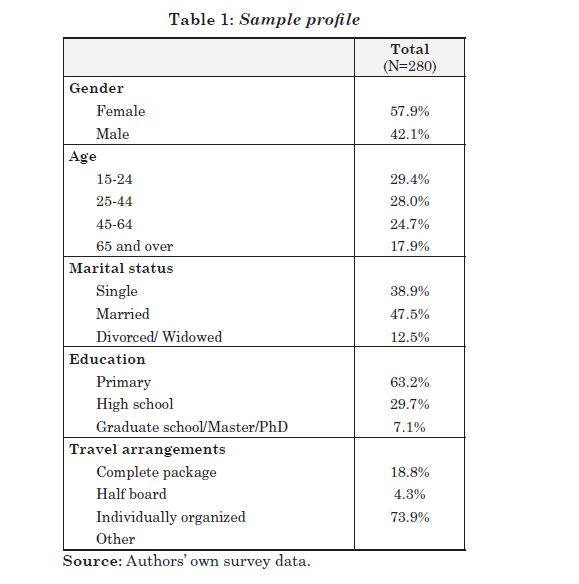
Table 1 summarizes the socio‑demographic profile of the survey sample. The respondents are mostly female (57.9%) and married (47.5%). The largest age cohorts of respondents are the 15 to 24 (29.4%) and the 25 to 44 (28.0%) age groups. Despite the effort made to insure a better representativeness of the population of Guimarães, the cohorts cited are overrepresented and the 65 and over age group respondents are underrepresented in the sample (26.8% was the corresponding proportion). A total of 29,7% of the survey respondents is endowed with a secondary education and 7.1% with a higher education level.
4.2. Importance rankings of travellers’ motivations
Table 2 shows the importance rankings of 53 motivation expressions delineated into the push and pull categories.

The push factors provide information on what internally encourages residents to travel, while pull factors indicate which attributes of the destinations are more attractive. Thus, planners of destinations can use the results to understand their competitive positions in the market (Jang & Cai, 2002).
With mean scores above 4.04, the most important push items include “to spend time with my family” (4.20), “to reduce stress” (4.19) and “to spend time with friends/someone special” (4.18). On the other hand, “to participate in sport events” (2.97) and “to do nothing” (2.81) are considered the least important. The top five items of pull factors include “clean/comfortable accommodations” (4.46), “security” (4.39) and “availability of information about destination” (4.16). The least important pull items are related to “game (bingos, casinos)” (2.61), and “nightlife (bars, clubs)” (3.01).
4.3. Push and pull factors
In order to determine the underlying dimensions of the correlated destination attribute variables, the 25 push and 28 pull items were factor analyzed utilizing two principal components analysis with varimax rotation.
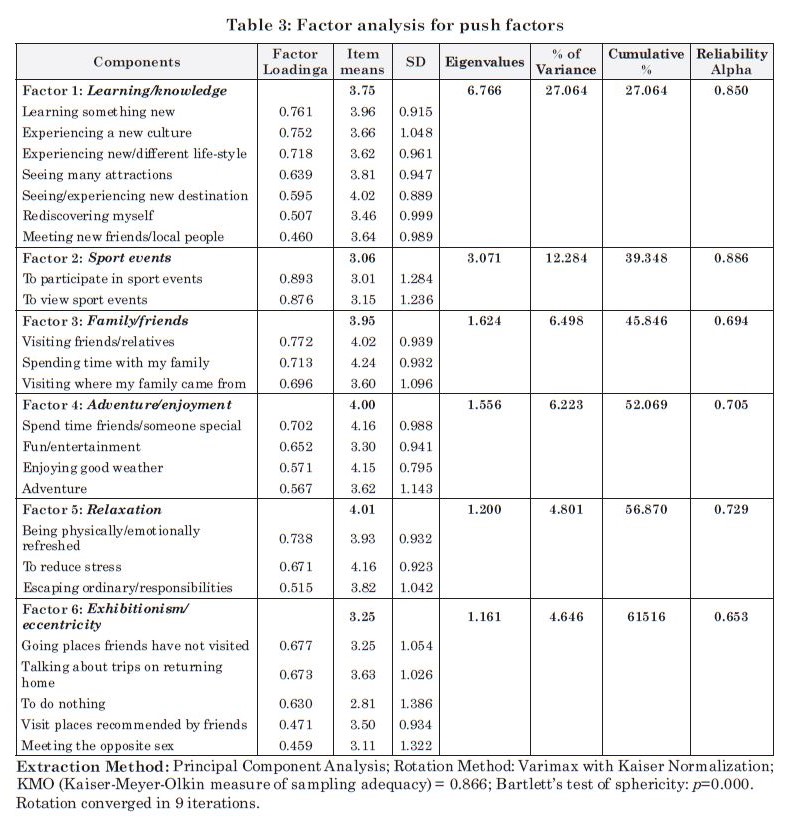
Push factors. After inspections of the factors, 1 item (“seeing nature”) was removed because it did not fit the factor included. A final six‑factor model was derived, including 24 push items (Table 3). These factors explained 61.52% of the variance. The first push factor was labeled Learning/knowledge and accounted for 27.06% of the variance. It had a reliability alpha of 0.85 with an eigenvalue of 6.77. The second factor was labeled Sport events and was comprised of 2 items: “to participate in sport events” and “to view sport events”. With an eigenvalue of 3.07, it captured 12.28% of the variance in the push motivation. The third factor, Family/friends, explained 6.5% of the variance with a reliability alpha of 0.69. The fourth factor was named Adventure/enjoyment, with a 6.22% explained variance and a reliability alpha of 0.71. With a reliability coefficient of 0.73, factor five, Relaxation, accounted for 4.8% of the variance. The sixth push factor was labeled as Exhibitionism/eccentricity and had the lowest explanatory power (4.65%) with a reliability alpha of 0.65. In sum, the three factors, Learning/knowledge, Sport events and Family/friends, captured 45.85% of the push variance, contributing to explaining much of why the residents of Guimarães travel.
Under the structure of the five‑point scale for motivations used in the survey, point 3 can be interpreted as an indifferent point that does not make a distinction between importance and unimportance. The higher the mean score is, the more important the motivation factor is. With the highest mean importance of 4.01, Relaxation was the most significant factor to the Guimarães travelers. Another factor was Adventure/enjoyment with a mean of 4.00. The results suggest that these factors were the main reasons for the residents of Guimarães travel decisions. These results corroborate those of Correia et al. (2007) and Valle et al. (2008) that point personal and social reasons for the trips of Portuguese tourists. According to these authors, these tourists’ main leading travel motivations are mostly linked to emotional factors, such as socialization and leisure.
Pull factors. As drawing forces into travel destinations, the 24 pull items (after 4 items were deleted: 2 because they did not fit into the included factors, and 2 had high loading factors in 2 factors and the decision to be made was unclear) also resulted in 6 factors with eigenvalues greater than or equal to one, and the factors accounted for 61.52% of the total pull variance, as presented in Table 4. The first pull factor was labeled Comfort and explained 27.06% of the variance with a reliability coefficient of 0.85. It is followed by factor 2 Sports/nightlife (12.28% of the total variance and Cronbach’s alpha level of 0.89), comprised of items related to “events reputation”, “nightlife (bars, clubs)”, “game (bingos, casinos)”, “business/profession”, and “recreational/sport facilities”. Factor 3, labeled Family oriented, explained 6.5% of the variance contained by the original variables, with the alpha level of 0.74. The fourth factor was named Health/religion and explained 6.22% of the variance with a reliability alpha of 0.61. With a reliability coefficient of 0.82, factor five, Snow and mountain, accounted for 4.8% of the variance. The final factor represented 4.65% of the total statistical variance and had a reliability alpha of 0.69. This factor is associated with the “cultural/historical attractions”, “beautiful landscapes/scenery” and “learning opportunities”.
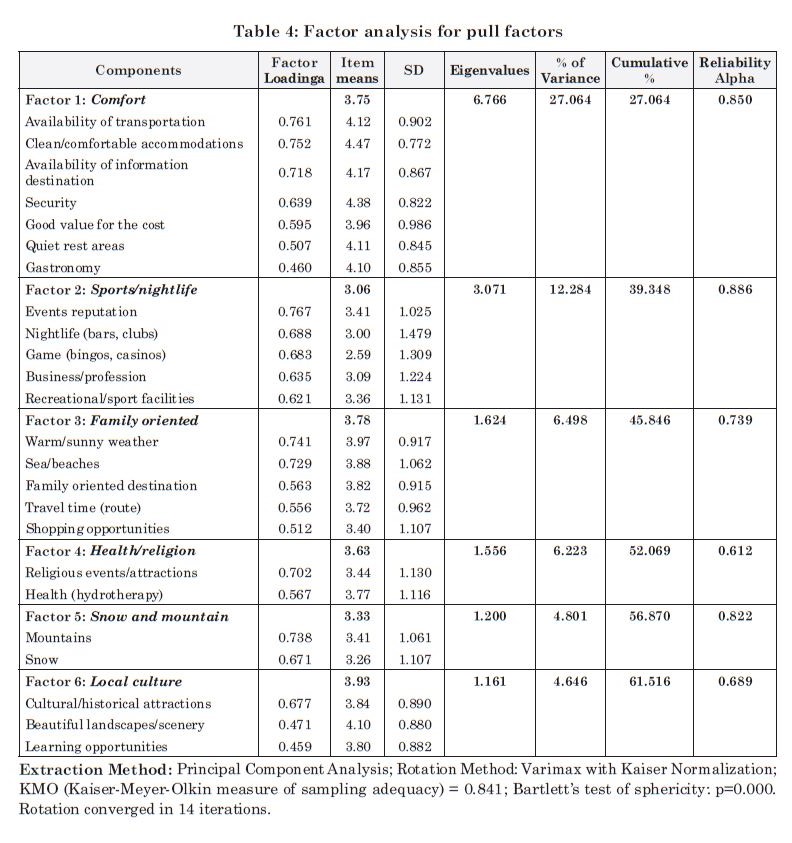
In sum, the three factors, Comfort, Sports and nightlife, and Family oriented, accounted for 45.85% of the pull variance. These factors explained by what destination attributes the Guimarães residents were greatly motivated. In addition, with high mean scores, Local culture, Family oriented, and Comfort appeared to be the most important pull factors to the Guimarães travelers. These results seem to be contradictory with those of Valle et al. (2008) who conclude that facilities (weather, beaches, hospitality, security, gastronomy…) and landscape features (natural environment, landscape, cultural attraction) are not individually significant.
4.4. Analysis of push and pull motivations by gender, age, and education
Independent samples t‑tests and one‑way ANOVAs are conducted to investigate whether Guimarães travellers’ motivations differ significantly by gender, age, and education. Tables 5, 6, and 7 show the results of these tests.
Table 5, with respect to the general motivation factors, shows that female respondents have higher mean scores across all factors than males, with the exceptions of Sport events and Exhibitionism/ eccentricity, in what regards the push factors, and Sports/nightlife and Snow and mountain, in pull factors. However, most of the differences are not statistically significant at the 0.05 level. Male and female respondents reported significantly different mean scores only in the case of three push factors (Sport events, Family/friends, and Relaxation) and two pull factors (Family oriented and Local culture). Hence, the results reveal that females are more likely to have family/friend and relaxation motivations to travel compared with men and less sport events motivations. On the order hand, females are more likely to travel to family oriented destinations and to have special local culture interests compared with males. McGehee et al. (1996) also concluded in their analysis of gender differences in motivational factors of Australian tourists that when compared to men women are more motivated by culture and opportunities for family bonding, whereas men place higher importance on sports and adventure.
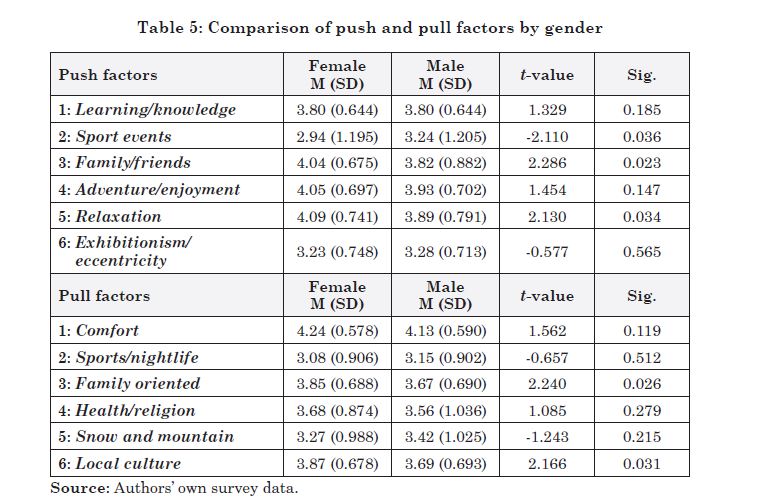
The rank of the push factors was similar between the two groups. Both groups ranked Relaxation followed by Adventure/enjoyment as the most important factors to travel by residents from Guimarães (although the order is this in the case of women and the opposite for men). Also, both gender groups ranked Sport events as the least important factor among the push factors.
The most important pull factor for both groups was Comfort, followed by Local culture. Also, both gender groups placed Sports and nightlife as the least important factor among the pull factors.
Table 6 shows the results of one‑way ANOVAs conducted to examine whether Guimarães travellers’ motivations differ by age significantly.
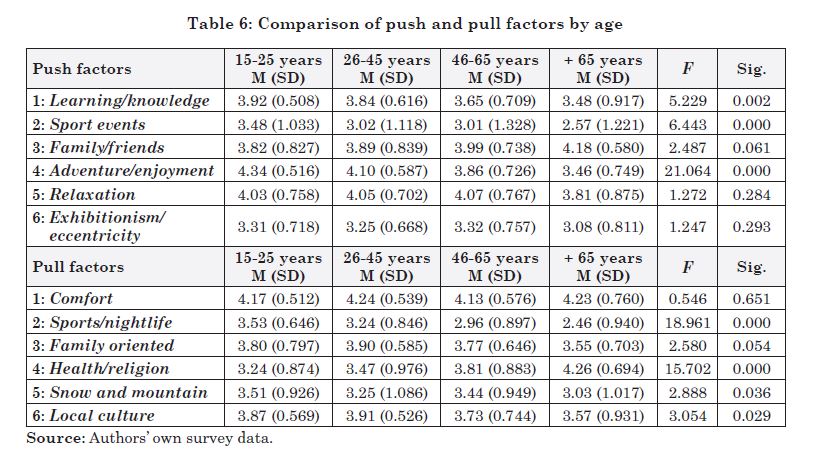
Bonferroni post hoc tests were carried out to determine which age groups differ significantly regarding these motivations. With respect to the push factors, the ANOVAs reveal that the age of a tourist has a significant effect on Learning/knowledge, Sport events, and Adventure/enjoyment factors. Post hoc tests reveal that Guimarães travellers in the oldest age group (over 65 years) reported significantly weaker Learning/knowledge motivations to travel compared with the youngest age groups (15‑25 and 26‑45 years), weaker Sport events motivations to travel compared with the youngest age group (15‑25 years), and weaker Adventure/enjoyment motivations to travel compared with all the youngest age groups. Moreover, in what regards the pull factors, Guimarães travellers in the oldest age group (over 65 years) are more likely to travel based on Health/religion motivations compared with the other age categories and less in what regards Sports/nightlife and Snow and mountain. This finding is consistent with Jonsson and Devonish (2008) that consider this result not surprising since one would expect that older tourists prefer quieter activities, while younger people look for fun and more physical activities.
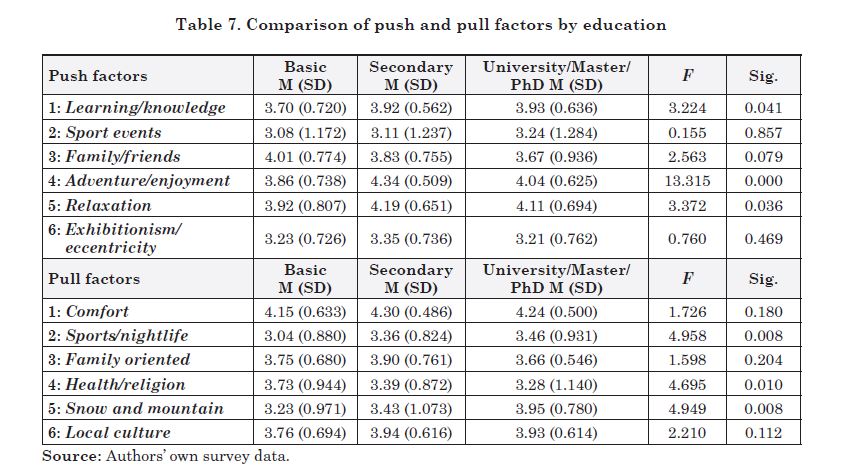
Table 7 shows the results of one‑way ANOVAs conducted to examine whether Guimarães travellers’ motivations differ significantly by education. Bonferroni post hoc tests were carried out to determine which education groups differ significantly regarding these motivations.
The results reveal that residents with secondary education are more likely to have Relaxation motivations to travel compared with less educated residents. This finding is similar to that for Adventure/ enjoyment and Learning/knowledge motivations.
With regard to the pull factors, the ANOVAs reveal that the education of a Guimarães traveller has a significant effect on Sports/nightlife, Health/religion, and Snow and mountain factors. Firstly, the results reveal that Guimarães higher educated travellers are more likely to travel based on Sports/ nightlife and Snow and mountain motivations than are the less educated residents. However, this group (less educated) report significantly stronger Health/religion motivations compared with other residents.
5. Conclusion
This study was aimed at capturing the underlying reasons for the travel decisions of the residents of Guimarães. Specifically, the objective was to determine push and pull tourism motivational factors of the municipality’s residents, as well as to discover significant differences in these factors and items across the main socio‑demographic characteristics (gender, age, and education).
With respect to gender differences, the rank of the push and pull factors were similar between the two groups. Both groups ranked Relaxation and Adventure/enjoyment as the most important push factors to travel by residents from Guimarães. Comfort is the most important pull factor for both groups, followed by Local culture. Also, both gender groups placed Sport events as the least important factor among the push factors and Sports/nightlife as the least important factor among the pull factors. Female respondents have higher mean scores across all factors than males, with the exceptions of Sport events and Exhibitionism/ eccentricity, in what regards the push factors, and Sports/nightlife and Snow and mountain, in pull factors. However, most of the differences are not statistically significant at the 0.05 level.
The comparison of the mean scores of push and pull factors by age shows that older tourists are more likely to travel for reasons based on Family/friends and Comfort, whereas younger tourists are more likely to travel to enjoy Sports/nightlife and to have Adventure/enjoyment.
Finally, less educated residents are less likely to travel based on Adventure/enjoyment, Relaxation, and Learning/knowledge motivations compared with the other groups. With regard to the pull factors, travellers with basic education are more likely to travel based on Health/religion motivations than are the more educated residents.
Management of tourist demand is widely considered an important tool in sustainable tourist destination development (Kastenholz, 2004). Products and marketing strategies compatible with the motivational factors that contribute to the perception of a given tourist destination are a key element of a successful tourism industry. Hence, the insight gained by the empirical analysis conducted in this paper may be an important policy tool for tourism planners and managers of tourist destinations.
Bibliography
Correia, A., Valle, P., & Moço, C. 2007. Modeling motivations and perceptions of Portuguese tourists. Journal of Business Research, 60(1), 76‑80.
Crompton, J. 1979. Motivations for pleasure vacation. Annals of Tourism Research, 6(4), 408‑424.
Dann, G. 1977. Anomie ego‑enhancement and tourism. Annals of Tourism Research, 4(4), 184‑194.
Freitas Santos, J., Vareiro, L., Remoaldo, P., & Cadima Ribeiro, J. 2014, August. The role of cultural mega events in the enhancement of city’s image attributes: Differences between engaged and attendee participants. Paper presented at the San Francisco International Business & Education Conference, San Francisco, United States of America.
Gram, M. 2007. Children as co‑decision makers in the family? The case of family holidays. Young Consumers, 8(1), 19‑28.
Hair, J., Anderson, R., Tatham, R., & Black, W. 1998. Multivariate data analysis: With readings. Englewood Cliffs: Prentice Hall.
Jang, S., & Cai, L. 2002. Travel motivations and destination choice: A study of British outbound market. Journal of Travel & Tourism Marketing, 13(3), 111‑133.
Jonsson, C., & Devonish, D. 2008. Does nationality, gender, and age affect travel motivation? A case of visitors to the Caribbean island of Barbados. Journal of Travel & Tourism Marketing, 25(3), 398‑408.
Kastenholz, E. 2004. ‘Management of demand’ as a tool in sustainable tourist destination development. Journal of Sustainable Tourism, 12(5), 388‑408.
Kim, K., Jogaratnam, G., & Noh, J. 2006. Travel decisions of students at a US university: Segmenting the international market. Journal of Vacation Marketing, 12(4), 345‑357.
Kozak, M. 2002. Comparative analysis of tourist motivations by nationality and destinations. Tourism Management, 23(3), 221‑232.
Li, M., Wen, T., & Leung, A. 2011. An exploratory study of the travel motivation of Chinese female outbound tourists. Journal of China Tourism Research, 7(4), 411‑424.
Marques, C. 2006. Seeking to escape: Sights over approach‑avoidance dialectics. In M. Kozak & L. Andreu (Eds.), Progress and Tourism Marketing (pp. 191‑206). Oxford: Elsevier.
McGehee, N., Murphy, L., & Uysal, M. 1996. The Australian international pleasure travel market: Motivations from a gendered perspective. The Journal of Tourism Studies, 7(1), 45‑57.
Mendes, R., & Vareiro, L. 2012. The effects of place of residence on tourist motivations: The case of the Urban Quadrangle of Minho. In A. Vieira, F. Costa, & P. Remoaldo (Eds.), Atas das VIII Jornadas de Geografia e Planeamento (pp. 80‑89). Guimarães, Portugal: Departamento de Geografia da Universidade do Minho.
Meng, F., & Uysal, M. 2008. Effects of gender differences on perceptions of destination attributes, motivations, and travel values: An examination of a nature‑based resort destination. Journal of Sustainable Tourism, 16(4), 445‑466.
Valle, P., Correia, A., & Rebelo, E. 2008. Determinants of tourism return behaviour. Tourism and Hospitality Research, 8(3), 205‑219.
Vareiro, L., Remoaldo, P., & Cadima Ribeiro, J. 2013. Residents’ perceptions of tourism impacts in Guimarães (Portugal): A cluster analysis. Current Issues in Tourism, 16(6), 535‑551.
Author notes